権利
Copyrights 日本貿易振興機構(ジェトロ)アジア
経済研究所 / Institute of Developing
Economies, Japan External Trade Organization
(IDE-JETRO) http://www.ide.go.jp
シリーズタイトル(英
)
ASEDP
シリーズ番号
73
journal or
publication title
Actors for Poverty Reduction in Vietnam
page range
[81]-109
year
2006
1. INTRODUCTION
‘Farm’ is a popular economic organization pattern in agriculture in many countries all over the world. However, in Vietnam, this organization pattern in agriculture, which has a relatively larger scale of land than household agricultural field, and in which industrial crops are grown or livestock are raised, has only been established and developing since the end of 1980s and early 1990s when Vietnam started the economic renovation process and renovation of the agricultural sector, and rural areas towards a market economy. Changes in land policies and patterns of production organization in agriculture towards diversification of ownership, different patterns of business, amongst other factors have created a foundation for the development of households, farms and other patterns of economic organizations in agriculture. As of 2001, there were more than 61 thousand agricultural, forestry and aquatic organizations registered as ‘farms’ (Trang trai in Vietnamese)1 in the whole country, attracting and employing more than 368.6 thousand laborers in rural areas. Farms also generate a large volume of agricultural products, contributing a new ‘driving force’ for agricultural development, and at the same time creating employment and incomes for the poor in this sector.
However, the development of farm organizations has also raised some issues that should be investigated in terms of policy, the State’s policy implementation as well as management, business and development of farm organizations in agriculture and the criteria for identifying agricultural farm patterns in Vietnam (to be seen in Section 2 of this report). Legal frameworks and policies on farm development are described briefly through some of the main policies that have been set up (Section 3). Sections 4 and 5 describe and analyze the current status and development of the various patterns of farms in different regions, the business as well as the management of farms, and the relationship between farms and other organizations inside and outside the agricultural sector. This study also discuses the roles of farms in agricultural and rural development in general and the impacts of the farm economy on the living standards of the poor in this sector (Section 6).
1
The study is based on reviews of official documents and statistical data, particularly data from the Census on Agriculture, Forestry and Fishery Production in Vietnam conducted by the General Statistical Office (GSO) in 2001 (GSO [2003]) and materials from other studies that have been published in Vietnam. Moreover, the study also uses materials and data from the surveys of other projects done by various organizations and documents of the author’s own field surveys (case studies) in some local areas within the framework of this research project.
2. ESTABLISHMENT OF FARM ORGANIZATIONS AND CRITERIA FOR IDENTIFYING VARIOUS FARM PATTERNS
For decades before ‘Doi Moi’, especially since the end of the 1950s in the North of Vietnam and after 1975 in the South, organizations for agricultural development in Vietnam mainly followed the pattern of agricultural organizations in the former Socialist Countries. These organizations established common collective agricultural organizations (in the form of cooperatives, agricultural production groups) and other state–owned agricultural organizations (such as state agriculture, forestry, and state farms). Most of the land, laborers, production means and the main material and technical facilities in agricultural production belonged to agricultural collectives and state organizations, under the management and operation of the cooperatives, state farms and forestry plantations. By 1985, there were more than 55.7 thousand cooperatives and agricultural production teams and more than 800 agricultural and forestry state farms. Cooperatives and agricultural production groups themselves encompassed about 83 percent of farm households, managed about 80 percent of cultivated land and 87 percent of agricultural labor in general (GSO [1988]). In such contexts and conditions, farm economy, private economy, individual economy and other types of agricultural organizations (apart from state and collective economy) did not receive enough support from the state and barely received favorable conditions for their development (Phan Si Man [2000]).
Types of farm organizations in agriculture in Vietnam (apart from agricultural and forestry state-owned farms) were only established and developed at the end of the 1980s, and at the beginning of the 1990s thanks to policy renovations in the whole economy in general, and due to policy renovations in agricultural and the rural sector (Nguyen Dien [2000]). On the one hand, the Government has recognized the long existing and positive impacts of the individual and private economy, ‘recognizing legal status, protecting legitimate working rights, legal incomes of individual households and private
persons’; ‘creating favorable conditions and environments for these people to develop cultivation, animal husbandry, forestry, and aquaculture production’; ‘encouraging individuals and private persons to invest capital, productive labor and techniques for production expansion’ (Resolution No.10, 1988) 2. Private persons and individuals have the right to hire labor and the right to hire or use some agricultural, forestry or surface land for production development. On the other hand, the Government has also renovated the organization model and management mechanism in the cooperatives, production groups, and in the agricultural and forestry state-owned farms; land allocation to farm-households, contracted products, giving the right to produce products to the members of cooperatives, and state-owned farms. The Government has encouraged and created favorable conditions for the members of the cooperatives, workers and officials working in the agricultural and forestry state-owned farms for developing family economies such as gardening, fruit and industrial crop planting, garden-forestry, animal raising and aquaculture production. At the same time, the Government has also permitted the liberalization of the material and fertilizer markets, and markets for agricultural, forestry and aquaculture products, permitting households and private persons/individuals to have the right to use their products and to sell their products at market by way of Resolution No 10 of 1988.
The above changes in mechanisms as well as policies have created opportunities and conditions for the strong development of family economy, private economy, individuals and other forms of economic organization in agriculture and rural areas. Many households, private persons, and individuals who may have more favorable conditions in terms of land, capital, techniques and production experience have developed commercial production, establishing agricultural, forestry and aquaculture farms of various forms and different scales.
Up to the mid 1990s, there were thousands of farm organizations in agriculture in Vietnam, including horticultural farms, animal farms, forestry farms, aquatic animal
farms as well as farms on mixed activities business, farms for producing and supplying
animal breeding and crop seeds, and many more. Ownership for the farm as well as forms of business and production organization of the farms also became diversified, including
farms of the farmer's households, worker households, officials in agricultural, forestry
state-owned farms; farms of workers, officials, and retired people living in rural areas;
farms of organizations, individuals with different ownership (private company, joint stock
2
Resolution No.10/1988/NQTW of the Vietnamese Central Communist Party dated 5 April 1988.
company, urban households or individuals who are not farmers) who were leased land, had land transferred from the state or leased land from other people for agricultural business; farms of households, organizations or individuals who invested their capital to exploit unused land, fallow land, bare hillside (which belongs to land for farm development planning and has a state permit) with the purpose of agricultural, forestry and aquaculture production.
However, until the end of the 1990s, in Vietnam there was still controversy over the concept ‘What is an agricultural farm?’ as well as the criteria for identifying forms of
farm organization in agriculture. That is why there was no official data on the number of
agricultural farms in the whole country (Nguyen The Nha [1999]). Criteria for identifying
farms and the number of farms set up by local authorities were not consistent and quite
different. To overcome this problem, in 2000 the Government issued regulations for the
farm economy (Decision No.03/CP, 2000)3 and after that the Ministry of Agriculture and Rural Development (MARD) in collaboration with GSO promulgated an inter-ministerial circular (Circular No.69/TTLT, 2000)4 to set the criteria for identifying and classifying types of farms in different regions all over the country. According to the criteria set by MARD and GSO, agricultural, forestry and aquaculture households can be classified as
farms if they meet two main criteria: (i) the average value of goods and services offered
for sale in a year should reach at least 40 million VND for farms in North Vietnam and Central Coastal Region, 50 million VND for farms in South Vietnam and Central Highlands; the size of a farm and its produce should be superior to that of a farmer's household making the same produce for different sectors and economic regions, meeting specific criteria of certain type of farms (see Box 1). Hence at present, identifying and classifying farms and types of farms is mainly based on economic-technical criteria, production field and production scale of farms, and does not depend on the land source used or ownership of the Farm owners.
3
Decision No.03/2000/CP of the Government on the Farm Economy dated 2 February, 2000.
4
Box 1: Some criteria for identifying and classifying scale and types of farms
¾ as for plant growing farms, the minimum area is two hectares for annual crop
farms in the North Vietnam and Central Coastal Region, 3 hectares for annual
crop farms in South Vietnam and Central Highlands; the minimum area for perennial farms in the respective zones is three hectares and five hectares; ¾ as for forestry farms, the minimum area is 10 ha (for all regions);
¾ cattle breeding and dairy farms must have at least 10 head; 50 head for fattening ¾ pig breeding farms should have at least 20 head, 100 head for pig fattening; 100
head for sheep and goat breeding farms, 200 head for sheep and goat fattening
farms; 2000 head for poultry farms (chicken, ducks, geese, etc.) ;
¾ as for aquatic animal farms, the minimum surface water area is 2 ha, but only 1 ha for shrimp farms
¾ as for mixed activity farms and farms producing other agricultural, forestry and aquaculture farms (such as bee raising, mushroom planting, flower planting, ornamental plants, etc), the criteria will be defined based on the value of goods (criterion 1)
Source: Circular No.69/LT promulgated by MARD and GSO, 2000.
3. THE LEGAL FRAMEWORK AND POLICY FOR FARM DEVELOPMENT
The establishment of farm organizations in agriculture in Vietnam is a result of policy reform of the economy and renovation in agriculture and rural areas (as mentioned above). However, policy as well as legal framework, and policy on development of agricultural farms were not established at the beginning of the renovation process. Only in the mid 1990s when farm organizations in agriculture began to develop at an increased pace in many provinces did the legal framework and policy on farm economy start to gain people’s attention. Resolution No.5 of the Central Committee of the Vietnamese Communist Party in 19935 was one of the first policy documents to mention the development of the farm economy, encouraging different economic ownerships to invest
5
Resolution No.5/1993/NQTW of the Central Committee of the Vietnamese Communist Party dated 10 June 1993
in and exploit ‘bare hillside, coastal alluvial land, aquaculture, offshore fishing, building of agriculture, forestry and aquaculture farms on appropriate scales’. Resolution No.6 of the Central Committee of the Communist Party6 continued to affirm the policy encouraging the development of family farms, and at the same time encouraging people who have capital and experience in investment management to develop farms on a large scale.
In recent years, the legal framework as well as policy on development of the
farm economy in Vietnam have been firmly established and expanded. The objectives of
the policies are to encourage the farm economy of households and individuals in order to efficiently exploit land for production development, scale expansion and efficiency in terms of land use for agriculture, forestry production, aquaculture and salt production (Land Law, 2003). This promoted commercial agricultural, forestry and aquaculture production on a large scale (Circular No.69/LT, 2000), at the same time as contributing to sustainable agricultural development, creating employment, increasing incomes; encouraging hunger eradication and poverty reduction in rural areas; promoting industrialization, the modernization process in agriculture and rural areas (Decision No.3/CP, 2000). The subjects of the policy on the development of farm economy included farmer households, worker households, officials, retired people, urban households and organizations and individuals specialized in agricultural, forestry and aquaculture production who have a demand for and the chance to develop agricultural, forestry and aquaculture Farms (Circular No.69/LT, 2000). Apart from the general policy for household economy, policies on Farm development have their own detailed regulations with respect to land, labor, taxes, credit, technology-technical support, market policy and invested asset protection, as well as other areas.
3.1 Tax policy
The State does not collect land use fees for land that is allocated within quota to households, individuals and farms using land for agricultural, forestry and aquaculture production. Land Law 2003 stipulates that the State may collect land fees for any land area in excess of a quota and land leased by the State, but farm owners are exempt from land use fees, land lease fees and agricultural land use taxes in the case of using bare hillside, fallow land or land located in areas with no previous investment for agricultural,
6
Resolution No.6/1998/NQTW of the Central Committee of the Vietnamese Communist Party dated 10 November 1998.
forestry and aquaculture production purposes (Decision No.3/CP, 2000, Circular No.82/BTC, 20007). Farms and farmers are also considered by the State to be exempt from agricultural land use taxes in any case where they face risk from market and price (Resolution No.9/CP, 20008).
The State exempts farms from income taxes with the maximum permitted period stipulated in regulations, reduces income taxes to minimum levels for farms with stable production and business, or for high value of goods in order to promote the development of the farm economy. Also provided are commercial tax exemptions for agricultural products; no water resource taxes for irrigation works, or for using surface water and underground water within farm boundaries (Decision No.3/CP, 2000) and no tax on exploitation of natural resources for some industrial crops, such as crops used in the paper industry, wood, and some other special crops (Resolution No.9/CP, 2000).
3.2 Land policy for farm development
According to the Vietnamese constitution and laws, all land is under people's ownership for which the State is the representative. Land is managed by the State which provides organizations and individuals with rights for long-term use via lease, and recognized land-use rights for people who land-use it stably. For the farm economy, the State allocates land to households and individuals to invest their capital in farm development or they lease land and receive land-use rights. At the same time the State encourages investment in the exploitation and use of bare hillside, fallow land, ponds, swamp, alluvial land along rivers and coastline for development of agricultural, forestry and aquaculture farms (Decision No.3/CP, 2000). Land policy for farm development has been institutionalized in Land Law 2003 with concrete regulations (see Box 2). Farm owners as well as households are not land owners. However they have favorable conditions and opportunities to access land, expand land scale and have rights to use land for farm development.
Moreover, Land Law 2003 also permits overseas economic organizations and overseas Vietnamese, foreign organizations and foreigners to hire land for investment in agricultural, forestry aquaculture, and salt productions. The State collects fees for land rent annually or once per period of land use (Article 35). Overseas Vietnamese, foreign organizations and foreigners are permitted to pay land use fees once, and they have the right to transfer, to lease, to mortgage leased land and their assets located on the leased
7
Circular No.82/2000/TT-BTC promulgated by Ministry of Finance dated 14 August 2000.
8
land to credit institutions which are permitted to operate in Vietnam during their land lease period (Article 119). This creates favorable conditions for overseas economic organizations, overseas Vietnamese, foreign organizations and foreigners to invest their capital in the development of agricultural, forestry and aquaculture farms.
Box 2: Some regulations on land for farm economy (in Land Law 2003)
¾ Land use for farm economy includes land allocated to households and individuals by the State for agriculture, forestry, fishery and salt production (they do not have to pay land use fees when within quota); land leased by the State, leased land, transferred land, inherited land, land offered as a gift; land contributed by households, and individuals.
¾ As for land for annual crops, land for aquaculture production, and land for salt production, the limit for each household or individual should not exceed 3 ha for each type of land, and this right is granted for 20 years. For perennial crops, the limit for each household or individual in the delta should not exceed 10 ha; in the midlands and mountainous areas, it should not exceed 30 ha. This having been granted for 50 years. The limit for protective forestry land or productive forestry for each household or individual should not exceed 30 ha and it is granted for 50 years. For bare hillside, fallow land, alluvial ground along rivers or the coast that is considered unused land, the limit and duration of land use for each household or individual should not exceed the limit and duration of land use for annual crops, perennial crops or forestry production. Moreover, any households or individuals who have already received a land quota and have a desire to expand above land limits or households or individuals who were not subject to receive land, but have a demand to use land for agricultural, forestry and fishery production purpose can lease some land with the same duration for each type of land. Limits for leased land depend on the land fund of each local area as set up by the provincial and city authorities (Article 67,70).
¾ Households or individuals who use land for farm economy have the right to exchange, inherit, transfer, mortgage or contribute as capital by land use rights; they have the right to be active in changing land use purpose for doing business approved by rural and urban district. If the duration of land use is over, but households or individuals want to continue using land, the State will allocate land to them (Article 82).
3.3 Policy support on investment and credit
The State supports investment in infrastructure development (such as transportation, irrigation, electricity, safe and clean water, information, and processing units) so as to encourage households and individuals to develop agricultural, forestry and aquaculture production in the very difficult socio-economic condition areas (Decision No.3/CP, 2000).
Farm owners can mobilize capital by borrowing money from banks, and from other
organizations and individuals for their business. They can borrow money from the state commercial bank and deposit assets generated from borrowed money as collateral for borrowing money from banks and credit institutions (Decision No.3 /CP, 2000). They can borrow money with preferential interest rates from development credit programs of the state following regulations set up by a specific program (Circular No.82/BTC, 2000).
Farms specializing in producing export goods, afforestation, planting perennial crops and
fruit crops, aquaculture production and milk cow raising, those producing fertilizers, pesticides, building processing units for agricultural, forestry and aquaculture processing or building irrigated system within farms can borrow money from the Development and Investment Support Fund of Government or get support in terms of interest rates and guarantees for investment credit (Circular No.82/BTC, 2000). For areas with difficult socio-economic conditions, Farm owners are given priority to borrow money from projects, and from programs on Employment Creation and the Program on Hunger Eradication and Poverty Reduction (Decision No.3/CP, 2000) for production development. The Government will establish a ‘Fund on Credit Guarantee to create favorable conditions for farm households and farm owners, to borrow money for business in the case of those not ensured conditions for collateral’ (Resolution No.9/CP, 2000).
3.4. Labor policy
The States encourages and creates favorable conditions supporting farm owners in expanding their production scale, creating employment opportunities for rural laborers, recruiting laborers from farm households and employing the underemployed, female laborers, the poor who have no land or who lack land for production. Farm owners have the right to hire an unlimited quantity of labor and do not need to take into account living areas for the laborers; duration, amount of work, wages and form of payment are discussed and agreed between laborers and farm owners following the regulations set by the legal framework on labor. Besides wages, farm owners have to pay laborers an additional fee (equivalent to 15 % of the agreed wages for social insurance and 2% for
health insurance); they have to equip laborers with safety clothing and take responsibility for laborers should they face risk, accident or sickness for the duration of the contract (Circular No.23/LD-TBXH, 20009). The State has a plan to support the training of laborers working in farms in different forms.
3.5 Policy on technological and technical support for farm development
MARD, in collaboration with provinces and cities, has planned to provide investment in nursery gardens for agricultural and forestry plants, production units for supplying breeding animals (husbandry and aquaculture) or support some farms with competent conditions for supplying the best seeds and breeds to the farms and households in the region. Encouraging farm owners to cooperate and associate with scientific and training centers for technology transfer and applying techniques to farms and providing a technical service to farmers living in the area are also planned (Decision No.3/CP, 2000).
3.6 Policy on market support
According to the regulations set by the Government, Ministries and related agencies (for example Ministry of Trade, MARD, etc.) and provinces, cities have the responsibility to provide market information for farms in order to orient their production in conformity with domestic and international market demand. The State provides development investment support for markets selling agricultural products and markets in rural areas that create favorable conditions for farms and households in the area to make commercial transactions and consume agricultural, forestry and aquaculture products (Resolution No.9/CP, 2000). The State also provides development investment support for processing industrial units and consuming commercial agricultural products of farms and farmers; developing centers for agricultural commercial translations and agricultural materials; creating conditions for farm owners to access and participate in programs, cooperation projects and domestic and international trade fairs. The State also creates conditions and encourages farm owners to directly export their products and the products of other farms and farmers and import of material inputs (Decision No.3/CP, 2000).
9
3.7 Policy on farm’s investment asset protection
Farms’ assets and legally invested capital are not being nationalized, or being confiscated
by administrative measures. In the case of national benefit, when the State has to use land that has already been allocated or leased to farmers farm owners can receive compensation and the land price is set at market price at the time they receive the decision for land acquisition (Decision No.3/CP, 2000). Therefore at the macro level, the legal framework and policy on farm development has already been set up and is consistent and open. All organizations and households are encouraged and given favorable conditions by the State for the establishment and development of different forms of farm business in the agricultural, forestry and aquaculture sectors. However, the development of these farms mentioned above is still dependant to a certain extent on policy and specific conditions in each local area as well as coordination between ministries and related agencies in each region (for example, concrete regulation on quota in land allocation and hired land to
farms will depend on the existing land fund of each local area and be decided by the
provinces).
4. FARM DEVELOPMENT STATUS IN AGRICULTURE
4.1 The number of farms
According to the Agricultural Census conducted by GSO in 2001 (GSO [2003]), the number of farms in agriculture in general in the whole country that were established in the period of 1995-2001 has increased 3.5 times compared to the farms established before 1995. Of these, cultivation farms increased 3.5 times; husbandry farms increased 3.4 times; forestry farms increased 2.8 times and aquaculture farms increased 5 times. In 2001, annual crop farms accounted for 35.6 percent of total farms, perennial crop farms accounted for 27.2 percent, aquaculture farms accounted for 27.9 percent, livestock farms 2.9 percent, forestry farms 2.7 percent, and mixed activity farms accounted for 3.7 percent (see Table 1).
Table 1: Number of Farms in Vietnam Total Annual crops farm Perennial crops farm Livestock farm Forestry farm Aquaculture farm Mixed activities farm 1995 17,254 8,526 3,696 513 580 3,372 567 1999 45,803 18,726 13,717 1,347 1,428 8,921 1,664 2001 61,017 21,754 16,578 1,761 1,668 17,016 2,240 Source: GSO, 2003, p.283.
However, farm development status has been quite different across regions and economic zones. More than 50 percent of farms are concentrated in the Mekong River Delta with a density of 11 farms per 1,000 rural households. The Southeastern region and Central Highlands had fewer farms in comparison with the Mekong River Delta, however
farm density in these two regions was almost the same, 10.2 and 9.4 respectively. The
number of farms was almost the same in the Northeastern region, North Central Coast and South Central Coast region, however farm density per 1,000 rural households in these regions was less compared to the Mekong River Delta, Southeastern region and Central Highlands. The number of farms per 1,000 rural households in the Northeastern region, North Central Coast and South Central Coast region were 2.1 and 2.7. Meanwhile the Red River Delta has the highest rural population density (with 3.4 rural households, accounting for one fourth of total rural households in the whole country), yet the number of farms in this region accounted for only 3 percent of total farms in the whole country. The number of farms per 1,000 rural households in the Red River Delta accounted for only 0.54, a little higher than the Northwestern region (0.36 Farms), but 20 times lower than the Mekong River Delta.
Farm allocations and structures by type of business were also considerably
different. Most farms in the Mekong River Delta were annual crop farms and aquaculture
farms. The annual crop farms in this region accounted for 81.7 percent of the total annual
crop farms in the whole country, accounting for 57 percent of the total farms in this region. There were some provinces where annual crop farms developed strongly such as An Giang (4,887 farms), Dong Thap (3,284 farms), Kien Giang (3,050 farms), Long An (2,393 farms) and Bac Lieu (1,900 farms) for example. In Long An, Dong Thap and Can Tho provinces, annual crop farms accounted for 93-95 percent of the total farms in these provinces. Annual crop farms also developed rather strongly in some provinces in the
South East and South Central Coast such as Tay Ninh (1,149 Farms), Phu Yen, and Binh Thuan. However, in the provinces located in the Red River Delta, midland and mountainous areas, the development of annual crop farms still faced constraints, mainly due to small farm size. Farms were also more dispersed. More than 99.4 percent of the rural households in the Red river Delta had a farm size of less than 1 hectare.
Table 2: Number of Farms in all Regions
Total Annual crops farm Perennial crops farm Live-stock farm Forestry farm Aqua-culture farm Mixed activitie s farm Whole Country 61,017 21,754 16,578 1,761 1,668 17,016 2,240 Red River Delta 1,834 182 284 156 40 1,026 146 North East 3,201 38 952 29 660 593 929 North West 135 16 44 40 29 4 2
North central Coast 3,013 728 919 34 483 712 137 South central Coast 2,904 842 410 117 121 1,298 116 Central Highland 6,035 416 5,293 84 114 43 85 South East 12,705 1,750 7,991 1,123 113 1,210 518 Mekong River Delta 31,190 17,782 685 178 108 12,130 307
Source: GSO, 2003, pp.432-433.
Perennial crop farms have mainly developed in the midlands, mountainous areas, and highlands. These regions have favorable conditions in terms of land and climate for the cultivation of perennial crops (for example tea, coffee, rubber, pepper and ground-nuts) and fruit trees for domestic and international markets. More than 80 percent of perennial crop farms in the whole country (in 2001) were located in the South East and Central Highlands. Perennial crop farms in these two regions accounted for a high portion of the total farms in these regions, respectively 62.9 percent in the South East) and 87.7 percent (in the Central Highlands). Some provinces strongly developed perennial crop
farms such as in Binh Phuoc (4,382 farms), Binh Duong (1,554 farms), Dak Lak (3,561 farms), Gia Lai (1,344 farms), Dong Nai (714 farms) and Binh Thuan (533 farms). On the
North Central Coast and South Central Coast, perennial crop farms accounted for about 8 percent of the total perennial crop farms in the whole country, but were mainly located in Thanh Hoa province (221 farms), Quang Tri (480 farms) and Binh Dinh (170 farms).
Perennial crop farms and fruit farms in the midlands and North mountainous region are still underdeveloped and are not symmetrical with development conditions in these regions. In 2001, the number of perennial crop farms in the North East and North West accounted for about 6 percent of total perennial crop farms in the whole country and for one fifth of the total perennial crop farms in the Central Highlands. The main constraint on perennial crop farm development in the North midlands and mountainous areas were difficulties in terms of transport and access to infrastructure, lack of industrial processing units and unstable markets for output (such as tea, coffee, fruits, etc.). Therefore instead of the development of specialized perennial crop farms or fruit farms, many owners of those farms moved into mixed activity farms as a means of diversification and reduction of risk for those processing and selling products.
Aquaculture farms have developed mainly along the coast, lowlands, and even in reservoirs, dams for hydroelectric plants and big dams for irrigation. The Central government and local authorities permitted rural households to transfer partly paddy production land in the low-lying land to aquaculture production. This has had a significant impact on the growth rate of aquaculture farms, especially in the Mekong River Delta and in some provinces in the Red River Delta. As of 2001, the number of aquaculture farms in the Mekong River Delta accounted for more than 71 percent of the total number of aquaculture farms in the whole country, and accounted for 38.9 percent of total farms in general in the region. They were mainly concentrated in Bac Lieu province (6,604 farms), Ca Mau (2,358 farms), An Giang (1,132 farms), Ben Tre (626 farms) and Soc Trang (566
farms). Aquaculture farms in the Ben Tre province accounted for 98.2 percent of total farms in the province. This figure was 94.5 percent in Ca Mau province and 77.2 percent
in Bac Lieu province. Development status and number of aquaculture farms in the provinces located along the coast in the South East and South Central Coast regions were similar. Most of the provinces in these two regions had between 150 to 200 aquaculture
farms; especially in Khanh Hoa and Ninh Thuan provinces where the number of farms in
each province was more than 540. However, the number of aquaculture farms in the South East and South Central Coast accounted for only 14.7 percent of aquaculture farms in the whole country and accounted for one fifth of total aquaculture farms in the Mekong River Delta.
The number of aquaculture farms in the provinces located along the coast in the Red River Delta and North Central Coast was less than the number of aquaculture farms in the Mekong River Delta, South East and South Central Coast regions, but the scale and size of aquaculture production of the farms in the Red River Delta and in the North Central Coast regions were significantly large compared to those in the South Vietnam.
The main reason for this was that aquaculture production in the Red River Delta and in the North Central Coastal regions required high investment for building ponds, purchasing breeding stock, fish food and means of production. Aquaculture farms along the coast in the Red River Delta and North Central Coast frequently faced risk and damage due to natural calamity, floods and storms. This coastal area has from 5 to 7 storms annually, causing significant damage and hardship for households and aquaculture
farm production.
The benefit rate on average for development investment in aquaculture production in some provinces in the Red River Delta and North Central Coast was lower compared to cultivation farms in the same region and much lower compared to production of the aquaculture farms in the South Central Coast and Mekong River Delta in 2001. The benefit rate for development investment on average (in 2001) in aquaculture farms production in Thai Binh province accounted for only 15.6 percent, in Ninh Binh province this was 22.1 percent, in Nghe An 20.7 percent, in Thua Thien-Hue 21.3 percent and in Quang Tri province 8.1 percent (the figure was higher in the South, 43.6 percent in Kien Giang, 64.9 percent Soc Trang, 66.4 percent in Bac Lieu province). High investment costs, low benefit rate for development investment and high risk mean many households and
farm owners in the Red River Delta and North Central Coast do not have enough capital
to invest in aquaculture production or have difficulty making an investment decision for the development of aquaculture farms.
In comparison with agricultural farms and aquaculture farms, the number of livestock
farms and aquaculture farms were fewer and increased at a slower rate. In 2001, the
number of livestock farms in the whole country accounted for only one tenth of annual crop farms or aquaculture farms. There was the same portion in comparison with forestry and annual crop farms or aquaculture farms. The number of livestock farms that were established during the period of 2000-2001 was 414, accounting for half the livestock
farms established during the period of 1996-1999 (834 farms). The number of forestry farms that were established during the period of 2000-2001 was only one third of those
established during the period 1996-1999 (240 farms and 848 farms respectively) (GSO [2003: 283]).
There have been some constraints on the development of livestock farms. First of all, foodstuff processing and the processing of livestock products were underdeveloped. There were unstable markets for inputs (for example, breeding, food and foodstuff for livestock production) and outputs. Secondly, lack of service provision (such as veterinary service, epidemic disease control for cattle and poultry) are key factors. Households engaged in livestock production as well as livestock farms in general faced high risk.
Moreover, livestock farms have to invest more capital, yet the benefits on average were lower compared to other farm patterns. This was one of the disadvantages for households or farm owners deciding to invest in livestock production. Meanwhile the main reasons for the slow growth rate of forestry farms is that these farms could only be developed in the midlands and mountainous areas, where there are favorable conditions in terms of forestry land yet where infrastructure was underdeveloped. Besides, difficulties in terms of investment capital, long production cycle and high regular management costs mean that the households and farm owners usually face difficulties due to lack of knowledge and lack of experience in forestry management and production.
Box 3: Investment and risk in an aquaculture farm in one province located on the coast in the Red River Delta
Nam Dinh is one of the provinces located on the coast in the Red River Delta region. In 2005, Nam Dinh had about 400 aquaculture farms and more than 2,400 households and farms engaged in aquaculture production along the coast. Aquaculture farms here mainly raised shrimps and arca. Investment capital on average for an aquaculture farm was 1-1.5 billion VND, 3 times higher than the average investment cost for aquaculture production done by the households. Hoang Thanh Dat's aquaculture farm located in Hai Loc commune (Hai Hau district) has 20 ha, with 2 billion VND total investment. But unfortunately a storm came during September 2005 and it caused serious damage for most of the aquaculture farms; more than 50 percent of aquaculture land was lost entirely with total damage of about 143.6 billion VND. Many households engaged in aquaculture and aquaculture
farm owners lost their investment capital, assets and aquaculture products. Source: VIE, 2005
4.2 Farm scale and business efficiency
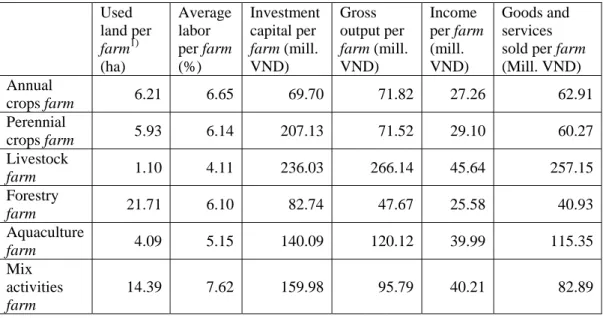
Data in Table 3 below illustrates the scale of each farm pattern in terms of land used per
farm, number of laborers, investment capital, and revenues and values of goods sold per farm. There was no significant difference in terms of laborers used in the farms and about
94 percent of farms use no more than 10 laborers. However, land used per farm, investment capital as well as production scale and revenues were all significantly different.
Table 3: Farm Scale on Average for Different Types of Production in 2001 Used land per farm1) (ha) Average labor per farm (%) Investment capital per farm (mill. VND) Gross output per farm (mill. VND) Income per farm (mill. VND) Goods and services sold per farm (Mill. VND) Annual crops farm 6.21 6.65 69.70 71.82 27.26 62.91 Perennial crops farm 5.93 6.14 207.13 71.52 29.10 60.27 Livestock farm 1.10 4.11 236.03 266.14 45.64 257.15 Forestry farm 21.71 6.10 82.74 47.67 25.58 40.93 Aquaculture farm 4.09 5.15 140.09 120.12 39.99 115.35 Mix activities farm 14.39 7.62 159.98 95.79 40.21 82.89
Note: 1) Including agricultural land, forestry land and water area for aquaculture Source: GSO, 2003, pp. 391-393.
Land used per farm on average was 4.89 ha, 7.4 times higher compared to the average farm size per rural household (0.66 ha /household). The average agricultural land per plant growing farm was 4.37 ha, 7.8 times higher than the average agricultural land per household (0.56 ha). Forestry farms and mixed activity farms usually have a larger farm size compared to plant growing, livestock and aquaculture farms. According to the results of the Agricultural Census in 2001, around 6.6 percent of forestry farms ranged in size from 50 ha to more than 100 ha (GSO [2003: 457]). Another research conducted in Lai Chau province in 2003 showed that among 10 forestry farms, there were two farms with farm size from 60 ha to above 90 ha (VIE [2003]). Plant growing farms and aquaculture farms have smaller farm size, usually between 3 to10 ha. Only 6.5 percent of annual crop farms (1,420 farms), 10 percent of perennial crop farms (about 1,700 farms) and 3.8 percent of aquaculture farms (648 farms) have a farm size above 10 ha. However, productivity and efficiency in land use in forestry farms and mixed activity farms were considerably lower compared to the plant growing farms and aquaculture farms. According to our calculation of the Agricultural Census data, gross output per 1 ha for forestry farms was on average only 2.2 million VND and for mixed activity farms it was 6.6 million VND. Meanwhile gross output per 1 ha on average for annual crop farms, perennial crop farms and aquaculture farms reached 11.5 million VND, 12 million VND,
and 9.8 million VND respectively. Similar results can be obtained when comparing incomes per hectare on average for the above mentioned farms (GSO [2003: 392-393]).
The total investment capital of farms in general in the whole country was 135.1 million VND in 2001; of which capital of the farm owner accounted for 84.2 percent, borrowed capital and other mobilized capital accounted for only 15.8 percent (GSO [2003: 393]). Livestock and perennial farms usually require high investment capital compared to other farms. However, investment efficiency in livestock and perennial crop
farms were significant lower compared to other farms. The benefit rate on average
(proportion of net benefit in total investment capital) for the perennial crop farms reached about 14.0 percent, whereas for the livestock farms it was 19.3 percent. Mixed activity
farms and aquaculture farms require lower investment capital, but the benefit rate was on
average higher. The figure was 25.13 percent, 28.5 percent respectively. Annual crop
farms needed the lowest investment capital, but produced the highest investment
efficiency, with a benefit rate on average of 39.1 percent, 2.78 times higher than perennial crop farms and twice as high as livestock farms. The differences in investment scale, and investment efficiency were one of the factors that created income differences between different farm patterns.
4.3 Farm business organizations and management
Most farms in Vietnam were family farms, and the farm owners were also the head of the family and were usually male. According to the Agricultural Census, farm owners who were male accounted for 91.2 percent, and farm owners who were female accounted for only 8.8 percent. In forestry farms, farm owners who were female accounted for only 6.5 percent, but in livestock farms this figure was 13.52 percent. Among the farm owners, 91.3 percent of them were farmers, 5 percent were officials and employees, about 3 percent were others (GSO [2003: 283]). Most of the farm owners were also planners. At the same time they were the organizers, managers and operators of their business as well as working on their farms. However, there were other family’ members who usually took part in the planning process as well as the management of their farms. They were also laborers working on their farms. For example, among three farms in Son La province and two Farms in Dak Lak where the author conducted a survey in September 2005, there were 4 farm owners who said that planning and managing farm business had been done by both husband and wife; both of them discussed and decided what to do. There were 3
farm owners of a total of 5 farm owners mentioned above who said that they were both
work on his farm; one farm owner was an official and partly involved in farm management and partly worked on his farm during his free time and during the weekend.
Compared to the family economy, farm owners usually have better ability and experience in organizing their business. They are more dynamic, knowledgeable and decisive compared to most of the heads of the other farmer households. However, the ability of the farm owners to do business and manage is still limited. According to the Agriculture Census, more than 78.6 percent of farm owners have not received any training on management and techniques, 13.5 percent had primary education or were technical workers, and only 7.8 percent had secondary school or college degree or above (GSO [2003: 283]). Many farm owners are still lacking knowledge and experience in management, and doing business in the market economy. Therefore, they tend to face difficulties in terms of access to credit, technology (animal breeding, crop plants, farming techniques, etc.) and market access, and especially in dealing with natural calamities and epidemic diseases. 68.8 percent of farm owners had investment capital shortage, 42.5 percent lacked scientific-technical knowledge and 57.4 percent of them faced difficulties accessing markets for their outputs. The number of forestry and aquaculture farm owners who faced difficulties due to lack of scientific-technical knowledge accounted for a rather high ratio, 54.9 percent and 51.6 percent respectively. It was higher compared to livestock
farms (22.2 percent), annual crop farms (35.6 percent) and mixed activity farms (48.2
percent Farm owners who faced difficulties accessing markets for their outputs made up a higher ratio in annual crop farms (71.1 percent) and perennial crop farms (62.4 percent), meanwhile this figure in the forestry and aquaculture farms was 38.0 percent and 37.8 percent respectively (GSO [2003: 365]). Constraints on ability, organization and management skill of the farm owners is one of the reasons that makes many farm owners confused about investment planning and long-term business strategy. It is also one of the factors that hinders the expansion of farms and the development of relationships between
farms and other organizations, economic units and society inside and outside the
agricultural, forestry and aquaculture sectors.
5. RELATIONSHIP OF FARMS WITH OTHER ORGANIZATIONS INSIDE AND OUTSIDE AGRICULTURAL AREAS
Most farms have certain economic relationships with other organizations inside and outside agricultural, forestry and aquaculture sectors. Of which, they mainly have relationships with organizations that provide services for inputs and outputs such as
extension services, veterinary services provided by the local authorities, state-owned enterprises in agriculture-forestry and aquaculture sectors. They also have relationships with state-owned enterprises, cooperatives or private enterprises conducting business in agricultural services (such as providing materials, fertilizers, seeds, animal breeding, or purchasing, processing and selling agricultural, forestry and aquaculture products). Farms also have relationships with other farms or households who are specialized in producing seeds, seedlings, animal breeding and aquaculture breeding, or with farms specialized in agricultural, forestry and aquaculture processing. Moreover, in some provinces, forestry, livestock and aquaculture farms also have relationships with projects, organizations funded by the government, NGOs and other socio-economic organizations.
The range and level of relationship in each farm with other organizations inside and outside the agricultural sector was quite different. They mainly have relationships with organizations or enterprises located in the local areas and in the surrounding areas.
Farms have relationships with local extension services, cooperatives or state-owned
agricultural enterprises located in the local areas in order to receive advisory support, knowledge on farm production and management, support in technical-technological application, disease control or buying seeds, seedlings and animal breeding for higher quality. The relationship between farms and other economic organizations, state-owned enterprises, private enterprises or private business households was mainly in terms of supplying materials, fertilizers, foodstuff for livestock or purchasing, processing and selling agro-forestry and fishery products. The survey on 30 Farms in Lai Chau province (VIE [2003]) shows that 100 percent of farms had relationships with agents and private commercial units in the local areas; 80 percent of farms had relationships with local extension services (at provincial and district level); 70 percent of farms had relationships with state-owned enterprises located in the local areas in terms of buying seeds, animal breeding, materials and fertilizers or receiving contracting land from enterprises. 50 percent of the farms had relationships with processing enterprises and 40 percent of the
farms had relationships with social organizations (women’s union, farmer's association
and veterans' association), other organizations and development projects. However, about 30 percent of the farms had relationships with 4 or 5 other organizations at the same time; 70 percent of the remaining farms had relationships with only 2 or 3 organizations.
The relationships between farms and other economic organizations are quite different, depending on market and social relations of the farm owners. In many cases, organizations or enterprises are purchasing, processing and selling farm products and they also provide inputs for farms. They could provide some capital in advance to farms or supply material, fertilizers, and animals' foodstuff to farms and purchase farm’s produce
after harvest. They deduct some money for services provided in advance to farm owners. However, the relationship between farms and agents for supplying agricultural inputs and purchasing outputs is neither commonly established nor officially implemented by the signing of contracts. Sometimes it is merely a trading partner relationship and all transactions are based on a verbal agreement between two trading partners with little economic or legal tie. Farms could buy materials, fertilizers, seeds, and seedlings from an agent supplying agricultural inputs and sell it to other purchasing agents and traders who could sell these products to the local market.
Relationships between farms and investment organizations or credit institutions and banks are still underdeveloped. We have yet to obtain data on the number of farms that have relationships with investment organizations or credit institutions and banks. There has been no data on the savings or investments of farms through credit institutions and banks. However, the Agricultural Census in 2001 shows that loans, on average, per
farm were not high, about 21.3 million VND and accounted for only 15.8 percent of total
investment capital of farms. The loan rate for annual crop farms was 18.2 percent; for perennial crop farms 12.4 percent; for livestock and forestry farms 13 percent; for aquaculture farms 19.5 percent. Meanwhile, 68.8 percent of agricultural farms in the whole country still faced a difficulty in terms of capital shortage, and 67.6 percent of
farms needed to borrow money from the State (GSO [2003: 365-366, 393]). It shows that
the relationships between farms and credit institutions and banks are still limited despite there being a big transaction demand from farms with credit institutions and banks. Out of the 5 farms that the author surveyed in Son La province, only 2 farms had borrowed money from banks, and the loan rate accounted for 20 percent of total invested capital in
farms. The main constraint that hinders the relationship between farms and credit
institutions and banks is the underdeveloped service network of credit institutions and banks, especially in mountainous and remote areas. Moreover, the procedures for borrowing money from the credit institutions and banks are not advantageous to farms. Limitations on long-term loan amount and collateral requirement for the amount of 10 million VND set up by the banks is also one of the constraints that hinders the relationship between farms and the institutions mentioned above.
Box 4: Farm manners and relationship level
¾ The farm of Mr. Nguyen Van Khoi in Nong Phu hamlet, Chieng Mung commune (Mai Son district, Son La province) has 5 ha for coffee and fruit production. The farm owner signed a contract with Son La Tea-Coffee Company (a provincial state-owned company) to purchasing materials, fertilizers, and seedlings for his farm and to sell the farm’s produce to the company after harvest. The price of inputs and outputs was set up by agreement between the two partners in the contract. About 60 percent of fertilizers were used and more than 50 percent of coffee was sold to the company through a contract annually. However, the farm also sold its products to Thai Ha Private Company (in the Son La town), bought materials from other agents and sold its products to other traders in the market at market price.
¾ The farm of Ms. Nguyen Thi Ly in Cu-E Bur commune (Buon Ma Thuot city, Dak Lak province) has 3.5 ha for coffee, fruit, and grass planting, and cow, goat and pig husbandry. The farm has often dealt with Bell Feed Company when purchasing animal breeding and foodstuff, but has no signed contract. The farm has also maintained relationships with other agents in order to sell coffee, but not on a regular basis. The amount of products sold to purchasing agents was not stable. Livestock products were processed by the farm, and sold to consumers and retailers at the market.
Source: Author's field survey in Son La and Dak Lak provinces, 2005.
Since most farms are established based on farmer's family economy, there are relationships up to certain level among farms and between farms and farmer's households, local authorities and other socio-economic organizations in rural areas. Among farms and between farms and farmer's households in the local areas there are relationships in terms of exchange, support on invested capital, seedlings, animal breeding, production experience and application of technology; or coordination and support of building rural infrastructure, risk prevention from natural disaster and epidemic diseases, safety protection in doing business and security within the community. These relationships are shown clearly in the regions where natural disaster often take place, and in the specialized regions for industrial crops, fruits or aquaculture production. However, relationships among farms or between farms and farmer's households are not well-established. They are
established to a lesser extent in terms of cooperation, coordination, and association for production environment protection or for access to market and market expansion as well as purchasing, processing and selling outputs to the market. There have been problems of polluted water source that has harmed farms’ business. They still exist in some local areas in all the regions. Agricultural farms in Vietnam are not well-established or established to a lesser extent with regard to direct relationships with foreign investment organizations, big domestic and international agricultural produce import-export companies or with big agents for the purchase and distribution of agricultural products to cities, urban areas and large industrial zones; research and development institutions and training centers on management and technical knowledge for farm production.
6. ROLES OF FARMS IN AGRICULTURAL AND RURAL DEVELOPMENT, AND IN POVERTY REDUCTION
Compared to the farmer's household economy, agricultural farms accounted for only 0.5 percent of total households, 1.26 percent of laborers and more than 4.3 percent of agricultural and forestry land (including water surface for aquaculture production) (GSO [2003: 122-123, 134, 136, 184, 301]). However, agricultural farm development has more advantages than the farmer's household economy and farms have become active players in taking roles for agricultural and economic rural development in Vietnam nowadays. Agricultural farms have contributed to better land exploitation and land use, attracting investment capital for agriculture and creating a larger volume of goods in the agro-forestry and fishery sectors than farmer's household economy. Farms have also created additional employment and significantly improved incomes for rural laborers. Farm development has also created a new motivation for the development of the agricultural labor force, and rural areas, and it is ‘a second breakthrough’ in agriculture since Doi moi (Nguyen Duc Thinh [2001]). By 2001, farm economy had already invested more than 8,245.83 billion VND, exploited and used more than 235,825.4 ha of agricultural land, 70,091.9 ha of forestry land, 67,316.4 ha of water surface for fishery production in general; of which, there were thousands of hectares of fallow land, bare hillside, swamp and water surface of river and coast which the State and farmer's households did not have the capacity to exploit. The total value of goods and services created by the farm economy reached 5,037.56 billion VND in 2001, accounting for more than 90 percent of the total value of farm products in general (GSO [2003: 301, 393]).
Farms are playing an active role in improving access to new technology and
scientific technical application in the agricultural, forestry and fishery sectors. In 2001, the numbers of different types of tractors, pumps, animal foodstuff processing machine, transport boat and vessels, fishing boats and other main production means purchased by
farms per 100 farms was higher than the number of the same machines and production
means per 100 rural households on average (GSO [2003: 274, 276, 278, 476, 478, 480]). Commercial production development and the application of new technical farming and technology in production in many farms has become ‘a new model’. Farm development has a positive impact on production and application of new technical farming and technology by other farmers in the local areas, especially in the mountainous and remote areas where level and conditions for commercial production remain underdeveloped.
As of 2001, agricultural farms had created employment and incomes for more than 368.65 thousands laborers in agriculture and rural areas. Of these, more than 200 thousand laborers had permanent employment and hundreds of thousands of laborers had seasonal work (GSO [2003: 284]). The number of laborers who had seasonal work on
farms in the peak season reached above 717.4 thousand more than one third of the hired
laborers in agriculture in general, and more than one fourth the number of permanent employees in rural areas. The wages of the hired laborers on the farms depended on agreement between farm owners and laborers, but it was usually about 400,000-600,000 VND per month. It was significantly higher than the minimum wage set up by the current law10. The data above looks very impressive, but underemployment and low incomes still commonly exist in many rural areas. More than 444,000 households and 2.7 million laborers (accounting for 3.4 percent of total households and about 9.3 percent of total rural laborers) in the rural areas in the whole country were working as hired laborers to earn money. Of which, more than 417.7 thousand farmer's households have no land for cultivation and there were more than 2 million laborers working as hired laborers in agriculture (GSO [2003: 134, 163, 178]). The rate for using laborers in agriculture and rural areas reached about 73-75 percent of full employment Meanwhile, labor migration from the agricultural sector and rural areas into industry, service and other non-agriculture activities has occurred slowly and been constrained many difficulties. In this context, the strong development of farms has had an implication on improving the opportunity of full employment and improving the incomes of laborers in the agricultural sector and rural areas.
10
The minimum wage, according to the current regulation in Vietnam, was 350,000 VND per person per month in 2005.
The development in agricultural farms brings benefits not only for farm owners and agricultural development in general, but also for many poor people living in the rural areas; especially for the poor who are lacking land or have no land for cultivation, are underemployed, lack production means, or who have to work as hired laborers and their livelihood relies mainly on working as hired laborers in agriculture. Our case studies in some farms in Son La and Dak Lak province illustrates this situation. Most hired laborers working on the farms were from poor households who lived in the local area or came from other rural areas. Incomes from working as hired laborers in the farms accounted for a significant part of total their annual source of income.
The farm of Mr. Pham Van Khoi (60 years old) in Noong Phu hamlet, Chieng Mung commune (Mai Son district, Son La province) usually hired 10 laborers (of which 4 laborers were male and 6 were female) to work on the farm, with an average wage of 400,000-450,000 VND per person per month. Out of 10 laborers working as permanent staff, there were 7 who were considered poor. The other 3 persons were non-poor, but they were underemployed. Besides this, during the peak season of coffee and fruits harvest (from October- November every year), an additional 30-40 laborers were hired with a labor wage of about 20,000-30,000 VND per laborer per day. One of the hired laborers who usually worked for this farm was a poor 40 year old man, of minority ethnicity. His family had 2 ha of hill land and there were 5 people in his family. Of which, 3 were laborers. Due to capital shortage as well as lack of production experience, his family only cultivated cassava and maize and produced very low yields. His earnings from working as a hired laborer on the farm were 400,000 VND per month. This was a stable source of income and accounted for 60 percent of his family’s annual income. The other hired laborer on the farm was a 30 year old woman who was also poor in the commune. She worked as a seasonal worker, with a wage of 2,000 VND per hour. This income was unstable, but it could help her to considerably improve her income. According to her, it contributed about 25-30 percent of her family’s annual income. Similar situations can be observed on the farm of Mr. Nguyen Khac Khanh (49 years old) in Hat Lot town (Mai Son district, Son La province). Besides using 3 family laborers, he hired additional 9-10 seasonal laborers for 2-3 months per year. These laborers were mainly from the local town and neighboring communes. The number of hired laborers was not stable. According to the farm owners, half of these laborers came from poor households. They worked on a daily basis with an average wage of 30,000 VND per person.
Benefits gained from creating employment and incomes by farms for the poor are manifested clearly in the farms that hire laborers from the poor migrant households.
The situations of hired laborers working on the Farm of Ms. Nguyen Thi Ly in Cu-E Bur commune, Dak Lak province are good examples. Among 9 hired laborers (4 men, 5 women) who worked as permanent workers on farm, were 2 laborers from poor households living in other areas. One person was a 46 year old man who had faced economic difficulties and had migrated from M'Drak district to Buon Ma Thuot city. He did not have land for cultivation and was unemployed. He worked all year round on the
farm with a wage of 600,000 VND per month and received additional money for lunch
every day from the farm owners. Moreover, in his family there were 2 other laborers working as hired laborers (permanent laborers) on other farms located in the area. Wages from hired work on the farms were rather stable and usually accounted for 95 percent of the total annual income of his family. Another laborer was an 18 year old man who was poor and had migrated from Nghi An commune (Nghi Loc district, Nghe An province) to Dak Lak province in 2002. He worked all year round on the farm for a wage of 500,000 VND per month and the farm owners paid for his food and his accommodation on the
farm. He sent most of his wage home to support his family income and expenditure.
Moreover, the farm of Ms. Nguyen Thi Ly also hired about 20 seasonal laborers (in April, June and September). Of whom, many were from poor households living in other local areas. Their wages being based on the quantity of work were usually higher than the wages of permanent hired workers on the farm.
Moreover, benefits for the poor created by the farms are not only seen from the aspect of improving their incomes. Our in depth survey into some cases of poor laborers working as hired workers on the farms in Son La and Dak Lak provinces also shows that benefits for the poor (as well as for the hired laborers) created by the farms were in terms of training, transfer (directly or indirectly) of knowledge and experience in doing business. Thanks to working as hired workers on the farms, the poor and hired laborers in general could access knowledge and gain experience about the way to organize business from the
farm owners. This is a real benefit for the poor and hired laborers in general. The
knowledge and production experience that they acquire from work could help them to improve their production capacity and help them to escape from poverty.
However, due to the limited number of farms and small scale of labor used on each farm, the impact of farms on the poor in rural areas is not on a large scale in general. Not all the poor have opportunities to find jobs or earn money from hired work on agricultural farms, especially in the areas with very few numbers of farms. Moreover, the poor and hired laborers working on farms are often passive and feel themselves in a weak position in relation to farm owners. They easily compromise with farm owners or agree with the offers of the farm owners on quantity of work, labor time, and wages paid, and
do not claim for necessary working conditions, insurance or compensation for hazardous situations or effects that could arise before or after working on the farms. In many cases,
farm owners use laborers and pay salary according to the agreement discussed directly
between farm owners and laborers, not by signing a contract. Therefore, on the one hand, the Government permits farm owners to use unlimited numbers of hired workers, encouraging farm owners to be involved in the program on hunger eradication and poverty reduction. But on the other hand, the Government also recommends the farm owners register labor use with the office in charge of labor management in the local area (rural district and urban district) and sign contracts with laborers working on the farms (Circular No.23/LD- TBXH, 2000).
7. CONCLUSION
‘Farm’ is a new economic organization model in agriculture in Vietnam, and the State has encouraged, supported and created conditions for its development. The establishment and diversification of farm development in agriculture has had a positive impact on development of production. Farms also partly contribute to better exploitation and use of land, capital and labor potential in agriculture and rural areas. They also promote commercial production and create employment and incomes for households in rural areas, where there are many poor people and poor households. However the establishment and development of farms in Vietnam is still unprompted, unstable, and lacking any long-term business strategy. Production scale and level of business management in the farms are still limited. Risks in investment and in doing business are major for many farm owners.
The main constraints and difficulties for farm development in agriculture in Vietnam nowadays are as follows:
(i) Many farm owners (and farmer's households) have a severe capital shortage, especially fixed capital and long-term invested capital,
(ii) Capacity and level of ability in terms of organizing production as well as management of the farm owners are still low, especially capacity on orientation to long term development, access to source of capital, market access, expanding partnership, cooperation in doing business and selling outputs; and, (iii) Ability to deal with natural disaster, market risk is still low. Farms (and
farmers' households) are vulnerable to natural disaster, epidemic diseases and negative impacts of the market.