NANZAN REVIEW OF AMERICAN STUDIES Volume 40 (2018): 85-119
Progress and Retreat: Immigrants, White Nationalism,
and Democracy in the United States
Tracy TESLOW
*New York City, June 15, 2016.
I see a woman in the night With a baby in her hand There’s an old street light Near a garbage can
Now she put the kid away and she’s gonna get a hit She hates her life and what she’s done to it There’s one more kid that’ll never go to school Never get to fall in love, never get to be cool
Keep on rockin’ in the free world1
As Neil Young’s “Keep on Rockin’ in the Free World” blares, Donald Trump, dressed in America’s political uniform (navy suit, white shirt, red tie), descends a gilded Trump Tower escalator behind his wife Melania, dressed in white, waving at the crowd of hundreds (not thousands, as he will momentarily claim, and including actors paid $50 to sport campaign t-shirts and wave signs).2 Introduced
*
Associate Professor, Department of History, University of Cincinnati, Cincinnati, Ohio, United States [[email protected]]. This article is based on a lecture on November 18, 2017, at the Center for American Studies, Nanzan University, Nagoya.
1. Neil Young, “Rockin’ in the Free World,” Freedom, Reprise Records 9 25899–1, 1989, 33 1/3 RPM record.
2. Randy Lewis, “Neil Young: Donald Trump ‘not authorized’ to rock in the free world,”
Los Angeles Times, June 16, 2015,
http://www.latimes.com/entertainment/music/posts/la-et-ms-donald-trump-neil-young-rockin-free-world―20150616―story.html?#. Daniel Kreps, “Neil Young: I’m OK With Donald Trump Using ‘Rockin’ in the Free World’,” Rolling Stone, May 24, 2016, https://www.rollingstone.com/politics/politics-news/neil-young-im-ok-with-donald-trump-using-rockin-in-the-free-world―35420/. Philip Bump, “Even the firm that hired actors to cheer Trump’s campaign launch had to wait to be paid,” The Washington Post, The Fix, June 20, 2017, https://www.washingtonpost.com/news/the-fix/wp/2017/01/20/even-the-firm-that-h i r e d - a c t o r s - t o - c https://www.washingtonpost.com/news/the-fix/wp/2017/01/20/even-the-firm-that-h e e r- t r u m p s - c a m p a i g n - l a u n c https://www.washingtonpost.com/news/the-fix/wp/2017/01/20/even-the-firm-that-h - https://www.washingtonpost.com/news/the-fix/wp/2017/01/20/even-the-firm-that-h a d - t o - w a i t - t o - b e - p a i d / ? u t m _ term=.505af1b7b099.
by his daughter Ivanka, also clad in white, Trump mounts the stage to officially launch his bid for president of the United States, his campaign to “Make America Great Again.” Flanked by eight American flags, it takes him only moments to deviate from prepared remarks in order to elaborate on just how, in his view, the U.S. has been a “dumping ground” for Mexico’s “problems.” As a few in the crowd cheer, he says,
When Mexico sends its people, they’re not sending their best. They’re not sending you. They’re sending people that have lots of problems, and they’re bringing those problems with us. They’re bringing drugs. They’re bringing crime. They’re rapists. And some, I assume, are good people.3
It had been a long time since Americans had heard a candidate for high office, seeking the nomination of a major political party, speak in this way about immigrants. Discourse about immigration, as about crime, poverty, education, housing, employment, and many other issues in American society, has been and remains contentious, reflecting partisan, as well as racial, tensions. But Donald Trump’s approach was brazen in ways that alternately astonished, infuriated, enticed, and emboldened segments of the electorate. Was Donald Trump an outlier, a sideshow to the real political contest? Would he be cast aside for voicing repugnant and ill-founded ideas in offensive ways? Or, did his overt slurs and attacks signal something else? Initially dismissed as an outsider with significant liabilities and little chance of success, his fortunes turned dramatically, surprising, perhaps, even himself.4
To many, both American citizens and people around the world, one of the most surprising and alarming elements of Donald Trump’s campaign and victory has been the right wing, often racist, populism that it has stoked. This essay attempts
3. “Full text: Donald Trump announces a presidential bid” [annotated verbatim text], The
Washington Post, Post Politics, June 16, 2015,
https://www.washingtonpost.com/news/post-politics/wp/2015/06/16/full-text-donald-trump-announces-a-presidential-bid/?utm_term=. da07478e7285. See also Michelle Ye Hee Lee, “Donald Trump’s false comments connecting Mexican immigrants and crime,” The Washington Post, Fact Checker, July 8, 2015, https:// www.washingtonpost.com/news/fact-checker/wp/2015/07/08/donald-trumps-false-comments-connecting-mexican-immigrants-and-crime/?utm_term=.3c0399ca6d3b. Lee cites reports from the U.S. Sentencing Commission, the Congressional Research Service, the American Immigration Council, the federal Government Accountability Office, and the Center for Investigative Reporting, all of which demonstrate that undocumented immigrants commit crimes at a lower rate than citizens.
4. In his book on the Trump White House, Michael Wolff claimed that Donald Trump didn’t want to win the election and expected to lose. See Wolff, Fire and Fury: Inside the
to put the election of Donald Trump, and the tense, partisan state of American politics and society today into some historical perspective by examining it in the context of the fraught history of immigration in the U.S. By way of introduction, I begin with some analysis of the 2016 election, and the factors that contributed to Donald Trump’s surprising victory.
I: Factors in the Election of Donald Trump: Economic Anxieties, Racial Resentments
Many factors shaped the election of Donald Trump and the loss of Hillary Clinton. One unavoidable factor was visceral hatred among Republicans for Bill and Hillary Clinton that dates back to Bill Clinton’s presidency some twenty years ago. A separate but related factor was the hatred, among those on the right, and the ambivalence or even outright dislike among Democrats and leftists, for Hillary Clinton herself. An important piece of that, for some voters, was their reluctance to vote for a woman for president. Republicans were also desperate to get one of their own in the White House, as well as to win control of Congress, after eight years of a Democratic president. Other factors were global economic shifts that have dramatically changed the American economy in the last generation, shifting it increasingly toward a service and information economy, which for many voters meant lower paying, more precarious employment, or no jobs at all. This has been accompanied by a massive concentration of wealth among the richest Americans, creating the greatest economic disparity in American history, greater than in the Gilded Age of robber barons in the late nineteenth century, or in the Roaring 1920s prior to the Great Depression. Pew Research Center data shows that the median net worth of upper-income families was forty times greater than that of lower-income families in 2007, and seventy-five times greater by 2016.5 Another way to view this massive disparity is in the Congressional Budget Office analysis, which shows that in the last thirty-eight years, since 1979, the income of the bottom 40% of Americans grew no more than 25%, while the income of the top 20% nearly doubled, and the top 1% experienced an astounding growth of 281%.6 These figures help explain the rise of the left wing populist “Occupy Wall Street” movement that popularized a critique of “the 1%.”7
5. Rakesh Kochhar and Anthony Cilluffo, “How wealth inequality has changed in the U.S. since the Great Recession, by race, ethnicity and income,” Fact Tank, Pew Research Center, November 1, 2017, http://www.pewresearch.org/fact-tank/2017/11/01/how-wealth-inequality-has-changed-in-the-u-s-since-the-great-recession-by-race-ethnicity-and-income/.
6. Chad Stone and Arloc Sherman, “Income Gaps Between Very Rich and Everyone Else More Than Tripled in Last Three Decades, Data Show,” Center on Budget and Policy Priorities, June 25, 2010, https://www.cbpp.org/research/income-gaps-between-very-rich-and-everyone-else-more-than-tripled-in-last-three-decades-new.
Economic distress and anxiety among many voters after a generation of stagnant, or declining, income drove some voters to embrace Donald Trump’s candidacy. This is despite the fact that policies embraced by Republicans have favored the wealthy and have directly contributed to the very socioeconomic distress low income voters have been experiencing.8 Arguably, it was the votes of white, working class voters in three states that had historically voted Democratic̶in Wisconsin, Michigan, and Pennsylvania̶that gave Donald Trump his narrow margin of victory.9
Another important factor in American presidential elections seems to be the penchant of voters to tire of whichever party is in power, and to seek “change.” Most analysts interpret this as an expression of frustration and dissatisfaction among voters, who generally begin a new presidency with high expectations, but
collapse of mortgage financing and the housing market in the United States. See Sanford F. Schram, The Return of Ordinary Capitalism: Neoliberalism, Precarity, Occupy (Oxford: Oxford University Press, 2015); Jeff Sharlet, “Inside Occupy Wall Street: How a bunch of anarchists and radicals with nothing but sleeping bags launched a nationwide movement,”
Rolling Stone, November 10, 2011,
https://www.rollingstone.com/politics/politics-news/inside-occupy-wall-street-236993/.
8. Adam Hirsch, Michael Ettlinger, and Kalen Pruss, “The Consequences of Conservative Economic Policy,” Center for American Progress, October 20, 2010, https://www. americanprogress.org/issues/economy/reports/2010/10/20/8521/the-consequences-of-conservative-economic-policy/. For a recent example of this sort of policy, see the Congressional Budget Office and Tax Policy Center analysis of the tax legislation passed by Congress in 2017, which cut taxes dramatically for the wealthy and corporations, but offered extremely modest and time-limited cuts for middle and lower income Americans, along with cutting subsidies for health insurance used disproportionately by people of limited means. “H.R. 1 The Tax Cut and Jobs Act, Cost Estimate,” Congressional Budget Office, November 13, 2017, https://www.cbo.gov/publication/53312; “Analysis of the Tax Cuts and Jobs Act,” Tax Policy Center, Urban Institute & Brookings Institution, https://www.taxpolicycenter.org/ feature/analysis-tax-cuts-and-jobs-act; Chuck Marr, Brendan Duke, and Chye-Ching Huang, “New Tax Law is Fundamentally Flawed and Will Require Basic Restructuring,” Center on Budget Policy Priorities, August 14, 2018, https://www.cbpp.org/research/federal-tax/new-tax-law-is-fundamentally-flawed-and-will-require-basic-restructuring; Chye-Ching Huang and Brandon Debot, “Corporate Tax Cuts Skew to Shareholders and CEOs, Not Workers as Administration Claims,” Center on Budget Policy Priorities, August 16, 2018, https://www. cbpp.org/research/federal-tax/corporate-tax-cuts-skew-to-shareholders-and-ceos-not-workers-as-administration.
9. Winning these three states gave him a winning margin in the Electoral College, and therefore, the presidency. “Federal Elections 2016: Election Results for the U.S. President, the U.S. Senate and the U.S. House of Representatives,” Federal Election Commission, Washington D.C., December 2017, https://www.fec.gov/introduction-campaign-finance/ election-and-voting-information/#election-results. Another useful, if unofficial, site for election and campaign data, including vote tallies, is David Liep, “Atlas of U.S. Presidential Elections,” https://uselectionatlas.org/.
then, when the party inevitably fails to accomplish everything promised, turn to the other party, in the hope that they will do better. Looking at the long history of American presidential elections this trend is apparent.10 (The other trend is a strong tendency to vote for Congressional representatives of the party out of power in mid-term elections.11 As of this writing, the November 2018 elections may be following that pattern, too.)
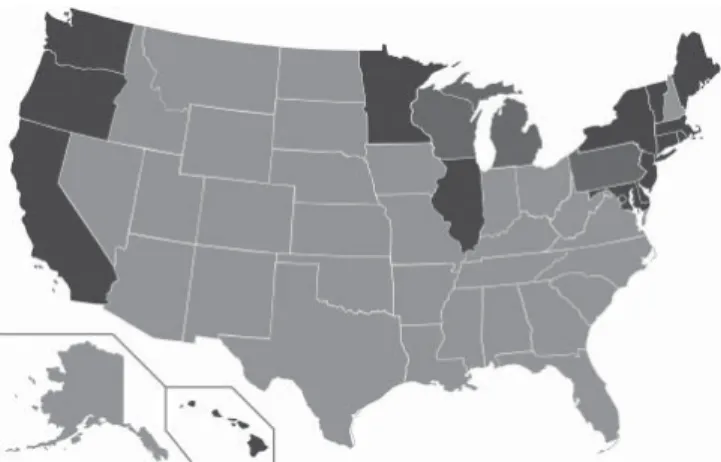
Donald Trump won the Presidency, but lost the popular vote. Hillary Clinton won 48% of the popular vote, while Trump won 46%, and third party candidates won a total of almost 6%. But because Donald Trump won 304 Electoral College votes, he won the election (Figure 1).12
That makes him only the fifth presidential candidate to win the office without winning the popular vote. (The last was George W. Bush, whose election came down to a contested set of votes in the state of Florida and a Supreme Court decision in his favor.)13 If we look more closely at state returns, we see that the election turned on the extremely narrow results in two Midwestern and one mid-Atlantic state, all with large rural and working class populations which had historically voted Democratic but have become contested states̶Michigan, Wisconsin, and Pennsylvania (Figure 2).
10. “Historic re-election pattern doesn’t favor Democrats in 2016,” Constitution Daily, National Constitution Center, January 25, 2013, https://constitutioncenter.org/blog/historic-re-election-pattern-doesnt-favor-democrats-in-2016.
11. Charles E. Cook, Jr., “Will the 2018 Midterm Follow Historic Patterns?” The Cook
Political Report, August 18, 2017,
https://www.cookpolitical.com/analysis/national/national-politics/will-2018-midterms-follow-historic-patterns.
12. O ff i c i a l e l e c t i o n r e s u l t s a r e f o u n d a t h t t p s : / / t r a n s i t i o n . f e c . g o v / g e n e r a l / FederalElections2016.shtml.
13. “Bush v. Gore,” Oyez, June 16, 2018, www.oyez.org/cases/2000/00-949. Figure 1. Based on 2016 U.S. Presidential Election Results, Federal
Fewer than 80,000 votes swung the election, an astoundingly small margin of victory. In Pennsylvania, Trump beat Clinton by only 44,292 votes, in Wisconsin by 22,748 votes, and in Michigan by a mere 10,704 votes.14 To underline just how tiny this margin is, in both Michigan and Wisconsin, third party Libertarian candidate Gary Johnson won more than 100,000 votes, while in Pennsylvania, Green Party candidate Jill Stein garnered nearly 50,000 votes, and “write-ins” totaled almost 48,000, both exceeding Trump’s margin of just over 44,000 votes in that state.
Not only did Donald Trump over-perform relative to his predecessors, Hillary Clinton underperformed in key areas and with critical populations, compared to Barack Obama’s success in 2008 and 2012. U.S. Census Bureau data illustrate the drop-off between the 2012 and 2016 presidential elections in voting among non-white populations, which historically have voted Democratic by large margins.15 Among white, non-Hispanic voters, turnout dipped for Bill Clinton’s second term in 1996, climbed back up for George W. Bush in 2000 and 2004, declined again in the years Obama won in 2008 and 2012, and rose once again in 2016 in an uptick that benefited Trump. Conversely, the non-white vote rose steadily between 1996 and 2012, especially among African Americans, whose
14. Total votes cast in each of these states were: Michigan, 4,779,284; Pennsylvania, 6,165,478; and Wisconsin, 2,976,150.
15. Thom File, “Voting in America: A Look at the 2016 Presidential Election,” Census Blogs, United States Census Bureau, May 10, 2017, https://www.census.gov/newsroom/blogs/ random-samplings/2017/05/voting_in_america.html. U.S. Census tabulations make a distinction between people who identify as white and Hispanic, and those who identify only as white, usually people of European descent.
Figure 2. Wisconsin, Michigan, and Pennsylvania (medium gray), states that historically voted Democratic (the “Blue Wall”) but voted Republican in the 2016 Presidential election. Source: https: // commons.wikimedia.org/w/index.php? curid=56384554
voting rose over thirteen points, first in opposition to Bush, and then in support of Obama. But in 2016, many stayed home. African American participation dropped 7%, from a high of 66.6% in 2012 down to 59.6% in 2016.
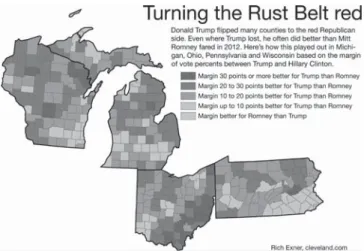
These trends were especially evident in the “rust belt” states that proved critical in the presidential election. In Michigan, Clinton was hurt by a much lower turnout of African American voters, who had turned out in droves to vote for Obama.16 In Michigan, Wisconsin, and Pennsylvania, Clinton did much worse than Obama in ex-urban and rural areas, where the voters are predominantly white. In Wisconsin and Michigan, which had both voted Democratic since 1988, more whites, women, and people without a college degree voted for Trump; in Pennsylvania the vote was evenly split (Figure 3).17 In Ohio, Trump exceeded the previous Republican presidential candidate, Mitt Romney, by large margins, especially among white voters, while the African American vote was down by roughly the same margins seen across the country.18 As a result, Republicans captured Ohio, a state Obama won in both 2008 and 2012. Though Trump’s margin of victory in Ohio was much larger than the margins in Wisconsin, Michigan, and Pennsylvania̶Trump won 51% to Clinton’s 43%, with a margin of over 446,000 votes19̶the trends were the same. In many places, Trump exceeded Romney’s results by 20% to 30% or more.
16. Jens Manuel Krogstad and Mark Hugo Lopez, “Black voter turnout fell in 2016, even as a record number of Americans cast ballots,” Pew Research Center, May 12, 2017, http:// www.pewresearch.org/fact-tank/2017/05/12/black-voter-turnout-fell-in-2016-even-as-a-record-number-of-americans-cast-ballots/.
17. Ruy Teixeira, “The math is clear: Democrats need to win more working-class white votes,” Vox, January 29, 2018, https://www.vox.com/the-big-idea/2018/1/29/16945106/ democrats-white-working-class-demographics-alabama-clinton-obama-base. See also Craig Gilbert, Todd Spangler, and Bill Laitner, “How Clinton lost ‘blue wall’ states of Michigan, Pennsylvania and Wisconsin,” Detroit Free Press, November 9, 2016, https://www.freep.com/ story/news/politics/2016/11/09/how-clinton-lost-blue-wall-states-michigan-pennsylvania-wisconsin/93572020/. Jackie Borchardt and Rich Exner, “Donald Trump flipped Rust Belt states by boosting rural vote; Hillary Clinton couldn’t make up the difference,” November 11, 2016, https://www.cleveland.com/politics/index.ssf/2016/11/donald_trump_flipped_rust_belt. html.
18. Borchardt and Exner, “Donald Trump flipped Rust Belt states”; Henry J. Gomez and Rich Exner, “A big reason why Donald Trump beat Hillary Clinton in Ohio: He ran up the score in Appalachia,” November 19, 2016, updated November 11, 2016, https://www. cleveland.com/politics/index.ssf/2016/11/appalachia_fueled_donald_trump.html.
19. David Liep, “2016 Presidential General Election Results-Ohio,” United States Presidential Election Results, Atlas of U.S. Presidential Elections, https://uselectionatlas.org/ RESULTS/.
II: Who were the Trump voters?
Many scholars and pundits see Donald Trump’s election as the culmination of cultural shifts and economic trends that reach back a generation and mark a realignment of national party coalitions.20 In 2004, a University of Michigan Election Study of voters and pollsters identified the white working class as a potential problem for the Democrats in national elections. This is particularly alarming to Democrats because workers of all stripes have been a reliable constituency since the election of Franklin Roosevelt during the Great Depression. Between 1932 and the 1970s, working class whites and other lower income groups consistently voted for Democrats. That began to change, first with Richard Nixon’s 1970s “tough on crime” rhetoric, aimed at white voters’ fear of crime and disorder, and his “Southern Strategy,” directed at voters’ discomfort with societal changes, particularly civil rights activism, feminism, and changing sexual mores. Nixon’s rhetorical strategies openly played on white racial anxieties, using coded language that invoked racial tensions and fears, without the openly racist and
20. Not all analysts see such a realignment. See for example, John B. Judis and Ruy Teixeira, “Movement Interruptus: September 11 slowed the Democratic trend we predicted but the coalition we foresaw is still taking shape,” The American Prospect, vol. 16, no. 1 (January 2005): 23–27; Larry M. Bartels, “Partisanship in the Trump Era,” Working Paper: 2–2018, Research Concentration: Elections and Electoral Rules, February 7, 2018; Paper for “Parties and Partisanship in the Age of Trump,” Bedrosian Center on Governance and Public Enterprise, University of Southern California, February 13, 2018.
Figure 3. Source: Rich Exner, https://public.tableau.com/profile/rich. exner#!/vizhome/rust-belt-presidential-vote/Dashboard1.
segregationist phrasing candidates like George Wallace had once used to attract a similar white electorate.21 Ronald Reagan’s 1980s attacks on “big government,” his appeal to conservative social values, his bellicose foreign policy, and his hopeful “Morning in America” rhetoric accelerated the movement of socially conservative working class voters, especially whites, to the Republican party. When working class voters turned out in large numbers for George W. Bush in 2000 and 2004, analysts on the left, such as Thomas Frank, in his 2004 book
What’s the Matter With Kansas?, lamented that the working class was voting
against its own economic interests in backing a party that advocated reducing government programs that working people and the poor relied upon, while enacting policies that enriched already wealthy Americans. Some argued, like Frank, that Republicans had successfully managed to shift the national debate away from questions of civic and economic equality and fairness, and toward divisive cultural issues, such as crime, abortion, or gay marriage that tapped into class, race, and rural/urban resentments.22
The University of Michigan American National Election Study quantified this trend. In 2004, whites comprised 77% of the electorate (a proportion that has been steadily dropping, reaching 72% in 2012, and down to 70% in 2016).23 The
21. Ian Haney López provided an analysis of this phenomenon, its history, and links to class politics and declining middle-class fortunes before Donald Trump became the high profile face of it. See López, Dog Whistle Politics: How Coded Racial Appeals Have Reinvented Racism
& Wrecked the Middle Class (Oxford: Oxford University Press, 2014). Many commentators
have noted the repeated use of white nationalist and white supremacist ideologies, conspiracy theories, tropes, and memes by Donald Trump and those around him, including aides Steve Bannon and Stephen Miller, and his son Donald Jr. See, for example, Sarah Posner and David Neiwert, “How Trump Took Hate Groups Mainstream: The Full Story of His Connection with Far Right Extremists,” Mother Jones, October 14, 2016, https://www.motherjones.com/ politics/2016/10/donald-trump-hate-groups-neo-nazi-white-supremacist-racism/; J. M. Berger, “How White Nationalists Learned to Love Donald Trump,” Politico, October, 25, 2016, https:// www.politico.com/magazine/story/2016/10/donald-trump-2016-white-nationalists-alt-right-214388; Nicholas Confessore, “Trump Mines Grievances of Whites Who Feel Lost,”
New York Times, July 14, 2016, A1; Lisa Desjardins, “How Trump Talks About Race,” PBS
Newshour, https://www.pbs.org/newshour/politics/every-moment-donald-trumps-long-complicated-history-race (updated August 23, 2018). On George Wallace, see Dan T. Carter,
George Wallace, Richard Nixon, and the Transformation of American Politics (Markham Press
Fund, 1992); and see also the documentary film “George Wallace: Settin’ the Woods on Fire,” Daniel McCabe and Paul Stekler, American Experience (PBS) (WGBH Educational Foundation: PBS Home Video, 2000).
22. Thomas Frank, What’s the Matter with Kansas? How Conservatives Won the Heart of America (New York: Henry Holt & Co, 2004). See also Pity the Billionaire: The Hard Times Swindle and the Unlikely Comeback of the Right (New York: Metropolitan Books, 2012).
23. University of Michigan, Institute for Social Research, Center for Political Studies, “American National Election Study, 2004: Pre- and Post-Election Survey,” Ann Arbor, MI:
study discovered that whites who had not gone to college, with a median or low income (then between $30,000 and $50,000), voted for the Republican candidate George W. Bush over the Democrat John Kerry by 24 points. This contrasts with the white college-educated population, where it was a tie (49–49).24 Moreover, it looked like a trend: in 1992 and 1996, Bill Clinton won the non-college educated white vote by only 1%; in 2000, Bush beat Al Gore by 19% with this group. As one might expect, among whites without a college education who earned more, between $50,000 and $75,000 a year, Bush beat Kerry by an even greater margin̶41%̶whereas among the college educated, Bush prevailed by only 5%.25 Pollster and political scientist Ruy Teixeira concluded in 2004 “the more voters looked like hardcore members of the white working class, the less likely they were to vote for Kerry in the 2004 election. That’s a problem̶a big
Inter-university Consortium for Political and Social Research (ICPSR), 2016. See also ANES 2012 Time Series Study, https://electionstudies.org/project/2012―time-series-study/, and ANES 2016 Time Series Study, https://electionstudies.org/project/2016―time-series-study/.
24. Alan Abramowitz and Ruy Teixeira, “The Decline of the White Working Class and the Rise of a Mass Upper Middle Class.” In ed. Ruy Teixeira, Red, Blue and Purple America: The
Future of Election Demographics (Washington, D.C.: Brookings Institution Press, 2008), 109–
46. Ruy Teixeira, “Public Opinion Watch,” Democracy and Government, Center for American Progress, May 11, 2005, https://www.americanprogress.org/issues/democracy/ news/2005/05/11/1466/public-opinion-watch/.
25. Judis and Teixeira, “Movement Interruptus.” See also Robert Griffin, John Halpin, and Ruy Teixeira, “Democrats Need to Be the Party of Working People: And They Can’t Retake Congress Unless They Win Over White Workers,” The American Prospect, Summer 2017, vol. 28, issue 3, 38–42.
Figure 4. Enthusiastic Trump voters at a rally. Source: Nate Cohn, “The Obama Trump Voters are Real: Here’s What They Think,” New York Times, August 15, 2017. Photo credit: REUTERS/Carlos Barria.
problem̶that Democrats have to take quite seriously.”26
In 2008 and 2012, Barack Obama and the Democrats were able to put together a winning coalition of African Americans, Latinos, young voters, white men and women, and leftists. Many working class whites voted for Obama, continuing the decades-long trend of workers voting for Democrats. But Hillary Clinton was unable to maintain the strength of Obama’s coalition. In addition to a lower turnout among African Americans, Democrats lost ground with the working class, as well as college educated and more affluent white men and women voters. Some speculate that in both 2008 and 2016, voters responded to a message of change.27 Obama campaigned on the idea of “hope and change,” pledging that his administration would work across party lines to help citizens prosper, and address the frightening economic recession, including a massive bailout of the auto industry. Donald Trump also campaigned on change, though the tenor of his campaign’s “populism” was more angry and resentful than hopeful, with promises to “drain the swamp” of career politicians and bureaucrats, and presumed corruption, to wrest control from “liberal elites,” and to “Make America Great Again,” a call that seemed nostalgic not only for an era of American dominance and robust economic growth, but, when accompanied by calls to “build a wall” to keep out Mexicans and proposals to curtail Muslim immigration, also signaled nostalgia for an era before women and people of color could expect to be considered the equal of white men.28
A constant stream of commentary and analysis followed Donald Trump’s election in November 2016. Much of the initial attention focused on Trump’s “populist” rhetoric, and its apparent effectiveness with white working class voters̶“globalization’s losers,” writer Jeff Guo termed them̶who many observers, strategists, politicians, pundits, and scholars viewed as the key to his
26. Judis and Teixeira, “Movement Interruptus”; Ruy Teixeira, “Public Opinion Watch.” 27. Political scientist Alan Abramowitz is credited with developing a predictive model of voter choice in presidential elections. The model considers the state of the economy, the incumbent’s popularity, how long the incumbent has been in office, and, since 2012, the degree of political polarization. See “Forecasting in a Polarized Era: The Time for Change Model and the 2012 Presidential Election,” PS: Political Science and Politics, vol. 45, (October 2012): 618–19.
28. Trevor Hughes, “Trump Calls to ‘Drain the Swamp’ of Washington,” USA Today, October 18, 2016, https://www.usatoday.com/story/news/politics/elections/2016/2016/10/18/ donald-trump-rally-colorado-springs-ethics-lobbying-limitations/92377656/; Ronald Brownstein, “Trump’s Rhetoric of White Nostalgia,” The Atlantic, June 2, 2016, https://www. theatlantic.com/politics/archive/2016/06/trumps-rhetoric-of-white-nostalgia/485192/; Theodore Schleifer, “Trump: Mexican ‘rapists’ coming now, Middle East ‘terrorists’ coming soon,” CNN, June 25, 2015, https://www.cnn.com/2015/06/25/politics/donald-trump-mexicans-terrorists-immigration-2016/index.html.
improbable victory.29 A number of other writers and scholars in the last two years have documented current hardships and precarious prospects for America’s working people. Matthew Desmond’s widely hailed exposé of housing insecurity,
Evicted: Poverty and Profit in the American City, revealed the “perverse market
structures, destructive government policies and cascade of misfortunes” that befall people who cannot afford increasingly unmanageable rents.30 A number of books explored the effects of post-industrial decline, often in rural, small town, or ex-urban America. Sarah Smarsh’s memoir of growing up poor on a Kansas farm in the 1980s and 1990s examined the causes and effects of intergenerational poverty, including unaffordable health care, dangerous workplaces, corporate agriculture, and domestic violence.31 In J.D. Vance’s Hillbilly Elegy: A Memoir of
a Family and Culture in Crisis, the author casts a critical eye over the Appalachian
community in Middletown, Ohio, where he grew up, and where his friends, family, and neighbors struggled with poverty, drug addition, violence, and hopelessness following the disappearance in the 1970s of the Armco steel factory jobs that had underwritten their formerly middle class life.32 Amy Goldstein’s five-year study examines what happened to a range of residents, from factory workers and teachers, to bankers, philanthropists and local politicians, in Janesville, Wisconsin, when a General Motors auto manufacturing plant closed.33 Yet, despite extensive evidence of economic insecurity and anxiety among a large segment of American voters, a growing number of pundits and political scientists have been arguing since Trump’s election that “racial resentment”34
29. Jeff Guo, “Stop blaming racism for Donald Trump’s rise,” The Washington Post, Wonkblog, August 19, 2016, https://www.washingtonpost.com/news/wonk/wp/2016/08/19/ stop-blaming-racism-for-donald-trumps-rise/?utm_term=.49fcde671dcc. Guo actually argued in this piece that workers with the lowest incomes seemed more likely to support Clinton, but those who harbored “racial resentments” and also experienced anxiety about their economic security were more likely to vote for Trump.
30. Matthew Desmond, Evicted: Poverty and Profit in the American City (New York: Crown Publishers, 2016).
31. Sarah Smarsh, Heartland: A Memoir of Working Hard and Being Broke in the Richest Country on Earth (New York: Scribner, 2018).
32. J.D. Vance, Hillbilly Elegy: A Memoir of a Family and a Culture in Crisis (New York:
Harper, 2016).
33. Amy Goldstein, Janesville: An American Story (New York: Simon & Schuster, 2017).
Janesville is the home of Congressman Paul Ryan. He has been Speaker of the House of Representatives since 2015, and was Mitt Romney’s vice presidential running mate in 2012. First elected to the House in 1999, he announced in April 2018 that he would not run for reelection. For a broader history of poverty in the United States, see historian Nancy Isenberg’s account of poor white Americans from colonial times to the present, White Trash:
The 400-Year Untold History of Class in America (New York: Viking, 2016).
34. Because it is difficult to measure overt racism among survey respondents̶most people are reluctant to voice or openly agree with obviously racist views, even if they are sympathetic
among white voters was a more crucial factor than economic distress or anxiety.35 For example, political scientist Philip Klinkner has argued that
the evidence from the 2016 election is very clear that attitudes about blacks, immigrants, and Muslims were a key component of Trump’s appeal .... In 2016 Trump did worse than Mitt Romney among voters with low and moderate levels of racial resentment, but much better among those with high levels of resentment.36
Based on data from the 2016 American National Election Survey, which queried a representative sample of 1,200 Americans on their views about the economy, race, and the presidential candidates, Klinkner concluded that:
Moving from the least to the most resentful view of African Americans increases support for Trump by 44 points, those who think Obama is a Muslim (54 percent of all Republicans) are 24 points more favorable to Trump, and those who think the word “violent” describes Muslims extremely well are about 13 points more pro-Trump than those who think it doesn’t describe them well at all.37
More recently, sociologist Robert Wuthnow has argued that in much of small town America, ill will toward immigrants is a more important factor than hostility toward African Americans, because they view immigrants as a threat to a local community’s traditional ways.38 Like Klinkner, political scientist Alan
to them̶social scientists have developed a method of asking respondents the degree to which they agree with more coded statements that reflect racial assumptions and biases, what Alan Abramowitz describes as “subtle feelings of hostility” toward non-whites, which he distinguishes from white supremacist assumptions of superiority and racial domination. Such statements used to measure “resentment” include: “Irish, Italian, Jewish, and many other minorities overcame prejudice and worked their way up. Blacks should do the same without any special favors.” These statements point to respondents’ sense of comparative advantage or disadvantage, rather than views about race and racialized groups per se. Alan Abramowitz, The
Great Alignment: Race, Party Transformation, and the Rise of Donald Trump (New Haven,
CT: Yale University Press, 2018), 129.
35. Mehdi Hasan, “Top Democrats are Wrong: Trump Supporters were More Motivated by Racism than Economic Issues,” The Intercept, April 6, 2017, https://theintercept. com/2017/04/06/top-democrats-are-wrong-trump-supporters-were-more-motivated-by-racism-than-economic-issues/.
36. Philip Klinkner, “The easiest way to guess if someone supports Trump? Ask if Obama is a Muslim,” Vox, June 2, 2016, https://www.vox.com/2016/6/2/11833548/donald-trump-support-race-religion-economy.
37. Klinkner, “The easiest way to guess if someone supports Trump?”
Abramowitz has also argued that racial anxiety is a much better predictor of support for Donald Trump than economic insecurity. Abramowitz argues that in an especially polarized electorate, characterized by hostile, “negative partisanship,” conservative white voters were ripe for a candidate like Donald Trump, who “appealed to white racial resentment more openly than any major-party nominee in the postwar era.”39 Similarly, in a comprehensive analysis of surveys taken before, during, and after the 2016 election, as well as polling and voter data, political scientists John Sides, Michael Tesler, and Lynn Vavreck conclude that issues of identity, especially race and ethnicity, but also religion and gender, were the driving force behind the way voters behaved in 2016, particularly white voters.40 No similarly strong correlation was found with economic factors. They found a “diploma divide,” in which voters with and without a college degree were diverging, especially among white voters. Donald Trump’s relentless emphasis on issues of race and immigration drew white voters whose racial attitudes were out of step with the Democratic Party, even among a small number who had voted for Barack Obama, a reality that turned out to be decisive in the key battleground states that gave Trump his victory. These voters tended to believe that “undeserving groups are getting ahead while [their] group is left behind,” a measure of “racial resentment.” Robert Griffin and Ruy Teixeira similarly found that voters “who held views of immigrants, Muslims, minorities, and feminist women as the undeserving ‘other’ were particularly susceptible to Trump’s appeal.”41 Sides, Tesler, and Vavreck argue that racial attitudes shaped the way voters understood economic outcomes, what they describe as “racialized economics.”42 Or, as Tesler put it in the Washington Post, “racial resentment is driving economic anxiety, not the other way around.”43 In 2016, views about whether the unemployment rate was up or down, or about the overall health of the national economy, were much more strongly correlated with racial resentment than they had been even a few years earlier.
Klinkner, Abramowitz, and other scholars are not arguing that economic
Princeton University Press, 2018).
39. Abramowitz, The Great Alignment, 9.
40. John Sides, Michael Tesler, and Lynn Vavreck, Identity Crisis: The 2016 Presidential
Campaign and the Battle for the Meaning of America (Princeton, NJ: Princeton University
Press, 2018).
41. Robert Griffin and Ruy Teixeira, “The Story of Trump’s Appeal: A Portrait of Trump Voters,” Democracy Fund Voter Study Group, June 2017, https://www.voterstudygroup.org/ publications/2016-elections/story-of-trumps-appeal%20.
42. Sides, et. al, Identity Crisis, 159.
43. Michael Tesler, “Economic anxiety isn’t driving racial resentment: Racial resentment is driving economic anxiety,” Washington Post, Monkey Cage, August 22, 2016, https://www. washingtonpost.com/news/monkey-cage/wp/2016/08/22/economic-anxiety-isnt-driving-racial-resentment-racial-resentment-is-driving-economic-anxiety/?utm_term=.f11a35f38ec0.
anxieties played no part in Trump’s success, but rather that white voters’ level of racial anxiety and resentment may better explain why they voted for a candidate who called for banning Muslim immigration and described Mexican immigrants as criminals and rapists, while also promising to bring back coal industry jobs, instead of voting for Hillary Clinton. Voting data show that Trump won with white voters across the board̶he not only won a big majority of white working class voters, he also garnered support among college-educated white voters, among more affluent white voters, with young white voters, and with white women.44 A Gallup study in August of 2016 suggested that Trump voters on average were not poorer or more likely to be unemployed than Clinton voters.45 There is no question that economic insecurity was a major factor in some white voters’ decisions to cast their vote for the Republican̶40% of white voters who said they were struggling economically preferred Donald Trump.46 A commentary on the 2016 Gallup study noted:
44. Most analyses rely on exit poll data to assess voter demographics. In these analyses, Hillary Clinton won among white college-educated women, and college graduates overall, but lost among white college-educated men. Griffin, Teixeria and Halpin, using additional data sets to estimate turnout and voting, have argued that Clinton actually won among all white college educated voters, but lost by a greater margin among white working class voters, who they estimate turned out in larger numbers than generally understood based on exit polling. Rob Griffin, Ruy Teixeira, and John Halpin, “Voter Trends in 2016. A Final Examination,” Center for American Progress, November 1, 2017, https://www.americanprogress.org/issues/ democracy/reports/2017/11/01/441926/voter-trends-in-2016/. See also “An examination of the 2016 electorate, based on validated voters,” Pew Research Center, August 9, 2018, http://www. people-press.org/2018/08/09/an-examination-of-the-2016-electorate-based-on-validated-voters/; Jon Henley, “White and wealthy voters gave victory to Donald Trump, exit polls show,” The Guardian, November 9, 2016, https://www.theguardian.com/us-news/2016/nov/09/ white-voters-victory-donald-trump-exit-polls; Max Ehrenfreund and Jeff Guo, “A Massive New Study Debunks a Widespread Theory for Donald Trump’s Success,” The Washington
Post, Wonkblog, August 12, 2016, https://www.washingtonpost.com/news/wonk/
wp/2016/08/12/a-massive-new-study-debunks-a-widespread-theory-for-donald-trumps-success/?utm_term=.2c9b183a9854; Jonathan Rothwell and Pablo Diego-Rosell, “Explaining nationalist political views: The case of Donald Trump,” SSRN (Social Science Research Network), November 2, 2016, https://papers.ssrn.com/sol3/papers.cfm? abstract_id=2822059. 45. Jeff Guo, “Stop Blaming Racism for Donald Trump’s Rise”; Nate Silver, “The Mythology of Trump’s ‘Working Class’ Support,” FiveThirtyEight, May 3, 2016, https:// fivethirtyeight.com/features/the-mythology-of-trumps-working-class-support/; Rothwell and Diego-Rosell, “Explaining nationalist political views.”
46. Max Ehrenfreund and Scott Clement, “Economic and Racial Anxiety: Two Separate Forces Driving Support for Donald Trump,” The Washington Post, Wonkblog, March 22, 2016, https://www.washingtonpost.com/news/wonk/wp/2016/03/22/economic-anxiety-and-racial-anxiety-two-separate-forces-driving-support-for-donald-trump/?utm_term=.4d3f61949967.
Trump supporters are more likely to emerge from places with low levels of intergenerational mobility, where poor children struggle to move up the socioeconomic ladder. They also tend to hail from places where middle-aged whites are dying faster. There is real suffering in these communities, a real sense that something has gone wrong.47
Yet, among the communities suffering from these very real social and economic woes, only the whites voted for Donald Trump in large numbers. Black, Latino, and other economically distressed voters continued to back Democratic candidates, which suggests economic troubles and anxiety about the future were not the only, or perhaps even the most salient, dividing line in the last election.48 The nexus of racial and economic anxieties is most pronounced among the openly racist white supremacists who staunchly support Donald Trump. Sociologist Rory McVeigh has argued that white supremacist organizations recruit among those who feel disenfranchised and disadvantaged, particularly in places that have borne the brunt of the global economic changes to the agricultural and manufacturing sectors. White supremacists, he argued,
believe that the white race is losing ground to other groups and that extreme measures are required to reverse the trend. They also resent white Americans who are enjoying economic prosperity. Prosperous whites are seen as beneficiaries of, and even conspirators in, the social changes that are leading to the declining position of the white majority. Promotion of free trade and a global economy are viewed as part of a plot that benefits the elite, as well as other races throughout the world, while reducing the standard of living for ordinary white Americans.49
47. Guo, “Stop Blaming Racism for Donald Trump’s Rise.”
48. Mehdi Hasan forcefully made this point in “Top Democrats Are Wrong: Trump Supporters Were More Motivated by Racism Than Economic Issues,” The Intercept, April 6, 2017, https://theintercept.com/2017/04/06/top-democrats-are-wrong-trump-supporters-were-more-motivated-by-racism-than-economic-issues/. Hasan argued “if you still believe that Trump’s appeal was rooted in economic, and not racial, anxiety, ask yourself the following questions: Why did a majority of Americans earning less than $50,000 a year vote for Clinton, not Trump, according to the exit polls? Why, in the key Rust Belt swing states of Michigan, Wisconsin, and Pennsylvania, did most voters who cited the economy as ‘the most important issue facing the country’ opt for Hillary over the Donald? And why didn’t Black or Latino working class voters flock to Trump with the same fervor as white working class voters? Or does their economic insecurity not count?” Hasan also noted that Trump “managed to win white votes regardless of age, gender, income or education.”
49. Rory McVeigh, “Structured Ignorance and Organized Racism in the United States,”
And they are even more angry and resentful about the real gains people of color have made in American society in recent decades, seeing those gains as coming at the expense of whites’ rightful place.
White supremacist organizations have existed in various forms throughout American history. The Ku Klux Klan is probably the most widely known, but there are many others, most of them fairly small.50 With the growth of the internet, and the proliferation of media outlets, their presence exceeds their numbers, however. Donald Trump’s blatant scapegoating and racism, and his failure to fully disavow white supremacists, created an opening for individuals and organizations that had long persisted underground and on the margins to emerge into the public square once again.51 During the presidential campaign, white supremacists hailed the candidacy of Donald Trump. Rocky Suhayda, chairman of the American Nazi Party, described Trump’s candidacy as a “real opportunity” for white supremacists to promote their “pro-white” movement.52 A KKK leader claimed she used Trump as a tool to recruit new members, while white nationalist writer Jared Taylor argued that voters who “see their country slipping through their fingers” would vote for Trump in large numbers. In a robocall heard by voters in Iowa in January 2016, Taylor echoed the candidate’s criticisms of immigrants, saying “We don’t need Muslims. We need smart, well-educated white people who will assimilate to our culture. Vote Trump.”53
50. The Institute for Family Studies conducted a study of white identity racist beliefs among American voters, using data collected by the 2016 American National Election Survey (ANES), and found that only about 6% of the white electorate professed belief in notions associated with white nationalist groups. George Hawley, “The Demography of the Alt-Right,” The Institute for Family Studies, August 9, 2018, https://ifstudies.org/blog/the-demography-of-the-alt-right.
51. Mark Potok, “The Year in Hate and Extremism” Southern Poverty Law Center, February 15, 2017, https://www.splcenter.org/fighting-hate/intelligence-report/2017/year-hate-and-extremism; Heidi Beirich and Susy Buchanan, “2017: The Year in Hate and Extremism,” Southern Poverty Law Center, February 11, 2018, https://www.splcenter.org/fighting-hate/ intelligence-report/2018/2017-year-hate-and-extremism. For an up-to-date list of American hate groups by state, see the Southern Poverty Law Center site. The most recent list, for 2017, is here: https://www.splcenter.org/hate-map/by-state.
52. Peter Holley, “Top Nazi Leader: Trump will be a ‘real opportunity’ for white nationalists,” Washington Post, Post Nation, August 7, 2016, https://www.washingtonpost.com/ news/post-nation/wp/2016/08/07/top-nazi-leader-trump-will-be-a-real-opportunity-for-white-nationalists/?utm_term=.2e200f97349b.
53. Holley, “Top Nazi Leader”; Peter Holley and Sarah Larimer, “How America’s dying white supremacist movement is seizing on Donald Trump’s appeal,” Washington Post, Morning Mix, February 29, 2016, https://www.washingtonpost.com/news/morning-mix/ wp/2015/12/21/how-donald-trump-is-breathing-life-into-americas-dying-white-supremacist-movement/?utm_term=.db037f0f137e; Peter Holley, “Hear a white nationalist’s robocall urging Iowa voters to back Trump,” Washington Post, Post Politics, Jan. 12, 2016, https://
In the days following Donald Trump’s victory, the Southern Poverty Law Center, which monitors hate groups and discrimination, reported more than two hundred incidents of hateful harassment and intimidation across the country.54 In one instance, at a York County high school in Pennsylvania, a student walked the hallway shouting “white power,” while others told their classmates they planned to “deport Mexicans back to Mexico and Blacks back to Africa.”55 In Durham, North Carolina, someone spray painted “Black lives don’t matter and neither does your votes” across the street from a popular African-American owned restaurant.56 In Wellsville, New York, a softball dugout was defaced with a swastika and the phrase “Make America White Again.”57
Among the most alarming examples of the re-emergence of organized racism in recent months came in the course of a national debate over the fate of hundreds of statues erected to memorialize Confederate soldiers and generals from the Civil War. On August 11 and 12, 2017, white supremacists converged in Charlottesville, Virginia, for a “Unite the Right” rally to protest the removal of a statue of Robert E. Lee, the Confederate General (Figure 5).58 Representatives of far right white organizations including the KKK, Identity Evropa, the Nationalist Front, the League of the South, the National Socialist Movement (a neo-Nazi
www.washingtonpost.com/news/post-politics/wp/2016/01/12/why-this-leading-white-nationalist-is-urging-iowa-voters-to-back-donald-trump/?utm_term=.ae538b123677.
54. “Over 200 Incidents of Hateful Harassment and Intimidation Since Election Day,” Southern Poverty Law Center, November 11, 2016, https://www.splcenter.org/ hatewatch/2016/11/11/over-200-incidents-hateful-harassment-and-intimidation-election-day. For examples, see Zainab Mudallal, “‘Black Lives Don’t Matter’ graffiti among hate acts around U.S. after Trump Win,” November 10, 2016, https://www.washingtonpost.com/express/ wp/2016/11/10/black-lives-dont-matter-graffiti-among-hate-acts-around-u-s-after-trump-win/?utm_term=.1590d5550fc6; Holly Yan, Kristina Sgueglia, and Kylie Walker, “‘Make America White Again’: Hate speech and crimes post-election,” CNN, updated December 22, 2016, https://www.cnn.com/2016/11/10/us/post-election-hate-crimes-and-fears-trnd/index. html.
55. Ivy DeJesus, “Shouts of ‘white power,’ talk of deportation reported at York tech school,” Pennsylvania Real-Time News, November 11, 2016, https://www.pennlive.com/ news/2016/11/school_racist_trump_york_vo-te.html.
56. Jeff Reeves, “Downtown Durham graffiti takes aim at Black voters,” WNCN/CBS, November 9, 2016, https://www.cbs17.com/news/downtown-durham-graffiti-takes-aim-at-black-voters/1016977909.
57. Allie Healy, “Western NY dugout defaced with ‘Make America White Again,’ swastika,” November 10, 2016, https://www.newyorkupstate.com/news/2016/11/western_ny_ dugout_defaced_with_make_america_white_again_swastika.html.
58. For an article that provides an overview of the rally and ensuing violence, with photographs and links to other articles, see Joe Heim, “Recounting a day of rage, hate, violence and death,” Washington Post, Local, August 14, 2017, https://www.washingtonpost.com/ graphics/2017/local/charlottesville-timeline/?utm_term=.5182f51c7777.
organization), and the Daily Stormer (an online white supremacist forum), showed up wearing helmets and bearing tiki torches, shields, and weapons. Chanting “We will not be replaced,” and the Nazi slogan “Blood and Soil,” they were confronted by hundreds of counter protestors. Before the rally began violence erupted. Heather Heyer, one of the counter protestors, died after James Alex Fields, a white nationalist from Ohio, ran her down with his car.59 DeAndre Harris, a Black man, was set upon by a group of the white supremacists and viciously beaten.60
59. Sheryl Gay Stolberg and Brian M. Rosenthal, “Man Charged After White Nationalist Rally in Charlottesville Ends in Deadly Violence,” August 12, 2017, https://www.nytimes. com/2017/08/12/us/charlottesville-protest-white-nationalist.html. Fields has been charged with multiple crimes in North Carolina, including first degree murder, that could lead to a life sentence, as well as thirty federal hate crime charges that carry the death penalty. His trial is set to begin November 26, 2018. Lauren Berg, “Fields could face death penalty in August 12 hate crimes case,” The Daily Progress, June 27, 2018, https://www.dailyprogress.com/racialstrife/ unite_the_right/fields-could-face-the-death-penalty-in-aug-hate-crimes/article_66d993a0-7a27-11e8-bc35-d3ef980792b8.html.
60. Harris was initially charged with assault and was then acquitted. After the men who beat him were identified from video of the attack, five were charged and four have so far been convicted on assault charges. Jacob Scott Goodwin received eight years in state prison, Alex Michael Ramos received six years, and Richard Wilson Preston received four years. Daniel Bordon awaits sentencing in January 2019 and Tyler Watkins Davis awaits trial in February 2019. Ian Shapira, “White supremacist is guilty in Charlottesville parking garage beating of black man,” May 2, 2018, https://www.washingtonpost.com/local/white-supremacist-is-guilty- in-charlottesville-parking-garage-beating-of-black-man/2018/05/01/033396b4-4af9-11e8-8b5a-3b1697adcc2a_story.html?utm_term=.e1d06b1281a0; Christine Hauser and Julia Jacobs,
Figure 5. White supremacists carrying Confederate and neo-Nazi flags at the “Unite the Right” rally in Charlottesville, Virginia. Credit: Edu Bayer/The New York Times/Redux, https:// www.nytimes.com/2017/08/18/us/confederate-monuments-southern-history.html.
David Duke, former Imperial Wizard of the KKK, who called the election of Trump a great victory of “our people,” described the rally as “a turning point” for white supremacists in the United States.
This represents a turning point for the people of this country. We are determined to take our country back. We are going to fulfill the promises of Donald Trump. That’s what we believed in. That’s why we voted for Donald Trump.61
People in the United States and around the world have found all this surprising and alarming. What is going on? How did the United States get to this point? Faced with these kinds of questions, history can offer insights, sometimes even hope, by looking to the past to understand how we got here, and how we might make sense of it. In considering how to place the recent presidential election, and more importantly the attendant racial tensions, in some historical perspective, two broad elements of American history stand out. First, the U.S. has been a racialized state from its earliest beginnings, in two distinct ways. On one hand, from the colonial period to the present, whiteness has been fundamental to conceptions about who counted as a “real American,” who was entitled to all the rights and benefits of citizenship and belonging in the United States. And, on the other hand, from its very beginnings, the United States has been a diverse place, filled not only with descendants of Europeans, who increasingly thought of themselves in racialized terms as “white,” but also hundreds of varied indigenous peoples, the descendants of Africans forcibly brought to North America, Mexicans and other peoples of Latin America and the Caribbean, and immigrants from across Asia. Second, the collision of these two realities̶notions of white entitlement and a diverse polity̶have been a constant source of tension and conflict in a democracy ostensibly dedicated to equality, freedom, and prosperity for all. American history has been characterized by halting progress in freedom, equality,
“Three Men Sentenced to Prison for Violence at Charlottesville Rally,” The New York Times, August 23, 2018, https://www.nytimes.com/2018/08/23/us/kkk-charlottesville-richard-preston. html; “Daniel Borden Found Guilty of Malicious Wounding,” WVIR/NBC, June 4, 2018, http://www.nbc29.com/story/38237585/daniel-patrick-borden-court-05-21-2018; Lauren Berg, “Man accused of participating in August 12 garage beating granted bond; charge certified to grand jury,” The Daily Progress, April 12, 2018, https://www.dailyprogress.com/racialstrife/ unite_the_right/man-accused-of-participating-in-aug-garage-beating-granted-bond/article_ e0321cae-3e90-11e8-818b-d36cf06504dc.html.
61. Adam Cancryn, “David Duke: Trump win a great victory for ‘our people,’” Politico, November 9, 2016, https://www.politico.com/story/2016/11/david-duke-trump-victory-2016-election-231072; Dan Merica, “Trump Condemns ‘hatred, violence, and bigotry on many sides’ in Charlottesville,” CNN, August 13, 2017, https://www.cnn.com/2017/08/12/politics/ trump-statement-alt-right-protests/index.html.
and economic security, often won at great cost. Gains have been strenuously resisted, frequently followed by reactionary backlash, in cycles of progress and retreat.62 For every advance in civil rights or equity, for every expansion and diversification of the citizenry, there has been a backlash by people and institutions who resisted change, who felt they, and their idea of who and what is “American,” was threatened.
To shed light on the current tensions in American life and politics, and the persistent contests over race, belonging, and citizenship in U.S. history, I turn to an arena where they are especially visible, and historically fraught̶immigration and naturalization. The rich diversity characteristic of American society since its beginning has been accompanied by resistance, rejection, and exclusion, marked by ongoing debate, still raging today, over just who is entitled to be a “real” American. Placing today’s tensions and hatreds into a broader, longer history helps illuminate their origins, place them in perspective, and contextualize a crucial element of American history and life that Donald Trump has made a centerpiece of his campaign and administration.
III: Nation, Citizenship, Whiteness: Nativism and Anti-Immigrant Politics
Since as early as 1620, when Puritan John Winthrop proclaimed that his colony would “be as a City upon a Hill,” Americans have described themselves as a chosen people destined to inhabit a Promised Land. This idea was well captured in 1845 by newspaper editor John O’Sullivan, when he argued that the United States
is by the right of our manifest destiny to overspread and to possess the whole of the continent which Providence has given us for the development of the great experiment of liberty and federative self government entrusted to us. It is a right such as that of the tree to the space of air and earth suitable for the full expansion of its principle and destiny of growth.63
But the westward expansion Winthrop imagined and O’Sullivan championed was fraught with racialized conflict. It was a process of conquest, colonizing already settled land, displacing, marginalizing, or killing indigenous inhabitants. In the
62. Historian Carol Anderson discusses the recurrent backlash against forms of racial progress in American history in White Rage: The Unspoken Truth of Our Racial Divide (New York: Bloomsbury, 2016).
63. John O’Sullivan, “The True Title,” New York Morning News, December 27, 1845, cited in Frederick Merk, Lois Bannister Merk, and John Mack Faragher, Manifest Destiny and
Mission in American History: A Reinterpretation (Boston, MA: Harvard University Press,
west and southwest following the Mexican-American war, American settlers, mostly white, confronted a significant resident Mexican and mestizo population. The expansion also engendered conflict over the expansion of slavery into new territories. And it provoked questions about whether Africans, Native Americans, and their descendants were capable of participating in American society as free and full citizens. Thomas Jefferson, in his Notes on the State of Virginia, famously doubted the capacity of Blacks for full citizenship, writing that he suspected they were “inferior to the whites in the endowment both of body and of mind.”64 Fifty years later, in 1830, as the country grew both in population and territory, Andrew Jackson, in his Second Inaugural Address to Congress, justified pushing Native Americans off their land in the southeastern United States by arguing that displacing “a few savage hunters” would actually enable them to “cast off their savage habits and become an interesting, civilized and Christian community,” under the “protection” and with the “good counsels” of the U.S. government.65 From John Winthrop to Andrew Jackson, it was clear that the benefits of westward expansion and national prosperity were intended for white Americans. As the country expanded, the market economy grew, and immigration increased, racial divisions hardened and conflicts escalated. Who got to be considered white among Americans was something that was constantly evaluated, negotiated, and constructed̶through law, social custom, violence, and science.
Anxiety about immigrants and anti-immigrant agitation and politics has a long history in the United States. In Colonial America, when European inhabitants were few, and the need for laborers and settlers was great, immigration was encouraged, without any restrictions as to skills, language, family connections, or moral character. Indeed, the Declaration of Independence complained that King George III had obstructed the migration of British and other Europeans to the colonies. But shortly after the nation was founded, legislators began to consider who ought to be granted the right to become an American. The 1790 Naturalization Act declared that only free white immigrants of good character could become citizens, after a residency of two years. As anxiety about immigrants grew, the period of residency was soon extended to five years, and for a brief period to fourteen years. These provisions excluded indentured servants, slaves, Native Americans, Asians, and other immigrants categorized as non-white and therefore as ineligible for citizenship.66
64. Thomas Jefferson, Notes on the State of Virginia (Philadelphia: Prichard and Hall, 1787), 153.
65. Andrew Jackson, “Second Inaugural Address,” March 4, 1833, The Avalon Project, Lillian Goldman Law Library, Yale Law School, http://avalon.law.yale.edu/19th_century/ jackson2.asp.
66. Annals of Congress, vol. 1, 566; United States Statutes at Large, Third Congress,
Session II, chap. 20, 414–15; United States Statutes at Large, vol. 1, Fifth Congress, Session II, chap. 54, 566–67; United States Statutes at Large, Seventh Congress, Session I, chap. 28,
Until the passage of the 13th, 14th, and 15th Amendments following the Civil War, slaves were considered property, not citizens. Free Blacks were ineligible for naturalization if they were immigrants, and subject to state restrictions on their civil rights if native born. In either case, many Americans believed African Americans did not have the character or capacity to be full citizens. Native Americans did not gain American citizenship until 1924. In 1940, naturalization was extended to Native peoples from the Western hemisphere, as well as to South Asians, Chinese, and Filipino immigrants. It was only with the 1952 Immigration and Nationality Act (commonly referred to as the McCarran-Walter Act), which prohibited racial and ethnic discrimination, that all other immigrant groups, including the Japanese, were theoretically allowed to become naturalized citizens. In practice, the Act’s provisions regarding moral character and “attach[ment] to the principles of the Constitution” created room for the federal government to exclude immigrants as subversive, based on subjective political determinations.67 (Individuals excluded on this basis have included a number of scholars, writers and activists, including Kōbō Abe, Michel Foucault, Gabriel Garcia Marquez, and Doris Lessing.)68
The idea that whiteness is foundational to American citizenship and belonging thus dates to the very beginning of the United States. Unlike many other nations of the world, the United States was not predicated on a legacy of ancestry, an attachment to a particular land or geographical space, nor tied to a single language or culture. Americans are not a “people” who became a nation state, as in Europe. Benedict Anderson has famously described all nations as “imagined communities” that are more than simply political entities.69 He argued that the nation’s borders are intellectual as much as geographical. In the United States, citizenship and public participation in the affairs of the nation was originally reserved for property-owning men who were thought to exemplify the self-sufficiency necessary for political participation in a democratic society (or, as historian Matthew Frye Jacobson memorably put it, a citizen was “at bottom, someone who could help put down a slave rebellion or participate in Indian wars”).70 The poor and property-less, and those thought to lack the emotional, moral, and cognitive
153–55.
67. Matthew Frye Jacobson, Whiteness of a Different Color: European Immigrants and the
Alchemy of Race (Cambridge, MA: Harvard University Press, 1998); Mae Ngai, Impossible Subjects: Illegal Aliens and the Making of Modern America (Princeton, NJ: Princeton
University Press, 2014).
68. Ngai, Impossible Subjects, 237–39; “Larry McMurtry Testimony,” [Subcommittee on
Courts, Intellectual Property, and Administrative Justice of the House Judiciary Committee, December 3, 2005], Pen America, https://pen.org/larry-mcmurtry-testimony/.
69. Benedict Anderson, Imagined Communities: Reflections on the Origins and Spread of Nationalism (New York: Verso, 2006 [1983]).
capacities necessary for participation in the republic were excluded from the civic realm. This notion of “self-sufficiency” was deeply gendered and racialized. Women, Blacks, and Native Americans, who were constructed as emotional, childlike, and dependent, were deemed ineligible for full citizenship.71 The 1790 Naturalization Act enshrined in law the idea that only white men had the capacity for citizenship. Thus, for most of the nineteenth century, white male immigrants could naturalize and gain the right to vote, while Blacks and women born in the United States could not. In 1870, following the Civil War, emancipation of the slaves, and passage of the 13th, 14th, and 15th Amendments to the Constitution that granted Blacks American citizenship, including the right to vote, the Naturalization Act was amended to include “aliens of African nativity and to persons of African descent.”72 Immigrants from Asia and other parts of the world were routinely denied the right to naturalize, and later even to immigrate, until reforms to the law in the 1950s and 1960s.73
Although the United States has portrayed itself as a refuge for the world’s oppressed and poor, anti-immigrant nativism has pervaded the nation’s history. Nativism in the nineteenth century, as it is today, was in part a response to massive immigration. Between 1820 and 1975, 47 million people immigrated to the U.S., the vast majority from Europe, mostly before the 1924 immigration act that intentionally and dramatically curtailed the influx of immigrants. For about a century, from 1820 to 1924, European immigration was pretty much continuous, with especially large numbers coming from England, Ireland, and Germany. Between 1845 and 1855, millions of Irish and Germans fled their homes to escape poverty, famine, and political turmoil. In that same period, thousands of Chinese flocked to the West coast of North America, then a U.S. territory recently conquered in the Mexican-American War. Indeed, significant numbers of people arrived from China, Japan, and the Philippines, until Asian immigration was largely cut off in the late nineteenth and early twentieth centuries. Between 1886 and 1908, some 400,000 Japanese immigrated to Hawaii, a U.S. territory before it became a state in 1950, and the West coast of the U.S. mainland.74 But the largest migration, by far, was the flood of European immigrants who arrived from Europe in two waves in the nineteenth and early twentieth centuries; first, almost 11 million from northwestern Europe (mostly England, Wales, Ireland, Germany, and Scandinavia), and then another 12 million from southern and eastern Europe
71. Jacobson, Whiteness of a Different Color, 15–38; Ngai, 21–55.
72. United States Statutes at Large, Forty-First Congress, Session II, chap. 254, 254–55.
73. Ngai, Impossible Subjects, 227–64.
74. Eiichiro Azuma, Between Two Empires: Race, History, and Transnationalism in
Japanese America (New York: Oxford University Press, 2005), 29; Eiichiro Azuma, “Brief
Historical Overview of Japanese Emigration, 1868–1998,” http://www.janm.org/projects/inrp/ english/overview.htm.
(including Italians, Slavs, and a large number of Jews fleeing persecution). To put the size of that migration in perspective, the nearly 23 million immigrants who arrived in the United States in the 45 years between 1870 and 1915 represented approximately one quarter of the total U.S. population of 92 million in 1910.75 Many established Americans reacted to this great flood of immigrants with alarm and resentment. White, native-born Protestants viewed the new residents as socially inferior hordes who lacked the intelligence and sociopolitical experience to make good republican citizens. Organizations such as the Order of United Americans and the United Sons of America protested America’s open borders and called for draconian restrictions. This was especially true in periods of economic distress or political discontent. In Baltimore, New York, Philadelphia, and other cities with large immigrant populations, nativists formed independent political parties that attracted working class and middle class voters angered by job competition, increased crime, public drunkenness, and poverty that accompanied increased immigration of often poor, uneducated, low skilled migrants, and the growing urbanization in the cities where they often settled. The “Know Nothings,” the most powerful and prominent of the nativist movements, with over a million members in the mid 1850s, demanded that immigrants be required to live in the United States for twenty-one years before they could vote, and wanted to bar all foreigners and Catholics from public office. Successfully running for six governorships and state legislative seats across the country, including nine where they held the majority, they enacted numerous laws to harass and penalize immigrants (including Mexicans in newly annexed territories).76
In antebellum America, Nativists were particularly exercised about Irish immigrants, especially Catholics, who were stereotyped as lazy, drunken, violent louts, beholden to a foreign religious hierarchy which instilled in them an authoritarian, anti-democratic ideology that threatened the American polity. Some nativists went so far as to accuse the Irish of being agents for the Pope in Rome, actively undermining American democracy. One newspaper editor complained that the Irish were “a mongrel mass of ignorance and crime and superstition, as utterly unfit for its duties, as they were for the common courtesies and decencies of civilized life.”77 Irish children were described as “undisciplined,” “inheriting
75. Bicentennial Edition: Historical Statistics of the United States, Colonial Times to 1970, Series C89–119, U.S. Census Bureau (Washington, D.C.: U.S. Government Printing Office, September 1975); 2016 Yearbook of Immigration Statistics, Table 2, Office of Immigration Statistics, Department of Homeland Security (Washington, D.C.: U.S. Government Printing Office, 2016); Ngai, Impossible Subjects, Table A1: Immigration to the United States, 1820– 2000, 272–73.
76. John R. Mulkern, The Know Nothing Party in Massachusetts: The Rise and Fall of a
People’s Movement (Lebanon, NH: Northeastern University Press, 1990); Jacobson, 69–71.
77. Herbert Gutman, “Work, Culture, and Society in Industrializing America, 1815–1919,”