Yoshiro Tamanoi, Economy and Ecology
*Translated
by Robert Chapeskie and Kiichiro Yagi
Introduction by Kiichiro Yagi
Yoshiro Tamanoi (1918-1985) was a scholar who traced a unique track in his research, which transcends the range of the discipline, not only in the his-torical study of economic thought, but also of economics in general.
Tamanoi started his career as a historian of economics close to Kozo Uno (1897-1977), whose influence was so strong in post-war academia that a distinctive school of Marxian economics emerged under his name. Tamanoi was one of Uno s first disciples to reconstruct Marxian economics as a basic theory of capitalism that can maintain itself on the basis of the transaction of commodities. When Tamanoi studied and began his academic career at the then Imperial Tohoku University in Sendai, Uno was a professor there. Both scholars moved from Sendai to newly founded departments of The University of Tokyo: Uno to its Institute of Social Science in 1947 and Tamanoi to its College of Liberal Arts in 1951.
Tamanoi deviated from the Uno school or Marxian economics in the 1960s by advocating a dialogue between Marxian economics and the so-called modern economics, and further by promoting comparative studies of economic systems. He published Marxian Economics and Modern Economics in 1966 and introduced the basic Western literature of comparative economic system studies. In this period, his favourite scholars were economists who had broad integrative scopes of social sciences, such as J. A. Schumpeter and K. E.
The History of Economic Thought, Vol. 62, No. 1, 2020. Ⓒ The Japanese Society for the History of Economic Thought.
* The original essay, “Ekonomii to Ekolojii (Economy and Ecology),” was first
pub-lished in Shis (Thought) no. 620, Feb. 1976, Iwanami Shoten, and later included in Tamanoi s book of the same title, published in 1978 from Misuzu Shobo, Tokyo.
Boulding. Tamanoi s seminar was famous then as a corridor through which many gifted leftist students converted from Marxism to modern American economics.
However, in the mid-1970s, Tamanoi showed his second transformation in the direction of ecological regionalism and extended his circle of acquaintances beyond academic economists to other disciplines, and further to local activists outside of academia. In 1976, he founded a transdisciplinary forum for regionalism that cooperated with various local initiatives. When he retired from The University of Tokyo in 1978, he accepted an offer from the Okinawa International University and moved to Okinawa. Between then and the year of his death, he divided his time between Okinawa and Tokyo. Tamanoi s regionalism resonated well in Okinawa and helped to advance the idea of the regional autonomy of Okinawa at the level of ordinary people. In this last stage, his reflection on human economy reached the ground level of the ecological flows of matter and energy. The article that has been translated into English here was included as a chapter of Economy and
Ecol-ogy (1978) that reflected his research interest at this stage. When several physicists moved to extend their thermological thinking to human society and founded the Society for Studies on Entropy in 1983, Tamanoi became its chairperson upon their request. It is worth noting that this group, including Tamanoi himself, was unequivocally critical of nuclear electricity generation. Indeed, the topics Tamanoi dealt with in these three stages were vastly different, but we cannot overlook the integrity of his pursuit throughout his entire life. What Tamanoi learned from Uno was the contradiction of the commodification of labour power. Capitalism assumes the availability of labour power as a sort of commodity, despite the fact that it is not a product of capitalist production. Uno and Tamanoi s views clearly recognize the distinction between Marx and other classical economists in this respect. Uno divided the political aspect and economic aspect of this contradiction of the commodity form of labour power and concentrated on the latter, giving the former task to political movements. Thus, he was able to construct a basic theory of capitalism capable of managing the economic element of the con-tradiction by way of economic fluctuation and crisis.
However, Tamanoi also anticipated the possibility of economics in the wider sense in this contradiction. In an investigation of the advance of economic insight into wage labour from David Ricardo to Marx, Tamanoi rediscovered Thomas Hodgskin, George Ramsay, and Richard Jones, who had critical in-sights on the prevailing view of wages and labour. The relationship between wages and labour power can take forms that differ from the prevalent one. In the feudal economies of the past or contemporary developing economies,
further in the future or in contemporary socialist economies, the forms and processes of the economic reproduction of labour power can be diverse. We can interpret Tamanoi s explorations in the second stage of his academic life as the quest for economics in the wider sense in the direction of diverse economic systems.
The connection between the second and third stage is also formed by the inability to subsume labour power in commodity form. The reproduction of labour power, that is, human life, is sustained by various circular flows of material and energy that support human production and consumption. Guided by the historical and anthropological view of Karl Polanyi, who questioned the marketization of labour power and land under capitalism, Tamanoi subscribed to the wider view of the human economy as an ecological system that is essentially integrated in the circulation of materials and energy. The contradiction of the commodification of labour power can be solved on the basis of the harmonious integration of the human economy with the basic ecological balance, which can be managed only by its regional integration at the level of people living in each place.
In the last stage of his pursuit of these studies, Tamanoi met Ivan Illich, whose vision of conviviality seemed to Tamanoi to be an ideal that he had been seeking throughout his lifelong research.
1
. Self-organizing Systems and Entropy-reducing Systems
When a thermostat is set to maintain a given temperature, if the recorded temperature falls below this ideal temperature, a boiler is switched on for heating. When the temperature is too high, the switch is turned off-this is how the system works. Here a feedback loop capable of effecting a controlled deviation of zero between the controlled standard value and the actual value must be put in place. This is also a kind of equilibrium system, but in this balance-maintaining structure, the conversion and transmission of information plays a fundamental role, and as a result it is not as simple a mechanism as in the case of the equilibrium theory found in the economics of the past in which the interdependent relationships of various economic quantities in the market are simultaneously determined.In comparison to this kind of homeostatic machine that is advanced and complex but involves no living beings, in the case of systems that involve life we see that the trait of independent self-preservation is operating from the start. No matter how simple the living organism, if it is hungry, for example, it will autonomously act on its environment by going in search of food. Compared to growing or cultivating food, going in search of food does
not advance beyond the level of simple self-preservation or self-production, but the former can be seen as a higher level of self-organizing system that only emerges with the latter as its staging ground.
The recent theoretical demand for viewing economic systems as self-or-ganizing systems is not something that emerged out of economic theory in particular but rather something that had as its moment the emergence, against the backdrop of the post-war development of science and technology, of the era of communication and control technology that gave birth to the principle of the servo-mechanism described above. Norbert Wiener, who was an academic forerunner of this emergence and pioneer of cybernetics, claimed that the thought of every age is reflected in its technique 1 and described the 17th century to the early 18th century as the age of clocks, the 18th and 19th centuries as the age of steam engines, and the current era as the age of com-munication and control.
This is clearly a technological view of civilization. During this so-called age of steam machines, in the domain of social science Karl Marx described the market economy regime of capitalism as an independent economic system based on commodity form. That is to say he viewed economic systems primarily as the independent self-preservation or self-production of human beings, and demonstrated that the maintenance of human beings lives was made possible through the reproduction of labour power. But what is particularly worth noting when we consider this today is the fact that even at that early point in time Marx had already observed that this kind of human independent self-production was in fact carried out with the metabolism of human beings and nature at its foundation. This was a pioneering insight that, while made in the midst of the technological era of the 19th century, was already an attempt to locate a life system that would transcend the tech-nological era of communication and control of the 20th century within the economic system of society.
Reading the first chapter of Wiener s Cybernetics (1948), entitled Newtonian and Bergsonian Time, we indeed see a wide avenue opening up for progress on issues surrounding the stipulation of the characteristics of biological phenomena. Namely, according to Wiener, in solar and cosmic astronomical systems the future simply repeats the past according to a fixed formula. This is a world in which time is reversible. In contrast to this, in a meteorological system, for example-in which innumerable particles of almost the same size are included-events are always unfolding in irreversible 1 N. Wiener, Cybernetics: Or Control and Communication in the Animal and the
time.
When compared to these two contrasting systems, most sciences can be positioned somewhere between them. Even astronomy includes space meteor-ology. When it comes to biology, completely monodirectional phenomena are studied. Birth is not the exact opposite of death, and anabolism that signifies the development of organization is not the exact opposite of catabolism that signifies the destruction of organization. As a result, while nothing new ever happens in the reversible time of physics, in biology, and in particular in the irreversible time structure of the theory of evolution, new things are constant-ly emerging. Wiener thought of Bergson as a philosopher who emphasized this characteristic.
Before going a bit further into the consideration of biological phenome-na, let us have in our minds the following words of the economist K. E. Boulding:
[. . .] atomic structures maintain themselves in the midst of a through-put of electrons, molecular structures maintain themselves in the midst of a throughput of atoms. [. . .] An atom or a molecule can presumably exist without throughput: the existence of even the simplest living organism is in-conceivable without ingestion, excretion and metabolic exchange. [. . .] It is not perhaps an important question at what point in the scale of increasing complexity life begins. What is clear, however, is that by the time we have got to systems which both reproduce themselves and maintain themselves in the midst of a throughput of material and energy, we have something to which it would be hard to deny the title of life . 2
It is presumably possible to break a living organism all the way down into the material elements of which it is composed. The journey upwards, on the other hand, advancing from tiny material elements to an organization that can be called life, is nearly impossible. This is the case because the moment the characteristic of self-preservation takes control must be introduced in a dimension in which there is a process whereby the physical elements that make up the organization are constantly changing. A virus, for example, can continue multiplying itself as long as it is engaged in metabolic activity in an environment in which protein synthesis can continue. Taken out of such an environment, a virus begins to take the form of inorganic matter like stone. We can think of the problem as lying in the nature of the independent metabolic activity unique to living organisms, and its defining characteristic can be sought, more than anywhere else, in the fact that living things can repeat this metabolism with only small inputs and outputs of energy. It is 2 K. E. Boulding, Beyond Economics, 1968, p. 91.
presumably around this point that the world of life elucidated by E. Schrödinger emerges.3
According to Schrödinger, an organism is constantly increasing its entropy as it moves through irreversible time. The reason that living organ-isms are nevertheless not destroyed is that they are constantly taking in food and expelling waste, and engaging in the transformation of the environment around them. In this case, something that is surely invaluable to the preserva-tion of life is included in the consumppreserva-tion of food: negative entropy. By taking in negative entropy from its environment an organism is able to offset the amount of positive entropy it creates by living. This, he says, is nothing other than the principle of the conversion of matter (Stoffwechsel) or metabolism.
This is the sole reason that organisms steadily maintain a low level of entropy; if so, however, do organisms appear, as Wiener says, within the irreversible time structure of most of the phenomena studied by science as entropy reducing systems? Professor Satoshi Watanabe s view4 on this point merits the attention of those interested in social and economic systems. According to Professor Watanabe, the entropy of an isolated system only changes in the direction of increasing. If so, then a decrease in the entropy of an open system that is not isolated does not run counter to the second law of thermodynamics. Since an organism being alive means it is converting external energy and matter, there is nothing surprising about living things being phenomena that run counter to the increase of entropy. If so, then rather than predicting or speculating about the future based on the present, shouldn t it be possible to assume a future state and work backwards to make a supposition about the past? Are these not indeed the grounds upon which a teleological explanation of living organisms can be given?
Thinking along these lines, Professor Watanabe writes as follows:
The type of low-entropy state that is deeply connected to biological phenomena is a low-entropy state in which there is a kind of stability. In a normal system an equilibrium state of maximum entropy is stable, but in certain special systems there is also a special state at a point of low entropy far from the point of equilibrium, and there are cases in which this state has stability. The study of such stable low-entropy states has only been undertaken very recently, beginning in countries like Belgium, and there is much that is still not understood.
If a type of low-entropy state deeply connected to biological phenomena 3 E. Schrödinger, What is Life?, 1944.
exists, can an ecosystem composed of living creatures on the surface of the Earth, that is, an ecological system, be viewed as a kind of thermodynamically steady-state system?5 It is here that the fundamental importance of thinking about economies in relation to the field of study of ecology is to be found. At the same time, here it also becomes clear that it is impossible to treat the concept of energy separately from that of entropy.
2
. The Metabolism of Humanity and Nature / the Ecosystem
Even in everyday usage, today we are aware that when we use the wordeconomy we must distinguish between whether we are referring to the market/commodity economy or to something that includes the non-market econo-my, that is, to economy in a broader sense that transcends the framework of the market economy. In the past these two senses often went undistinguished in the field of economics. Precisely speaking, the economy was seen as directly equivalent to the market economy, and economic systems were implicitly viewed as extensions of the market economy. This was particularly true in modern economics.
Karl Polanyi called this kind of view of economics an obsolete market mentality and bitterly condemned it. He emphasized the need to establish a new frame of reference to replace this narrow definition of economics. The market cannot be superseded as a general frame of reference unless the social sciences succeed in developing a wider frame of reference to which the market itself is referable. This indeed is our main intellectual task today in the field of economic studies. 6
Even when considering the processes of production and consumption in the market economy, today we have already begun to feel the need to use the new concept of throughput in addition to the existing concepts of input and output.7 This is because we have come to understand that neither production nor consumption are autotelic to the daily life of human beings itself. Mass production and mass consumption are economic processes that have to be held in check, and within production systems it is necessary to distinguish between large-scale waste expelled from the system and recyclable elements 5 H. J. Morowitz, Energy Flow in Biology, 1968, pp. 1-21. See also V. I. Kremyanskiy, Certain Peculiarities of Organism as a System from the Point of View of Physics, Cybernetics, and Biology, General Systems, vol. 5, 1960. Here surplus energy and
surplus work are emphasized as more advanced open systems of living phenomena. 6 Karl Polanyi, Primitive, Archaic and Modern Economies, ed. by G. Dalton, 1968,
p. 174.
that can be reinvested. It has come to be acknowledged that the expansion of the scale of production and consumption is not necessarily an indicator of the success of an economy. Today it has become necessary to view this as through-put along with inthrough-put and outthrough-put, that is, as the rate of [. . .] metabolism 8 needed to maintain an economic system as a self-organizing system.
This new approach can also be considered a push to in some sense theoretically re-examine the concept of productive power in Marxian econom-ics. As noted above, it has become clear that the concept of energy cannot be addressed in isolation from the concept of entropy. But regarding the processes of production and consumption, even Marx, who on the one hand suggested dealing with them on the basis of the metabolism of human beings and nature, on the other hand tried to express them as the increase in yield relative to the unit cost of labour energy when it came to the construction of the concept of productive power. This was nothing but an approach address-ing quantities the metabolism or material conversion of which was possible, and was not a concept constructed with a view toward the state quantities of materials.
When we think about it, however, Marx s having constructed the concept of productive power around the pillar of a simple concept of energy can be seen as having been the result of the economic system called capitalism having created a world focused from the start on industry through the medium of the market, or, to put it another way, an anti-agriculture or anti-living beings world, and it thus having been possible for economics to describe, within the framework of the market economy, the expansion of production in industry without considering the concept of entropy.
In order to consider these issues further, let us begin by taking a look at the labour process Marx laid out before the production of surplus value in
Capital.9
As is widely known, Marx sought the factors of the labour process in three elements: labour itself as an activity carried out purposively, the subjects of labour, and the instruments by which labour is performed. The instruments of labour are the things or composites of things that human beings introduce between themselves and nature because they are useful in conveying or transmitting their activity. According to Marx, the state of these instruments of labour determines the level of productivity and the nature of their ownership determines the relationship of production. At the same time, when the labour process composed out of these factors is seen from the per-8 Ibid., p. 137.
spective of the products that emerge as a result of it, both the instruments and subjects of labour appear as a means of production, and labour itself can be viewed as productive labour.
Here what must be noted to begin with is how Marx viewed land within the context of these trans-historical rules. Here land represents Nature, and Marx therefore stipulates that the soil [. . .] exists independently of him, and is the universal subject of human labour, and the earth itself is an instrument of labour.
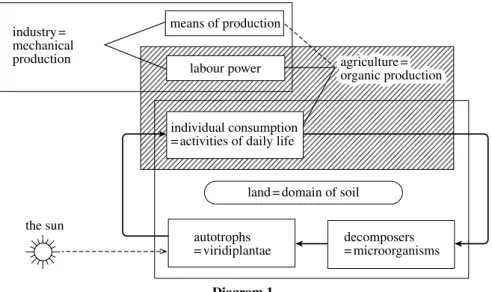
Now let us look at Diagram 1. As Marx also asserts, labour power or labour capacity only exists as a quality or function of living people. When exercising his labour power, a human being must expend some amount of things such as his muscle, nerve or brain [power], and this must therefore be replenished. This is the law of material balance. A person who possesses labour power must be able, after having finished a day of work, to repeat the same labour the next day on the basis of the same conditions of power and health.
industry = mechanical
production agriculture=
organic production
land = domain of soil the sun
Diagram 1
labour power
individual consumption = activities of daily life
agriculture = organic production
autotrophs
= viridiplantae decomposers= microorganisms means of production
Whether labour power will be reproduced like this tomorrow, however, depends on whether the human being who possesses it can, in an environment of daily life separate from his place of production, repeat the process of indi-vidual consumption today.
In order for a human being to be able to repeat purposive activities of production independent of nature in this way, there must exist human beings, i.e., Homo sapiens, who repeat their individual consumption processes, i.e., their activities of daily life. When this becomes clear, the form of a new
world reveals itself. Stated in general terms this is the world of an ecosystem, or a world of living creatures engaging in the metabolism of matter and energy, in which individual living creatures including human beings assimilate matter from their environment into their own bodies and dissimilate the matter out of which their bodies are constructed into their environment. This kind of environment is nothing other than a land/soil environment.
This land is not Mother Earth reflected in Marx s eyes. Nor is it humanity s original tool house. Soil does not have to go very deep in order to directly facilitate the lives of animals and the growth of plants. The field of ecology has termed this useful part of the land topsoil. This surface layer is the soil in which small creatures such as worms and microorganisms live. Fallen leaves and branches pile up on this surface bathed in sunlight, to which are added the excretions, waste products, and carcasses of animals. Wind blows and rain falls. Fungi and bacteria decompose the rotting soil thus formed. It is from this kind of topsoil that greenery first emerges. This is the soil environment we require, the land essential to our existence in our daily lives.
An ecosystem, as is widely known, is composed of three categories of living creatures who engage in metabolism with their ecological environment within it: 1) viridiplantae who convert inorganic matter to organic matter through the sun s energy (autotrophs/ producers ); 2) animals who consume plants or meat for nutrition (heterotrophs/ consumers ); and 3) microorgan-isms who decompose the excretions and remains of animals and plants and reduce them to inorganic matter (heterotrophs/consumers/decomposers). Fol-lowing the route of a food chain, the metabolism conducted by these living organisms with differing roles creates a flow of energy and recycling of matter. Of course, the root of the activity of this kind of ecosystem is the energy of the sun that enters the system from the outside. In contrast to this energy, which, according to the second law of thermodynamics, creates a one-way flow in which it is released as heat in the ecosystem, the organic matter needed for life, after having been created through photosynthesis, changes form from autotroph to heterotroph and ultimately becomes part of the in-organic matter nutrient pool out of which it is once again absorbed by plants. Now let us look at Diagram 2.10 There is a one-way flow of energy from left to right in the middle of the diagram, and the cyclical flow of matter is depicted in contrast to it. In this way an ecosystem of living creatures charac-terized by its metabolism is reproduced through an irreversible flow of energy 10 E. P. Odum, Fundamentals of Ecology, 1971, p. 87. I have made small changes to
and reversible flow of matter.
An important fact here is that a low-entropy-maintaining steady-state system that reduces entropy with only small additions and subtractions of energy is presumably created in such an ecosystem. It is precisely this state that can be viewed as a special stable state separate from the equilibrium state of maximum entropy that was mentioned earlier. Regarding the nature of this steady system centred on the metabolism, i.e., anabolism and catabolism, which occurs within it, and in particular regarding its rules such as the temporal structure surrounding its irreversible flow of energy and reversible cycle of matter, we can only await the work of experts in the field of ecology. I would like to think we can look forward to the rules pertaining to this kind of steady state being made clear in the field of ecology through their relationship to the climax in the transition and structure of the food chain.
Here there is a methodological problem that must not be overlooked: while in the past human beings, as so-called tool making animals, have been seen as existing apart from nature, here they are objectified within an ecosystem as one of its members. One might say this is placing the per-spective from which the system is viewed within the system itself rather than outside it.
By entering the system, the analyst can presumably close the theoretical model for the time being. Moreover, as the person in charge of labour power,
Pg= gross production; Pn= net primary production,
which may be consumed within the system by heterotrophs or exported from the system; P = secondary production; R= Respiration Diagram 2 importation exportation absorbed light autotrophs heterotrophs heat importation exportation nutrient pool Pg Pn R R P
that same human being as Homo sapiens can thus also open up the model by appearing independently of nature. Here the analyst stands outside of the sys-tem. Economics in a narrow sense as the study of capitalist market economies managed to objectify human beings within its system based on the systemic fiction of the commodification of human labour power. By doing so economic theory was able to secure the completeness of a systemically closed model and theory. Departing from this kind of economics in a narrow sense, the theory of economics in a broader sense that transcends the framework of the market will presumably become able to put forward a system of some kind based on the concept of an ecosystem.
But while this ecosystem characterized by metabolism centred on organ-isms is clearly an autonomous system, it is by no means one that arrives at a simple equilibrium-maintaining structure (homeostasis). Human beings are objectified as Homo sapiens within the system, and at the same time are able to look at the system from the outside. This is why as a pivotal stage in the history of human civilization, human beings, just like simple creatures which look for food when they are hungry, were able to organize the raising and cultivation of food, that is, to begin the era of fixed agriculture. Understanding an ecosystem does not mean simply belonging to nature. This understanding is nothing other than praxis, and we must think of an ecosystem itself as something that is only secured as a fixed system through praxis.
3
. The Essential Difference between Agriculture and Industry
Two aspects come to mind as domains of inquiry upon which this kind of ecological principle sheds light. One is the reproduction of food, the other the reproduction of the fertility of the soil. Both are of course inextricably linked to each other, and are presumably fundamental concepts that explain the reproduction of labour power in an economy in the broad sense of the word. The reproduction of food is nothing other than the activity of cultivating and raising things like grain, fruits and vegetables, and livestock. It is already clear that this kind of agricultural activity is fundamentally different from the industrial activity that has been carried out from the start as a purposive activity of human beings. The original form of agriculture has gone through various historical developments up to the present day. No one would be forgiven for confusing the methods of farming and raising livestock devel-oped in Mesopotamia around 6000 or 7000 B.C.E. with modern agricultural methods. But the issue here is more fundamental. We are trying to consider the relationship between human beings and nature, the relationship thatcomposes agriculture, in comparison to purposive industrial activity.
If we look at the concepts of the labour process in Capital with this in mind, we see that, as symbolically illustrated by the view of land previously referred to, they are rules concretely premised on industrial production, or at least not rules with the rhythm of natural living systems found in non- industrial production as part of their foundation. Here the rules of agricultural production seem to have been tacitly abstracted.
Let us move forward with our consideration of this point by examining Eduard David s Sozialismus und Landwirtschaft,11 one of the few texts that has clearly identified this issue. David was a leading proponent of revisionist agricultural theory in the Social Democratic Party of Germany, and this book was a well-known work that emerged out of the debate that took place between 1893 and 1895 within that party over its agriculture platform.
This work s first edition was a pamphlet written in an argumentative style and published in 1903, but its second edition, published in 1922, was a major work that included detailed theoretical reflections. Today there is a need to shed light on this text that has long been neglected by the academic world as revisionism.
In the context of what we have discussed thus far, let us now directly examine David s explanation that attempts a thorough comparison of the characteristics of agricultural and industrial production.
According to David, in Marx s approach the process of industrial production and that of agricultural production are essentially the same, and the rules obtained from an analysis of industrial production are thus seen as applicable to agricultural production as well. As soon as one applies the terminology used for the various stipulations surrounding the labour process in Capital to agricultural production, however, difficulties arise. For example, Marx includes land among the instruments of labour. In agricultural produc-tion, however, land is by no means something that functions merely as a tool of human action. Soil gives a part of its substance to build up plant production. 12
When it comes to raw materials, too, their character differs significantly between agriculture and industry. Seeds are the raw materials of agriculture, but what makes a plant or animal seed a seed is the raw materials of life inside nuclear cells. The difference becomes clear if we compare the role of 11 Eduard David, Sozialismus und Landwirtschaft, Zweite Auflage, 1922. This book has already been introduced by Seiichi Tobata in the first issue of N gy Keizai Kenky [Agricultural Economy Studies] (1925).
seeds in agriculture as they pass through the process of germination and growth with the role of seeds in industrial processing such as milling, brew-ing, and distillation. In industrial processing seeds are actually raw materials in a Marxian sense, that is, dead material that is merely changed into a new product through a simple form of transformation via mechanical, physical or chemical operations. With agricultural production, however, the situation is completely different: seeds function as living organisms. The true transformation the seeds undergo here, David believes, is nothing other than physiological evolution.13
According to David, therefore, the ordinary method of classifying industries that ignores the difference between agricultural production and industrial production is completely mistaken. People often use a method of classification that separates industry into two categories, primitive/gathering industry and manufacturing industry, but this leads them to overlook the fundamental difference between agriculture and the mining industry which both belong to the former category. As a result, here it is once again necessary to elucidate the fundamental difference between organic production and mechanical production (see Diagram 1 on p. 59).
This difference is illustrated as follows.14 In organic production there is the development of living beings, and in mechanical production the processing of dead matter. In the latter, the separation and combination of the substances needed for production are carried out by the purposive will of human beings making use of intermediate matter that undergoes these will-less transformations. In contrast, in agricultural production human beings as producers must leave this separation/combination up to the autonomous workings of living nature. Here it is this living nature that is the direct producer, and the work of human beings occupies at best a secondary posi-tion.
The production of industrial goods is thus a mechanical process and agricultural production an organic process. In the case of the agricultural production process, therefore, once the organic process disappears it is the end of distinctly agricultural production.15 The work of harvesting, for exam-ple, can be seen as a transition from the domain of agricultural production to the domain of industrial production; on the one hand it is based on the previously existing particular conditions of the organic processes in agriculture, while on the other hand it is already moving into the territory of 13 Ibid., p. 43-44.
14 Ibid., p. 44. 15 Ibid., p. 45.
mechanical production as work performed on dead, movable objects such as threshing and transporting.
When it comes to activities such as milling, baking, the making of dairy products, and distilling, although they are often conducted within an agricultural enterprise, they are all included in mechanical production. David says that all of Marx s propositions regarding the production process are valid regarding these sorts of so-called agricultural side-businesses.
In short, according to David agricultural labour does nothing more than prepare the way for and augment the living processes of plants and animals. Several notable characteristics of organic production emerge from this. To begin with, unlike that in mechanical production, the labour useful to organic production lacks consistency. Not only does it tend to be intermittent in a temporal sense, but the degree and type of labour involved also change. The timing of the starting and ending of this production is determined by nature, and nature also dictates the ongoing tempo of the production process. Having explained the above, David then presents the following extremely important assertion.16
The operation of agriculture is a form of life / living community and involves working processes the likes of which are not found in mechanical production. For example, the faeces and urine excreted by animals in the process of living contains nutrients essential to the life of plants. The richness of the soil is entirely dependent on whether or not these nutrients are once again returned to it. In comparison to this, the operation of industry is nothing more than a mechanism of dead equipment. Moreover, what must also be noted here is that individual consumption is conducted outside of the process of production.
In contrast, the operation of agriculture is a cosmos of living beings in which the material life of human beings is also embedded. And the more this cosmos is closed off, that is, the fewer products are released to the outside from within the cycle of plant and animal living processes combined as a single operation, the more easily soil stasis, or in other words an equilibrium between the collection of nutrients via harvesting and the supplying of nutrients through fertilization, is achieved.
What is made clear here also merits attention from the ecological perspective presented above. Namely, this is the view that industry / mechani-cal production is nothing more than a mechanism of lifeless equipment and human consumption / process of living exists outside of the path of production. In fact, agriculture / organic production forms a kind of living 16 Ibid., p. 49.
community, and, as we saw in Diagram 1, a cosmos unfolds there within which human consumption / living activity is also materially involved. And closing off this cosmos to begin with is of paramount importance when it comes to preserving the soil stasis.
This formulation of David s in the 1920s can be seen as something first concretized against the backdrop of the principle of compensation that formed the foundation of the proud tradition of German agricultural science that had spawned A. D. Thaer (1752-1828) and Justus von Liebig (1803-1873), and in particular its theory of crop rotation. David himself referred to Liebig s Die Grundsätze der Agrikulturchemie,17 Chemische Briefe,18 and
Naturgesetze des Feldbaus19 in the writing of the second edition of his major work Socialism and Agriculture. It has also been noted that even before the publication of this major work he had already put forward his own approach to this issue in an essay entitled Ökonomische Verschiedenheiten zwischen Landwirtschaft und Industrie 20 in Neue Zeit (1894-1895), the theoretical journal of the Social Democratic Party of Germany.
4
. A Classical Point of Contention concerning “Nature”
-Smith
and
Ricardo-The existence of the world of the domain of soil described by ecology, the cosmos David tried to illuminate and more specifically the communities of life within it that involve human beings, lead us inexorably back to a classical point of contention in the history of economics.
In Adam Smith s system of thought, which has been positioned as the starting point of economics in a narrow sense, the various elements that existed prior to the formation of this paradigm swirl and eddy, and this is a source of intellectual appeal even today. When it comes to Ricardo, one of the expounders of Smith s paradigm, while the theory of the world of industry and the market is further refined, the flipside of this is that the examination of the non-industrial world is far sparser than in Smith. This is highlighted by Smith s view of nature and the contrasting, critical view of it offered by Ricardo.
In Chapter 5 of Book 2 of The Wealth of Nations Smith writes as 17 Justus v. Leibig, Die Grundsätze der Agrikulturchemie, 1855.
18 Id., Chemische Briefe, 1844. 19 Id., Naturgesetze des Feldbaus, 1855.
20 E. David, Ökonomische Verschiedenheiten zwischen Landwirtschaft und Industrie, Neue Zeit 1894/95 II, p. 449-55.
follows:
In agriculture too nature labours along with man [. . .] The most important operations of agriculture seem intended, not so much to increase, though they do that too, as to direct the fertility of nature towards the produc-tion of the plants most profitable to man. A field overgrown with briars and brambles may frequently produce as great a quantity of vegetables as the best cultivated vineyard or corn field. Planting and tillage frequently regulate more than they animate the active fertility of nature; and after all their labour, a great part of the work always remains to be done by her. [. . .] In them [manufactures] nature does nothing; man does all; and the reproduction must always be in proportion to the strength of the agents that occasion it. 21 This famous passage in Smith drew a strong reaction from Ricardo. In Chapter 2 of his On the Principles of Political Economy, and Taxation he quotes from it, adding the italics included above for emphasis and responding as follows:
Does nature nothing for man in manufactures? Are the powers of wind and water, which move our machinery, and assist navigation, nothing? The pressure of the atmosphere and the elasticity of steam, which enable us to work the most stupendous engines-are they not the gifts of nature? to say nothing of the effects of the matter of heat in softening and melting metals, of the decomposition of the atmosphere in the process of dyeing and fermen-tation. There is not a manufacture which can be mentioned, in which nature does not give her assistance to man, and give it too, generously and gratuitously. 22
The winner of this dispute is already clear. Nature has two categories. Just as Ricardo said, nature does indeed operate in industry as well as agriculture, but to borrow David s term this is not living nature. Standing in the world of industry and the market, Ricardo commits the error of conflating organic production and mechanical production. He completely overlooks the cosmos of living ecosystems focused mainly on the world of soil/land. Compared to this one-sided approach of Ricardo s, Smith s stipulations are surprisingly rich.
As we have seen, Smith observed that a field overgrown with briars and brambles may frequently produce as great a quantity of vegetables as the best cultivated vineyard or corn field and was implicitly aware of the existence of 21 Adam Smith, An Inquiry into the Nature and Causes of the Wealth of Nations, ed. by E.
Cannan, 3rd ed. 1922, vol. I, p. 343.
22 David Ricardo, Principles of Political Economy and Taxation (The Works, ed. by Sraffa, vol. I), p. 76.
a soil stasis. Thus in Section 3 of Chapter 11, Book 1 of The Wealth of
Nations he states that the land is manured either by pasturing the cattle upon it, or by feeding them in the stable, and from thence carrying out their dung to it. 23 He then goes on to make the following observation concerning the management of agriculture in the Scottish low country before the union with England.
A portion of this waste land, however, after having been pastured in this wretched manner for six or seven years together, may be ploughed up, when it will yield, perhaps, a poor crop or two of bad oats, or of some other coarse grain, and then, being entirely exhausted, it must be rested and pastured again as before, and another portion ploughed up to be in the same manner exhausted and rested again in its turn. 24 Here, there is clearly an awful approach to management, but there is an assumption of the principle of the land recovering by means of fertilization through the use of grazing cows and fallow periods.
the sun
Diagram 3
feed livestock
food humanbeings
autotrophs
= viridiplantae nutrient pool= inorganic nutrients decomposers = organisms soil organic matter land = domain of soil
In short, Smith s ideal was lands [. . .] kept constantly well manured and in good condition. This is an ordinary enough ideal, but its implication is important. According to Smith, land has to be put in a condition suitable for adequate livestock feed. As a result, the increase of stock and the improvement of land are two events which must go hand in hand, and of which the one can nowhere much outrun the other. Without some increase of 23 Adam Smith, ibid., pp. 220-21.
stock, there can be scarce any improvement of land, but there can be no con-siderable increase of stock, but in consequence of a concon-siderable improvement of land; because otherwise the land could not maintain it. 25
Here let us look at Diagram 3. It presents the reproduction of the fertility of the soil based on an ecosystem, but as becomes evident when we superimpose it on Diagram 1, human beings and livestock are involved in this cycle of materials, and a structure of equilibrium between the nutrients in the soil being sucked up by the production of food or feed and nutrients being replenished by fertilization (including cattle manure) of the kind imagined by Adam Smith and David is depicted. This is a mechanism of compensa-tion of plant nutrients by humus and minerals. The richness of the soil is maintained thanks to this equilibrium, and the principles that give rise to this equilibrium are the cycle of matter and flow of energy in an ecosystem. The fertility of the soil is presumably something that arises out of the collaborative operation of the organic products of photosynthetic plants and the decomposition of organic matter by organisms that live in soil including water. This simple model must indeed be seen as acquiring even greater significance today when large quantities of chemical fertilizers are being add-ed to the top layer of soil.
Seen in this light, it is clear that in order for the growing and cultivation of agricultural produce to be repeated on a permanent basis while maintaining the soil stasis, the fertility of soil distorted by the cultivation of a particular crop must constantly be restored. This is eloquently described through fact and experience by the history of European agriculture as it progressed along the path from the three-field system (through the corn-crop grass system) to the crop rotation system.
This is a history of attempts to permanently maintain and increase humus or nitrogen-containing matter, but another fact consistent with it is that in a given expanse the land space is organized and closed off and a complete fertility reproduction system is created; even in the three-field system, for example, the land is initially arranged by adding large areas of grazing/pas-ture land to cultivated land. It is clear that the meaning of the land does not come only from individual fields, and fertility as a secondary power of nature can only be maintained when the various elements that make up the soil in a given expanse of land are linked together.
To be sure, the introduction of animal-powered grain drills and cultiva-tors was a technological premise of the Norfolk crop rotation system, but the principle of a complete system of crop rotation, while implemented in 25 Loc. cit.
three-year cycles in the case of the three-field system and four, six, or seven year cycles depending on the region in the case of the Norfolk system, can be sought in a cycle implemented through a combination of livestock and the rotation of multiple crops. Moreover, an extremely important point included within this principle was the enabling of agricultural labour to be distributed as evenly as possible throughout the year, and here labour too repeats a cycle. Let us now pose a question. Assuming the activities of growth and cultivation of food based on the reproduction of fertility described above, temporally over a period of several years and spatially within a given expanse a combination of multiple items is cultivated rather than a single crop. When this kind of agricultural production is assumed, what becomes of the
law of diminishing (or increasing) returns that economists often view as self-evident? In order to formulate this law we must take a specific crop and consider the amount produced in a given unit of land, but is there any way this premise can be derived from a fertility reproduction system?
In the abstract, of course, assuming a fixed level of technology, in the case of continuous additional investment in a given piece of land it can be said that there is certain level of intensity that, if exceeded, will not result in surplus yield such as that proportional to earlier investment even if additional investment in production costs is made. 26 This is precisely the hypothesis of the theory of rent in economics narrowly defined, but in this kind of theory of rent the various issues of methods of agriculture surrounding the reproduc-tion of fertility have clearly been abstracted. Diminishing returns are subtly exchanged for diminishing profits on investment, and as a result are dissolved into the relation between investment or costs and their effect on production, one of the general propositions of market economics. This is nothing more than the image of a law projected from the world of markets and industry. Is it not indeed necessary to undertake, separate and apart from this kind of market economics formulation, a reexamination of diminishing or increas-ing returns in agriculture as part of the question of land use to determine whether the result is a depletion of fertility or its increase in relation to the mechanisms of maintaining fertility of the kind already discussed? This is the approach of economics in a wider sense indicated by ecology and the principle of soil stasis.
5
. Economic Systems and Agriculture
As it must mediate the natural rhythm of living systems, the activity of grow-ing and cultivatgrow-ing food, even if it spreads the distribution of labour as evenly as possible throughout the year, cannot in general be expected to achieve the standardization of production processes found in industry. This indicates that in principle the modern form of enterprise based on efficiency will have difficulty adapting to this kind of agricultural activity. In relation to this point I must conclude by touching on the relationship between economic systems and agriculture.
Let us begin by considering the question of the natural order of the employment of capitals discussed by Smith, who was tacitly aware of the existence of living nature, in Chapter 5, Book 2 and Chapter 1, Book 3 of
The Wealth of Nations. According to Smith, as the original order of things in
nature, when the freedom of a market economy is assumed capital should be employed in the following order: agriculture → manufacture → commerce (wholesale trade)→ retail trade. When it comes to commerce, he also says that the employment of capital should come in the order of home-trade, direct foreign trade, round-about foreign trade, and carrying trade.
This natural order of employing capital is in fact nothing more than a conceptual order within Smith s theory. As history demonstrates, in reality capitalist development has followed precisely the opposite course. Smith himself acknowledges this fact, and says that this natural order has, in all the modern states of Europe, been, in many respects, entirely inverted. The foreign commerce of some of their cities has introduced all their finer manufactures, or such as were fit for distant sale; and manufactures and for-eign commerce together, have given birth to the principal improvements of agriculture. 27
Here a brief note must be added. As is widely known, in the midst of developing this kind of historical critique Smith himself focused on the formation of the yeomanry (independent farmers) who came to have the desire and spare energy to invest in the land at the end of the middle ages in Europe. The idea that as this yeomanry emerges its wealth and industrious-ness eventually give rise to rural industry, lead to the development of the social division of labour link between agriculture and industry, and create an ideal capitalism was proposed long ago by Professor Hisao Ōtsuka with Adam Smith in mind.
Here we must pay attention, however, to what exactly is meant by saying that capitalism emerges in agriculture. As Marx says, But the form of landed property with which the incipient capitalist mode of production is confronted does not suit it. It first creates for itself the form required by subordinating agriculture to capital. It thus transforms feudal landed property, clan property, small-peasant property in mark communes-no matter how divergent their juristic forms may be-into the economic form corresponding to the requirements of this mode of production. 28
In other words, the problem is that the capitalist mode of production, and therefore the capitalist form of landed property, does not originally arise on the basis of the small-scale mode of production of independent farmers. On the contrary, it is the dissolution of private property based on the labour of its owner that is the starting point of capitalist private property. Here we must not lose sight of the fact that private property based on the labour of its owner is in fact premised on private landed property. In other words, although capitalism may originate in the privatization of land, it can only arise through the negation of the small production upon which this is based. There is a transition from one private property to another private proper-ty. And this transition process, that is, The transformation of scattered private property, arising from individual labour, into capitalist private property is, naturally, a process, incomparably more protracted, violent, and difficult, than the transformation of capitalistic private property, already practically resting on socialised production, into socialised property. 29
Smith was ultimately unable to recognize this protracted, violent, and difficult process. This was a conceptual delusion of Smith, a market econo-mist who stopped at conceptually assuming a natural order of employing capital in which it is as though the employment of capital in agriculture becomes possible out of the blue, and Marx s achievement must be seen in his having dispelled this delusion and explicitly introduced this process as that of the expropriation of the immediate producers by capital, or the process of the primitive accumulation of capital.
As it happens, the form of capitalist landed property corresponds to capitalist agriculture; it is a relationship in which tenant farmers engage in production by hiring agricultural wage-labourers and must disburse some of the return on capital thus obtained to the landowner as rent. Looked at from another angle, this relationship between landed property and capital is one in which land must to begin with be placed outside of the system of capitalism, 28 K. Marx, Capital, vol. III, Part 6, Chapter 37.
since nature represented by land cannot be produced by capital itself. It is obvious that capitalism as a rational market economic system based on the commoditization of labour power begins to lay the foundation for the development of productive power not in agriculture itself, which is based on land, but rather in industry that is separate from agriculture.
This is demonstrated by the historical process of the primitive accumula-tion of capital described by Marx and the history of Britain from the end of the 18th century to the first half of the 19th century that followed it. The General Enclosure Act was passed in 1801. Its greatest consequence was the enclosure of common land. This largely destroyed the foundation of the self-sufficient economy of small farmers and greatly advanced the dissolution of the small-scale mode of production. The upper stratum of independent farmers, the yeomanry, was also almost entirely wiped out by this Second Enclosure process. And it was through this same process that large-scale land ownership and a capitalist tenant farming system emerged.
Worth noting here, however, is the fact that as part of the social and international economic background to this transition to capitalist agriculture Britain had already become a wheat importing country by the 1790s, and this Second Enclosure was begun as a result of the demand for more grain this occasioned. The famous Corn Laws were subsequently repealed in 1846. With this repeal cheap grain flooded into Britain from overseas, and the reliance on overseas staple food that had begun at the end of the 18th century steadily increased until it surpassed 30%. Under these circumstances, in Britain, the home country of capitalism, from the end of the 18th to the middle of 19th century there was a system of importing a large portion of the nation s food from overseas without domestic self-sufficiency, shifting, in a manner of speaking, the bulk of agriculture outside of the country and there-by concretizing the trend toward large-scale business and capitalism in what remained of domestic agriculture.
This important historical fact shows that for capitalism, an economic system of rational markets, agriculture is an extremely difficult phenomenon to handle. At the same time, it also shows that for countries such as Germany, France, America and Japan that lagged behind Britain in the transition to capitalism, that is, countries that provided staple grain domestically without relying on imports from foreign countries, the transition of agriculture toward capitalism of the kind seen in Britain was almost impossible. In any case, it is clear that creating compatibility between agriculture based on organic pro-duction and the rationality of capitalist markets is extremely difficult.
Here I will not discuss in detail how and to what extent post-Russian Revolution socialist nations were able to implement this lesson in new praxis.
I will only note that in his later years Marx asserted in the preface to the Russian language edition of his Communist Manifesto (1882) that the present Russian common ownership of land may serve as the starting point for a communist development. Marx had already used this phrase the previous year in a letter to Vera Zasulich, a Narodnik leader. The [first]
draft of this letter is extremely significant in today s context.
This draft begins by posing the following question: in the final analysis, it is a question of the transformation of one form of private property into
another form of private property (Western European development). Since the land in the hands of the Russian peasants have never been their private
property, how could this development be applicable? 30 If he had lived longer, perhaps the elderly Marx would have fundamentally reconsidered his claim in Capital that, regarding Western Europe as well, The rationalising of agriculture, on the one hand, which makes it for the first time capable of operating on a social scale, and the reduction ad absurdum of property in land, on the other, are the great achievements of the capitalist mode of production. 31
It is indeed difficult to universalize an efficiency-centric corporate form in agricultural activities. It is rash to absolutize, however, the small-farm form that is dominant even today in the agricultural regions of the world. Chinese-style people s communes are another possible form, and there is presumably great potential for other forms of organization as well. As we have already seen, for land to have the significance of land it must possess completeness in a certain spatial expanse, and to this end at the unit of the local community the validity of various forms of organization focusing on families and villages must presumably be examined.
Economics in the wider sense must take up this new topic and address this kind of marketless community, beginning with a typological elucidation of local differences regarding the form of organization of agricultural activi-ties. In place of economics in a narrow sense that has concerned itself almost exclusively with market economies and commodity economies, this should involve adjacent sciences such as history, cultural anthropology, and geography shedding a comprehensive light on this topic together with ecology as discussed above. It goes without saying that this history must also extend far beyond what has been considered economic history in the past, and a rich and vibrant history of communities including not only the history of settlement and farming but also that of legal systems and constitutions must 30 K. Marx, Letter to Vera Zasulich. (Collected Works of Marx and Engels, vol. 24, 1989.) 31 K. Marx, Capital, vol. III, Part 6, Chapter 37.
be examined.
Otto Brunner, who was an early emphasizer of the necessity of this kind of history, states as follows.
When we look at the rural areas of Europe, for example, Even today, lasting effects remain of the view originating at the end of the 18th century, that is, the view that thinks of the feudal system and the bourgeoisie as forces that oppose each other in principle, and sees in the peasant-aristocrat sphere a world of domination and bondage, of unfreedom, of the primitive and traditional, and even of the irrational. This view is correct for us only within a very limited scope, and seems to look at things too much from the perspective of the city, the modern state, and industrial society. In the last few decades much energy has been poured into the study of the history of settlements and the history of agriculture. This has broken through the narrow old concept of economic history and developed a comprehensive social history of rural areas. As I see it, the extremely important results of this research have not all been sufficiently incorporated into the understanding of history. Today the history of land clearance and settlement, that is, the process of the formation of Europe s agricultural areas, has been elucidated precisely as a pan-European phenomenon, and to the extent that these agricultural areas were not transformed by the industrialization and urbanization of the 19th century they stand before us in a form created up until the high middle ages. 32
As long as it abstracts the existence of this kind of local community at its foundations, today s industrial world, no matter how high a degree of organization it attains, cannot help but remain an unstable, pseudo-industrial world.
(Robert Chapeskie: Freelance Translator) (Kiichiro Yagi: Professor emeritus, Kyoto University and Setsunan University)
32 Otto Brunner, Neue Wege des Verfassungs- und Sozialgeschichte, Zweite Auflage, p. 91-92.