
東京都下五日市北方の上部二畳系砕岩中の紡錘虫
35
0
0
全文
(2) Vol. 9, No. 2 Journal of Hokkaido Gakugei University December, 1958. Fusulinids from the upper Permian Conglomerates of the northern part of Itsukaichi, Tokyo-to, Japan Sumio SAKAGAMI Department of Geology, Halcodate Bi'anoh,. Hokkaido Galeugei University. SJiS^ : Jtiw^TB. Fl ffA^®±^^g^r^fe'ct,®^g(A. Stratigraphical Abstract In 1958, the writer reported on the stratigraphical sequence of the late Permian conglomerates in the northern part of Itsukaichi, Kwanto zuassif. In that paper, the writer pointed out that the conglomerates may be divided into two types from their lithological characters but occupy the same horizon. Namely, one is the Tamanouchi conglomerate which has a matrix of grey limestone containing the younger type of fusulinids and embraces pebbles of chert, shale, schalstein and limestone yielding early Permian and middle Pennsylvanian fusulinids, and the other is the Nishinoiri conglomerate which possesses a matrix of greenish black sandstone with pebbles of chert, shale, schalstein and limestone containing early Permian and middle Pennsylvanian fusulinids. Kanmera (1953) stated that two conglomerate members occur in the Permian system in Japan, namely, one in the lower part of the middle Permian and the other in the upper Permian. The Tamanouchi and Nishinoiri conglomerates correspond to the latter type. However, the lithological characters of the Hinode formation (upper Permian) differ from those of the Kuma formation in Kyushu and its correlative formations. Although the latters do not contain chert and schalstein, the former is rich in these rocks. Furthermore, in the Kuma formation the limestone contains abundant remains of highly advanced fusulinids — Lepidolina or more advanced types of Yabeina, but in the Hinode formation the matrix of the Tamanouchi conglomerate contains fusulinids as — Yabeina globosa, Neoschivagerina dotwillei and so on. However, the fusulinids that occur in the matrix of the Tamanouchi conglomerate may have been derived from their hinterland. Therefore the writer considered that the conglomerate bearing Hinode formation may be correlated with the Kuma formation.. In the Kwanto massif, the Kamiyoshida formation which was named by Fujimoto (1935) may be correlated to the Hinode formation from lithological resemblance. The writer believes that there are two different lithofacies in the late Permian system of Japan, namely, one. yields the highly advanced fusulinids (Lepidolina etc.) and lacks chert and schalstein as the Kuma formation and so forth, and the other does not yield such fusulinids and contains chert and schalstein as the Hinode and Kamiyoshida formations. However, very recently, Morikawa'& reported that Parafnsulina and Psetidodoliolina were found in the base of the Kamiyoshida formation of Fujimoto. The present report is a systematic description of the fusulinids from these conglomerates, * Read at the 70th meeting of the Palaeontological Society of Japan, at Sapporo, June 6, 1958. 72 —.
(3) Fusulinids from the upper Permian Conglomerates of the northern part of Itsukaichi, Tokyo-to, Japan. Table 1. Fusulinids in the Tamanouchi and Nishinoir. conglomerates.. Nishinoiri. Tamanouchi ;onglomerat(. Localities. b II •a. u. ib 5 ip' bjori. vi cs. >^>. Species. p. L. conglomerate. M. p. M. <0. 1>>. t4. •K. 1>>1 2^. s-S 'z\>. (3 d. .d. u. a?. M. 1& 03. 1^ M> 1^. p. p. x. x. x. \y. x. p. •a. (fl -a >> '{3 a>' t-tF";. 's^ mi>. p. x. Oxcmainella cf. angulata OZAWA Ozcnvainella spp.. x. Stajj'ella moeUeri OZAWA. X. Staffella, sp.. /\. Nankinella sp.. x. x. Schubertella cf. irum.ensis FUTIMOTO. x. Mesosohilbertella t/iompsoni SAKAGAMI. x. Pseu.dostaff'ella.i tamano u.uhwnsis SAKAGAMI. x. Yangchienia sp.. x. x. \y. Fusn.linellci bocki MOLLER. X. Fusn.lmella •pseudobock.i LEE and Ci-lEN. x. x. Fusnlina sp. Tritic'ites Kawanoborinns'ss FUJIMOTO. /\. X. ><. Tr'iticites sp.. x. x. x. x. x. X?. x. Tritwitesl sp.. x. Pseudosahwagerina sp.. x. Paraschwagerina sp. Sch'wagerina vzilgaris (SCHELLWIEN). x. Sch'wagerina viilgaris var. globosa (SCHELLWIEN). x x. Schwagerina sant'i/nensis globosa SAKAGAMI, n. subsp.. Schzuagerina kraffti (SCHELLWIEN). x. x. Schwagerina furoni var. tmnanouchiensis SAKAGAMI. x. So/wagerina a p. A. x. Sohwagerina spp. j x. x. Parafusztlina cf. japonica (GUMBEL). x. x. Verbeekina sp.. x. Misellina clandw.e (DEPRAT). x. Pseudodo'.iolina ozawai YABE and HANZAWA. x. Neosohwagerina cruticztlifera (SCHWAGEK). x. Neoschwageri'na douvillei OZAWA. x. x. x. x. x. Neo.whzvagermn margaritae DEPRAT Neosahwagerina ap.. x. Yabeina cascadensis (ANDERSON). x. P : pebble, M : matrix, L : limestone block.. 73 —. x. x. x. x. x.
(4) Sumio Sakagami Since PseudostaffeUaf tamanouchiensis SAKAGAMI, Schwagerina furoni var. tamanonchiensis SAKAGAMI and Mesoschubertella ihompsoni SAKAGAMI from the Yagoold Valley have been. described in the previous papers (Sakagami, 1956 ; Kanuma and Sakagami, 1957) they will not be included in the present paper. All of the specimens treated in this paper are preserved in the collection of the Department of Geology, Hakodate Branch, Hokkaido Gakugei University. Here, the writer wishes to express his thanks to Prof. Haruyoshi Pujimoto of the Geological and Mineralogical Institute, Tokyo University of Education and Prof. Kotora Hatai of the Department of Geology, Collegp of Education, Tohoku University for their kind guidance and reading of this manuscript. Systematic Description Genus Ozaiuainella THOMPSON, 1935 Ozaiuainella cf. (ingn.lata (COLANI) Pl. 1, Fig. 1. 1924 Fusitlinella angulata COLANI, Geol. Surv. Indochine, Mem., vol. 11, fasc.1, pp. 74, 75, pl. 2, figs. 16-21. 1930 Staffella angul.ata LEE and CHEN, Nat. Res. Inst. Geol., Mem., no. 9, pp. 117, 118, pl. 7, figs. 12-21. 1934 Orobias angulata CHEN, Pal. Sinica, ser. B, vol. 4, fasc. 2, pp. 14, 15, pl. 1, figs. 6, 7; Nat. Res. Inst. Geol., Mem., no. 19, pp. 38, 39, pl. 6, figs. 1-4, 6, 20. 1936 Orobias angzdata LEE, Geol.Surv. China, Bull., vol. 16, pp. 76-78, pl. 2, figs. 1-3. 1941 Ozaivainellci, angzilata TORI ^AMA, Geol. Soc. Japan, Jour., vol. 48, p. 110, figs. 1-5. 1944 Ozawainella angitlata TORIYAMA, Jap. Jour. Geol. Geogr., vol. 19, nos. 1-4, pp. 69, 70, pl. 6, figs. 1-2. 1957 Ozaivcvinella angulata IGO, Sci. Rep., Tokyo Kyoiku Daigaku, sec. G, vol. 5, no. 47, pp. 181, 182, pl. 3, figs. 1-3.. Shell minute and lenticular with acute periphery. Axial length and width, 0.35 mm and 0.67mm respectively in the third volution, form ratio of 1:0.51. Rate of growth of a single specimen of first to third volution, 0.18, 0.32 and 0.67 mm, respectively. Remarks: - The present form resembles Ozaiualnella angnlata COLANI recorded by Toriyama from the limestone pebbles of the Yasuba type conglomerate in the Sakuradani area in the Province of Awa, Shikoku. However, Colani's original illustrations slightly differ from the present form by the more acute shape of the marginal periphery. Occurrence and Geological age: - The present form occurs in a limestone pebble of the Nishinoiri conglomerate in the Minamikanyu Valley. The geological age is uncertain because other determinable fusulinids do not occur in association in the limestone pebble. Reg. no. 1318-A.. Ozawainella spp. Pl, 1, Figs. 2-5.. Form 1 (Pig. 2): Shell rather large for the genus, lenticular with acutely angular periphery. Almost straight lateral slopes. Axial length and width, 1.07 mm and 2.41 mm respectively in the seventh volution, form ratio of 1:0.44. Rate of growth of a single specimen of first to third volutions, 0.29, 0.48, 0.70, 1.00, 1.44, 1.85 and 2.41 mm, respectively.. — 74 —.
(5) Fusulinids from the upper Permian Conglomerates of the northern part of Itsukaichi, Tokyo-to, Japan. Present form occurs in association with M.esoschii.beriella thompsoni SAKAGAMI, Schwagerina vulgaris (SCHELLWIEN), Schwagerina santyn.ensis globosa SAKAGAIW, n. subsp. and Schwa-. gerina kraffti (SCHELLWIEN) in a limestone pebble of the Nishinoiri conglomerate in the Nishinoiri Valley. Its age may correspond to that of the upper Pseit-doschtuagerina zone. Reg. no. 1262-C.. Form 2 (Pig. 3): A single tangential section. Shell minute and lenticular with acute periphery. Axial length and width 1.02 mm and 1.78 mm respectively in the fourth volution, form ratio of 1:0.57. Rate of growth of first to fourth volutions, 0.52, 0.89, 1.30 and 1.78 mm, respectively. The present form occurs in a limestone pebble of the Nishinoiri conglomerate in the Sakaguchiiri Valley. The age is uncertain because other determianable fusulinids do not occur in the limestone pebble. Reg. no. 1287-A. Form 3 (Fig. 4): A single axial but ill-preserved section. Shell minute and lenticular with acute periphery. Axial length and width, 0.95 mm and 1.42 mm respectively in the fifth volution, form ratio of 1:0.67. The present form was found in a limestone pebble of the Nishinoiri conglomerate in the Minamikanyo Valley. Associated fusulinids do not occur in the limestone pebble. Reg. no. 1314-A. Form 4 (Fig. 5): A single ill-preserved section. Shell minute and discoidal with subangular periphery. The present specimen not determinable owing to the ill-preservation. Occurrence is the same as the preceeding species. Reg. no. 1304-A.. Genus Siajfella OZAWA, 1925 Siaffella nioelleri OZAWA PI. 1, Figs. 6, 7. 1925 Stctjfella moelleri OZAWA, Jouv. Coll. Sci., Imp. Univ. Tokyo, vol. 45, art. 6, pp. 19, 20, pl. 2, fig. 9. 1958 Staffella moelleri TOXIYAMA, Mem. Fac. Sci., Kyushu Univ., sev. D, vol. 7, pp. 71-73, pl. 6, figs. 29-34.. Shell minute and spherical, periphery of all volutions rounded, axial regions slightly depressed in the outer volutions. Axial length and width, 0.61 mm and 0.82 mm respectively, in fourth volution, form ratio 1:0.75. Spirothecal structure unobservable with certainty. Chomata developed. Average tunnel angle measures 35° and 30° in the second and third volutions, respectively. (Table 2) Table 2.. Rate of Growth. Specimen. L. w. R. p. 2521-B. 0.61. 0.82. 0.75. 0.08. 0.21. 2522-H. 0.61. 0.83. 0.73. 0.08. 0.21. 1. 1. Thickness of Spirotheca. 2. 3. 4. 0.35. 0.49. 0.82. 0.34. 0.56. 0.83. Tunnel angle. 1. 2. 3. 4. 2521-B. 0.021. 0.029. 0.038. 2522-H. 9. 0.025. 0.034. 2. 3. 0.046. 34°. 31°. 0.038. 30°. 28°. Measurements (in mm) L : length, W : width, R : form ratio, P: proloculus diameter.. 75 —. 4.
(6) Surnio Sakagami Remarks: - The present form agrees with Slaffella moelleri OZAWA from the Akiyoshi limestone in Japan in its essential characters. Occurrence and Geological age: - The present form occurs in association with Staffella sp., Pseudostaffella ? tamanouchiensis SAKAGAMI, Mesoschn.beriella thompsoni SAKAGAMI, Schtuagerina vitlgaris (SCHELLWIEN), ScJuvagerina vulgaris var. globosa (SCHELL-WIEN) and Sdnuagerina sp. in a limestone pebble of the Tamanouchi conglomerate. Hence its geological age may correspond to that of the upper Psendosclnvageriiia zone. Reg. nos. 2521-B, 2522-H.. Staffella sp. Pl. 1, Fig. 8.. A single axial section. Shell minute. Periphery of all volutions rounded, axial regions slightly depressed in the outer two volutions. Axial length and width, 0.38 mm and 0.81 mm respectively, form ratio of 1:0.47. Proloculus very small, its outside diameter about 0.048 mm. Rate of growth of first to fifth volutions, 0.11, 0.16, 0.29, 0.46 and 0.81 mm, respectively. Spirothecal structure unobservable with certainty. Thickness of spirotheca 0.009, 0.009, 0.017, 0.017 and 0.024mm, respectively. Occurrence and Geological age: - Same as the preceeding species. Reg. no. 1255-B. Genus Nankinella LEE, 1933 Nankinella sp. Pl. 1, Fig. 9.. Shell minute and discoidal with angularly rounded periphery, possessing a short axis of coiling. Axial regions slightly depressed in the outer volutions. Axial length and width measure 0.53mm and 0.73mm, respectively, in the fourth volution, form ratio of 1:0.73. Proloculus indeterminable. Rate of growth of a single specimen of first to fourth volutions, 0.26, 0.45, 0.65 and 0.73 mm, respectively. Spirotheca rather thick, its thickness of first to fourth volutions, 0.013, 0.034, 0.042 and 0.046mm, respectively. Spirothecal structure not observed owing to secondary mineralization. Occurrence and Geological age: - The present form occurs in a limestone pebble of the Tamanouchi conglomerate in the Yagooki Valley. Associated fusulinids are Staffella moelleri OZAWA, Pseudostaffella ? iamanouchiensis SAKAGAMI, Mesoschuberiella Ihompsoni SAKAGAMI, Schwagerina mdgaris (SCHELLWIEN), Schiuagerina vtdgwis var. globosa (SCHELLWIEN) and Scinvagerina sp.. Hence its geological age may correspond to that of the upper Psendoschtvagerina zone. Reg. no. 2521-D. Genus Schnbertella STAFF and WEDEKIND, 1910 Schubertella cf. irnmensis (FUIIMOTO) Pl. 1, Figs. 10, 11. 1936 Ftisulinella irmnensis FUJIMOTO, Sci. Rep., Tokyo Bunrika Daigaku, Sec. G, vol. I, no. 2, pp. 38-40, pl. 2, figs. 1-8, 27 ?.. Two specimens of a typical axial section and a centered slightly oblique section. Shell minute in size and typical fusiform with convex lateral slopes. The first one to two volutions are coiled at a large angle to the axis of the outer volutions. Length and width in fifth volution of the axial section measure 0.89 mm and 0.48 mm, respectively, form ratio of about 1:1.9.. — 76 —.
(7) Fusulinids from the upper Permian Conglomerates of the northern part of Itsukaichi, Tokyo-to, Japan. Proloculus minute and its outside diameter about 0.05 mm. Septa unfluted, however, fluted in axial regions. Spirotheca very thin and composed of a thin tectum and a lower less dense layer. Chomata well developed. Tunnel angle in second to fourth volutions measure 12°, 23° and 28°, respectively. (Table 3) Table. L. w. R. p. 1576-B. 0.89. 0.48. 1.9. 0.05. 1584-C. 0.56. 0.35. 1.6. 0.04. Specimen. 3.. Rate of Growth 2. 3. 0.08. 0.15. 0.09. 0.16. 1. 4. 5. 0.26. 0.38. 0.48. 0.27. 0.35. Thickness of Hpirotheca. 1576-B 1584-C. Tunnel angle. 1. 2. 3. 4. 5. 2. 3. 4. 0.004. 0.004. 0.009. 0.011. 0.017. 12°. 23°. 28°. 0.009. 0.021. 0.006. 0.006. ?. Measurements (in mm). Remarks:- The present form well agrees with Fitsu.linella ir'umerisis which Fujimoto reported from the limestone of Asamido, Iruma-gun, Sozugawa, Tano-gun, Saitama Prefecture, Kwanto massif, in the essential characters. However, the present form slightly differs from Fujimoto's original illustrations in the tunnel angle, namely, the tunnel of the present form is generally narrower than that of Fujimoto's specimen. Occurrence and Geological age: - The present form occurs in limestone pebbles of the Tamanouchi conglomerate in the Minokuchi Valley. The age of the present form may correspond to that of the upper Pseudoschwagerina zone but associated fusulinids do not occur in the pebble. Reg. nos. 1576-B, 1584-C. Genus Mesoschitberiella KANUMA and SAKAGAMI, 1957 Mesoschttbefiella ihompsoni SAKAGAMI Pl. 1, Figs, 12-16. 1957 Mesoschubertella thompsoni SAKAGAMI, K&NUMA and SAKAGAMI : Trans. Proc. Palaeont. Soc. Japan, N. S., no. 26, pp. 43, 44, pl. 9, Hgs. 1-10.. Shell minute and bulged fusiform. First one to two volutions coiled at a large angle to axis of outer volutions. Length and width in fourth volution, 0.6mm to 1.1 mm and 0.4mm to 0.8mm, respectively, form ratio of 1:1.2 to 1:1.6. Proloculus minute. Its average outside diameter is about 0.05 mm for five specimens. Septa nearly straight in median portion but become slightly fluted in axial regions. Spirotheca composed of a tectum, a diaphanotheca and a lower tectorium. Chomata developed. Tunnel angle in second volution about 20°-28°, in third volution about 23°-31°. (Table 4) Remarks : - M.esoschubertella ihompsoni SAKAGAMI was described from the pebbles of the Tamanouchi conglomerate in the Yagooki Valley as the type species of the genus Mesoschubertella KANUMA and SAKAGAMI. The present form agrees in all essential characters with the holotype, however, the number of volutions of the present form is generally fewer than that of the holotype. 77 —.
(8) Sumio Sakagami Tabl. Specimen. L. w. 1252-A. 0.60. 0.48. ..3. 4.. Rate of Growth. p. R. 1. 2. 3. 4. 0.04. 0.11. 0,16. 0.29. 0.48. 5. 1257-A. 0.87. 0.56. ..6. 0.05. 0.10. 0.18. 0,27. 0.45. 1257-B. 0.67. 0.45. ..5. 9. 0.12. 0.19. 0.27. 0.45. 1289-A. 0.89. 0.72. .3. ?. 9. 0.29. 0.46. 0.72. 1290-A. 0.79. 0.64. .2. 0.64. 1302-A 1302-B. 0.68 1.07. 0.78. 1305-A 1309-A. ..4. 0.78 0.60. 0.42. ..4. 0.06. 0.16. 0.27. 0.42. 0.04. 0.16. 0.26. 0.42. 0.68. 9. 0.19. 0.34. 0.53. 0.78. 9. 0.11. 0.21. 0.34. 0.53. 0.05. 0.10. 0.19. 0.30. 0.42. Thickness of Spirotheci. 1. 2. 3. 4. 1252-A. 0.009. 0.013. 0.021. 0.021. 1257-A. 0.016. 0.016. 0.021. 0.025. 1257-B. 9. 0.017. 0.034. 0.034. 1289-A. 9. 9. 0.038. 3. 4. 0.78. Tunnel angle. 5. 2. 3. 25°. 25° 26°. 0.025 20°. 20". 0.063. 9. 30°. 0.034. 28°. 31°. 1290-A. 0.009. 0.017. 1302-A. 0.010. 0.021. 0.025. 0.021. 1302-B. ?. 0.025. 0.025. 0.025. 0.034. Septal count 5. 0.56. 4. 38°. 9 9. 1305-A. 0,004. 0.009. 0.013. 0.021. 0.030. 1309-A. 0.009. 0.006. 0.013. 0.021. 0.021. 9. 13. 17 20°. 23°. Measurements (in mm). Occurrence and Geological age: - The present species occurs from the pebbles of the Tamanouchi conglomerate in the Yagooki and Minokuchi Valleys, and the pebbles of the. Nishinoiri conglomerate in the Nishinoiri, Sakaguchiiri, Minamikanyo and Shirahagi Valleys. The geological age may correspond to that of the upper Pseudoschwagerina zone from the associated fusulinid species. Reg. nos. 1252-A, 1257--A, 1257-B (Nishinoiri Valley) ; 1289-A,. 1290-A (Sakaguchiiri Valley); 1302-A, 1302-B, 1305-A, 1309-A (Minamikanyo Valley); 1355A (Shh-ahagi Valley). Genus Yangchienia LEE, 1933 Yangchienia sp. Pl. I, Fig. 17.. A single but typical axial section. Shell minute and globular fusiform with inflated central portion. First two volutions coiled at a large angle to axis of outer volutions. Axial length and width, 1.47mm and 1.05mm, respectively, in sixth volution, form ratio of 1:1.4. Proloculus spherical and small, its outside diameter about 0.064 mm. Height of volution of first to sixth volutions is 0.040, 0.048, 0.079, 0.095, 0.095 and 0.126 mm, respectively. Spirotheca relatively thick and composed of a tectum and a lower transparent layer in outer part of last volution, however, spirotheca in inner volutions apparently composed of a tectum, a diaphanotheca and a lower dense layer. -_ 78 —.
(9) Fusu'linids from the upper Permian Conglomerates of the northern part of Itsukaichi, Tokyo-to, Japan. Septa unfluted throughout shell. Chomata well developed. Generally more than one-half to two-thirds as high as chambers. Tunnel narrow. Axial filling absent. (Table 5) Table. 5.. Rate of Grrowth. Specimen. L. w. R. p. 2617-A. '1.47. 1.05. 1.4. 0.064. 1. 2. 3. 4. 5. 6. 0.14. 0.27. 0.38. 0.57. 0.77. 1.05. Thickness of Spirotheca. 2617-A. Tunnel angle. 1. 2. 3. 4. 5. 6. 3. 4. 5. 0.013. 0.023. 0.025. 0.034. 0.046. 0.042. 16. 18. 18. Measurements (in mm). Remarks: - The present species is easily distinguished from the other species in the genus by the shell form. This form somewhat resembles Yangchienia kiuangsiensis which Chen (1956) recently reported from South China, however, the rate of growth of the present form is greater than that of the latter. The present form may be a new species, however, specific name must wait until a larger number of specimens accumulate. Occurrence and Geological age: - The present species occurs in association with Schwagerlna fnroni var. iamct.nouchiensis SAKAGAMI, Schwagerina cf. japonica (GUMBEL), Sc/?.zuagerina sp. A, and Neoscluuagerina margariiae DEPRAT in a small limestone block embedded in the Tamanouchi conglomerate in the Yagooki Valley. The age may correspond to that of the Neoschtvagerina zone. Reg. no. 2617-A. Genus Fusi.dinel.la MOLLER, 1877 Fiiszilinella bocki MOLLER PI. 1, Fig. 18. 1878 Fusttlinelfa boolci MOLLER in Thompson's illustration (1948), Univ. Kansas Paleont. Contr., Protozoa, art. 1, pl. 6, fig. 3. 1925 Fusulinella hoclci OZAWA, Jour. Coll. Sci., Imp. Univ. Tokyo, vol. 45, art. 6, pp. 17, 18, pl. 3, figs. 7, 9, 10. 1927 Neofusulinella bocki LEE, Pal. Sinica, ser. B, vol. 4, fasc. I, pp. 16-18, pl. 1, Fig. 2; pl. 2, figs. 12-17. 1936 Fusnlmella bockt FUJIMOTO, Sci. Rep., Tokyo Bunrika Daigaku, sec. C, vol. 1, no. 2, pp. 42, 43, pl. 2, figs. 16, 17, 19. 1944 Fusidinella, bocki TORIYAMA, Jap. Jour. Geol. Geogr., vol. 19, nos. 1-4, pp. 70-72, pl. 6, figs. 3-8. 1945 Fusulinella bodci THOMPSON, Amer. Jour. Sci., vol. 243, pp. 447-450, pl. I, fig. 15. 1953 Fuszilinella bocki KANUMA, Bull. Tokyo Gakugei Univ., vol. 4, pp. 24-26, pl. 3, figs. 1-5. cf. 1958 Fiisulinella bocki TORIYAMA, Mem. Fac. Sci., Kyushu Univ., ser. D, vol. 7, pl. 2, figs. 2022; pl. 3, figs. 1, 2.. A single axial section. Shell small in size and bulged fusiform, Lateral slopes of last volution slightly convex. Length and width in fifth volution measure 2.96 mm and 1.63 mm, respectively, form ratio of 1:1.8. Proloculus spherical and small, its outside diameter 0.16 mm. Rate of growth in first to last volutions, 0.34, 0.56, 0.87, 1.32 and 1.63 mm, respectively. Septa weakly fluted in median portion but complicated in axial region. Spirotheca relatively thin and composed of a thin tectum, upper and lower tectoria and a diaphanotheca. Thickness of spirotheca in first to. — 79 —.
(10) Sumio Sakagami last vplut.ions, 0.017, 0.021, 0.021, 0.042 and 0.055 mm, respectively. Chomata well developed from first to fourth volutions. Generally one-third to one-half as high as chambers. Tunnel side of chomata very steep but poleward slopes low. Tunnel angle of first to last measures 15°, 24°, 25° and 34°, respectively. Remarks: - The present form closely resembles Moller's original illustration, except for the difference in the developement of the chomata. Occurrence and Geological age: - The present form occurs in association with Fti.sti-. linella pseudobocki LEE and CHEN in a limestone pebble of the Nishinoiri conglomerate in the Nishinoiri Valley. The age corresponds to that of Fusidinella zone. Reg. no. 1579-A.. Fusnlinella pseudobocki (LEE and CIIEN) Pl. 1, Figs. 19-21. 1931 Neof'usulinella pseudobooki LEE and CHEN, Nat. Res. Inst., Geol. Mem., no. 9, pp. 122, 123, pl. 9, figs. 10-14; pl. 10, figs. 1-7. 1938 Pusulinella, pseudobocki FUJIMOTO, Jour. Geol. Soc. Japan, vol. 45, p. 275, pl. 8, figs, 14, 15. 1953 Fttsulwella pseztdoboclci KANUMA, Bull. Tokyo Gakugei Univ., vol. 4, pp. 28, 29, pl. 3, figs, 10-12. 1957 Fusn.lmella psendobooki IGO, Sci. Rep., Tokyo Kyoiku Daigaku, sec. C, vol. 5, no. 47, pp. 207209, pl. 8, figs. 1-12. cf. 1958 FusiUinella pseudobocki TORIYAMA, Mem. Fac. Sci., Kyushu Univ., ser. D, vol. 7, pp. 43-45, pl. 3, figs. 3, 4.. Shell small in size and fusiform to elongate fusiform with slightly inflated median portion and rounded polar region. First one volution coiled at a large angle to axis of outer volutions. Axial length and width of two axial sections (Reg. nos. 1268-A, 127L-A), 2.59 mm, 2.11mm and 1.14mm, l.llmm, respectively, in sixth volution, form ratio of 1:2.3 and 1:1.9, respectively. Proloculus spherical and small, its average diameter of two specimens 0.09 mm. Septa nearly straight in median portion but become irregularly fluted in axial region. Spirotheca thin and composed of a thin tectum, upper and lower tectoria and a diaphanotheca. Chomata Table 6.. Specimen. L. 1576-A. w. R. 1.02. p. Thickness of. Rate of Growth. Sph'otheca. 1. 2. 3. 4. 5. 9. 9. 0.24. 0.42. 0.68. 1.02. 6. 1. 2. 9. 0.025. 1268-A. 2.59. 1.14. 2.3. 9. 0.19. 0.30. 0.48. 0.76. 1.14. 1.30. 0.013. 0.021. 1271-A. 2.11. 1.11. 1.9. 0.10. 0.18. 0.24. 0.37. 0.53. 0.75. 1.11. 0.006. 0.017. 0.08. 0.16. 0.26. 0.37. 0.54. 0.008. 0.013. 1271-B. 0.54. Thickness of Spirotheca. 1576-A 1268-A. 3. 4. 5. 0.029. 0.042. 0.025. 6. Septal count. 1. 2. 3. Tunnel angle. 4. 4. 2. 3. 0.042. 22°. 31°. 39°. 0.025. 0.034. 9. 28°. 42°. 45°. 0.030. 19°. 22°. 24°. 1271-A. 0.021. 0.017. 1271-B. 0.017. 0.017. 0.038. 7. 10. Measurements (in mm). — 80 —. 10. 12. 5.
(11) Fusulinids from the upper Fermian Conglomerates of the northern part of Itsukaichi, Tokyo-to, Japan. asymmetrical or subsymmetrical and well developed from first to last volutions. Tunnel angle becomes gradually broader in outer volutions and is about one-third as high as chambers.. (Table 6) Remarks'. - This species was first described from the Moscovian Huanglung limestone of China. The present form agrees in all its essential characters with the original illustration of Lee and Chen. Occurrence and Geological age: - The present species occurs in limestone pebbles of the Tamanouchi conglomerate in the Minokuchi Valley and that of the Nishinoiri conglomerate in the Nishinoiri Valley. In the Minokuchi Valley, the present materials occur in association with F'usii.linella bocki MOLLER, however, in the Nishinoiri Valley, they do not occur in association with the other determinable fusulinids in the limestone pebble. The age corresponds to that of Fusnlinella zone. Reg. nos. 1576-A (Minokuchi Valley); 1268-A, 1271. -A, 1271-B (Nishinoiri Valley). Genus Fnsullna FISCHER DE WALDHEIM, 1829 Fusulina sp. Pl. I, Fig. 22.. A few oblique sections. The present form belongs to the genus Fiisnlina by the spirothecal structure and its general appearance. The spirotheca is composed of a tectum, a diaphanotheca, lower and upper tectoria. Occurrence and Geological age: - The present form was found in a limestone pebble of the Nishinoiri conglomerate in the Nishinoiri Valley. Associated fusulinids do not occur in the limestone pebble. The age corresponds to that of Fnsidina zone. Reg. nos. 1274-A, 1275-A.. Genus Triticiles GIRTY, 1904 Triiiciles kawanoboriensis FUJIMOTO Pl. 2, Figs. 1-4. 1927 Schell'wienia montiparu OZAWA, Jour. Coll. Sci., Imp. Univ. Tokyo, vol. 45, art. 6, pp. 40, 41, pl. 9, fig. I. 1936 Triticites montipara FUJIMOTO, Sci. Rep., Tokyo Bunrika Daigaku, ser. C, vol. 1, no. 2, pp. 5052, pl. 3, figs. 1-7. 1937 Triticites kaivanoboriensis FUJIMOTO, Jap, Jour. Geol. Geogr., vol. 14, nos. 3-4, pp. 118, 119, pl. 7, figs. 1-7. 1957 Trilicites ka'wanoboriensis SAKAGAMI and OMATA, Jap. Jour. Geol. Gcogr., vol. 28, no. 4, pp. 255, 256, pl. 20, figs. 7, 8.. Shell small in size and fusiform with straight axis of coiling. Lateral slopes convex in inner volutions, but slightly concave in outer ones. Slopes near axis faintly bulged. Average length and width in fifth volution measure 3.9mm and 1.5mm, respectively, for two axial sections, form ratio 1:2.6, Proloculus spherical and small. Its average outside diameter of seven specimens 0.14 mm. Septa unfluted, but become in-egularly fluted in axial regions. Spirotheca rather thin and composed of a tectum and a keriotheca. Chomata well developed in first to last volutions. Tunnel relatively narrow and becomes gradually broader in outer volutions. (Table 7). — 81 —.
(12) Sumio Sakagami Table 7. Specimen. L. w. R. p. 2574-B. 3.70. 1.33. 2.8. 0.15. 1577-A 1578-A 1578-B. 1.24. 1258-B 1259-A. 1.16 4.03. 1.74. 2.3. 3. 0.22. 0.37. 4. 5. 1. 2. 0.59. 0.93. 1.33. 0.016. 0.032. 0.84. 1.07. 0.024. 0.024. 1.00. 0.013. 0.016. 0.26. 0.40. 0.11. 0.20. 0.29. 0.45. 0.68. 0.15. 0.26. 0.37. 0.56. 0.87. 0.15. 0.20. 0.27. 0.45. 0.75. 0.11. 0.21. 0.34. 0.57. 0.15. 0.26. 0.44. 0.74. 9. 0.78.. 2. 0.16. 1.00. 9. 1. 0.59. 1.07. 1577-B. Thickness of Spirotheca. Rate of Growth. Thickness of Spirotheca. 0.013. 0.013. 1.24. 0.010. 0.016. 0.92. 1.16. 0.010. 0.016. 1.15. 1.74. 0.017. 0.032. Septal count. 3. 4. 5. 2574-B. 0.056. 0.048. 0.056. 1577-A. 0.032. 0.040. 0.048. 1577-B. 0.030. 0.048. 0.048. 1578-A. 0.040. 0.048. 1578-B. 0.032. 0.056. 0.064. 1258-B. 0.032. 0.040. 0.079. 1259-A. 0.056. 0.056. 0.079. 1. 2. 3. Tunnel angle. 4. 5. 1. 2. 3. 4. 23°. 31°. 31°. 39°. 16°. 24°. 25°. 34°. 30°. 32°. 32°. 34°. 9. 7 9. 10 10. 14 10. 15 12. ? 14. Measurements (in mm) Remarks: - The present form agrees with Trilicites montipara which was described by Fujimoto from Raiden-yama, Nishitama-gun, Tokyo-to, Kwanto massif. Occurrence and Geological age: - The present form occurs in association with Triiiclies sp. in limestone pebbles of the Tamanouchi conglomerate in the Yagooki and Minokuchi. Valleys, and that of the Nishinoiri conglomerate in the Nishinoin Valley. The age may correspond to that of the lower Psendoschwagerina zone. Reg. nos. 2574-B (Yagooki Valley);. 1577-A, 1577-B, 1578-A, 1578-B (Minokuchi Valley); 1258-B, 1259-A (Nishinoiri Valley). Triiicites? sp. Pl. 2, Figs. 5-7.. Shell small in size and fusiform with straight or somewhat convex lateral slopes. Shell expands slowly in inner two or three volutions, but rapidly in outer volutions. Average length and width in fifth volution measure about 2.58 mm and 1.24 mm, respectively, for three axial sections, form ratio 1:2.1. Proloculus small and spherical. Its average outside diameter of three specimens 0.13 mm. Septa weakly and irregularly fluted in median portion but somewhat complicated in axial regions. Spirotheca relatively thin and composed of a thin tectum and a fine alveolar. keriotheca. Chomata poorly developed. (Table 8) Remarks: - The present form exhibits the features of the genus Pseudoschiuagerina which is characterized by the coiling of shell, namely, the ceilings in the inner volutions are tight but increase rapidly in the outer ones. However, the present form, from the general characters, may be referable to the genus TriticUes.. — 82 —.
(13) Fusulinids from the upper Permian Conglomerates of the northern part of Itsukaichi, Tokyo-to, Japan. Table Specimen. L. w. R. p. 8.. Rate of Growth. 1. 2. 3. 4. 5. 1574-A. 2.85. 1.33. 2.1. 0.15. 0.26. 0.41. 0.57. 0.89. 1.33. 1581-A. 2.35. 1.25. 1.9. 0.13. 0.20. 0.30. 0.46. 0.73. 1.25. 1586-A. 2.55. 1.15. 2,2. 0.11. 0.19. 0.25. 0.46. 0.74. 1.15. Thickness of Hpirotheca. 1574-A. Tunnel angle. 1. 2. 3. 4. 5. 1. 2. 3. 4. 0.016. 0.030. 0.040. 0.048. 0.048. 9. 19°. 30°. 9. 35°. 45°. 1581-A. 0.013. 0.013. 0.030. 0.034. 0.034. 1586-A. 0.013. 0.017. 0.030. 0.055. 0.055. 9 22°. 36°. Measurements (in mm). Occurrence and Geological age: - The present form occurs in the Tamanouchi conglomerate in the Yagooki Valley. Associated fusulinids do not occur in a limestone pebble. The age may correspond to that of Pseudoschwagerina zone. Reg. nos. 1574-A, 1581-A, 1586-A. Genus Psendoschwagerina DUNBAR and SKINNER, 1936 Psendoschwagerina sp. Pl. 2, Fig. 8.. A single excentric section. Spirotheca very thin in inner volutions, becoming relatively thick in ultimate volution. Septa very thin and finely fluted in inner volutions, but relatively thick in ultimate volution. Ultimate volution more tightly coiled than penultimate one. The present form is from a limestone pebble of the Tamanouchi conglomerate in which no associated fossils were found. The age may correspond to that of Pseudoschwagerina zone. Reg. no. 2503-B.. Genus Paraschwagerina DUNBAR and SKINNER, 1936 Paraschmagerina sp. Pl. 2, Fig. 9.. A single excentric section. The early volutions' are very tightly coiled but the outer volutions highly inflated. Width of last volutions measures about 3.07 mm. Septa thin and fluted. The present form is from a small limestone pebble of the Tamanouchi conglomerate in the Minokuchi Valley. Associated fusulinids do not occur in a limestone pebble. Reg. no. 1582-A. Genus Schivagerina MOLLER, 1877 Schwagerina viilgaris (SCHELLWIEN) Pl. 2, Figs. 10, 11, 17. 1909 Fitsttlina vulgaris SCHELLWIEN, Palaeontogr., no. 56, p. 163, pl. 14, figs. 1, ?„ 1925 Schellzuienia milgaris OZAWA, Jour. Coll. Sci., Imp. Univ. Tokyo, vol. 45, art. 6, pp. 23, 24, pl. 7, fig. 3. 1927 Schellwienia. milgai-is LEE, Pal, Sinica, ser. B, vol. 4, fasc. 1, pp. 59-64, pl. 8, figs. 6-9, 11, 12 ; pl. 9, fig. 9.. — 83 —.
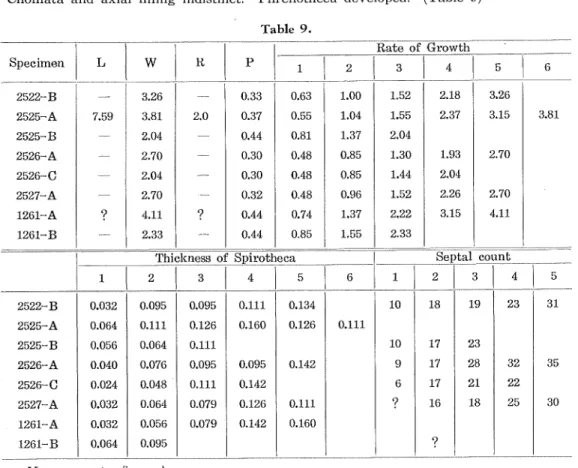
(14) .Sumio Sakagami 1934 Psezi.dof'usii.l'ina v'tdgaris CHEN, Pal. Sinica, ser. B, vol. 4, fase. 2, pp. 67, 68, pl. 6, fig. 10. 1936 Pseiidofttstilina vulgaris FUJIMOTO, Sci. Rep., Tokyo Bunrika Daigaku, sec. C, no. 2, pp. 75-77, pl. 11, figs 1-7. 1955 Psendofusulina vulguris MORIKAWA, sci. Rep., Saitama Univ., ser. B, vol. 2, no. 1, pp. 89, 90, pl. 9, figs. 1-6. 1958 Pseudofusulma mtlgaris TORIYAMA, Mem. Fac. Sci., Kyushu Univ., ser. D, vol. 7, pp. 164-168, pl. 20, figs. 12-18, pl. 21, figs. 1-15.. Shell moderate in size and of bulged form with straight axis of coiling. Length and width in sixth volution of a typical axial section measure about 7.6 mm and 3.8 mm, respectively, form ratio 1:2. Proloculus spherical and large, its outside diameter 0.37 mm. Septa rather thin and intensely folded. Spirotheca very thick and composed of a thin tectum and a coarse alveolar keriotheca.. Chomata and axial filling indistinct. Phrenotheca developed. (Table 9) Table 9.. Specimen. L. 2522-B. 2525-A. w. K. 3.26 7.59. 3.81. 2.0. Rate of Growth. p. 1. 2. 3. 4. 5. 0.33. 0.63. 1.00. 1.52. 2.18. 3.26. 0.37. 0.55. 1.04. 1.55. 2.37. 3.15. 2.70. 6. 2525-B. 2.04. 0.44. 0.81. 1.37. 2.04. 2526-A. 2.70. 0.30. 0.48. 0.85. 1.30. 1.93. 2526-C. 2.04. 0.30. 0.48. 0.85. 1.44. 2.04. 2527-A. 2.70. 0.32. 0.48. 0.96. 1.52. 2.26. 2.70. 0.44. 0.74. 1.37. 2.22. 3.15. 4.11. 0.44. 0.85. 1.55. 2.33. 1261-A. 9. 1261-B. 4.11. 9. 2.33. Thickness o. 3.81. Septal counfc. Spirotheca. 1. 2. 3. 4. 5. 2522-B. 0.032. 0.095. 0.095. 0.111. 0.134. 2525-A. 0.064. 0.111. 0.126. 0.160. 0.126. 2525-B. 0.056. 0.064. 0.111. 2526-A. 0.040. 0.076. 0.095. 0.095. 2526-C. 0.024. 0.048. 0.111. 0.142. 2527-A. 0.032. 0.064. 0.079. 0.126. 0.111. 1261-A. 0.032. 0.056. 0.079. 0.142. 0.160. 1261-B. 0.064. 0.095. 0.142. 6. 1. 2. 3. 4. 5. 10. 18. 19. 23. 31. 10. 17. 23 35. 0.111. 9. 17. 28. 32. 6. 17. 21. 22. 9. 16. 18. 25. 30. 9. Measurements (in mm). Remarks: - The present form agrees in all its essential characters with Schellwien's original illustration, however, the number of septa of the former is a little greater than that of the latter. The present form resembles Fujimoto's and Morikawa's specimens from the Kwanto massif. Occurrence and Geological age: - The present form occurs from the pebbles of the. Tamanouchi conglometate in the Yagooki and Minokuchi Valleys, and the pebbles of the Nishinoiri Valley. The age may correspond to that of the upper Pseudoschwagerina zone.. — 84 —.
(15) Fusulinids from the Upper Permian Conglomerates of the northern part of Itsukaichi, Tokyo-to, Japan Reg. nos. 2522-B, 2525-A, 2525-B, 2526-A, 2526-C, 2527-A (Yagooki Valley) ; 1261-A, 1261-B. (Nishinoiri Valley). Schwagerina vnlgaris var. globosa (SCHELLWIEN) Pl. 2, Fig. 12. 1909 Fusnlina viil.gwris var. globosa SCHELLWIEN, Palaeontogr., no. 56, pp. 164, 165, pl. 14, figs. 3-7. 1925 Schell'wienw vtilgaris var. globosa OZAWA, Jour. Coll. Sci., Imp. Univ. Tokyo, vol. 45, art. 6, pp. 24, 25, pl. 7, figs. 1, 2. 1927 Schellwienia vttlgm'is var. globosa LEE, Pal. Sinica, ser. B, vol. 4, fasc. 1, p. 67, pl. 9, fig. 12. 1936 Pseudofitsiilina mdgaris va.v. globosa FUJIMOTO, Sci. Kep., Tokyo Bunrika Daigaku, sec. C, no. 2, pp. 77, 78, pl. 12, figs. 1-7, pl. 14, figs. .1, 2. 1953 Psendofits'ulma vulgaris var. globosa TORIYAMA, Mem. Fac. Sci., Kyushu Univ., ser. D, vol. 7, pp. 168-170, pl. 21, flgs. 16-18; pl. 22, figs. 1-7.. A single axial section. Shell spherical in form with straight axis of coiling. Length and width in fifth volution measure 4.1mm and 3.6mm, respectively, form ratio 1:1.1. Structure and thickness of spirotheca as in Schivagerina vnlgarls. Chomata and axial. filling indistinct. Phrenotheca developed. (Table 10) Table 10. Specimen. L. w. R. p. 2522-A. 4.07. 3.63. 1.1. 0.41. 2. 3. 0.63. 1.11. 1,78. Thickness of Spirotheca. Rate of Growth. 2522-A. Rate of Growth. 1. 4. 5. 1. 2. 2.63. 3.63. 0.048. 0.095. ZZLi0.142. 0.176. 5 0.192. Measitrements (in mm). Remarks: - The present form agrees with Schwagerina vulgarls (SCHELLWIEN) in its large proloculus, thickness of spirotheca and so on, except that the present form is more globular. Occurrence and Geological age: - The present form occurs in association with Schwagerlna vnlgaris (SCHELLWIEN) and etc. in a limestone pebble of the Tamanouchi conglomerate in the Yagooki Valley. The age is the same as the preceeding species. Reg. no. 2522-A. Schtuagerina santyuensis globosa SAKAGAMI, n. subsp. Pl. 2, Figs. 13, 14.. Shell of bulged form with straight axis of coiling. Length and width in third volution measure 3.70mm and 2.85mm, respectively. Form ratio of first to third volutions, 1:1.3, 1:1.3 and 1:1.3, respectively. Proloculus spherical and large, its average outside diameter of two specimens is 0.50 mm. Shell expands rapidly, its average height of first to third volutions of two specimens is 0.35, 0.34 and 0.44 mm, respectively. Spirotheca thick and composed of a thin tectum and a coarse alveolar keriotheca. Septa irregularly fluted throughout length of shell. Phrenotheca poorly. developed. (Table 11) Remarks: - The present subspecies resembles Pseiidofusulina santyuensis, which Fuji-. — 85 —.
(16) Sumio Sakagami Table 11. Specimen. L. w. R. p. 1262-A. 3.70. 2.85. 1.3. 0.47. 1262-B. 0.52. 3.44. Rate of Growth 2. 3. 1.02. 1.85. 2.85. 9. 1.67. 2.52. 3.44. 1.00. Thickness of Spirotheca. 1. 2. 3. 1262-A. 0.048. 0.079. 0.105. 1262-B. 0.056. 0.076. 0.142. 4. 1. Septal count 4. 1. 2. 3. 4. 0.126. Measurements (in mm). moto reported from the limestone of Kanousiro, Kwanto massif, in its large proloculus, irregular septal fluting and rapid expansion of the shell. However, the present form can be distinguished from Psetidofaisnlina santyuensis by its globular form and more rapid expansion of the shell. Occurrence and Geological age: - This new form occurs in association with Ozaivainella sp., Mesosch'uberiella thompsoni SAKAGAMI, Schwagerina vu.lgaris (SCHELLWIEN), Sch'wagerina. krciffti (SCHELLWIEN) in a limestone pebble of the Nishinoiri conglomerate ' in the Nishinoiri Valley. Its age may correspond to that of the upper Psetidoschiuagerinci zone. Reg. nos. 1262-A, 1262-B.. Schtvageritia kraffti (SCHELLWIEN) Pl. 3, Fig. 1. 1909 Fusulina krajj'ti SCHELLWIEN, Palaeontogr. no. 56, p. 169, pl. 16, figs. 1-9. 1925 Fiwilina (Sohelhmenw) kraffti OZAWA, Jour. Coll. Sci., Imp. Univ. Tokyo, vol. 45, art. 6, pp.25, 26, pl. 7, fig. 4 ; pl. 6, fig. 7. 1927 Schell'wienia krafft'i OZAWA, Jour. Fac. Sci., Imp. Univ. Tokyo, sec. 2, vol. 2, pl. 3, p. 147, textfigs. 5a-c.. 1936 Pseiidofusnlina kraffti FUJIMOTO, Sci. Rep., Tokyo Bunrika Daigaku, sec. C, vol. 1, no. 2, pp. 80, 81, pl. 14, figs. 3-8. 1955 Pse'tidofzisitlina kraffti MOKIKAWA, Sci. Kep., Saitama Univ. ser. B, vol. 2, no. 1, pp. 94, 95, pl. 7, figs. 15-17.. A single axial section and a few oblique sections. Shell medium in size and ellipsoidal fusiform. Length and width in sixth volution, 4.74 mm and 2.78 mm, respectively, form ratio 1: 1.7.. Proloculus moderate in size, its outside diameter 0.26 mm. Rate of growth in first to last volutions, 0.44, 0.71, 1.04, 1.52, 2.26 and 2.78 mm, respectively. Septa irregularly fluted throughout shell. Spirotheca thick and composed of a tectum and keriotheca. Thickness of spirotheca in first to last volutions 0.032, 0.040, 0.064, 0.111, 0.176 and 0.079 mm, respectively. Tunnel narrow and chomata poorly developed. Remarks: - There are no conspicuous differences between the present form and Fnsu.lina kraffli which Schellwien reported from Dawas. However, the present form differs from Schellwien's illustrations by the non development of axial fillings. Ozawa's specimens from Akasaka are doubtful as to reference to Schwagerina kraffii, as already mentioned by Morikawa. The Akasaka specimens differ from Schellwien's illustrations by the more regularly — 86.
(17) Pusulinids from the upper Fermian Conglomerates of the northern part of Itsukaichi, Tokyo-to, Japan fluted septa. Occurrence and Geological age: - The present form occurs in association with other indeterminable Schwagerinid species from the pebbles of the Nishinoiri conglomerate in the Nishinoiri and Minamikanyo Valleys. Reg. no. 1307-A. Schtvagerina sp. A Pl. 3, Fig. 2.. Shell large in size and bulged fusiform with straight axis of coiling. Lateral slopes convex in inner volutions, but slightly concave in outer volutions. Axial regions rather acute. Length and width in sixth volution measure 8.1mm and 4.1mm, respectively, form ratio 1:2. Proloculus large, its outside diameter 0.38 mm. Septa rather thin and regularly fluted with sen-ated form throughout shell length. Spirotheca composed of a thin tectum and a keriotheca showing fine alveolar structure.. Chomata and axial filling indistinct. (Table 12) Table 12. Specimen. L. w. R. p. 2542-A. 9.50. 4.81. 2.0. 0.38. 2. 3. 4. 5. 0.74. 1.18. 1.74. 2.41. 3.22. 7. Thickness of Spirotheca. Rate of Growth. 2542-A. Rate of Growth I. 6. 7. 1. 2. 3. 4. 5. 6. 4.11. 4.81. 0.064. 0.087. 0.111. 0.079. 0.126. 0.095. Measurements (in mm). Remarks: - The present species somewhat resembles Sclnvageri-na haiikinsi DUNBAR and SKINNER from Texas, in its outside form, however, the present species can be distinguished from Schiuagerina haiikinsi by the smaller rate of growth besides other features. The present species resembles Schwagerina diver siformis DUNBAE and SKINNER in its septal fluting of serrated form, however it differs therefrom by the smaller form ratio. Occurrence and Geological ag&: - Same as the preceeding species. Reg. no. 2542-A. Schivagerina spp. Pl. 2, Figs. 15, 16 ; Pl. 3, Figs. 4-9.. At least six species referable to the genus Schiuagerina were obtained.. Form 1 (Pl. 2, Fig. 15): Shell medium in size and cylindrical form with straight axis of coiling. Length and width in seventh volution, 5.37 mm and 2.71 mm respectively, form ratio 1:2.0. Proloculus small, its average outside diameter 0.38mm. Rate of growth in first to last volutions, 0.30, 0.49, 0.79, 1.14, 1.66, 2.26 and 2.71, respectively. Spirotheca thin and composed of a tectum and a keriotheca. Thickness of spirotheca in first to sixth volutions, 0.016, 0.040, 0.032, 0.032, 0.040, and 0.056, respectively. The present form occurs in association with Schwagerina vulgaris and so on in a limestone pebble of the Nishinoiri conglomerate in the Nishinoiri Valley. The age corresponds to that of the upper Pseudoschwagerina zone. Reg. no. 1263-A.. Form 2 (Pl. 3, Fig. 4): A single tangential section. Shell fusiform. Spirotheca very. — 87 —.
(18) Sumio Sakagami thick and phrenotheca well developed. The present form resembles Sclnvageriiia crassiseptciia (DEFEAT), however, since only one tangential section is at hand identification is difficult. The present form occurs in association with Schtvagerina vulgaris type and other indeterminable fusulinids in a limestone pebble of the Tamanouchi conglomerate in the Yagooki Valley. Reg. no. 2524-C. Form 3 (Pl. 3, Fig. 5): A single axial section. Shell large and cylindrical fusiform with straight axis of coiling. Half length and width in sixth volution, 5.19 mm and 3.15 mm, respectively. Proloculus relatively large, its outside diameter 0.41 mm. Rate of growth of first to last volutions, 0.63, 0.96, 1.33, 1.89, 2.48 and 3.15 mm, respectively. Spirotheca relatively thin and composed of a tectum and a keriotheca. Thickness of spirotheca in first to last volutions, 0.038, 0.034, 0.064, 0.064, 0.079 and 0.079 mm, respectively. Axial filling developed in inner volutions. The present form occurs in association with Ozawainella sp. in a limestone pebble of the Tamanouchi conglomerate in the Yagooki Valley. Reg. no. 2571-A. Form 4 (Pl. 3, Fig. 6): Shell small and elongate fusifonn. Length and width 3.77 mm and 1.33mm, respectively, form ratio 1:2.8. Proloculus relatively large, its outside diameter 0.31 mm. Rate of growth of first to fourth volutions, 0.46, 0.63, 0.96 and 1.33 mm, respectively. Thickness of spirotheca first to last volutions, 0.016, 0.032, 0.048 and 0.064 mm, respectively. Chomata and axial filling developed. The present form occurs in the matrix of the Tamanouchi conglomerate in the Yagooki Valley. Reg. no. 2601-B. Form 5 (Pl. 3, Fig. 7): Shell small and fusiform. Axial length and width 2.55 and 1.60 mm, respectively, form ratio 1:1.6. Proloculus large, its outside diameter 0.51mm. Septa irregularly fluted throughout shell. The present form occurs in a limestone pebble of the. Nishinoiri conglomerate in the Sakaguchiiri Valley. Other determinable fusulinids do not occur in a limestone pebble. Reg. no. 1283-A. Form 6 (Pl. 3, Fig. 9): A tangential section of gigantic shell. Spirotheca very thick, its thickness in outer volutions measures about 0.27 mm. Phrenotheca poorly developed. The present form occurs in a limestone pebble of the Nishinoiri conglomerate in the Shirahagi Valley. Associated fusulinids do not occur in a limestone pebble. Reg. no. 1356-A. Genus Pa.rcifiisii.lina DUNBAR and SKINNER, 1931 Parafusiilina cf. japonica ^GuMBEL) Pl. 3, Fig'. 3. 1883 Fusitlina japonica GUMBEL, SCHWAGER, Richthofeii's Gliina, vol. 4, pp. 121-124, pl. 15, figs. 1-11. 1914 FitSttlina japonica DEPRAT, Mem. Serv. Geol. Indochine, vol. 4, fasc. 1, pp. 7-9, pl. I, figs. 1-9. 1915 Fnsulina japonica, DEPRAT, Mena. Serv. Geol. Indochine, vol. 4, fasc, 1, pp. 7, 8, pl. 1, figs. 17, 19, 20. 1924 Fii.snlina japonica COLANI, Mem. Serv. Geol. Indochine, vol. 11, pp. 136, 137, pl. 7, figs. 1, 27, 28, 30, pl. 8, figs. 1-5, 9, 10, 12-15. 1925 Schellwienia japonica OZAWA, Jour. Coll. Sci., Imp. Univ. Tokyo, vol. 45, art. 6, p. 30. 1927 Schellwienia jnponicct, OZAWA, Jour. Fac. Sci., Imp. Univ. Tokyo, vol. 2, pt. 3, pp. 147-149, pl. 37, fig. 7a. 1934 Parafiwt.lina, japow.ca CHEN, Pal. Sinica, ser. B, vol. 4, fasc. 2, pp. 81, 82, pl. 6, figs. 1, 9 ; pl. 8, fig. 7. 1936 Psendofu8ulina japon'ica FUJIMOTO, Sci. Rep., Tokyo Bnnrika Daigaku, sec. C., no. 2, pp. 56-59, pl. 5, figs. 8-10; pl. 6, fig. 3. 1965 Pseiidofusitlina japonica MORIKAWA, Sci. Rep., Saitama Univ., ser. B, vol. 2, no. 1, pp. 106, 107,.
(19) Fusulinids from the upper Permian Conglomerates of the northern part of Itsukaichi, Tokyo-to, Japan pl. 14, figs. 11, 12. 1957 Pseudofusulina japonwi KOBAYASHI, Sci. Rep., Tokyo Kyoiku Daigaku, sec. C, vol. 5, no. 48, pp. 285, 286, pl. 6. flR's. 3-5. 1958 Parafusnlvna japonica MORIKAWA, Sci. Rep., Saifcama Univ., ser. B, vol. 3, no. 1, pp. 112-114, pl. 19, figs. 1-7.. Shell large and elongate fusiform with straight axis of coiling. Lateral slopes nearly straight and axial regions narrowly rounded. Length and width in sixth and a half volutions measure 12.3mm and 4.2mm, respectively, form ratio 1:3. Proloculus very large; present specimen with two proloculus ; one spherical in shape and its outide diameter about 0.66 mm, the other ellipsoidal, its maximum diameter 0.63 mm and minimum diameter 0.48 mm. Septa thick and regularly fluted. Spirotheca become gradually thicker towards outer volutions ; composed of a thin tectum and a fine alveolar keriotheca.. Axial filling poorly developed in axial regions. Chomata indistinct. (Table 13) Table 13. Specimen. L. w. R. p. 2541-A. 12.5. 4.16. 3.0. 0.66. Rate of Growth. 2541-A. Rate of Growth. 1. 2. 3. 4. 5. 0.96. 1.37. 1.93. 2.52. 3.22. Thickness of Spirotheca. 6. 7. I. 2. 3. 4. 5. 6. 7. 4.00. 4.16. 0.048. 0.056. 0.064. 0.079. 0.111. 0.142. 0.111. Mecisii.rem.ents (in mm). Remarks: - Considerable variation can be recognized in this species. The present form most resembles Ozawa's illustration in the general characters, especially the mode of septal fluting. However, the proloculus of the present form is larger than that of Ozawa's, and the external form is more elongate. Very recently, Morikawa reported Parafusulina japonica. from the Akasaka limestone. IVIorikawa's illustration resembles with present specimen. Occurrence and Geological age: - The present form was collected from a limestone block embedded in the Tamanouchi conglomerate in the Yagooki Valley. It is associated with Yangchienia sp., Schiuagerina fti.roni var. tamanon.chien.sis SAKAGAMI, Schwagerina sp. A and Neoschtvagerina ma.rgari1.ae DEPRAT. Its age may correspond to that of Neoschwagerina zone. Reg. no. 2541-A.. Genus VerbeeJnna STAFF, 1909 Verbeekina sp. Pl. 4, Fig. 3.. A single ill-preserved specimen. However, the present form belongs to the genus Verbezki'na by its general appearance. The present form occurs in the matrix of the Tamanouchi conglomerate in the Yagooki Valley. Reg. no. 2601-C. Genus Misellina SCHENCK and THOMPSON, 1940. Miselllna clmidiae (DEPRAT) Pl. 4, Figs. 1, 2. 1912 Doliolina claudiae DEPRAT, Mem. Serv. Geol. Indochine, vol. 1, pt. 3, pp.44, 45, pl. 4, figs. 5-9.. — 89 —.
(20) Sumio Sakagami 1913 Doliolina clmidiae DEPRAT, Mem. Serv. Geol. Indochine, vol. 2, pt. 1, p. 50. 1925 Verbeekina olcm.dwe OZAWA, Jour. Coll. Sci., Imp. Univ. Tokyo, vol. 45, art. 6, pp. 52, 53, pl. 11, figs. 9-11. 1934 Dolwlina olaudiae CHEN, Pal. Sinica, ser. B, vol. 4, fasc. 2, pp. 99, 100, pl. 16, figs. 13-20. 1936 Doliolina claudias FUJIMOTO, Sci. Rep., Tokyo Bunrika Daigaku, sec. C, no. 2, pp. 104, 105, pl. 21, figs. 4-9. 1957 Misellina claudiae KOBAYASHI, Sei. Rep., Tokyo Kyoiku Daigaku, sec. C, vol. 5, no. 48, pp. 296, 297, pl. 1, fig. 19. 1958 Misellmci. claudiae TORIYAMA, Mem. Fac. Sci., Kyushu Univ., ser. D, vol. 7, pp. 208-211, pl. 38, figs. 1-19.. A single sagittal and a few oblique sections. Shell minute. Rate of growth of first to seventh volutions, 0.15, 0.26, 0.38, 0.54, 0.78, 0.97 and 1.21 mm, respectively. Septa straight, septal count of first to seventh volutions, 8, 8, 12, 15, 18, 22 and 21?, respectively. Spirotheca composed of thin tectum and rather thick keriotheca showing coarse alveolar structure; thickness of first to seventh volutions, 0.032, 0.064, 0.111, 0.126, 0.160, 0.126 and O.lll mm, respectively. Parachomata well developed. Remarks: - The present form well agrees with Deprat's original illustration in the measurements of the rate of growth. The writer believes that the present form belongs to Misellina claudiae (DEPRAT), but it is represented only by a few imperfect specimens. Occzwence. and Geological age: - The present form occurs in association with Schtvagerina sp., Verbeekina sp., Pseudod.oli.Glina ozaioai YABE and HANZAWA, Neoschwa.gerina craticttlifera (SCHWAGEK), Neoschwagerina domnllei OZAWA, Yabeina cf. cascaden.sis (ANDERSON) from the matrix of the Tamanouchi conglomerate in the Yagooki Valley. As previously mentioned (Sakagami, 1956, 1958), most of the fusuliuids that occur in the matrix may have been, in part, derived from their hinterland. Accordingly, from the above mentioned fusulinid fauna, the precise geological age is doubtful. The present species is known from the Parafusulina zone to Neoschwageri.na zone in Japan. Reg. nos. 2524-A, 2524-B, 2527-A, 2527-B. Genus Pseiidodoliolina YABE and HANZAWA, 1932 Psendodoliolina ozaivai YABE and HANZAWA Pl. 4, Fig. 4. 1914 Dolio'ina lepida DEPRAT, Mem. Serv. Geol. Indochine, vol. 3, fasc. 1, pl. 3, figs. 12-14. 1932 PseudodoHolina owwai YABE and HANZAWA, Proc. Imp. Acad., vol. 8, no. 2, pp. 40-42. 1934 Psezi.dodoliol.ina osawai CHEN, Pal. Sinica, ser. B, vol. 4, fasc. 2, pp. 100, 101, pl. 16, figs. 3, 4. 1936 Psezidodolioliua ozawai FUJIMOTO, Sci. Rep., Tokyo Bunrika Daigaku, sec. C, no.2, pp.108-110, pl. 21, figs. 13-18. 1956 Pseudodolwlina OM'wai GHEN, Pal. Sinica, new ser. B, no. 6, pp. 53, 54, pl. 4, figs. 12-14. 1957 Pseudodoliolma oea-wai KOBAYASHI, Sci. Rep., Tokyo Kyoiku Daigaku, sec. C, vol. 5, no. 48, pp. 298-300, pl. 8, figs. 1, 2, pl. 9, figs. 1-4. 1958 Psezidodoliolina owtwui TORIYAMA, Mem. Fac. Sci., Kyushu Univ., aer. D, vol. 7, pp. 213-215, pl. 39, figs. 26-32.. Shell small and ellipsoidal with straight axis of coiling. Length and width of a single axial but slightly tangential section about 3.0mm and 1.6mm, respectively, form ratio 1:1.9. Septa straight and parachomata well developed. Spirotheca very thin ; composed of a single layer of tectum in inner volutions, and of a tectum and lower less dense layer in outer 90 —.
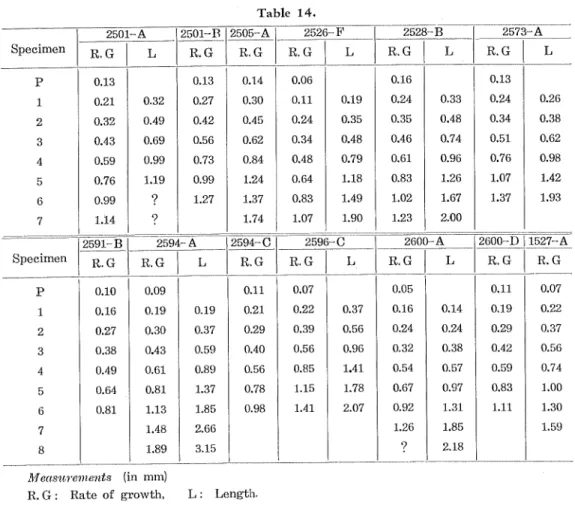
(21) Fusulinida from the upper Permian Conglomerates of the northern part of Itsukaichi, Tokyo-to, Japan. volutions. Remarks: - Yabe and I-Ianzawa in 1932, established the genus Psei.tdodol.ioli.na based upon Pseudodoliolina ozaivai. YABE and HANZAWA, a species which had been described by Deprat, Ozawa and Colani from Akasaka, Yun-nan and Indochina, for the reason of that the spirotheca of Doliolina lepida from Akasaka etc. lacks a keriotheca. The present form agrees with the type specimen from Akasaka in its general characters, however, the spirotheca of the present form in the outer volutions seems to differ from that of the holotype which is composed of a single layer. The spirotheca of the present form is composed of a tectum and less dense layer not showing alveolar structure. Thompson (1948) pointed out that a lower less dense layer is descernible in the spirotheca of the genotype of Pseii.dodoliolina in the outer volutions. The less dense layer of the present form may correspond to Thompson's material. Occurrence and Geological age: - Same as the preceecling species. Reg. no. 2600-E, Genus Neoscluvagerina YABE, 1903 Neoschtvagerina cratict.ilifera. (SCHWAGEE) Pl. 4, Figs. 5, 6. 1883 Schzvagerina craiieulifira SCHWAGER, Richthofon's China, vol. 4, p. 140, pl. 8, figs. 15-25. 1906 Neosch.wager'ina craticillifera YABE, Jour. Coll. Sci., Imp. Univ. Tokyo, vol. 21, art. 5, p. 3, pl. 1, fig. 3. 1912 Nwsch.wci.gerina craticillifera DEPRAT, Mem. Serv. Geol. Indochine, vol. 1, pt, 3, pp. 47--49, pl. 2, figs. 1, 2, 4. 1914 Neoschivagerina craticulifera DEPRAT, Mem. Serv. Geol. Indochine, vol. 3, fasc. 1, pp. 24-26, pl. 7, figs. 4-8. 1925 Neoschwa.gerina craticuUfcra, OZAWA, Jour. Coll. Sci., Imp. Univ. Tokyo, vol. 45, art. 6, pp. 54, 55, pl. 2, fig. 8c, pl. 9, fig. 4. 1927 Neosclvwagerinu oratiwlifura OZAWA, Jour. Fac. Sci., Imp. Univ. Tokyo, vol. 2, pt. 3, pp. 154156, pl. 40, figs. 1-7, 10, 11 a. 1936 Neoschwagerina cratic'l.liferci FUJIMOTO, Sci. Rep., Tokyo Bunrika Daigaku, sec. C, vol. 1, no. 2, pp. 112, 113, pl. 22, figs. 6-9, pl. 23, figs. 6, 7. 1944 Neosclnvagerina craticulifera TORIYAMA, Jap. Jour. Geol. Geogf., vol. 19, nos. 1-4, pp. 81, 82, pl. 6, fig. 26. 1956 Neosclt.'ivager'ina crati'jtl'Ufera CHEN, Pal. Sinica, new ser. B, no. 6, pp.56, 57, pl. 12, figs. 10-12. 1957 Neuscliwagerina craticnlifera KOBAYASIU, Sci. Rep., Tokyo Kyoiku Daigaku, sec. C, vol. 5, no. 48, pp. 303-305, pl. 9, figs. 8-13. 1958 Neoschiuagerina cratioulifera TORIYAMA, Mem. Fac. Sci., Kyushu Univ,, ser, D, vol. 7, pp. 215220, pl. 40 ; pl. 41, figs. 1-5.. Shell fusiform with straight axis of coiling. Lateral slopes nearly straight in outer volutions. Length and width in seventh volutions 1.9mm to 2.7mm and l.lmm to 1.7mm, respectively. Form ratio 1:1.4 to 1:1.8. Proloculus spherical and small; its average outside diameter about 0.10 mm for 13 specimens. Three kinds of septa—septa, transverse septula and axial septula developed. Septa and transverse septula thicker and larger than axial septula. Axial septula not observed in inner volutions, but one or two axial septula intercalated between each pair of septa in outer. volutions. (Table 14) Occurrence and Geological age: - The present form occurs in the matrix of the Tama— 91 —.
(22) Sumio Sakagami. Table 14.. 2501-B 2505-A. 2501-A Specimen. R.G. L. R.G. R.G. 2526-F R.G. 2528-B. L. R.G. 2573-A. L. R.G. L. p. 0.13. 0.13. 0.14. 0.06. 1. 0.21. 0.32. 0.27. 0.30. 0.11. 0.19. 0.24. 0.33. 0.24. 0.26. 2. 0.32. 0.49. 0.42. 0.45. 0.24. 0.35. 0.35. 0.48. 0.34. 0.38. 3. 0.43. 0.69. 0.56. 0.62. 0.34. 0.48. 0.46. 0.74. 0.51. 0.62. 4. 0.59. 0.99. 0.73. 0.84. 0.48. 0.79. 0.61. 0.96. 0.76. 0.98. 5. 0.76. 1.19. 0.99. 1.24. 0.64. 1.18. 0.83. 1.26. 1.07. 1.42. 6. 0.99. 9. 1.27. 1.37. 0.83. 1.49. 1.02. 1.67. 1.37. 1.93. 7. 1.14. 9. 1.74. 1.07. 1.90. 1.23. 2.00. 2591-B Specimen. 2594-A. R.G. R.G. p. 0.10. 0.09. 1. 0.16. 0.19. 2. 0.27. 3. 0.38. 4 5 6. 2594-0. L. 0.16. 2596-C. 0.13. 2600-A. L. R.G. 2600-D. 1527-A. L. R.G. R.G. R.G. R.G. 0.11. 0.07. 0.11. 0.07. 0.19. 0.21. 0.22. 0.37. 0.16. 0.14. 0.19. 0.22. 0.30. 0.37. 0.29. 0.39. 0.56. 0.24. 0.24. 0.29. 0.37. 0.43. 0.59. 0.40. 0.56. 0.96. 0.32. 0.38. 0.42. 0.56. 0.49. 0.61. 0.89. 0.56. 0.85. 1.41. 0.54. 0.57. 0.59. 0.74. 0.64. 0.81. 1.37. 0.78. 1.15. 1.78. 0.67. 0.97. 0.83. LOO. 0.81. 1.13. 1.85. 0.98. 1.41. 2.07. 0.92. 1.31. 1.11. 1.30. 7. 1.48. 2.66. 1.26. 1.85. 8. 1.89. 3.15. 9. 2.18. 0.05. 1.59. Measurements (in mm) R. G : Rate of growth,. L: Length.. nouchi conglomerate in the Yagooki and Minokuchi Valleys. The age may correspond to that of Neoschwagerina zone. Reg. nos. 2501-A, 2501-B, 2526-F, 2528-B, 2573-A, 2591-B,. 2594-A, 2594-C, 2596-C, 2600-A, 2600-U (Yagooki Valley); 1572-A (Minokuchi Valley). Neoschwagerina dmwillei OZAWA Pl. 4, Figs, 7-10. 1925 Neosohwagerma douvillei OZAWA, Jour. Coll. Sci., Imp. Univ. Tokyo, vol. 45, art. 6, pp. 55-57, pl. 11, figs. 5-7. 1925 Neosch.wagerinct douvillei OZAWA, Jour. Coll. Sci., Imp. Univ. Tokyo, vol. 45, art. 4, pl. 3, fig. 6. 1936 Neoschwagerina dozwillei FUJIMOTO, Sci. Rep., Tokyo Bunrika Daigaku, sec. C, vol. 1, no. 2, pp. 114, 115, pl. 23, figs. 1-5. 1956 Neosoh'wagerwa dotwillei CHEN, Pal. Sinica, new ser. B, no. 6, pp. 58, 59, pl. 13, figs. 3-7, pl. 14, fig. 7. 1958 Neuschwagerwa doiwillei TORIYAM/, Mem. Fac. Sci., Kyushu Univ., sor. D, vol. 7, pp. 223-227, pl. 41, figs. 9-13, pl. 42, figs. 1-6.. Shell fusiform with straight axis of coiling. Lateral slopes nearly straight. Length and width in eleventh volutions about 4.0mm and 2.4mm, respectively, form ratio 1:1.7. Proloculus spherical and its average outside diameter about 0.14 mm for five specimens. Three kinds of septa—septa, transverse septula and axial septula developed. One or two axial. — 92 —.
(23) Fusulinids from the upper Permian Conglomerates of the northern part of Itsukaichi, Tokyo-to, Japan. Table 15. 2591-A. 2525-G Specimen. p. L. R.G. R.G. 2593-A. L. 0.11. 0.17. L. R.G 0.11. 2593-B. 2596-B. R.G. R.G. 0.13. 0.15. 1. 0.24. 0.22. 0.22. 0.22. 0.22. 0.22. 0.24. 2. 0.34. 0.41. 0.33. 0.37. 0.28. 0.33. 0.33. 0.33. 3. 0.45. 0.67. 0.46. 0.74. 0.37. 0.52. 0.46. 0.44. 4. 0.59. 1.00. 0.65. 0.85. 0.52. 0.78. 0.63. 0.57. 0.20. 5. 0.76. 1.22. 0.85. 1.18. 0.70. 1.00. 0.81. 0.72. 6. 0.93. 1.55. 1.04. 1.52. 0.85. 1.33. 1.07. 0.93. 7. 1.16. 1.96. 1.30. 1.96. 1.07. 1.67. 1.33. 1.15. 8. 1.42. 2.48. 1.55. 2.41. 1.30. 2.15. 1.63. 1.41. 9. 1.78. 2.96. 1.55. 9. 1.96. 10. 2.07. 3.33. 11. 2.63. 3.85. Mecimremenis (in mm). septula intercalated between each pair of septa. Secondary transverse septula lacking in the inner volutions, rarely occurring in outer ones. (Table 15) Remarks: - The present form well agrees with Ozawa's species from the Akiyoshi limestone in the all essential characters. Ozawa pointed out that Neoschivagerina globosa DOUVILLE and DEFEAT differs, from Neoschwagerina globosa YABE in the appearance of septa. To avoid confusion, the species described as Neoschiuageriiia glolosa by Douville and Deprat should receive the name of Neoschwagerhia douvillei. Occurrence and Geological age: - The present form occurs in the matrix of the Tamanouchi conglomerate in the Yagooki Valley. The age may correspond to that of Neoschiuagerina zone. Reg. nos. 2525-C, 2591-A, 2593-A, 2593-B, 2596-B. Neoschwagerina margarUae DEFEAT Pl. 4, Figs. 11-13. 1913 Neosohwagerina margm'Uae DEPRAT, Mem. Serv. Geol. Indochine, vol. 2, pp. 58-60, pl. 8, fig. 10, pl. 9, figs. 1-3. 1924 Neoschwager'ina mcwgaritae COLANI, Mem. Serv. Geol. Indochine, vol. 11, fasc. 1, pp. 122, 123, pl. 24, flgs. 1-7, 9. 1925 Neoschwagerina margwitcie OZAWA, Jour. Coll. Sci., Imp. Univ. Tokyo, vol. 45, art. 6, pp. 5860, pl. 11, figs. 1-3. 1927 Neoschwagerina margaritae OZAWA, Jour. Fac. Sci., Imp. Univ. Tokyo, vol. 2, pt. 3, pp. 158, 159, pl. 17, figs. 5, 7. 1936 Neoschwagerina mwgwitae FUJIMOTO, Sci. Rep., Tokyo Bunrika Daigaku, sec. C, vol. 1, no. 2, pp. 117, 118, pl. 22, figs. 16, 17, pl. 24, figs. 1-4. 1956 Neosclmagerina mwgaritae CHEN, Pal. Sinica, new ser. B, no. 6, pp. 62, 63, pl. 10, figs. 1-3. 1957 Neoschwagerwa margm'itas KOBAYASHI, Sci. Rep., Tokyo Kyoiku Daigaku, sec. C, vol. 5, no. 48, pp. 306-308, pl. 10, figs. 3-6.. Shell large and globular. Length and width in 15 volutions 6.1 mm and 5.2 mm, respectively, form ratio 1:1.2, in an axial section. 93 —.
(24) Sumio. iakagami. Table 16. Specimen. 2542-B. 2618-A. 2522-B. R.G. R.G. L. R.G. 1. 0.14. 0.15. 0.15. 0.22. 0.22. 2. 0.30. 0.37. 0.30. 0.41. 0.41. 3. 0.43. 0.52. 0.44. 0.59. 0.74. 4. 0.61. 0.70. 0.74. 0.85. 1.11. 1.11. 1.37. p. I,. 0.03. 5. 0.81. 0.96. 1.11. 6. 1.07. 1.26. 1.55. 1.44. 1.74. 7. 1.41. 1.63. 1.93. 1.85. 2.15. 8. 1.78. 1.96. 2.44. 2.29. 2.55. 9. 2.15. 2.33. 2.96. 2.70. 3.07. 10. 2.52. 2.70. 3.48. 3.15. 3.55. 11. 2.89. 3.07. 3.77. 3.66. 4.n. 12. 3.22. 3,59. 4.44. 4.26. 4.63. 13. 4.11. 4.96. 4.74. 5.14. 14. 4.70. 5.55. 5.27. 5.70. 15. 5.22. 6.06. 5.96. 6.22. 16. 5.40. 9. Measurements (in mm). Proloculus very small, its outside diameter is 0.032 mm. Three kinds of septa—septa, transverse septula and axial septula developed. Secondary transverse septula lacking in first. to last volutions. (Table 16) Remarks: - The present form agrees in its important characters with Neoschiuagerina margaritae form Tonldn, Nagato, Akasaka and the Kwanto massif which have been reported by Deprat, Ozawa, Ozawa and Fujimoto, respectively. Occurrence and Geological age: - The present form occurs in association with Yangchiema sp., Schivagerina furoni var. iamanoiichiensis SAKAGAMI, Pm'afusiilina cf. japonica I'GUMBEL) and Schtvagerina sp. A in a small limestone block embedded in the Tamanouchi conglomerate in the Yagooki Valley. The age may correspond to that of Neoschwagerina zone. Reg. nos. 2542-B, 2552-B, 2618-A.. Genus Yabeina DEPRAT, 1914 Yabeina cf. cascadensis (ANDERSON) Pl. 4, Figs. 14-16. 1941 Neosohwagerina cawadensis ANDERSON, Wash. State Coll. Res. Studies, vol. 9, pp. 190-194, pl. 1, figs. 1, 2, pl. 2, fig. 1. 1950 Yabeina cascadensis THOMPSON and WHEELER, Contr. Cushman Found. Foraminiferal Research, vol. 1, pts. 3 and 4, p. 61, pl. 7, figs. 1-5. 1957 Yabeina cf. cascadensiss KOBAYASHI, Sci. Rep, Tokyo Kyoiku Daigaku, sec. C, vol. 5, no. 48, p. 308, pl. 10, fig. 8.. Shell globular. Lateral slopes convex throughout. Length and width in tenth volution. — 94 —.
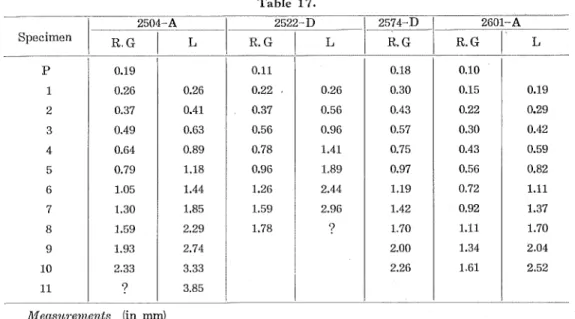
(25) Fusulinids from the upper Permian Conglomerates of the northern part of Itsukaichi, Tokyo-to, Japan. about 3.3mm and 2.3mm, respectively, form ratio 1:1.4, in axial section.. Proloculus spherical and rather large ; its outside diameter 0,19 mm. Four kinds of septa—septa, transverse septula, axial septula and secondary transverse septula first become distinct in seventh volution and two or three of them intercalated between each pair of transverse septula. (Table 17) Table 17. 2522-D. 2504-A Specimen. R.G. p. 0.19. L. 2601-A. 2574-D. L. R.G 0.11. R.G. R.G. 0.18. 0.10. L. 1. 0.26. 0.26. 0.22 .. 0.26. 0.30. 0.15. 0.19. 2. 0.37. 0.41. 0.37. 0.56. 0.43. 0.22. 0.29. 3. 0.49. 0.63. 0.56. 0.96. 0.57. 0.30. 0.42. 4. 0.64. 0.89. 0.78. 1.41. 0.75. 0.43. 0.59. 5. 0.79. 1.18. 0.96. 1.89. 0.97. 0.56. 0.82. 6. 1.05. 1.44. 1.26. 2.44. 1.19. 0.72. 1.11. 1.42. 0.92. 1.37. 1.70. 1.11. 1.70. 7. 1.30. 1.85. 1.59. 2.96. 8. 1.59. 2.29. 1.78. 9. 9. 1.93. 2.74. 2.00. 1.34. 2.04. 10. 2.33. 3.33. 2.26. 1.61. 2.52. 11. 9. 3.85. Measurements (in mm). Remarks: - The present form agrees with Yabeina cascadensis (ANDERSON) which Thompson, Wheeler and Danner reported from British Columbia, in the thickness of spirotheca and the later appearance of secondary transverse septula. However, the present form seems to differ from their specimen by the larger proloculus and smaller form ratio. Occurrence and Geological age: - The present form occurs in the matrix of the Tamanouchi conglomerate. The age may correspond to that of Yabeina zone. Reg. nos. 2504-A, 2506-B, 2522-D, 2523-A, 2574-D, 2601-A. References 1) CHEN, S., 1934 : Fusulinidae of South China, Part I: Pal. Sinica, Ser. B, Vol. IV, Fasc. 2, pp. l185, pis. 1-16. 2) — , 1956 : Fuaulinidae of South China, Part II: Pal, S'inioa, Ne'w Ser. B, No. 6, pp. 17-71, pis. 1-14. 3) COLANI, M., 1924 : Nouvelle contribution a 1'etude des Fusulinides da 1'Extreme-Orient: Indochine Serv. Geol. M6m., Vol. XI, Fasc. 1, pp. 1-191, pis. 1-29, graphs 1-28.. 4) DEPRAT, J., 1912 : Etude des Fusulinides de Chine et d'lndochine et classification des calcaires a fusulines : Indoohine Serv. Gkol. M 6m., Vol. I, F'asc. 3, pp. 1-76, pis. 1-9.. 5) •, 1913 : Etude des Fuaulinides de Chine et d Indochine et classification des calcaires a fusulines (IP Memoire), Les Fusulinidea des calcaires carboniferiena et permiens du Tonkin, Du Laos et du Nord-Annam : Indochine Serv. Gkol. M.km., Vol. II, Faso, 1, pp. 1-74, pis. 1-10.. 6) — , 1914 : Etude des Fusulinides du Japan, de Chins et d'lndochine et classification des calcaires a fnsulines (III' Memoire), Etude comparative des Fusulinides d'Akasaka (Japan) et des Fusulinides de Cqine et d'lndochine : Indochine Seru. Geol. Hfem., Vol. Ill, Fasc. 1, pp. 1-45, pis. 1-8.. — 95 —.
(26) Sumio Sakagami 7) — , 1915 : Etude des Fusulinides de Chine et d'lndochine et classification des calcaires a fusulines (IV" Memoire), Les Fusulinides des calcaires carboniferiena et permiena du Tonkin, du Laos et du Nord-Annam : Indoohine Se.rv. G&ol. Men?,., Vol. IV, Fasc. 1, pp. 1-30, pis. 1-3. 8) DUNBAR, C.0. and SKINNER, J. W., 1937 ; The Geology of Texas, Vol. Ill, Part 2, Permian Fusulinidae of Texas : Texas Univ., Bull. 3701, pp. 517-825, pis. 42-81.. 9) FUJIMOTO, H., 1936 : Stratigraphical and Palaeontological Studies of the Titibu System of the Kwanto-mountainland, Part 2, Palaeontology : Tokyo Bzmrika Daigaku, Soi. Rep., Sec. C, No. 2, Vol. I, pp. 29-125, pis. 1-26. ^0) • , 1937: Some Fusulinids from Kawanobori-mura, Kyushu, Japan : Jap. Jour. Geol. Geogr., Vol. XIV-XV, Nos. 8, h, pp. 117-126, pis. 7, 8.. 11) - , 1938: Some foraminiferous fossils from the Koten Series of Zido coal-field, Tyosen: Geol. Soc. Japan, Jozir., Vol. 45, pp. 271-276, pl. 8.. 12) IGO, H., 1957 : Fusulinids of Fukuji, Southeastern part of the Hida masgif, central Japan: Sci. Rep., Tokyo Kyoiku Daigakzi, Sec. C, Vol. 5, No. W, pp. 153-246, pis. 1-15.. 13) KANMERA, K., 1953 : The Kuma formation with special reference to the upper Pevmian in Japan (in Japanese with English abstract): Jour. Geol. Soo. Japan, Vol. 59, No. 697, pp. 449-4G8.. 14) - , 1958 : Fusulinids from the Yayamadake limestone of the Hikawa Valley, Kumamoto Prefecture, Kyushu, Japan. Part III—Fusulinida of the lower Permian : Mem. Few. Soi., Kyuahu Univ., Ser. D, Geology, Vol. 8, No. 3, pp. 153-215, pis. 24-35.. 15) KANUMA, M, 1953: On some Moscovian Fusulinids from southern part of Hida Plateau, Gifu Prefecture, Japan : Bzdl. Tokyo Ga.1w.gei Unw., Vol. Ji, pp. 23-33, pl. 3. 16) — , and SAKAGAMI, S., 1957: Mesoschubertella, a new Permian fusulinid genus from Japan: Trans. Proe. Palaeont. Soc. Japan, N. S., No. 26, pp. 41-46, pl. 8. 17) KOBAYASHI, M., 1957 : Paleontological study of the Ibukiyama limestone, Siga Prefecture, central Japan : Soi. Rep., Tokyo Kyoiku Daigahii,, See. C, Vol. 5, No. h8, pp. 247-311, pis. 1-10. 18) LEE, J. S., 1927 : Fusulinidae of North China : Pal. Sinica, Ser. B, Vol. h, Fasc. 1, pp. 1-172, pis. 1-24.. 19) — , and CHEN, S., 1930: Huanglung limestone and its fauna, Protozoa, Foraminifera : Nat. Res. Inst. Geol.,, Mem. No. 9. pp. 90-136 pis. 2-13.. 20) MORIKAWA, R., 1955 : Schwaerininae in the vicinity of the Shomaru Pass, eastern parb of Kanto mountainland, central Japan; Soi, Rep., Saitama, Univ., Ser. B, Vol. S, No. 1, pp. 45-114, pis. 5-15. 21) — , 1958 : Fusulinids from the Akasaka limestone (Part 1): Soi. Rep., Saitwna Univ., Ser. B, Vol. S, No. 1, pp. 93-130, pis. 12-26. 22) OZAWA, Y., 1925; On the Classification of Fusulinidae : Jour. Coll. Sci., Imp. Uniu. Tokyo, Vol. XLV, Art. h, pp. 1-26, pis. 1-4. 23) -— , 1925 : Palaeontoloigcal and Stratigraphical studies on the Permo-Carboniferous limestone of Nagato. Part II, Palaeontology : Jour. Coll, Soi., Imp. Uniu. Tokyo, Vol. XLV, Art, S, pp. 1-90, pis. 1-14.. 24) —— , 1927 : Stratigraphical studies of the Fusulina limestone of Akasaka, Province of Mino : Jour. Fac. Soi., Imp. Univ. Tokyo, See. Z, Vol. II, Part 3, pp. 121-164, pla. 34-45.. 25) SAKAGAMI, S., 1956 : Fusulinids from the limestone conglomerate in the Yagooki Valley, Tamanouchi, Hinode-muva, Nishitama-gun, Tokyo-to, Japan : Trans. Proc. Palaeont. Soc, Japan, N.S., No. U. PP. 259-265, pl. 37. 26) • , 1958: Conglomerates in tho upper Permian system of the northern part of Itsukaichi, Tokyo-to, Japan (in Japanese with English abstract): Jnb. Publ. Commem. Prof. H. FnjiMOI'O siwtieth birthday, pp. 91-95. 27) —, and OMATA, T., 1957 : Lower Permian fusulinids from Shiraiwa, northwestern part of Ome, Nishitama-gun, Tokyo-to, Japan : Jap. Jour. Geol. Geogr., Vol. XXVITI, No. /i, pp. 247-264, pis. 19, 20.. — 96 —.
(27) Fusulinids from the upper Permian Conglomerates of the northern part of Itsukaichi, Tokyo-to, Japan 28) SCHELLWIEN, E. and DYHRENFURTH, G., 1909: Monographie der Fuaulinen. Teil II, Die Asiatischen Fusulinen. A. Die Fusulinen von Dawas: Palaeontogr., Band 56, pp. 137-176, pis. 13-16. 29) THOMPSON, M. L , 1948 : Studies of American fusulinids : Univ. Kansas Paleont. Contr; Protowa, Art. 1, pp. 1-184, pis. 1-38. 30) — , WHEELEK, H. E. and DANNEE, W. R., 1950 : Middle and upper Permian fusulinids of Washington and British Columbia : Found. Foraminiferal Research, Vol. I, Pts. 3-h, pp. 46-63, pis. 3-8.. 31) TORIYAMA, R,, 1944 : The fusulinids in the limestone cong'lomerates of the Sakuradani area in the Province of Awa. Studies on the Yasuba conglomerates and its allies in the Titibu group in the Island of Sikoku—II : Jap. Jww. Geol. Geogr; Vol. XIX, Nos. 1-h, pp. 67-82, pl. 6. 32) — , 1945 : The fusulinida in the limestone conglomerates of Inomine in the Province of. Tosa. Studies on the Yasuba conglomerates and its allies in the Titibu group in the Island of Sikoku-m : Jap. Jour. Geol. Geogr., Vol. XX. No. 1, pp. 1-11, pl. 1.. 33) — , 1958 : Geology of Akiyoshi. Part III, Fusulinids of Akiyoshi: Mem. Fac. Sci., Kyuslw Univ., Ser. D, Geology, Vol. VII, pp. i-iii; 1-264, pis. 1-48. 34) YABE, H., 1906 : A contribution to the genus Fusulina, with notes on a Fusulina-limestone from Korea : Jour. Coll. Sci., Imp. Univ. Tokyo, Vol. XXI, Art, 5, pp. 1-36, pis. 1-3. 35) — , and HANZAWA, S., 1932: Tentative classification of the foraminifera of the Fusulinidae : Proc. Imp, Acad., Vol. 8, pp. 40-43.. 97.
(28) Explanation of Plate 1 Pig. 1. Onawainella of. angulata, (OZAWA). Axial section (slightly tangential), X 50, Reg. no. 1318-A. Figs. 2-5. Ozazuainella spp. Fig. 2, Form 1, axial section, X 30, Reg. no. 1262-C. Fig. 3, Form 2, tangential section, X 30, Reg. no. 1287-A. Fig. 4, Form 3, axial section, X 30, Reg. no. 1314-A. Fig. 5, Form 4, axial section, X 30, Reg. no. 1304-A.. Figs. 6, 7. Staffella moelleri OZAWA Axial sections, X 30, Reg. noa. 2521-B, 2522-H. Fig. 8. Staffera sp. Axial section, X 30, Reg. no. 1255-B. Fig. 9. Nankinella sp. Axial section, X 30, Reg. no. 2521-D, Figs. 10, 11. Sshubertella cf. irumensis (FUJIMOTO) Fig. 10, typical axial section, X 50, Reg. no. 1576-B. Fig. 11, centered slightly oblique section, X 50, Reg. no. 1305-A. Figs. 12-16. Mesosch'ubertella thompsoni SAKAGAMI Figs. 12a, 12b, axial section, X 30 and X 100, Reg. no. 1257-B. Figs. 13-15, axial sections, x 30, Reg. no. 1309-A, 1355-A, 1289-A. Fig. 16, cross section, X 30, Reg. no. 1305-A. Fig. 17. Yangchienia sp. Axial section, x 30, Reg. no. 2617-A.. Fig. 18. Fitstdinella bootci MOLLER Axial section, X 15, Reg. no. 1579-A. Figs. 19-21. Fn.sulinella pseudobooki (LEE and CHEN) Fig. 19, tangential section, X 15, Reg. no. 1576-A. Figs. 20, 21, axial sections, X 15, Reg. nos. 1268-A ; 1271-A. Fig. 22. Fustilina sp. Excentric section, X 15, Reg. no. 1275-A.. — 98 —.
(29) S. SAKAGAMI : Fusulinids in conglomerates. Plate 1. ' (''•''•iWj. ^•mi^. 21 SAKAGAMI photo. - 99 —.
(30) Explanation of Plate 2 Figs. 1-4. Triticites kazoanoboriensis FUJIMOTO Figs. 1, 3, 4, axial sections, X 15, Reg. nos. 1259-A, 1578-A, 2574-B. Fig. 2, centered oblique section, X 15, Reg. no. 1577-A. Figs. 5-7. Triticites 1. sp. Axial sections, x 15, Reg. nos. 1581-A, 1586-A, 1574-A. Fig. 8. Pseudosclmagerina sp. Excenteic section, x 10, Reg. no. 2503-B. Fig. 9. Parasch'wagerina sp. Excentric section, x 10, Reg. no. 1582-A. Figs. 10, 11, 17. Soh'wagerina vulgwis (SCHELLWIEN) Figs. 10, 17, axial sections, )<10, Reg. nos. 2525-A, 1261-A. Fig. 11, excentric section, X 10, 1587-A.. Fig. 12. Schwagerina mdgaris var. globosa (SCHELLWIEN) Axial section, x 10, Reg. no. 2522-A. Figs. 13, 14. Sohwagerina santyziensis globosci SAKAGAMI, n. subsp. Fig. 13, axial section of holotype, >< 10, Reg. no. 1262-A. Fig. 14, cross section of paratype, x 10, Reg. no. 1262-B. Figs. 15, 16, Scliwagerina spp. Fig. 15, Form 1, axial section, X10, Reg. no. 1263-A. Fig. 16, cross section, x 10, Reg. no. 1264-B.. —100—.
(31) S. SAKAGAMI : Fusulinids in conglomerates. Plate 2 I' .'*^. r-s-.A. »Ad&i. 17 SAKAGAMI photo —101—.
(32) Explanation of Plate 3 Fig. 1. Sohwagerina kraffli (SCHELLWIEN) Axial section, ><10, Reg. no. 1307-A. Fig. 2. Schwcigerina sp. A Axial section, x 10, Res'. no. 2542-A.. Fig. 3. Parafusnlina cf. juponica (GUMBEL) Axial section, x 10, Reg. no. 2541-A. Figs. 4-9. Sclnvagerinci spp. Fig. 4, Form 2, tangential section, x 10, Reg. no. 2524-C. Fig. 5, Form 3, axial section, x 10, Reg. no. 2571-A. Fig. 6, Form 4, axial section, x 20, Reg. no. 2601-B. Fig. 7, Form 5, axial section, x 10, Rsg. no. 1283-A. Fig. 8, tangential section, X 10, Reg. no. 1585-A. Fig. 9, Form 6, tangential section, >< 10, Reg. no. 1356-A.. —102—.
(33) S. SAKAGAMI : Fusulinids in conglomerates. SAKAGAMI photo —103—. Plate 3.
(34) Explanation of Plate 4 Fig. 1. Misellina claudiae (DEPRAT) Figs. la, Ib, cross section and tangential section, ><20, Reg. nos. 2524-A, 2524-B. Fig. 2, excentric section, x 20, Reg. no. 2527-A. Fig. 3. Verbeekina sp. X 10, Reg. no. 2601-C. Fig. 4. Pseztdodolwlinci ozaiuai YABE and HANZAWA Tangential section, x 20, Reg. no. 2600-E. Figs. 5, 6. NeosGhwagerina orationlifera (SCHWAGER) Fig. 5, axial section, x 15, Reg. no. 2594-A. Fig. 6, cross section, X 10, Reg. no. 1572-A. Figs. 7-10. Neosohwagerina d.oumllei OZAWA Figs. 7, 9, axial section, X 10, Reg. nos. 2593-A, 2525-C. Fig. 8, slightly tangential axial section, x 10, Reg. no. 2502-A. Fig. 10, cross section, X 10, 2501-C. Figs, 11-13. Neosohwagerina margaritae DETRAT Fig. 11, axial section, ?<10, Reg. no. 2618-A. Fig. 12, cross section, ><10, Reg. no. 2542-B. Fig. 13, oblique section, ><10, Reg. no. 2523-A. Figs. 14-16. Ycibeina cascadenszs (ANDERSON) Fig. 14, tangential section, x 10, Reg. no. 2523-B. Fig. 15, excentric section, x 10, Reg. no. 2506-B. Fig. 16, axial section, x 10, Reg, no. 2504-A.. —104—.
(35) S. SAKAGAMI : Fusulinids in conglomerates. <^^. ^. n^?!^< ^,'f' ••. 12. 15. SAKAGAMI photo. —105—. Plate 4.
(36)
図


+3
関連したドキュメント
We present sufficient conditions for the existence of solutions to Neu- mann and periodic boundary-value problems for some class of quasilinear ordinary differential equations.. We
In Section 13, we discuss flagged Schur polynomials, vexillary and dominant permutations, and give a simple formula for the polynomials D w , for 312-avoiding permutations.. In
Analogs of this theorem were proved by Roitberg for nonregular elliptic boundary- value problems and for general elliptic systems of differential equations, the mod- ified scale of
Then it follows immediately from a suitable version of “Hensel’s Lemma” [cf., e.g., the argument of [4], Lemma 2.1] that S may be obtained, as the notation suggests, as the m A
Definition An embeddable tiled surface is a tiled surface which is actually achieved as the graph of singular leaves of some embedded orientable surface with closed braid
Our method of proof can also be used to recover the rational homotopy of L K(2) S 0 as well as the chromatic splitting conjecture at primes p > 3 [16]; we only need to use the
The proof uses a set up of Seiberg Witten theory that replaces generic metrics by the construction of a localised Euler class of an infinite dimensional bundle with a Fredholm
Correspondingly, the limiting sequence of metric spaces has a surpris- ingly simple description as a collection of random real trees (given below) in which certain pairs of
