An Inverse Assignment
Problem
ある逆割り当て問題について
Seiichi
IWAMOTO
(岩本誠–)Department of
Economic Engineering
Faculty of
Economics,
Kyushu
University
27
Fukuoka
812-81,
Japan
Tbtsuichiro
$IKI$ (伊喜哲–郎)Department of
Mathematics
Faculty of Education, Miyazaki
University
Miyazaki
889-21,
Japan
Abstract
In this paper wefocus our attentionon the famous “PlaneAssignment Problem” in Beckmann’s Dynamic Programming
of
Economic Decisionsand develop a further theory of the assignment problem. Formulating the problem into an optimal (main)stopping problem, we propose a new inversion of the stoppingproblem. By exchange of objective function and constraint function together withreplacement ofoptimizer
$\min$ by ${\rm Max}$, we introduce an inverse assignment problem, which is also an optimal
stopping problem. We establish several inverse theorems between main and inverse stopping problems. We also analyze the finite-stage (nonstopping) problems and
specip the enveloping relation to the stoppingproblems. Detailed numerical solutions for both problems are specified.
1
Introduction
In this paper we devote ourselves exclusively to the study of the so called Plane Assign-ment Problem which has its origin inBeckmann and Laderman [1]. ThePlaneAassignment
Problem is
one
of the most typicalresourse
allocation $\mathrm{p}\mathrm{r}\dot{\mathrm{o}}$blems[4]. For its simple struc-ture and elegant economicinterpretation, thisproblemhasseveralapproaches, forinstance,
linear programming, integer programming, combinatorial programming, and dynamic pro-gramming (see [8]). Beckmam [2] illustrates heuristically the principle of optimality [3]
through the problem.
In this paper wedevelop a further inverse theory of the assignment problem. We formu-late the problem into an optimal stopping problem, whichwe call main stopping problem.
We propose an inversion of the stopping problem. By exchange of objective function and
constraint function together with replacement ofoptimizer $\min$ by ${\rm Max}([5],[6],[7])$, we
inverse relation betweenmain and inverse stopping problems is condensed intofour inverse theorems; Weak Inverse Theorem, Strong Inverse Theorem, Strict Inverse Theorem and Inverse Stopping Time Theorem. We specify detailed numerical optimalsolutions for both
problems.
In Section 2 weformulate Beckmann’s Plane Assignment Problem into an optimal
stop-pingproblem in adeterministicsense. We
sh.ow
themonotonicityof optimal value function and derive therecursive equation.In Section 3 we introduce its inverse problem, show the monotonicity of its optimum
value function, and derive the recursiveequationfor the inverse
pro.blem.
The three inverse theorems are established. .$\mathrm{s}$In Section 4 we discuss both main and inverse nonstopping (finite-stage) problems. We
give both problems their optimal solutions and show inverse relations. An enveloping
property between stopping and nonstopping problems is shown for both main and inverse problems, respectively. Further aninverse relation between both optimalstopping times is
established.
In Section 5 we illustrate detailed $\mathrm{n}\mathrm{u}.\mathrm{m}$erical solutions both for Beckmann’s Assignment
Problem and for its inverse problem.
2
Main Stopping
Problem
Webeginto consider the Beckmann’s Plane Assignment Problem [2] in the following quata-tion:
Example $[\mathrm{B}\mathrm{E}\mathrm{C}\mathrm{K}\mathrm{M}\mathrm{A}\mathrm{N}/\mathrm{L}\mathrm{A}\mathrm{D}\mathrm{E}\mathrm{R}\mathrm{M}\mathrm{A}\mathrm{N}[1](1956)]$ : Plane Assignment.
As anillustration of the principleof optimality consider theproblem of
find-ing the best combination oftwo indivisible resources to meet a given demand. Let the demand be a number of passengers andtheresourcestobetwo types
ofplanes
Let the cost of operating a DC 6 on a given flight be 1.4 times that of running a DC 3. For any number $n$ ofpassengers up to $n=200\mathrm{i}.\mathrm{t}$ is desiredto
find the cheapest combination ofplanes that will carry them.
From 1 to 38 passengerss are carried most cheaply by one DC 3; from 39 to
58 passengers by one DC 6.
To decide whichisthe cheapestcost oftrnasporting 59 passengerswe denote the minimum cost oftransporting$m$passengers by$v(m)$ and have therecursive
relation
$v(m)= \min[1.4+v(m-58), 1.0+v(m-38)]$ in particular
where “$\min$” means the smaller of the two values
in the brackets. Since $v(1)=v(21)=1.0$ one has $v(59)=2.0$. And so on.
Now let us formulate Beckmann’s Assignment Problem into a stopping problem and analyze it.
Throughout the paper, we use the cost
function
$f$ : $\{1, 2, \ldots, 38, \ldots, 58\}arrow\{1.0,1.4\}$defined by
$f(1)=f(2)=\cdots=f(38):=1.\mathrm{o}$, $f(39)=\cdot*\cdot=f(58):=1.4$ (1)
Thus the
a..ssignment
problem is formulated into the following minimization problem :minimize $f(x_{1})+f(x_{2})+\cdots+f(x_{t})$
MSP(200) subject to (i) $x_{1}+x_{2}+\cdots+x_{t}=200$ (2)
(ii) $1\leq x_{n}\leq 58$ $1\leq n\leq t$ (iii) $1\leq t\leq 200$
The condition (iii) means when to stop assigning. Thus the deterministic variable $t$ is
considered as a stopping time. This is the main reason why we call MSP(200) a main stopping problem. Of course, the problem is a problem of finding not only an optimal stoppingtime $t$but also anoptimal assignment itself $(x_{1}, \ldots , x_{t})$, whichtogether yields the
minimum cost.
Let $v(200)$ be the minimum value. In general, let$v(m)$ be theminimum valueof$\mathrm{M}\mathrm{S}\mathrm{P}(m)$ with theright-handside parameter $m$in place of 200, where $m$ ranges on the set of natural
numbers $N=\{1,2, \ldots, 200, \ldots\}$. Let $<1.0,$$\infty>$ be the set of discrete real numbers
1.0, 1.1,
...
with step-size $\mathrm{o}.\mathrm{i}$:$<1.0,$$\infty>=\{1.0,1.1, \ldots, 5.2, \ldots\}$.
Note that the set $<1.0,$ $\infty>$ contains all the possible values that the optimal value
function $v$ takes.
First we have the monotonicity ofoptimum value function $v(\cdot)$ as follows:
LEMMA 2. 1 The minimum value
function
$v$ : $Narrow<1.0,$$\infty>is$ nondecreasing, andit goes to $\infty$ as so does$m$.
Second we have the following recursive equation.
THEOREM 2. 1
$v(m)= \min[1.4+v(m-58), 1.0+v(m-38)]$ $m=59,60,$$\ldots$ . (3)
Let us define the optimalpocicy$\pi^{*}:$ $Narrow\{38,58\}$ by $\pi^{*}(m)=\{$ 58
38 if $\{$
$1.4+v(m-58)$
$1.0+v(m-38)$ attains the minimum in (3) (5)
where
$\pi^{*}(1)=\cdots=\pi^{*}(38)=38$, $\pi^{*}(39)=\cdots=\pi^{*}(58)=58$. (6)
In the last section, Table 1 shows an optimal solution- a pair of optimal value and
optimal policy-for MPS $\{v(\cdot), \pi^{*}(\cdot)\}$. Figure 1 illustrates that an successive application
ofoptimal policy $\pi^{*}(\cdot)$ ffom the given initial state $m=200$ generates an optimal decision
tree for the given Beckmann’s problem. In summary, the optimal decision tree states that the cheapest cost 5.2 oftransporting 200 passengers is attained by use ofacombination of
one DC 3 and three DC 6.
3
Inverse Stopping Problem
In this section, as an inverse problem, we consider the following maximization problem : Maximize $x_{1}+x_{2}+\cdots+x_{t}$
ISP(5.2) subject to $(\mathrm{i})’f(x_{1})+f(x_{2})+\cdots+f(x_{t})\leq 5.2$ (7)
(ii) $1\leq x_{n}\leq 58$ $1\leq n\leq t$ (iii) $t\geq 1$.
This is also a stopping problem. Thus we call this problem Inverse Stopping Problem. Let $u(5.2)$ be the maximum value. In general, let $u(c)$ be the minimum value of $\mathrm{I}\mathrm{S}\mathrm{P}(c)$
with the right-hand side parameter $c$ in place of 5.2, where $c$ ranges on the set ofdiscrete
real numbers $<1.0,$$\infty>=\{1.0,1.1.’ 1.2, \ldots\}$. Then we have the monotonicity ofoptimum
value function $u(\cdot)$ as follows:
LEMMA 3. 1 The maximum value
function
$u:<1.0,$ $\infty>arrow N$ is nondecreasing, and it goes to $\infty$ as so does $c$.We have also the following recursive equation.
THEOREM 3. 1
$u(c)={\rm Max}[58+u(c-1.4), 38+u(c-1.0)]$ $c=1.5,1.6,$$\ldots$. (8)
$u(\mathrm{o}.1)=u(0.2)=\cdots=u(0.9)=0$,
$u(1.0)=u(1.1)=\cdots=u(1.3)=38$, $u(1.4)=58$ (9)
We define the optimal pocicy$\hat{\sigma}:<1.0,$ $\infty>arrow\{38,58\}$ by
$\hat{\sigma}(c)=\{$ 58
38 if $\{$
$58+u(c-1.4)$
wehere
$\hat{\sigma}(1.0)=\cdots=\hat{\sigma}(1.3)=38$, $\hat{\sigma}(1.4)=58$. (11)
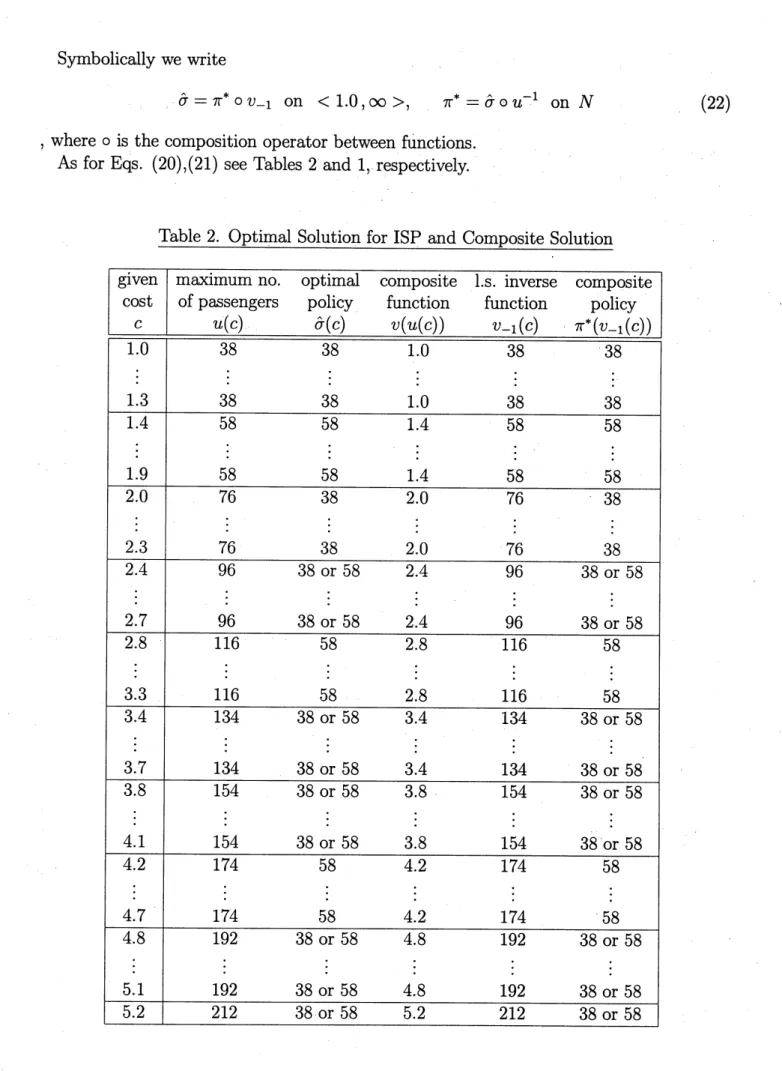
The optimal solution for IPS $\{u(\cdot),\hat{\sigma}(\cdot)\}$ is shown in Table 2 in Section 5. Figure 2
illustrates that an successive application ofoptimal policy $\hat{\sigma}(\cdot)$ from the given initial total
cost $c=5.2$ generates an optimal decision tree for the inverse problem. The optimal
decision tree states that the maximum total number ofpassengers 212 for the total cost
5.2 or less is also attained by useof the combination ofone DC 3 and three DC 6.
Furthermore, we have the following inverse relationshipbetween Main and Inverse
Stop-ping Problems:
THEOREM 3. 2 (Weak Inverse Theorem $I$)
(i) $v(u(c))\leq c$ $c\in<1.0,$$\infty>$ (12)
(ii) $u(v(m))\geq m$ $m\in N.$ (13)
It is verified in Tables 2 and 1 that Eqs. (12),(13) hold, respectively.
Let $w:Xarrow Y$ be a nondecreasing function, where $X,$$\mathrm{Y}$ are nonempty discrete subsets
in one-dimensional Euclidean space $R^{1}$. Then we define two kinds of its inverse function
as follows: One is the upper-semi inverse
function
$w^{-1}$ : $\mathrm{Y}arrow X$$w^{-1}(y):= \min\{x\in X|w(x)\geq y\}$. (14)
The other is the lower-semi inverse
function
$w_{-1}$ : $Yarrow X$$w_{-1}(y):={\rm Max}\{x\in X|w(x)\leq y\}$
.
(15)We say that a value $y\in \mathrm{Y}$ is attainable if there exists some $x\in X$ satisfying $w(x)=y$.
Then we have the following properties.
LEMMA 3. 2
$w_{-1}(y)\geq w^{-1}(y)$
for
attainable $y\in Y$ (16)$w_{-1}(y)<w^{-1}(y)$
for
nonattainable $y\in Y.$ (17) Furthermore,for
any nonattainable $y\in Y$, both $w_{-1}(y)$ and $w^{-1}(y)$ take two adjacent(neighbouring) values in$X$.
Moreover, we have a rather strict inverse relations as follows: THEOREM 3. 3 (Strong Inverse Theorem $I$)
$(\mathrm{i})’$ $v_{-1}(c)=u(c)$ $c\in<1.0,$$\infty>$ (18)
$(\mathrm{i}\mathrm{i})’$ $u^{-1}(m)=v(m)$ $m\in N.$ (19)
As for Eqs. (18),(19) seeTables 2 and 1, respectively. Further, one pairof optimal value function and optimal policy characterizes the other pair as follows:
THEOREM 3. 4 ($St\dot{\mathcal{H}}Ct$ Inverse Theorem$I$)
(iii) $\hat{\sigma}(c)=\pi^{*}(v_{-1}(.c))$ $c\in<1.0,$$\infty>$ (20)
(iv) $\pi^{*}(m)=\hat{\sigma}(u^{-1}(m))$ $m\in N$. (21)
Table 1. Optimal Solution for MSP and Composite Solution
Symbolically wewrite
$\hat{\sigma}=\pi^{*}\mathrm{o}v_{-1}$ on $<1.0,$$\infty>$, $\pi^{*}=\hat{\sigma}\circ u^{-}1$ on $N$ (22) , where $\circ$ is the composition operator between functions.
As for Eqs. (20),(21) see Tables 2 and 1, respectively.
Table 2. Optimal Solution for ISP and Composite Solution
4
Nonstopping
Problems
In this section we consider the nonstopping problems. Let $n$ be any given total number
ofplanes. Then two problems arise. One is a main problem. For any given total number
of passengers $m$, we consider the $\mathrm{p}\mathrm{r}\mathrm{o}\mathrm{b}\dot{\mathrm{l}}\mathrm{e}\mathrm{m}$ of finding the minimum total cost of carrying
$m$ passengers by $n$ planes. The other is its inverse problem. For any given total cost of
operating $c$, we consider the problem of finding the maximumtotal number ofpassengeres
that $n$ planes carry for not morethan the total cost $c$. Since all the results in the following are proved in asimilar way as in Sections 2 and 3, the proof is omitted in this section.
4.1
Main Problems
For any $n\in N$, let us define the following two discrete intervals;
$N_{n}$ $:=$ $\{n, n+1, \ldots, 58n\}$ (23)
$C_{n}$ $:=$ $\{1.0n, 1.0n+0.1, \ldots , 1.4n+0.5\}$. (24)
Then the interval $N_{n}$ contains all the possible totaI numbers of passengers $n$ planes can
carry. The interval $C_{n}$ does all the possible total costs forwhich or less $n$ planes can carry.
Given two positive integers $n,$$m$ satisfing $m\in N_{n}$, we consider the problem.of dividing
$m$ into $n$ possible natural numbers between 1 and 58 and minimizing the summed value
measured through the cost function $f$:
minimize $f(x_{1})+f(x_{2})+\cdots+f(x_{n})$
$\mathrm{N}\mathrm{M}\mathrm{P}(m;n)$ subject to (i) $x_{1}+x_{2}+\cdots+x_{n}=m$ (25)
(ii) $1\leq x_{i}\leq 58$ $1\leq i\leq n$.
Let $v_{n}(m)$ be the minimum value. Then we have the following double-monotone property
and recursive equation:
LEMMA 4. 1 (i) The minimum value
function
$v_{n}$ : $N_{n}arrow C_{n}$ is nondecreasing :$v_{n}(m)\leq v_{n}(m+1)$ $m,$ $m+1\in N_{n}$. (26)
(ii) The sequence
of
minimumfunctions
$\{v_{n}\}_{n\geq 1}$ is nondecreasing:$v_{n}(m)\leq v_{n+1}(m)$ $m\in N_{n}\cap N_{n+1}$
.
(27)THEOREM 4. 1
$v_{1}(m)=f(m)$ $m\in N_{1}$ (28)
$v_{n+1}(m)= \min_{x\cdot*}.[f(X)+v_{n}(m-X)]$ $m\in N_{n+1}$, $n\geq 1$ (29)
where $x:*means$ that the minimization is taken
for
all $x$ satisfying$1\leq x\leq 58$, $m-x\in N_{n}$. (30)
Inparticular, when
{m--38,
m–58}
$\subset N_{n}$, Eq. (29) reducesLet $\pi_{n+1}^{*}(m)\subset\{1,2, \ldots, 58\}$ be the set of all minimizers for (29), where
$\pi_{1}^{*}(1)=\cdots=\pi_{1}^{*}(38)=38$, $\pi_{1}^{*}(39)=\cdots=\pi_{1}^{*}(58)=58$. (32)
Then the $\mathrm{P}^{\mathrm{o}\mathrm{i}\mathrm{n}\mathrm{t}- \mathrm{t}}\mathrm{O}^{-\mathrm{S}\mathrm{e}\mathrm{t}}$ valued function $\pi_{n}^{*}$ : $N_{n}arrow\{1,2, \ldots, 58\}$ is called n-th optimal
deci-sion
function.
We call the sequence ofoptimal decision functions $\pi^{*}=\{\pi_{1}^{*}, \pi_{2}^{*}, \ldots , \pi_{n}^{*}, \ldots\}$ an optimal policy for Nonstopping Main Problem $\mathrm{N}\mathrm{M}\mathrm{P}(m;n)$.Furtherwehavethe following relation$\mathrm{b}\mathrm{e}\mathrm{t}\mathrm{w}\mathrm{e}\vee \mathrm{e}\mathrm{n}$ Stopping
Problem$\mathrm{a}\mathrm{n}\dot{\mathrm{d}}\mathrm{N}\mathrm{Q}\mathrm{n}\mathrm{S}\mathrm{t}_{0}\mathrm{p}\mathrm{p}\dot{\mathrm{i}}\mathrm{n}\mathrm{g}‘ \mathrm{P}\mathrm{r}\mathrm{o}\mathrm{b}-$ $\mathrm{l}\mathrm{e}\mathrm{m}$:
THEOREM 4. 2 (Main Envelope Theorem)
$v(m)= \min_{n|m\in Nn}v_{n}(m)$ $m\in N$. (33)
Let $t^{*}(m)$ be the first positive integer $n$ such that $v(m)=v_{n}(m)$. Then $t^{*}$ is the
o..ptimal
stopping time for MSP:$v(m)=v_{t^{*}}(m)$ $m\in N$. (34)
As for Eqs. (33),(34), see Table 3.
4.2
Inverse Problems
We consider the inverse problem of$\mathrm{N}\mathrm{M}\mathrm{P}(m;n)$ as follows:
Maximize $x_{1}+x_{2}+\cdots+x_{n}$
NIP$(c;n)$ subject $.\mathrm{t}\mathrm{o}$ $(\mathrm{i})’f(x_{1})+f(x_{2})+\cdots+f(x_{n})\leq c$ (35)
(ii) $1\leq x_{i}\leq 58$ $1\leq i\leq n$
where $c\in C_{n}$, $n\geq 1$. Let $u_{n}(c)$ be the maximum value. Then the maximum value
functions enjoy the following double-monotone property and recursive equation:
LEMMA 4. 2 (i) The maximum value
function
$u_{n}$ : $C_{n}arrow N_{n}i\mathit{8}$ nondecreasing:$u_{n}(c)\leq u_{n}(c+\mathrm{o}.1)$ $c,$ $c+\mathrm{o}.1\in C_{n}$. (36)
(ii) The sequence
of
maximumfunctions
$\{u_{n}\}_{n\geq 1}$ is nonincreasing:$u_{n}(c)\leq u_{n+1}(c)$ $c\in C_{n}\cap C_{n}+1$. (37)
THEOREM 4. 3
$u_{1}(1.0)=u_{1}(1.1)=\cdots=u_{1}(1.3)=38$, $u_{1}(1.4)=\cdots=u_{1}(1.9)=58$ (38)
$u_{n+1}(c)={\rm Max}.[xx\cdot**+un(c-f(X))]$ $c\in C_{n+1}$ (39)
where $x:**denoteS$ that the maximization is taken
for
all $x$ satisfying$1\leq x\leq 58$, $c-f(_{X})\in C_{n}$. (40)
In $parti_{C}ular$, when
{c-1.0,
c–1.4}
$\subset C_{n}$, Eq.(39) reducesLet $\hat{\sigma}_{n+1}(c)\subset\{1,2, \ldots, 58\}$be the set of all maximizers for (39), where
$\hat{\sigma}_{1}(1.\mathrm{o})=\cdots=\hat{\sigma}_{1}(1.3)=38$, $\hat{\sigma}_{1}(1.4)=\cdots=\hat{\sigma}_{1}(1.9)=58$. (42)
Then the $\mathrm{P}^{\mathrm{o}\mathrm{i}\mathrm{n}\mathrm{t}- \mathrm{t}}\mathrm{O}^{-\mathrm{S}\mathrm{e}\mathrm{t}}$ valued function $\hat{\sigma}_{n}$ : $C_{n}arrow\{1,2, \ldots , 58\}$ is an n-th optimal decision
function.
Thus the sequence of $\mathrm{o}\mathrm{p}$timal-
decision functions$\hat{\sigma}=\{\hat{\sigma}_{1},\hat{\sigma}_{2}, \ldots,.\hat{\sigma_{n}:.}.’\ldots\}\mathrm{i}‘..\mathrm{s}.\mathrm{a}\mathrm{n}$ optimalpolicy for Nonstopping Inverse Problem NIP$(c;n)$.
We have the following enveloping relation. $.\wedge$ . $\cdot$ .
.
$\cdot$ .l
THEOREM 4. 4 (Inverse Envelope Theorem)
$u(c)={\rm Max} u_{n}(Cn|c\in cn)$ $c\in<1.0,$$\infty>$ . (43)
Let$\hat{t}(c)$ be the firstpositive integer$n$such that$u(c)=u_{n}(c)$. Then$\hat{t}$
istheoptimalstopping time for ISP:
$u(c)=u(\hat{t}c)$ $c\in<1.\mathrm{o},$ $\infty>$ . (44)
As for Eqs. (43),(44), see Table 4. Furthermore, we have three corresponding inverse
theorems for Nonstopping Problems.
THEOREM 4. 5 (Weak Inverse Theorem II) For$n\geq 1$
(i) $v_{n}(u_{n}(c))\leq c$ $c\in C_{n}$ (45)
(ii) $u_{n}(v_{n}(m))\geq m$ $m\in N_{n}$. (46)
THEOREM 4. 6 (Strong Inverse Theorem II) For $n\geq 1$
$(\mathrm{i})’$ $(v_{n})_{-1}(c)=un(c)$ $c\in C_{n}$ (47)
$(\mathrm{i}\mathrm{i})’$
$(.u_{n}. )^{-1}(m)$
.
$=$
.
$v_{n}(m)-.\cdot$ $m\in.N_{n}....\cdot$ $\backslash (4\dot{8})\backslash \sim$
THEOREM 4. 7 (Strict Inverse Theorem II) For$n\geq 1$
$(\mathrm{i}\mathrm{i}\mathrm{i})’$ $\hat{\sigma}_{n}(c)=\pi^{*}n((v_{n})-1(c))$ $c\in C_{n}$ (49)
$(\mathrm{i}\mathrm{v})’$ $\pi_{n}^{*}(m)=\hat{\sigma}n((u_{n})-1(m))$ $m\in N_{n}$. (50) Symbolically we have
$\hat{\sigma}_{n}=\pi_{n}^{*}\circ(v_{n})_{-1}$ on $C_{n}$, $\pi_{n}^{*}=\hat{\sigma}_{n}\circ(u_{n})^{-1}$ on $N_{n}$. (51)
Further both optimal stopping times are characterized in the following inversesense:
THEOREM 4. 8 (Inverse Stopping Time Theorem)
$\hat{t}=t^{*}\circ v_{-1}$ on $<1.0,$$\infty>$, $t^{*}=\hat{t}\circ u-1$ on N. , $:$. . (52)
Finally we we $\mathrm{s}\mathrm{p}\mathrm{e}\mathrm{c}\mathrm{i}\mathfrak{g}_{r}$ Tables 4 and 5, which illustrate optimal value functions, optimal
policies and optimal stopping times for the main and inverse nonstopping problems, re-spectively. Further the forementioned relations are also shown in tables. The specification
Table.3. Envelope Property and Optimal $\mathrm{s}_{\mathrm{t}\mathrm{O}\mathrm{p}\mathrm{P}}\mathrm{i}\mathrm{n}\mathrm{g}$ Time for MPS
Table 4. Envelope Property and Optimal Stopping Time for IPS
References
[1] M.J. Beckmann and J. Laderman, A bound on the
use.of
inefficient indivisible units,Naval Research Logistics Quartely 3(1956), 245-252
[2] M.J. Beckmann, Dynamic Programming
of
Economic Decisions, Springer, NY, 1968.[3] R.E. Bellman, Dynamic Programming, Princeton Univ. Press, NJ, 1957.
[4] T. Ibaraki and N. Katoh, Resource Allocation Problems: Algorithmic Approaches, MIT
Press, MA, 1988.
[5] S. Iwamoto, Inverse theorem in dynamic programming I, J. Math. Anal. Appl.
58(1977), 113-134.
[6] S. Iwamoto, Inverse theorem in dynamic programming II, J. Math. Anal. Appl. 58(1977), 249-279.
[7] S. Iwamoto, Inverse theorem in dynamic programming III, J. Math. Anal. Appl. 58(1977), 439-448.
[8] S. Iwamoto, Theory