A method
of computations of
fundamental groups
of
3-dimensional manifolds
Maki Takai
(
高井
真希
)
1
Introduction.
By the theorem of Hilden-Montesinos (Hilden [7], Montesinos [9]), for every
3-dimensional compact oriented manifold$\mathrm{Y}$, there exists a topological branched
cov-ering
$h$
:
$\mathrm{Y}arrow S^{3}$of the 3-sphere $S^{3}$ of degree 3 branching at a knot $B_{h}$, whose monodromy around
the knot is given only by transpositions.
We regard the knot $B_{h}$ as abraid, for every knot (and link) is isotopic in $S^{3}$ to
a braid. We may identify $S^{3}$ with $\partial(\overline{\Delta(\mathrm{o},a^{;})}\cross\Delta(\mathrm{O}, b’))$, where
$\Delta(0, a’)$ is the disc
in the complex plane $\mathbb{C}$ with the center $0$ and the radius $a’$
.
We may assume that$B_{h}$ is contained in $\partial\overline{\Delta(0,a^{J})}\cross\Delta(0, b^{l})$ as in Figure 1.
$(0\leq s\leq 2\pi)$
Figure 1:
Let $B$ be
$\mathrm{t}.\mathrm{h}.\mathrm{e}$ cone over
$B_{h}$
conneCtin.g
every$.\mathrm{p}$oint of
$B_{h}$ with the origin of $\mathbb{C}^{2}$
.
Let
$f$ : $Xarrow\Delta(\mathrm{O}, a)\cross\Delta(0, b)$
be thetopological finite branched covering branching at $B\mathrm{w}\mathrm{i}\mathrm{t}\mathrm{h}’ \mathrm{t}\mathrm{h}\mathrm{e}$ samemonodromy
cone over Y.) Since $X$ is a topological cone
over
$\mathrm{Y}$,$\pi_{1}(X-\{_{X}\}, p_{0})\simeq\pi_{1}(\mathrm{Y}, p0)$, $(x=f^{-1}((0,0)))$
.
Put
$X_{t}$ $=f^{-1}(t\mathrm{X}\Delta(0, b))$,
$f_{t}$ $=f|_{X_{t}}$
:
$X_{t}arrow t\mathrm{x}\Delta(0, b)$.
Then every $f_{t}(t\neq 0)$ is a finite branched covering of the disc $t\cross\Delta(\mathrm{O}, b)$
,
and$f$ can be regarded as a topological degenerating family offinite branched coverings
of discs: $f=\{f_{t}\}$
.
Its topological type is determined by the pair$(\Phi_{t}, \theta(\delta))$, $(\delta:s\mapsto a’e^{is}, (0\leq S\leq 2\pi))$
of the monodromy $\Phi_{t}$ of $f_{t}$ (for a fixed $t\neq 0$) and the braid monodromy $\theta(\delta)$ of$f$
.
But they must $\mathrm{S}\mathrm{a}\mathrm{t}\mathrm{i}\mathrm{s}\mathfrak{h}^{r}$ the following equality (Namba [10]):
$\Phi_{t}0\theta(\delta)=\Phi t$,
where $\theta(\delta)$ is regarded as an automorphism of $\pi_{1}(t\cross\Delta(\mathrm{o}, b)-B_{f,q0})$ (see Section
2).
Conversely, let
$\Phi$ : $\pi_{1}(\Delta(0, b)-$
{
$n$ points}, $q\mathrm{o})arrow S_{d}$be a representation whose image is a transitive subgroup of the d-th symmetric
group $S_{d}$
.
Let $\sigma$ be a braid which satisfies$\Phi\circ\sigma=\Phi$
.
We denote the $n$-pointsby $\{q_{1}, \ldots , q_{n}\}$ and let $\gamma_{1},$ $\ldots$
,
$\gamma_{n}$ bethelassos as inFigure2.
Then
$\pi_{1}(\Delta(\mathrm{o}, b)-\{q_{1}, \ldots, qn\},$ $q0)=<\gamma 1,$ $\ldots,$ $\gamma_{n}>$
is a free group. Put
$A_{j}=\Phi(\gamma_{j})$ $(j=1,2, \ldots, n)$
.
We regard the braid $\sigma$ as a link which is contained in
$\partial\overline{\Delta(\mathrm{o},a’)}\mathrm{X}\Delta(0, b’)$ as
in Figure 1. By the condition $\Phi 0\sigma=\Phi$, we can construct a topological branched
covering
$h$ : $\mathrm{Y}arrow\partial(\overline{\Delta(0,a’)}\cross\overline{\Delta(\mathrm{o},b’)})$
branching at the link $\sigma$ whose monodromy is $\Phi$
.
More precisely, we can constructa topological branched covering $\mathrm{Y}’$ of $\partial\overline{\Delta(0,a)\prime}\cross\Delta(\mathrm{O}, b’)$ branching at the link $\sigma$
whose monodromy is $\Phi$
.
We then attach solid tori to $\mathrm{Y}’$ at the part correspondingto the mutually prime cyclic decomposition of the permutation
$q_{0}$
Figure 2:
over $\partial\overline{\Delta(0,a)\prime}\cross\partial\overline{\Delta(0,b’)}$
.
Then we get a 3-dimensional compact oriented manifold $\mathrm{Y}$ and a topological finite branched covering$h$ : $\mathrm{Y}arrow\partial(\overline{\Delta(0,a’)}\cross\overline{\Delta(\mathrm{o},b\prime)})$
of the 3-sphere branching at the link a whose monodromy is $\Phi$
.
We then construct the topological cone $X$ of$\mathrm{Y}$ as above and construct a
topo-logical finite branched covering
$f$ :$Xarrow\Delta(\mathrm{o}, a)\mathrm{x}\Delta(\mathrm{o}, b)$
such that
$\Phi_{f}=\Phi$, $\theta(\delta)=\sigma$
.
This isregarded asa topological degeneratingfamily of finitebranched coverings of discs.
Thus to construct topological degenerating families of finite branched covering$s$
of discs (hence to construct 3-dimensional compact oriented manifolds) is reduced
to find out the pair $(\Phi, \sigma)$ as above such that $\Phi 0\sigma=\Phi$
.
2
Monodromy of
a
branched
covering
of
degree
3
of the disc and
its
canonical forms.
Let $X$and $\mathrm{Y}$ beRiemann surfaces and let
$f$ : $Xarrow \mathrm{Y}$beafinite branched covering,
that is, a surjective proper finite holomorphic mapping. A point $p$ of$X$ is called a
ramification point of $f$ if $f$ is not biholomorphic around $p$
.
Its image $q=f(p)$ iscalled a branch point of$f$
.
The set of all ramification points (resp. branch points) isdenoted by $R_{f}$ (resp. $B_{f}$ ) and is called the ramification locus (resp. branch locus).
Then
is an unbranched covering, whose mapping degree is called the degree of $f$ and is
denoted by degf. (X, $f$) (or simply $f$) is called a finite branched covering of Y.
Deflnition 1. Two
finite
branched coverings$f:Xarrow \mathrm{Y}$, $f’:x’arrow \mathrm{Y}$
are said to be isomorphic
if
there is a biholomorphic mapping $\psi$ which makes thefollowing diagram commutative:
.
$X \frac{\psi\backslash }{r}X’$
$f\downarrow$ $\downarrow f’$
$\mathrm{Y}arrow\dot{.}d\mathrm{Y}$
Deflnition 2. Two
finite
branched coverings$f:Xarrow \mathrm{Y}$, $f’:X’arrow \mathrm{Y}$
are said to be equivalent (resp. topologically equivalent)
if
there are biholomorphicmappings (resp. $or\dot{\eta}entation$ preserving homeomorphisms) $\psi$ and $\varphi$ which make the
following diagram commutative:
$Xarrow\psi X’$
$f\downarrow$ $\downarrow f’$
$\mathrm{Y}arrow^{\varphi}\mathrm{Y}$
Let $B_{n}$ be the Artin braid group of $n$ strings. Then $B_{n}$ is expressed as follows:
$B_{n}=<\sigma_{1},$
$\ldots,$ $\sigma n-1$ $|\sigma_{i}\sigma_{i}+1\sigma*\cdot=\sigma_{i}+1\sigma i\sigma i+1$
$\sigma_{i}\sigma_{j}=\sigma_{j}\sigma_{i}$, for $|i-j|\geq 2>$
.
Let $\{q_{1}, \ldots , q_{n}\}$ be a set of $n$ distinct points in C. The fundamental group $\pi_{1}(\mathbb{C}-\{q_{1}, \ldots , q_{n}\}, q_{0})$ is the free group
$\pi_{1}(\mathbb{C}-\{q1, \ldots, qn\}, q\mathrm{o})=<\gamma_{1},$ $\ldots,$ $\gamma_{n}>$
generated by the lassos $\gamma_{1},$ $\ldots,$ $\gamma_{n}$ as in Figure 2.
The braid group $B_{n}$ acts on this group as follows:
$-$ .
$\sigma_{i}(\gamma_{i})$ $=\gamma_{i}^{-1}.\gamma i+1\gamma i$
$\sigma:(\gamma_{i+1})$ $=’\gamma_{i}$
$\sigma_{i}(\gamma_{j})$ $=\gamma_{j}$ $(j\neq i, i+1)$
.
Note that this action is faithful (Birman [1]). A similar assertion holds ifwe replace
$\mathbb{C}$ by adisc $\Delta(0, b)$
.
Theorem 1. Put $B=\{q_{1}, .\mathrm{Y}. , q_{n}\}\subset \mathrm{P}^{1}=\mathbb{C}\cup\{\infty\}$. For any homomorphism
$\Phi:\pi_{1}(\mathrm{P}1-B, q0)arrow S_{d}$ whose image $Im\Phi$ is transitive, there exists a unique (up
to isomorphisms)
finite
branchedcovering $f$ :$Xarrow \mathrm{P}^{1}$ such that$B_{f}\subset B$, $\Phi_{f}=\Phi$
.
For theproof ofTheorem1, see Forster [4]. There is a higher dimensional analogy
of the theorem (Grauert-Remmert [6]).
Theorem 2. For two
finite
branched coverings $f$:
$Xarrow \mathrm{P}^{1}$, $f’$ : $X’arrow \mathrm{P}^{1}$ suchthat $B_{f}=B_{f’}=\{q_{1}, \ldots , q_{n}\}\subset \mathbb{C}$ , they are topologically equivalent
if
and onlyif
there is a braid $\sigma$ in $B_{n}$ such that $\sigma^{*}(\Phi_{f})=\Phi_{f}0\sigma=\Phi_{f’}$. Here the equality is that
as representation classes.
For the proofof Theorem 2, see Namba [10].
Remark. Theorem2 holds even if$\mathrm{P}^{1}$ is replaced by the compelx plane $\mathbb{C}$ or a disc
in C.
Every branched covering
$f$ : $Xarrow\Delta(0, b)$
ofdegree $d$can be extended to a branched covering
$\hat{f}:\hat{X}arrow \mathrm{P}^{1}$
of degree $d$ in the following canonical manner: Put
$B_{f}=\{q_{1}, \ldots, q_{n}\}$, $A_{j}=\Phi_{f}(\gamma_{j})$ $(j=1, \ldots, n)$,
where $\gamma_{j}$ is a lasso as in Figure 2. Let $\gamma_{\infty}$ be the lasso around the point $\infty$ as in
Figure 3.
Then
$\pi_{1}(\mathrm{P}^{1}-\{q1, \ldots, q_{n}, \infty\}, q\mathrm{o})=<\gamma 1,$ $.:$
.
$,$ $\gamma_{n},$
$\gamma\infty|\gamma_{\infty}\gamma_{n}\cdots\gamma 1=1>$
.
Put
$A_{\infty}=(A_{n}\cdots A_{1})^{-1}$
.
We define a homomorphism
$\Phi:\pi_{1}(^{\mathrm{p}}1-\{q1, \ldots, q_{n}, \infty\}, q0)arrow S_{d}$
by
$\Phi(\gamma_{j})=A_{j}$ $(j=1, \cdots n)$, $\Phi(\gamma_{\infty})=A_{\infty}$
.
Then the branched covering$\hat{f}:\hat{X}arrow \mathrm{P}^{1}$
$q_{0}$
Figure 3:
Note that if$A_{\infty}=1$, then $\hat{f}$ does not branch at the point $\infty$
.
Let
$f$
:
$Xarrow\Delta(0, b)$be a branched covering of the disc $\Delta(0, b)$ ofdegree 3. Let $\gamma_{j}(j=1, \ldots , n)$ be the
lassos as in Figure 2. Put $A_{j}=\Phi_{f}(\gamma_{j})$ ($j=1,$ $\ldots$ , n). Suppose that every $A_{j}$ is a
transposition in the 3rd symmetric group $S_{3}$
.
As above, we extend the covering tothat of $\mathrm{P}^{1}$ which is denoted by the same notation $f$ for simplicity. Let
$\gamma_{\infty}$ be the
lasso around the point $\infty$ and put
$A_{\infty}=(A_{n1}\ldots A)^{-}1=\Phi_{f(\gamma)}\infty$
as above. There are three cases:
Case 1. $A_{\infty}=1$
.
In this case, the extended covering does not branch at $\infty$.
Case 2. $A_{\infty}$ is a transposition. In this case, the point $\infty$ is a branch point, that
is there is a point over $\infty$ with the ramification index is 2. Since we may
change the monodromy with an equivalent representation
,
we may assumethat $A_{\infty}=(12)$
.
Case 3. $A_{\infty}$ is a cyclic permutation. In this case, the point $\infty$ is a branch point.
We may assume that $A_{\infty}=(132)$
.
Under these assumptions, we have the following theorem:
Theorem 3. Underthe above assumptions, the covering$f$ is topologically equivalent
to one
of
the following canonicalforms:
Arranging $A_{1},$ $A_{2},$$\ldots,$ $A_{n}$ in this order:
Case 2: (12),(23), (23),
where $g\iota s$ the genus
of
the Riemannsurface
$X$.
3
Isotropy subgroups of the braid
groups.
Let
$\Phi:<\gamma_{1},$
$\ldots,$ $\gamma_{n}>arrow sd$
be a representation of the free group $<\gamma_{1},$ $\ldots$
,
$\gamma_{n},>\mathrm{o}\mathrm{f}n$ generators into the d-thsymmetric group $S_{d}$ whose image $Im\Phi$ is transitive.
By the discussion in Section 1, it is important to consider the braid $\sigma\in B_{n}$
such that $\Phi 0\sigma=\Phi$, where the equality is not as representaion classes but is just
as representaions. (The action of the braid $\sigma$ on the free group
$<\gamma_{1},$ $\ldots$
,
$\gamma_{n}>\mathrm{i}\mathrm{s}$defined in Section 2.) Put
$I(\Phi)=\{\sigma\in B|n\Phi 0\sigma=\Phi\}$,
the isotropy subgroup of $B_{n}$ for $\Phi$
.
Since the number ofrepresentaions $\Phi$ is finite (in fact is less than
$(d!)^{n}$), $I(\Phi)$ is
asubgroup of $B_{n}$ of finite index.
Note that the following equality holds:
$I(\Phi 0\tau)=\tau-1I(\Phi)\tau$
.
Put
$\Phi(\gamma_{j})=A_{j}$ $(j=1,2, \cdots, n)$
.
Now, let $\Phi$ be the representation of the canonical forms as
in Theorem 3.
For Case 2 and 3 $(\mathrm{i}.\mathrm{e}, A_{1}=(12),$ $A_{2}=\cdots=A_{n}=(23))$, by the theorem of
Birman-Wajnryb (Birman-Wajnryb [2]) $I(\Phi)$ is generated by the following elements:
$\sigma_{1}^{3},$
$\sigma_{2}$,
...
,
$\sigma_{n-1}$,$\sigma_{1}^{-1}\sigma_{2}^{-}\sigma-2\sigma_{2}\mathrm{r}3-1\sigma_{1}-\mathit{2}-\sigma_{2}\iota 1\sigma^{-}3\sigma_{43}\sigma\sigma_{2}\sigma_{1\mathit{2}3}2\sigma\sigma\sigma_{2}2\sigma_{1}(n\geq 5)$
.
The following theorem for Case 1 $(\mathrm{i}.\mathrm{e}, A_{1}=A_{2}=(12),$ $A_{3}=\cdots=A_{n}=(23))$
is the main result.
Theorem 4. For Case 1, $I(\Phi)$ is generated by the following elements:
$\sigma_{1},$ $\sigma_{2}^{3},$ $\sigma_{3}$,
...
,
$\sigma_{n-1},$ $\sigma_{2}^{-1}\sigma_{3}^{-}\sigma_{2}\sigma 2-11\sigma \mathit{2}\sigma 3\mathit{2}\sigma 2$, $\sigma_{2}^{-1}\sigma_{3}^{-}\sigma_{4}\sigma^{-}\sigma_{2}\sigma^{-}\sigma_{4}\sigma 1-231-231-15\sigma 4\sigma_{3}\sigma_{234}\mathit{2}\sigma\sigma\sigma_{3}2\sigma_{2}(n\geq 6)$.
Remark. For Case 1, the generators ofthe isotropy subgroup $I(\Phi)$ of $B_{n}(S^{\mathit{2}})$ are
4
Riemann pictures
and symplectic basis
for
canon-ical
forms.
In this section, we introduce a picture, (we call it a Riemann picture), which
repre-sents a finite branched covering of a disc $\mathrm{t}\mathrm{o}\mathrm{p}\mathrm{o}1.\mathrm{o}\mathrm{g}\mathrm{i}_{\mathrm{C}\mathrm{a}}11\mathrm{y}$ (see Namba-Takai [11]). We
explain it by an example:
Let us consider Case 1 ofgenus 1.
Let $X$ be a Riemann surface of genus 1. Let $f$
:
$Xarrow \mathbb{C}$ be a branchedcovering of degree 3 with the monodromy $\Phi$ of canonical form of Case 1. Put
$B_{f}=\{q_{1}, q_{2}, \ldots , q_{6}\}$
.
Let $q_{0}$ be a reference point. We take the lassos $\gamma_{j}$ around $q_{j}$as in Figure2. We extend the coveringto thebranched covering of$\mathrm{P}^{1}$ in a canonical
way as in Section 2. In this case, we have
$\pi_{1}(^{\mathrm{p}_{-}^{1}}B_{f}, q\mathrm{o})=<\gamma_{1},$ $\gamma 2,$ $.,.,$ $\gamma\epsilon,$ $\gamma_{\infty}|\gamma\infty\gamma\epsilon\cdots\gamma 2\gamma 1=1>$,
$A_{1}=A_{2}=(12)$ $A_{\mathit{2}}=\cdots A_{6}=(23)$, $A_{\infty}=id$ $(A_{j}=\Phi(\gamma_{j}))$
.
Consider the picture (Figure 4) in which the circle part of every lasso $\gamma_{j}$ in Figure
2 is degenerated to the point $q_{j}$:
$q_{0}$
Figure 4:
We then pull the picture in Figure 4 backoverthe covering$f$and get the following
picture in Figure 5 which we call the Riemann picture of$f$:
In Figure 5, the point$s$ \copyright, \copyright, \copyright are the inverse images of the reference point
$q_{0}$ while the pointts 1,
...
, 6 and $\infty$ are the inverse images of $q_{1},$ $\ldots$ , $q_{6}$ and $\infty$ respectively. Note that around every point \copyright, \copyright, \copyright, the pathes connecting to thepoints 1,
...
,
6 and $\infty$ in this order are arranged clockwisely. On the other hand,around every point 1,
...
,
6 and $\infty$, the pathes connecting to the points \copyright, \copyright, \copyrightare arranged counterclockwisely in order to be compatible with the monodromy.
(We omit unramified points in the picture.)
The covering (X, $f$) can be topologically expressed by this picture.
Put $\xi_{3}$ $=$ $[1, 21][\infty, 11][1,12]$, $\xi_{2}$ $=$ $[\infty, 22]$, . $\xi_{1}$ $=$ $[6, 23][\infty, 33][6,32]$, $\alpha=$ $[3, 23][4,32]$, $\beta=$ $[5,23][4,32]$
.
Figure 5:
Here the notation $[6, 23]$ for example
means
the path in Figure 5 whose initialpoint is \copyright and the terminal point is \copyright passing through the branch point 6. Then
these are loops with the initial point \copyright. We can observe the following relations:
$\beta\alpha\beta^{-1}\alpha^{-}\xi_{3}1\xi_{2}\xi_{1}$ $=1$,
$<\alpha,$ $\beta>$ $=$ $1$,
where thenotation $<,$ $>\mathrm{m}\mathrm{e}\mathrm{a}\mathrm{n}\mathrm{s}$theintersection number. We pullback the relation
$\gamma_{\infty}\gamma_{6}\cdots\gamma_{1}=1$
over $f$ and get the following three relations:
$[\infty, 11][2,12][1,21]=1$,
$[\infty, 22][6,23][5,32][4,23][3,32][2,21][1,12]=1$, $[\infty, 33][6,32][5,23][4,32][3,23]=1$
.
The above relation
$\beta\alpha\beta^{-1}\alpha^{-}\xi_{3}1\xi 2\xi_{1}=1$
can be induced from these three relations.
The Riemann picture of a general (X, $f$) is definedasin the aboveexample, that
is, a pull-back over $f$ of the graph on $\mathrm{P}^{1}$ of Figure 2 degenerated the
circle part of
every lasso to the branch point.
Remark. 1. The Riemann picture is determined by (X, $f$) up to orientation
preserving homeomorphisms of$X$
.
2. As noted above, we can draw the Riemann picture of (X, $f$) even when only the
monodromy $\Phi=\Phi_{f}$ is given and (X, $f$) is not explicitely given.
topologically, which we called a Klein picture. Klein pictures and Riemann pictures
aredual in asense. Klein picturesareusefultoobserve the degeneration ofbranched
coverings, while Riemann picutres are usefulto computefundamental groups as will
be seen in Section 5.
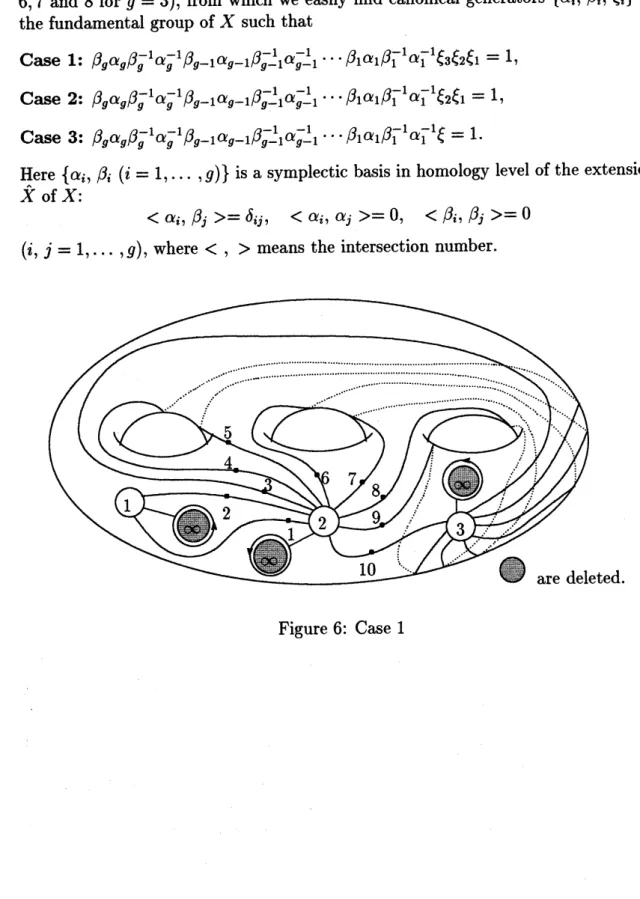
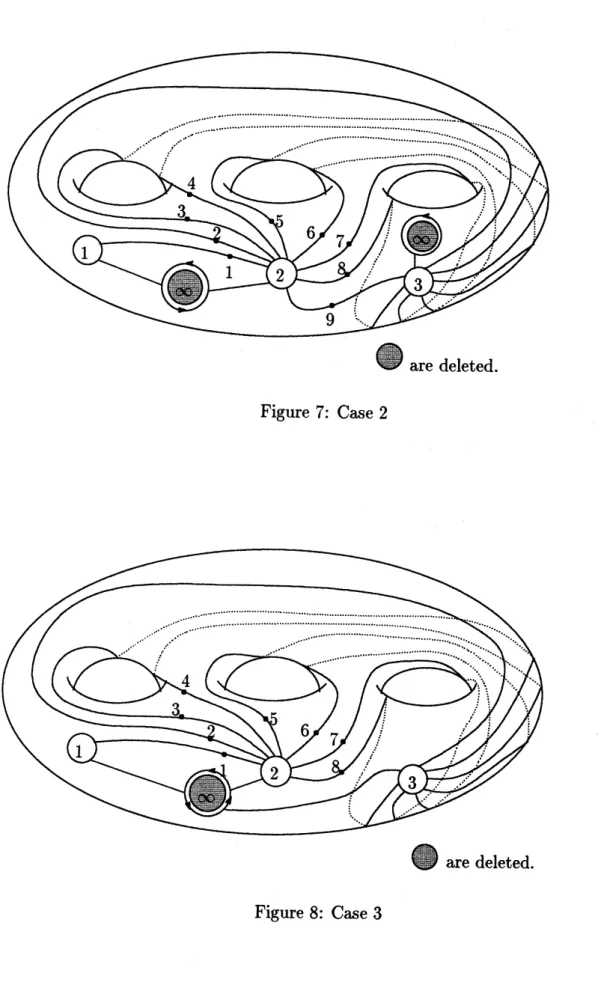
We draw the Riemann pictures of thecanonical forms in Theorem 3 (see Figures
6,7 and 8 for $g=3$), from which we easily find canonical generators $\{\alpha_{i}, \beta i, \xi_{i}\}$ of
the fundamental group of$X$ such that
Case 1: $\beta_{g}\alpha_{g}\beta_{g}^{-1-}\alpha_{g}1\beta g-^{\iota 1\beta_{g}^{-1}\alpha_{g1}^{-}}\alpha g--1-1\ldots\beta 1\alpha_{1}\beta 1-1\alpha_{1}-1\xi 3\xi_{\mathit{2}}\xi_{1}=1$,
Case 2: $\beta_{g}\alpha_{g}\beta^{-1-}gg\alpha 1\beta_{g}-1\alpha g-1\beta_{g-1}^{-1}\alpha_{g1}^{-}-1\ldots\beta 1\alpha_{1}\beta^{-1}11\alpha^{-}1\xi 2\xi_{1}=1$,
Case 3: $\beta_{g}\alpha_{g}\beta_{ggg1}-1-\alpha 1\beta_{g1g-}-\alpha 1\beta_{g-}^{-1}1\alpha--1\ldots\beta_{11}\alpha\beta^{-}11\alpha_{1}^{-}\xi 1=1$
Here $\{\alpha_{i}, \beta_{i} (i=1, \ldots , g)\}$ is a symplectic basis in homology level of the extension
$\hat{X}$
of$X$:
$<\alpha_{i},$ $\beta_{j}>=\delta_{ij}$, $<\alpha_{i},$ $\alpha_{j}>=0$, $<\beta_{i},$ $\beta_{j}>=0$
$(i, j=1, \ldots,g)$, where $<,$ $>\mathrm{m}\mathrm{e}\mathrm{a}\mathrm{n}\mathrm{s}$ the intersection number.
Figure 7: Case 2
$\bullet$
are deleted.
In fact we may take as follows: Case 1: $\xi_{3}$ $=$ $[1, 2l][\infty, 11][1,12]$ ’ $\xi_{2}$ $=$ $[\infty, 22]$ . $\xi_{1}$ $=$ $[2g+4,23][\infty, 33][2g+4,32]$ $\alpha_{1}$ $=$ $[3, 23][4,32]$ $\beta_{1}$ $=$ $[5, 23][4,32]$ $\alpha_{j}$ $=-[2j+1,23][2j, 32]\cdots[3,23][2j, +2,32]$ $\beta_{j}$ $=$ $[2j+3,23][2j+2,32]$ $\alpha_{g}$ $=$ $[2g+1,23][2g, 32]\cdots[3,23][2g+2,32]$ $\beta_{\theta}$ $=$ $[2g+3,23][2g+2,32]$
.
Case 2:$\xi_{\mathit{2}}$ $=$ $[\infty, 21][\infty, 12]$
$\xi_{1}$ $=$ $[2g+3,23][\infty, 33]12g+3,32]$ $\alpha_{1}$ $=$ $[2, 23][3,32]$ $\beta_{1}$ $=$ $[4,23][3,32]$ $\alpha_{j}$ $=$ $[2j, 23][2j-1,32]\cdots[2,23][2j+1,32]$ $\beta_{j}$ $=$ $[2j+2,23][2j+1,32]$ $\alpha_{g}$ $=$ $[2g, 23][2g-1,32]\cdots[2,23][2g+1,32]$ $\beta_{g}$ $=$ $[2g+2,23][2g+1,32]$
.
Case 3:$\xi$ $=$ $[\infty, 21][\infty, 13][\infty, 32]$
$\alpha_{1}$ $–[2^{:},$ $231[3,32]$ $\beta_{1}$ $=$ $[4, 23]13,32]$ $’\lambda$ $\alpha_{j}$ $=$ $[2j, 23][2j-1,32]\cdots[2,23][2j+1,32]$ $\beta_{j}$ $=$ $[2j+2,23][2j,+1,32]$ $\alpha_{g}$ $=$ $[2g, 23][2g-1,32]\cdots[2,23][2g+1,32]$ $\beta_{g}$ $=$ $[2g+2,23][2g+1,32]$
.
5Calculations
of
fundamental
groups.
In this section, we compute fundamental groups of 3-dimensional compact oriented
manifolds using the local version of the theorem of Zariski-van Kampen (see Dimca
[3], Matsuno [8]$)$ and the method of Reidemeister-Schreier (see Rolfsen [12]). One
cancomputethe fundamental group rigorously ifone uses the Riemann picture. We
explain this using a concrete example:
Let us
cons.ider
Case 1 ofgenus 1 for simplicity. Ifwe take the braid $\sigma$ as$\sigma=\sigma^{-1}\sigma^{-}\sigma^{-}\sigma 1\sigma \mathit{2}\sigma\sigma 23\mathit{2}21\mathit{2}\mathit{2}35\sigma\sigma_{4}\sigma 3\sigma 32$ ($\sigma$ induces a knot), then we have the equality
$\Phi 0\sigma=\Phi$
where $\Phi$ is the monodromy of the canonical form. Hence we may construct a
topo-logical degenerating family
$f$ : $Xarrow\Delta(\mathrm{o}, a)\mathrm{x}\Delta(\mathrm{o}, b)$
ofbranched coverings of discs constructed from the pair $(\Phi, \sigma)$ (see Section 1). Let
$B_{f}$ be the branch locus of$f$. Let $\gamma_{j}$ $(j=1, \ldots , 6)$ be the lassos as in Figure 2. The
local version of the theorem of Zariski-van Kampen asserts that the fundamental
group of$\Delta(0_{\backslash ,J}a)\cross\Delta(\mathrm{O}, b)-B_{f}$ is generated by $\gamma_{j}(j=1, \ldots , 6)$ whose generating
relations are $\sigma(\gamma_{j})=\gamma_{j}(j=1, .., , 6)$
.
That is to say$\pi_{1}(\triangle(0, a)\cross\Delta(0, b)-B_{f},$ $q\mathrm{o})=<\gamma 1,$$\ldots,\gamma_{6}|\sigma(\gamma j)=\gamma j(j=1, \ldots, 6)>$
$=<\gamma_{1},$
$\ldots,\gamma_{6}|(\sigma_{232}-12-1\sigma\sigma^{-}\sigma\sigma_{1}\sigma 23\sigma 2\sigma-1-125\sigma_{4}\sigma 3\sigma^{3})2\gamma_{j\gamma_{j}}=(j=1, \ldots,6)>$
$=<\gamma_{1}-1-1’\ldots,\gamma_{6}|\gamma_{1}\gamma_{4}\gamma_{3}\gamma 2\gamma_{3}-1^{-1}\gamma_{4}\gamma 1\gamma_{1}^{-1}=1,$
$\gamma^{-1}1\gamma 4\gamma 3\gamma 2\gamma_{3}-1\gamma 4\gamma-1-2\gamma_{3}-1\gamma_{4}-1\gamma_{5}^{-}\gamma_{\epsilon}\gamma 511-1$
$\gamma_{1}\gamma_{\mathrm{s}_{1-1}}-1-\gamma_{6\gamma_{5}}\gamma 1\gamma 5\gamma 6\gamma 5\gamma_{4}\gamma 3\gamma_{\mathit{2}}\gamma 4\gamma 3\gamma_{2}-1\gamma 3-1\gamma_{4}-1\gamma 1\gamma_{\mathit{2}}^{-1}=1,$ $\gamma_{1\gamma 4}-1-1-1-1-\gamma 31\gamma\gamma 3\gamma \mathit{2}\gamma_{3}-1-1-\gamma_{4}\gamma 214-1-1$ $\gamma_{5-1}\gamma_{6}\gamma_{5}\gamma 1\gamma 5\gamma_{\epsilon}\gamma 5\gamma 4\gamma 3\gamma_{2}\gamma_{4\gamma,-1}3\gamma \mathit{2}-1\gamma_{3}^{-}1-\gamma 41\gamma_{1}\gamma_{3}^{-1}=1,$
$\gamma 1-1\gamma 4\gamma 3\gamma \mathit{2}\gamma_{3}\gamma_{4}\gamma_{3}\gamma_{4}\gamma 3\gamma_{2}\gamma_{3}$
$\gamma_{4}\gamma_{1}\gamma_{4}^{-1}=1,$ $\gamma^{-1}1\gamma 4\gamma_{3}\gamma 2\gamma_{3}\gamma_{4}\gamma_{3}\gamma_{\mathit{2}}-1\gamma_{3}^{-}1-\gamma 41\gamma 1\gamma_{5}-1=1,$ $\gamma_{\mathrm{s}}\gamma_{6}^{-}=11>$
.
Now, forfixed $t\neq 0$, the restriction of $f$ is
$f_{t}$ : $x_{t}arrow t\cross\Delta(0, b)$
.
This is a covering of degree 3 and the genus of $X_{t}$ is 1. We extend the covering to
the branched covering of$\mathrm{P}^{1}$ in the caconincal way as in Section 2 which is denoted
by the same notation for simplicity.
Now the method ofReidemeister-Schreiersays that the fundamentalgroup $\pi_{1}(X-$
$\{x\},$ $p_{0}),$ $(x=f^{-1}((0,0)))$ is generated by these loops $\xi_{1},$ $\xi_{2},$ $\xi_{3},$ $\alpha$and$\beta$ (see
Sec-tion 4) andtheir generating relations are pull-back over$f_{t}$of these of the fundamental
group $\pi_{1}(\Delta(0, a)\cross\Delta(\mathrm{O}, b)-B_{f,q0})$, expressed by the generators$\xi_{1},$ $\xi_{\mathit{2}},$ $\xi_{3},$ $\alpha$and$\beta$
.
We can carry this out observing the Riemann picture in Figure 5. The result is
as follows:
$\pi_{1}(\mathrm{Y}, p\mathrm{o})\simeq\pi_{1}(X-\{X\}, p\mathrm{o})=\{1\}$,
where $\mathrm{Y}$ is the 3-dimensional compact oriented manifold on which $X$ is a cone (see
References
[1] J. S. Birman: Braids, Links, and Mapping Class Group, Ann. Math. Studies,
82, Princeton, (1974).
[2] J. S. Birman, B. Wajnryb: 3-Fold branched coverings and the mapping class
group ofa surface, Lect. Notes in Math., 1167, Springer, (1985), 24-46.
[3] A. Dimca : Singurarities and Topology of Hypersurfaces, Springer- Verlag,
(1992).
[4] O. Forster: Riemannsche Fl\"achen, Springer-Verlag, (1977).
[5] R. H. Fox: Covering spaces with singularities, Lefschetz Symposium, Princeton
Univ. Press, (1957), 243-262.
[6] H. Grauert, R. Remmert: Komplexe R\"aume, Math. Ann., 136(1958),245-318.
[7] H. M. Hilden: Every closed orientable 3-manifold is a 3-fold branched covering
space of$S^{3}$, Bull. Amer. Math. Soc., Vol. 80, No. 6 (1974), 1243-1244.
[8] T. Matsuno : On a theorem of Zariski-Van Kampen type and its
applica-tions,Osaka J. Math. 32, 645-658, (1995).
[9] J. M. Montesinos
:
A representation of closed, orientable manifolds as3-fold branched coverings of $S^{3}$, Bull. Amer. Math. Soc., Vol.80, No. 5 (1974),
845-846.
[10] M. Namba: Degenerationg families ofmeromorphic functions, Proc. Internat.
Conf. ”Geometry and Analysis in Several Complex Variables”, Kyoto Univ.
(1997), RIMS Kokyuroku, 1058 (1998), 77-94.
[11] M. Namba, M. Takai: Degenerating families ofbranched coverings, toappear.
[12] D. Rolfsen: Knots and Links, Publish or Perisch Inc., (1976).
Maki Takai
Depertment of Mathematics
OsakaUniversity
Toyonaka City, 560-0043, Japan