Star-shaped periodic solutions for
$\dot{\mathrm{x}}(t)=-\alpha\{1-||\mathrm{x}(t)||^{2}\}R(\theta)\mathrm{X}([t])$
大阪電気通信大学工学部 坂田定久 (Sadahisa Sakata)
大阪府立大学工学部 原 惟行 (Tadayuki Hara)
1. Introduction
Recently in [1], Hara considered a -dimensional delay differential system
$\dot{\mathrm{x}}(t)=-\alpha\{1-||\mathrm{x}(t)||^{2}\}R(\theta)_{\mathrm{X}(t}-1)$, (1.1)
where$\alpha>0,$
$R(\theta)=,$
$| \theta|<\frac{\pi}{2},$ $\mathrm{x}=$ and $||\mathrm{x}||^{2}=x^{2}+y^{2}$.
Hegave
a conjecture:Conjecture. There exists a constant $\alpha_{0}>\pi/2-’|\dot{.}\theta|suc\dot{h}\theta\iota at\alpha>r\alpha_{0}implies$
’
the following:
(a)
If
$\theta/\pi$ is rational, then (1.1) has a star-shapedperiodic solution.(b)
If
$\theta/\pi$ is irrational, then each solution orbit denselyfills
out an annvlar regioncentered at the origin.
Our purposeis to givean
answer
insomesense
to this conjecture for an approximatesystem to (1.1)
$\dot{\mathrm{x}}(t)=-\alpha\{1-||\mathrm{x}(t)||^{2}\}R(\theta)_{\mathrm{X}([}t])$, (1.2)
where $[\cdot]$
means
the greatest-integer function.We shall consider thesystem (1.2) together with the initial condition
$\mathrm{x}(t_{0}+s)=\phi(s)$ for $s\in[-1,0]$, (1.3)
where $\phi\in C$, the family of all continuous functions from $[$-1,$0]$ into $\mathrm{R}^{2}$
.
In whatfollows, $N$ denotes the minimal integer not less than the initial time $t_{0}$
.
Then $N=t_{0}$if$t_{0}\in \mathrm{Z}$, the set of all integers, and $N=[t_{0}]+1$ if$t_{0}\not\in \mathrm{Z}$
.
Furthermore,$\mathrm{Q}$ means the
Our results in this paper are similar to ones ([2]) for a linear system
$\dot{\mathrm{x}}(t)=-\alpha R(\theta)\mathrm{X}([t])$ (1.4)
which is the first approximate system for (1.2).
2.
Preliminary
propositions
In this section, we give preliminary propositions to prove our theorems.
For each solution $\mathrm{x}(t)$ of
(.1.2)
and eachinte...g
er $n\geq N$, there exists one and onlyone $\varphi\in[0,2\pi)$ such that . .
$\mathrm{x}(n)=R(\varphi)$
.
(2.1)Changing variables
$\mathrm{u}(t)=R(-(\theta+\varphi))_{\mathrm{X}}(t)$ (2.2)
or
$\mathrm{x}(t)=R(\theta+\varphi)\mathrm{u}(t)$,
we
obtain the following proposition.Proposition 2.1. Let$\mathrm{x}(t)$ be a solution
of
(1.2). Then$\mathrm{u}(t)$, determined by (2.1) and(2.2), $sati_{\mathit{8}}fies$
for
any integer$n\geq N$:
(a) $||\mathrm{u}(t)||=||\mathrm{x}(t)||$
for
$t\geq n$.(b) $\mathrm{u}(n)=||\mathrm{x}(n)||\cdot$.
(c) $\dot{\mathrm{u}}(t)=-\alpha\{1-||\mathrm{u}(t)||^{2}\}$
for
$t\in[n,n+1)$.
This proposition follows by elementary calculation and also shows :
Proposition 2.2. Let$\mathrm{x}(t)$ be a solution
of
(1.2). Then the following are valid:(a) $\mathrm{x}(N)=0$ implies $\mathrm{x}(t)=0$
for
$t\geq N$.
(b) $||\mathrm{x}(t_{0})||=1$ implies $\mathrm{x}(t)=\mathrm{x}(t_{0})$
for
$t\geq t_{0}$.
(c) $||\mathrm{x}(t_{0})||<1$ implies $||\mathrm{x}(t)||<1$
for
$t\geq t_{0}$.
(d) $||\mathrm{x}(t_{0})||>1$ implies $||\mathrm{x}(t)||>1$, whenever $\mathrm{x}(t)$ exists.
Proof. We prove only (c) and omit the proof ofothers. First, suppose $||\mathrm{x}(t_{1})||=1$
for
some
$t_{1}\leq N$ and $||\mathrm{x}(t)||<1$on
$[t_{0}, t_{1})$. Using change of variableswith
we have $v(t)=v(t_{0})$ and
$\mathrm{x}([t_{0}])=R(\varphi_{0})$,
$\dot{u}(t)=-\alpha||\mathrm{X}([t\mathrm{o}])||\{1-u(t)^{2}-v(t0)^{2}\}$ (2.3)
for $t\in[t_{0}, t_{1})$, where $u(t\mathrm{o})^{2}<1-v(t\mathrm{o})^{2}$
.
Since
$u=\pm\sqrt{1-v(t_{0})2}$ are critical pointsfor (2.3), uniqueness of solutions for (2.3) guarantees
$-\sqrt{1-v(t_{0})2}<u(t)<\sqrt{1-v(t_{0})2}$ on $[t_{0}, t_{1}]$,
which implies
$||\mathrm{x}(t_{1})||=u(t_{1})^{2}+v(t_{1})^{2}<1$
.
This contradicts the supposition $|.|.\mathrm{x}(t_{1})||=1$. Therefore $\mathrm{x}(t)$ satisfies $||\mathrm{x}(t)||<1$ on $[t_{0}, N]$
.
Next,suppose
$||x(t_{1})||=1$ forsome
$t_{1}>N$ and $||\mathrm{x}(t)||<1$ on $[t_{0}, t_{1})$.
Thenthere is an integer $n\geq N$ fulfilling$n<t_{1}\leq n+1$
.
For convenience sake, put$\rho=||\mathrm{x}(n)||$, $\beta=\sqrt{1-\rho^{2}\sin^{2}\theta}$
.
It follows $\mathrm{h}\mathrm{o}\mathrm{m}$ Proposition 2.1 that
$\dot{u}(t)=-\alpha\rho\{\beta 2-u(t)^{2}\}$ (2.4) and
$\dot{v}(t)=0$ or $v(t)=$ -psin$\theta$ (2.5)
for $t\in[n, n+1)$, where $\mathrm{u}(t)=$. Therefore we caneasily show that the inequality
$||\mathrm{x}(t_{1})||<1$ holds, a contradiction. Thus we conclude that $||\mathrm{x}(t)||<1$ for $t\in[t_{0}, \infty)$. This completes the proof. $\square$
Remark 2.1. Propositions 2.1 and
2.2
show that every solution $\mathrm{x}(t)$of
(1.2) with$\mathrm{x}(N)\neq 0$ moves straighdy
from
$\mathrm{x}(n)$ to $\mathrm{x}(n+1)$ as$t$ doesfrom
$n$ to $n+1$.
Therefore,$if||\mathrm{x}(n)||arrow 0$ as $narrow\infty$
,
then the solution $\mathrm{x}(t)$ approaches the origin as $tarrow\infty$.Furthermore,
if
$\mathrm{x}(N+m)=\mathrm{x}(N)$for
some
integer$m$, then$\mathrm{x}(t)$ runs on a star-shapedperiodic orbit
for
all time.Now,
we
prepare several lemmas for provingour
theorems in the next section. Let$0<\rho<1$ and put $\beta=\sqrt{1-\rho^{2}\sin^{2}\theta}$
.
Then it is easy tosee
$0<\rho\cos\theta<\beta\leq 1$.
So,defining the function $f$ on $(0,1)$ by
$f( \rho)=\frac{1}{\rho\beta}\log\frac{\beta+\rho\cos\theta}{\beta-\rho\cos\theta}$,
Lemma 2.1. The
function
$fi\mathit{8}$ continuous and strictly increasing in $\rho$, andsatisfies
$\lim_{\rhoarrow+0}f(\rho)=2\cos\theta$, $\lim_{\rhoarrow 10}-f(\rho)=\infty$
.
Proof. It is convenient to put
$g( \rho)=\log\frac{\beta+\rho\cos\theta}{\beta-\rho\cos\theta}$
.
Then it is obvious that $g$ is positive and continuous, and hence$f$ is also. Since $\beta$ tends
to 1 as $\rhoarrow+0$, it follows that $g(\rho)$ tends to $0$ as $\rhoarrow+0$, and so L’Hospital’s theorem
asserts
$\lim_{\rhoarrow+0}f(\rho)=\lim_{\rhoarrow+0}\frac{g(\rho)}{\rho}=\lim_{\rhoarrow+0^{g’}}(\rho)$
.
Here, elementary calculation shows
$g’( \rho)=\frac{2\cos\theta}{(1-\rho^{2})\beta}$
.
This implies that $f(\rho)$ tends to 2$\cos\theta$ as $\rhoarrow+0$. On the other hand, since $\beta$ tends
to $\cos\theta$ as $\rhoarrow 1-0$, the equalities
$\lim_{\rhoarrow 10}f(\rho-)=\frac{1}{\cos\theta}$
$\lim_{-,\rhoarrow 0^{g}}(\rho)=\infty 1$
hold. Differentiating $f(\rho)$, we have
$f’( \rho)=\frac{(2\rho\cos\theta)/(1-\rho)2-g(\rho)\beta+(g(\rho)\rho\sin 2\theta)/\beta}{(\rho\beta)^{2}}$
and then
$f’( \rho)\geq\frac{h(\rho)-g(\rho)}{(\rho\beta)^{2}}$, (2.6)
where $h(\rho)=(2\rho\cos\theta)/(1-\rho^{2})$
.
It is easy to see that $h(\rho)$ tends to$0$ as $\rhoarrow+0$ and$h’( \rho)=\frac{2\cos\theta(1+\rho^{2})}{(1-\rho^{2})^{2}}$.
Since $1-\rho^{2}<\beta^{2}\leq\beta<\beta(1+\rho^{2})$, it follows that
$g’( \rho)<\frac{2\cos\theta(1+\rho^{2})}{(1-\rho^{2})^{2}}=h’(\rho)$
.
This, together with the fact
$\lim_{\rhoarrow+0^{g}}(\rho)=\lim_{\rhoarrow+0}h(\rho)=0$,
implies that
$g(\rho)<h(\rho)$ for $0<\rho<1$
.
Hence we
can
conclude from (2.6) that $f(\rho)$ is strictly increasing in $\rho$. Thus the proofProposition 2.3. Let $\mathrm{x}(t)$ be a solution
of
(1.2) $\mathit{8}atisfying0<||\mathrm{x}(N)||<1$.
Then,for
any integer$n\geq N$, the following are valid :(a) $\alpha=f(||\mathrm{x}(n)||)$ implies $||\mathrm{x}(n+1)||=||\mathrm{x}(n)||$
.
(b) $\alpha<f(||\mathrm{x}(n)||)$ implies $||\mathrm{x}(n+1)||<||\mathrm{x}(n)||$.
(c) $\alpha>f(||\mathrm{x}(n)||)$ implies $||\mathrm{x}(n+1)||>||\mathrm{x}(n)||$.
Proof. In the
same manner
as the proof of Proposition 2.2, we get (2.4), (2.5),$u(n)=\rho\cos\theta$ (2.7)
and $\mathrm{a}\mathrm{l}\mathrm{s}\mathrm{o}-\beta<u(t)<\beta$ for $t\in[n, n+1]$
.
Applying the quadrature to (2.4), we have$\frac{\beta+u(n+1)}{\beta-u(n+1)}=\frac{\beta+u(n)}{\beta-u(n)}e^{-2\alpha\rho\beta}$
.
(2.8)On the other hand, $u(n+1)=-u(n)$ ifand only if
$\frac{\beta-u(n+1)}{\beta+u(n+1)}=\frac{\beta+u(n)}{\beta-u(n)}$
.
(2.9)Here, if$\alpha=f(\rho)$, then (2.7) asserts
$\alpha=\frac{1}{\rho\beta}\log\frac{\beta+u(n)}{\beta-u(n)}$
,
and so (2.9) follows from (2.8). Hence we can conclude from Proposition 2.1 (a) and
(2.5) that
$\alpha=f(||\mathrm{x}(n)||)$ implies $||\mathrm{x}(n+1)||=||\mathrm{x}(n)||$
.
Inthe
same way,
wearrive at the conclusion that (b) and (c) ofthis lemmaarevalid. $\square$The following lemma is an immediate consequence of Lemma 2.2 in [2].
Lemma
2.2.
There exists apositive integer$m$ such that$R(m(2\theta-\pi))=I$if
and onlyif
the ratio $\theta/\pi$ is rational.3.
Theorems
Let $\phi$ be an initial function with $||\phi(0)||<1$. Then Proposition 2.2 asserts that the
solution $\mathrm{x}(t)$ of (1.2) and (1.3), satisfies $||\mathrm{x}(t)||<1$ on $[t_{0}, \infty)$
.
First of all, we give asufficient condition for such
a
solution to approach the origin as $tarrow\infty$.
Theorem 3.1. Assume $\alpha\leq 2\cos\theta$
.
Then each solution$\mathrm{x}(t)$of
(1.2) with $||\mathrm{x}(t_{0})||<1$Proof. We may
assume
that $0<||\mathrm{x}(N)||<1$. Then Lemma 2.1 asserts $\alpha<$ $f(||\mathrm{x}(N)||)$. It follows from Proposition2.3
that$||\mathrm{x}(N+1)||<||\mathrm{x}(N)||<1$.
Repeating this argument, we have
$||\mathrm{x}(n+1)||<||\mathrm{x}(n)||<$
.
$1$for
any
integer $n\geq N$. So, suppose the sequence $\{||\mathrm{x}(n)||\}$ converges to a positive $\rho_{0}$as $narrow\infty$. Then it is clear that
$||\mathrm{x}(n)||\geq\rho_{0}$ (3.1)
for any $n$
.
Now, consider a system$\dot{\mathrm{y}}(t)=-\alpha\{1-||\mathrm{y}(t)||^{2}\}R(\theta)\xi,$ $\mathrm{y}(\mathrm{O})=\xi$, (3.2)
where $||\xi||=\rho_{0}$
.
Proposition2.3
asserts that the solution $\mathrm{y}(t;0,\xi)$ of (3.2) satisfies$||\mathrm{y}(1;0,\xi)||<||\xi||=p_{0}$,
because $\alpha<f(||\xi||)$
.
Since the set $S=\{\xi\in \mathrm{R}^{2} : ||\xi||=\rho_{0}\}$ is compact, continuousdependence of solutions on their initial values shows $\sup\{||\mathrm{y}(1;0,\xi)|| : \xi\in s\}<\rho_{0}$.
Hence there exist apositive $\epsilon$ and
an
integer $K$ such that $n\geq K$ implies$||\mathrm{x}(n+1)||<\rho_{0}-\epsilon$,
because $||\mathrm{x}(n)||arrow\rho_{0}$ as $narrow\infty$. Thiscontradicts (3.1). Therefore we arrive at$\rho_{0}=0$,
and so $||\mathrm{x}(n)||$ tends to $0$ as $narrow\infty$
.
Thus we conclude from Remark 2.1 that$\mathrm{x}(t)$
approaches the origin as $tarrow\infty$
.
Next, we choose $\phi$ so that$(1+\alpha)||\phi||<1$,
where $|| \phi||=\sup\{||\phi(s)|| : -1\leq s\leq 0\}$
.
Then it follows from Proposition 2.2 that$||\mathrm{x}(t)||<1$
on
$[t_{0}, \infty)$.
Hence (1.2) implies that$||\mathrm{x}(t)||\leq||\mathrm{x}(t_{0})||+\alpha(t-t\mathrm{o})\{1-||\mathrm{x}(t)||^{2}\}||\mathrm{x}([t_{0}])||<(1+\alpha)||\phi||$
for$t\in[t_{0}, N]$. Inparticular,
$||\mathrm{x}(N)||<(1+\alpha)||\phi||$
.
Since
the sequence $\{||\mathrm{x}(n)||\}$ is strictly decreasingin $n$,we
have from Remark 2.1 thatfor$t\geq N$, and hence
$||\mathrm{x}(t)||<(1+\alpha)||\phi||$
for$t\geq t_{0}$. This shows that thezero solutionisstable. Thus the proof is completed. $\square$
Next, we shall give a sufficient condition for (1.2) to possess star-shaped periodic solutions. This result is a consequence of the following proposition.
Proposition 3.1. Assume that $\alpha>2\cos\theta$ and $\theta/\pi\in \mathrm{Q}$, and let$\mathrm{x}(t)$ be a solution
of
(1.2) satisfying $f(||\mathrm{X}(N)||)=\alpha$
.
Then there exists a positive integer$m$ such that$\mathrm{x}(t+m)=\mathrm{x}(t)$ (3.3)
for
$t\geq N$.
Proof. Since domain of$f$ is the interval $(0,1)$, it follows that $0<||\mathrm{x}(N)||<1$
.
ThenProposition 2.3 and its proof show
$\mathrm{u}(N+1)=||\mathrm{x}(N)||=R(2\theta-\pi)\mathrm{u}(N)$
or
$\mathrm{x}(N+1)=R(2\theta-\pi)\mathrm{x}(N)$,
and ofcourse $f(||\mathrm{x}(N+1)||)=\alpha$. Repeating this argument, we have
$\mathrm{x}(N+n)=R(n(2\theta-\pi))\mathrm{x}(N)$
forany positiveinteger $n$. Hence Lemma2.2 ensures the existenceofapositive integer
$m$ such that
$\mathrm{x}(N+m)=\mathrm{x}(N)$
.
(3.4)Since the system (1.2) is autonomous, we then arrive at the conclusion that
$\mathrm{x}(t+m)=\mathrm{x}(t)$
for$t\geq N$
.
This completes the proof. $\square$Theorem 3.2. Assume that $\alpha>2\cos\theta$ and $\theta/\pi\in$ Q. Then there exist $\mathit{8}tar$-shaped
periodic solutions
of
(1.2).Proof. It follows $\mathrm{h}\mathrm{o}\mathrm{m}$
Lemma
2.1 that there exists one and only one $\rho\in(0,1)$satisfying $\alpha=f(\rho)$
.
Put $\sigma=t_{0}-[t_{0}]$, and choose $\phi\in C$ so thator
$\frac{\beta-\phi_{u}(S)}{\beta+\phi_{u}(S)}=\frac{\beta-\rho\cos\theta}{\beta+\rho\cos\theta}e^{2\alpha\rho\beta(S+)}1$, $\phi_{v}(s)=-\rho\sin\theta$
for $s\in[-1,0]$, where
$\phi(s)=$
and $\beta=\sqrt{1-\rho^{2}\sin^{2}\theta}$.
Then it iseasy
tosee
that $\phi_{u}(-1)=\rho\cos\theta,$ $\phi u(\mathrm{o})=-\rho\cos\theta$ and
$\dot{\phi}_{u}(s)=-\alpha\rho\{\beta^{2}-\phi_{u}(s)2\}$,
which implies
$\dot{\phi}(s)=-\alpha\{1-||\phi(s)||^{2}\}$
for $s\in[-1,0)$
.
So, define $\psi\in C$ by$\psi(s)=$
Then the function$\psi$ fulfills
$\dot{\psi}(s)=-\alpha\{1-||\psi(s)||^{2}\}$ (3.5)
for $s\in[-\sigma, 0)$, and
$\dot{\psi}(s)=-\alpha\{1-||\psi(s)||^{2}\}R(\pi-2\theta)$ (3.6)
for $s\in[-1, -\sigma)$
.
Now, let $\mathrm{x}(t)$ be the solution of (1.2) with the initial condition$\mathrm{x}(t_{0}+s)=R(\theta)\psi(\mathit{8})$ on $[$-1,$0]$. (3.7)
And, consider thecase of$t_{0}\not\in \mathrm{Z}$
.
Then $[t_{0}]=N-1<t_{0}<N$ and it follows $\mathrm{h}\mathrm{o}\mathrm{m}(3.4)$that
$R(\pi-2\theta)\mathrm{x}(N+m)=R(\pi-2\theta)\mathrm{x}(N)$
and so
$\mathrm{x}([t_{0}]+m)=\mathrm{x}([t_{0}])$
.
Thus $\mathrm{x}(t)$ fulfills
$\dot{\mathrm{x}}(t)=-\alpha\{1-||\mathrm{x}(t)||^{2}\}R(\theta)\mathrm{x}([t_{0}])$ (3.8)
for $[t_{0}]+m\leq t<N+m$
.
Furthermore (3.7) impliesOn the other hand, by (3.7), the equality (3.5) becomes (3.8) for $[t_{0}]\leq t<t_{0}$
.
Hence$\mathrm{x}(t)$ fulfills (3.8)
on
$[[t_{0}], N)$.
By uniquenessofsolutions for (3.8), wecan
conclude that(3.3) holds
on
$[[t_{0}], N]$.
Similarly, it follows from (3.6) and the equality $\mathrm{x}([t_{0}]-1+m)=R(\pi-2\theta)\mathrm{X}([t_{0}])$that (3.3) holds on $[t_{0}-1, [t_{0}]]$
.
Therefore, by Proposition 3.1, we arriveat the conclu-sion that (3.3) holds for all$t\geq t_{0}-1$.
Next, consider the case of$t_{0}\in$ Z. Since $t_{0}=N$,(3.4) implies
$\mathrm{x}(t_{0^{-1}}+m)=R(\pi-2\theta)\mathrm{X}(t_{0}+m)=R(\pi-2\theta)\mathrm{x}(t_{0})$
.
On the other hand, (3.6) becomes
$\dot{\mathrm{x}}(t)=-\alpha\{1-||\mathrm{x}(t)||^{2}\}R(\theta)R(\pi-2\theta)\mathrm{x}(t_{0})$
.
By uniqueness of solutions, we arrive again at the conclusion that (3.3) holds for all
$t\geq t_{0}-1$
.
This shows that $\mathrm{x}(t)$ is a priodic solution, more precisely a star-shapedperiodic solution. Moreover, for any $\varphi\in(0,2\pi)$, the solution of (1.2) with the initial condition
$\mathrm{x}(t_{0}+s)=R(\theta+\varphi)\psi(s)$ on $[$-1,$0]$
is also periodic. Thus the proofis
now
completed. $\square$In the case that $\alpha>2\cos\theta$ and $\theta/\pi$ is irrational, the system (1.2) does not possess
nontrivial periodic solutions. But we obtain asimilar result to Theorem
3.4
in [2]. Theorem 3.3. Assume that $\alpha>2\cos\theta$ and $\theta/\pi\not\in \mathrm{Q}$, and let $\mathrm{x}(t)$ be a solutionof
(1.2) with $f(||\mathrm{X}(N)||)=\alpha$. Then $ihe$ trajectory
of
$\mathrm{x}(t)$for
$t\geq N$ is everywhere denseon
the closed annular region $\{\xi\in \mathrm{R}^{2} : ||\mathrm{x}(N)||\cdot|\sin\theta|\leq||\xi||\leq||\mathrm{x}(N)||\}$.
The proof of this theorem is analogous to one of Theorem
3.4
in [2], and so it is omitted.Finally we describe a result which is
more
precise than Proposition 2.2 (d).Theorem
3.4.
Any solution $\mathrm{x}(t)$of
(1.2) $wi\hslash||\mathrm{x}(t_{0})||>1$possesses
afinite
escapetime $T$, that is, $||\mathrm{x}(t)||arrow\infty a\mathit{8}tarrow T-0$
.
Proof. Suppose $\mathrm{x}(t)$ exists in the future. Then it follows from Proposition 2.2 (d)
that $||\mathrm{u}(t)||>1$ and so
for each $n\geq N$, where $\mathrm{u}(t)=$ is the function determined by (2.1) and (2.2).
Since $u(n)>0,$ $||\mathrm{u}(t)||$ is strictly increasing in $t$ and hence
$||\mathrm{u}(t)||\geq\rho_{N}$
on
$[n,n+1)$,where $\rho_{N}=||\mathrm{x}(N)||$
.
This implies$\dot{u}(t)\geq\alpha\rho N(\rho^{2}N-1)$,
so that
$u(t)\geq\alpha\rho_{N}(\rho_{N}^{2}-1)(n-N)$
on $[n, n+1]$ for each $n\geq N$
.
Thus we conclude that$||\mathrm{x}(t)||arrow\infty$ as $tarrow\infty$
.
(3.9) Now, consider the case of $\theta\neq 0$.
Then there exists a posotive $\rho^{*}$ such that $\rho>\rho^{*}$implies
$\alpha\rho(\rho^{2}\sin\theta 2-1)>\pi$
.
(3.10)Onthe other hand, according to the quadrature, we havefrom Proposition 2.1 (c) that
$\tan^{-1}\frac{u(t)}{\delta_{n}}=\tan^{-1}\frac{\rho_{n}\cos\theta}{\delta_{n}}+\alpha\rho_{n}\delta_{n}(t-n)>\alpha\rho_{n}\delta_{n}(t-n)$
for $t\in[n, n+1)$, where $\rho_{n}=||\mathrm{x}(n)||$ and $\delta_{n}=\rho_{n}^{2}\sin^{2}\theta-1$. But (3.9) implies that
$\rho_{n}>\rho^{*}$ for$n$large enough. Hence (3.10) shows thatfor such aninteger$n$, the inequality
$\tan^{-1}\frac{u(n+\frac{1}{2})}{\delta_{n}}>\frac{\pi}{2}$
holds, which is a contradiction. Therefore our supposition is false in the case of$\theta\neq 0$.
Next, consider thecase of$\theta=0$. In this case, (c) in Proposition 2.1 becomes $\dot{u}(t)=\alpha\rho_{n}\{u(t)^{2}-1\}$, $\dot{v}(t)=0$
.
According to the quadrature again, we have
$\frac{u(t)-1}{u(t)+1}=\frac{\rho_{n}-1}{\rho_{n}+1}e^{2\alpha}\rho_{n}(t-n)$ (3.11)
on
each interval $[n, n+1)$, because $u(t)>1$ on $[n, n+1)$.
But (3.9) implies that theinequality
holds for $n$ large enough. Hence it follows from (3.11) that
$u(n+ \frac{1}{2})-1>u(n+\frac{1}{2})+1$
for $n$ above, which is a contradiction. Therefore the solution possesses a finite escape
time. This completes the proof. $\square$
4.
Numerical examples
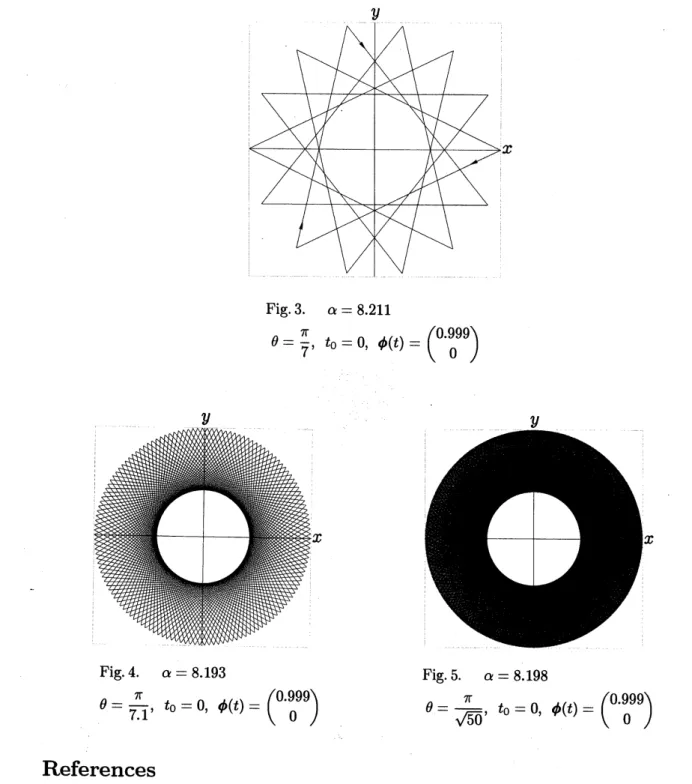
The following figures are some orbits of (2.1) which illustrate Theorems 3.1-3.3.
Fig.1. $\alpha=1.800<2\cos\theta$
$\theta=\frac{\pi}{7}$ $t_{0}=0,$ $\phi(t)=$
Fig.$2\mathrm{A}$. $\alpha=1.805>2\cos\theta$ Fig.$2\mathrm{B}$
.
$\alpha=1.805>2\cos\theta$Fig.3. $\alpha=8.211$
$\theta=\frac{\pi}{7},$ $t_{0}=0,$ $\phi(t)=$
Fig. 4. $\alpha=8.193$ Fig.5. $\alpha=8.198$
$\theta=\frac{\pi}{7.1},$ $t_{0}=0,$ $\phi(t)=$
$\theta=\frac{\pi}{\sqrt{50}}$ $to=0,$ $\phi(t)=$
References
[1] T. Hara, The asymptotic stability and star shaped periodic solutions for delay
differential system, Nonlinear Anal. 30 (1997)
4555-4563.
[2] S. Sakata, T. Hara, A two-dimensional linear differential system with piecewise