Gillnet Selectivity for Multi-Species Coastal
Fisheries in Palau
著者
MATSUOKA Tatsuro, MIYAKE Munetoshi, INOUE
Akio, KIRA Katsumi
journal or
publication title
南太平洋海域調査研究報告=Occasional papers
volume
30
page range
107-112
URL
http://hdl.handle.net/10232/16893
Survey Team II, Report 8. The Progress Report of the 1995 Survey of the Research Project, "Man and the Environment in Micronesia"
GILLNET SELECTIVITY FOR MULTI-SPECIES COASTAL FISHERIES IN PALAU
Tatsuro Matsuoka, Munetoshi Miyake, Akio Inoue and Katsumi Kira
Introduction
Fishes were sampled with gillnets in a coastal water in Palau in order to study applicability of selectivity of gillnets in multi-species fisheries in tropical shallow waters. Development of selective fishing is emphasized in the FAO Code of Conduct for Responsible Fisheries, while studies on multi-species fishery management are encouraged in the Kyoto Declaration and Plan of Actions (Matsuoka 1996). However, selectivity of fishing gear has been studied mainly for mono-species fisheries in high-latitude waters. The basis for implication of selectivity in multi-species fishing in most tropical coastal waters has not been established. This study aimed at clarification of the basic factors and conditions to be taken into methodology to deal with selectivity of fishing gear in coastal waters of tropical countries such as Palau. Authors are deep ly indebted to Mr. S. Ishizuka, a post graduate student of Kagoshima University who assisted in preparation of the figures.
Materials and Methods
A series of gillnet trial fishing was carried out in a shallow water in the vicinity of Ollei Vil lage on the northern end of Babeldaob Island, Palau in October, 1995. The applied ex perimental gillnet was designed for sampling in coastal waters. One net was composed of six panels of webbing of different mesh sizes, i.e. 60.4 mm, 66.9 mm, 75.5 mm, 81.3 mm, 89.6 mm, and 99.4 mm of the same twine material, PA monofilament #4, rigged with a constant hanging ratio, 0.50. A complete net was 72 m long and 3.5 m high (Fig. 1). In the experiments, four nets were joined with two each of commercial gillnets of PA monofilament, 91.4 mm in mesh size on each end of the series of the nets. This method intended to enable random sampling by different meshes in shallow waters where a patch of different environmental components are merged in a small area.
Caught specimens were identified at the species level. The four body-form parameters, i.e. the anterior girths, Gj around the preoperculum and operculum, the maximum body girth, G2 and the standard body length, Lb were measured. A net mark was examined to identify capture status for each fish. The girth at the net mark, either Gtll or Gn2 depending on its position was
also measured.
Selectivity of the tested meshes for the major species, Gerres acinaces was calculated according to the fish body form parameters measured as above.
108 T. Matsuoka et al. TO ftrr. ^ i N — .—«#... 12.0m mesh size 60.4mm 99.4mm 75.5mm 89.6mm 81.3mm 66.9mm 3.5m
Fig. 1. Arrangement of six mesh panels in experimental gillnet.
Results
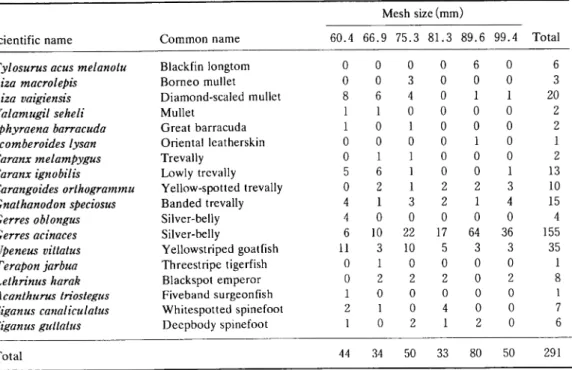
Species variation A total of 291 specimens of 18 species were sampled through six times of
fishing in the trial ground of approximately 3 m in depth at high tide. A total of 155 specimens
of G. acinaces which was the most popular species comprised of 53.3% of the specimens. Thiswas followed by 35 specimens of Upeneus vittatus and 20 of Liza vaigiensis, which comprised of
12.0% and 6.9% of the specimens. The top three species comprised of 62.2% of the specimens
and 95% of the specimens were composed of ten species (Table l). Major species were sampled
by the six meshes fairly at random.
Table 1. Fish species and number of specimens sampled by different meshes
Common name
Mesh size (mm )
Scientific name 60.4 66.9 75.3 81.3 89.6 99.4 Total
Tylosurus acus melanotu Blackfin longtom 0 0 0 0 6 0 6
Liza macrolepis Borneo mullet 0 0 3 0 0 0 3
Liza vaigiensis Diamond-scaled mullet 8 6 4 0 1 1 20
Valamugil seheli Mullet 1 1 0 0 0 0 2
Sphyraena barracuda Great barracuda 1 0 1 0 0 0 2
Scomberoides lysan Oriental leatherskin 0 0 0 0 1 0 1
Caranx melampygus Trevally 0 1 1 0 0 0 2
Caranx ignobilis Lowly trevally 5 6 1 0 0 1 13
Carangoides orthogrammu Yellow-spotted trevally 0 2 1 2 2 3 10
Gnathanodon speciosus Banded trevally 4 1 3 2 1 4 15
Gerres oblongus Silver-belly 4 0 0 0 0 0 4
Gerres acinaces Silver-belly 6 10 22 17 64 36 155
Upeneus vittatus Yellowstriped goatfish 11 3 10 5 3 3 35
Terapon jarbua Threestripe tigerfish 0 1 0 0 0 0 1
Lethrinus harak Blackspot emperor 0 2 2 2 0 2 8
Acanthurus triostegus Fiveband surgeonfish 1 0 0 0 0 0 1
Siganus canaliculatus Whitespotted spinefoot 2 1 0 4 0 0 7
Siganus guttatus Deepbody spinefoot 1 0 2 1 2 0 6
<£U • <v o 0) a . <n • . -o 15 10 • / %s m • • / • observed E n 5 — regression 2 100 200 300 Number of specimens 400
Fig. 2. Regression relationship between accumulated numbers of sampled speci
mens and occurred species.
According to the time-series catch record, the relationship between the accumulated num
bers of specimens, n and occurred species, N{n) was represented by an equation as (Fig. 2);
N{n) = 18.2ll-exp (-0.0104 •«) |
•(1)This was calculated by iteration under the confined condition where N{n) is no less than 18, be cause a total of 18 species occurred in situ.
Garres acinaces n=155 Upeneus vittatus n=35 Liza vaigiensis n=20 Others n=81 Total n=291 20% 40% 60% 80% 100%
jmandible, ^| preoperculum, fj^j operculum, HU max. body
Idiagonal, [Ml others
Fig. 3. Ratios among capture status for three major species: The listed status in
dicates; (1) entangled on mandible, wedged at right angle to the body's
axis around (2) preoperculum, (3) operculum, and (4) the maximum
body section, (5) diagonally wedged between preoperculum and the
110 T. Matsuoka et al.
Capture status The capture status for all the specimens were categorized into; (l) entan
gled on mandible, wedged at right angle to the body's axis around (2) preoperculum, (3) oper
culum and (4) the maximum body section, (5) diagonally wedged between preoperculum andthe maximum body section, and (6) various entanglement (Fig. 3). The ratios among the six
categories of capture status for three major species revealed that the capture mechanisms arequite different from species to species. Only 47% of G. acinaces were wedged at right angle,
while 45% were wedged diagonally with a few entanglement. On the other hand, 74% of U. vit tatus were wedged at right angle, however, 26% were entangled. L. vaigiensis were mainly
wedged at right angle (65%), however, 15% were diagonally wedged and 20% were entangled.
In total, the capture status for all samples varied greatly, where only 56% were
right-angle-wedged, while others were either diagonally wedged (29%) or entangled on mandi
ble or other parts of bodies (15%).
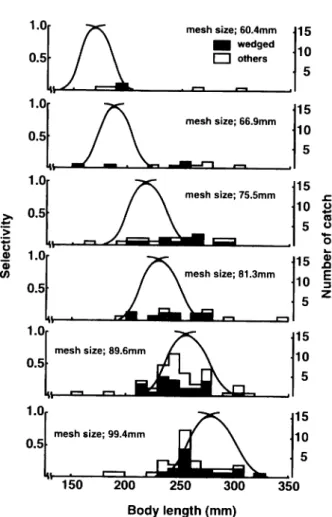
Selectivity curve Selectivity of the tested meshes was availed only for G. acinaces because of the insufficient numbers of samples for other species. Selectivity curves were calculated on the basis of the observed catch status and measured body-form parameters according to Kawamura
(1972) and Matsuoka et al. (1995).
The linear regressions of the opercular and the maximum body girths, Gi and G2 to length,
Lb were obtained as;Gj = 0.818 Lb- 8.50 (2) G2 = 0.852 Lb + 0.336 (3).
The girths were converted to dimensionless values by dividing by lengths. The standard devia tions, Ugi and Ug2 of the relative girths derived above were represented as;
Ugi = 0.00000867 Lb + 0.0356
(4)
Ug2 = -0.0000280 Lb + 0.0441
(5).
The mesh size calibration coefficients, kj and k2 were found to be 1.23 and 1.13 on the
basis of the net mark girths, Gn measured around either opercular or the maximum body sec tion divided by the mesh sizes which caught them.
In comparison of the calculated selectivity curves of the tested meshes to the length dis tributions of the fish sampled by respective meshes revealed that 93% of the right-angle-wedged samples occurred within the 5% selective ranges for the respective meshes (Fig. 4). Large portions of samples caught in the other categories of capture status appeared out
> o 150 mesh size; 60.4mm H wedged I I others 15 10 5 200 250 300 Body length (mm)
Fig. 4. Calculated selectivity curves of six meshes of experimental gillnet for G.
acinaces and length distribution of specimens caught by respective
meshes.
350
Discussions
Given a certain fishing gear, the constant in the specimen-species regression equation, for
example 18.2 in the Equation (l) in the present case, indicates the number of species to occur
in a fishing ground when a water is infinitely fished. The value reflects, therefore, the magni
tude of specific variation in the fished ground and less selectivity of the applied gear.
There are only a few data to be compared to the present constant, 18.2. Matsuoka (1992)
reported the values of 51.2 and 25.8 for bottom longline and handline in a lagoon water within
the barrier reef on the southern coast of Papua New Guinea. The present value is apparently
less than the above, however, it is unknown what is the responsible factor, either the selectivity
of gillnets in comparison to hook and line gear or less specific variation in the studied ground.
The obtained value appeared almost the same to the number of species actually sampled, which
112 T. Matsuoka et al.
trial and a small number of trials were carried out.
In the studies case, 95% of specimens were composed of ten species. According to Equa
tion (1), the tenth major species occurs in theory when the 77th fish is sampled. In other words,
the equation indicates that if at least a certain number, S ofsamples are required for all the ma
jor species, 77 x S specimens are to be sampled. This means that, for example, a total of 23,000
specimens must be caught if 300 specimens each, which is approximately the usual minimum
number ofspecimen needed to calculate selectivity, are required for all the ten species.
Selectivity curves obtained for G. acinaces indicates difficulties to achieve reliable selectivity
curves for fishes irregularly enmeshed. Together with the another finding that a large portion of
individuals of sampled species were diagonally wedged or entangled in the studied ground,
estimation
of selectivity
for tropical
shallow
waters
is assessed
to
be uneasy.
Despite recent encourage of selective fishing and multi-species management, those on the basis
of application of the conventional selectivity curve theory is thought difficult even for a gillnet
on which researches on selectivity have been conducted most commonly among fishing gears.
This is attributed to; (l) a large variation in caught species, consequently (2) a greatly large
number of specimens required to estimate selectivity curves for all the major species, and furth
er (3) irregular enmesh of a large portion of tropical shallow species, which is the negative fac
tor against accurate estimation of selectivity curves. These may indicate that it is impractical and
unrealistic to manage tropical fisheries on the basis of size-selectivity researches for all the
fishes. A different concept of fishing gear management may have to be established for
multi-species fisheries.References
Kawamura, G. 1972. Nippon Suisan Gakkaishi, 38(10): 1119-1127.
Matsuoka, T., Mana, R., & Nagaleta, H. 1992. Application of bottom longline fishing in tro
pical shallow water, Fisheries Section Technical Report 1/92, 25 pp. University of Papua
New Guinea, Port Moresby.