Periodic Solution of Autonomous Nonlinear
Equation of Motion with One-degree-of-freedom
著者
MINAKAWA Yoichi
journal or
publication title
鹿児島大学工学部研究報告
volume
22
page range
117-123
別言語のタイトル
保存力場自律系1自由度の非線形運動方程式の周期
解
URL
http://hdl.handle.net/10232/12605
Periodic Solution of Autonomous Nonlinear
Equation of Motion with One-degree-of-freedom
著者
MINAKAWA Yoichi
journal or
publication title
鹿児島大学工学部研究報告
volume
22
page range
117-123
別言語のタイトル
保存力場自律系1自由度の非線形運動方程式の周期
解
URL
http://hdl.handle.net/10232/00004681
Periodic Solution of Autonomous Nonlinear Equation
of Motion with One-degree-of-freedom
Youichi MlNAKAWA (Received May 31, 1980)
Summary
We discuss the difference between the cosine Fourier series and the sine Fourier series which are
applied to obtain the approximate solution of autonomons nonlinear equation of motion with one-degree-of-freedom in conservative field. And, it is shown that the approximate solutionobtained by applying the
cosine Fourier series converges to the exact periodic solution of the equation, but that obtained by
applying the sine Fourier series does not converges to the exact solution generally. Then we examine
the condition where the approximate solution obtained by the sine Fourier series converges to the exact
solution. Applying the cosine Fourier series, we numerically analyse system where the equation of
motion is derived by considering the finite deformation theroy in elasticity.
1. Introduction
There are many papers which deal with the nonlinear free vibration of the conservative
system with one-degree-of-freedom. The free vibration of the equation in which nonlinear spring
term is expressed as a odd function such as
x+<y02x+&r3=0,
x+sinx=0 (1)
is solved analytically by using elliptic functions. Meanwhile, the free vibration of the equation in
which nonlinear spring term is not expressed by odd functions is not analytically solved. But the orbit
of the free vibration on the phase plane is examined by some authors.1)2) And it is expected that the
periodic solution obtained by applying the Galerkin's approximation where sine and cosine functions
are completed, converges to the exact solution of the equation.3)
In this paper,4)5) we discuss the difference the cosine Fourier series and the sine Fourier
series which are applied to obtain the approximate solution of the conservative system with
one-degree-of-freedom. And it is shown that the approximate solution obtained by applying the cosine
Fourier series converges to the exact solution of the equation, but that obtained by applying the sine
Fourier series doesn't generally converge to the exact solution of the equation. Then the condition
in which the approximate solution obtained by the sine Fourier series converges to the exact solution
are examined.
2. The phase plane
The equation of motion with one-degree-of-freedom in conservation field is given by
x+K(x)=0 (2)
Then, Eq. (2) is transformed into the following equation
118 ± ¥ X ¥ %YL^ (1980)
where Vf(x)=j*JST(€)«
£o2=*o72+F(x0) (*o> *o)
The orbits of Eq. (3-a) depend on the function K(x). But we place the focus on the periodic
solution of Eq.(2), so it is assumed that there is a closed orbit in Eq. (3-a). Then the solution corresponding to the closed orbit is examined here.
:potential energy, rkinematic energy, :initial values.
(3-b)
3. The relations between a symmetry of the orbit and a symmetry of solution 3-1 A general discussion in conservative field
If there is a closed orbit in Eq.(3), the orbit is symmetric with respect to the x-axis. An
example of the orbit is shown in Fig. 1. Now, we examine a feature of the periodic solution.
Fig.l An Orbit
Let's suppose the initial value on the intersection of the closed orbit and the x-axis. Since
the orbit is symmetric with respect to the x-axis, the orbit is expressed by the following function
/*=*(*) (<S».
\x=-g(x) (^0).
(4)
Here, the following equation is applicable
dx=ydx (5)
where y=x, and substituting Eq. (4) into Eq. (5) and calculating the definite integral from initial
values (*, x(*)) = (0, x(0)) to (t, x(0) or(-f, x(-*))> the following equations are obtained
Jo
x(-t)=x(0) +[~tg(x)dT.
Jo
From Eq. (6), we can establish the expression
x(0 =*(-0 =sb(0) -{/(*)*•
(6-a)
(6-b)
(7)
The above equation makes it clear that the solution x(0 is an even function with respect to t And
the solution x(t) is not only an even function with respect to t but a continuous periodic function
because the solution is corresponding to a closed orbit of Eq. (3). If a function is an even function
and a periodic function, it can be expressed by the cosine Fourier series. And the approximate
solution obtained by applying the cosion Fourier series to the function converges to the exact periodic
solution uniformly. Then let's examine the feature of the cosine Fourier series on the phase plane
Periodic Solution of Autonomous Nonlinear Equation of Motion with One-degree of-freedom 119
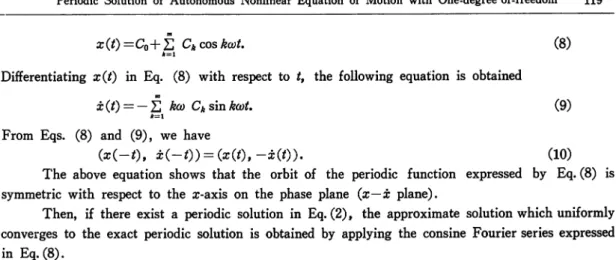
*(0=Co+S C* cos to*. (8)
*=i
Differentiating x(t) in Eq. (8) with respect to t, the following equation is obtained
m
x(t) = —H k(o Ck sin kcot. (9)
From Eqs. (8) and (9), we have
(x(-0, *(-0) = (*(0.-*(0). (10)
The above equation shows that the orbit of the periodic function expressed by Eq. (8) is symmetric with respect to the x-axis on the phase plane (x—x plane).
Then, if there exist a periodic solution in Eq. (2), the approximate solution which uniformly converges to the exact periodic solution is obtained by applying the consine Fourier series expressed
in Eq.(8).
3-2 A special discussion in conservative field
In this section, a case where the closed orbit of Eq. (3) is symmetric with respect to x=C0, as shown in Fig. 2, is considered.
Fig. 2 An Orbit
Then, Eq. (3) is transformed by
x=C0+X where C0=constant.
Substituting Eq. (11) into Eq. (3), we have
X(G>+X) = ± V2E<?-2V(C0+X):
As we are considering the case where the closed orbit is symmetric with respect to x=C0
X(C0+X) =X(C0-X) (13-a)
x(X)=x(-X). (13-b)
(12) and (13), we have
V(C0+X) = V(C0-X). (14)
From Eqs. (14), and (3-b), the following equation is obtained
K(Po+X) = -K(Po-X) (15)
If we examine the case expressed by Eq. (13), it is shown that the system has the potential energy function V(C0+X) which is an even function with respect to X, and has the spring function
jfiT(C0-r-^O which is an odd function with respect to X.
Then, let's investigate the feature of the periodic solution of the system.
Set the initial value on the intersection of the closed orbit and X=0 (x=C0). Since the closed orbit
o r
From Eqs,
(ID
120 K j e * * 3 6 i * « w * « f t mn2^ (wso)
is symmetric with respect to X=0, it is expressed by
X=G(X) (feO) (16-c)
X=G(-X) (tgfi) (16-b)
where G(X)=G(-X), X=x.
Substituting Eq. (16) into Eq. (15) and calculating the definite integral from initial values (t, X(f))
= (0,0) to (f, X(f)) or (-t, X(-t)), we have
X(t)=X(0)+\'G(X)dT,
(17-a)
X(-t)=X(0)-['G(X)dT.
(17-b)
Jo
Considering AT(0)=0 in Eq. (17), the following equation is obtained
X(f) =-X(-t) =^G(X)dr.
(18)
The above equation shows that the solution X(t) is an odd function with respect to t And the solution X(t) is not only an odd function but a continuous periodic function because it is corres
ponding to a closed orbit.
If a function is an odd function and a periodic function, it can be expressed by the sine Fourier
series. And the approximate solution obtained by applying the sine Fourier series converges to the exact periodic solution uniformly. Then, let's study the feature of the sine Fouries series on the phase plane,
X(t) = £sk sin kcot
(19-a)
or x(0=C0+i; Sk sin kcot. (19-b)
Differentiating X(t) with respect to t, we have
X(t) = E kco Sk cos kcot. (20)
*=i
From Eqs. (19) and (20), a point on the phase plane is expressed by
(X(-t), X(-t)) = (-X(t), *(/)) (21)
The above equation shows that the orbit of the periodic function expressed by Eq. (19) is symmetric
with respect to X=0 (x=C0) on the phase plane.
Then, if there is a periodic solution in Eq. (2) of which orbit on the phase plane is symmetric with respect to x=C0, the approximate solution which uniformly converges to the exact periodic solution is obtained by applying the sine Fourier series expressed in Eq. (19).
4. The problems in elasticity considering the finite deformation theory
Considering the finite deformation theory in elasticity, we have the following equation of motion with one-degree-of-freedom in conservative field
x+co02x+ax2+bxz=§ (22)
The above equation is included in Eq. (2), and the discussion described in 3-1 is applied to it.
Then, let's seek the condition where Eq. (22) is regarded as the system treated in 3-2. The
condition examined in 3-2 is originally expressed by Eq. (13), and it is equivalent to Eq. (14) or Eq. (15).
Periodic Solution of Autonomous Nonlinear Equation of Motion with One-degree-of-freedom 121
Set K(x) =CQo2x+ax2+bx*, the condition in Eqs. (13), (14) and (15) is given by
/a+3bC0=0,
\C0(bC02+aC0+co02)=0.
From Eq. (23), we have <z=0, (C0=0),
*2=|too2(c0=-^).
(23) (24) (25) If in the system where Eq. (24) or Eq. (25) is satisfied and there is a closed orbit which intersects
the line x=C0, the sine Fouries series in Eq. (19-b) may express the approximate periodic solution
of the system which uniformly converges to the exact periodic solution.
The equation of motion corresponding to Eq. (24) is the Duffing equation, and the periodic solution of the equation may expressed by both cosine and sine Fourier series.
5. Numerical Analysis
Here, sinusoidal shallow arch models are adopted as the system governed by Eq. (22), because
the coefficients of Eq. (22) for the arch are explicitly calculated in papers.6)7)
Then, we have
x+co02x+ax2+bx3=0 (26)
where co02=l-\-H2/29 a=—3H/4f £=1/4, if:the nondimentionalized rise of the arch.
We analyze the case which corresponds to the nondimentionalized rise H=3. The orbits on
the phase plane is shown in Fig. 3. In the system Eq. (24) or Eq. (25) is not satisfied and we
Fig.3 Orbits
have to apply the consine Fourier series in order to obtain the periodic solution which is uniformly converges to the exact periodic solution of the system.
Then let assume the following cosine Fourier series
x(0=Co+L Ck cos kcot. (27)
The backbone curve which is obtained by assuming Eq. (27) is shown in Fig. 4. The response shape and the value of each coefficient in Eq. (27) at the points A,B, and C in Fig. 4 are depicted in Figs. 5,6 and 7, respectively.
122 & K A ± ^ I ^ S B W 3fc$ m 22 -t (1980)
Fig.4 Backbone Curve
u>/w.= 0.69lJ3
MAX(X) =6.8852
MODE SHAPE (FREI B-PQINT (H = 3.0)
MIN(X) =-2.3 VIBRATION)
Fig. 6 Response Shape
102
Co=1.2713
w/wo=0.6997 MAX (X) =3. 1332
MODE SHAPE (FREI
A-POINT (H=3.0)
MIN (X) =-1.5609
VIBRATION) Fig.5 Response Shape
w w.= 1.3971 MAX (X)=10.9960
MODE SHAPE (FREE C-^POINT (H = 3.0)
MIN (X) =-5.380E VIBRATION)
Periodic Solution of Autonomous Nonlinear Equation of Motion with One-degree-of-freedom 123
References
1) N. Minarsky: Nonlinear Oscillations, D. van 6) Nastrand Company, Inc. 1962
2) J.J. Stoker: Nonlinear Vibrations in Mechnical
and Electrical Systems, Interscience Publishers 7)
1950
3) M. Urabe: Galerkin's Procedure for Nonlinear Periodic Systems, Archive for Rational Mech. and
Analysis, p.120, 1965 8) 4) Y. Minakawa: Doctor Thesis, University of Tokyo,
1976
5) Y. Minakawa: Periodic Solution of Autonomous
Nonlinear Equations of Motion with
One-degree-of-freedom in Conservative Field, Kanto Branch
Meeting of A.I.J., p.29, 1977
N.J. Hoff and V.G. Bruce: Dynamic Analysis of the Buckling of Laterally Loaded Flat Arches, J.
of Math, and Physics, p. 276, 1954
G.A. Hegemier and F. Tzung: The Influence of
Damping on the Snapping of a Shallow Arch under a Step-Pressure Load, AIAA J. p.1494,
1969
Y. Minakawa: Nonlinear Free Vibration in Con servative Field, Transaction of A.I.J., No. 278, p. 9, 1979