〔論 説〕
Inflation Targeting and the Role of Exchange Rate:
The Case of the Czech Republic
Yutaka Kurihara
Abstract
This paper analyzes the recent conduct of monetary and exchange rate policies in Czech Republic. The Czech experience with inflation targeting seems to have been satisfactory. The authorities have succeeded in maintaining a stable and moderate rate of inflation. Despite the warnings of skeptics, technical problems in the application of inflation targeting have not interfered with the operation of this regime. The paper shows that the exchange rate system, regardless of free-floating rhetoric, does not heavily influence the conduct of monetary policy in the Czech Republic. Also, it matters not merely in that it is useful for forecasting inflation rate.
Introduction
Inflation targeting entails an institutional commitment to price stability as the prime goal of monetary policy, giving the central bank accountability
targets for inflation, and a policy of communicating to the markets the rationale for the decisions made by the central banks. The independence of central banks is needed to give the monetary authorities the leeway necessary to commit to stability. On the other hand, central banks are responsible for the conduct of monetary policy and its outcomes. Also, sound, stable fiscal policy and a stable banking system are needed to avoid problems that would prevent the central bank from subordinating other goals to the objective of price stability or undermining the independence of the central banks. Central banks sometimes need to avoid the government intervention; the conduct of inflation targeting makes central banks possible. This multidimensional nature of this definition explains why there is no consensus about which practice is inflation targeting especially for emerging markets.
Many obstacles to inflation targeting have raised questions regarding its use in emerging markets. In general, changes in import prices due to movements in the exchange rate are quickly passed to domestic market prices in emerging markets (Calvo and Reinhart, 2000). With this type of high pass-through, a change in the exchange rate has a large short-run impact on inflation and a small short-run impact on output not only emerging markets but also in developed markets. The exchange rate should be adjusted to offset the effects so as not to harm the domestic markets. Foreign deflation, for example, will induce an inflation-targeting central bank to expand the money supply and allow the currency to depreciate, whereas an inflationary shock will induce the opposite reaction.1
Most developing countries have recently experienced the former case.
The difficulty of forecasting inflation may be an obstacle to inflation targeting. It is not realistic to hope to forecast inflation with the requisite
reliability if the country is still in the process of bringing down inflation from high levels, reforming the tax and public spending systems, and restructuring the private sector. Credibility problems sometimes make inflation targeting less attractive. They mean more volatility and less flexible policy conduct.
Theoretical arguments about the need for a nominal anchor, inflation targeting, may help to justify a move toward inflation targeting, but it is important to know how well this approach has worked in actual application. This paper is structured as follows. Section 1 reviews the monetary policy of the Czech Republic. Section 2 presents one theoretical model for empirical analysis. Section 3 shows the results and analyzes them. Section 4 analyzes the role of exchange rate. Finally, this paper ends with a summary.
1.Inflation Targeting in the Czech Republic
The Czech Republic is one of two successor states of Czechoslovakia, the other being Slovakia. The Czech Republic entered 1993 as a newly independent country that still shared a monetary union with Slovakia. This arrangement rapidly proved to be unsustainable and the union was dissolved in 1993. Since then, the Czech Republic has conducted its own independent economic and monetary policies.
The heritage of Czechoslovakia was overall macroeconomic stability. The country had been a bulwark of fiscal and monetary prudence during communism and the early transition policies confirmed this trend (Drabek et al., 1994). Restrictive monetary and fiscal policies accompanied the start of reforms in January 1991, ensuring that inflation fell after the initial jump caused by price liberalization. After falling to approximately 10% in 1992, inflation rose to about 20% in 1993 due to the introduction of value-added tax
The years 1993 to 1997 can generally be reckoned as a period of prosperity. The economy recovered greatly and growth rates were quite high. Growth was accompanied by high employment rates without parallel in other countries. Inflation stabilized at around 10%. In the second half of 1995, the Czech Republic liberalized the current account of the balance of payments. As a result of relatively high interest rates, a stable nominal exchange rate, and low perceived political risk, the economy of the Czech Republic began to attract large amounts of both short-term and long-term capital inflows in 1994 and 1995. However, reflecting sluggish export growth and strong increases in imports, economic growth began to slow down in 1995 to 1996. Prompted by a combination of a major currency crisis in Asia and some European countries and a recession, in 1997, the government passed an austerity package that contained expenditure cuts, other measures to dampen domestic demand, and medium-term institutional and structural measures to stimulate the supply side of the Czech economy.
By early in 2000, the economy emerged from the recession. The new government conducted a massive clean-up and privatization of major banks, which led to a revival in lending activity. Fiscal policy was largely relaxed to pay the costs of the banking restructuring and to stimulate demand by investment in infrastructure and significant increases in pay for public employees. Unemployment was stabilized and inflation remained low and stable (Beblavy, 2007).
At the beginning of the transition, the Czech Republic policymakers had to institute a monetary policy framework that would take advantage of sound economic fundamentals. The policy response was a fixed exchange rate as the intermediate target of monetary policy complemented by a monetary target.
The central bank also announced inflation targets in terms of the so-called headline consumer price index; however, the exchange rate peg remained the nominal anchor.
The policy irrelevance of monetary targeting in the environment of high and unstable capital inflows was one of the reasons that the Czech central bank switched to direct inflation targeting after the exchange rate crisis of 1997. In 1998, the central bank argued that monetary targeting had a problem caused by a lack of predictable relationship between monetary aggregates and inflation. The Czech national bank set a target for net inflation as the final target in 1998.
2.Theoretical Analysis
One way to infer the importance of inflation, the real economy, and the exchange rate in the policy decisions of the Czech National Bank is to estimate an extended Taylor Rule.2
Assume that the call rate partially adjusts to the target according to the function:
rt=(1 − r)rt *
+ rrt-1+ vt (1)
where r is the call rate, rt *
is the target rate for it, and v is a random shock. The coefficient r captures the degree of interest rate smoothing practiced by the central bank.
rt * is assumed as follows: rt * = rt ** + b (E[pt+n│Wt− p * ]+ gE[output gapt│Wt]+ h [zt│Wt] (2) where rt **
is the long-run equilibrium nominal interest rates, pt+n is inflation
between period t+n and period t, and z is another variable that may influence
rt
=(1 − r)[a + bpt+n+ g output gapt+ hzt]+ rrt-1+ et (3)
where a =(rt **
− bp*
), and et=(1 − r)[b (pt+n− E[output gapt│Wt])+
(zt− E[zt│ Wt])+ vt
Let utbe a vector of variables included in the central bank’s information set
at the time it sets the interest rate that are orthogonal to e.
E[et│ut]= 0 (4)
3.Empirical Analysis
Equation (4) entails the orthogonality conditions that we exploit to estimate the unknown parameters via GMM. I use lags 1, 2, 3, 4, 5, 6, and 12 of the overnight call rate based on Eichengreen (2008), the index of industrial production, the inflation rate, and the lagged rate of real exchange rate depreciation as the elements of the central bank’s information set. The sample period is 1998 to 2007.
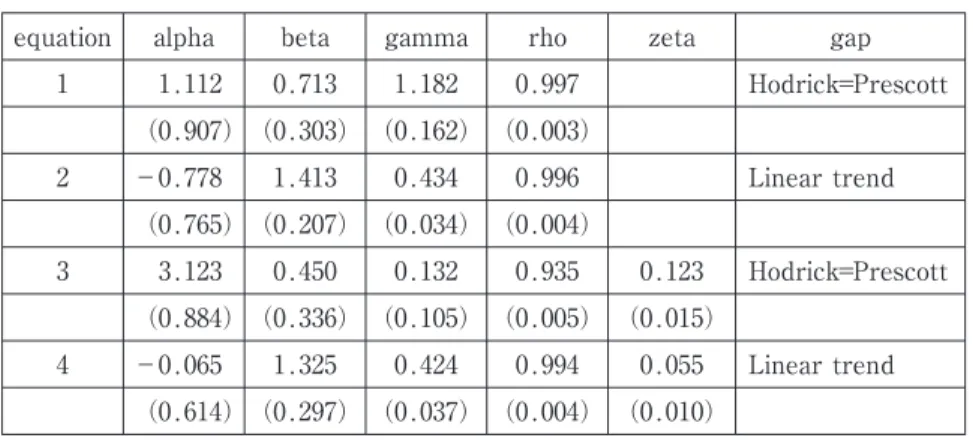
An important step is to estimate the output gap. Many methods may be employed for this purpose. The time series for industrial production is transformed into an output gap series in two ways following Eichengreen (2008). One is to use the two-sided linear Hodrick-Prescott filter and the other is to use a linear trend. The results are shown in Table 1.
The results show a good fit for actual movements in the call rate. The first two equations show that the call rate rises along with inflation. The call rate also rises as actual output increases relative to capacity. The lagged dependent variable is significant and large. However, although the presence
of the lagged dependent variable explains the success of these equations in following trends in the call rate, the other variables still appear to have a role in determining fluctuations.
The key result is that the rate of change in the real exchange rate also influences the setting of the policy instrument.3
When the real exchange rate depreciates, there is a tendency for the Czech National Bank to raise the call rate. The addition of the rate of currency depreciation reduces the magnitude of the other coefficients but does not change the results. The Czech National Bank cares about the movements of the real exchange rate above and beyond its use in forecasting future inflation. The distinction between forward-looking and backward-forward-looking is sometimes important.
It is interesting to note that the substitution of backward-looking behavior for forward-looking behavior produces a negative coefficient on the excess of actual output over capacity output. Estimates of monetary policy reaction functions that are framed in terms of backward-looking price movements can
Inflation Targeting and the Role of Exchange Rate
Table 1 GMM Estimates: Forward-Looking Inflation
equation alpha beta gamma rho zeta gap
1 1.112 0.713 1.182 0.997 Hodrick=Prescott (0.907) (0.303) (0.162) (0.003) 2 −0.778 1.413 0.434 0.996 Linear trend (0.765) (0.207) (0.034) (0.004) 3 3.123 0.450 0.132 0.935 0.123 Hodrick=Prescott (0.884) (0.336) (0.105) (0.005) (0.015) 4 −0.065 1.325 0.424 0.994 0.055 Linear trend (0.614) (0.297) (0.037) (0.004) (0.010)
be seriously misleading (Eichengreen, 2008).
The differences in the two sets of estimates is consistent with the assumption that the Czech National Bank looks forward rather than backward when it formulates monetary policy.
4.The Role of the Exchange Rate
The adoption of inflation targeting as an economy’ s monetary policy framework does not guarantee exchange rate stability and does not eliminate the potential for wide swings in exchange rate. Some advocates of inflation targeting take the position that the only exchange rate regime that is fully compatible with an inflation-targeting framework for the conduct of monetary policy is essentially free floating. At the most basic level, the choice of exchange rate regime, or the weight placed on changes in the exchange rate in the central bank’ s reaction function, should be a function of a country’ s
equation alpha beta gamma rho zeta gap
1 −0.505 1.314 1.312 0.994 Hodrick=Prescott (0.512) (0.199) (0.155) (0.004) 2 1.833 0.398 0.499 0.995 Linear trend (0.324) (0.044) (0.043) (0.003) 3 5.018 −0.410 1.108 0.937 0.119 Hodrick=Prescott (0.354) (0.099) (0.112) (0.006) (0.013) 4 4.1818 −0.298 0.395 0.993 0.148 Linear trend (0.2018) (0.095) (0.035) (0.005) (0.007)
economic development strategy. The Czech Republic has been committed to a strategy of export-led growth, in which it keeps the exchange rate stable at a competitive level. A strategy of keeping the exchange rate from appreciating and keeping interest rates low to confer additional resources into the production of exports ― or, more generally, into the production of those goods for which the scope for productivity improvement is greatest ― works less well in a deregulated financial environment.
The other reason that the Czech policymakers may be reluctant to move to greater exchange rate fluctuation is the worry that exchange rate stability is important for economic growth. The main reason is that it influences the bond markets. Bonds markets are very important for the economy and are related to interest rates. However, there is little evidence that greater exchange rate variability is a significant implement for bond market development (Eichengreen, 2008). The analysis of interest rates instead of exchange rates is sometimes important as countries pursue similar interest rate policies. The Czech Republic is not an exception. However, this paper omits this view.
5.Conclusions
The Czech experience with inflation targeting has been satisfactory. The authorities have succeeded in maintaining a stable and moderate rate of inflation. The technical problems suggested by skeptics of the application of inflation targeting have not interfered with the operation of this regime. This situation also suggests that the Czech National Bank cares about the real exchange rate as it has direct implications for the future course of inflation. Reasons such as the balance of investment traded and non-traded goods sectors impact implications for financial stability. Real exchange rates are
Problems exist in judging whether or not the framework of inflation targeting has been successful from this analysis. Targeting should restrain inflation in the long run. Also, a strong commitment to transparency should be guaranteed. These aspects have played important roles in the policies of targeting countries. Furthermore, the Czech Republic has conducted an overall package of reforms that has promoted and sustained economic growth and modernization. Inflation targeting seems to be a useful strategy for the conduct of monetary policy; however, further research is needed to study these issues more.
Notes
1.Anecdotal evidence suggests that this is the case for Brazil and Mexico. See Mishkin and Savastano (2000).
2.I follow the approach of Clarida, Gali, and Gertler (1998). 3.The result is similar to Corbo (2000).
References
Beblavy, M. (2007), Monetary Policy in Central Europe, Routledge: London. Calvo, G. and C. Reinhart (2000), “Fear of Floating,” NBER Working Paper 7993. Clarida R., J. Gali, and M. Gertler (1998) , “Monetary Policy Rule in Practice: Some
International Evidence,” European Economic Review 46 (1), 1033-1068.
Drabek, Z., K. Janacek, and K. Tuma (1994), “Inflation in the Czech and Slovak Republics,” Journal of Comparative Economics 18 (2), 146-174.
Eichengreen, B. (2008), “The Role of the Exchange Rate in Inflation targeting: A Case Study of Korea” in D. T. Bentley and E. P. Nelson (Eds.), Inflation Roles, Targeting and Dynamics, Nova Science: New York.
Mishkin, F. and M. Savastano (2000), “Monetary Policy Strategies for Latin America,” NBER Working Paper 7617.