Preferable Word Order and Co-occurrence
Frequency
著者
OTA Yuko
journal or
publication title
Journal of International Cultural Studies
volume
26
page range
69-87
year
2020-03-31
1 .Introduction
Fraser (1999) mentions that some examples of discourse markers (hereafter, DMs) are expressions in bold in the following sequences.
( 1 )a. A: I like him. B: So, you think you’ll ask him out then, b. John can’t go. And Mary can’t go either.
c. Will you go? Furthermore, will you represent the class there? d. Sue left very late. But she arrived on time.
e. I think it will fly. After all, we built it right. (Fraser 1999, p. 931) After reviewing previous theoretical research on DMs, Fraser tries to answer what DMs are. To answer the question, four sub-questions are posed. Those questions are:
1. What do DMs relate? 2. What are not DMs?
The Preferable Word Order and Co-occurrence Frequency
OTA, Yuko
Abstract
Fraser (1999) mentions that there is a case where the level of acceptability changes due to the word order. Fraser states that “Frankly, however, ...” is less acceptable than “However, frankly....” The exact opposite is claimed by Petersen (1988) and Strunk & White (1999). This paper examines which word order is more preferable; whether however comes before sentence adverbs or vice versa. To find it out, Google searches are conducted on combinations of some other sentence adverbs and however. The results contradict Fraser. Moreover, the lower acceptability of frankly and the other pragmatic markers are confirmed. The number of hits is much smaller than in other pairs. I hypothesize that the reason is redundancy.
[Keywords: acceptability / word order / Co-occurrence / discourse connectives / Sentence Adverbials]
3. What is the grammatical status of DMs?
4. What are the main classes of DMs? (Fraser 1999, p. 937)
On the status of DMs, Fraser concludes as follows:
DMs, except for a few idiomatic cases, are expressions drawn from the syntactic classes of conjunctions, adverbials, or prepositional phrases, have the syntactic properties associated with their class membership, have a procedural meaning and have co-occurrence restrictions which are in complementary distribution with their conceptual counterparts. (ibid., p. 946) Fraser says, “syntactically, DMs do not constitute a separate syntactic category (p. 943).” For example, “coordinate conjunctions and, but and or function primarily though not exclusively as DMs (p. 943).” Moreover, “subordinate conjunctions such as so, since, because and while also function as DMs, although they function in other ways as well (ibid).” See (2).
( 2 )a. Since Christmas, we have had snow every day. b, The book was so good that I read it a second time.
c. You should read while doing it. (ibid., p. 943)
Adverbials as in (3a-b) are used uniquely as a DM, while those as in (3c-f) ambiguously. ( 3 )a. She won’t eat. Consequently, she will lose weight.
b. Bill likes to walk. Conversely, Sam likes to ride.
c. I believe in fairness. Equally, I believe is practicality. (ibid., p. 943) d. I treat everyone equally.
e. A: I can’t see the buoy. B: Then don’t leave.
f. Will he be able to leave then? (ibid., p. 944)
Fraser continues, “there are prepositional phrases which function uniquely as DMs (p. 944),” as in (4a-b), “and those which are ambiguous (ibid.),” as in (4c-f).
( 4 )a. Harry shut his eyes. As a consequence, he missed the bird.
b. You shouldn’t do that. In particular, you shouldn’t touch that brown wire. c. We should have ice cream for dessert. After all, it’s my birthday.
d. He didn’t do after all.
e. He didn’t want to go. On the other hand, he didn’t want to stay. f. One hand was unadorned. He had a colourful tattoo on the other hand.
(ibid., p. 944) Based on the above examples ( 2 ) to ( 4 ), Fraser adds that the environments for their different functions are in complementary distribution. In other words, the syntactic environments where an expression functions as a DM are different from those environments where it occurs (p. 944).
Fraser argues that “semantically, there are several aspects to the meaning of an expression when it functions as a DM (p. 944).” According to Fraser, DMs have a core meaning, which is procedural, not conceptual (p. 931), and “an expression with a procedural meaning specifies how the segment it introduces is to be interpreted relative to the prior (p. 944).”
Fraser gives the following example to illustrate that every individual DM has a specific, core meaning (p. 945).
( 5 )a. She’s good looking. But he’s ugly as sin.
b. He’s good looking. But that isn’t going to get him a job in this market. c. A: He’s late. B: But he’s not late at all.
d. You say that Mary is coming. But we weren’t talking about Mary at all.
e. A: James is not in his office. B: But I just saw him there. (ibid., p. 945) Fraser alleges that “the core meaning of simple contrast coupled with the context will render the notion of but plus whatever additional Interaction is present (p. 945).” That is, “on one hand, the DM forces a relationship between the segments S2 and S1 by virtue of the DM meaning, while on the other hand, the context, both linguistic and non-linguistic, elaborates and enriches the relationship based on the details present (pp. 945-956).”
Fraser states that, although there are certain exceptions, they signal a relationship between the interpretation of the segment they introduce, S2, and the prior segment, S1 (p. 931). Fraser argues that there are two main classes of DMs below:
( 6 )Discourse Markers which relate messages a. Contrastive markers
b. Collateral markers c. Inferential markers
d. . ....
( 7 )Discourse Markers which relate topics (Ibid., p. 946)
DMs which relate messages in ( 6 ) are “those that relate the explicit interpretation conveyed by S2 with some aspect associated with the segment, Sl, and DMs which relate topics in (7) are those that relate the topic of S2 to that of S1 (p. 931).”
Here is an example of a topic relating DMs which involves an aspect of discourse management.
( 8 )This dinner looks delicious. Incidentally, where do you shop?(Ibid., p. 949)
Fraser mentions that “incidentally signals that S2 is to be interacted as a digression from the topic of S1 (p. 949).”
2 .The Purpose of Research
In the conclusion section, Fraser adds, “Even given this progress, there is much we don’t understand.” Then, some questions are raised. One of them is how DMs interact with other pragmatic markers, which constitute an entire, separate message.
As such an example, Fraser shows that there is a case where the level of acceptability can be different due to the order of however, which is a DM, and frankly, which is one of the pragmatic markers. See ( 9 ).
( 9 )a. However, frankly, you didn’t do very well.
b. ? Frankly, however, you didn’t do very well. [emphasis added]
(Fraser, 1999, p. 950) Fraser says that the example (9a) seems acceptable, but that (9b) seems much worse. As one of the questions to be answered in the future, Fraser brings up a question: “Is such co-occurrence a rule-governed, principle-governed, or an idiosyncratic matter? (p. 950)”
Interestingly, however, Petersen’s (1988) and Strunk & White’s (1999) remarks are opposite to Fraser’s. Petersen claims that sentence connectors such as however should not be placed at the beginning of the sentence because that makes it sound pretentious or argumentative. Concerning how to use however, Strunk & White says, “Avoid starting a sentence with however when the meaning is ‘nevertheless.’ The word usually serves better when not in the first position (p. 51),” showing the following examples:
(10) a. The roads were almost impassable. However, we at last succeeded in reaching camp. b. The roads were almost impassable. At last, however, we succeeded in reaching camp.
(Strunk & White, 1999, p. 51) Strunk & White state that “when however comes first, it means ‘in whatever way’ or ‘to whatever extent’ (p. 51)” as shown in the examples (11).
(11)a. However you advise him, he will probably do as he thinks best.
b. However discouraging the prospect, they never lost heart. (ibid.) The problem is that it is not clear whether their observations are based on the objective data or just their intuitions. Therefore, it is necessary to check whether the difference in the acceptability between them can be seen through Google searches1. This paper
examines whether a specific word order is required when however and sentence adverbials appear in a sentence and whether it is unique to frankly and the same type of ones.
3 .Methods
With an aim to find out the answer to the questions that are raised in the previous section, the number of hits for the strings, “However, frankly,” and “Frankly, however” is counted respectively in both American and British English. The reason is that there can be a difference between American and British English and that Fraser belongs to an American university and Petersen (1988) and Strunk & White (1999) are from the United Kingdom.
For this research, Google is used as a search engine. It is necessary to see whether “Frankly, however” is smaller than that for the search string “However, frankly,” If so, it can be said that Fraser’s (1999) observation is plausible. If not, however, there is a possibility that Fraser might not be correct.
Concerning the effect of frequency, studies show that participants rated sentences as more acceptable if they had read them earlier and that speakers’ previous experience with the sentences can improve the level of acceptability of similar types of sentences (Luka & Barsalou, 2005; Dąbrowska, 2010 as cited in Hsu & Hsieh, 2013, pp. 93-94). If the number of hits for words or phrases is large, people are more likely to be exposed to the expressions and then the level of acceptability will be higher.
It is predicted that the words which are classified into the same group have the same tendency to some degree. For the sake of the research on whether the same difference in the
level of acceptability as (11) can be observed in pairs of however and other sentence adverbs, the same method is adopted. The words which are chosen as sentence adverbs are honestly, regretfully, certainly, apparently, and fortunately for the purpose of comparing one from the same group as frankly with some in the group different from it. Although they are classified as one group of commentary pragmatic markers by Fraser2, Swan (1988) argues that they can
be divided into three groups. Swan classifies frankly and honestly as speech-act adverbs (p. 64), apparently and clearly as evidential modal adverbs (p. 451), and (Un)fortunately as an evaluative adverb (p. 464). Although regretfully is not taken up in Swan’s list, it will fall under evaluative adverbs.
4 .Results
To see if Fraser’s (1999) observation can be verified, I counted the number of hits for the search strings, “However, frankly,” and “Frankly, however.” The example (12) was found as one of “Frankly, however.” The example (13) is one example of “However, frankly.” (Henceforth, in all the examples found through Google searches, the emphasis is added by the author.) (12) There’s more holding back IoT. Berg analyst Kurkinen said smart devices would be more
useful to consumers if they got along better. Such interoperability would mean that as you “leave your home and lock your front door, your door lock could tell your thermostat to switch to ‘away mode’ and turn off the lights,” he noted. “Quite frankly, however, there are very many standards and initiatives related to interoperability and.... (“The Internet of Things: Convenience at a Price,” 2015, March, 30, “Not Easy, and Not Cheap,” para. 3) (13) This professor may have told the student that she wasn’t good at math, and may
perhaps even have displayed some subtly discriminatory attitudes in the classroom. However, frankly, the chances are nil that anyone with the mental equipment to obtain a professorship at Stanford University would, in the late 1980s in as politicized an atmosphere as an elite university, blithely tell a black student that black people cannot do math. (McWhorter, n.d., “Stories of Victimology,” para. 2)
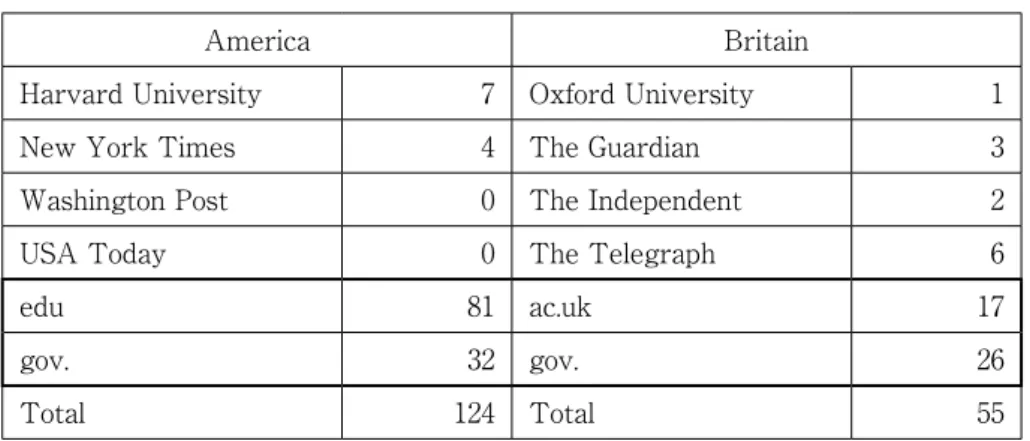
As can be seen from Tables 1 and 2, which are the results of Google searches, the number of hits is small but surely both strings are used. It is confirmed that there are some cases where “Frankly, however” is used. What is more, the ratio of hits for it in each country is larger than that of “However, frankly.”
Table 1 : The Number of Hits for the String “Frankly, however”
America Britain
Harvard University 7 Oxford University 1
New York Times 4 The Guardian 3
Washington Post 0 The Independent 2
USA Today 0 The Telegraph 6
edu 81 ac.uk 17
gov. 32 gov. 26
Total 124 Total 55
Table 2 : The Number of Hits for the String “However, frankly”
America Britain
Harvard University 0 Oxford University 0
New York Times 1 The Guardian 1
Washington Post 0 The Independent 0
USA Today 0 The Telegraph 1
edu 20 ac.uk 14
gov. 13 gov. 9
Total 34 Total 25
These results contradict Fraser’s observation in both American and British English.
The second question is whether the same difference in the acceptability as (11) can be seen in other combinations of however and sentence adverbs or not. The first one is the combination of however and honestly, whose examples are shown below:
(14) In the aftermath of the 2010 earthquake in Haiti, many Haitians have looked not toward the U.S., France, and Canada as history might suggest, but within the Latin American region, attracted by the economic stability of countries like Chile and Brazil in the Southern Cone. Honestly, however, the pressure to produce a 40-page paper (in Spanish) on this topic by the end of the semester has been quite demanding.
(Randolph, 2015, May 12, para. 1) (15) Interviewer: Which channels do you watch? Rasheed’s father: In general we watch Arabic most of the time. However, honestly, we watch certain channels because we like their
ethics. We want the channel to teach the culture and the habits of the community to our
children. (Mechanic, 2015, p. 153)
Tables 3 and 4 show the results of hits for the combination of however and honestly. The total number of hits for the combination is much smaller than that of “Frankly, however” and “However, frankly.”
Table 3 : The Number of Hits for the String “Honestly, however”
America Britain
Harvard University 0 Oxford University 2
USA Today 1 The Guardian 2
The Washington Times 0 The Telegraph 0
edu 21 ac.uk 8
gov. 4 gov. 0
Total 26 Total 12
Table 4 : The Number of Hits for the String “However, honestly”
America Britain
Harvard University 1 Oxford University 0
USA Today 0 The Guardian 1
The Washington Times 0 The Telegraph 0
edu 12 ac.uk 11
gov. 6 gov. 0
Total 19 Total 12
In American English, the number of hits for “Honestly, however” is larger than that of the reversed word order. In British English, on the other hand, the number of hits for both cases is the same. These results also contradict Fraser.
The next tables indicate the results of the search strings “Regretfully, however” and “However, regretfully.” The examples (16) and (17) are samples from Google searches.
(16) The group said: “At the end of a very difficult year, Alton Towers Resort has confirmed a proposed restructure of the business to be completed in time for the opening of the new season in March 2016. “Regretfully however, it may result in the loss of up to 190
(17) However, regretfully, we were unable to complete the call as County staff recommended
directly sending the review. (Boswell, 2009, para. 1)
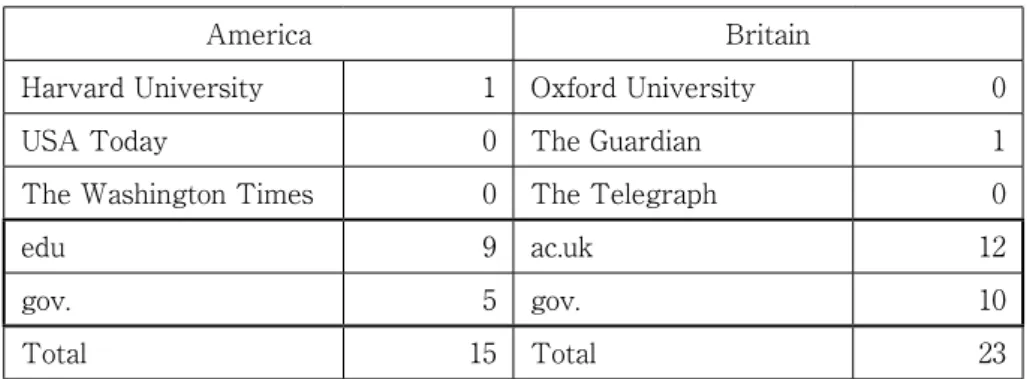
Tables 5 and 6 show the number of search results. The total number of hits for “Regretfully, however” and “However, regretfully” is also much smaller than those of the combinations of however and frankly.
Table 5 : The Number of Hits for the String “Regretfully, however”
America Britain
Harvard University 1 Oxford University 0
USA Today 0 The Guardian 2
The Washington Times 0 The Telegraph 0
edu 45 ac.uk 36
gov. 15 gov. 5
Total 61 Total 43
Table 6 : The Number of Hits for the String “However, regretfully”
America Britain
Harvard University 1 Oxford University 0
USA Today 0 The Guardian 1
The Washington Times 0 The Telegraph 0
edu 9 ac.uk 12
gov. 5 gov. 10
Total 15 Total 23
In the number of hits, “Regretfully, however”exceeds “However, regretfully” in both American and British English. This is also contradictory to Fraser’s observation.
Next, here are the results of the search strings, “Certainly, however” and “However, certainly.” Samples from Google searches are as follows:
(18) Certainly, however, there was politics: political ideology, pumped in particular from the Centre for Policy Studies, which said that markets were a good thing; and there was Ken Baker’s political agenda. (“Political Coup Bred Educational Disaster,” 1999, “Struggling schools,” para. 1)
certainly, the persons who are involved in these transactions are being charged substantially by the bank. (“City of West Lafayette Common Council Pre-Council Minutes,” 2005, “Ordinance No. 33-05”)
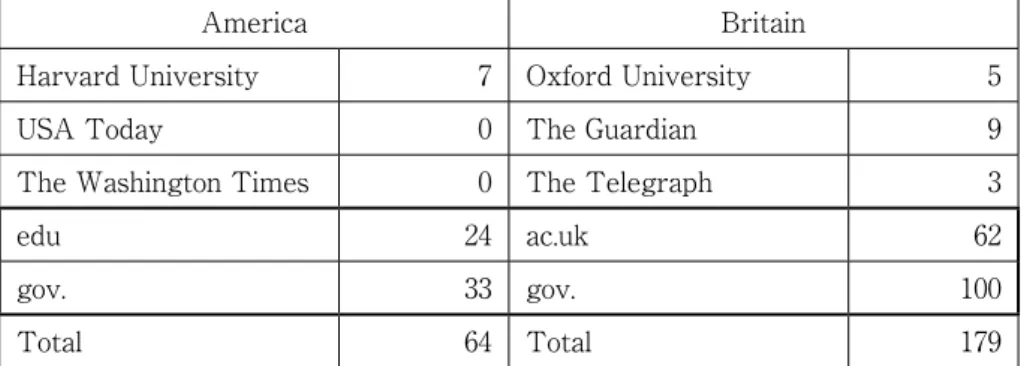
Tables 7 and 8 show the number of hits for the search strings “Certainly, however” and “However, certainly.” Compared with the results of the other three combinations which we have seen above, the number of hits for them is much larger. It is clear that something is different from the other three combinations of however and frankly, honestly, or regretfully. The total number of hits for “Certainly, however.” and “However, certainly” is much larger than those of the combinations of however and frankly.
Table 7 : The Number of Hits for the String “Certainly, however”
America Britain
Harvard University 17 Oxford University 5
USA Today 0 The Guardian 7
The Washington Times 1 The Telegraph 3
edu 148 ac.uk 243
gov. 80 gov. 72
Total 246 Total 330
Table 8 : The Number of Hits for the String “However, certainly”
America Britain
Harvard University 7 Oxford University 5
USA Today 0 The Guardian 9
The Washington Times 0 The Telegraph 3
edu 24 ac.uk 62
gov. 33 gov. 100
Total 64 Total 179
As for the difference because of the word order, in both American and British English, far more cases of however coming after certainly were found than that of however coming before certainly.
The examples of the combination of apparently and however which I found through Google searches are shown below.
(20) That, at any rate, is the impression given by military payroll records released by the Bush administration on Tuesday. Apparently, however, Lt Bush’s superiors at Ellington didn’t see it that way. (Goldenberg & Burkeman, 2004, para. 1) (21) Because the environment around Io has very high radiation, this mode was implemented
to provide additional protection against corruption of the images due to radiation-induced noise. However, apparently due to accumulated radiation damage to the camera electronics, this readout mode did not function properly during the flyby.
(“Original Caption Released with Image,” n.d., para. 2) Results for the search strings “Apparently, however,” and “However, apparently” are shown in Tables 9 and 10.
Table 9 : The Number of Hits for the String “Apparently, however”
America Britain
Harvard University 21 Oxford University 9
USA Today 3 The Guardian 17
The Washington Times 9 The Telegraph 7
edu 130 ac.uk 310
gov. 99 gov. 16
Total 262 Total 359
Table 10: The Number of Hits for the String “However, apparently”
America Britain
Harvard University 13 Oxford University 6
USA Today 1 The Guardian 7
The Washington Times 3 The Telegraph 5
edu 49 ac.uk 91
gov. 33 gov. 33
Total 99 Total 142
The tables show that the number of hits for them is much larger than those of the other three sentence adverbs, frankly, honestly, and regretfully just as the previous one, certainly.
The tendency for however to follow sentence adverbs is also confirmed in both a American and British English.
each case through Google searches are shown in (22) and (23).
(22) This is Don Juan at the end of his tether, an exhausted husk of a man with nothing to draw on. Fortunately, however, the film is visually elegant and constantly droll.
(French, 2005, para. 10) (23) One has to rely on the few sporadic small-scale surveys and studies from individual
states. However, fortunately, the National University of Educational Planning and Administration (NUEPA) carried out a two year study of government school teachers across nine Indian states in 2014-15, ... (Kingdon, 2017, p. 23) Tables 11 and 12 show the number of hits. The tables show that the number of hits for them is also much larger than those of the first three sentence adverbs, frankly, honestly, and regretfully just as certainly.
Table 11: The Number of Hits for the String “Fortunately, however”
America Britain
Harvard University 97 Oxford University 80
USA Today 4 The Guardian 38
The Washington Times 12 The Telegraph 39
edu 233 ac.uk 329
gov. 107 gov. 175
Total 453 Total 661
Table 12: The Number of Hits for the String “However, fortunately”
America Britain
Harvard University 14 Oxford University 8
USA Today 0 The Guardian 6
The Washington Times 1 The Telegraph 3
edu 81 ac.uk 214
gov. 39 gov. 1
Total 135 Total 232
Concerning the difference depending on the word order, the same pattern as most of the other cases is seen. There is no difference in the pattern between American and British English.
outnumber those of the reversed word order. On top of this, it is important to note that there are a smaller number of hits for the combinations of however and frankly, honestly, or regretfully.
5 .Discussion
As shown in the previous section, in all the pairs, the ratios of hits for the search strings where the sentence adverbs precede however are larger than those of the reversed word order. The results verify Petersen’s (1988) observation, but not Fraser (1999). Furthermore, there is no big difference between American and British English in the tendency for however to be placed after sentence adverbs.
Then, another question to be discussed here is in what context each word order is preferable. As mentioned in section 2, Petersen claims that sentence connectors such as however should be placed at the beginning of the sentence in a logical argument or an argumentative context. Documents by governments or in educational institutions are supposed to be formal and logic must be clear. If Petersen is right, in such contexts, however in the sentence-initial position should be preferable, but in reality, it is not. The number of hits is indeed larger in websites of governments or educational institutions than in the newspapers and magazines, but the number of hits for the strings where however occurs after sentence adverbs is larger than that of the reversed word order.
Concerning the case where sentence adverbs occur in the initial position of the sentence, Csüry (2013, p. 102) states as follows:
In order to avoid misleading local connections between neighboring text units, writers (or probably speakers) put a thematic marker or a framing adverbial in the sentence-initial position and relegate the connective to specific adverbial positions inside or at the end of
the sentence. (Csüry, 2013, p. 102)
With regard to sentence adverbs placed at the end of the sentence, Yasui (1982) mentions that they are added there as an afterthought or to be emphasized in order to show that they are emphasized.
(24)a. To be sure, he is satisfied.
b. He is satisfied, to be sure. (Yasui, 1992, p. 288)
however. As predicted, the results show that the words which are classified into the same group have the same tendency, but it contradicts Fraser’s indication.
The next topic which I would like to discuss is about the results that clearly show a smaller number of hits for the combinations of however and frankly, honestly, or regretfully. It can be hypothesized that the cause of the results must be the redundancy.
The lower level of acceptability because of redundancy is observed not only by Quirk et al. (1985), who argue that it is undesirable for but to be used with however at the same time in a sentence but also by Araki et al. (1985, p. 543), who also state that the co-occurrence of but and however as shown in (25) is verbose in literary style and should be avoided.
(25)But these plans, however, cannot be carried out without money.
(Araki et al. 1985:543) Morris ed. (1969, p. 261) remarks that too much contrast can ruin a sentence and that the contrastive conjunction but is redundant when used with however. Morris ed. also observes that it is hard to justify the sentence illustrated below (ibid.).
(26)But the army, however, went on with its plans. (Morris ed., 1969, p. 261) In a colloquial style, however sometimes follows just after but. Quirk et al. (1985, p. 643) indicate that emphatic endorsement by conjunct co-occurrence of the same class is more characteristic of loose informal talk rather than formal writings.
Seemingly, honestly and regretfully appear in a context similar to frankly, where they seem to be used to connect two contradictory statements. The Collins English Dictionary says that “You use frankly when you are expressing an opinion or feeling to emphasize that you mean what you are saying, especially when the person you are speaking to may not like it.” See the examples in (27), which are given in the dictionary.
(27)a. ‘You don’t give a damn about my feelings, do you.’--- ‘Quite frankly, I don’t.’ b. Frankly, Thomas, this question of your loan is beginning to worry me. c. I was frankly astonished at the singer’s interpretation of the song.
[italics added] As you know, the sentence connector however also signals the reader or listener to find a contradiction. That is why the co-occurrence is undesirable.
On the other hand, the sentence adverbs certainly, apparently, and fortunately occur in both contexts where the proceeding statement is contradictory to the preceding statement and where it is not. Take certainly as an example. The Collins English Dictionary’s definition of it is that “You use certainly to emphasize what you are saying when you are making a statement.” See (28) and (29).
(28) September brings a change in seasons and a chance to remember. A dozen years have passed since the day the twin towers fell, but we never look at a bright-blue, clear September sky quite the same way, and certainly each September 11 anniversary gives us pause. [emphasis and italics added] (Sonenshine, 2013, para. 1) (29) Don’t forget to create some of your own rocks to hide. Should you decide to do so, on the back, write in permanent pen or paint, “Take picture and post on Facebook in ‘Onslow Rocks’ group. Rehide.” But, certainly, if you do find a painted rock that you can’t seem to part with, keep it. [emphasis and italics added]
(Didonato, 2017, para. 5) The Collins English Dictionary defines a sentence adverb apparently as “it appears that; as far as one knows; seemingly.”
(30) Then Trump rashly accepted the idea of a face-to-face meeting on June 12, without adequate preparations and apparently based on the delusion that North Korea would simply hand over its nuclear weapons [emphasis and italics added].
(Kristof, 2018, para 14) (31) Don’t skip drinking during exercise in hot weather, a new study reminds us. This advice might seem obvious. But apparently some athletes, especially in team sports, have begun to eschew fluids during hot weather workouts, in hopes that the privation might somehow make them stronger [emphasis and italics added]. (Reynolds, 2018, para 1-2) The Collins English Dictionary says that fortunately is used to introduce or make a statement about an event or situation that is good.
(32) From Germany we flew to England just before the start of World War II and, fortunately, after some months in Britain, the family arrived safely by boat in New York Harbor. We debarked on Jan. 3, 1940, at Ellis Island [emphasis and italics added].
(33) They hid the affair, of course, but fortunately for them Schwob’s divorced father married Suzanne’s widowed mother in 1917, making them stepsisters [emphasis and italics
added]. (D’Erasmo, 2018, para 1)
Examples (28), (30) and (32) have a coordinating conjunction and. In the context, no contradiction can be confirmed between the segments which it connects. Examples (29), (31) and (33) have a coordinating conjunction but, which is used to introduce a contradiction. Note that certainly, apparently, and fortunately do not contain the meaning of “contrary to expectations,” judging from those definitions. Therefore, there is no redundancy in the co-concurrence of the sentence adverb and however. It will be true of the rest of the said sentence adverbs.
6 .Conclusion
Fraser (1999) mentions that the level of acceptability can differ because of the order of the sentence connector however and the sentence adverb frankly. In this research, however, Fraser’s observation was not verified by the findings through Google searches. As for six combinations in total, as predicted, the same tendency was confirmed: the cases of however following the sentence adverbs were found more often than those of the reversed word order in both formal and less formal writings.
The results of Google searches showed that the number of hits for the combinations of some pragmatic markers and however is smaller than those of the others. My conclusion is that the reason is the redundancy in meaning. Both however and sentence adverbs are used in the contradictory context. Generally speaking, therefore, their co-occurrence should be avoided. The rest of the pragmatic markers do not have such a constraint on the context. That is why their co-concurrence is more acceptable.
Notes
1. The reason for using Google searches is that there are no hits at all in Corpus of Contemporary American English and Time Magazine Corpus.
2. Fraser’s definition of commentary pragmatic markers is as follows:
Frankly, obviously, and stupidly do not signal a two-placed relationship between the adjacent discourse segments, but rather signal a comment, a separate message, that relates to the following segment. These are commentary pragmatic makers. (p. 942)
References
Application Form for Admission Doctor of Liberal Studies Program. (n.d.). Southern Methodist University. Retrieved January 28, 2020, from
https://www.smu.edu/-/media/Site/Simmons/MLS/PDF/DLSApplicationApril2015.pdf?la=en Brigety Reuben Robinson Lecture. (2017, February). Retrieved from
http://www.gspia.pitt.edu/Portals/0/General_PDF/Brigety%20Reuben%20Robinson%20Lecture%20Feb%20 2017.pdf?ver=2017-02-15-152927-520
City of West Lafayette Common Council Pre-Council Minutes. (2005, December 1). Retrieved from
https://www.westlafayette.in.gov/government/minutes/cc120105.htm
Close, R.A. (1975). A Reference Grammar for Students of English. London: Longman
Csüry, I. (2013). Connectives and Discourse Markers: Describing Structural and Pragmatical Markers in the Framework of Textology. Officina Textologica 18: Fifteen Years of Research in Text Linguistics, the Officina Textologica Project, 83-106. Debreceni Egyetemi Kiadó–Debrecen University Press, Debrecen.
Dąbrowska, Ewa (2010). Naïve v. expert intuitions: An empirical study of acceptability judgments. The Linguistic Review 27, 1-23.
D’Erasmo, S. (2018, August 17). Stepsisters, Lovers and Gender-Bending Artists, Now Celebrated in a Novel.
The New York Times. Retrieved from
https://www.nytimes.com/2018/08/17/books/review/rupert-thomson-never-anyone-but-you.html
Didonato, T. (2017, June 17). Katie Dodge Rocks Onslow County with Hidden Surprises. The Washington Times.
Retrieved from
https://www.washingtontimes.com/news/2017/jun/17/katie-dodge-rocks-onslow-county-with-hidden-surpri/ Fraser, B. (1999). What are discourse markers? Journal of Pragmatics 31, 931-952.
French, P. (2005, October 23). Son and Lovers. The Guardian. Retrieved from https://www.theguardian.com/theobserver/2005/oct/23/features.review27
Goldenberg, S. & Burkeman, O. (2004, February 12). George’s War. The Guardian. Retrieved from https://www.theguardian.com/world/2004/feb/12/uselections2004.usa2
Gutstein, D.W. (1985, November 24). Long Island opinion; Tasting Turkey and Freedom. The New York Times.
Retrieved from
https://www.nytimes.com/1985/11/24/nyregion/long-island-opinion-tasting-turkey-and-free
Hellebore, D. (2015, November 9). Alton Towers to Make up to 190 Staff Redundant. The Guardian. Retrieved from
https://www.theguardian.com/business/2015/nov/09/alton-towers-to-make-up-to-190-staff-redundant Hsu, C. & Hsieh, S. C. (2013). The Effects of Syntactic Knowledge and Extra-Grammatical Factors on Sentence
Acceptability Judgement: An Empirical Study on Chinese Topic Constructions. Taiwan Journal of Linguistics
Vol. 11.1, 91-124.
In The Court of Appeals of Iowa. (2007, May 23). Retrieved from
https://www.iowacourts.gov/media/documents/7345_3FDE13C181AF5.pdf Kingdon, G. G. (2017). The private schooling phenomenon in India: A review. Retrieved September 23, 2018, from
James, S. (2013, December 27). Ole Gunnar Solskjaer the Target after Cardiff City Sack Malky Mackay. Retrieved from
https://www.theguardian.com/football/2013/dec/27/malky-mackay-sacked-cardiff
Jefferson, T. (1792, November 6). From Thomas Jefferson to the Mayor and Municipality of Marseilles. Retrieved from https://founders.archives.gov/documents/Jefferson/01-24-02-0551
Luka, Barbara J., and Lawrence W. Barsalou. (2005). Structural facilitation: Mere exposure effects for grammatical acceptability as evidence for syntactic priming in comprehension. Journal of Memory and Language 52, 436-459.
Matsui, C. (2002). Eigogaku Gairon. (2nd ed.). Tokyo: Asahishuppansha.
McWhorter, J. H. (n.d.). Losing the Race: Self-Sabotage in Black America. The New York Times. Retrieved September 24, 2018, from
http://www.nytimes.com/books/first/m/mcwhorter-race.html
Mechanic, S. (2015). A Study of Language Use, Language Attitudes and Identities in Two Arabic Speaking Communities in the UK. Retrieved January 28, 2020, from
http://etheses.whiterose.ac.uk/10502/1/Sanaa%20Bichani%20thesis%202015.pdf
Memorandum of Conversation, (1946, May 9). Foreign Relations of the United States, 1950, Western Europe, Volume III. Retrieved September 23, 2018, from
https://history.state.gov/historicaldocuments/frus1946v08/d782
Original Caption Released with Image. (n.d.). Retrieved September 23, 2018, from https://photojournal.jpl.nasa.gov/catalog/PIA02517
Petersen, M. (1988). Nihonjin no Eigo. Tokyo: Iwanamishoten.
Political Coup Bred Educational Disaster. (1999, September 16). The Guardian. Retrieved from https://www. theguardian.com/uk/1999/sep/16/nickdavies
Randolph, M. (2015, May 12). Traveling within Chile: Northern Deserts and Southern Lakes. Retrieved from
https://amherstglobaleducationblog.sites.amherst.edu/2015/traveling-within-chile-northern-deserts-and-southern-lakes/
Report of the National Commission on Technology, Automation, and Economic Progress. (1966, February). Retrieved September 23, 2018, from
https://files.eric.ed.gov/fulltext/ED023803.pdf
Scrivener, S. (n.d.). The Art Object does not Embody a Form of Knowledge. Coventry University. UK. Retrieved September 24, 2018, from
https://www.herts.ac.uk/__data/assets/pdf_file/0008/12311/WPIAAD_vol2_scrivener.pdf
Sentence Connectors (n.d.). Collins Free Online English Dictionary. Harper Collins Publishers. Retrieved September 23, 2018, from
https://www.collinsdictionary.com/dictionary/english/sentence-connector
Sonenshine, T. D. (2013, September 11). Sonenshine: Personifying America outside the Perimeter: Diplomats Gamble with their Lives to Win Friends. The Washington Times.
Retrieved from
https://www.washingtontimes.com/news/2013/sep/11/sonenshine-personifying-america-outside-the-perime/ Strunk, W. Jr. & White, E. B. (1999). The Elements of Style. (4th ed.). Longman.
Swan, T. (1988). Sentence adverbials in English: A synchronic and diachronic investigation. Oslo: Novus. The Internet of Things: Convenience at a Price. (2015, March, 30). The Guardian.
Retrieved from
https://www.theguardian.com/technology/2015/mar/30/internet-of-things-convenience-price-privacy-security
The Players Cannot Help Counsel; They’ll Tell All. (n.d.).
Retrieved January 28, 2020, from http://ota.ox.ac.uk/text/5224.html
The Secretary of State to Certain Diplomatic Offices. (1950). Foreign Relations of the United States, 1950, Western Europe, Volume III. Retrieved January 28, 2020, from https://history.state.gov/historicaldocuments/
frus1950v03/d92
Uchida, S. (2007). Bun wo Koeta Bumpo. A New Introduction to English Linguistics. Tokyo: Eihosha. Yasui, M. (1992). A Better Guide to English Grammar. (2nd ed.). Tokyo: Kaitakusha.