Chemical and Pharmaceutical Bulletin Advance Publication by J-STAGE DOI:10.1248/cpb.c19-00634
Ⓒ 2019 The Pharmaceutical Society of Japan
Advance Publication October 3, 2019
Chem. Pharm. Bull.
Structure–Activity Relationship Study on Col-003, a Protein–Protein
Interaction Inhibitor between Collagen and Hsp47
Masahito Yoshida,a, § Masazumi Saito,a Shinya Ito,b Koji Ogawa,c Naoki Goshima,c Kazuhiro Nagata,*, b and Takayuki Doi*, a, d
aGraduate School of Pharmaceutical Science, Tohoku University,
6-3 Aza-Aoba, Aramaki, Aoba-ku, Sendai 980-8578, Japan
bInstitute for Protein Dynamics, Kyoto Sangyo University,
Motoyama, Kamigamo, Kita-ku, Kyoto 603-8555, Japan
cNational Institute of Advanced Industrial Science and Technology (AIST)
2-4-7 Aomi, Koto-ku, Tokyo 135-0064, Japan
dGraduate School of Life Sciences, Tohoku University,
6-3 Aza-Aoba, Aramaki, Aoba-ku, Sendai 980-8578, Japan
§ Current address: Department of Chemistry, Graduate School of Pure and Applied Sciences, University
of Tsukuba, 1-1-1 Tennoudai, Tsukuba, Ibaraki 305-8571, Japan
Chemical and Pharmaceutical Bulletin Advance Publication Summary
This study demonstrates the structure–activity relationship of Col-003, a potent collagen–heat-shock protein 47 (Hsp47) interaction inhibitor. Col-003 analogues were
successfully synthesized by Pd(0)-catalyzed cross-coupling reactions of
5-bromosalicylaldehyde derivatives with alkyl–metal species, and the inhibitory activities of the synthetic analogues were evaluated using surface plasmon resonance analysis (BIAcore). We succeeded in discovering two potent inhibitors that showed 85% and 81% inhibition at a concentration of 1.9 M against the collagen–Hsp47 interaction. This indicates that elongation of an alkyl linker between two aromatic rings could considerably improve inhibitory activity due to the adjustment of a pendant phenyl moiety to an appropriate position, in addition to the hydrophobic interaction with an alkyl linker moiety.
Key words: protein–protein interaction; collagen; heat-shock protein 47; small-molecule
Chemical and Pharmaceutical Bulletin Advance Publication Introduction
Protein–protein interactions (PPIs) are known to be important triggers in biological processes, and therefore they are being addressed as novel therapeutic targets in drug discovery.1,2) PPIs commonly act on interfaces that are broad, uneven protein surfaces;3–5) therefore, the development of PPI inhibitors remains a difficult and challenging issue. Heat-shock protein 47 (Hsp47) is a collagen-specific molecular chaperone expressed on the endoplasmic reticulum and plays an important role in the correct folding of procollagen for the secretion of triple-helix collagen.6–8) Abnormal secretion and accumulation of collagen cause fibrotic diseases, such as liver and lung fibrosis; therefore, the inhibition of collagen secretion is expected to be one of the therapeutic alternatives for the above diseases, and the collagen–Hsp47 interaction is a challenging target for developing novel inhibitors of collagen secretion.9–12)
We have recently reported a small-molecule inhibitor of the collagen–Hsp47 interaction, 5-benzyl-3-nitrosalicylaldehyde, called Col-003 (1). It was discovered by screening chemical libraries using surface plasmon resonance (SPR) analysis (BIAcore), which revealed that 1 strongly binds to Hsp47 but not to collagen.13) In addition, the binding site of 1 on Hsp47 was analyzed not only by druggable pocket analysis using the crystal structure of canine Hsp47 but also by 2D NMR analysis of the interactions between Hsp47 and collagen model peptide (GPP)10 or 1. The results indicated that 1 would competitively
bind near the collagen-binding interface on Hsp47 via interaction of a pendant benzyl moiety in 1 with the aromatic rings of Tyr-355 and His-245 in Hsp47. To obtain further information regarding the mode of action, we planned a structure–activity relationship
Chemical and Pharmaceutical Bulletin Advance Publication
study on Col-003 (1) based on the synthesis of its analogues and evaluation of their inhibitory activities.
Results and Discussion
To elucidate the substituent effects of Col-003 (1), we designed analogues 2 that possess a halogen atom instead of a nitro group and a 2-methyl- or 2-chlorobenzyl group as a pendant moiety for inducing steric and electronic effects with an ortho-substituted aromatic ring. Analogues 2 can be prepared through the Pd(0)-catalyzed cross-coupling reaction of 5-bromosalicylaldehyde 3 with benzylzinc reagents 4, as shown in Chart 1.
Chart 1. Design and Retrosynthesis of Col-003 Analogues 2
One-step synthesis of analogues 2a–2e with the Pd(0)-catalyzed Negishi cross-coupling reaction was attempted, and the results are presented in Table 1. The reaction of 5-bromosalicylaldehyde (3a)14) (X = H) with benzylzinc reagents15) 4A–C (R = H, Cl or Me) was performed in the presence of a catalytic amount of Pd(OAc)2/S-Phos at room
temperature to afford the desired 2aA–2aC (entries 1–3). Similarly, reactions of 5-bromo-3-fluorosalicylaldehyde (3b)16) and 5-bromo-3-chlorosalicylaldehyde (3c)17) with
OH X O
Col-003 (1) (R = H, X = NO2)
and its analogs 2 (X = NO2, H, F, Cl, Br) (R = H, Cl, Me) OH X O Br 3 [Zn] 4 R R
Chemical and Pharmaceutical Bulletin Advance Publication
benzylzinc reagents 4A–C successfully provided the corresponding analogues 2bA–2bC and 2cA–2cC in moderate to good yields (entries 4–9). Alternatively, all the reactions of 3,5-dibromosalicylaldehyde (3d)18) and 5-bromo-3-nitrosalicylaldehyde (3e)19) with 4A–4C resulted in a complex mixture (entries 10–15), probably because 3d has two reactive bromide atoms, which might have made the regioselective reaction difficult, and 3e would undergo nucleophilic addition of the organozinc reagents to an aldehyde moiety activated by an adjacent highly electron-withdrawing NO2 group.
Table 1. Synthesis of Col-003 Analogues with the Negishi Cross-Coupling Reaction
Entry X R Product Yield (%)a) Entry X R Product Yield (%)a)
1 H H 2aA 64 9 Cl Me 2cC 43 2 H Cl 2aB 57 10 Br H 2dA –b) 3 H Me 2aC 97 11 Br Cl 2dB –b) 4 F H 2bA 95 12 Br Me 2dC –b) 5 F Cl 2bB 70 13 NO2 H 1 (2eA) –b) 6 F Me 2bC 64 14 NO2 Cl 2eB –b) 7 Cl H 2cA 93 15 NO2 Me 2eC –b)
8 Cl Cl 2cB 90 a) Isolated yield. b) Complex mixture.
Next, we employed ortho-bromination and ortho-nitration of phenols in the coupling
OH X O Br 3a: X = H 3b: X = F 3c: X = Cl 3d: X = Br 3e: X = NO2 OH X O R Zinc reagent 4 1.0 mol% Pd(OAc)2 2.0 mol% S-Phos THF, rt, 4 h 2aA–2eC R 4A: R = H 4B: R = Cl 4C: R = Me ZnCl•LiCl
Chemical and Pharmaceutical Bulletin Advance Publication
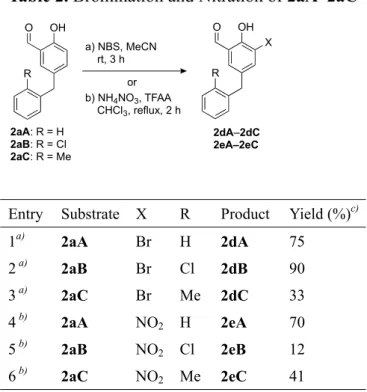
products 2aA–2aC. Treatment of 2aA–2cA with NBS/MeCN or NH4NO3/TFAA20)
provided the brominated analogues 2dA–2dC or nitrated analogues 2eA–2eC, respectively (Table 2).
Table 2. Bromination and Nitration of 2aA–2aC
Entry Substrate X R Product Yield (%)c)
1a) 2aA Br H 2dA 75 2 a) 2aB Br Cl 2dB 90 3 a) 2aC Br Me 2dC 33 4 b) 2aA NO2 H 2eA 70 5 b) 2aB NO2 Cl 2eB 12 6 b) 2aC NO2 Me 2eC 41
a) Condition a). b) Condition b). c) Isolated yield.
With the availability of the desired analogues, we evaluated the inhibitory effect of the synthetic analogues against the collagen–Hsp47 interaction in SPR analysis using an Hsp47-immobilized sensor tip,21) and the results are summarized in Table 3. The parent Col-003 (1) exhibited 80% inhibition of the collagen–Hsp47 interaction at a concentration of 16.7 M (entry 1); however, the inhibitory rate of analogue 2aA lacking the nitro group decreased considerably to 34% (entry 2). Interestingly, replacement of the benzyl group in
2aA with 2-chloro and 2-methylbenzyl groups maintained inhibitory activity (entries 7 and
OH O R 2aA: R = H 2aB: R = Cl 2aC: R = Me a) NBS, MeCN rt, 3 h b) NH4NO3, TFAA CHCl3, reflux, 2 h OH O R 2dA–2dC 2eA–2eC X or
Chemical and Pharmaceutical Bulletin Advance Publication
12). Substitution of the nitro group in Col-003 (1) with a halogen atom markedly affected the inhibition of the collagen–Hsp47 interaction. Analogue 2b, with a fluorine atom in the salicylaldehyde moiety (entries 3, 8, and 13), exhibited more potent inhibition than the other halogenated analogues 2c (X = Cl) (entries 4, 9, and 14) and 2d (X = Br) (entries 5, 10, and 15). The results indicated that a nitro group or a fluorine atom at position 3 of the salicylaldehyde moiety, which exhibits strong electronegativity, is required to induce potent inhibitory activity against the collagen–Hsp47 interaction. In addition, the introduction of substituents to the pendant benzyl moiety affected the inhibitory activity. Interestingly, the introduction of an electron-donating methyl group at position 2 of the benzyl group maintained the inhibition of the collagen–Hsp47 interaction (entries 11–15), although the analogues possessing a 2-chlorobenzyl group were less potent than the parent compound (entries 6–10). Thus, -electron density in the analogues could also play an important role in the potency of inhibitory activity against the collagen–Hsp47 interaction. To this end, it should be noted that the fluorinated analogue 2bC is slightly superior to Col-003 (1) at a concentration of 1.9 M (entry 13 vs. entry 1).
Chemical and Pharmaceutical Bulletin Advance Publication Table 3. Evaluation of the Inhibitory Activities of Col-003 Analogues 2
Entry X R Compound Inhibition rate (%)a)
1 NO2 H 2eAb) 80 (18)c) 2 H H 2aA 34 3 F H 2bA 73 4 Cl H 2cA 55 5 Br H 2dA 49 6 NO2 Cl 2eB 55 7 H Cl 2aB 63 8 F Cl 2bB 67 9 Cl Cl 2cB 43 10 Br Cl 2dB 10 11 NO2 Me 2eC 66 12 H Me 2aC 64 13 F Me 2bC 81 (35)c) 14 Cl Me 2cC 59 15 Br Me 2dC 39
a) 16.7 µM concentration of the compound. b) Col-003
(1). c) 1.9 µM concentration of the compound.
Because the pendant benzyl moiety in 1 was found to be important in potent inhibitory activity, we next investigated the synthesis and inhibitory activity of the nitrated analogues possessing alkyl linkers of different lengths between two aromatic rings in 1, and their syntheses are summarized in Chart 2. Suzuki–Miyaura cross-coupling of aryl bromide 3e with phenylboronic acid (6D) was smoothly performed in the presence of Pd(PPh3)4/K3PO4
to provide the corresponding biphenyl analogue 5eD with 56% yield. In addition, the
OH O R
2
Chemical and Pharmaceutical Bulletin Advance Publication
analogues 5eE–5eG possessing alkyl linkers of different lengths were prepared using Suzuki–Miyaura cross-coupling. However, the reactions of 3e with (phenylalkyl)borane22)
8E–8G were problematic because a complex mixture was afforded in the presence of a
3-nitrosalicylaldehyde moiety, and the reaction of the simpler aryl bromide 3a also failed to afford the corresponding products. Thus, we utilized a phenol-protected aryl bromide 7 to promote Suzuki–Miyaura cross-coupling leading to the formation of Col-003 analogues 5. Eventually, the methoxymethyl (MOM)-protected aryl bromide 7 was readily coupled with
8E–8G under ambient conditions (45°C, 12 h) to provide 9E–9G in moderate to good
yields. After removal of the MOM group under acidic conditions, ortho-nitration of the resulting phenols using NH4NO3/TFAA provided the desired analogues 5eE–5eG in
moderate yields.
Chart 2. Synthesis of Col-003 Analogues 5eD–5eG Possessing Alkyl Linkers of Different
Lengths OH O Br 3e OH O Phenylboronic acid (6D) Pd(PPh3)4, K3PO4 dioxane–H2O 95 °C, 18 h, 56% 5eD NO2 NO2 OMOM O Br 7 OMOM O Alkylborane 8E–G Pd(PPh3)4, K3PO4 dioxane–H2O 45 °C, 12 h 9E: n = 1 (69%) 9F: n = 2 (73%) 9G: n = 3 (65%) n OH O 1) 2 M HCl/dioxane 10 °C, 1 h 2) NH4NO3, TFAA CHCl3, reflux, 1.5 h n NO2 5eE: n = 1 (38%) 5eF: n = 2 (36%) 5eG: n = 3 (21%) n 8E: n = 1 8F: n = 2 8G: n = 3 B
Chemical and Pharmaceutical Bulletin Advance Publication
Inhibitory activities of the synthetic analogues 5eD–5eG were evaluated using SPR analysis in the same manner, and the results are presented in Table 4. The inhibitory activity of biphenyl analogue 5eD was similar to that of the parent Col-003 (1) in the range
of concentrations between 1.9 and 5.6 M (entries 1 and 2). Therefore, a
3-nitrosalicylaldehyde moiety and a pendant phenyl group seem to be a requisite scaffold to induce the desired activity. Notably, elongation of the alkyl linker markedly improved the inhibitory activity against the collagen–Hsp47 interaction at lower concentrations. For example, analogue 5eE, having a phenylethyl moiety as a pendant, effectively inhibited the interaction, with 89% inhibition at 5.6 M and 65% at 1.9 M (entry 3). Moreover, analogue 5eF containing a phenylpropyl moiety and analogue 5eG possessing a phenylbutyl moiety exhibited potent activity with 85% and 81% inhibition at 1.9 M and
59% and 52% inhibition at 0.6 M, respectively, although bell-shaped
concentration-response curves were observed (entries 4 and 5). In our previously proposed binding model of Col-003 (1) with Hsp47, a pendant benzyl moiety would interact with the aromatic rings of Tyr-355 and His-245 in Hsp47.13) Therefore, elongation of the alkyl linker in Col-003 (1) might adjust to an appropriate position in the pendant phenylpropyl or phenylbutyl moiety in 5eF or 5eG to interact with the aromatic rings of the Tyr-355 and His-245 residues. This should induce potent inhibition of the collagen–Hsp47 interaction in addition to a hydrophobic interaction with an alkyl linker moiety.
Chemical and Pharmaceutical Bulletin Advance Publication Table 4. Inhibitory Activities of Col-003 (1) and Its Analogues 5eD–5eG.
Entry m Product Inhibition rate (%)
0.2 µM 0.6 µM 1.9 µM 5.6 µM 1 1 1 0.8 6.2 22 53 2 0 5eD N.D. N.D. 34 71 3 2 5eE 9.0 26 65 89 4 3 5eF 25 59 85 74 5 4 5eG 23 52 81 41 Conclusion
We demonstrated the synthesis of analogues of the collagen–Hsp47 interaction inhibitor Col-003 and evaluated their inhibitory activities using SPR analysis. The Pd(0)-catalyzed Negishi cross-coupling reaction was found to be effective for the preparation of the Col-003 analogues 2a, 2b, and 2c in moderate to good yields. Although brominated or nitrated analogues 2d and 2e were hardly synthesized by the abovementioned Pd(0)-catalyzed reaction, ortho-bromination and ortho-nitration of 2a were performed to prepare the corresponding analogues 2d and 2e. In addition, the analogues possessing alkyl linkers of different lengths were synthesized by Pd(0)-catalyzed Suzuki–Miyaura cross-coupling in acceptable yields. The inhibitory activity of the synthetic analogues evaluated using SPR analysis indicated that a nitro group could be replaced with a halogen atom. Particularly, the fluorinated analogue 2bC was found to be as potent as the parent 1.
OH O
5e
NO2 m
Chemical and Pharmaceutical Bulletin Advance Publication
In addition, the inhibitory activity decreased with the introduction of an electron-withdrawing chlorine atom to the pendant benzyl moiety, whereas substitution with an electron-donating methyl group was tolerated. Notably, two- and three-carbon elongation of the alkyl linker between two aromatic rings in 1 markedly increased the inhibitory potency. Thus, the above results indicated that potent inhibition of the collagen– Hsp47 interaction required a pendant phenylpropyl or phenybutyl group, which would interact with the aromatic rings of Tyr-355 and His-245 in Hsp47. Elucidation of the mechanism of action of Col-003 is underway based on the information obtained from the structure–activity relationship in our laboratories.
Experimental
All commercially available reagents were used as received. Dry THF was obtained by passing commercially available predried, oxygen-free formulations through an activated alumina column. Column chromatography was carried out with silica gel 60N (Kanto Chemical Co., 100–210 m). All reactions were monitored by thin-layer chromatography carried out on 0.2-mm E. Merck silica gel plates (60F-254) with UV light. 1H NMR spectra (400 MHz) and 13C NMR spectra (100 MHz) were recorded on a JEOL JNM-AL400 spectrometer. Chemical shifts () are given from TMS (0 ppm) as an internal standard for
1H NMR and 13CDCl
3 (77.0 ppm) for 13C NMR. The following abbreviations are used: s
(singlet); d (doublet); t (triplet); q (quartet); quin (quintet); m (multiplet); and dd (double doublet). Mass spectra and high-resolution mass spectra were measured on JEOL JMS-700 and MS-AX500 instruments, respectively. IR spectra were recorded on a JASCO
Chemical and Pharmaceutical Bulletin Advance Publication
FT/IR-4100. Only the strongest and/or structurally important absorption is reported as the IR data given in cm1. Melting points were determined with Yazawa Micro Melting Point BY-2 and are not corrected.
General Procedure: Synthesis of Col-003 Analogues by Negishi Cross-Coupling To
the solution of 5-bromosalicylaldehyde derivative 3 (1.0 equiv), Pd(OAc)2 (0.01 equiv) and
S-Phos (0.02 equiv) in THF (1.0 mL/mmol) was added dropwise the benzylzinc reagent
415) (1.3 equiv) in THF (0.70 mL/mmol) at room temperature under an argon atmosphere. After being stirred at the same temperature for 4 h, the reaction mixture was quenched with saturated aqueous NH4Cl. The organic layer was separated, and the water layer was
extracted twice with Et2O. The organic layer was washed with brine and dried over MgSO4.
The filtrate was concentrated in vacuo, and the resulting residue was purified by column chromatography on silica gel (eluted with hexane/EtOAc = 50:1) to afford Col-003 analogues 2.
5-Benzylsalicylaldehyde (2aA) Colorless oil; 64% yield (682 mg, 3.2 mmol); 1H-NMR (400 MHz, CDCl3) δ: 10.9 (1H, s), 9.82 (1H, s), 7.37 (1H, dd, J = 8.0, 2.4 Hz), 7.31 (3H, t,
J = 8.0 Hz), 7.24–7.20 (1H, m), 7.17 (2H, d, J = 7.2 Hz), 6.92 (1H, d, J = 8.8 Hz), 3.96 (2H,
s); 13C-NMR (100 MHz, CDCl3) δ: 196.5, 160.1, 140.4, 137.8, 133.3, 132.7, 128.8, 128.6,
126.4, 120.4, 117.7, 40.6; IR (neat) 3164, 3027, 2845, 1624, 1483, 1279, 1146, 735, 700 cm–1; HREIMS m/z: 212.0852 ([M]+ calcd for C14H12O2: 212.0837).
5-(2-Chlorobenzyl)salicylaldehyde (2aB) White solid; 57% yield (140 mg, 0.57 mmol);
mp 39.5–40.6°C; 1H-NMR (400 MHz, CDCl3) δ: 10.9 (1H, s), 9.83 (1H, s, a), 7.40–7.36
Chemical and Pharmaceutical Bulletin Advance Publication
s); 13C NMR (100 MHz, CDCl3) δ: 196.5, 160.2, 138.0, 137.7, 134.2, 133.4, 131.0, 130.9,
129.8, 128.1, 127.0, 120.5, 117.8, 38.1; IR (neat) 3194, 3064, 2848, 1658, 1483, 1281, 1146, 770, 752 cm–1; HREIMS m/z: 246.0449 ([M]+ calcd for C14H11ClO2: 246.0448).
5-(2-Methylbenzyl)salicylaldehyde (2aC) Colorless oil; 97% yield (1.5 g, 6.6 mmol);
1H-NMR (400 MHz, CDCl
3) δ: 10.9 (1H, s), 9.76 (1H, s), 7.29 (1H, dd, J = 8.0, 2.0 Hz),
7.22 (1H, d, J = 0.8 Hz), 7.17–7.15 (3H, m), 7.10–7.06 (1H, m), 6.89 (1H, m), 3.94 (2H, s), 2.22 (3H, s); 13C-NMR (100 MHz, CDCl3) δ: 196.5, 159.8, 138.1, 137.5, 136.4, 132.9,
131.8, 130.4, 129.7, 126.7, 126.1, 120.3, 117.5, 38.1, 19.5; IR (neat) 3103, 3018, 2850, 1653, 1483, 1279, 1144, 770, 743 cm–1; HREIMS m/z: 226.0994 ([M]+ calcd for C15H14O2:
226.0994).
5-Benzyl-3-fluorosalicylaldehyde (2bA) White solid; 95% yield (436 mg, 1.9 mmol); mp
64.9–66.2°C; 1H-NMR (400 MHz, CDCl3) δ: 10.8 (1H, s), 9.85 (1H, d, J = 1.6 Hz), 7.32
(2H, t, J = 8.0 Hz), 7.26–7.22 (1H, m), 7.19–7.16 (4H, m), 3.95 (2H, s); 13C-NMR (100 MHz, CDCl3) δ: 196.2 (d, J = 2.5 Hz), 152.0, 148.1 (d, J = 12 Hz), 139.6, 133.1 (d, J
= 4.9 Hz), 128.8 (d, J = 3.3 Hz), 128.0 (d, J = 3.3 Hz), 126.7, 123.5, 123.3, 122.0 (d, J = 4.2 Hz), 40.6; IR (neat) 3165, 3028, 2853, 1663, 1480, 1388, 1276, 718, 701 cm–1; HREIMS m/z: 230.0757 ([M]+ calcd for C14H11FO2: 230.0743).
5-(2-Chlorobenzyl)-3-fluorosalicylaldehyde (2bB) White solid; 70% yield (183 mg, 0.69
mmol); mp 93.5–95.3°C; 1H-NMR (400 MHz, CDCl3) δ: 10.8 (1H, s), 9.85 (1H, m), 3.90
(1H, dd, J = 12.0, 2.4 Hz), 7.24–7.16 (5H, m), 4.07 (2H, s); 13C-NMR (100 MHz, CDCl3)
δ: 196.2 (d, J = 2.5 Hz), 152.0, 148.2 (d, J = 13 Hz), 137.3, 131.5, 131.4 (d, J = 4.9 Hz), 130.9, 129.9, 128.4, 128.1 (d, J = 3.3 Hz), 127.2, 123.4, 123.2, 122.1 (d, J = 3.3 Hz), 38.1;
Chemical and Pharmaceutical Bulletin Advance Publication
IR (neat) 3420, 2940, 2865, 1665, 1476, 1266, 1142, 739, 716 cm–1; HREIMS m/z: 264.0341 ([M]+ calcd for C14H10ClFO2: 264.0353).
3-Fluoro-5-(2-methylbenzyl)salicylaldehyde (2bC) Yellow solid; 64% yield (157 mg,
0.64 mmol); mp 79.0–80.4°C; 1H-NMR (400 MHz, CDCl3) δ: 10.8 (1H, s), 9.82 (1H, s), 7.19–7.07 (6H, m), 3.95 (2H, s), 2.22 (3H, s); 13C NMR (100 MHz, CDCl3) δ: 196.3 (d, J = 3.3 Hz), 147.9 (d, J = 3.4 Hz), 137.4, 136.5, 132.4 (d, J = 5.4 Hz), 130.6, 129.8, 127.8 (d, J = 2.4 Hz), 127.1, 126.3, 123.3, 123.1, 122.0 (d, J = 3.3 Hz), 38.2 (d, J = 1.6 Hz), 19.5; IR (neat) 3052, 3015, 2849, 1662, 1477, 1384, 1276, 725, 713 cm–1; HREIMS m/z: 244.0900 ([M]+ calcd for C15H13FO2: 244.0900).
5-Benzyl-3-chlorosalicylaldehyde (2cA) Yellow solid; 93% yield (459 mg, 1.86 mmol);
mp 94.0–95.0°C; 1H-NMR (400 MHz, CDCl3) δ: 11.3 (1H, s), 9.83 (1H, s), 7.46 (1H, d, J
= 2.0 Hz), 7.32 (2H, t, J = 7.2 Hz), 7.28–7.25 (2H, m), 7.17 (2H, d, J = 7.2 Hz), 3.95 (2H, s); 13C-NMR (100 MHz, CDCl3) δ: 196.0, 155.5, 139.6, 137.4, 134.1, 133.5, 131.8, 128.8,
126.7, 122.1, 121.2, 40.5; IR (neat) 3257, 3033, 2892, 1647, 1453, 1436, 1222, 1140, 752, 701 cm–1; HREIMS m/z: 246.0443 ([M]+ calcd for C14H11ClO2: 246.0448).
3-Chloro-5-(2-chlorobenzyl)salicylaldehyde (2cB) Yellow solid; 90% yield (254 mg, 0.90
mmol); mp 111.0–112.0°C; 1H-NMR (400 MHz, CDCl3) δ: 11.3 (1H, s), 9.83 (1H, s), 7.47
(1H, d, J = 2.0 Hz), 7.41–7.39 (1H, m), 7.28 (1H, d, J = 2.0 Hz), 7.25–7.22 (2H, m), 7.20– 7.18 (1H, m), 4.07 (2H, s); 13C-NMR (100 MHz, CDCl3) δ: 196.0, 155.6, 137.24, 137.21,
134.2, 131.9, 131.8, 130.9, 129.9, 128.3, 127.2, 122.1, 121.1, 37.9; IR (neat) 3060, 2924, 2868, 1652, 1445, 1220, 1140, 759, 704 cm–1; HREIMS m/z: 280.0049 ([M]+ calcd for C14H10Cl2O2: 280.0058).
Chemical and Pharmaceutical Bulletin Advance Publication
3-Chloro-5-(2-methylbenzyl)salicylaldehyde (2cC) Yellow solid; 43% yield (112 mg,
0.43 mmol); mp 96.8–98.0°C; 1H-NMR (400 MHz, CDCl3) δ: 11.3 (1H, s), 9.79 (1H, s),
7.41 (1H, d, J = 2.0 Hz), 7.20–7.17 (4H, m), 7.10–7.08 (1H, m), 3.95 (2H, s), 2.23 (3H, s);
13C-NMR (100 MHz, CDCl
3) δ: 196.1, 155.4, 137.4, 137.1, 136.4, 132.8, 131.5, 130.6,
129.8, 127.1, 126.3, 122.0, 121.1, 38.0, 19.6; IR (neat) 3071, 3021, 2921, 1652, 1458, 1217, 1140, 746, 700 cm–1; HREIMS m/z: 260.0604 ([M]+ calcd for C15H13ClO2: 260.0604).
General Procedure: Synthesis of Col-003 Analogues 2d by ortho-Bromination To a
solution of 2a (1.0 equiv) in MeCN (10 mL/mmol) was added N-bromosuccinimide (NBS) (1.3 equiv) at room temperature under an argon atmosphere. After being stirred at the same temperature for 3 h, the reaction mixture was quenched with saturated aqueous Na2S2O3.
The organic layer was separated, and the water layer was extracted once with Et2O and
twice with EtOAc. The organic layer was washed with brine and dried over MgSO4. The
filtrate was concentrated in vacuo, and the resulting residue was purified by column chromatography on silica gel (eluted with hexane/EtOAc = 60:1) to afford the 3-bromosalicylaldehyde derivative 2d.
5-Benzyl-3-bromosalicylaldehyde (2dA) Yellow solid; 75% yield (108 mg, 0.37 mmol);
mp 109.0–110.3°C; 1H-NMR (400 MHz, CDCl3) δ: 11.4 (1H, s), 9.78 (1H, s), 7.63 (1H, d,
J = 2.0 Hz), 7.34–7.32 (3H, m), 7.26–7.23 (1H, m), 7.17 (2H, d, J = 7.2 Hz), 3.95 (2H, s);
13C-NMR (100 MHz, CDCl
3) δ: 196.0, 156.5, 140.4, 139.6, 138.1, 134.1, 132.7, 128.8,
126.7, 121.0, 111.2, 40.4; IR (neat) 3173, 3027, 2851, 1657, 1453, 1239, 1136, 737, 698 cm–1; HREIMS m/z: 289.9934 ([M]+ calcd for C14H11BrO2: 289.9942).
Chemical and Pharmaceutical Bulletin Advance Publication
mmol); mp 122.3–123.6°C; 1H-NMR (400 MHz, CDCl3) δ: 11.5 (1H, s), 9.79 (1H, s), 7.64
(1H, d, J = 2.4 Hz), 7.41–7.39 (1H, m), 7.32 (1H, d, J = 2.4 Hz), 7.24–7.22 (2H, m), 7.20– 7.18 (1H, m), 4.09 (2H, s); 13C-NMR (100 MHz, CDCl3) δ: 195.9, 170.2, 156.6, 140.3,
137.3, 134.2, 133.6, 132.7, 130.9, 129.9, 128.4, 127.2, 111.2, 37.9; IR (neat) 3422, 3067, 2851, 1654, 1444, 1277, 1136, 752, 696 cm–1; HREIMS m/z: 323.9549 ([M]+ calcd for C14H10BrClO2: 323.9553).
3-Bromo-5-(2-methylbenzyl)salicylaldehyde (2dC) White solid; 33% yield (101 mg,
0.33 mmol); mp 99.2–100.9°C; 1H-NMR (400 MHz, CDCl3) δ: 11.4 (1H, s), 9.75 (1H, s),
7.58 (1H, d, J = 2.0 Hz), 7.22–7.17 (4H, m), 7.10 (1H, m), 3.95 (2H, s), 2.23 (3H, m);
13C-NMR (100 MHz, CDCl
3) δ: 196.0, 156.4, 140.2, 137.4, 136.5, 133.4, 132.4, 130.7,
129.8, 127.1, 126.3, 121.0, 111.2, 38.0, 19.6; IR (neat) 3063, 3025, 2965, 1652, 1455, 1217, 1140, 745, 691 cm–1; HREIMS m/z: 304.0086 ([M]+ calcd for C15H13BrO2: 304.0099).
General Procedure: Synthesis of Col-003 Analogues 2e by ortho-Nitration To a
suspension of 2a (1.0 equiv) and NH4NO3 (2.0 equiv) in chloroform (7 mL/mmol) was
added trifluoroacetic anhydride (TFAA) (8.0 equiv) at 0°C under an argon atmosphere. After being stirred in reflux for 2 h, the reaction mixture was cooled to room temperature and diluted with H2O. The organic layer was separated, and the water layer was extracted
three times with chloroform. The combined organic layers were washed with brine and dried over MgSO4. The filtrate was concentrated in vacuo, and the resulting residue was
purified by column chromatography on silica gel (eluted with hexane/EtOAc = 8:1) to afford the 3-nitrosalicylaldehyde derivative 2e.
Chemical and Pharmaceutical Bulletin Advance Publication
2.8 mmol); mp 101.8–103.5°C; 1H-NMR (400 MHz, CDCl3) δ: 11.3 (1H, s), 10.4 (1H, s),
8.15 (1H, d, J = 2.4 Hz), 7.93 (1H, d, J = 2.4 Hz), 7.32 (2H, t, J = 8.0 Hz), 7.27–7.23 (1H, m), 7.17 (2H, d, J = 7.2 Hz), 4.00 (2H, s); 13C-NMR (100 MHz, CDCl3) δ: 189.3, 155.0,
138.8, 137.3, 133.5, 131.0, 128.9, 128.7, 126.9, 125.3, 116.8, 40.4; IR (neat) 3173, 3027, 2851, 1657, 1453, 1239, 1136, 737, 698 cm–1; HREIMS m/z: 257.0675 ([M]+ calcd for C14H11NO4: 257.0688).
5-(2-Chlorobenzyl)-3-nitrosalicylaldehyde (2eB) Orange solid; 12% yield (29 mg,
0.10 mmol); mp 86.5–88.0°C; 1H-NMR (400 MHz, CDCl3) δ: 11.3 (1H, s), 10.4 (1H, s),
8.15 (1H, d, J = 2.4 Hz), 7.93 (1H, d, J = 2.4 Hz), 7.41–7.39 (1H, m), 7.26–7.22 (3H, m), 4.11 (2H, s); 13C-NMR (100 MHz, CDCl3) δ: 189.2, 155.1, 137.2, 136.4, 135.1, 134.2,
131.9, 131.03, 130.99, 130.1, 128.8, 127.4, 125.3, 38.1; IR (neat) 3224, 3072, 2854, 1665, 1530, 1260, 1094, 1038, 799 cm–1; HREIMS m/z: 291.0287 ([M]+ calcd for C14H10ClNO4:
291.0298).
3-Nitro-5-(2-methylbenzyl)salicylaldehyde (2eC) Orange solid; 41% yield (121 mg, 0.45
mmol, 41%); mp 93.3–94.9°C; 1H-NMR (400 MHz, CDCl3) δ: 10.9 (1H, s), 9.83 (1H, d, J
= 2.0 Hz), 8.06–7.97 (2H, m), 7.36–7.23 (3H, m), 6.96 (1H, d, J = 8.4 Hz), 4.05 (2H, s), 2.35 (3H, s); 13C-NMR (100 MHz, CDCl3) δ: 196.4, 160.3, 133.8, 131.3, 130.3, 130.0,
126.5, 125.2, 124.4, 122.5, 121.9, 121.3, 120.5, 38.1, 19.9; IR (neat) 3161, 3068, 2853, 1657, 1520, 1345, 1280, 771, 740 cm–1; HREIMS m/z: 271.0745 ([M]+ calcd for C15H13NO4: 271.0845).
Synthesis of 3-Nitro-5-phenylsalicylaldehyde (5eD) To a solution of 3-nitro-5-bromosalicylaldehyde (3e) (48 mg, 0.196 mmol, 1.0 equiv) in 1,4-dioxane
Chemical and Pharmaceutical Bulletin Advance Publication
(1.6 mL, 8.3 mL/mmol) and H2O (1.6 mL, 0.83 mL/mmol) was added phenyl boronic acid
(6D) (48 mg, 0.392 mmol, 2.0 equiv), K3PO4 (83 mg, 0.392 mmol, 2.0 equiv) and
Pd(PPh3)4 (23 mg, 0.0196 mmol, 0.1 equiv) at room temperature under an argon
atmosphere. After being stirred at 95°C for 18 h, the reaction mixture was cooled to room temperature and diluted with H2O. The organic layer was separated, and the water layer
was extracted three times with EtOAc. The organic layer was washed with brine and dried over MgSO4. The filtrate was concentrated in vacuo, and the resulting residue was purified
by column chromatography on silica gel (eluted with hexane/EtOAc = 40:1) to afford 3-nitro-5-phenylsalicylaldehyde (5eD) (27 mg, 0.11 mmol, 56%) as an orange solid; mp 115.3–116.4°C; 1H-NMR (400 MHz, CDCl3) δ: 11.4 (1H, s), 10.5 (1H, s), 8.57 (1H, d, J =
2.4 Hz), 8.35 (1H, d, J = 2.4 Hz), 7.60–7.58 (2H, m), 7.51–7.48 (2H, m), 7.45–7.41 (1H, m); 13C-NMR (100 MHz, CDCl3) δ: 189.1, 155.6, 137.0, 135.4, 135.2, 133.6, 129.3, 129.0,
128.6, 126.7, 125.7; IR (neat) 3237, 3067, 2926, 1693, 1462, 1261, 1139, 761, 696 cm–1; HREIMS m/z: 243.0529 ([M]+ calcd for C13H9NO4: 243.0532).
General Procedure: Synthesis of Compounds 9 by Suzuki-Miyaura Cross-Coupling
To a solution of alkylborane 822) (1.5 equiv) in 1,4-dioxane (9.0 mL/mmol) was added 5-bromo-2-(methoxymethoxy)benzaldehyde 723) (1.0 equiv), K3PO4 (2.0 equiv), and
Pd(PPh3)4 (0.01 equiv) at room temperature. After being stirred at 45°C for 12 h, the
reaction mixture was diluted with H2O. The organic layer was separated, and the water
layer was extracted three times with EtOAc. The organic layer was washed with brine and dried over MgSO4. The filtrate was concentrated in vacuo, and the resulting residue was
Chemical and Pharmaceutical Bulletin Advance Publication afford coupling products 9.
2-(Methoxymethoxy)-5-phenethylbenzaldehyde (9E) Brown oil; 69% yield (230 mg,
0.85 mmol); 1H-NMR (400 MHz, CDCl3) δ: 10.5 (1H, s), 7.69 (1H, d, J = 2.4 Hz), 7.32–
7.10 (7H, m), 5.28 (2H, s), 3.52 (3H, s), 2.89 (4H, s); 13C-NMR (100 MHz, CDCl3) δ:
190.1, 158.1, 141.2, 136.1, 128.44, 128.39, 128.36, 128.3, 127.8, 126.0, 115.1, 94.7, 56.4, 37.7, 36.8; IR (neat) 2929, 2853, 1683, 1495, 1151, 987, 700 cm–1; HREIMS m/z: 270.1234 ([M]+ calcd for C17H18O3: 270.1256).
2-(Methoxymethoxy)-5-(3-phenylpropyl)benzaldehyde (9F) Orange oil; 73% yield
(255 mg, 0.89 mmol); 1H-NMR (400 MHz, CDCl3) δ: 10.5 (1H, s), 7.66 (1H, d, J = 2.4 Hz), 7.34 (1H, dd, J = 8.6, 2.4 Hz), 7.28 (2H, t, J = 7.6 Hz), 7.20–7.12 (4H, m), 5.27 (2H, s), 3.51 (3H, s), 2.63 (4H, q, J = 6.8 Hz), 1.97–1.89 (2H, quin); 13C-NMR (100 MHz, CDCl3) δ: 189.9, 158.0, 141.9, 136.0, 135.8, 128.4, 128.3, 127.7, 125.8, 125.2, 115.1, 94.7, 56.4, 35.3, 34.3, 32.8; IR (neat) 2935, 2858, 1684, 1582, 1149, 988 cm–1; HREIMS m/z: 284.1411 ([M]+ calcd for C18H20O3: 284.1412).
2-(Methoxymethoxy)-5-(4-phenylbutyl)benzaldehyde (9G) Brown oil; 65% yield
(238 mg, 0.80 mmol); 1H-NMR (400 MHz, CDCl3) δ: 10.5 (1H, s), 7.64 (d, J = 2.4 Hz), 7.32 (1H, dd, J = 8.6, 2.4 Hz), 7.28–7.25 (2H, m), 7.18–7.11 (4H, m), 5.23 (2H, s), 3.51 (3H, s), 2.64–2.59 (4H, m), 1.66–1.62 (4H, m); 13C-NMR (100 MHz, CDCl3) δ: 189.9, 157.9, 142.3, 136.1, 135.9, 128.33, 128.27, 128.2, 127.6, 125.7, 125.2, 115.0, 94.7, 56.4, 35.7, 34.7, 30.9; IR (neat) 2933, 2857, 1685, 1495, 1149, 988, 700 cm–1; HREIMS m/z: 298.1550 ([M]+ calcd for C19H22O3: 298.1569).
Chemical and Pharmaceutical Bulletin Advance Publication
Nitration To a solution of MOM ether 9 (1.0 equiv) in 1,4-dioxane (70 mL/mmol) was
added 4 M HCl in 1,4-dioxane (70 mL/mmol) slowly at 10°C under an argon atmosphere. After being stirred at the same temperature for 1 h, the reaction mixture was concentrated
in vacuo, and the resulting residue was used for the next reaction without further
purification.
To a suspension of crude product and NH4NO3 (2.0 equiv) in chloroform (7 mL/mmol)
was added TFAA (8.0 equiv) at 0°C under an argon atmosphere. After being stirred in reflux for 1.5 h, the reaction mixture was cooled to room temperature and diluted with H2O.
The organic layer was separated, and the water layer was extracted three times with chloroform. The organic layer was washed with brine and dried over MgSO4. The filtrate
was concentrated in vacuo, and the resulting residue was purified by column chromatography on silica gel (eluted with hexane/EtOAc = 25:1) to afford nitrated analogues 5eE–5eG.
3-Nitro-5-(2-phenethyl)salicylaldehyde (5eE) Orange solid; 38% yield (64 mg,
0.24 mmol); mp 107.1–108.2°C; 1H-NMR (400 MHz, CDCl3) δ: 11.3 (1H, s), 10.4 (1H, s),
8.08 (1H, d, J = 2.4 Hz), 7.87 (1H, d, J = 2.4 Hz), 7.31–7.20 (3H, m), 7.13 (2H, d, J = 6.8 Hz), 3.01–2.91 (4H, m); 13C-NMR (100 MHz, CDCl3) δ: 189.2, 154.9, 139.9, 137.1,
134.9, 133.6, 130.8, 128.6, 128.4, 126.5, 125.2, 37.1, 36.3; IR (neat) 3055, 2921, 2861, 1691, 1532, 1305, 768, 700 cm–1; HREIMS m/z: 271.0835 ([M]+ calcd for C15H13NO4:
271.0845).
3-Nitro-5-(3-phenylpropyl)benzaldehyde (5eF) Orange oil; 36% yield (65 mg,
Chemical and Pharmaceutical Bulletin Advance Publication 2.0 Hz), 7.92 (1H, d, J = 2.4 Hz), 7.30 (2H, t, J = 7.6 Hz), 7.22–7.16 (3H, m), 2.70–2.65 (4H, m), 1.98 (2H, quin, J = 7.6 Hz); 13C-NMR (100 MHz, CDCl3) δ: 189.2, 154.9, 141.2, 136.9, 134.9, 134.4, 130.6, 128.5, 128.4, 126.1, 125.3, 35.1, 33.9, 32.3; IR (neat) 3219, 2934, 2860, 1694, 1538, 1463, 1308, 751, 700 cm–1; HREIMS m/z: 285.0987 ([M]+ calcd for C16H15NO4: 285.1001).
3-Nitro-5-(4-phenylbutyl)salicylaldehyde (5eG) Orange solid; 21% yield (40 mg,
0.13 mmol); mp 52.4–53.1°C; 1H-NMR (400 MHz, CDCl3) δ: 11.2 (1H, s), 10.4 (1H, s), 8.12 (1H, d, J = 2.0 Hz), 7.90 (1H, d, J = 2.0 Hz), 7.28 (2H, t, J = 6.8 Hz), 7.20–7.15 (3H, m), 2.69–2.63 (4H, m), 1.67 (4H, quin, J = 4.0 Hz); 13C-NMR (100 MHz, CDCl3) δ: 189.2, 154.8, 141.9, 136.9, 134.9, 134.6, 130.6, 128.4, 128.3, 125.9, 125.2, 35.6, 34.3, 30.7, 30.4; IR (neat) 3218, 2934, 2858, 1693, 1537, 1309, 749, 701 cm–1; HREIMS m/z: 299.1146 ([M]+ calcd for C17H17NO4 299.1158). Acknowledgments
This study was supported by a grant from the New Energy and Industrial Technology Development Organization (NEDO) of Japan. This work was partially supported by Japan Society for the Promotion of Science KAKENHI Grant No. JP15H05837 (Grant-in-Aid for Scientific Research on Innovative Areas: Middle Molecular Strategy) and the Platform Project for Supporting Drug Discovery and Life Science Research from AMED under Grant Nos. JP19am0101095 and JP19am0101100.
Chemical and Pharmaceutical Bulletin Advance Publication
Conflict of interest
The authors declare no conflict of interest.
Supplementary Materials
Chemical and Pharmaceutical Bulletin Advance Publication References and Notes
1) Wells, J. A., McClendon, C. L., Nature, 450, 1001–1009 (2007).
2) Arkin, M. R., Tang, Y., Wells, J. A., Chem. Biol., 21, 1102–1114 (2014). 3) Clackson, T., Wells, J. A., Science, 267, 383–386 (1995).
4) Clackson, T., Ultsch, M. H., Wells, J. A., de Vos, A. M., J. Mol. Biol., 277, 1111–1128 (1998).
5) Keskin, O., Ma, B., Nussinov, R., J. Mol. Biol., 345, 1281–1294 (2005). 6) Nagata, K., Saga, S., Yamada, K. M., J. Cell. Biol., 103, 223–229 (1986). 7) Tasab, M., Batten, M. R., Bulleid, N. J., EMBO J., 19, 2204–2211 (2000). 8) Ito, S., Nagata, K., Semin. Cell Dev. Biol., 62, 142–151 (2017).
9) Sakaida, I., Matsumura, Y., Kubota, M., Kayano, K., Takenaka, K., Okita, K.,
Hepatology, 23, 755–763 (1996).
10) Bickel, M., Baringhaus, K. H., Gerl, M., Günzler, V., Kanta, J., Schmidts, L., Stapf, M., Tschank, G., Weidmann, K., Werner, U., Hepatology, 28, 404–411 (1998).
11) Higashi, K., Tomigahara, Y., Shiraki, H., Miyata, K., Mikami, T., Kimura, T., Moro, T.,
J. Biol. Chem., 286, 4485–4492 (2011).
12) Liu, Y., Wang, Z., Kwong, S. Q., Lui, E. L., Friedman, S. L., Li, F. R., Lam, R. W., Zhang, H., Ye, T., J. Hepatol., 55, 612–625 (2011).
13) Ito, S., Ogawa, K., Takeuchi, K., Takagi, M., Yoshida, M., Hirokawa, T., Hirayama, S., Shin-ya, K., Shimada, I., Doi, T., Goshima, N., Natsume, T., Nagata, K., J. Biol. Chem.,
292, 20076–20085 (2017).
Chemical and Pharmaceutical Bulletin Advance Publication
15) Organozinc reagents 4 were prepared in accordance with the procedure reported in Manolikakes, G., Schade, M. A., Hernandez, C. M., Mayr, H., Knochel, P., Org. Lett.,
10, 2765–2768 (2008).
16) Micklatcher, M. L., Synthesis, 1878–1880 (1999).
17) Fox, B. M., Beck, H. P., Roveto, P. M., Kayser, F., Cheng, Q., Dou, H., Williamson, T., Treasor, J., Liu, H., Jin, L., Xu, G., Ma, J., Wang, S., Olson, S. H., J. Med. Chem., 58, 5256–5273 (2015).
18) Córdoba, R., Tormo, N. S., Medarde, A. F., Plumet, J., Bioorg. Med. Chem., 15, 5300– 5315 (2007).
19) Heinrich, M. R., Steglich, W., Banwell, M. G., Kashman, Y., Tetrahedron, 59, 9239– 9247 (2003).
20) Silva, A. M. S., Patoilo, D. T., Cavaleiro, J. A. S., Synlett, 1381–1385 (2010).
21) Inhibitory activities of synthetic analogues were evaluated as previously reported. See Reference 13.
22) (Phenylalkyl)boranes 8 were prepared in accordance with the procedure reported in Sawamura, M., Nagao, K., Ohmiya, H., Synthesis, 44, 1535–1541 (2012).
23) 5-Bromo-2-(methoxymethoxy) benzaldehyde (7) was synthesized in the same manner as reported in McKiernan, G. J., Hartley, R. C., Org. Lett., 5, 4389–4392 (2013).