From Brain to Consciousness:
Putting ‘Conscious’ in a More Positive Spotlight
Oliver Carter
脳における意識以上の神経活動についての一考察
オリバー カーター
要 旨 文明の黎明期より、人類は「思考と意識」の研究を続けてきた。この研究活動は、幾 世紀にもわたり宗教と哲学の見地からのみ行われてきた。しかし16世紀に入ると、科 学的見地から研究がなされるようになったのである。現在、神経活動の大半は「意識」 を形成するためだけではなく、それ以上に多くの役割を担っていることが明らかに なっている。 本稿では、こうした「意識」以上の神経活動を「conscious」と定義する。そして、従 来の概念を根本的に見直し、「conscious」というものを連続体として理解することを提 案する。 キーワード Brain Conscious Consciousness 目 次 Abstract BackgroundDefinitions and Explanation Objective
The Evolutionary Perspective The Individual Brain Perspective
The Neuroscience and Clinical Evidence Perspective Discussion and Summary
Abstract
Mind and consciousness have been matters of human inquiry from the dawn of civilization. It was an inquiry of religious belief systems and philosophers for centuries, and only began to be treated in any scientific-like manner in the 16th century. It has become clearer that neural activity does
much more than allow consciousness to emerge. This neural activity which I term ‘conscious’ (n.) herein, lies beneath the ‘threshold’ of consciousness, and is usually summed up in the word ‘unconscious.’ In this paper I propose that by making a paradigm shift, and understanding ‘conscious’ as a continuum, we can put ‘conscious’ in a whole brain setting—a more positive light.
Background
From the religious philosophical treatises of the Vedanta tradition (Baars, 1997; 2009-a; Rao, 2001), to the treatment given the subject of mind by the early Greek philosophers (Koch, 2009; Seager, 2009), we find efforts to explain, and understand, consciousness. In some ancient eastern traditions, consciousness was a universal monism-like matter; something yoga and meditation possibly allowed one to ‘tune into,’ as it were (Coseru, 2010). In the ancient west, Plato and Aristotle gave us mind as something non-physical, and as something naturalistic yet which could transcend the physical, respectively (Seager, 2009). We will notice in some ancient religious belief system rituals, and various ancient texts, an effort to determine, both the nature of mind and consciousness, and its location in the body, as well. Many seem to have thought of the heart as being the seat of conscious mind (Carlson, 2001; Lambert, and Kinsley, 2005), but as early as the 4th century BCE we find the exception in a proposition made by the Greek physician Hippocrates
(Finger, 2000; p 69):
Men ought to know that from nothing else but the brain come joys, delights, laughter, and sports, and sorrows, griefs, despondency, and lamentations. And by this, in an especial manner, we acquire wisdom and knowledge, and see and hear and know what are foul and what are fair, what are bad and what are good, what are sweet, and what are unsavory… And by the same organ we become mad and delirious, and fears and terrors assail us… All these things we endure from the brain when it is not healthy… In these ways I am of the opinion that the brain exercises the greatest power in the man.
With the postmortem anatomical studies done on humans by Andreas Vesalius in the 16th
century (Baars, 2007a), and the attempts by Rene Descartes to explain how his idea of a non-physical mind works through a non-physical brain in the 17th century (Bear, Connors, and Paradiso,
2007), inquiry into consciousness took a small step towards what is now called ‘scientific method.’ It is of interest that another well known medical physiologist of the seventeenth century, Thomas Willis, diametrically opposed Descartes’ general position. Willis reached the conclusion that there
was a continuum of, not only Central Nervous System (CNS), but of the rudimentary elements of mental life, from non-human animals to humans (Lambert, and Kinsley, 2005). By the end of the 17th century, inquiry into mind, and consciousness had begun to be somewhat integrated with the
discipline of science.
In the nineteenth century we find further developments in consciousness studies and introspection, by especially the Austrian physician and neurologist, Sigmund Freud, and the American psychologist and philosopher, William James. The notion of an ‘unconscious,’ was expounded on by Freud (Koch, 2004; Ramachandran, 1998), and James published his Principles of
Psychology in 1890; which even now stands accurate on many aspects regarding human
consciousness (Baars, 1997; Koch, 2004; Topolinski, and Strack; 2009). James additional philosophical view on pragmatism may have possibly helped pave the way for the study of consciousness to become the scientific endeavor which it has today (Hookway, 2010; Baars,
2009-b). With James’ death in the early twentieth century, however, the introspective approach to the
study of consciousness, and its attention in scientific inquiry, also slowly died out—as the school of Behaviorism gained strength.
Behaviorism, especially the radical form pushed by B.F. Skinner, discredited the introspective styles of the earlier theories on consciousness, and basically denied the existence of the mental aspect that is consciousness (LeDoux, 1996; Edelman, and Tononi; 2000; Parot, 2001; Solso, 2001). With everything being seen in stimulus and response (S-R) terms, and with practically no consciousness research, the first half of the twentieth century could be likened to the ‘Dark Ages,’ in that respect. The light would begin to shine again however, as (especially) the last ten years of that same century came to be called, ‘The Decade of the Brain.’
Definitions and Explanation Definitions
It is always good to provide working definitions, or descriptions, in a presentation; and perhaps even more so when the subject is something as slippery as that of consciousness. We will occasionally find some who point out seeming weaknesses in our more common definition, or who tend to overlook some of its constituents or descriptive elements. Often enough, however, such can usually be found to be due to teleological, religious belief system concerns (Rao, 2001; Dossey, 2010), purely philosophical concerns (Block, 2001; Zahavi, 2009; Rosenthal, 2009), or efforts to obtain a more refined, and concrete (or simpler) definition/description (Edelman, 2003; Kinsbourne, 2006; Lamme, 2006; Morin, 2006; Cook, 2008; Seth, et al. 2008; Hohwy, 2009; Schier, 2009). I argue that these do not affect the more pragmatic, yet common, working definition for our purposes here. On the other hand—as far as English is concerned—we have to admit of some deficiency in that common definition. What is empirically known today, and the age of the definitions we have received, has created some mismatch. In order to get a common definition that we can work with, it will be beneficial to compare a few dictionaries of the English language. The Oxford English Dictionary will give us, “The state or fact of being mentally conscious or
aware of anything… The state of being conscious, regarded as the normal condition of healthy waking life.” (Volume III, pp 847, 848) Webster’s International Third Edition gives us, “The state or activity that is characterized by sensation, emotion, volition, or thought: mind in the broadest sense… waking life (as that to which one returns after sleep, trance, fever) wherein one’s mental powers have returned.” (p 482) And finally, for now, The Random House Dictionary of the English
Language gives us, “The state of being conscious; awareness of one’s own existence, sensations,
thoughts, surroundings, etc… full activity of the mind and senses: to regain consciousness after fainting.” The average of these will provide a general foundation, and a common definition of consciousness in the English language.
Almost immediately we find the ‘awareness equals consciousness equals awareness’ circular description. Additionally, we will find that our common definition gives little work room for the first person (subjective) perspective (1P) as opposed to the third person (objective) perspective (3P) viewpoints (Damasio, and Meyer, 2009). It is also important that since we wish to investigate consciousness using a scientific methodology, we will need to treat it as a variable, and posit testable propositions (Baars, 2003; Bussche, et al. 2010). For the sake of argument, therefore, I will hold ‘awareness’ to be a resultant property of consciousness; and in that way largely synonymous, rather than simply being a definition of it. After that, a few technical refinements will be useful.
Core consciousness is the simple concept of consciousness which depends on wakefulness and provides the organism with a sense of self at a single moment in time and space, and is of the simple biological function. It does not rely on autobiographical memory, episodic memory, or semantic memory, although it can be related to working memory in essence, and is a prerequisite for focusing and attention in a cognitive sense. Extended consciousness is the more complex concept of consciousness which depends on core consciousness, and provides the organism with an involved sense of self (autobiographical, episodic, and semantic memories) across that individual’s historical time, and makes possible the concept of an extended future. Deficiencies in core consciousness will affect extended consciousness (Damasio, and Meyer, 2009). Along with what we have so far, it would also be beneficial to keep in mind the nuances of phenomenal
consciousness (P-consciousness), and access consciousness (A-consciousness), as proposed by
Ned Block (Block, 1996; Morin, 2006; Rosenthal, 2009). P-consciousness is that most subjective, inner experience of the ‘what it is like’ feeling—such as that sensed with the sweetness of a ripe strawberry, its hue of redness, or the feeling of its texture when bitten into—while A-consciousness is considered that which can be accessed; such as recalling that strawberry picking event upon purposely looking at a certain advertisement for a restaurant’s desert menu which has strawberries in the photo, all the while keeping an eye on the time; since you had promised to meet a friend at a certain restaurant for lunch that afternoon.
Terms such as primary consciousness and higher-order consciousness (Edelman, 2009) can be held to largely equate those of core consciousness and extended consciousness, respectively.
Metacognition (Edelman, 2009) can very well be held to equal meta-consciousness, and reflective consciousness (Morin, 2006), therefore I will simply use core consciousness and
extended consciousness here. Further arguments will be found for refined definitions such as
minimal consciousness, ecological self, recursive consciousness, among others (Morin, 2006), but
to treat these goes beyond the scope of this presentation, and will not materially alter my proposal. One more area of inquiry must be mentioned here for the purpose of definition, namely, that of
fringe consciousness.
Fringe consciousness (basically equal to peripheral consciousness) is that condition in which some internal object, or target, is not fully acknowledged cognitively. Not being in the direct spotlight of attention, therefore, it is not reportable in any clear and concrete manner (Baars,
2009-b ; Topolinski, and Strack, 2009). One example would 2009-be that ‘gut feeling’ that something is not
quite right, as when you have forgotten to do something but cannot quite pinpoint what it might be. Another would be trying to recall the name of the person you have just met again, for the second time after a number of months; you know that you know their name, and feel that it’s right there at the back of your head, but you cannot reproduce it. This is similar to the common
‘tip-of-the-tongue’ (TOT) experience where you know that you know a certain word you wish to use in
conversation, but cannot seem to locate where it is (at least not spontaneously) and it may come to mind several hours later, even.
In summary on this portion, therefore, our working definition for consciousness is that condition or state (or activity level) of mental arousal opposed to that of sleep, having fainted, certain epileptic states, or coma, wherein mindfulness, sensations, degrees of memory, and thoughts of internal and external matters can be said to exist, or emerge subjectively, and which can accurately be reported on, or observed behaviorally (holding Locked-In states where even voluntary eye lid motion is absent, on the side). It has a core element and an extended element— both of which will evidently have their respective extremes (from a ‘fringe-like’ effect to a ‘meta-like’ effect)—and in this respect, can be seen as having a degree of continuum.
Explanation
In looking over the common dictionary entries provided above, one interesting point can be observed, namely, that consciousness is often enough defined as a state of being conscious. If we were to imagine, by analogy, wood as being defined as the state of being wooden, it might be understandable how this is awkward. Here, the word conscious is being used as an adjective (a modifier of a noun) to describe a certain state, fact, or activity, thereby defining that state, fact, or activity to be consciousness. We can see by general definition therefore, that to be conscious is to have a state of consciousness. This is the common usage, and exactly that used in clinical situations where testing is done bedside, or with measures like the Glasgow Coma Scale, the Full Outline of Unresponsiveness Scale (FOUR), or the Reaction Level Scale 85, among a number of others scales and tests that exist.
To study consciousness in a scientific methodology, we must treat it as a variable, and thus we have to consider that state, fact, or activity which consciousness is, against that which consciousness is not—and by the above reasoning, that which is not conscious, is unconscious. While this is necessary for scientific method and clinical settings, it only gives room for a positive
paradigm shift in understanding consciousness (rescuing it from the darkness of Behaviorism) by making use of a negative reference to brain state, or activity level.
Present evidence clearly shows that it is the brain which provides us with consciousness (Damasio, 1994; Tononi, and Edelman, 1998; Miller, 2005; Seth, et al., 2006; Schiff, 2009). Furthermore, it has secured the understanding that most of what the brain does is not activity which is directly involved in having a state of consciousness (LeDoux, 2002; Owen, 2008; Bradly, 2009); in other words, the brain is mostly unconscious. More than being only a matter of processes like the enteric system, intrinsic cardiac plexus, or other autonomic system elements, unconscious activity is demonstrated in, for example, blind sight, inattentional blindness, backward masking task results, and automaticity, among other unconscious events (Baars, 2007-b; Scott, and Dienes, 2010).
It appears that William James had been reluctant to use the word unconscious (Baars, 2009-b; Koch, 2009; Ramachandran, 1998), but that was possibly due to the era he lived in, and his taking consciousness to be a whole-brain phenomenon. We can, however, find the occasional concern for the concept of having to use a negative to refer to what most of the brain actually does.
For example, Rodney Cotterill (1998) bewails that,
It is perhaps unfortunate that the word unconscious [sic] is used to describe both the lack of consciousness, as during sleep or a coma, and mental processes that lie below the level of consciousness during waking. (p 296, footnote)
Likewise, Gazzaniga (2008) offers an important reminder in telling us that,
You should note here an important point: Attention and consciousness are two different animals. First off, cortical processors control the orientation of attention. Although there may be top-down voluntary control, there may also be bottom-up unconscious [sic] signals of such strength that they can co-opt attention. We experience this all the time. (p 286)
Simon van Gaal, et al. (2008) summarize with the following:
In the present experiments, we show that unconscious signals are processed more elaborately (probably activating brain areas further downstream) when the current task demands it than when they are irrelevant for the task at hand. This is in line with the idea that the depth and scope of neural processing of masked stimuli is modulated by top-down settings of the cognitive system. However, more importantly, our results go one step further by showing that cognitive control processes itself can be triggered unconsciously. So … unconscious stimuli seem able to exert a form of cognitive control. (p 8060)
To cap this concept off, I would like to quote LeDoux (2002) here:
Unconscious operation of the brain is thus the rule rather than the exception throughout evolutionary history of the animal kingdom. It’s a linguistic quirk, or a revealing cultural assumption that the older (unconscious) processes are defined as negations of the newer one (consciousness). Language isn’t perfect. (p 11)
What should be emphasized here is that the language is indeed imperfect in this particular case. The concept and usage of these words developed in an era which lacked the more empirical knowledge of our day and age, and for that reason is imperfect. Upon considering what it might mean to say that most of a person’s brain does not have a state of consciousness, while that very person is even seemingly awake and acting, we might dreadfully tend to see some truth in that philosophical zombie. That, however, is a pragmatic dead-end street in a social sense. Another concern which might come to mind, could be a negative overtone similar to that found in the out-dated expression, ‘half-breed,’ to describe a person born of parents of different ethnic lineage—as if they were only ‘half ’ a person. More than simply lacking ‘political correctness,’ that term is scientifically inaccurate. One question I ask, therefore, is whether it is possible to put consciousness science, and the overall state of neural activity itself, in an even more positive light, by creating a new sense of the word ‘conscious.’ By applying the word as a non-count noun to describe the activity of neural tissue in aggregate, can we create a whole brain paradigm along with, though besides, consciousness? A second question is to ask what, if any, benefits can be realized by such a paradigm shift.
Objective
It has been shown that our common English terminology here is somewhat out of date, and generally tends to split the brain into that ‘which is,’ and that ‘which is not.’ My objective is to provide answers to the questions asked above, in a two stage process. First, by presenting the reasoning behind creating a new sense (outside of clinical usage and scientific method needs) for the word conscious, as a non-count noun ‘conscious’, I provide for a whole-brain paradigm. This will be done by presenting three lines of argumentation demonstrating how brain build and activity is a continuum of sorts, over species and human individuals. One line is that of the evolutionary development of brain, a second line is that of the brain development, and states, of the individual human. A third line is that of evidence from the neurosciences, and clinical settings. Second, having provided for a whole-brain paradigm, I show that there is a possible, pragmatic, and beneficial application which can be made use of in real-life situations. In conclusion, I argue this will put the overall state of brain activity (‘conscious’) and consciousness science in an even more positive spotlight.
The Evolutionary perspective
When one thinks of Evolutionary Theory, Charles Darwin will most usually come to mind. In a similar fashion, when one thinks of consciousness—as per our working definition—many usually think of the human being; the Homo sapiens. Darwin had held that mind was an incremental continuum across evolutionary history, spread among the various genera and species (LeDoux, 1996; Edelman, 2009; Pinker, 2010). Until somewhat recently, it would be hard to find theories on non-human consciousness (Edelman, and Seth, 2009; Krubitzer, 2009), yet what about that neural
activity, ‘conscious’? Without going into the exasperating detail here, it can be concluded that there is essentially a continuum spread across evolutionary time, genus, and species. Neural Darwinism appears to be a good theory explaining the evolutionary brain development building towards the integrated connectivity, and systems required for human consciousness. Neocortical development shows the quantitative and qualitative increment of a continuum, while evidence of the activities of the Homo genus over evolutionary time, and animal studies, all support this conclusion.
Neural Darwinism
Within the class of eukaryotic cells, the neuron stands out as being the top of the line in the excitable cell group, followed by the glia class—as regards brain. Excitable cells grouped as ganglion, which developed towards brain, and brain developed in complexity. While the round worm (C. elegens) is said to have only 302 neurons, the H. sapiens is said to have some 100 billion, and the degree of complexity involved should be obvious. A number of conserved aspects such as certain homeobox genes (Krubitzer, 2009), glia cells (Nicola, and Barres, 2009), basic structural and functional homologies (Edelman, and Seth, 2009; Kamikouchi, et al., 2009), or the Von Economo neurons (VENs) found in chimpanzees, gorillas, some whales, and humans (Holden, 2006; Campbell, and Garcia, 2009; Preuss, 2009), have surely helped out along the way as well. (also see : Yopak, et al., 2010; Gannon, 2010; Seth, 2010)
Neural Darwinism (ND; also termed the theory of neuronal grouping selection) follows the logic of the evolutionary selection principle put forth by Darwin (Edelman, 2003; Seth, and Baars, 2005; McDowell, 2010). It holds that ‘mind must have arisen as a result of natural selection and somatic selection, and somatic selection points to development, structure, and function of brain (Edelman, and Tononi, 2000; p 83).’ The three main tenets of ND are 1) developmental selection, 2) experiential selection, and 3) reentry. Number one can be generally summed up in the expression, ‘neurons that fire together, wire together,’ and the second relates to behavioral responses in an evolutionary niche over time, and will overlap with number one to some degree. These first two provide a basis for the third number—reentry—which, being different from mere feedback systems, allows multiple parallel paths where information is not prespecified (Edelman, and Tononi, 2000; p 85). These all argue for a continuum of brain development on the evolutionary scale, and ND involves even the individual scale. To achieve yet a better visualized line of development, I turn to the important and latest developed area, the neocortex.
Neocortical Development
With a larger brain volume to body mass ratio, an increment in neuron types, and connectivity— not to mention a larger degree of convolutions—the H. sapiens represent the most complex neocortical build in the primate lineage. The most prominent area is most evidently that of the prefrontal cortex (PFC); though not that alone. The PFC is the more executive-control involved area, and in the primate brain has three major regions whereas non-primate mammals have two. Additionally, the anterior portion, Brodmann’s 10 (BA 10) which is located in the Lateral prefrontal
cortex (LPFC), and found almost exclusively in primates, gives evidence of playing an important role in memory planning, cognitive flexibility, initiating and inhibiting behavior. It has especially increased in size and connectivity in the human brain (Dietrich, 2003; Goldberg, and Bougakov, 2007; Gazzaniga, 2008).
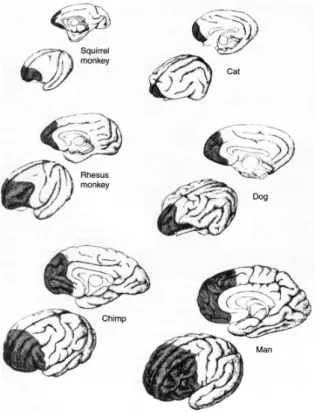
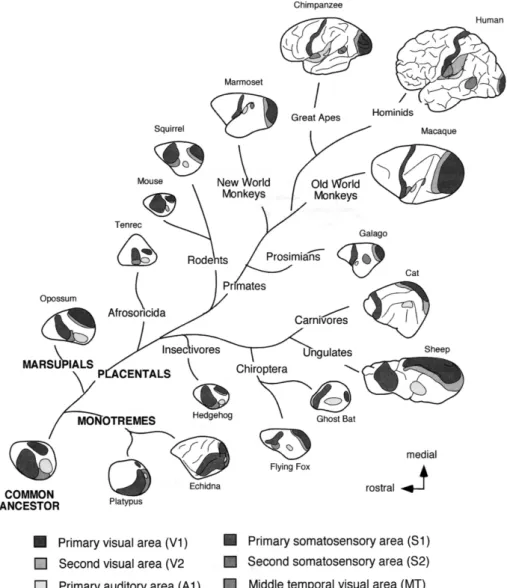
Figure 1 (below) gives a general comparison across several mammalian lines, and although microcolums and connectivity cannot be seen, it provides a good idea of the development across mammal species. The medial (middle) view is above, and slightly right of center of the rostral-lateral (front-side) view for each specimen. In figure 2 (below) another scale of relative development can be seen. The general cortical areas related to vision, auditory, and somatosensosry processing are shown. We can again see that the ubiquity of the organization evidences an underlying developmental ‘blueprint’ of sorts, for the mammalian brain—at least— and the most complex development is in the human brain. Cortical system developments can be found, such as the arcuate fasciculus, which show increments in connectivity and trajectory across brain builds (Preuss, 2009).
The neocortical sheet, the latest developed area of brain, gives us a general continuum of quantitative and qualitative complexity of development over evolutionary time. The results reflected in the attributes which the H. sapiens excels at over and above other primate species, as they are correlated with the PFC, equally reflect the potential of ‘conscious’ that we have arrived at through this continuum of brain build.
FIGURE 2 A phylogenetic tree illustrating evolutionary development of mammalian cortical
fields. Some areas such as MT, however, are only found in primates, while others (e.g. BA 10) are almost exclusively—but not only—found in primates. Additionally, the percentage of association cortex area is considerably increased in H. sapiens. (Source : Krubitzer, 2009; p 47)
Homo genus development
The fact that as a species within a genus whose other members had become extinct (in one way of speaking; see below), we H. sapiens have had a hard time conceptualizing our being part of the flow of natural development. We have now come to see, however, that the neural capacity and arrangement making our state of consciousness is the result of brain and ‘conscious’ development representing a continuum of sorts, extending from the ancestors of our genus to us H. sapiens.
The evidence reasonably suggests that stone tool technology and the Homo lineage co-evolved (Klein, 2009), although that ‘necessary ingredient’ for having a clear state of consciousness— namely symbolism—appears to have developed more robustly in the Middle Stone Age, thus later (Tattersall, and Matternes, 2000; Tattersall, 2009). While the recent draft sequence on the genome of H.neanderthalensis gives secure evidence that they were closer to present day Eurasia individuals, rather than African individuals, and that interbreeding occurred up to around 2% (making the Neandertal genetically still here, so to speak), it still cannot inform us about specific brain build, linguistic abilities, or the potential degree of extended consciousness they may have enjoyed (Gibbons, 2010; Green, et al., 2010). With the Neandertal we do have evidence for symbolism, thus some degree of a linguistics base, and extended consciousness can arguably be given them (Zilhao, et al., 2010-a; Zilhao, 2010-b). Additionally, with findings which can possibly be attributed to H. sapiens, or at least other Homo genus species, we can clearly deduce a slow, steady continuum of cognition development, and, by extension, ‘conscious’ development which leads to extended consciousness (higher-order consciousness) development (Hodder, 2004; Shermer, 2004; Wong, 2005; Alperson-Afil, 2009; Balter, 2009-a; Balter, 2009-b; Balter, 2009-c; Culotta, 2009; Lawler, 2009; Outram, et al., 2009; Suwa, et al., 2009; Wong, a; Wong,
2009-b). This line of evidence also bolsters the understanding of a continuum across evolutionary time
within the Homo genus, and, for the H. sapiens even; yet we can also see the results of such continuum across the spread of contemporary non-human animals as well—from the least ‘mindful’ to the more ‘mindful.’
Non-human cognition, intelligence, and levels of consciousness
If we were to picture the continuum of brain build and its complexity seen in evolutionary history to date, as a vertical array of sorts, then we might well consider the spread of brain build, cognitive capacity, intelligence, and consciousness properties seen across the present results of evolutionary forces, from the earthworm to the human being, as the horizontal spread of that array. To visualize this fully would require us to consider the fuller range of present living animals, which would be far beyond the scope of this presentation—therefore I will present only a few instances here to make the point.
We can see a tendency by the philosophically minded in some of the literature, to refine what might be meant by ‘cognition’ (Stewart, 1996; Shettleworth, 2001) and how that would come to bear on animal studies of cognition and intelligence, yet I argue that by taking the general English definition, we will be just fine in the present purpose. While there have been a number of attempts over the past 100 years, or so, to demonstrate animal intellect and cognition, some have been shown to have used misguided methodologies, or to have relied on misinterpretations, such as Von Osten’s clever horse, Hans (Gould, and Gould, 1998). Other studies and cases have been based on better methodology, and have taken care not to over anthropomorphize.
Of the more recently well tested and known examples of birds, Alex, the communicating Gray Parrot (Psittacus eriyhacus) is a good example. Irene Pepperberg has shown that Alex could distinguish between abstract concepts of not only ‘same,’ and ‘different,’ but between colors,
shapes, and number. Additionally, through a number of experiments, and in a novel way, it was demonstrated that Alex understood the concept of nothing (or zero), as well. While Pepperberg has summarized that Alex did not perform in communicative tests as well as a human 2-3 year old would, the parrot’s skill matched that of some non-human primates (Pepperberg, 1998; Scholtyssek, 2006; Pepperberg, 2006). The African Grey parrot is not the only example of cognitive abilities of some birds however, there are examples of comparatively higher levels of cognition and memory capacity in a number of Corvids (compared to other non-primates) which has been argued to practically equal that of the Great Apes; in cases (Emery, and Clayton, 2004; Marzluff, et al., 2010; also see : Levey, et al., 2009).
In the studies of our close relatives, the chimpanzees (pan troglodytes) and bonobos (pan
paniscus), there have also been examples involving communication with humans, such as Kanzi
(bonobo). With these members of the Great Apes, however, there are other aspects of a developed cognitive capacity which fits in along the continuum from monkeys and other animals of simpler cognitive capacity (including the earlier hominids), to the H. sapiens. Social cognition, while not equal to that of humans, or the same as Prairie Voles (McGraw, and Young, 2009), is one example, along with tool usage (especially by the chimpanzees), and a ‘theory of mind’ (TOM)-like cognitive ability (Gallup, and Povinelli, 1998; Whiten, and Boesch, 2001; Shermer, 2004; Waal, 2005; Mulcahy, 2006; Palagi, 2007; Kacelnik, 2009; Balter, 2010; Cohan, 2010; McGrew, 2010; Towner, 2010).
Even in other animals such as dogs, horses, elephants, and dolphins, we find levels of cognitive complexity which fit along the horizontal array of evolutionary brain and ‘conscious’ build. Some dogs, like chimpanzees, but to a more ‘primitive’ degree, demonstrate inequity aversion—in other words, they know when they are not getting the fair end of a deal, and react in an emotional manner (Range, et al., 2009). The ability of some elephants to basically pass the ‘mirror test,’ as well as the evidence for their attention to deceased clan (or species) members, demonstrates at least a certain quality of cognitive capacity which species lower on the ladder (so to speak), have not evidenced to date (Plotnik, et al., 2006; Douglas-Hamilton, et al., 2006). These studies and examples, among others, give ample evidence in support of a continuum of ‘conscious’ across animal species today. (also see : Griffin, 2001; Hampton, 2001; Fagot, and Cook, 2006; Janik, et
al., 2006; Pennisi, 2006; Premack, 2007 [In Premack’s argument, earlier transitional, and hominid
middle species, have been ignored, as well as earlier members of the Homo genus, thus in this way is perhaps ‘jumping’ to a conclusion against Darwin’s proposal of the continuum of mind.]) In summary here, from the perspective of evolutionary selective processes, and the stream of time over which such has had to work, we can conclude with a rather high degree of confidence that there is a continuum of brain build—anatomically, functionally, and cognitively (ND; PFC development). While it may be popular, or convenient, to do so ( Premack, 2007; Gazzaniga, 2008), we are required to visualize not just a comparison between the H. sapiens and the Great Apes—because both lineages have had their own specific niches of selective pressures—rather, we must visualize brain development over the whole line of species which have, and do, house brains. A chimpanzee-centric model has sufficiently been found to be less realistic (Lovejoy, 2009; cf.
Bolhuis, and Wynne, 2009; Harrison, 2010) with recent investigations of Ardipithecus ramidus, and the Neandertal genome project, yet ‘conscious’ has been shown to be reflected in a continuum in both the vertical array of evolution, and the horizontal array which is its present width.
Do we then apply our definition of having a state of consciousness to non-human animals, therefore? Can we think of a bonobo as having a certain degree of consciousness, or our pet dogs, or parrots? They evidence relatively high levels of ‘conscious’ which might just pass that
threshold. The evidence accumulated to date, and the scientific procedure for investigating such
(Rossano, 2003; Seth, et al., 2005; Edelman, and Seth, 2009) give us room to understand that not only does ‘conscious’ exist as a continuum of sorts, but that from it certain degrees, levels, or types of consciousness also emerge, and therefore other non-human animals more evidently display the capacity for a level, and, or, type of consciousness due to that. However, since the main problem in animal studies is accurate report (Seth, et al., 2005), I turn to the individual human, to further demonstrate the paradigm of ‘conscious’ as a continuum.
The Individual Brain Perspective
One thing we will often enough hear is the comment that the human brain is the most complex system known to us within the system of the universe. While that could be presumptuous on our part, we must marvel at the fact that within a segment of brain the size of a grain of sand, say, from the neocortex, we find some 100,000 neurons with around 2,000,000 axons, making in the neighborhood of 1,000,000,000 synaptic connections; that’s a lot of ‘neuron talking’ being done (Ramachandran, and Blakeslee 1998). To help conceptualize the continuum of ‘conscious’ in the individual human brain, we will look at two aspects: the development process, and, reportable and observable states of the brain.
Development of the Human Brain
Fast forwarding the processes and cellular activities from the blastocyst, through neural migration during gestation—starting in the thirteenth postconceptional week (PCW) or so—we arrive at the rather developed, prenatal human brain. This is the early preterm period (around 24-32 PCW). Around this time we can see that input from the thalamus, which is important for consciousness (as we will see later), is in place, but the corticocortical pathways are not formed enough to project to the prefrontal area (Kostovic, and Judas, 2009). Even earlier on, however, neuronal activity, in certain spiking patterns, appears to play a role in specifying aspects of brain structure development, long before external sensory input can play any role.
By around the 33rd PCW, there is a noticeable electroencephalography (EEG) above what can
be seen in the early preterm period, with large increases of axonal and synaptic growth (cortiocortical, and thalamocortical pathway development), as well as neuronal differentiation, neurochemical maturation, and pruning (here mostly the dying off of cell parts due to lack of use) among other processes and activities. At this point the fetus will react to auditory input (Gage, and Johnson, 2009), have autonomic reaction to vibroacoustic stimuli (Zelazo, 2009), and will make
‘voluntary’ movements. We can understand that levels of ‘conscious’ are signified here, and at this point, the final weeks before full term, we find wakefulness and the basic building blocks of core
consciousness (or minimal consciousness), yet ‘conscious’ has not quite built up enough to
completely cross beyond that threshold much yet.
In the months which follow birth—neonatal and infancy—cortical expansion is robust. Areas, for example, which support simple declarative memory in the medial temporal lobe (MTL) are rather functional during the first months, but PFC still has to wait until the latter half of the first year to functionally mature enough for non-verbal declarative memory to be expressed (Morasch, and Bell, 2009). Studies have shown that infant recall emerges at around the sixth postnatal month, and improves as PFC matures further in the last months of the first year onward (Morasch, and Bell, 2009). Yet it takes up to some sixteen, to seventeen more years for PFC to fully mature through myelination, pruning, and apoptosis—with myelination usually continuing for up to a couple of decades (Zelazo, 2009). The matter of PFC development likely has more bearing on cognitive capacity and acuity, yet these facets have bearing on ‘conscious.’ Therefore brain development processes, extending over a period of time between the early preterm fetus and adulthood, signify a build of ‘conscious’ along that time continuum. This element of continuum can also be visualized by looking at the instance of the individual brain states.
States of the Human Brain
A most natural place to begin here, and which is very fitting with the general chronological development shown in the above subheading, is that state from which we start each day—sleep. Referring back to our working definition, it will be recalled that ‘a condition or state (or activity level) opposed to that of sleep’ is necessary for having, or experiencing, a state of consciousness. Additionally, it is simply commonplace to speak of a person’s being sound asleep, as being
unconscious—meaning there is no state of having consciousness. Will that mean that there is no
‘conscious’ level at all?
The first trade mark of being sound asleep is that of the EEG signature of slow-wave sleep (SWS), or non-REM (NREM). SWS is usually divided into four signature stages, yet can be labeled as N1-N3, with N2 and N3 being the really deep sleep stages, and with N3 having two different signatures (Tononi, 2009). In N3 the thalamocortical system, which is necessary for consciousness, is active, but a bi-stable condition of ‘ups and downs’ keeps it to a very minimum. Because studies have shown that up to 60% of the time, those awakened from SWS report thoughts (not dreams, per se), it can be understood—even giving margin for error—that there are clearly cognitive-like events happening in the brain; our ‘conscious’ level persists (Tononi, 2009; Dang-Vu, et al., 2009). This is further verified by the fact that sleep walking (SW), otherwise known as
somnambulism (also somnophagia, and sexsomnia) occurs during SWS, as well, but accurate
report cannot be given by subjects.
After falling asleep, a person usually enters REM after about 90, or so, minutes (although entry into N1 may slightly resemble it). Except in those rare cases of REM sleep disorder behavior, muscle tone is lost (sleep paralysis, or atonia) and acting out our dreams is thus prevented. When
awakened from REM, dream content will be reported up to 90% of the time in the early night cycles, and almost 100% in the early morning cycles—which is about the report rate for ‘day dreaming’ in wakefulness. Dreams will always be hallucinatory and imaginative in nature, consisting of frames of non-related events merging into a single flow, and stem from memory access (Griffin, and Tyrrell, 2004). Dreaming, therefore, will always require a certain degree, or level, of cortical integration and connectivity above that of SWS. There are instances where that level of ‘conscious’ will be very much border-lined with extended consciousness, in states of lucid dreaming.
Lucid dreaming is that state where during REM, the degree of cortical connectivity and integration will allow a person to experience exceptionally vivid dreaming while being aware of that being a dream. It allows cognitive interaction within the dream contents, and the dreamer can control aspects of the dream, attention directed towards participants in the dream, and can feel and emotionalize in the dream. Studies have demonstrated that lucid dreaming (sometimes called
dreams of knowledge) does occur during REM, and that factors of motor control concur with
preplanned activity. (Lucid dreaming can be learned as a skill, and thus this was possible to test.) There is evidence, though still not proven, that a lack of connectivity of the dorsal lateral prefrontal cortex (DLPFC) which is found in other stages of sleep, including REM, is not found in the instance of lucid dreaming (Tononi, 2009; Revonsuo, 2009). This means more of PFC is being connected with the limbic system and extrastriate—two areas involved with REM (possibly in dreaming, especially). There is, paradoxically, the opposing state to lucid dreaming, as well, however; sleepwalking.
Sleepwalking (SW) is that state, more often in the first third of the night, where in SWS a person will become aroused, and undertake action (both simple, meaningless motor behavior, or complex, seemingly meaningful behavior; see second paragraph of subheading). Here we come so very, very close to an example of that philosophical zombie—a person sans consciousness acting in an everyday manner (Koch, 2004). Reports of dreaming during SW are uncommon, and total lack of recall is most usual. Therefore unlike dreaming states (except for REM sleep disorder
behavior), motor function and behavioral activity become on-line while visual-episode
consciousness and memory are not. There have been a number of court cases in which defendants have been acquitted of crime due to having been asleep at the time. One famous case is that Ken Parks, a known sleepwalker, who drove his car to his in-law’s house, strangled his father-in-law into unconsciousness, and then stabbed his mother-in-law to death (Tononi, 2009). Another far less publicized case is that of Jan Luedecke, who was acquitted of charges of sexual assault because of being asleep at the time (Marshall, 2006; also see Ebrahim, 2006; Anderson, et al., 2007). We can all associate with the emotional attachment one may have of a dream remembered, be it positive or negative, and we all know of that gap of ‘no report’ after having been sound asleep, yet the levels, or degrees, of ‘conscious’ which operate in lucid dreaming, and SW, are surely hard for most of us to fully grasp.
In summary here, from the perspective of the individual brain, we can compare the different levels of connectivity, and integrated activity, and more conceptually visualize just how ‘conscious’
is a continuum. Across the graph of brain activity from a ‘start’ position, so to speak, in both the development of the brain from the first PCW, and the state of the brain across the stages of sleep from SWS to wakefulness, while not so perfectly straight, nor linear, ‘conscious’ nevertheless presents itself as a basic continuum (consider figure 3, below; Source: Adapted from Carter, 2009; pp 176, 177). Evidences from neuroscience and clinical cases, will further demonstrate these aspects.
FIGURE 3
The Neuroscience and Clinical Evidence Perspective
The findings of neuroscience (including all branches, cognitive science, and consciousness science), along with clinical evidence, give us a somewhat clearer picture of the central nervous system today, than even as recent as ten years ago. The scientific study of brain (micro), and of the brain (macro), has slowly provided us with knowledge of degrees, or levels, which are required for reaching beyond threshold levels of consciousness. Of course there is so much more to learn and verify, yet we can make safe theories, and assumptions for further hypotheses, even now. The range of information in the literature is vast, and here I will only point out a summary of evidence
for the continuum that ‘conscious’ is, by touching on blind sight, inattentional blindness,
split-brain studies, and disorders of consciousness.
Neuroscience Evidence
Blind sight (BS) is that condition where there is no normal visual experience that can be reported
on, yet behaviorally, visual experience is demonstrably present. Upon coming out of a coma, D.H. realized she was totally blind—she could not report seeing anything. Observation and testing demonstrated, nevertheless, that she could behave in certain manners which demonstrated visual experience below the threshold of consciousness. Without being able to verbally report any visual knowledge of the vertical to horizontal angle of a mailbox slot, she could smoothly insert a ‘letter-like’ sample into the slit (Ramachandran, and Blakeslee, 1998). One elderly patient being slowly overcome by a focal atrophy version of Alzhiemer’s Disease was reported on by Dr. Bradly (2009). The atrophy had begun in the visual cortex and had at first induced blurred vision, followed by blindness. Dr. Bradly had been informed by the patient’s daughter that she could somehow still hit tennis balls (she had once been a semi-professional tennis player), yet having seen the patient walk into a wall while being led to his office on her first visit there, may have wondered. As she entered his office, he threw a wad of paper to her and she caught it with ease. In BS, the level of ‘conscious’ which is found still allows a certain degree of function, but not at a level which reaches the state of having consciousness (Lamme, 2006; Lamy, salti, and Bar-Haim, 2008).
Inattentional Blindness (IB) is that circumstance where visual sensory input is clearly taking place, but accurate report of the experience of having seen an object or event, cannot be given. The most famous study is probably that done by Simons (2000), where in a video a person in a gorilla suit walks across the basketball court while some others are throwing a basketball around. The subjects watching the film in the study were asked to pay attention, and count the number of throws members of a black team and a white team made, then report on their tallies. Seventy-nine percent of the subjects failed to consciously experience seeing the gorilla walk through the middle of the players, and even though the visual input had definitely gone through at least the basic visual cortex areas they could not report knowledge of the event (Simons, 2000; Rensink, 2009). A somewhat similar effect can be seen in auditory sensory perception, which in effect also demonstrates a ‘bottleneck’ of sorts (Baars, 2007-b), by preventing a level of ‘conscious’ from getting spotlight attention—and by extension preventing that experience from involving higher levels for consciousness.
Clinical Evidence
Split-brain studies are those done involving patients who have usually had the corpus callosum
(and in cases, other commissures too) severed completely; and occasionally, involves those with corpus callosum damage. In tests which have been very carefully designed, it has been found that both hemispheres evidence their usual asymmetrical differences, showing asymmetrical contents, and activity. Both hemispheres still have connectivity through subcortical structures, yet the two cortical hemispheres cannot directly communicate. Cases of ‘right hand-left hand conflicts’ are not
so commonly reported among commissurotomy patients, but can be found—such as pulling up trousers with one hand, and pulling them down at the same time with the other hand (LeDoux, 2002, p305), or having a suicidal left hand occasionally trying to choke the patient (Ramachandran, 1998). More common, however, are reports on events demonstrating a lack of left-hemisphere (LH) knowledge of what the right-hemisphere (RH) had been doing with the left hand in a particular test situation.
For example, when a picture had been shown to the RH only (via left eye), and the patient was asked to draw what had been seen (and the patient didn’t admit to having seen anything because speaking and ‘knowing’ linguistically, is usually a LH ‘conscious’), the left hand began to draw a phone. The patient, however, could not report on what was being drawn (some outside observers didn’t know either) until it was almost finished (Gazzaniga, and Miller, 2009). Linguistic ability, and inner voice, arguably, do not make all there is to consciousness, but do contribute quite a bit for most of us (Morin, 2009; compare Mitchell, 2009), and there are asymmetrical differences in the two hemispheres regarding spatial cognition, numerical cognition, and ‘self-other’ cognition (Corballis, 2003; Feinberg, and Keenan, 2005; Laeng, et al., 2007; Morris, Pelphrey, and McCarthy, 2007; Knowlton, and Holyoak, 2009). From this perspective as well, we can understand that ‘conscious’ is that which builds as connectivity, integration, and reentry processes build toward having a state of consciousness.
Disorders of consciousness (DOC), as a general term, could possibly be seen as a spread across a spectrum (continuum) of sorts, although the term most usually refers to the states of coma,
vegetative state (VS), minimally conscious state (MCS), and locked-in syndrome (LIS) alone.
This spectrum is visualized in figure 4 (compare figure 3). The VS category has had two general divisions, namely, persistent vegetative state (PVS), and permanent vegetative state (PVS), but since confusion was common, it has been suggested that PVS be regarded as standing for the latter, and anything before that (i.e. at 12 months for a traumatic brain injury, and 6 months for a non-traumatic brain injury) should simply be called VS (Owen, 2008).
Coma is considered to be that state of extremely low level ‘conscious’ which otherwise behaviorally resembles SWS. Prime damage remains in the brain stem area—ascending reticular activating system (ARAS)—or possibly in a diffused number of disconnected, dysfunctional pockets in other areas, but which at any rate are not building towards having a state of consciousness in any way—due to thalamocortical system breakdown, or a certain degree of herniation (Owen, 2008; Young, 2009). The level of ‘conscious’ in a coma state is, obviously, more than that in brain death, and less than that of NREM sleep. Recovery is possible, yet often means a shift into PVS, or MCS, and afterwards possibly into better scenarios (Tononi, and Koch, 2008).
VS is that state in which sleep-wake cycles can be seen, and autonomic, ballistic-like motions, or inconsistent reflexive behavior can be seen, but in which evidence of the patient’s lack of awareness of self or environment, lack of voluntary, purposeful movements, and lack of language comprehension and expression persist (Demertzi, Laureys, and Boly, 2009). While the brainstem and hypothalamus, as well as the ARAS are usually without much damage, widespread lesions of gray-white matter can be found, diffused axonal injury, or bilateral thalamic damage—especially in the paramedian thalamic nuclei. It has been shown that the diagnosis of VS is not always a hard-lined and rigid definition, but can, even itself, be something of a range of possible brain conditions, or processing abilities overlapping with MCS.
One famous study done by Owen et al. (2006) involving a patient who had been clearly diagnosed to be in VS demonstrates this well. The patient was verbally asked to imaging playing tennis, and then, to imagine walking through her house, looking at, and imagining, the furniture there, while being scanned by f MRI. A number of normal subjects were also scanned while being asked to do the same task, their averages overlapped, and then compared with the patient. The questions were particularly chosen in this study because they create statistically distinguishable patterns of neural activity (neural markers). Playing tennis activates the supplementary motor area in imaginative exercises as well as actual movements, and imagining walking through one’s house would activate parahippocampal, and lateral premotor cortices, as well as the posterior parietal lobe. The results of the control scans very much matched that of the patient statistically, which results allow us to consider such a high degree of ‘conscious’ that we can reasonably say the patient had been aware of herself and her surroundings, and had been able to willfully execute the demands, as well as understand them (Owen, et al., 2006, 2007). Furthermore, the mere fact that the patient had demonstrated an understanding of the oral instructions given before the scans, and later willfully execute them, gives us plenty of room to consider the involvement of a somewhat ‘self related’ state of extended consciousness; to some degree (Monti, Coleman, and Owen, 2009). MCS is that condition in which a patient will present a level of consciousness (LOC) above that in VS as diagnosed by clear evidence of at least one of the several following behaviors—1)
following simple commands; 2) gestural, or verbal yes/no responses; 3) intelligible verbalization;
4) movements or affected behavior beyond simple reflexes (Giacino, and Schiff, 2009). As can be noted, there is much weight given to the integrity of language and motor systems, demonstrating, in turn, a higher level of overall ‘conscious.’ Here also, there have been studies which have
demonstrated various improvements of cognition and volitional movement by pharmacological and electrode implants—thus, most likely, increments in LOC also occur.
In especially two case studies, it was demonstrated that administration of zolpidem (a GABA agonist) allowed one patient to emerge from MCS, and another patient who was more likely in MCS to stand, walk, oral-feed, and repeat single words and sentences (Giacino, and Schiff, 2009). Among a number of studies, one double-blind case study done by Schiff (2009-b) with central thalamic deep-brain stimulation clearly evidenced improvements in cognitively mediated behaviors (Schiff, 2009-b). We cannot be absolutely sure of the subjective 1P state of consciousness in these cases, but observational results inform us that a higher LOC has been obtained—which can in turn be attributed to a higher degree of ‘conscious’ (more brain is integrated and working).
In summary here, from the perspective of evidence obtained by the neurosciences and clinical studies, we can visualize how living brain cells (especially neurons, though not only) working in an integrative, connected fashion—amounting to what I herein term ‘conscious’—increase to a threshold from which the state of having consciousness emerges. The particulars of cellular activity have a bearing as well, for example the synchronicity responsible for SWS, in one domain, or a certain cluster of neurons’ neurotransmitter receptor count, say dopamine (DA), in another domain. Therefore ‘conscious’ increment is not just the matter of the number of cells that are alive and functioning properly, but is also a result of the quality of cellular activity. That the very term LOC is used even, in DOC research (Giacino, and Schiff, 2009), allows us to consider that ‘conscious’ levels are higher in MCS compared to VS, higher in VS compared to coma, and higher in coma compared to brain death (zero ‘conscious’).
Discussion and Summary
The inquiry into mind and consciousness is no longer only a philosophical exercise, but has also become a full-fledged scientific concern—if not even more so. Having emerged from the ‘Dark
Ages of Behaviorism,’ consciousness science, involving neuroscience, cognitive science, and
psychology, has led the way in firmly establishing the scientific study of brain processes related to mind and consciousness. In this way, the scientific study of consciousness has been put in a positive light in the academic world at large. In doing so it was necessary to hold consciousness as a variable, which in turn, required testing it against what it was not—unconsciousness. For scientific and clinical purposes this is necessary, although it can be said to leave a sense that something is lacking.
The tendency for some to hold to dualistic philosophies persists (compare: Demertizi, et al., 2009), yet the evidences most clearly demonstrate that it is brain, upon which mind and subjective consciousness fully depend. Taking that and the fact that most brain processes are not those of consciousness, along with the evidenced understanding that ‘a deep structure of necessary and undeniably efficacious nonconscious mechanisms underlies consciousness ( Edelman, and Tononi, 2000: p 218),’ one might sense that the brain is being seemingly split in two—with only one proponent (consciousness) getting public spotlight attention. What brain does mostly, however, is
not directly related to consciousness, and is too often referred to in the negative—as that which it
is not.
One proposal and objective in this paper is to amend this lack by adaptation of a new sense of the word conscious, by making syntax-based semantic application of it as a non-count noun on a discourse-like level (Murcia, and Freeman, 1999; pp 23, 24, 273-276). I argue that the need for such a clarifying, and positive reflecting term in consciousness science is strong, yet in fairness acquiesce that creating a new sense of an old word, namely ‘conscious,’ is likely not be the best route. Further study is needed on that matter, yet for the moment, as it is, I hold ‘conscious’ to be a place holder for a whole-brain phenomenon. It is that constitution, or condition, of active cellular process which is exclusive to ganglion and brain. As demonstrated above, in a number of ways it is a continuum across evolutionary time, species, and individual brain build and state. It draws more attention to the wholeness of synaptic connectivity which builds toward the individual person (LeDoux, 2002; Cook, 2008), and puts into a more positive spotlight, more of what brain does mostly.
The neurons of the ARAS have the property of ‘conscious’ when they are alive, just as all neurons, and maybe some glia cells, do. In this manner, all of brain has this property regardless of any level of consciousness, or participation by any ‘conscious’ in such state or content. Mechanisms and processes which have no, or little (and indirect) relation to having consciousness, along with those that do, all have the property of ‘conscious,’ thus this term pertains to the whole brain. This property does have level, degree, or intensity, just as a single neuron’s spiking frequency can be described in such terms, and is relative to connectivity, integration and plasticity, among other properties, also. For that reason, the aggregate ‘conscious’ we see in SWS is of a different level than that of being awake, and that of a two day old human baby will be different from that same person at the age of 22. In this way ‘conscious’ is thus a continuum and a whole-brain property—defined as such even in the case of the hemispherectomy patient. It applies to all brain and ganglion concerned species. What benefits, then, can this paradigm shift offer in a pragmatic way?
Anthropocentric idealism of the past has been cleared up by the ever gathering evidence. We cannot surgically remove the H. sapiens from the evolutionary phylogenetic tree from which its branch extends, and say there is no comparison in any way with all other life forms. This is as true for brain build, as it is for most other physiological elements. Just as the common fruit fly experiences ‘conscious’ perturbation with loss of sleep (Bushey, et al., 2007), so does the human. Rather than deny any different and special attributes which we H. sapiens have even over just the other primates, or they over other species, this paradigm shift helps keep our connections in mind—and especially the continuum of ‘conscious’ as a property of ganglion and brain. While there are ‘phase shifts,’ as Michael Gazzaniga put it (2008, p 3) regarding the difference in being human versus ape, ‘conscious’ is clearly a general continuum. A non-extremist respect for our fellow animals can thus be achieved.
On the level of human relations there will surely be practical application. Just as there is no ‘half-breed,’ there is no ‘half ’ individual, nor ‘half conscious.’ It will surely become easier to see
‘whole’ individuals even while acknowledging differences—such as in age, gender, sexual orientation, or cultural disposition (compare: Kagen, 2010; Pinker, 2002; pp 435-439). As the world grows smaller, the ‘salad bowl’ (compare ‘melting-pot’) grows larger, and this paradigm will surely help in international and intercultural interchanges.
Social matters such as child raising, family planning, and education will likely find much to benefit from with a ‘whole-brain’ paradigm. This is thinkable in that seeing each individual as a special individual on the same continuum as oneself, can arguably lead to the simultaneous acceptance and appreciation of unity and diversity with others. In how it is that each finger print is subtly different, yet generally the same, each brain, thus individual, can be understood—surely resulting in more productive, and positive-in-outcome social bonding among peoples of different social class, ethnic linage, and educational background.
Additionally, with further educational avenues focused towards the general public which emphasize a ‘whole-brain’ view, I envisage a better public understanding of what the fine differences between neurological disorders and illnesses, and psychiatric problems are. That, in turn, may well lead to increases in ‘quality of life’ concerns for many who are afflicted—such as those with Asperger’s syndrome, high-functioning Autism, Schizophrenia, Bipolar Disorder, Dyslexia, Multiple sclerosis, and Alzheimer’s disease among others (compare: Fins, 2009). This paradigm shift gives further room for advances in positive, and productive-in-outcome human relation building—on the family level through to the international level.
As Stephen Covey movingly demonstrated in his New York Times Bestseller, The 7 Habits of
Highly Effective People, a paradigm shift can be a powerful, positive and productive-result
producing event—when it goes in that direction (Covey, 1989; esp. see: pp 30, 31). To test the proposal presented here, and check the results in an empirical manner, will surely require some time. There are studies to be done, and measures are already being taken, as can be seen in the Society for Neuroscience’s efforts to reach out to educators at K-12 levels, as well as at the university level (also see: Hardiman, and Denckla, 2010), and by programs such as The Center for Consciousness Studies at the University of Arizona, to promote a better public understanding. Of course, in all this we have to reason carefully, and keep as balanced, and well-supported-by-the evidence, an understanding as possible (compare: Baars, 1997; p 129; Shermer, 2004).
In summary, then, the best evidence tells us that ‘conscious’ is a continuum, an inherent factor in itself of brain on the evolutionary and individual scales. It is what extends in degree, connectivity, integration, and activity, from wakefulness to the emergence of core consciousness, then especially for humans, extended consciousness. It largely lies in, and is, that activity—the mechanisms and processes—which is not that of consciousness. Gaining an understanding of it, and being informed of it, can lead to a ‘whole brain’ paradigm. While the present term choice, viz. ‘conscious,’ likely stands to be corrected after further study and thought, it eliminates the need for a negative, and demonstrates, as a place holder, a conclusion of the best evidences collected by the brain sciences and consciousness science.
By programs and avenues offering further public awareness, this paradigm shift, which can lead to a more positive and productive outlook, can in turn, give impetus to pragmatic social
applications—leading to possible improvements in many areas. One key factor for the social applications which I foresee this paradigm as playing an important role in is that of a more natural, based-on-stronger-evidence understanding of what is involved in being human. Natural and cultural environment needs ‘conscious’ for that to happen, and so to capitalize on, and add to, a clear observation of Joseph LeDoux (2002; p 24), to understand how the mind, through the brain, makes us who we are, we need to understand the whole mind, and to further that endeavor, we need to have a whole brain paradigm.
Acknowledgments
I wish to extend gratitude to Professor Matsubara for help with the Japanese abstract, Professor Yanokuchi for help with graphics, and Dr. Masaomi Sindo for suggestions for future study related to this paper. I wish to extend special thanks to Dr. Baars of the Neurosciences Institute in San Deigo, CA, USA, and Dr. Munn of the university of Montana, USA, for reviewing and offering challenging suggestions. I thank Elsevier, John Wiley and Sons, Penguin Group, and Oxford University Press for kindly allowing me to make use of copyright materials as noted in the reference section.
————————————————————————————————————————
References
Alperson-Alfil, Nira, et al. (2009) Spatial Organization of Hominin Activities at Gesher Benot Ya’aqov, Israel. Science 326(5960), pp 1677-1680.
Anderson, Monica L., et al. (2007) Sexsomnia: Abnormal sexual behavior during sleep. Brain Research Reviews 56(2), pp 271-282.
Baars, Bernard J. (1997) In the Theater of Consciousness. New York: Oxford University Press.
Baars, Bernard J. (2003) Cognitive Theories of Consciousness. IN: Nadel (ed.) Encyclopedia of Cognitive Science, vol 1, pp 738-744. New York: Nature Publishing Group.
Baars, Bernard J.( 2007-a) Mind and Brain. IN: Baars, and Gage (eds.) Cognition, Brain, and Consciousness. Academic Press.
Baars, Bernard J. (2007-b) Attention and Consciousness. IN: Baars, and Gage (eds.) Cognition, Brain, and Consciousness. Academic Press.
Baars, Bernard J. (2009-a) History of Consciousness Science. IN: Banks (ed.) Encyclopedia of Consciousness, vol 1, pp 329-338. Boston: Academic Press;.
Baars, Bernard J. (2009-b) William James on the Mind and its Fringes. IN: Banks (ed) Encyclopedia of Consciousness, vol 2. Academic Press; pp 459-468.
Balter, Michael (2009-a) Early Start for Human Art? Ochre May Revise Timeline. Science 323(5914), p 569. Balter, Michael (2009-b) Clothes for the (Hu) Man. Science 325(5946), p 1329.
Balter, Michael (2009-c) Better Homes and Hearths, Neandertal-Style. Science 326(5956), pp 1056, 1057. Balter, Michael (2010) Animal Communications Helps Reveal Roots of Language. Science 328(5981), pp 969-971. Bear, M.F., Conners B.W., and Paradiso, M.A. (2007) Neuroscience—Exploring the Brain, 3rd. Ed. Baltimore:
Lippincott Williams, and Wilkins.
Block, Ned (1996) How can we find the neural correlate of consciousness? Trends in Neurosciences 19(11), pp 456-459.
Block, Ned (2001) Paradox and cross purposes in recent work on consciousness. Cognition 79(1,2), pp 197-219. Bolhuis, J.J., and Wynne, C.D.L. (2009) Can Evolution explain how minds work? Nature 458(7240), pp 832, 833. Bradley, Walter G. (2009) Treating the Brain—What the Best Doctors Know. New York:Dana Press.