- 1 -
New enzymatic synthetic methods of chiral amino acids and amines
Kazuyuki Yasukawa
- 2 -
Contents
Introduction………p. 3
Chapter I……….…p. 9 “Dynamic kinetic resolution of -aminonitrile to form chiral -amino acid”
Chapter II……….…..p. 34
“Identification of Nitrile hydratase gene and expression in E. coli”
Chapter III………..…p. 46 “Enzymatic synthesis of chiral phenylalanine derivatives by a dynamic kinetic resolution of corresponding amide and nitrile substrates with multi enzyme system”
Chapter IV………...…p. 63 “Tailoring D-amino acid oxidase from pig kidney to R-stereoselective amine oxidase and its use in deracemization of -methylbenzylamine”
Conclusion………p. 79
- 3 -
Introduction
Chiral compounds are very important building blocks in the synthesis of biologically active compounds. These building blocks include nitrogen and oxygen containing
compound such as amine or amino acid. Many chemical or enzymatic synthetic methods have been described. Today, both the academia and the industry focus on the efficient enzymatic synthesis of chiral compounds as a hot topic of research, especially for the development of sustainable technologies for the production of chiral compounds.
Enzymatic synthesis can be used not only for syntheses under mild conditions but also for the introduction of a chiral center in a molecule.
The works presented in this thesis introduce a new enzymatic synthetic methods of chiral amino acids and amines.
Natural and unnatural chiral -amino acids are extensively used for pharmaceutical, animal feed, and artificial sweetener. Fermentation methods have been successful in the production of (S)-amino acids such as lysine, phenylalanine, tryptophan, threonine, arginine, histidine, isoleucine, serine and valine in industrial scale.[1] On the other hand, a
few proteinogenic (S)-amino acids and non-natural amino acids are produced by enzymatic method. Enzymatic synthesis of chiral -amino acid involves the following: (i) Asymmetric reductive amination of keto acid, for example, the synthesis of (S)-amino acid from -keto acid with NAD(P)-dependent L-amino acid dehydrogenase with cofactor
regeneration.[2,3] The synthesis of (R)-amino acid with D-amino acid dehydrogenase created
by directed evolution from meso-2,6-D-diaminopimelic acid dehydrogenase.[4] (ii)
- 4 -
be synthesized using D-amino acid aminotransferase from other amino acid and -keto acid, although it gives a mixture of four compounds. Ammonia lyase and aminomutase were mainly uesd to produce (S)--amino acid and (R)--amino acid, respectively.[5]
Especially, aspartase and phenylalanine ammonia lyase catalyzed addition of ammonia to fumaric acid and cinnamic acid, and directly converted the substrates to (S)-aspartate and (S)-phenylalanine, respectively which were required in large quantities for the aspartame production. Methylaspartase catalyzed synthesis of methylaspartates reported by Asano et al.[6] (iii) Kinetic resolution (KR) by hydrolysis of racemic amino acid derivatives using
stereoselective lipase, acylase, amidase, hydantoinase and carbamoylase is traditional and easy to use method. However, the theoretical yield of product is limited to 50% in the KR.[7] KR of -aminonitriles using nitrilase[8-12] and dynamic kinetic resolution (DKR) are
the examples of the third category.[13] DKR would be one of the most powerful and elegant
methods for efficient synthesis of one enantiomer from racemic starting materials.
Therefore, DKR has attracted increasing interests from both the industrial and the academic sides. For instance, optically pure -amino acids were produced from
-amino--caprolactam (ACL), N-acyl--amino acid, and 5-monosubstitued hydantoin compounds to be racemized and hydrolyzed by racemase and stereoselective hydrolase(s) in one pot reaction.[13]
Asano et al. focused on amino acid amides as starting compounds for chiral -amino acid synthesis by DKR, because the substrate can be easily obtained by hydrolysis of -aminonitrile which is prepared by Strecker synthesis. They have been studying many (R)- or (S)-stereoselective amino acid amide hydrolases since the information had been limited
- 5 -
on enzymes acting on -amino acid amides and have utilized R-stereoselective amino acid amidases such as D-aminopeptidase, D-amino acid amidase, alkaline D-peptidase, and R-amidase in the KR of amino acid amides.[7] S-Stereoselective amino acid amide hydrolases
such as L-amino acid amidase from Pseudomonas azotoformans[14] and Brevundimonas
diminuta[15] have been characterized by Asano et al.
The purpose in this study is to obtain optically pure -amino acids in theoretical yield with high enantiomeric excess by DKR of racemic -aminonitriles. This DKR process consists of three steps: (i) hydration of both enantiomer of racemic -aminonitrile by a non-stereoselective NHase (EC 4.2.1.84), (ii) stereoselective hydrolysis of resulting racemic -amino acid amide by one of stereoselective amino acid amide hydrolases[14-18],
and at the same time, (iii) racemization of remaining -amino acid amide by ACL racemase (Scheme 1).[19-21] A non-stereoselective NHase is a key enzyme in this method.
Biotransformation of nitrile has been very successful industrial applications and has a great further potential in organic chemistry. Asano et al. have isolated various
nitrile-degrading microorganisms[22-23], and first discovered and characterized NHase from
Rhodococcus rhodochrous J-1 (formerly identified as Arthrobacter sp. J-1).[24-26] He also
- 6 -
discovered that Pseudomonas chlororaphis B23 accumulates huge quantities of amides from nitriles and is suitable for the industrial production of acrylamide from
acrylonitrile.[22, 26] Moreover, nicotinamide and 5-cyanovaleramide are also industrially
produced by NHase.[27-28]
Recently, Asano et al. have been successful in the enzymatic synthesis of nitriles from aldoximes by using the microbial enzyme aldoxime dehydratase (EC 4.99.1.5).[29-30]
They isolated the enzyme for the first time and studied its enzymological properties[31], and
found that the enzyme and nitrile-degrading enzymes such as NHase[32] and nitrilase[33] are
linked genetically forming clusters[34-35], in the “aldoxime-nitrile pathway”.
In the past, several NHase have been purified and characterized from various microorganisms.[24-26, 36-44] However, none of these has been explored in detail for their
catalytic activity to hydrate -aminonitriles. Most of research for the enantioselective NHase for -aminonitrile has been done in whole cell systems rather than with purified NHase.[10-12, 45-47] Whole cell system is complicated by the presence of amidases that
catalyze the hydrolysis of the product -amino acid amides and their velocities are not measured, but only by yields of the products. Thus, in this study, the author reports the screening, purification, characterization of -aminonitriles hydrating NHase, and cloning of its gene and its application to the DKR of -aminonitriles to form chiral -amino acids.
On the other hands, the efficient enzymatic synthesis of chiral amines as a building block in the fields of pharmaceuticals and agrochemicals has also been the focus of academia and industry. Lipase, R, or S-stereoselective transaminase has been mainly used to examine the enzymatic synthesis of chiral amines.[48-50] The deracemization of racemic
- 7 -
amine to form (R)-amine has been reported using S-stereoselective amine oxidase employing a chemical reductant.[51-56] Amine oxidases (AOx) catalyze the oxidative
deamination of amine to form aldehyde, hydrogen peroxide, and ammonia via an imine intermediate. AOx can be classified into two groups based on the type of cofactor in the active site, namely Cu containing TPQ-dependent AOx[57] and flavin-dependent AOx [58].
These AOx preferentially oxidize simple straight chain primary amines such as butylamine, phenylethylamine, and dopamine rather than chiral amines at the alpha position such as -methylbenzylamine (MBA).[59-60] Several studies have examined the actions of AOx on
chiral (S)-amine.[51-56] Turner et al. reported engineered S-stereoselective flavin-dependent
monoamine oxidase (MAO) variants from Aspergillus niger for the deracemization of racemic amines producing chiral primary, secondary, and tertiary amines.[51, 52, 55, 56] The
catalytic activity of these mutants toward chiral primary amines was shown to be higher than that of simple primary amines. Leisch et al. successfully synthesized (R)-amine by deracemization using S-stereoselective cyclohexyl amine oxidase from Brevibacterium oxydans IH-35A.[53, 54] Kohler, et al. more recently synthesized secondary cyclic (R)-amines from their corresponding racemic amines or imine compounds by a cascade reaction with a metalloenzyme under mild conditions.[61] The reaction consisted of two steps; amine
oxidation by mutant MAO and the reduction of imine with an artificial
transfer-hydrogenase[62] instead of a harsh chemical reductant. However, R-stereoselective AOx
suitable for deracemization have not yet been identified. TPQ-dependent AOx from Escherichia coli and Klebsiella oxytoca were shown to oxidize the R-enantiomer of amphetamine preferentially with moderate enantiomeric ratios (E = ̴ 15)[63], although they
- 8 -
are not suitable for the deracemizaion reaction because cofactor TPQ and intermediate imine formed a covalent bond. The purpose of the present study was to evolve flavin-dependent porcine kidney D-amino acid oxidase (pkDAO) into R-stereoselective AOx and apply it to the deracemization of racemic amines.
In this thesis, the author studied functional analysis of -aminonitrile hydrolyzing enzyme and its application to chiral amino acids synthesis by dynamic kinetic resolution. Furthermore, development new R-stereoselective amine oxidase applicable to the
production of (S)-amine by deracemization method was described.
In chapter I, the author described the isolation and characterization of
non-stereoselective nitrile hydratase from -aminonitrile hydrolyzing microorganism. He also developed new enzymatic synthesis of chiral amino acid by dynamic kinetic resolution.
In chapter II, the cloning and expression of nitrile hydratase gene in Escherichia coli, and its application for production chiral amino acids were carried out.
In chapter III, enzymatic synthesis of chiral phenylalanine derivatives by a dynamic kinetic resolution of corresponding amide and nitrile substrates with recombinant E. coli encoding NHase as well as E. coli co-expressing D-amino acid amidase and mutant ACL racemase was established.
In chapter IV, he described the evolving R-stereoselective amine oxidase from porcine kidney D-amino acid oxidase. He also established to enzymatic deracemization of racemic amine using engineered enzyme.
- 9 -
Characterization of non-stereoselective nitrile hydratase applicable to the production of chiral -amino acid by one-pot three enzyme cascade
Five new bacterial strains having low-stereoselective nitrile hydratase (NHase) activity toward (RS)--aminobutyronitrile (ABN) were isolated from soil. Strain 71D, a bacterium producing high NHase activity with low stereoselectivity, was selected and identified as Rhodococcus opacus. NHase was purified 256-fold with a yield of 12.3% from the cell-free extract of R. opacus 71D. This enzyme was characterized as an 22
hetero-tetramer with a native molecular weight of 119,000, composed of - and -subunits with molecular weights of 32,300 (-subunit) and 27,200 (-subunit), respectively. Optimum pH and temperature for the activity of the purified enzyme were 8.0 and 20oC, respectively.
NHase from R. opacus 71D showed wide substrate specificity toward a variety of nitriles including -aminonitrile, and aliphatic and aromatic nitriles. The specific activity of the purified enzyme was 1,040 U mg-1 protein with its Km being 4.7 mM, toward (RS)--.
The enantiomeric ratio of several (S)--amino acid amides obtained with the purified enzyme were shown to be very low (E=1.0-2.1), as expected. Thus, purified NHase could be used as a bio-catalyst to hydrate racemic aminonitriles to corresponding racemic -amino acid amides.
- 10 - Materials.
(RS)--Aminobutyronitrile·1/2 H2SO4, (RS)-alaninonitrile·1/2 H2SO4,
(RS)-valinonitrile·1/2 H2SO4, (RS)-leucinonitrile·1/2 H2SO4, (RS)-tert-leucinonitrile·1/2 H2SO4,
(RS)-phenylalaninonitrile·1/2 H2SO4, and (R)--aminobutyric acid were obtained from
Mitsubishi Gas Chemicals Co., Ltd. (Niigata, Japan) as gifts, or were synthesized in Laboratory of Enzyme Chemistry and Engineering, Toyama prefectural University. (RS)-Phenylglycinonitrile hydrochloride was purchased from Aldrich. DEAE-Toyopearl 650M and Butyl-Toyopearl 650M were obtained from Tosoh (Tokyo, Japan). MIGHTYSIL PR-18 GP column was from Kanto Chemical Co., Inc. (Tokyo, Japan). Gigapite was from
Seikagaku Kogyo (Tokyo, Japan). Superdex 200 High-Load 26/60 and Macro-Prep Ceramic Hydroxyapatite Type 1 were from Amersham Bioscience (Uppsala, Sweden). Crown pak CR (+) column was from Daicel Chemical Industries, Ltd (Osaka, Japan). All other chemicals were from commercial sources.
Bacterial strain, plasmids, and culture conditions.
Rhodococcus opacus 71D isolated from soil, was cultivated at 30oC for 72 h with agitation at 96 rpm in the basal medium containing 0.2% K2HPO4, 0.1% NaCl, 0.02%
MgSO4·7H2O, 0.001% CaCl2, 0.05% polypepton, 0.1% trace metals solution, and 0.3%
butyronitrile. The trace metals solution contained the following salts in 1 L of water: 0.01 g ZnSO4·7H2O, 0.001 g CuSO4·5H2O, 0.001 g MnSO4·5H2O, 0.01 g FeSO4·7H2O,
- 11 -
Escherichia coli JM109/pACL60 was grown as described previously.[15, 19] E. coli JM109/pDAP1 was cultured at 37oC for 24 h in LB medium containing 80 g/ml ampicillin
and 0.5 mM IPTG.
Enzyme assay and definition of a unit of NHase activity.
The reaction mixture (total volume 1.0 ml) was composed of 50 mM potassium phosphate buffer (KPB), pH 7.0, 20 mM (RS)--aminobutyronitrile (ABN), 0.1 mM CoCl2,
and an appropriate amount of the enzyme. The enzyme was added to initiate the reaction. After incubation at 30oC, a sample (0.1 ml) was taken from the reaction mixture at several
intervals. The reaction was stopped by adding 900 l of 60 mM HClO4. The amount of
-aminobutyramide (ABA-NH2) formed in the reaction mixture was determined with a HPLC
apparatus equipped with a Crown Pak CR (+) column ( 0.4 x15 cm) at a flow rate of 0.3 ml min-1 using the solvent system of 60 mM HClO4/10% MeOH.
One unit (U) of NHase activity was defined as the amount of bacterial cells or enzyme that catalyzed the formation of 1 mol of -ABA-NH2 from -ABN per min.
D-aminopeptidase (DAP).
DAP activity toward (R)--ABA-NH2 was determined by measuring the amount of
(R)--aminobutyric acid (ABA) formed. One unit (U) of DAP activity was defined as the amount of the enzyme that catalyzed the formation of 1 mol of ABA from (R)--ABA-NH2 per min.[16]
- 12 - Preparation of purified ACL racemase.
E. coli JM109/pACL60 was subcultured at 37oC for 12 h in a test tube containing 5 ml of LB medium supplemented with 80 g/ml ampicillin. The subculture was then transferred at 37oC for 12 h in 500 ml of LB medium supplemented with 80 g/ml
ampicillin and 0.5 mM IPTG. After 24 h, cells were harvested by centrifugation at 8,000 x g for 10 min at 4oC and washed with 0.9% NaCl. Cells were resuspended in 20 mM KPB (pH 7.0), containing 20 M PLP, and disrupted by sonication for 10 min (19 kHz; Insonator model 201M; Kubota, Tokyo, Japan). To remove intact cells and cell debris, the lysate was centrifuged at 8,000 x g and 4oC for 15 min. The supernatant was heated at 60oC for 10 min
followed by centrifugation to remove inactivated precipitates. The enzyme solution was applied to a DEAE-Toyopearl 650M column equilibrated with 10 mM KPB containing 20 M PLP. After the column had been washed with 10 mM KPB including 20 M PLP, the enzyme was eluted with a linear gradient of NaCl (0-500 mM) in the same buffer. The enzyme thus purified was dialyzed against 10 mM KPB containing 20 M PLP. The enzyme solution was applied to a Mono Q 5/5 Column equilibrated with 10 mM KPB containing 20 M PLP. After the column had been washed with 10 mM KPB containing 20 M PLP, the enzyme was eluted with a linear gradient of NaCl (100-300 mM) in the same buffer. The enzyme thus purified was dialyzed against 10 mM KPB containing 20 M PLP.
An activity assay was performed with a reaction mixture comprised of 50 mM KPB (pH 7.0), 100 mM (R)--ABA-NH2, and 2 M PLP. One unit (U) of ACL racemase activity
was defined as the amount of the enzyme that catalyzed the formation of 1 mol of (S)--ABA-NH2 from (R)--ABA-NH2 per min.
- 13 - Purification of NHase from R. opacus 71D.
R. opacus 71D was used as the source of the enzyme for purification. Enzyme
purification was performed at 4oC unless otherwise stated. The KPB used in the purification
process contained K2HPO4: KH2PO4 (pH 7.0), 0.1 mM CoCl2, and 4 mM n-butyric acid.
Cells were harvested by centrifugation at 15,000 x g for 5 min, washed by 10 mM KPB containing 0.9% NaCl, then washed by 10 mM KPB, and resuspended in the same buffer. For the preparation of cell-free extracts, cells were disrupted by ultrasonic disintegration twice for 10 min. The homogenate was centrifuged at 15,000 x g for 10 min and a supernatant was obtained. Solid ammonium sulfate to 30% saturation was added to the enzyme solution. After stirring, the precipitate was removed by centrifugation at 15,000 x g for 20 min and the supernatant was obtained. The supernatant was dialyzed against the same buffer. Solid ammonium sulfate was added to the enzyme solution to 30% (w/v) saturation and centrifuged at 15,000 x g for 10 min and a supernatant was obtained. The enzyme solution was applied to a Butyl-Toyoperl column ( 2.8 x 8 cm) equilibrated with 10 mM KPB 30% saturated with ammonium sulfate. After washing the column with 10 mM KPB 20%saturated with ammonium sulfate, the enzyme was eluted with a 400 ml liner gradient of 20-0% saturation of ammonium sulfate. The enzyme thus purified was dialyzed against 10 mM KPB. The enzyme solution was applied to a DEAE-Toyopearl 650M column ( 1.8 x 10 cm) equilibrated with 10 mM KPB. After the column had been washed with 10 mM KPB, the enzyme was eluted with a linear gradient of NaCl (0-500 mM) in the same buffer. The enzyme thus purified was dialyzed against 10 mM KPB.
- 14 -
The enzyme solution was applied to a GIGA-PITE column ( 1.8 x 5 cm) equilibrated with 10 mM KPB. After washing the column with the same buffer, the enzyme was eluted with 50 ml liner gradient of 10-300 mM KPB. The enzyme thus purified was dialyzed against 10 mM KPB. The enzyme solution was applied to a Mono Q 5/5 Column equilibrated with 10 mM KPB. After the column had been washed with 10 mM KPB, the enzyme was eluted with a linear gradient of NaCl (200-400 mM) in the same buffer. The enzyme thus purified was dialyzed against 10 mM KPB. The enzyme solution was applied to a hydroxyapatite column ( 1.8 x 2 cm) equilibrated with 10 mM KPB. After washing the column with the same buffer, the enzyme was eluted with 50 ml liner gradient of 10-300 mM KPB. The enzyme thus purified was dialyzed against 10 mM KPB. The dialyzed enzyme was used for characterization.
Conversion of (R)--aminobutyric acid from (RS)--aminobutyronitrile.
The identity of (R)--ABA formed by NHase, ACL racemase, and DAP was confirmed by its isolation. The reaction mixture (40 mL) contained 2.0 mmol KPB (pH 8.0), 4.0 mmol (RS)--ABN sulfuric acid salt (0.532 g), 80 nmol pyridoxal phosphate, 4.0 mol CoCl2, 120 U of NHase, 39 U of ACL racemase, and 93 U of DAP. After the mixture
was incubated at 30oC for 10 h, (R)--ABA formed was isolated by Dowex-X8 column
chromatography and recrystallized from water-methanol-ether. The optical purity of the isolated (R)--ABA was more than 99% ee with isolation yield 68% (0.28 g, 2.72 mmol); Optical rotations were measured on a SEPA-300 (Horiba, Ltd., Kyoto, Japan). []20D -19.7o
- 15 -
400 MHz) : 3.60 (t, 1H, J = 5.8 Hz), 1.79 (dq, 2H, J = 5.8, 7.5 Hz), 0.87 (d, 3H, J = 7.5 Hz). 13C NMR (400 MHz, D
2O) = 174.8, 55.8, 23.6, 8.5; MS (microTOF) m/z: calcd for
C4H10N1O2 [M+H]+ 104.0706; found, 104.0731.
RESULTS
Screening and isolation of non-stereoselective -aminobutyronitrile-hydrolyzing microorganisms.
In the initial screening, microorganisms (64 strains) were isolated from soil as butyronitrile-utilizing microorganisms. The activity toward -ABN was determined by thin layer chromatography (TLC) using the developing solvent n-butanol/acetic acid/water = 4/1/1, and -ABA-NH2 visualized with ninhydrin. Among the 64 isolates, 9 strains showed
degradation activity toward -ABN. The stereoselectivity of -ABN degrading activity by these strains was determined by chiral HPLC. Enantiomeric ratios[65] of these strains for
-ABN were shown to be 1.2-2.7 (S). From these microorganisms, strain 71D was selected and identified as R. opacus, and was used for further investigations because of its very low stereoselectivity and highest activity toward -ABN (Figure 1-1).
16
Identification of non-stereoselective -aminobutyronitrile-hydrolyzing microorganism, strain 71D.
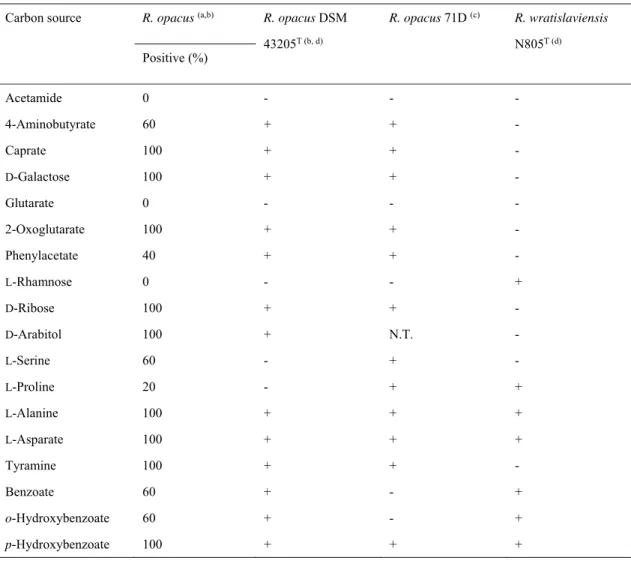
The taxonomical characteristics of strain 71D are shown (Table 1a, 1b, 1c, 1-1d). In 16S rDNA sequence similarity, determination of partial sequences of the most variable region revealed 100% identical to that of Rhodococcus opacus or Rhodococcus wratislaviensis (the highest value). The taxonomical characteristics of the strain 71D indicate that it belongs to the genus R. opacus, because it is irregular rods (0.8 x 2.0-3.0 m), Gram-positive, non-spore forming, non-motile, catalase-positive, oxidase-negative, acid fast-negative, utilization of carbon source: 4-aminobutyrate, D-ribose, tyramine are positive and L-rhamnose is negative (Table 1-2).
Figure 1-1. Time course of a-aminobutyramide formation catalyzed by acetone dried cells of R. opacus 71D.
The reaction mixture (1 mL) was composed of 50 mM Potassium phosphate buffer, pH 7.0, 50 mM (RS)--ABN, 0.1 mM CoCl2 and acetone dried cells (1 mg).
17
Table 1-1a. Taxonomical characteristics of the strains isolated from soil.
71D Grams stain +
Shape Rods Color Deep yellow Size 0.8X2.0-3.0 Acid fast - Motility - Growth in air + Growth anaerobically - Catalase + Oxidase - Glucose - OF test (gas/acid) (-/-) 16S rDNA R. opacus or R. wratislaviensis
18
Table 1-1b. Acid and gas from sugars.
Various sugars (1%) were added to 10 ml medium containing 1% polypepton, 1% meat extract and 0.5%NaCl. Cultivation was carried out for 24 h at 30oC with static culture.
71D (gas/acid) D-Glucose (-/-) Glycerol (-/-) D-Maltose (-/-) D-Xylose (-/-) D-Sorbitol (-/-) Sucroce (-/-) L-Arabinose (-/-) D-Fructose (-/-) D-Galactose (-/-) D-Mannose (-/-) Trehalose (-/-) D-Raffinose (-/-) D-Mannitol (-/-) Lactose (-/-) Starch potato (-/-)
19
Table 1-1c. Taxonomical characteristics.
71D NO2 and NO3 reduction - Denitrification - MR test - VP test - Indole formation - H2S formation - Starch hydrolysis + Citrate use Koser Christensen Simmons + + + (NH4)2SO4 use - Pigment formation King A KingB - - Urease + Growth temperature 30 pH 6-9 Litmus milk -
20
Table 1-1d. Taxonomical characteristics.
71D Dihydroxyaceton
formation
-
Cellose hydrolysis - Malonic acid utilization -
5% NaCl - DNase - Tween 80 hydrolysis - Vitamin requisistion - Gelatin liquefaction - n-hexadecan use +
21
Table 1-2. Utilization of carbon sources by Rrhodococcus opacus and R. wratislaviensis.
Carbon source utilization was detected by means of reduction of MTT, enzymatic activity by cleavage of chromogenic substrates.
Carbon source R. opacus (a,b) R. opacus DSM 43205T (b, d) R. opacus 71D (c) R. wratislaviensis N805T (d) Positive (%) Acetamide 0 - - - 4-Aminobutyrate 60 + + - Caprate 100 + + - D-Galactose 100 + + - Glutarate 0 - - - 2-Oxoglutarate 100 + + - Phenylacetate 40 + + - L-Rhamnose 0 - - + D-Ribose 100 + + - D-Arabitol 100 + N.T. - L-Serine 60 - + - L-Proline 20 - + + L-Alanine 100 + + + L-Asparate 100 + + + Tyramine 100 + + - Benzoate 60 + - + o-Hydroxybenzoate 60 + - + p-Hydroxybenzoate 100 + + + (a) Inclusion: DSM 43204, DSM 43206, DSM 43250, DSM 43251 (b) These data were taken from S. Klatte et al. (1994). [66]
(c) This work
(d) These data were taken from M. Goodfellow et al. (2002). [67]
22 Purification of NHase.
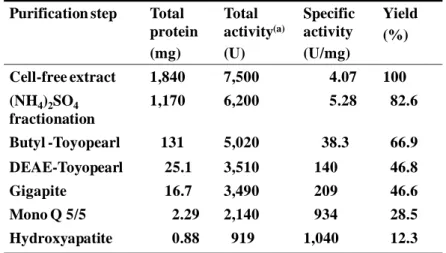
The results of purification of NHase from R. opacus 71D are summarized in Table 1-3. The enzyme was purified 256-fold with a yield of 12.3% from the cell-free extract. The specific activity of the purified enzyme was 1040 U mg-1 protein. The subunit Mr was
estimated to be 32,300 (-subunit) and 27,200 (-subunit), respectively, by comparing mobilities on SDS-PAGE to that of standard proteins. Results of SDS-PAGE analysis of samples from the final step of the purification are shown in Figure 1-2. The molecular weight of purified native NHase was estimated to be about 119,000 from its mobility relative to standard proteins on gel filtration by HPLC.
Table 1-3. Summary of purification of NHase from R.opacus 71D.
(a) -Aminobutyronitrile was used as a substrate. Purification step Total
protein (mg) Total activity(a) (U) Specific activity (U/mg) Yield (%) Cell-free extract 1,840 7,500 4.07 100 (NH4)2SO4 fractionation 1,170 6,200 5.28 82.6 Butyl -Toyopearl 131 5,020 38.3 66.9 DEAE-Toyopearl 25.1 3,510 140 46.8 Gigapite 16.7 3,490 209 46.6 Mono Q 5/5 2.29 2,140 934 28.5 Hydroxyapatite 0.88 919 1,040 12.3
- 23 -
Effect of temperature and pH on NHase activity.
The optimal temperature for NHase activity was assayed at various temperatures for 5 min (Figure 1-3(A)). The reaction mixture (total volume 1.0 ml) was composed of 50 mM KPB (pH 7.0), 20 mM (RS)--ABN, 0.1 mM CoCl2, and purified NHase (0.7
U). The optimal temperature of the NHase of R. opacus 71D was 20oC at pH 7.0. The
stability of the enzyme was examined at various temperatures. After the enzyme (0.7 U) had been pre-incubated for 30 min in 20 mM KPB (pH 7.0), a sample of the enzyme
Figure 1-3. Optimum temperature (A) and temperature stability (B) for the activity of NHase from R. opacus 71D.
Figure 1-2. SDS-PAGE of purified NHase.
Lane 1: Molecular weight standards, Lane 2: Purified NHase. The protein standards used were phosphorylase b (Mr 97,400), bovine serum albumin (Mr 66,200), ovalbmin (Mr 45,000), carbonic anhydrase (Mr 31,000), and
- 24 -
solution was taken, and the activity was assayed as described in the Experimental section. It exhibited the following levels of activity: 50oC, 0%; 40oC, 74%; 37oC, 77%;
30oC, 95%; 20oC, 94%; 4oC, 100% (Figure 1-3 (B)).
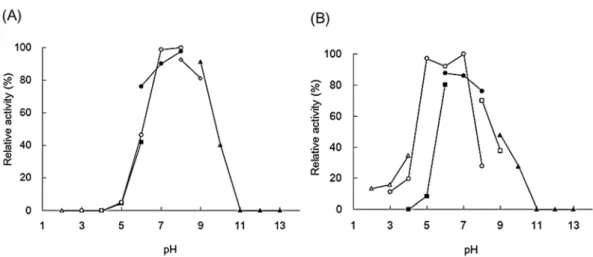
The optimal pH and pH stability for the activity were measured using the following buffers (final concentration 100 mM): Glycine-HCl (pH 2.0-4.0), acetic acid/sodium acetate (pH 3.0-6.0), KPB (pH 6.0-8.0), Tris-HCl (pH 8.0-9.0), Glycine-NaOH (pH 9.0-13.0), and McIlvaine (pH 3.0-8.0). After the enzyme (3.0 U) had been pre-incubated for 30 min at 30oC in 100 mM of each buffer, a sample of the enzyme
solution was taken, and the activity was assayed as described in the Experimental section. The optimal pH of the enzyme was pH 8.0 (KPB) at 30oC and the enzyme was
stable between pH 6.0 and pH 7.0 at 30oC for 30 min (Figure 1-4).
Inhibitors.
The purified enzyme solution (3.0 U) was treated with each 1 mM compound for 30 min at 30oC. The concentration of compounds was 1 mM in the reaction mixture.
Residual activities were measured after the treatment following the assay method Figure 1-4. The optimal pH (A) and pH stability (B) for the activity of NHase from R. opacus 71D.
- 25 - described above.
The enzyme was strongly inhibited by thiol reagents, Ag2+, Cu2+, Hg2+, and
p-chloromercuribenzoate showing residual activity as 6.59, 30.9, 0.847, and 23.8%, respectively, while iodoacetate (105%residual activity) showed no significant inhibition of the activity of the enzyme. As carbonyl reagents, phenylhydrazine (62.9%) and PMS (79.8%) inhibited the enzyme, but D, L-penicillamine (147%) and D-cycloserine (126%) did not inhibit this enzyme. Chelating reagents such as EDTA (46.8%), EGTA (84.7%), and NaN3 (86.6%) inhibited the activity of the enzyme. Ammonium peroxide (120%)
(oxidizing reagent) and 2-mercaptoethanol (94.6%) (reducing reagent) had no effect on this enzyme but dithiothreitol (74.4%) (reducing reagent) inhibited the activity of the enzyme.
Substrate specificity and enantiomeric ratio.
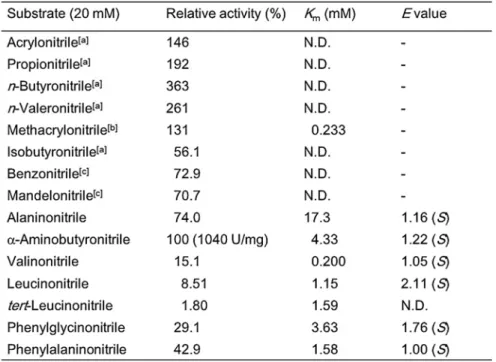
Enzyme activities toward various nitriles were examined at a concentration of 20 mM (Table 1-4). The activity for -ABN corresponding to 1040 U/mg was taken as 100%. The enzyme acted on a broad range of nitriles including acrylonitrile, n-butyronitrile, benzonitrile, alaninonitrile, phenylglycinonitrile, and mandelonitrile. Kinetic parameters for several racemic -aminonitriles and methacrylonitrile with high affinities of known NHases such as P. chlororaphis B23[37], Arthrobacter sp. strain
J-1[25], and R. rhodochrous J-1[40] were calculated by the Hanes-Woolf plot. The lowest
Km and highest Vmax values were for valinonitrile and ABN, respectively, for the
-aminonitriles. NHase preferentially hydrated the S-enantiomer of -aminonitriles rather than the R-enantiomer. However, as shown in Table 1-2, E-values[65] for the hydrolysis
- 26 -
characterized to catalyze non-stereoselective hydrolysis of -aminonitriles. Table 1-4. Substrate specificity and stereoselectivity of NHase from R. opacus 71D.
The activity for -aminobutyronitrile correspondindng to 1040 Umg-1 was taken as 100%.
a Assay with aliphatic nitrile as a substrate - The reaction mixture (total volume 1.0 mL) was composed of 50 mM
KPB (pH 7.0), 20 mM aliphatic nitrile, and the appropriate amount of the enzyme. The enzyme was added to initiate the reaction. After incubation at 30oC, sample (0.1 ml) was taken from reaction mixture at 5 min. The
reaction was stopped by adding 900 l of ethylacetate. The amount of amide formed in the reaction mixture was determined with GC apparatus equipped with a -Dex-325 column (Supelco, USA) using He as a carrier gas (Detector temperature: 230oC and injection temperature 220oC).
b The Km value for methacrylonitrile was assayed at 30oC as the rate of the formation of methacrylamide from
several concentration methacrylonitrile in 50 mM KPB (pH 7.0) containing 0.1 mM CoCl2 by measuring
absorbance at 224 nm (∆ = 3400 M-1cm-1).
c When benzonitrile and mandelonitrile were used as substrate, the amount of corresponding amides formed was
determined by HPLC with MIGHTYSIL PR-18 GP column using the solvent system of 80% acetonitrile containing 10 mM H3PO4 at a flow rate of 1.0 ml min-1.
- 27 -
Dynamic kinetic resolution of racemic -aminonitrile to form chiral -amino acid.
The time course of (R)--(ABA) conversion from racemic (RS)--ABN sulfuric acid salt by purified NHase, D-aminopeptidase (DAP) from O. anthropi C1-38[16] and
ACL racemase is shown in Figure 1-5.
In the initial phase of the reaction, the NHase rapidly converted ABN to racemic -ABA-NH2 with E-value of 1.2. After 20 min, -ABN was completely converted to
(R)- and (S)--ABA-NH2. (R)-ABA-NH2 was hydrolyzed by DAP, while the remaining
(S)--ABA-NH2 was racemized by ACL racemase. The concentration of (R)--ABA
was the same as that of -ABN originally present in the reaction mixture. All of (RS)--ABN was converted to (R)--ABA in 6 h (conversion >99% with >99% ee). (S)--ABA also could be obtained by DKR of racemic ABN by purified NHase, L-amino acid amidase (LaaABd) from B. diminuta TPU 5720[26] and ACL racemase (Figure 1-6). All
- 28 -
Figure 1-5. The enzymatic conversion of (RS)--aminobutyronitrile to (R)--aminobutyric acid.
The reaction mixture (total volume 1.0 ml) was composed of 50 mM KPB, pH7.0, 20 mM (RS)--aminobutyronitrile, 500 nM pyridoxal phosphate, NHase (1.0 U), DAP (0.52 U), and ACL racemase (1.6 U) at 30oC. The NHase was added to initiate the reaction.
Symbols: (R)--aminobutyramide (■), -aminobutyramide (□), (R)--aminobutyric acid (●), and (S)--aminobutyric acid (○).
Figure 1-6. The enzymatic conversion to (S)--aminobutyric acid from (RS)--aminobutyronitrile.
The reaction mixture (total volume 1.0 ml) was composed of 50 mM KPB, pH7.0, 20 mM (RS)--aminobutyronitrile, 500 nM pyridoxal phosphate, the NHase (0.92U), LaaABd (0.39 U), and ACL racemase (1.6
U) at 30 oC. The NHase was added to initiate the reaction.
Symbols: (R)--aminobutyramide (■), -aminobutyramide (□), (R)--aminobutyric acid (●), and (S)--aminobutyric acid (○)
- 29 -
Discussion
An -aminopropionitrile hydrolyzing microorganism has been isolated using the substrate as a nitrogen source.[8] Considering that -aminonitrile would be
spontaneously decomposed to toxic aldehyde and cyanide ions, the author attempted the first screening for -aminonitrile hydrolyzing microorganisms using n-butyronitrile as a sole carbon and nitrogen source because of its structural similarity to -ABN and less toxic nature. In the second screening, the author selected a bacterium hydrolyzing -ABN with lower stereoselectivity. Finally, the author isolated and identified R. opacus 71D exhibiting very low stereoselectivity toward -ABN. It is capable of growing in a medium containing n-butyronitrile as a sole source of carbon and nitrogen and its NHase activity was induced by n-butyronitrile, as well as by various nitrile and amide compounds. Among the inducers tested, isovaleramide was selected as the best for enzyme formation, but it could not grow on nitriles as a sole carbon and nitrogen source such as methacrylonitrile, isobutyronitrile, isovarelonitrile, or aromatic nitriles such as benzonitrile and phenylacetonitrile, or -aminonitriles such as ABN and (RS)--ABN.
NHase from R. opacus 71D was purified 256-fold with a yield of 12.3% from the cell-free extract. The properties of this enzyme are summarized in Table 1-5.
The specific activity of the purified enzyme is 1040 U mg-1 protein for -ABN
as a substrate. From results of SDS-PAGE and gel filtration by HPLC, the molecular weight of this enzyme is about 119,000, forming an 22 hetero-tetramer composed of
and -subunits of NHase with molecular weights of 32,300 (-subunit) and 27,200 (-subunit), respectively. The purified enzyme was unstable when incubated in aqueous
- 30 -
solution at temperatures higher than 30oC for 30 min (50% activity remained when it
was incubated at 40oC for 30 min) and was labile to dilution. This enzyme was
stabilized by the addition of 4 mM butyrate, as it has been reported that NHase can be stabilized by organic acids such butyrate or valerate.[15-17] The optimal pH, temperature,
stability, and inhibitors are similar to other NHase from mesophilic bacteria such as R.
rhodochrous J-1 (low-molecular mass NHase), Rhodococcus sp. N-774, and P.
chlororaphis B-23, except for the KCN inhibition. NHase can be classified according to
the presence of a metal cofactor such as ferric NHase or cobalt NHase. Generally, ferric NHases such as from P. chrorolaphis B23[37] and Brevibacterium sp. R312[68] are only
slightly inhibited by KCN, whereas cobalt NHase such as that of R. rhodochrous J-1[40]
enzyme is strongly inhibited by 0.01 mM KCN (Relative activity 38%). NHase from R.
opacus 71D is not as sensitive to KCN. When incubated at 30oC for 30 min in the
standard reaction mixture containing KCN at 1 mM, 5 mM, and 10 mM, the residual activity of this enzyme was 65%, 38%, and 20%, respectively. Thus, this enzyme is very
- 31 -
suitable for converting aminonitriles to corresponding amides because -aminonitriles are usually unstable in aqueous solution and produce cyanide by the spontaneous retro-Strecker reaction.
NHase contained cobalt ions and also had wide substrate specificity, acting on aliphatic nitriles such as acrylonitrile, n-butyronitrile, -ABN, and aromatic nitriles such as benzonitrile, mandelonitrile, and phenylglycinonitrile. Moreover, the author reported Km and E values for several -aminonitriles using the purified enzyme for the
first time. This is the first report showing the substrate specificity of nitrile hydratase acting on -aminonitriles and aliphatic and aromatic nitriles.
Recently, stereoselective NHase has been attracting attention since it had been believed to be not very stereoselective. Some NHase can hydrate (RS)-2-(4-isobutyl phenyl)-2-methylpropionitrile with R or S-stereoselectivity and Rhodococcus sp. strain HT 40-6 act on the S-enantiomer of mandelonitrile.[69] However, a stereoselective
NHase acting on -aminonitrile has been never reported. The author thus attempted to utilize a non-stereoselective NHase toward -aminonitrile in DKR.
Asano et al. have reported the discoveries and properties of R-stereoselective amino acid amidases such as DAP, D-amino acid amidase (DaaA)[27], and alkaline D
-peptidase[31] and S-steroselective amino acidc amide hydrolase such as LaaABd and L
-amino acid amidase (LaaAPa) from P. azotoformans IAM 1603.[29] By combination of
non-stereoselective NHase, ACL racemase and R- or S-stereoselective amidase, it is possible to construct an efficient system to produce the corresponding (R)- or (S)--amino acids from racemic -(S)--aminonitriles. Actually, (S)-alanine with yielding 99% and 99% ee was converted from 50 mM alaninonitrile using NHase (1.6 U), ACL racemase (0.5 U), and LaaAPa (2 U) in 3 hour. Moreover, using NHase, ACL racemase, and
- 32 -
LaaABd, 10 mM valinonitrile, 30 mM leucinonitrile, and 10 mM phenylalaninonitrile
were converted to the corresponding S-enantiomer of -amino acids with yield 74.5-99% (Table 1-6). LaaABd acted on not only (S)-alaninamide and (S)-phenylalaninamide,
but also R-form alaninamide and slightly phenylalaninamide.[26] (S)-Phenylalanine was
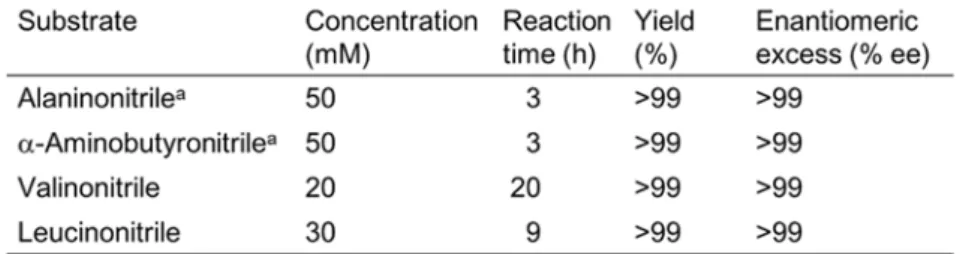
produced from phenylalaninonitrile with a little bit low enantiomeric excess. (R)-Amino acids also would be produced from several racemic -aminonitriles. DAP acted on (R)-amino acid amides with small substituents, such as (R)-alaninamide and
(R)--aminobutyramide. On the other hand, DaaA showed hydrolyzing activity toward bulky amino acid amides with (R)-leucinamide and (R)-phenylalaninamide. Alaninonitrile (50 mM), 30 mM leucinonitrile, and 20 mM valinonitrile were converted to the
corresponding (R)--amino acids (Table 1-7). To the best of knowledge, this is the first report on the dynamic kinetic resolution of racemic -aminonitriles to the
corresponding not only (R)--amino acids but also (S)--amino acids. This new method of dynamic kinetic resolution has a possibility to be developed to the large scale production of optically active -amino acids.
- 33 -
Table 1-6. Conversion of -aminonitrile to (S)--amino acid by DKR.
The reaction (1 mL) was carried out using 1.6 U NHase, 0.5 U ACL racemase, and 1.8 U LaaABd at 30oC. a The reaction (1 mL) was carried out using 1.6 U NHase, 0.5 U ACL racemase, and 2 U LaaAPa. b The reaction (1 mL) was carried out using 1.6 U NHase, 1.0 U ACL racemase, and 1 U LaaABd.
The yield and enantiomeric excess were determined by HPLC.
Table 1-7. Conversion of -aminonitrile to (R)--amino acid by DKR.
The reaction (1 mL) was carried out using 1.6 U NHase, 0.5 U ACL racemase, and 1.9 U DaaA at 30oC. a The reaction (1 mL) was carried out using 1.6 U NHase, 0.5 U ACL racemase, and 1.8 U DAP.
- 34 -
Chapter II
Identification of nitrile hydratase gene and expression in E. coli
Previous chapter, the author succeeded in the demonstration of dynamic kinetic resolution of chiral -amino acid from -aminonitrile using three purified enzymes including nitrile hydratase (NHase) from Rhodococcus opacus 71D which was newly isolated, stereoselective amidase and -amino--caprolactam (ACL) racemase from
Achromobacter obae. The author’s way of constructing enzymatic process is in the
order of (i) by purified enzyme and (ii) by cell-free synthesis. In the order of (i) to (iii), it becomes difficult to achieve high e.e. of the product, especially in this kind of cascade reactions.
In this chapter, enzymatic properties of NHase, a useful biocatalyst for converting to racemic -amino acid amide from racemic -aminonitrile, was characterized in detail. NHase gene from R. opacus 71D was expressed in E. coli JM109 under downstream region of lac promoter for efficient production process of chiral -amino acid. Under optimum conditions, 200 mM of (R)--aminobutyric acid (yield >99% and >99% ee) was produced in 18 h using cell-free extract of three
recombinants including NHase, D-aminopeptidase from Ochrobactrum anthropi C1-38, and ACL racemase.
- 35 -
Experimental section
Materials.
Escherichia coli JM109 (e14- (mcrA-), recA1, endA1, gyrA96, thi-1, hsdR17, (rK
-mK-), supE44, relA1, -, ∆ (lac-proAB), [F’traD36, proAB+, lacIq, lacZ∆M15] was used
as a host for DNA manipulation and expression. Plasmid pUC18 (Takara Bio, Ohtsu, Japan) was used as a vector for E. coli.
Cloning of the NHase gene from R. opacus 71D.
The chromosomal DNA from R. opacus 71D was isolated by the method of Saito and Miura.[70] Oligonucleotide primers 5’-ATGAACGGCGTNTTCGATCTAGG-3’ and
5’-TGTGTACGCAANYKCGTGTCGGT-3’ were designed on the N-terminal amino acid sequences of - and -subunit of NHase. Reaction mixture (50 l) for the PCR contained 25 l 2 X GC buffer, 2.5 mM dNTP Mixture, 100 pmol each primers, 100 ng template, and 2.5 U LA Taq. The PCR product (0.7 kb) was cloned pT7blue vector in E.
coli and nucleotide sequencing was performed using the dideoxynucleotide
chain-termination method with M13 forward and reverse oligonucleotides as primers. Sequence reactions were carried out with a Thermosequenase cycle sequencing kit and dNTP mixture with DNA Thermo sequenase DNA polymerase with pyrophosphatase (Pharmacia Biotech, Tokyo, Japan). Inverse PCR was performed as described by Ochman et al.[71] The chromosomal DNA from R. opacus 71D was digested with FbaI,
NcoI, EcoRI, or ScaI and circularized by ligation. Reaction mixture (50 l) for the
inverse PCR contained 25 l 2 X GC buffer, 2.5 mM dNTP Mixture, 100 pmol each primers, 100 ng template, and 2.5 U LA Taq. The amplified PCR product was analysed
- 36 -
using ABI PRISM 310 Genetic analyzer. Homology search was performed with the sequence similarity searching programs BLAST and ClustalW method was used to align the sequence. The genetyx software system (Software Development Co., Tokyo, Japan) was used for computer analysis of nucleotide sequences and deduced amino acid sequences. The nucleotide sequences data of NHase in this study has been submitted to the GenBank/EMBL/DDBJ Data Bank with accession number AB481223.
Construction of the plasmid and expression of the NHase gene from R. opacus 71D in E. coli.
The gene for the and -subunits of NHase and p15K were amplified by PCR with the primer set GCCGGGATCCCaaggagTTTCGCATGAACG-3’ and 5’-TGCTCGAAGCTTAGTGTGGGTTAGCTGGTC-3’ (restriction site, Shine-Dalgarno sequence, and initiation codons are shown with underlines, lowercase letters, and bold letters, respectively) using DNA of R. opacus 71D as a template. The amplified fragment was cloned between BamHI and HindIII sites of pUC18 to produce pNH1.
NHase and -subunit genes and the p15K gene were amplified from pNH1 with the primer set GCCGGGATCCCaaggagTTTCGCATGAACG-3’ and
TCCTGGTGTAGCGGTACCCTCATGAGGCTG-3’ and
GCCCGGTACCaaggagTGCCTCATGAGCGCCTCGCTACACCAGGA- 3’ and 5’-TGCTCGAAGCTTAGTGTGGGTTAGCTGGTC-3’, respectively. After two PCR products were ligated at the KpnI site, the ligated DNA fragment was inserted between
BamHI and HindIII sites of pUC18 and the plasmid pNH2 was obtained.
To express active NHase in E. coli JM 109, the author constructed NHase
- 37 -
LB medium containing ampicillin (80 g/ml) at 37oC for 7 h. Then, 1 mM IPTG and 1
mM CoCl2 were added to the culture, and incubated at 30oC for an additional 12 h.
Enzymatic synthesis of (R)--aminobutyric acid from (RS)--aminobutyronitrile.
The reaction mixture contained 1 mmol KPB, pH 8.0 (100 mM), 20 nmol PLP (2 M), 1 mol CoCl2 (0.1 mM), the cell-free extract of E. coli pNH2 (6.4 U as NHase), E.
coli pDAP1 (19.9 U as DAP), the heat treated cell-free extract of E. coli pACL60 (1.4 U
as ACL racemase), and 0.266 g (RS)-ABN (200 mM) in a total volume of 10 ml. After the reaction mixture was incubated at 30oC for 18 h, it was adjusted to pH 1.0 with
concentrated HCl, and then filtrated and neutralized with 6 N NaOH. The solution was evaporated in vacuo and recrystallized from water-methanol. Finally, (R)--ABA was obtained at a yield of 0.163 g (79.0%) with 99.9% ee as colorless crystals; []24
D -19.6 o
(c1.00, H2O).
- 38 -
Production of NHase in E. coli.
When the E. coli JM109 transformant harboring pNH1 was cultivated in LB medium supplemented with ampicillin, IPTG, and CoCl2 for 24 h at 37oC, NHase
activity was not detected in the cell-free extract solution of the transformant, while activity was shown when the induction temperature was set to less than 30oC. E. coli
JM109/pNH1 showed NHase activity (2,450 U/g acetone dried cells) toward substrates such as -ABN. Activity was 7 times higher per mg dry cells than that of R. opacus 71D (336 U/g acetone dried cells). Thus, the author improved the expression of NHase by replacing the overlapped sequence between the -subunit stop codon and p15K start codon, with a new SD sequence (AAGGAG) and start codon, and constructed the pNH2 plasmid (Figure 2-1). After E. coli JM109 harboring pNH2 was cultivated in LB
medium supplemented with ampicillin for 7 h at 37oC, 1 mM IPTG and 1 mM CoCl 2
were added to the culture, which was then incubated aerobically at 30oC for an
additional 12 h. Because NHase activity per mg dry weight cells of E. coli harboring pNH2 (11,000 U/ g acetone dried cells) was about 30 times higher than that of R.
opacus 71D, the author decided to use the much improved plasmid pNH2 for NHase
- 39 -
Enzymatic synthesis of (R)--aminobutyric acid from (RS)--aminobutyronitrile.
The optimum temperature was similarly assayed by measuring the product formed at different temperatures with 100 mM KPB; pH 8.0, 2 M PLP, 50 mM (RS)--ABN, 0.1 mM CoCl2, purified NHase, ACL racemase, and DAP (Figure 2-2 (A) ). Optimal pH
for the conversion was measured using the following buffers: KPB (pH 6.0-8.0) and Tris-HCl (pH 7.0-9.0). The reaction mixture (total volume 1.0 ml) was composed of 100 mM buffer, 2 M PLP, 50 mM (RS)--ABN, 0.1 mM CoCl2, purified NHase, ACL
racemase, and DAP (Figure 2-2(B)). From these results, optimum conditions for the production of (R)--ABA were determined to be a pH 8.0 at 30oC.
Figure 2-1. Production of NHase from R. opacus 71D in recombinant E. coli.
Restriction site, Shine-Dalgarno sequence, initiation codon of p15K, and stop codon of -subunit are shown in underline, lowercase, bold letters, and italic letters respectively.
- 40 -
Figure 2-3 shows the typical time course of DKR of -ABN under optimum conditions (pH 8.0 at 30oC). -ABN was added to the reaction mixture intermittently
with a portion of 0.133 g (1 mmol) twice because NHase and ACL racemase were strongly inhibited by higher concentrations of the substrate. The first portion of the substrate was quickly converted to racemic -ABA-NH2 in less than 10 min. The
resulting racemic -ABA-NH2 (100 mM) was quickly hydrolyzed by DAP to form
(R)--ABA. Moreover, the remaining S-enantiomer was racemized by ACL racemase. After the 30 min reaction, another portion of the 1 mmol substrate was added to the reaction mixture. Racemic -ABN (200 mM) was completely converted to (R)--ABA (200 mM) with a 99% yield and 99% ee after an 18 h reaction.
Figure 2-2. Optimum temperature (A) and pH (B) for conversion of (RS)--aminobutyronitrile to (R)--aminobutyric acid.
- 41 -
Discussion
The author cloned the NHase gene from R. opacus 71D and determined its sequence and flanking region. The amidase gene was found to be located upstream of the -subunit gene, and surprisingly, these genes overlapped with each other at the stop codon and start codon (ATGA sequence). Most amidase genes were found
approximately 100 bp upstream of NHase ORF, except in R. rhodochrous J-1, with an amidase gene being located 1.9 kbp downstream of the -subunit of the low molecular weight NHase gene.
Moreover, the author amplified the aldoxime dehydratase (Oxd) gene from R.
opacus 71D by the method as described by Kato et al.[72] OxdB4-S3/OxdB4-AS2 primer
pairs allowed the amplification of a 450 bp DNA fragment from this strain and protein Figure 2-3. DKR of -aminobutyronitrile to form (R)--aminobutyric acid using NHase, D-aminopeptidase and ACL racemase.
Symbols: (R)--aminobutyramide (■), aminobutyramide (□), (R)--aminobutyric acid (●), and (S)--aminobutyric acid (○).
- 42 -
encoded by this fragment showed similarities to the known Oxd from Pseudomonas sp. K-9, R. erythropolis N-771, and R. globerulus A-4 (Figure 2-4). An inverted repeat sequence was also found downstream of the p15K gene. Based on these results, R.
opacus 71D was shown to have an aldoxime-nitrile pathway gene cluster.
Alignment of the amino acid sequence showed that the deduced primary structure of the -subunit was similar to known cobalt containing NHase such as those from
Pseudonocardia thermophila (identity: 64.1%), Rhodococcus sp. Cr4 (60.5%), R. rhodochrous J-1 (60.1%), Bacillus sp. RAPc8 (55.6%), and Bacillus sp. BR449
(55.2%). Analysis of the amino acid sequence of the -subunit showed weak identities and significant homologies to P. thermophila (identity: 57.1%), Rhodococcus sp. Cr4 (45.3%), R. rhodochrous J-1 (45.3%), Bacillus sp. RAPc8 (38.8%), and Bacillus sp.
Figure 2-4. Alignment of amino acid sequences of Oxd from R. opacus 71D, Pseudomonas sp. K-9, Rhodococcus sp. N-771, R. globerulus A-4, and Bacillus sp. OxB-1.
Identical amino acids are marked in black and similar amino acids are marked in gray. The sequences have the following accession numbers: Oxd from Pseudomonas sp. K-9, AB193508; Rhodococcus sp. N-771, AB094201; R. globerulus A-4, AB105912; and Bacillus sp. OxB-1, AB028892.
- 43 -
BR449 (38.8%). The -subunit of NHase revealed that it contained a characteristic cobalt-binding motif, CSLCSC[73], which differed from the proposed iron-binding motif
of other NHases (Figure 2-5).
It has been reported that the downstream region (activator protein) of the NHase gene is necessary to functionally express NHase in E. coli.[74] In the author’s initial
experiment, the expression level of NHase was very low when NHase and p15K genes were placed under the lac promoter in the pUC18 vector. Accordingly, the author replaced an overlapped sequence found between the -subunit stop codon and the p15K start codon, with a new SD sequence and a start codon. NHase productivity per mg dry
E. coli cells weight was elevated to about 30 times more than R. opacus 71D.
In chapter I, the author reported the one-pot synthesis of chiral -amino acids by DKR of -aminonitriles using purified three enzymes. In this study, non-natural (R)-aminobutyric acid was synthesized at a high concentration from racemic
-aminobutyronitrile using cell-free extracts of E. coli pNH2, E. coli pACL60, and E .coli pDAP1. Previous chapter is demonstration of the same reactions catalyzed by three purified enzymes. Cell-free synthesis, especially in this kind of cascade reactions is much more difficult to achieve high ee of the product because there is a risk of side reactions catalyzed by other enzymes originated from E. coli, such as L-amino acid amide hydrolase, amino acid racemase, and enzymes catalyzing decomposition of amino acid and amino acid amide. In this study, non-natural (R)--ABA was
synthesized at a high concentration from racemic -ABN using cell-free extracts of E.
coli pNH2, E. coli pACL60, and E .coli pDAP1. DKR of (RS)--ABN (100 mM) to
form (R)--ABA was carried out at optimum conditions using cell-free extracts of E.
(R)-- 44 (R)--
-ABA synthesized showed only 68.6% ee because of the existence of a natural S-amidase in E. coli. Since ACL racemase is very stable up to 60oC for 10 min, the
cell-free extract of E. coli pACL60 was treated at 60oC for 10 min and successfully used for
DKR of -ABN to inactivate S-amidase. When the concentration of -ABN was high, -ABA-NH2 was obtained in lower yields such as 100, 100, 26.8, and 9.2% yields from
50, 100, 150, and 200 mM -ABN, respectively, in 2 h. -Aminonitrile was used at a low concentration (1 mM) because NHase was sensitive to even low concentrations. [46]
On the other hand, NHase activity in this study was not affected much up to 100 mM -ABN and substrate sharply decreased when 100 mM substrate was used. ACL racemase was also inhibited in the presence of 10 mM -ABN (relative activity; 21.3%) and was completely inhibited at 50 mM. Therefore, the substrate needed to be quickly and completely converted to the product. Finally, the author successfully carried out fed-batch reactions to produce (R)--ABA at a yield of 99% and 99% ee with cell-free extracts of E. coli pNH2 and E. coli pDap1 and a heat-treated cell-free extract of E. coli pACL60.
- 45 -
(A)
(B)
Figure 2-5. Alignment of amino acid sequences of -subunit (A) and -subunit (B) of NHase from R. opacus 71D, P. thermophila, Rhodococcus sp. Cr4, R. rhodochrous J-1, Bacillus sp. RAPc8, and Bacillus sp. BR449.
Identical amino acids are marked in black and similar amino acids are marked in gray. The cobalt binding site is marked with the red box. The sequences have the following accession numbers: NHase from R. opacus 71D, AB481223; P. thermophila, Q7SID2 (), Q7SID3 (); Rhodococcus sp. Cr4, AX538021 (), AX538019 (); R. rhodochrous J-1, P21219 (), P21220 (); Bacillus sp. RAPc8, AF257489 (), AF257488 (); and Bacillus sp. BR449, AF257489 (), AF257488 ().
- 46 -
Chapter III
Enzymatic synthesis of chiral phenylalanine derivatives by a dynamic kinetic resolution of corresponding amide and nitrile substrates with multi enzyme system
In the previous chapter, the author succeeded in production of chiral -amino acids such as R and S isomers of aliphatic amino acids by dynamic kinetic resolution (DKR) of the corresponding racemic -aminonitrile using R- or S-stereoselective amidase and -amino--caprolactam (ACL) racemase.[75] However, ACL racemase has
narrow substrate specificity, preferentially acting on small -amino acid amides such as alaninamide, -aminobutyramide and leucinamide, but hardly racemizes -amino acid amides with bulky side chains such as phenylalaninamide.
Recently, directed evolution has become one of the methods for improving biocatalysts without detailed knowledge of enzyme structure and catalytic
mechanism.[76] In earlier study, our laboratory obtained a mutant ACL racemase
(L19V/L78T) with high phenylalaninamide racemizing activity by directed evolution based on the crystal structure of natural enzyme.[77]
In this chapter, the author describes an efficient synthetic method for
(R)-phenylalanine and (R)-(R)-phenylalanine derivatives by DKR of corresponding amide and nitrile substrates with multi enzyme system (Scheme 3-1).
- 47 -
Scheme 3-1. Dynamic kinetic resolution of (RS)-phenylalaninamide to form (R)-phenylalanine.
Experimental section
Materials.
Restriction enzymes, DNA modifying enzymes, pUC18, and pSTV29 vectors were from Takara Shuzo Co., Ltd. (Kyoto, Japan). All other chemicals were from commercial sources.
Analytical methods.
Optical rotations were measured on a SEPA-300 (Horiba, Ltd., Kyoto, Japan).
1H NMR spectrum was recorded on Bruker Biospin AVANCE II 400 (Bruker Biospin,
Rheinstetten, Germany) system. The reaction products were characterized by MS using a Bruker-Daltonics micrOTOF instrument with an ESI source in positive mode (Bruker-Daltonics, Bremen, Germany). Data evaluation was performed using the Generate Molecular Formula software suite within Bruker Daltonics micrOTOF DataAnalysis version 3.4. Concentration and enantiopurity of all -amino acid amides and -amino acids were determined by HPLC equipped with a Crown Pak CR (+) column (Daicel Chemical Industries, Ltd., Osaka, Japan) using a solvent system of 60 mM HClO4/10%
- 48 - methanol.
Construction of pACLmut and pDBFB40.
Plasmid pET15ACL[77] containing the gene coding for the ACL racemase was
used as a template in mutagenesis. The author targeted the mutagenesis to residues that interact with the 4 angstrom in the ligand, -caprolactam of active site, based on the crystal structure.[77] These residues have been identified as L19, W49, L78, M293, T295
and W436. Mutation library was constructed to contain possible amino acid changes at these residues. This library was screened against (R)-phenylalaninamide as substrate. After screening, L78T, L78S, and L78V single mutants were having higher activity than the native enzyme. These mutants were used as the parent for the second round of mutagenesis and screening. As in the second screening, the mutagenesis was performed on residues within the 6 angstrom in the ligand. Mutant ACL racemase (L19V/L78T) having both of L19V and L78T mutations was found to have the higher activity than the parent. The details of gene mutation and the enzymatic properties of the mutant ACL racemase will be described elsewhere. Mutant ACL racemase gene was inserted downstream of the lac promoter in high-copy-number plasmid pUC18, yielding pACLmut.
D-amino acid amidase gene from Ochrobactrum anthropi SV3 was amplified with oligonucleotides primer 5’-GAAATAAGCTTTAaggaggAATAGCCGATGAGTG-3’ and 5’-TTGAAGGTACCCTAACTGCGGGAG-3’ (restriction site, Shine-Dalgarno sequence, and initiation codon are shown in underline, lowercase and bold letters, respectively) from plasmid pDAA-BFB40[18], digested with HindIII and KpnI and
- 49 -
pACLmut and pDBFB40 were introduced into E. coli JM109, and the resulting
transformant (E. coli pACLmut/pDBFB40) was cultivated in LB medium supplemented with ampicillin (80 g/ml), and chloramphenicol (30 g/ml).
Preparation of enzyme from recombinant E. coli.
Recombinant E. coli transformants harboring pACLmut and pDBFB40 was grown in LB medium containing ampicillin and chloramphenicol at 37oC for 24 h.
Cells were harvested by centrifugation at 9,500 x g for 5 min at 4°C, and washed with 0.85% NaCl. The washed cells from 2 L culture were resuspended in 20 mM potassium phosphatebuffer (KPB) and disrupted by sonication for 20 min (19 kHz, Insonator model 201M; Kubota, Tokyo, Japan). Cell-free extract was prepared by centrifugation of the lysate at 15,000 x g for 20 min at 4°C.
Definition of ACL racemase activity.
Activity of ACL racemase was measured by detecting the formation of (R)-phenylalanine via (R)-phenylalaninamide from (S)-phenylalaninamide at 30oC. The
standard assay solution contained 100 mM KPB (pH 7.0), 2 M PLP, and 20 mM (S)-phenylalaninamide. One unit of enzyme activity was defined as the amount of enzyme catalyzing the conversion of substrate to the product at a rate of 1 mol/min.
Definition of D-amino acid amide amidase activity.
D-amino acid amide amidase (DaaA) activity was measured by the method of Komeda et al.[18] The standard reaction mixture contained 100 mM Tris-HCl buffer (pH
- 50 -
enzyme activity was defined as the amount of enzyme catalyzing the conversion of substrate to the product at a rate of 1 mol/min.
Preparation of -amino acid amides.
Preparation of -amino acid amides from aldehydes.
-Aminonitriles were obtained by Strecker synthesis with 0.10 mol aldehyde, 0.12 mol sodium cyanide, and 0.15 mol ammonium chloride. The reaction products were extracted with ethylacetate, dried over anhydrous Na2SO4, and evaporated in
vacuo. Products were diluted with MeOH/MeCN (1/9) and sulfuric acid was dropped.
After filtration, -aminonitrile sulfuric acid salt was obtained. A reaction mixture containing -aminonitrile sulfuric acid salt was added to acetone, H2O and 5.0 eq
NaOH was stirred at room temperature for 24 h. The acetone layer containing -amino acid amide was obtained and then pH was adjusted to pH 7.0 by concentrated HCl. After stirring at room temperature for 3 h, reaction mixture was filtrated and -amino acid amide HCl was obtained as white crystals. -Amino acid amide HCl synthesized included (RS)-phenylglycinamide HCl, chloro-(RS)-phenylglycinamide HCl, 4-methyl-(RS)-phenylglycinamide HCl, and (RS)-homophenylalaninamide HCl.
Preparation of -amino acid amides from -amino acids.
-Amino acid amides were prepared from -amino acids by the method as described by Asano et al.[16] Methylester -amino acids were synthesized by dropping
2.5 eq of thionyl chloride into -amino acids suspended anhydride MeOH at 0oC. After
the reaction was finished, methanol and HCl gas were evaporated in vacuo and -amino acid methylester HCl was obtained as white crystals. -Amino acid amides were
- 51 -
synthesized by ammonolysis of amino acid methylesters in anhydride MeOH saturated with dry ammonia gas at 0oC. -Amino acid amide HCl synthesized included
phenylalaninamide HCl, (R)-phenylalaninamide HCl, (S)-phenylalaninamide HCl, (RS)-tyrosinamide HCl, 4-fluoro-(RS)-phenylalaninamide HCl,
3-fluoro-(RS)-phenylalaninamide HCl, 2-fluoro-(RS)-3-fluoro-(RS)-phenylalaninamide HCl, 4-chloro-(RS)-phenylalaninamide HCl, 4-bromo-(RS)-4-chloro-(RS)-phenylalaninamide HCl, and 4-fluoro-(RS)-phenylglycinamide HCl.
Enzymatic synthesis of (R)-phenylalanine from (RS)-phenylalaninamide.
The reaction mixture contained 1 mmol Tris-HCl buffer, pH 8.0 (100 mM), 20 nmol PLP (2 M), the cell-free extract of E. coli pACLmut/pDBFB40 (11 U of mutant ACL racemase and 1300 U of DaaA) from 50 ml culture, and 0.8 g
(RS)-phenylalaninamide HCl (400 mM) in a total volume of 10 ml. When the reaction mixture was incubated under stirring at 40oC for 22 h, it was adjusted to pH 1.0 using
concentrated HCl and then, the solution was filtrated and neutralized with 6 N NaOH. The reaction mixture was evaporated in vacuo and recrystallized from water-methanol. Finally, (R)-Phenylalanine was obtained in yield of 0.553 g (84%) with 99% ee as colorless crystals; []24
D 35.0o (c1.00, H2O). 1H NMR (D2O, 400 MHz) : 7.2-7.4 (m,
5H), 3.9 (dd, 1H, J = 7.9, 5.2 Hz), 3.2 (dd, 1H, J = 14.5, 5.2 Hz), 3.0 (dd, 1H, J = 14.5, 8.0 Hz). MS m/z: calcd for C9H12N1O2 [M+H]+ 166.0863; found, 166.0884.
Enzymatic synthesis of (R)-tyrosine from (RS)-tyrosinamide.
The reaction mixture contained 0.5 mmol Tris-HCl buffer, pH 8.0 (100 mM), 10 nmol PLP (2 M), the cell-free extract from 25 ml culture (5.3 U of mutant ACL
- 52 -
racemase and 650 U of DaaA), and 0.4 g of (RS)-tyrosinamide HCl (1.8 mmol) in a total volume of 5 ml. When the reaction mixture was incubated with stirring at 40oC for 24 h,
the reaction mixture was adjusted to pH 1.0 with concentrated HCl and then, aggregate proteins of the cell-extract were removed by vacuum filtration and the solution was neutralized with 6 N NaOH. The precipitated (R)-tyrosine was filtrated, washed with cold water, and (R)-tyrosine was obtained in yield of 0.247 g (74%) with >99% ee as colorless crystals; []24D 8.0o (c1.00, 6.2 N HCl). 1H-NMR (D2O, 400 MHz) 6.8-7.1
(m, 4H), 3.8 (dd, 1H, J = 7.8, 5.2 Hz), 3.2 (dd, 1H, J = 14.7, 5.1 Hz), 3.0 (dd, 1H, J = 14.7, 7.8 Hz). MS m/z: calcd for C9H12N1O3 [M+H]+ 182.0812; found, 182.0853.
Enzymatic synthesis of 4-fluoro-(R)-phenylalanine from 4-fluoro-(RS)-phenylalaninamide.
The reaction mixture contained 0.5 mmol Tris-HCl buffer, pH 8.0 (100 mM), 10 nmol PLP (2 M), the cell-free extract from 25 ml culture (5.3 U of mutant ACL racemase and 650 U of DaaA), and 0.44 g of 4-fluoro-(RS)-phenylalanineamide HCl (400 mM) in a total volume of 5 ml. When the reaction mixture was incubated with starting at 40oC for 24 h, the reaction mixture was adjusted to pH 1.0 with concentrated
HCl and then, the solution was filtrated and neutralized with 6 N NaOH. The reaction mixture was evaporated in vacuo and recrystallized from water-methanol., 4-fluoro-(R)-phenylalanine was obtained in yield of 0.270 g (73%) with 99% ee as colorless crystals; []24D 7.8o (c1.00, H2O). 1H NMR (D2O, 400 MHz) : 7.0-7.3 (m, 4H), 4.1 (dd, 1H, J =
7.5, 5.6), 3.2 (dd, 1H, J = 14.7, 5.5 Hz), 3.1 (dd, 1H, J = 14.7, 7.6 Hz). MS m/z: calcd for C9H11F1N1O2 [M+H]+ 184.0768; found, 184.0789.