Study on Proton Conductive
Aromatic Polymer Membranes with
High Ion Exchange Capacity
A Doctoral Thesis
Present to
Special Doctoral Program for Green Energy Conversion Science
and Technology
Interdisciplinary Graduate School of Medicine and Engineering
University of Yamanashi
March 2017
Yaojian Zhang
Contents
Chapter 1 Introduction
1.1 Principle and application of proton exchange membranes..…....…..…………1
1.2 Developments in proton exchange membranes…………..………...4
1.2.1 Perfluorosulfonic acid membranes………...………..…4
1.2.2 Aromatic hydrocarbon membranes………..……….…….6
1.3 Properties requirement and modification methods………...……….9
1.3.1 Proton conductivity……….……....………9
1.3.1.1 Synthesis of amphiphilic block copolymers………...………...10
1.3.1.2 Synthesis of polymer containing strong acid groups……….11
1.3.1.3 Enhancement of the hydrophilicity……….………..13
1.3.2 Mechanical property ……….……...…………..14
1.3.2.1 Cross linking……….……...…..………14
1.3.2.2 Composite membranes with inorganic fillers………….…………...17
1.3.2.3 Composite membranes with organic fillers………...…………19
1.3.2.4 Synthesis of polymers containing stiff segments………..21
1.3.3 Chemical stability……….……...…….………....22
1.3.3.1 Cross linking……….……...…….………….23
1.3.3.2 Composite membranes with high chemical stability materials…….24
1.3.3.3 Synthesis of polymers with stable skeleton………..….25
1.4 Objective of the research……….……...………….…26
Chapter 2 Thermal crosslinked sulfonated poly(phenylene sulfone)s as PEMs 2.1 Introduction….… ……….……...……….…………..33 2.2 Experiment..……… ...……….…………...34 2.2.1 Materials…...……….……...……….………...34 2.2.2 Measurements… ……..……….……...………..…………..34 2.2.3 Synthesis of SFPS………...…….……...……….………37 2.2.4 Synthesis of SPPSU-2S……….…...………...…37 2.2.5 Synthesis of SPPSU-4S……….…...…….……...38
2.2.6 Membrane preparation and thermal crosslinking……….... 38
2.3 Results and discussion……… ……….……...………38
2.3.1 Synthesis of SPPSU-2S and SPPSU-4S………...38
2.3.2 Preparation of CSPPSU-2S and CSPPSU-4S membranes…………...…42
2.3.3 Crosslinking mechanism……….……...………..45
2.3.4 Properties and morphology of CSPPSU-2S and CSPPSU-4S membranes ……….………45
2.4 Conclusion...……….……...………54
References………..……….……...………..55
Chapter 3 Ladder-type aromatic block copolymers containing sulfonated triphenylphosphine oxide moieties as PEMs 3.1 Introduction……..……….……...………...56
3.2 Experiment………...………57
3.2.1 Materials………...………57
3.2.3 Synthesis of the hydrophobic oligomer 1………..………...60
3.2.4 Synthesis of the hydrophilic oligomer 3…………..……….……61
3.2.5 Synthesis of the multiblock copolymer BrP-SPE….………64
3.2.6 Synthesis of the title ladder-type ionomer LadP-SPE..………65
3.2.7 Membrane preparation……….……...………….66
3.3 Results and discussion……….……....………69
3.4 Conclusion……….……...………...78
References……….……...………..……..79
Chapter 4 Synthesis and characterization of sulfonated terpolymers as PEMs 4.1 Introduction……..……….……...………...81 4.2 Experiment………...……...………82 4.2.1 Materials……….……...………...………82 4.2.2 Measurements……….……...………...82 4.2.3 Synthesis of SQF……….……...………..83 4.2.4 Membrane preparation……….……...………….84
4.3 Results and discussion……….……....…...………….84
4.3.1 Synthesis of SQF……….……...………..84
4.3.2 Properties and morphology of the SQF membranes….………...88
4.4 Conclusion……….……...……….102
References……….……...………..102
Chapter 5 Conclusions and future prospects 5.1 Conclusions……….……...…………..……….104
5.2 Future prospects……….……...………...……..114
List of publications……….…...………..………...………116
Meeting abstracts...….…..……….……...………..117
Chapter 1
Introduction
1.1 Principle and application of proton exchange membranes
The rapid growth of technology has enriched our life widely, however massive consumption of fossil energies emits greenhouse gas, dust, and other poisonous gases resulting in serious environment pollution. The storage of the fossil fuel sources is decreasing rapidly. It is considered that the remaining petroleum, natural gas and coal could last less than 300 years. Therefore, all the governments try to settle different plans to develop new energy sources. The nuclear energy could provide huge amount of energy with limited consumption. However, as we experienced in the disaster in Fukushima, human could still not control nuclear technology. The clean energy sources such as solar, wind, tidal and geothermal are environmentally friendly, but limited by storage and transportation problems. Then, hydrogen and methanol as a renewable and transportable energy source attract tremendous attention from all over the world. Under such conditions, proton exchange membrane fuel cells (PEMFCs) have been developed extensively as a promising hydrogen and methanol power generation device.
Neglect of Carnot’s law, the PEMFCs could generate the electricity from fuels through electrochemical processes under low temperature (from ambient temperature to 100 oC).1 Therefore, the device offers several merits such as environmental friendliness, renewable fuel, high power density and portable application. The schematic principle of PEMFCs is shown in Figure 1-1 (hydrogen as fuel).The electrochemical reactions in the fuel cells are listed as follows.
In Figure 1-1, during the fuel cell operation, protons and electrons are produced from the oxidation of hydrogen on the anode in the presence of a catalyst (usually platinum) and transported through the proton exchange membranes (PEMs) and external circuit, respectively, resulting in the power outputting. On the cathode, combined with oxygen, the protons and electrons produce water.
Figure 1-1. The schematic illustration of principle of PEMFCs.
The PEMs are one of the key components of the PEMFCs and influence the instrument performance strongly.2,3 The most important properties required for ideal PEMs could be outlined as (1) good proton conductivity, (2) high electron resistance and (3) low fuel (hydrogen, methanol or ethanol) permeability. Normally, the PEMs
are composed by polymers attached by sulfonic acid groups which could provide protons promoting the ion conduction. According to the previous report, the transportation of proton in the membranes could be mainly regarded as two mechanism: vehicular (also named diffusion) and Grotthuss (also named hopping) mechanisms (Figure 1-2).4,5 In the vehicular mechanism, the proton firstly bonded with some H2O molecules forming H+-nH2O cluster, and then transferred to other part of the membrane through the molecular diffusion process. The Grotthuss mechanism mentions that the protons detached from the sulfonic groups linked to one of the water molecules forming the H3O+ form. Then one hydrogen of H3O+ was transferred to the nearby water molecule through network formed by the water molecules through hydrogen bonds in the system. The hopping step is hydrogen transportation process. Actually, both mechanisms are active simultaneously and the Grotthuss mechanism is considered to be the faster method. The two mechanisms both involve water molecules suggesting humidity dependence of the proton transportation.
1.2 Developments in proton exchange membranes
After decades of research, most developed PEMs could be roughly divided into perfluorosulfonic acid membranes and aromatic hydrocarbon membranes. And each kind of membranes has its merits and drawbacks inciting researchers to do tremendous modifying work. These work are summarized simply as follows.
1.2.1 Perfluorosulfonic acid membranes
Many kinds of perfluorosulfonic acid membranes have been developed by companies shown in Scheme 1-1.6 The state of the art, the most popular one is Nafion developed by DuPont and prepared from free radical polymerization of a hydrophobic tetrafluoroethylene and a comonomer with pendant perfluorosulfonyl fluoride groups.7 Nafion possesses several unique characters due to its perfluoroalkyl polymer structure. The flexible polymer chain endows the membrane with desirable elongation for practical application and excellent chemical stability. The C-F groups with 497 kJ/mol bond energy are difficult to be broken under oxidative conditions. Moreover, the Nafion also shows good proton conductivity possibly ascribed to the following aspects: (1) The pendant long side chain increasing the acidity of the sulfonic acid groups. (2) Due to the difference between the hydrophilic property of superacid groups and hydrophobic property of perfluoroalkyl chain, the sulfonic acid groups aggregate easily to form well-connected proton transport channels good for proton conduction.8 Although the original function was used as a permselective separator in chlor-alkali industry, Nafion with such outstanding properties show quite popularity as electrolyte working in fuel cell. However, Nafion also suffers several drawbacks, such as insufficient proton conductivity under high temperature (>100 oC) and low
relative humidity (RH), poor resistance to fuel crossover and high cost.9,10 Therefore, a number of literatures have reported the modification methods of Nafion.
Nafion (DuPont): m>1, n=2, x=5-13.5, y=1000 Flemion (Asahi Glass Company): m=0.1, n=1-5 Acipex (Asahi Chemical): m=0.3, n=2-5, x=1.5-14 Dow (Dow Chemical Company): m=0, n=2, x=3.6-10
Scheme 1-1. Chemical structures of perfluorosulfonic acid polymers.
Making composite membranes is one of the common methods to decrease the cost of Nafion membrane. In order to prepare qualified membranes with this method, many factors need to be considered such as balancing the decreasing of perfluorinated polymer and maintaining of the membrane performance and the compatibility of the two or three composited materials. Jin et al. reported mesoporous silica nanospheres were used to prepare Nafion composite membranes.11 Homogenous composite membranes were obtained by using the nanosized and monodisperse spherical filler. The produced membrane showed improved water retention property, thermal stability and reduced methanol crossover. Although the composite membranes exhibited lower conductivity, the one containing 1 wt% of fillers gave good direct methanol fuel cell (DMFC) performance: maximum power density could reach 21.8 mW/cm2, about 20 % higher than that with Nafion cast membrane attributed to lower methanol permeability.
1.2.2 Aromatic hydrocarbon membranes
Besides Nafion and its derivatives, a wide variety of aromatic hydrocarbon membranes, such as poly(arylene ether)s (PAEs)12-14, polyphenylenes15, polyimides (PIs)16 and polybenzimidazoles (PBIs)17 have been developed extensively as the alterative next generation PEMs backbone in terms of better environmental compatibility and lower cost.18-20
Lots of literatures have focused on the research of PAEs due to their easy synthesis, good thermal stability, mechanical property and chemically modified capability. Scheme 1-2a showed some structures of PAEs used to produce PEMs. Although large amount of groups could be applied as A or B parts, there should be ether bonds in the polymer to connect aromatic segment due to the preparation method of nucleophilic substitution polymerization involving phenol and fluoro- or chloro-phenyl containing monomers. The bent ether bonds could also increase the flexibility of the produced membranes. Huang et al. investigated the influence of side chains on PAEs.21 The fuel cell performance with membranes containing fluoropheny side groups and cyano groups on side groups could reach 115.5 mW/cm2 and 94.7 mW/cm2,respectively, higher than that of the membrane without side chain (72.5 mW/cm2) attributed to the smaller size hydrophobic domains and more uniform distribution of hydrophilic domains morphological structure of PAEs with side chains.
Polyphenylenes are characterized by phenylene structure contained in the polymer (Scheme 1-2b). Compared to that of PAEs polymers, benzene rings in polyphenylenes are connected by sole C-C bonds (without heteroatom linkages) decreasing the flexibility of the polymer. Ghassemi et al. reported one kind of the polyphenylene ionomer were produced by nickel-catalyzed polymerization of
2,5-dichloro-4’-substituted benzophenones.22 The polymer showed high thermal stability: 5% weight loss temperature was higher than 480 oC, but couldn't make a self-standing membrane. It showed high proton conductivity in the range of 0.06-0.11 S/cm when the polymer supported on the glass fabrics. Umezawa et al. reported diblock polyphenylene polymer with good film performing capability showed controlled water uptake, sufficiently high proton conductivity and good fuel cell performance.15
PIs are one kind of high performance materials and have a wide variety of applications. The material shows high thermal stability, mechanical property and good film performing capability possibly ascribed to the stiff structures and have been be considered for a desirable candidate for PEMs.23 The PIs have two kinds of characteristic groups: phthalic polyimides (five-membered ring, Scheme 1-2c) and naphthalenic polyimides (six-membered ring, Scheme 1-2d). Phthalic polyimides have been found to degrade easily as PEMs under humidified conditions. Compared to phthalic polyimides, naphthalenic polyimides show lower ring stain and higher electron donating property contributing to its chemical and thermal stability.7 Therefore, large amount of work have been focused on the development of sulfonated naphthalenic polyimides as PEMs. Our group reported one kind triazole-containing naphthalenic polyimide membranes and its durability performance for fuel cell applications.24 After 10000 wet/ dry cycles test, although the membranes showed some hydrolytic degradation, loss in ionic groups (11%) and molecular weight (40%), it still retained high mechanical strength and low hydrogen permeability.
PBIs are a series of heterocyclic polymers containing benzimidazole linkages (Scheme 1-2e) in the backbone. Even unoccupied sulfonic acid groups, the PBIs
doped with phosphoric acid have been reported to exhibit high proton conductivity (higher than 0.01 S/cm) at low relative humidity and elevated temperature which made them attractive for high temperature fuel cell (120 - 200 oC).25,26 The high temperature fuel cells have many advantages such as fast electrochemical reaction, high CO tolerance of catalyst and simple water management which accelerated the development of PBI membranes. Chen et al. synthesized three novel PBIs containing ether linkages with three different bulky substituents.27 Casting from the solution all gave self-standing membranes which showed good mechanical strength, excellent oxidative stability and high thermal stability (decomposition temperature higher than 350 oC). The fuel cell performance was conducted under 160 oC anhydrous conditions. The new PBI with CF3-phenyl substituted doped with phosphoric acid gave an open circuit voltage of 0.95 V and peak power density of 636 mW / cm2, better than that of the commercial available PBI, named as m-PBI, (583 mW / cm2) doped with phosphoric acid.
Beside the polymer matrix, protonic functional groups are indispensable for qualified PEMs and generally include various acid groups. Compared to carboxylic acid, hydroxyl and phosphoric acid, sulfonic acid groups acquire much wider application due to its higher acidity. Post-sulfonation is the most common way to attach sulfonic acid groups on polymers and normally performed by an electrophilic substitution reaction. The sulfonation could be easily conducted using concentrated sulfuric acid, chlorosulfonic acid, oleum and sulfur trioxide. While the method is often restricted due to their unprecise control of the location and degree of sulfonation and possible side or degradation reactions. In order to address these issues, the direct copolymerization of sulfonated monomers and/or oligomers have been developed as an alternative method to prepare PEMs resins. However, the pre-synthesis of sulfonated reactants might aggravate the reaction complexity excessively, increasing the cost of the product.
1.3 Properties requirement and modification methods
As discussed above, a number of aromatic-type PEMs with different chemical structures and various strategies for importing sulfonic acid groups have been explored as alternatives to state-of-the-art perfluorinated ionomer membranes. Despite the vast body research, some of the key properties of PEMs for practical application are still need to be optimized and tremendous literatures have tried to discuss about the modification methods which are listed as follows.
1.3.1 Proton conductivity
almost all the researches regard the improvement of the proton conductivity as the first target.8 The sulfonated aromatic polymers have an intrinsic weak point, lower acidity than that of Nafion (pKa = ca. -1 for aromatic-type PEMs and pKa = -6 for Nafion membranes)26 meaning insufficient effective protons of aromatic-type PEMs at low humidity. The most common way to complementary the drawback is to increase the ion exchange capacity (IEC) which also resulted in high water uptake, reduced dimensional stability, mechanical stability and chemical property under fuel cell operating conditions (normally under 0-100% RH and lower than 100 oC). In order to obtain high proton conductivity without decreasing or obviously influence on other properties, several other strategies were applied.
1.3.1.1 Synthesis of amphiphilic block copolymers
Amphiphilic block copolymers contain sulfonated hydrophilic segments and unsulfonated hydrophobic segments tending to form well-developed hydrophilic-hydrophobic phase-separated morphology with interconnected ionic path. Then with certain IEC values, the valid proton in the PEMs were transported more effectively benefit the proton conductivity. Our group reported sulfonated block PAEs containing m-terphenyl (MTP) groups PEMs.28 The membranes with IEC 2.13 meq/g exhibited hydrophilic/hydrophobic phase-separated morphology with distinct interfaces from its TEM images and outstanding proton conductivity up to ca. 400 mS/cm at 95% RH and 80 oC. It was founded that compared to the hydrophobic with p-biphenyl moieties, the introduction of MTP in the hydrophobic segments gave membranes with higher IEC value, higher proton conductivity (ca. 2.13 meq/g, 320 mS/cm for the PEMs with MTP moieties and 1.69 meq/g, 200 mS/cm for the PEMs
with p-bophenyl moieties at 80 oC and 90% RH) and minor impact on the mechanical stability. Another literature of our group introduced a block copolymers composed with highly sulfonated phenylene ether sulfone ketone units as hydrophilic blocks and phenylene ether biphenyene sulfone units as hydrophobic blocks.29 Although the highly sulfonated hydrophilic blocks resulted in unclear nanophase-separated morphology, it endowed the PEMs with high proton conductivity and improved chemical stability. The membrane with low IEC (1.18 meq/g) value exhibited comparable or even higher proton conductivity than that of Nafion under high RH (> 80%) range and 80 oC.
1.3.1.2 Synthesis of polymer containing strong acid groups
Inspired by the superacid groups improving the proton conductivity of Nafion, researchers tried to attach the aromatic polymer with perfluorosulfonic acid groups (Scheme 1-3a) thereby combining the merits of aromatic resin and superacid groups. Danyliv et al. reported aromatic ionomer bearing perfluorosulfonic acid groups.30 The polymer was synthesized by bottom-up method with an ionic monomer containing a superacid group and other comonomers. The resultant membranes demonstrated high glass transition temperature (higher than 160 oC) and good proton conductivity (0.01-0.1 S/cm under 60-90 oC and 95% RH). Assumma et al. prepared PEMs with perfluorosulfonated poly(arylene ether sulfone) multiblock copolymer and investigated the effects of processing conditions on the properties of the membranes.31 They founded that, although casting from DMAc and DMSO both could give self-standing membranes, compare to the one casted from DMAc solvent, the membrane prepared by DMSO solvent presented more pronounced structural
organization due to the self-assembly of blocks units. Prepared by DMSO as casting solvent and a 150 oC annealing process, the ionomers containing longer block lengths and IEC ca. 1.32 meq/g exhibited comparable proton conductivity to Nafion under 80 oC and 30% RH.
Except for the perfluorosulfonic acid, other strong acid groups with high dissociation property were developed. Our group reported one block copolymer containing sulfonated triphenylphosphine oxide moiety (Scheme 1-3b).32 The membrane with IEC 1.26 meq/g and well-developed hydrophilic/hydrophobic phase separation exhibited reasonable water uptake and about 1.3 times higher conductivity (216 mS/cm) than that of Nafion at 95% RH 80 oC. The strong electron withdrawing properties of triphenylphosphine oxide group and high density of sulfonic acid groups might result in the high concentration of effective protons contributing to high proton conductivity. It has been reported that the sulfonamide acid groups (Scheme 1-3c) grafted polymer has similar performance with Nafion on ionic conductivity, water content under different RH and fuel cell test ascribed to strong acidity of sulfonamide and well connected internal conducting channels.33 Assumma et al. compared the performance of membranes with sulfonamide and sulfonic acid groups.34 The membrane prepared by polymer containing sulfonamide groups with 1.31 meq/g IEC value showed about 2.7 times higher proton conductivity and 3 times higher water uptake than those with the same polymer back bone containing sulfonic acid groups at 95% RH and 60 oC. Some researchers also reported that highly sulfonated poly(phenylene sulfide) membrane exhibited high proton conductivity which might be ascribed to the phenylenedisulfonic acid groups with high acidity.35,36
Scheme 1-3 Chemical structures of strong acid groups: (a) perfluorosulfonic acid group, (b) sulfonated triphenylphosphine oxide group, (c) sulfonamide acid group.
1.3.1.3 Enhancement of the hydrophilicity
In the preceding section illustrated, water plays the most vital role in accelerating proton transportation. Thus, inorganic nanoparticles with high water-preserving capability and dimensional stability were added in a polymeric matrix to increase the hydrophilicity and suppress the excessive swelling of the composite.37 However, the incompatibility of inorganic material and polymer increased the difficulty of composite membrane preparation and possibly weaken the performance of PEMs. Surface modification to change the nanoparticles from hydrophilic to hydrophobic is one of the solutions for the problem. Salarizadeh et al. reported PEMs were incorporated with Fe2TiO5 surface modified by silane coupling agent (AIT).38 The resulting membrane exhibited higher proton conductivity and water uptake than those of the pristine membrane and composite membrane incorporated with pristine Fe2TiO5. The composite membrane with 3% AIT showed 24 mS/cm proton conductivity at 25 oC in fully hydrated state and 149 mW/cm fuel cell power density at 80 oC under 100% RH, about 243% and 51% higher than those of pristine membrane, respectively. Bonis et al. reported another organically functionalized titania (TiO2-RSO3H) filler.39 Compared to the pristine membrane, the composite membrane with sulfonated poly(ether ether ketone) (sPEEK) even with a lower IEC values showed a comparable
proton conductivity and higher methanol crossover resistance leading to a good performance in direct methanol fuel cells.
To increase the water retention of the membrane for high proton conductivity, introducing the hydrophilic segment (not acid group) into the polymer main chain is another methods. It has been reported a series of sulfonated polyimide copolymers containing hydrophilic triazole groups in the main chains were synthesized as PEMs.40 Instead of dissociation to provide proton, the NH groups in the triazoles contributed to more hydrophilicity of the membrane resulting in higher water uptake and proton conductivity of the PEMs than those of the non-triazole-containing equivalents.
1.3.2 Mechanical property
Good mechanical property is indispensable for the PEMs in practical application. The suitable mechanical properties of PEMs for fuel cell application includes desirable tensile strength, tensile strain and high tolerance to wet/dry cycling at high temperature. If PEMs maintain superior mechanical properties, thinner membranes could be applied which is also a key issue for a high performance PEMFC. In addition, the mechanical property of the membrane is also dependent on its IEC value. Because high IEC value is good for proton conductivity and water uptake, however, often causes increasing swelling and weakening the membrane mechanical stability. To balance the IEC value and mechanical property is always a big issue for researchers. In order to improve the mechanical property, lots of methods have be investigated.
Cross linking is an effective method to restrict the movement of molecular chain under high temperature and RH thus modifying the mechanical property of the membrane. The cross linking could be generally separated by two kinds. One is acid-base or electrostatic interactions. Li et al. reported composite membranes based on poly(ether ether ketone) (PEEK) grafted with benzimidazole and sPEEK for fuel cell.41 All the composite membranes exhibited enhanced Young’s modulus (1789.5-1974.3 MPa), better than that of parent sPEEK membrane (a Young’s modulus of 993.2 MPa), and showed comparable tensile strength at maximum and elongation at break to the sPEEK membranes. The authors assumed that the acid-base cross linking between sulfonic acid and benzimidazole groups limited the molecular motion of the polymer chain giving a strong membrane. Meanwhile, the composite membranes showed only slight decrease in proton conductivity, improved dimensional stability, reduced water uptake and methanol permeability promising for PEM application. Gang et al. reported sPEEK membranes incorporated with graphitic carbon nitride nanosheets for DMFC.42 The graphitic carbon nitride nansheets is one kind of two-dimensional soft materials containing base groups (amino –NH2 and imino –NH groups) which may form acid-base pairs with the polymer matrix. Compared with the pristine membrane, the composite membrane with 0.5 wt% nanosheets showed a 68% increase in the ultimate tensile strength, decreasing methanol permeability at room temperature and a 39% higher maximum power density in PEMFC. Besides, doping the PEMs with base material, attaching the base and acid groups on the same polymer backbone is another method to perform the crosslinking membranes. Qi et al. reported one kind of new monomer with acid and base groups: sulfonated diamine monomer containing pyridine functional groups.43 A
series of PIs PEMs were prepared by the new monomer and evaluated. The membranes with different IEC values (0.40 - 0.74 meq/g) demonstrated desirable mechanical property: a tensile strength of 31.2-45.1 MPa, a Young’s modulus of 1.23 - 1.92 GPa and an elongation at break of 22.6 - 77.9 %. All the prepared membranes also showed good thermal stability, oxidative stability and mechanical properties partially ascribed to the acid-base crosslinking function. Besides the base groups, multiple valence cations could also function as crosslinker in the PEMs. Gasa et al. reported sPEEK crosslinked by divalent barium cations and the crosslinking degree could be easily varied by the neutralization by the barium cations.44
Another cross linking method is forming covalent bonds between molecules through chemical reaction. Compared to acid-base cross linking, the procedure gives pronounced efficiency on the performance modification of membranes. Han et al. reported crosslinking sPEEK via Friedel-Crafts reaction using 1,6-dibromohexane and aluminum trichloride (c-sPEEK).45 Instead of connecting the sulfonic acid groups of acid-base method to cause decreasing IEC, the crosslinking reactant attached on the benzene rings giving a self-standing membranes. The tensile strength and Young’s modulus of the prepared membranes showed an increasing tendency in the similar order of crosslinking degree and were higher than that of plain sPEEK and Nafion membranes. The elongation at break of the c-sPEEK membrane was slightly lower than those of plain membranes and Nafion possibly ascribed to the stiff crosslinking structure, however, better than that of crosslinked sPEEK with a carboxyl-terminated benzimdazole trimer46 due to the more flexibility of the alkyl crosslinker than that of carboxyl-terminated benzimdazole trimer. The c-sPEEK membranes with IEC 1.95 - 2.09 meq/g also exhibited better dimensional, thermal and chemical stability than
pristine membranes and higher proton conductivity than that of Nafion 212 at 30 and 90 oC and 90% RH. In order to avoid consuming the sulfonic acid groups during the crosslinking reaction, end-group crosslinking, was developed and used to crosslink sulfonated poly(phenylene sulfide nitrile)s for PEMs by thermally-induced click reaction.47 The produced membrane exhibited an enhanced proton conductivity compared to that of the precursor polymer and Nafion 212 membranes, even at 120 oC and low RH, possibly attributed to its well-connected proton transport channels and triazole groups in the crosslinking groups function as proton carriers under low RH conditions. In addition, the crosslinked membranes exhibited reduced water uptake and improved mechanical and chemical properties. All the advantages of the membranes ensured a significantly improved single cell performance and durability compared to that of its precursor polymer.
Crosslinked membrane with covalent bonds could also be produced by plasma polymerization method. Jiang et al. reported one sulfonated ultra-thin plasma polymerized membranes from CF3SO3H and styrene monomer.48 The crosslinking degree could be improved through increasing the plasma discharge powers which would degrade the sulfonation contents unfavorable for the high IEC value membranes. Through modification of the reaction conditions, membranes with high IEC values and crosslinking degree were obtained and showed high chemical, thermal, mechanical properties and proton conductivity.
1.3.2.2 Composite membranes with inorganic fillers
The primary objective of applying inorganic fillers is to improve the membrane water retention, thermal and chemical stability. However in most cases, the incorporation of
these materials in polymer matrix could strengthen the mechanical properties through the interfacial interaction between the two composite materials. Due to the synergetic effects, the composite membranes may exhibit excellent properties in comparison to the characteristics of each component in the material. However, the amount of inorganic particles distributed in the membrane determined by the particles distribution, and excessive filler loading may lead to a mechanical failure.
Pu et al. reported composite membranes of PBI and nano-SiO2.49 The membranes were prepared by a solvent-exchange method due to the hydrophilicity of nano-SiO2 and water-insolubility of PBI. The tensile strength and tensile modulus of the membranes doped or not phosphoric acid increased gradually and effectively with the increasing of SiO2 contains from 0 to 15 wt% which was ascribed to the well-dispersed nano-SiO2 particles spreading the stress over a wider area. However, due to the highly brittle nature of inorganic material, all the membranes maintained a comparable elongation at break and the composite material without phosphoric acid content showed poor membrane performing capability when the SiO2 content was higher than 20 wt%. Compare to the parent membrane, the composed membranes showed improved thermal, chemical stability and phosphoric acid trapping capability. Two membranes doped with phosphoric acid with 15 wt% and 0 wt% inorganic particles exhibited 3.9 mS/cm and 0.18 mS/cm proton conductivity, respectively under 180 oC anhydrous conditions. Gosalavit et al. prepared hybrid membranes with sulfonated montmorillonite (sMMT) and sPEEK for DMFC.50 Montmorillonite was modified with silane coupling agent and 4-sulfophthalic acid to increase the sulfonic acid groups of the modified membranes. Compared to the parent membrane, the composite membrane with 3 wt% sMMT showed an improved strength at break (51.2
MPa for the composite membrane and 38.6 MPa for plain membrane). The membrane with 5 wt% filler showed an abruptly decrease in stress at break (23.6 MPa) due to the significant aggregation of sMMT layered silicate functioned as the defect. The produced membranes also showed enhanced proton conductivity and stability in water and methanol aqueous and reduced methanol permeability with the increasing loading content of sMMT. In the fuel cell performance test, the nanocomposite membranes showed an outstanding performance compared to the plain sPEEK and Nafion 117 membranes.
1.3.2.3 Composite membranes with organic fillers
The organic fillers in polymer matrix could supply reinforcement, allow improved stability and reduce the cost of proton exchange resin. This kind membranes could be separated into homogeneous and heterogeneous films.
The homogeneous membranes normally made by solution casting method. Sgreccia et al. reported composite membranes formed by sPEEK and silylated poly-phenyl-sulfone (SiPPSU).51 The sPEEK membrane with high IEC values showed unstable morphology and was reinforced by the SiPPSU phase. Compared to the pristine sPEEK membrane, the blend membrane with 7 wt% SiPPSU treated under the same conditions showed an improved elastic modulus (2060 ± 170 MPa for the blend membrane and 1760 ± 10 MPa for the pristine membrane) and ultimate strength (70 ± 7 % for the blend membrane and 58 ± 4 % for the pristine membrane). In the thermal stability measurement, less than 0.5 mol% silicon in the membrane could improve the degradation temperature apparently. The blend membrane also exhibited decreased water uptake and improved stability of proton conductivity performance under high
RH conditions compared to the pristine membrane.
The heterogeneous films mainly contain multilayers which have been developed for fuel cell application in the last few years. The approach is expected positively to integrate the advantages deriving from each building layer and overcome the drawbacks through combining components. According to the preparation method, this kind of membranes includes 2 main categories (a) hot pressing and (b) solution extraction.52
Hot pressing is a simple and easy route to bond independent membrane layers physically together to provide a multilayer membrane at high temperature (close to or slightly below the polymer’s glass transition temperature, Tg) and pressure. However, the Tg of aromatic polymer is normally higher than their degradation temperature. Therefore, Nafion with a lower Tg is often involved in the hot pressing procedure to prepare multilayer membranes. Yang et al. gave one of the first reports about a hybrid membrane with two external layers of Nafion membranes and one internal layer of sPEEK membrane by hot pressing.53 Compared to the parent Nafion membrane, the produced membranes showed a significant decrease in methanol permeability attractive for DMFC.
Solution extraction method is to prepare the composite membrane layer by layer. The first layer was produced separately. Then the solution of the second layer was cast, sprayed or dipped on the surface of the first layer and dried. The same process could be applied repeatedly to form the final membrane with multi-layers or -materials. Polytetrafluoroethylene (PTFE) is one of the most popular fillers mainly for reinforcement. For example, Lu et al. reported one composite membranes prepared by immersing the porous PTFE membranes into poly(ethersulphone)-poly(vinyl
pyrrolidone) (PES-PVP) solution and dried.54 After doping with phosphoric acid, the PES-PVP/PTFE composite membranes showed more than 10 times higher tensile strength than those of the unreinforced membranes. The paper also claimed that the PTFE and PES-PVP were not compatible for good membrane. However, the doped phosphoric acid could improve the interaction between the polymers. Yu et al. reported one composite membranes fabricated by sulfonated poly(arylene ether sulfone) matrix and nonwoven polyacrylonitrile filler.55 Compared to the pristine membrane, the hybrid membranes showed nearly 2 times higher Young’s modulus and 50% enhancement in yield strength owing to the rigid filler for the fully hydrated sample under ambient temperature. The proton conductivity was lower compared to the parent membrane due to the broken proton conduction pathways from the nonwoven PAN. However, with enhanced dimensional stability, even comparable to Nafion, and durability, the composited membranes displayed similar fuel cell performance to the pristine one.
1.3.2.4 Synthesis of polymers containing stiff segments
The water molecule could act as a plasticizer increasing the elongation of the membrane. However, under high temperature and RH, the PEM with high water uptake, especially for softer molecular chain, often showed inferior mechanical stability. Our group has firstly introduced ladder structure (rod-like stiff structure, Scheme 1-4) to the polymer to modify the mechanical property under high RH and temperature. A series of PEMs of ladder-type sulfonated aromatic block copolymers were synthesized via an intrapolymer Heck reaction (Scheme 1-4).56 In the dynamic mechanical properties (DMA) test, different from the similar polymer without ladder
structure in the hydrophilic segments with a glass transition under the test conditions, the mechanical property of the ladder membranes was only slightly dependent on the humidity under 80oC suggesting the ladder structure contributed to the enhancement of the mechanical strength. Another aromatic block copolymer with ladder structure on the hydrophobic segment was also performed and evaluated.57 The DMA test was performed and compared to the reference polymer with similar structure without ladder structures. However, both membranes showed distinct peaks in loss moduli and tan δ curves demonstrating the glass transition may be ascribed to the low ladder structure ratio in the polymer.
Scheme 1-4 Chemical structure of ladder-type sulfonated aromatic block copolymers.
1.3.3 Chemical stability
Under the fuel cell operating conditions, hydrogen peroxide could be at the electrodes due to the combustion between absorbed hydrogen and crossover oxygen. In the presence of impurity cations such as Fe 2+ and Cu 2+, some oxidative radicals (HO· and HO2·) are produced to cause serious oxidative degradation of the PEMs (Scheme 1-5).58 Due to the long time working requirement and harsh conditions in the fuel cell, the high chemical stability is indispensable for a qualified PEM. Compared to the perfluornated membranes, the aromatic polymers with inferior chemical bonds showed reduced chemical stability and several methods could be applied to obtain reinforced membranes.
Scheme 1-5 Radical formation equations.
1.3.3.1 Cross linking
Cross linking could enhance the chemical stability of the membranes from two aspects: (a) Strengthen the membranes by forming more ionic or covalent chemical bonds. (b) Form compact structure to resist the permeability of radicals into the membranes. Zhang et al. reported sPEEK with pendant benzimidazole groups (BI-sPEEKs) prepared by sPEEK with pendant carboxylic acid groups (C-sPEEKs) and 1,2-diaminobenzene.59 Compared to the C-sPEEK membranes, the BI-sPEEK membranes could survive longer hours before starting to dissolve in Fenton’s reagent at 80 oC attributed to the crosslinking between the basic benzimidazole groups and sulfonic acid groups in the polymer. Due to the acid-base interaction, the BI-sPEEK membranes showed improved thermal stability and decreased water uptake and methanol permeability in contrast to C-sPEEK membranes. Sulfonated poly(imide-benzimidazole) contains both covalent and ionic crosslinking induced by a new cross linker, 4,4’-bibromomethenyl diphenyl ether, prepared by Yue et al..60 Compared to the non-cross-linked membranes, The resulting membranes showed enhanced hydrolytic stability in deionized water at 80 oC (more than 2 months for crosslinking membrane, and less than two days for non-cross-linked membranes) and
chemical stability in Fenton’s test at 80 oC (surviving more than 690 min for crosslinking membrane, and less than 270 min for non-cross-linked membranes before the membranes dissolved in Fenton’s solution completely). In addition, all the crosslinking membranes (IEV = 0.87 - 1.37 meq/g) showed improved mechanical property and desirable proton conductivity (higher than 10 mS/cm under hydrous condition, 30 - 90 oC) appropriate for fuel cell application.
1.3.3.2 Composite membranes with high chemical stability materials
Some stable materials could be incorporated into the membranes to protect the PEMs from the attacking of radicals. Inorganic materials are always popular for the research. Wen et al. reported sulfonated poly (ether sulfone) (sPES) modified by boron phosphate (BPO4), one kind bifunctional inorganic particles exhibiting both hydrophilic and ion conducive properties.61 The oxidative stability of the membranes were evaluated by the duration of sample started to break into pieces in Fenton’s reagent at 80 oC. The composite membrane with 40 wt% BPO4 kept an integral shape even after 20h longer than that of parent sPES membranes (4h). The duration of the samples remaining intact increased with the increasing amount of BPO4 in the membrane might ascribed to the excellent oxidation resistance of BPO4 improving chemical stability of the composite membranes. In addition, the composite membranes showed an improved thermal stability, dimensional stability and proton conductivity and enough tensile strength (filler lower than 30 wt%) for fuel cell application. All the facts demonstrated that the composite membranes were promising for PEMFCs application.
1.3.3.3 Synthesis of polymers with stable skeleton
Constructing robust macromolecule chains are the desirable method to improve the intrinsic chemical stability of the membranes. One method is to design aromatic polymer skeleton featuring heteroatoms (such as F, N and P). Kim et al. synthesized a series of poly (arylene ether ether ketone ketone) copolymers including SPAEEKK-B from 4,4’-biphenol, SPAEEKK-H from hydroquinone and SPAEEKK-D from 4-(4-hydroxyphenyl)-2,3-phthalazin-1-one.62 The chemical stability of the membranes were thoroughly investigated in the Fenton’s reagent at 30 and 80 oC. Compared to the SPAEEKK-B and SPAEEKK-H membranes, the SPAEEKK-D showed the highest durability in the Fenton’s solution. As described above, our group has reported one sulfonated aromatic multiblock copolymers containing triphenylphosphine oxide moiety in hydrophilic segments as oxidatively stable PEMs.32 With hydrolytic stability test in water at 140 oC for 24h, the residue sample almost maintained their pristine values in weight, molecular weight and chemical structure. With Fenton’s test under 80 oC for 1h, the prepared membranes exhibited much better chemical stability with negligible changes in weight and molecular weight than the sulfonated multiblock copolymers without phosphine oxide moiety of our previous work (10-90 % weight loss and 40-60 % molecular weight loss, the IEC values of samples during 0.91-1.69 meq/g). Especially, the post-test membranes preserved mechanical property and IEC values further confirming their good oxidative stability ascribed to the phosphine oxide groups trapped the ferrous ions in the Fenton’s solution decreasing the radicals quantity and oxidative degradation.
The polymer structure may also be responsible for its chemical stability. Fang et al. reported one kind of sulfonated polyimides (sPIs) synthesized from 4,
4’-diaminodiphenyl ether-2, 2’-disulfonic acid (ODADS).63 Compared to the sPIs prepared from sulfonated diamine 2, 2’-benzidinedisulfonic acid (BDSA), the new one showed better stability towards water under 50 or 80 oC might due to the flexible structure from ODADS. In the oxidative stability test in the Fenton’s reactant, The ODADS-based membranes also exhibited longer elapsed time that the membranes became brittle and started to dissolve than BDSA-based ones. Another example is that, as mentioned before, compared to the phthalic PIs, the PIs with naphthalenic structure exhibited improved chemical and thermal stability due to their lower ring strain and higher electron donating feature. However, PIs are hydrolyzed rather easily in hot water.
1.4 Objective of the research
As described above, a vast body of research has been devoted to the development of aromatic-type PEMs as alternatives to Nafion. Although some of these candidates may exhibit certain outstanding properties, so far none seems to have the optimum balance of all the advantages including high proton conductivity, desirable mechanical property and good chemical stability that are demonstrated by Nafion. In order to address all the issues, several aromatic copolymers with different structures were developed.
In chapter 2, sulfonated aromatic polymer with high sulfonation degree was prepared, then crosslinked by a simple thermal process for PEMs. High IEC values of the PEMs were the most simple and effective method to improve the proton conductivity meanwhile inter-polymer crosslinking were introduced to remedy the mechanical and chemical stability under high temperature and wide RH ranges. Chapter 3
demonstrated ladder-type aromatic block copolymers containing sulfonated triphenylphosphine oxide moieties as PEMs. Different from the inter-polymer crosslinking of the second chapter, ladder-type structures, intra-polymer crosslinking, were constructed via Heck reaction to enhance the mechanical and chemical properties. Block copolymers could form well-connected phase-separated micromorphology benefiting proton transportation. And triphenylphosphine oxide moieties with high sulfonic acid groups density was designed to further improve the chemical stability and proton conductivity. Chapter 4 described a novel series of sulfonated terpolymers combination of sulfophenylene, quinquephenylene and perfluoroalkyl groups. Compared to the polymer backbones of Chapter 2 and 3 prepared by aromatic nucleophilic substitution reaction, the terpolymers were synthesized through a Ni-promoted polymerization route. The main chain consisted solely of C-C bonds from polyphenylene and aliphatic segments were to improve the chemical and mechanical properties. A well-controlled phase-separated morphology might be constructed, due to the existence of superhydrophobic perfluoroalkyl groups, to optimize the proton conductivity and fuel cell performance. Finally,the influence of the high IEC value and block structures on the proton conductivity and the influence of three structures: inter-polymer crosslinking, ladder structure and polyphenylene, with the stiff decreasing orders, on the mechanical and chemical stabilities will be compared and discussed.
References
(1) C. Wang, S. Wang, L. Peng, J. Zhang, Z. Shao, J. Huang, C. Sun, M. Ouyang, X. He, Energies, 2016, 9, 603-641.
(2) R. Borup, J. Meyers, B. Pivovar, Y. S. Kim, R. Mukundan, N. Garland, D. Myers, M. Wilson, F. Garzon, D. Wood, P. Zelenay, K. More, K. Stroh, T. Zawodzinski, J. Boncella, J. E. McGrath, M. Inaba, K. Miyatake, M. Hori, K. Ota, Z. Ogumi, S. Miyata, A. Nishikata, Z. Siroma, Y. Uchimoto, K. Yasuda, K. Kimijima, N. Iwashita, Chem. Rev., 2007, 107, 3904-3951.
(3) H. Hou, M. L. Di Vona, P. Knauth, Chemsuschem, 2011, 4, 1526-1536. (4) H. Sun, Z. Sun, Y. Wu, Int. J. Hydrogen Energy, 2012, 37, 12821-12826.
(5) K. D. Kreuer, A. Rabenau, W. Weppner, Angewandte Chemie-International Edition in English, 1982, 21, 208-209.
(6) M. J. Comstock. In Perfluorinated Ionomer Membranes; Comstock, M. J., Ed.; American Chemical Society, 1982.
(7) M. A. Hickner, H. Ghassemi, Y. S. Kim, B. R. Einsla, J. E. McGrath, Chem. Rev., 2004, 104, 4587-4611.
(8) F. A. Zakil, S. K. Kamarudin, S. Basri, Renew. Sust. Energ. Rev., 2016, 65, 841-852.
(9) T. Higashihara, K. Matsumoto, M. Ueda, Polymer, 2009, 50, 5341-5357. (10) J. A. Kerres, J. Membr. Sci., 2001, 185, 3-27.
(11) Y. Jin, S. Qiao, L. Zhang, Z. P. Xu, S. Smart, J. C. D. d. Costa, G. Q. Lu, J. Power Sources, 2008, 185, 664-669.
(12) K. Miyatake, Y. Chikashige, E. Higuchi, M. Watanabe, J. Amer. Chem. Soc, 2007, 129, 3879-3887.
(13) J. Chen, Y. Maekawa, M. Asano, M. Yoshida, Polymer, 2007, 48, 6002-6009. (14) G. Sangeetha Rani, M. K. Beera, G. Pugazhenthi, J. Appl. Polym. Sci., 2012, 124, E45-E56.
(15) K. Umezawa, T. Oshima, M. Yoshizawa-Fujita, Y. Takeoka, M. Rikukawa, Acs Macro. Lett., 2012, 1, 969-972.
(16) X. Chen, P. Chen, K. Okamoto, Polym. Bull., 2009, 63, 1-14.
(17) J. Lobato, P. Canizares, M. A. Rodrigo, J. J. Linares, J. A. Aguilar, J. Membr. Sci., 2007, 306, 47-55.
(18) A. Kraytsberg, Y. Ein-Eli, Energy Fuels, 2014, 28, 7303-7330. (19) T. W. Xu, J. Membr. Sci., 2005, 263, 1-29.
(20) S. Bose, T. Kuila, N. Thi Xuan Lien, N. H. Kim, K. Lau, J. H. Lee, Prog. Polym. Sci., 2011, 36, 813-843.
(21) H. Wei, R. Chen, G. Li, Int. J. Hydrogen Energy, 2015, 40, 14392-14397. (22) H. Ghassemi, J. E. McGrath, Polymer, 2004, 45, 5847-5854.
(23) H. Zhang, P. K. Shen, Chem. Rev., 2012, 112, 2780-2832.
(24) K. Miyatake, H. Furuya, M. Tanaka, M. Watanabe, J. Power Sources, 2012, 204, 74-78.
(25) J. S. Wainright, J. T. Wang, D. Weng, R. F. Savinell, M. Litt, J. Electrochem. Soc., 1995, 142, L121-L123.
(26) J. Fang, J. Qiao, D. P. Wilkinson, J. Zhang, Electrochemical Polymer Electrolyte Membranes; CRC Press, 2015.
(27) J. Chen, P. Chen, Y. Liu, K. Chen, J. Membr. Sci., 2016, 513, 270-279.
(28) J. Miyake, M. Sakai, M. Sakamoto, M. Watanabe, K. Miyatake, J. Membr. Sci., 2015, 476, 156-161.
(29) K. Miyatake, D. Hirayama, B. Bae, M. Watanabe, Polym. Chem., 2012, 3, 2517-2522.
189, 43-50.
(31) L. Assumma, H. Nguyen, C. Iojoiu, S. Lyonnard, R. Mercier, E. Espuche, ACS Appl. Mater. Interfaces, 2015, 7, 13808-13820.
(32) J. Miyake, M. Watanabe, K. Miyatake, ACS Appl. Mater. Interfaces, 2013, 5, 5903-5907.
(33) S. C. Savett, J. R. Atkins, C. R. Sides, J. L. Harris, B. H. Thomas, S. E. Creager, W. T. Pennington, D. D. DesMarteau J. Electrochem. Soc., 2002, 149, A1527-A1532. (34) L. Assumma, C. Iojoiu, G. Albayrak Ari, L. Cointeaux, J. Sanchez, Int. J. Hydrogen Energy, 2014, 39, 2740-2750.
(35) K. Miyatake, H. Iyotani, K. Yamamoto, E. Tsuchida, Macromolecules, 1996, 29, 6969-6971.
(36) K. Miyatake, E. Shouji, K. Yamamoto, E. Tsuchida, Macromolecules, 1997, 30, 2941-2946.
(37) B. P. Tripathi, V. K. Shahi, Prog. Polym. Sci., 2011, 36, 945-979.
(38) P. Salarizadeh, M. Javanbakht, S. Pourmahdian, A. Bagheri, H. Beydaghi, M. Enhessari, J. Colloid Interface Sci., 2016, 472, 135-144.
(39) C. de Bonis, C. Simari, V. Kosma, B. Mecheri, A. D’Epifanio, V. Allodi, G. Mariotto, S. Brutti, S. Suarez, K. Pilar, S. Greenbaum, S. Licoccia, I. Nicotera, J. Solid State Electrochem., 2016, 20, 1585-1598.
(40) J. Saito, K. Miyatake, M. Watanabe, Macromolecules, 2008, 41, 2415-2420. (41) H. Li, G. Zhang, W. Ma, C. Zhao, Y. Zhang, M. Han, J. Zhu, Z. Liu, J. Wu, H. Na, Int. J. Hydrogen Energy, 2010, 35, 11172-11179.
(42) M. Gang, G. He, Z. Li, K. Cao, Z. Li, Y. Yin, H. Wu, Z. Jiang, J. Membr. Sci., 2016, 507, 1-11.
(43) Z. Qi, C. Gong, Y. Liang, H. Li, Z. Wu, S. Zhang, Y. Li, J. Appl. Polym. Sci., 2015, 132, DOI: 10.1002/app.42238.
(44) J. V. Gasa, R. A. Weiss, M. T. Shaw, J. Membr. Sci., 2007, 304, 173-180.
(45) S. Han, M. Zhang, J. Shin, Y. Lee, J. Appl. Polym. Sci., 2014, 131, DOI: 10.1002/app.40695.
(46) M. Han, G. Zhang, M. Li, S. Wang, Y. Zhang, H. Li, C. M. Lew, H. Na, Int. J. Hydrogen Energy, 2011, 36, 2197-2206.
(47)N. R. Kang, S. Y. Lee, D. W. Shin, D. S. Hwang, K. H. Lee, D. H. Cho, J. H. Kim, Y. M. Lee, J. Power Sources, 2016, 307, 834-843.
(48) Z. Jiang, Z. Jiang, Y. Meng, J. Membr. Sci., 2011, 372, 303-313.
(49) H. Pu, L. Liu, Z. Chang, J. Yuan, Electrochem. Acta, 2009, 54, 7536-7541.
(50) R. Gosalawit, S. Chirachanchai, S. Shishatskiy, S. P. Nunes, J. Membr. Sci., 2008, 323, 337-346.
(51) E. Sgreccia, M. L. Di Vona, P. Knauth, Int. J. Hydrogen Energy, 2011, 36, 8063-8069.
(52) C. M. Branco, S. Sharma, M. M. de Camargo Forte, R. Steinberger-Wilckens, J. Power Sources, 2016, 316, 139-159.
(53) B. Yang, A. Manthiram, Electrochem. Commun., 2004, 6, 231-236.
(54) S. Lu, R. Xiu, X. Xu, D. Liang, H. Wang, Y. Xiang, J. Membr. Sci., 2014, 464, 1-7.
(55) D. M. Yu, S. Yoon, T. Kim, J. Y. Lee, J. Lee, Y. T. Hong, J. Membr. Sci., 2013, 446, 212-219.
(56) J. Miyake, M. Watanabe, K. Miyatake, Rec Adv., 2014, 4, 21049-21053.
964-966.
(58) M. Inaba, T. Kinumoto, M. Kiriake, R. Umebayashi, A. Tasaka, Z. Ogumi, Electrochem. Acta, 2006, 51, 5746-5753.
(59) Y. Zhang, K. Shao, C. Zhao, G. Zhang, H. Li, T. Fu, H. Na, J. Power Sources, 2009, 194, 175-181.
(60) Z. Yue, Y. Cai, S. Xu, J. Power Sources, 2015, 286, 571-579.
(61) S. Wen, C. Gong, W. Tsen, Y. Shu, F. Tsai, Int. J. Hydrogen Energy, 2009, 34, 8982-8991.
(62) D. S. Kim, M. D. Guiver, J. Polym. Sci., Part A: Polym. Chem., 2008, 46, 989-1002.
(63) J. Fang, X. Guo, S. Harada, T. Watari, K. Tanaka, H. Kita, K. Okamoto, Macromolecules, 2002, 35, 9022-9028.
Chapter 2
Thermal crosslinked sulfonated poly(phenylene sulfone)s as
PEMs
2.1 Introduction
As discussed in Chapter 1, a wide variety of aromatic polymers and copolymers have been studied as basic materials for PEMs. Among them, poly(phenylene sulfone)s (PPSU) with excellent thermal stability, low cost and good membrane forming capability have been applied widely.1
For sulfonated PPSU, it is crucial to balance the IEC values and membrane stability. High IEC values are desirable for the proton conductivity, however, often result in excess swelling to cause mechanical failure and chemical instability. It was reported that the crosslinking could mitigate excess swelling of high IEC membranes.2 The crosslinking could be generally made by acid-base (electrostatic) interactions or covalent bonds. The ionically crosslinked membranes are not very stable particularly at high temperature and humidity due to the relatively weak electrostatic interactions. The covalent bond crosslinking requires some crosslinkers and should increase the cost.
Recently, It was reported that the sulfonated ionomers could be effectively crosslinked through thermal annealing.3-5 This method is economically preferable and upscalable, and thus suitable for the practical application. In this chapter, the sulfonated PPSU synthesized from sulfonated bis(4-fluorophenyl)sulfone (SFPS) and 4,4’-biphenol (BP) is reported. The degree of sulfonation could be increased by further sulfonation of the polymer. The obtained polymers, SPPSU-2S and SPPSU-4S, were then thermally
crosslinked under well-controlled conditions. The properties of the polymer membranes were investigated in order to evaluate the effect of the crosslinking on the proton conductivity and stability.
2.2 Experiment
2.2.1 Materials
Dimethyl sulfoxide (DMSO), toluene (dehydrated), 30% oleum, concentrated sulfuric acid (96%), hydrochloric acid (35%), potassium carbonate (K2CO3), calcium carbonate (CaCO3), lead(II) acetate (Pb(OAc)2) trihydrate, and sodium chloride (NaCl) were purchased from Kanto Chemical Co. and used as received. Bis(4-fluorophenyl)sulfone (FPS) and 4,4'-biphenol (BP) were obtained from TCI Inc. and used as received. Methyl sulfoxide-d6 (DMSO-d6, for NMR, with 0.03% tetramethylsilane (TMS), 99.9 atom% D)was purchased and used as received.
2.2.2 Measurements
(1) Nuclear magnetic resonance analysis (NMR)
1H and 19F NMR spectra were recorded on a JEOL JNM-ECA 500 at room temperature (r.t.) with DMSO-d6 as solvent and TMS as an internal reference.
(2) Gel permeation chromatography (GPC)
Apparent molecular weights were obtained on gel permeation chromatography (GPC) and calibrated with standard polystyrene samples.
(3) IEC
IEC of the membranes was measured by titration at r.t. A small piece of dry membrane in acid form was immersed into a large excess of NaCl aqueous solution. Then, the
solution was titrated with 0.1 M NaOH aqueous solution. (4) Transmission electron microscopic (TEM)
For TEM observations, the membranes were stained with lead ions by ion exchange of sulfonic acid groups in about 0.5 M Pb(OAc)2 aqueous solution. The samples were sectioned into 50 nm slices with a Leica microtome Ultracut UCT, collected by copper grids, and then examined with a Hitachi H-9500 TEM.
(5) Water uptake
Water uptake was measured at 80 °C in a humidity controllable chamber. The weight of the membranes was recorded by magnetic suspension balance. The water uptake was calculated by the following equation.
Water uptake (%) = 100 × (Wwet – Wdry) / Wdry
The membranes were dried at 80 °C for 3 h under vacuum to obtain the weight of dry membranes (Wdry) and exposed to the given humidity for at least 2 h to obtain the weight of hydrated membranes (Wwet).
(6) Through-plane proton conductivity
Through-plane proton conductivity (σ) was calculated using four-point probe impedance spectroscopy under different RHs by a Scribner MTS 740 test system. A frequency range of 1 Hz to 1 MHz and a peak-to-peak voltage of 10 mV were used for the impedance measurements. Ion conducting resistances (R) were determined from the impedance plot. The proton conductivity was calculated according to the following equation:
σ = L / (S × R)
where L, S, and R are the thickness of the membrane, the area of the electrode, and the resistance of the membrane, respectively.
(7) DMA
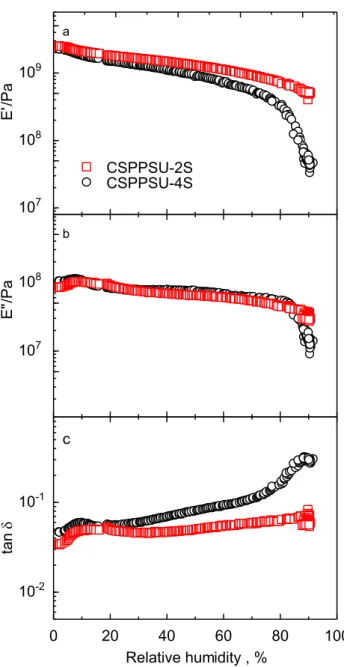
DMA of the samples was evaluated via an ITK DVA-225 dynamic viscoelastic analyzer. The storage modulus (E’), loss modulus (E”), and tan (E”/ E’) of the membranes was measured over a humility range from 0 to 90% RH at 80 °C (10 Hz). (8) Tensile strength
The tensile strength was investigated by a Shimadzu AGS-J 500N universal test machine attached with a Toshin Kogyo Bethel-3A temperature and humidity controllable chamber. The measurement was performed with samples cut into dumbbell shape (DIN-53504-S3, 35 mm × 6 mm (total) and 12 mm × 2 mm (test area)) and conducted at 80 °C, 60% RH at a tensile rate of 10 mm/min.
(9) Thermogravimetric analysis (TGA)
The thermal stabilities of the membranes were recorded using TGA with an SII TG/DTA 6000. The samples were heated from 80 to 800 °C in nitrogen atmosphere at a heating rate of 10 °C/min.
(10) Chemical stability
Chemical stability of membranes was tested with Fenton’s reagent (3% H2O2 aqueous solution containing 2 ppm FeSO4). After immersing the sample in the solution at 80 °C for 1 h, the changes of weight, molecular weight and IEC values were recorded.
Scheme 2-1. Synthesis of SPPSU-2S, SPPSU-4S, CSPPSU-2S, and CSPPSU-4S membranes
2.2.3 Synthesis of SFPS
SFPS was prepared by the sulfonation of FPS using 30% oleum according to the literature.6 The typical procedure is as follows. FPS (5.00 g) and 30% oleum (10 mL) were added into a 100 mL round-bottom flask equipped with a magnetic stirring bar. After stirred at 120 °C for 12 h, the mixture was poured into a large excess of cold brine. After filtration, the precipitate was dissolved in water, basified with 10 wt% NaOH aqueous solution, reprecipitated with additional NaCl. The crude product was purified by recrystallization three times and dried in vacuum oven at 120 °C overnight to obtain SFPS in 35% yield.
2.2.4 Synthesis of SPPSU-2S
A typical procedure is as follows. SFPS (0.70g, 1.52 mmol), BP (0.28g, 1.52 mmol), K2CO3 (0.53g, 3.80 mmol), DMSO (5 mL), and toluene (3 mL) were added into a 100 mL three-neck flask equipped with a magnetic stirring bar, Dean-Stack trap,
condenser, and nitrogen inlet/outlet. After heated at 140 °C for 24 h, the mixture was cooled to room temperature, diluted with DMSO and poured into a large excess of 1 M H2SO4 to precipitate a solid product. After filtration, the crude product was dissolved in water and dialyzed. After drying in a vacuum oven at 80 °C for 12 h, SPPSU-2S was obtained in 87% yield.
2.2.5 Synthesis of SPPSU-4S
A typical procedure is as follows. SPPSU-2S (0.25 g) and concentrated sulfuric acid (25 mL) were added into a 100 mL round-bottom flask. After heated at 60 °C for 3 days, the mixture was poured into ice water to precipitate a solid product. After filtration, the crude product was dissolved in water and dialyzed. After drying in a vacuum oven at 80 °C for 12 h, SPPSU-4S was obtained in 91% yield.
2.2.6 Membrane preparation and thermal crosslinking
Casting from DMSO solution (3 wt%) and drying at 80 °C for overnight gave yellow and flexible membranes of SPPSU-2S and SPPSU-4S. The resulting membranes were annealed in the air at 120 °C for 24 h, at 160 °C for 24 h, and at 180 °C for 6 h, to obtain the crosslinked CSPPSU-2S and CSPPSU-4S membranes.
2.3 Results and discussion
2.3.1 Synthesis of SPPSU-2S and SPPSU-4S
Scheme 2-1 shows the overall synthetic route for the target polymers (SPPSU-2S and SPPSU-4S). SFPS was prepared by the sulfonation reaction of FPS with 30% oleum at 120 °C for 12 h. The chemical structure of SFPS was characterized by 1H and 19F
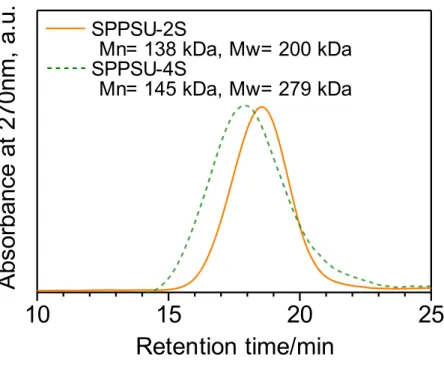
NMR spectra, in which all peaks were well-assigned to the supposed chemical structure (Figure 2-1). SPPSU-2S was prepared by nucleophilic substitution polycondensation of SFPS and BP under the basic conditions. The equimolar amount of the monomers was used to obtain high molecular weight polymer. The chemical structure of SPPSU-2S was characterized by NMR spectra (Figure 2-2a). GPC analyses (Figure 2-3) suggested the formation of high molecular weight (Mn=138 kDa and Mw=200 kDa) polymer (SPPSU-2S).
6
7
8
9
1H NMR
/ ppm
2
a
1
3
Figure 2-1. (a) 1H and (b) 19F NMR spectra of SFPS in DMSO-d6 at r.t..
Figure 2-2. 1H NMR spectra of (a) SPPSU-2S and (b) SPPSU-4S in DMSO-d
6 at r.t..
-110
-100
-90
19F NMR
4
b
/ ppm
Figure 2-3. GPC profiles of SPPSU-2S and SPPSU-4S.
SPPSU-4S was prepared by the sulfonation reaction of SPPSU-2S at 60 °C for 72 h. It should be noted that, compared to the sulfonation of FPS with 30 wt% oleum, concentrated sulfuric acid was enough for the reaction due to the existence of electron-donating ether groups in place of electron-withdrawing fluorine groups for FPS. The chemical structure of SPPSU-4S was characterized by 1H NMR spectrum (Figure 2-2b). Comparison of the 1H NMR spectra between SPPSU-2S and SPPSU-4S revealed that the sulfonation reaction was quantitative and selective on the biphenylene unit, in which one sulfonic acid group was introduced at the specific position of each phenylene group; the protons 1, 2 and 3 on the sulfonated biphenyl sulfone groups did not change and the new peaks (protons 9, 10, and 11) were assignable to bis(sulfophenylene) groups. The integral ratios of these peaks were in good accordance with the structure of SPPSU-4S. Furthermore, the IEC values of
10
15
20
25
Ab
so
rb
an
ce
a
t
27
0n
m,
a
.u
.
Retention time/min
SPPSU-2S Mn= 138 kDa, Mw= 200 kDa SPPSU-4S Mn= 145 kDa, Mw= 279 kDaSPPSU-2S and SPPSU-4S obtained by titration, calculation and 1H NMR spetra were in good agreement within acceptable errors proving that the target structures were obtianed (Table 2-1). Due to the introduction of the sulfonic acid groups, the molecular of SPPSU-4S (Mw = 279 kDa, Mn = 145 kDa, Figure 2-3) was higher than that of SPPSU-2S (Mw = 200 kDa, Mn = 138 kDa, Figure 2-3).
2.3.2 Preparation of CSPPSU-2S and CSPPSU-4S membranes
The thermal crosslinking reaction was carried out at three steps as described in the experimental section in order to avoid immediate decomposition of the sulfonic acid groups. The obtained membranes, CSPPSU-2S and CSPPSU-4S, were brown colored (Figure 2-4) compared with yellow color of the parent SPPSU-2S and SPPSU-4S membranes, suggesting the changes in the electronic structure of the aromatic rings. While SPPSU-2S and SPPSU-4S were soluble in water and several polar organic solvents, the heat treated CSPPSU-2S and CSPPSU-4S were insoluble in any solvents (Table 2-1). The results were indicative of the interpolymer crosslinking reaction. The IECs of CSPPSU-2S and CSPPSU-4S were 2.13 and 3.20 meq/g, respectively, and were lower than those of the parent polymer membranes. The results suggest sulfone bond formation from the sulfonic acid groups.4 The losses of the sulfonic acid groups calculated from the IEC values were 39% and 40% for CSPPSU-2S and CSPPSU-4S, respectively, implying similar degree of crosslinking for the membranes. It is considered that the annealing induced interpolymer sulfone bond formation in addition to the decomposition (removal) of the sulfonic acid groups. Detailed structural analyses with NMR spectra were unavailable due to the insolubility of the CSPPSU membranes.