PAPER
Wait-Free Linearizable Distributed Shared Memory
Sen MORIYA†∗, Regular Member, Katsuro SUDA†∗∗, Nonmember, Michiko INOUE†, Member, Toshimitsu MASUZAWA†, and Hideo FUJIWARA†, Regular Members
SUMMARY We consider a wait-free linearizable implemen- tation of shared objects on a distributed message-passing sys- tem. We assume that the system provides each process with a local clock that runs at the same speed as global time and that all message delays are in the range [d − u, d] where d and u (0 < u ≤ d) are constants known to every process. We present four wait-free linearizable implementations of read/write registers on reliable and unreliable broadcast models. We also present two wait-free linearizable implementations of general objects on a re- liable broadcast model. The efficiency of an implementation is measured by the worst-case response time for each operation of the implemented object. Response times of our wait-free imple- mentations of read/write registers on a reliable broadcast model is better than a previously known implementation in which wait- freedom is not taken into account.
key words: synchronous message-passing system, distributed shared memory, linearizability, wait-freedom
1. Introduction
How to provide logically shared objects in a distributed system is a fundamental problem on concurrent com- puting. A distributed system has good scalability while it needs low-level or complex control to shared data through message-passing paradigm. Logically shared objects greatly simplifies a design of a user program owing to its simple and general computing paradigm. A distributed shared memory consisting of such shared objects aims at providing useful and scalable program- ming environment for high-performance computing us- ing multiple processors.
We implement logical shared objects which are used by multiple application processes concurrently. The implemented shared objects should provide some consistency for concurrent accesses. We consider lin- earizableimplementations [1] of shared objects on a dis- tributed message passing system. Informally, lineariz- ability guarantees that operations to the implemented objects seem to be executed sequentially in some total order, and, for two operations such that one operation starts after the other operation completed, this total
Manuscript received October 4, 1999. Manuscript revised March 16, 2000.
†The authors are with the Graduate School of Infor- mation Science, Nara Institute of Science and Technol- ogy(NAIST), Ikoma-shi, 630–0101 Japan.
∗Presently, with NTT Communication Science Labora- tries.
∗∗Presently, with NTT Software Corporation.
order preserves the real-time order on them. It has some good properties, such as locality and nonblock- ing. Locality means that a system is linearizable if each individual object is linearizable. Locality allows a concurrent system to be designed and constructed in a modular fashion; each of linearizable objects can be implemented, verified and executed independently. Nonblocking property means that a pending operation is never required to wait for another pending operation to complete. Nonblocking implies that linearizability is an appropriate condition for a system where real-time response is important.
An implementation of objects is said to be wait- free if any operations of the implemented objects are completed in finite time regardless of other processes’ behavior [2]. We consider a wait-free linearizable im- plementation, which tolerates crash faults of any num- ber of processes. James et al. showed that there are no wait-free linearizable implementations of read/write registers on a fully asynchronous system [3]. In this paper, we assume that all message delays in the sys- tem are in the range [d − u, d] for some constants d and u(0 < u ≤ d), and these constants are known to every process. We also assume that the system provides each process with a local clock that runs at the same speed as global time. We consider two kinds of models on message exchange, a reliable broadcast and an unreli- able broadcast. These two models differ in a guarantee on a case where a process crashes during its broad- cast. A reliable broadcast model guarantees that every correct process receives a broadcasted message. In an unreliable broadcast model, if a process crashes during its broadcast, the message is not guaranteed to be sent to all correct processes. In such a case, some correct processes receive the message while the other correct processes may not receive it. We consider two kinds of models also on local clocks, asynchronous clocks and u-synchronous clocks. In a u-synchronous clock model, the difference between any pair of two local clock values is at most u. In an asynchronous clock model, we make no assumptions on such a difference. The efficiency of an implementation is measured by the worst-case re- sponse time res time(op) for each operation op of the implemented objects.
Several authors have investigated linearizable im- plementations of shared objects on a system in which no
Table 1 Previous known results on linearizable implementa- tions.
read/write registers
res time res time
bound clocks (write) (read)
upper u-synchronous [4] 4u + αm 4u+ (1 − α)m∗ (0 < α ≤ 1, m = d − u) lower asynchronous [5] u/2
[4] The sum is d + u/2. u/2 FIFO queues
res time res time (dequeue) (enqueue) lower asynchronous [6] d + u/2 u(n − 1)/n
if u ≤ (2/3)d general objects
res time res time (opa) (opv)
upper asynchronous [6] u 2d
all message delays in [d − u, d] n : the number of processes ∗The bibliography [4] shows that the implementation achieves res time(write) = 4u + α(d − u) and res time(read) = 4u + ( 1 − α)(d − u) + b where b is an arbitrarily small constant implying the length of an interval for a broadcast. We ignore the length here and regard the small constant b as zero.
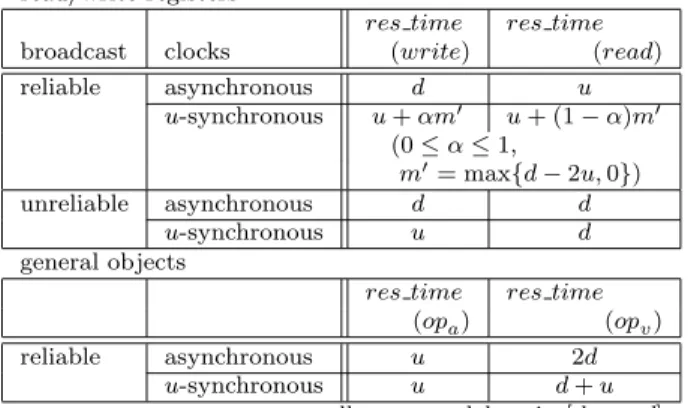
Table 2 Wait-free linearizable implementations in this paper. read/write registers
res time res time
broadcast clocks (write) (read)
reliable asynchronous d u
u-synchronous u + αm′ u + ( 1 − α)m′ (0 ≤ α ≤ 1,
m′= max{d − 2u, 0})
unreliable asynchronous d d
u-synchronous u d
general objects
res time res time (opa) (opv)
reliable asynchronous u 2d
u-synchronous u d + u
all message delays in [d − u, d]
processes crash and all message delays are in the range [d − u, d]. Previous results are shown in Table 1. Attiya et al.[5] and Mavronicolas et al.[4] showed lower bound results about any implementations of read/write regis- ters on an asynchronous clock model. Mavronicolas et al. also presented an implementation of read/write reg- isters on a u-synchronous clock model [4]. Inoue et al. presented an implementation of general objects such that res time(opa) = u and res time(opv) = 2d on an asynchronous clock model, where opa is any opera- tion returning a unique response, called to be ack-type, and opv is any operation that is not ack-type, called to be val-type[6]. They also showed lower bound re- sults about any implementations of FIFO queues on an asynchronous clock model [6].
In this paper, we propose wait-free linearizable im- plementations. First, we present four wait-free lineariz-
able implementations of read/write registers. Two of them are implementations using reliable broadcasts on an asynchronous and u-synchronous clock models. The other two are implementations on an unreliable broad- cast model, on an asynchronous and u-synchronous clock models. Furthermore, we present two wait-free linearizable implementations of general objects on an asynchronous and u-synchronous clock models using re- liable broadcasts. The implementation of general ob- jects on an asynchronous clock model is based on an implementation in [6], which is not wait-free. We show our results in Table 2. All of them are wait-free, that is, they tolerate crash faults of any number of processes. Moreover, the response time of our implementation on a u-synchronous clock model using reliable broadcasts is more efficient than previous known implementation on a u-synchronous clock model in [4].
2. Definitions 2.1 System
A distributed message-passing system consists of multi- ple processes and a communication network. A process communicates with any other processes by exchang- ing messages through the network. No messages are omitted in exchange of messages. All message delays are in the range [d − u, d] for some constants d and u (0 < u ≤ d) where every process knows these d and u. Each process has a local clock that runs at the same rate as global time†. The process obtains local time from its local clock. The process has a timer based on its local clock, and it can set an alarm by the timer. We assume the difference between any pair of local clock values in a system is at most ǫ for some constant ǫ. Such a model is called ǫ-synchronous clock model. If ǫ is the infinity, the model is called asynchronous clock model.
We assume that a process may crash. After a pro- cess crashes, it ceases to operate. We consider two kinds of models about exchange of messages, a reliable broadcast model and an unreliable broadcast model. In both models, processes communicate with each other by sending and receiving messages. A reliable broadcast means that every broadcasted message is guaranteed to be received by all correct processes. Therefore, in a re- liable broadcast model, a broadcast is modeled as one event where the process sends a message to all processes atomically. On the other hand, a broadcast is imple- mented by sending a message sequentially to all pro- cesses in an unreliable broadcast model. In this model, if a process gets faulty during its broadcast, some cor- rect processes receives a message while the other correct processes do not receive it.
A process p is modeled as a state machine. Its
†We use system-wide global time to specify system be- havior. Note that the global time is introduced only for specification and no processes can use it.
state changes when some event occurs at p. A system configuration (or we call just configuration) is defined as all process states, a set N of in-transit messages and sets Ap of alarms which have been set and have not gone off at each process p. An in-transit message is a triple (M, s, r) where M is a message, s is the sender, and r is the destination. An alarm is a pair (K, t) where Kis the type of an alarm and t is the local time for the alarm to go off. Each process has the following events.
• Communication events: events in which a process sends or receives a message. In a reliable broad- cast model, broadcast events BroadCast(p, M ) and receive events Receive(p, q, M ) can occur. In an unreliable broadcast model, send events Send(p, q, M ) and receive events Receive(p, q, M ) can occur.
Send(p, q, M ) : Process p sends a message M to process q. A triple (M, p, q) is added to N . BroadCast(p, M ) : Process p broadcasts a mes-
sage M , that is, it sends M to all processes†. For each process q, (M, p, q) is added to N . Receive(p, q, M ) : Process p receives a message M
from process q. A triple (M, q, p) is removed from N .
• Time events: events about the local clock.
T imerSet(p, ¯t, K) : Process p sets its timer of type K to go off after ¯t. When an event T imerSet(p, ¯t, K) occurs at local time t, a pair (K, t + ¯t) is added to Ap.
Alarm(p, K) : An alarm of type K occurs at pro- cess p. When an event Alarm(p, K) occurs at local time t, a pair (K, t) is removed from Ap.
ReadClock(p, s) : Process p obtains the clock value s from its local clock.
• Stop(p) : Process p crashes. In this event, p’s state changes to fault state and p ceases to operate.
• A process communicates also with the outside of the system, which we call environment. We de- scribe events about communication between a pro- cess and the environment later.
The receive, alarm and stop events are input events, which arise out of the process’s control.
The system history (or we call just history) is defined as a finite or infinite alternating sequence of configurations and occurrences of events, H = c0,(e1, t1), c1,· · · , ck,(ek+1, tk+1), ck+1,· · · , where each ck(k ≥ 0) is a configuration, (ek, tk)(k ≥ 1) is an occur- rence of an event, ek is an event and tk is global time when ek occurs. Each tk is denoted by time(ek). A process p’s state of a configuration ck is a projection of ck to p, denoted by ck|p. The first configuration c0
is called an initial configuration, in which all processes are in the initial state, and N and Ap for any process
pare empty. For each k, tk ≤ tk+1holds. A history H implies that, for each k(k ≥ 0), an event ek+1 occurs at some process p at tk+1 in a configuration ck, and p’s state changes from ck|p to ck+1|p (and N or Ap also may change). To be simplified, all events in a history are distinct. We assume the following conditions on any history H.
• If Ap contains a pair (K, t), Alarm(p, K) occurs or p is in a fault state at local time t. Conversely, Alarm(p, K) occurs at t, only if (K, t) is in Ap.
• If a triple (M, p, q) is added to N at T , Receive(q, p, M ) occurs in [T + d − u, T + d] or q is a fault state at T + d. Only if N contains a triple (M, p, q), a receive event Receive(q, p, M ) occurs.
2.2 Implementation of an Object
We define a deterministic shared object (we call just ob- ject in the following). An object is a data structure to which multiple processes can access concurrently. An object has a unique name and a type. The type is a tuple (OP , RES, Q, q0, δ), where OP is a set of opera- tions, RES is a set of responses, Q is a set of states, q0 is an initial state, and δ : Q × OP → Q × RES is a function called sequential specification. The se- quential specification defines a behavior of the object when operations are applied sequentially: if an oper- ation op is applied to the object in a state s, the ob- ject changes its state to s′ and returns the response res where δ(s, op) = (s′, res) holds. Such an object is called to be deterministic, since the sequential specification is a function. If an operation op always returns a unique response, that is |{res|∃s, s′[δ(s, op) = (s′, res)]}| = 1, op is called to be ack-type. An operation is called to be val-type, if it is not ack-type. In the following, opa denotes any ack-type operation and opv denotes any val-type operation.
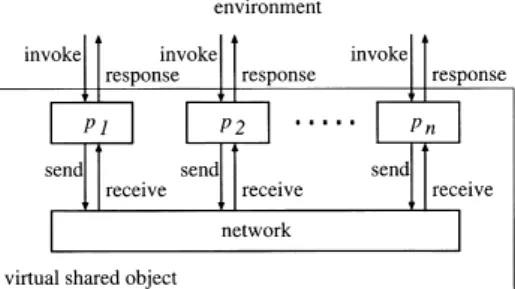
Next, we define an implementation of an object O of type (OP , RES, Q, q0, δ). We implement a virtual shared object which is used concurrently by environment. Figure 1 illustrates the implementa- tion. An object is implemented by a set of processes {p1, p2,· · · , pn}. A subscript i of each pi is the pro- cess identifier. Environment can access an object by communicating with a process pi. Communication be- tween environment and a process pi is modeled as the following events.
• Invoke(pi, op) : Environment calls pi to apply an operation op(∈ OP ) to the object O.
• Response(pi, res) : Process pi returns a response res(∈ RES) for an invocation to environment. The invoke event is an input event. We assume the
†For convenience, we assume that a process sends a mes- sage to all processes including itself by a broadcast.
Fig. 1 Implementation of a shared object.
following condition about communication between en- vironment and pion any history H.
• Once environment invokes an operation to a pro- cess pi, it does not invoke the next operation to pi
until pi returns a response for the former invoca- tion.
To return consistent responses, the processes exchange messages with each other.
For each pi, we consider a sequence obtained by re- stricting a history to pi’s invoke and response events. In an implementation, a process returns a response if and only if an operation is invoked to the process. There- fore, the obtained sequence should be an alternating sequence Inv1, Res1, Inv2, Res2,· · · where Invk is an invoke event and Resk is a response event for each k(k ≥ 1). For each invoke event Invk, the next event Resk is called to be a corresponding response event. A pair of events (Invk, Resk) is called an operation ex- ecution. An invoke event that has no corresponding response events is said to be pending. If an invoke event of an operation is not pending, it is said to be completed.
The implemented object should provide some con- sistency for concurrent accesses. We adopt lineariz- abilityas a consistency condition of an implementation of an object. Herlihy et al. showed a local property of linearizability [1]. The locality means that an im- plementation of multiple shared objects is linearizable if and only if each object is implemented linearizably. This says that objects can be implemented and verified independently. In this paper, we consider an implemen- tation of one object, and we define an implementation of only one object. From locality, we can implement multiple objects from our implementations of one ob- ject.
Now we define linearizability and wait-freedom. We consider a sequence of operation executions τ = (Inv1, Res1), (Inv2, Res2), · · ·. For each k(k ≥ 1), let Invk and Resk be Invoke(pik, opk) and
Response(pik, resk) respectively. For an object O of type (OP , RES, Q, q0, δ), if there exists a sequence θ = q0, q1,· · · of states of O, where δ(qk−1, opk) = (qk, resk) holds for each k ≥ 1, τ is said to be legal. In a system history H, if time(Resk) < time(Invl) holds for two operation executions opk = (Invk, Resk) and
opl = (Invl, Resl), we say that opk precedes opl and opl succeeds opk, denoted by opk → opH l. A sequence obtained by restricting a history H to completed invoke and response events is denoted by complete(H). Definition 1: A history H is said to be linearizable, if there exists a history H′ that satisfies the followings.
• The history H′ is obtained from H by adding corresponding response events for some (possibly empty) pending invoke events.
• There exists a legal sequence τ consisting of all operation executions in complete(H′) such that, for any operation executions op1and op2satisfying op1complete(H
′)
−→ op2, op1precedes op2 in τ . ✷ Definition 2: For an implementation I, if any possi- ble system history H is linearizable, the implementa- tion I is said to be linearizable. ✷ Definition 3: A history H is said to be wait-free, if any invoke event Inv in a history H satisfies one of the followings.
• There exists a corresponding response event.
• For the process pi in which Inv occurs, Stop(pi)
occurs after Inv. ✷
Definition 4: For an implementation I, if any possi- ble system history H is wait-free, the implementation
I is said to be wait-free. ✷
The efficiency of an implementation I is measured by the worst-case response times of operation execu- tions. For an operation execution (Inv, Res), we de- fine the response time as time(Res) − time(Inv). Let OP E(H) denote a set of operation executions that appear in a history H. For an operation execution ope = (Inv, Res), let ope.op denote an operation in- voked in Inv. For an implementation I of an object O of type (OP , RES, Q, q0, δ), we define the worst- case response time of op, denoted by res time(op), as max{res time(ope)|ope ∈ OP E(H), ope.op = op, H is a history of I}.
3. Read/Write Registers
In this section, we present four implementations of a read/write register. We show the type of a read/write register on a domain D in Fig. 2. The efficiency of a read/write register is mea- sured by res time(read) and res time(write) where res time(write) = max{res time(write(v))}. Two im- plementations described in the first subsection use reli- able broadcasts, and two implementations described in the second subsection does not use reliable broadcasts. In all implementations, each process keeps a local copy of a read/write register. When a write operation is invoked at a process, the process assigns a timestamp
type of read/write register (OP , RES, Q, q0, δ) OP = {write(v)|v ∈ D} ∪ {read} RES = {ack} ∪ D
Q = D
∀v, v′ δ(v, write(v′)) = (v′, ack)
∀v δ(v, read) = (v, v)
Fig. 2 Type of a read/write register on a domain D.
to the write operation and broadcasts an update mes- sage that contains the written value and the timestamp of the write operation. A process updates its local copy according to received update messages. The update de- pends on a timestamp assigned to the write operation. In a read operation, the value of its local copy at some time during the operation is returned.
We describe each program code by event-driven form for input events. A series of each event and the succeeding internal changes of the state is atomic, that is, the process does not crash during the series. If mul- tiple input events occur at the same time, they are han- dled in an order such that they appear in the described code except a stop event.
3.1 Implementations Using Reliable Broadcasts In this subsection, we show two implementations using reliable broadcasts. The first one is an implementation on an asynchronous clock model and the other is on a u-synchronous clock model.
3.1.1 Asynchronous Clocks
The first implementation, which we call registerRB−AC (for “reliable broadcast, asynchronous clocks”), pro- vides a read operation with response time u and a write operation with response time d. The program code for pi is given in Fig. 3.
First we assume that no faults occur and later con- sider the case where any number of processes crash. In a write operation, the process broadcasts an update mes- sage first. When a process receives the update message, it updates its local copy according to the message. The write operation is completed by returning ack after d since its invocation. In a read operation, the value of its local copy at invoked time is returned. After u since its invocation, the process returns the value.
In this implementation, a process uses an integer countas a timestamp. The integer count increases by one when a write operation is invoked at the process. If the timestamp contained in a received update mes- sage is greater than the process’s count, the process sets its count to the timestamp. Since any message de- lay is not greater than d, a write operation execution W2 succeeding another one W1 is assigned a greater timestamp than W1’s timestamp.
A process sets its local copy to the written value contained in each update message in order of its times-
data type
timestamp=(integer, process identifier);
variables
count, type integer, init 0; res val, type value of the register ; last up ts, type timestamp, init (0, 0);
local copy, type value of the register, init initial value of the register;
transition functions of processpi
Invoke(pi, write(v)) : count:= count + 1;
BroadCast(pi,update(v, (count, i))); /* update message */ T imerSet(pi, d,WRITE);
Invoke(pi, read) : res val:= local copy; T imerSet(pi, u,READ);
Receive(pi, pj,update(v, (recvd count, recvd uid))) : count:= max(count, recvd count);
iflast up ts <†(recvd count, recvd uid)
thenlocal copy:= v; last up ts := (recvd count, recvd uid);
Alarm(pi,WRITE) : Response(pi,ack);
Alarm(pi,READ) : Response(pi, res val);
Stop(pi) :
No events can happen after this event.
†A relation (a1, b1) < (a2, b2) means that a1< a2, or a1= a2
and b1< b2.
Fig. 3 Implementation registerRB−AC. (The code for pi.)
tamp (breaking tie by process identifiers). However, there is a case where a process receives an update mes- sage after it updates its local copy according to some update message with a greater timestamp. In this case, the process considers that such an update message has already been handled and the value is overwritten by the write operation with a greater timestamp. Thus the process ignores such an update message. An update message broadcasted at time t of a write operation W is received in [t + d − u, t + d]. Therefore, at each process, the update message for W is handled in this interval, or it is ignored. For two read operations executions R and R′ such that R′ precedes R, it is guaranteed that Rreturns the value written by the write operation with timestamp greater than or equal to R′.
Next, we consider the case where any number of processes crash. If a process crashes during an opera- tion, the operation is left pending. In implementation registerRB−AC, only a write operation influences the other processes. In a reliable broadcast model, if and only if some process broadcasts an update message in a write operation execution, all correct processes receive the update message. This does not depend on whether the write operation is completed. Therefore, implemen- tation registerRB−AC works correctly in a case where some processes crash.
Now we prove that registerRB−AC is a wait-free linearizable implementation of a read/write register. We show that any possible history H in registerRB−AC
is linearizable and wait-free. A pending invoke event of a write operation W is said to be valid if some response event of a read operation execution returns the value written by W . Let H′be a history in which a response event corresponding to each valid pending event e in H is added at time(e) + d.
Lemma 1: Let Inv be an invoke event of any write operation execution W in a history complete(H′). Let M be the update message of W . If a process piupdates its local copy according to M , it is done in [time(Inv)+
d− u, time(Inv) + d]. ✷
For a write operation execution W , let ts(W ) de- note a pair of W ’s timestamp and the process identifier. Lemma 2: For write operation executions W1 and W2 in complete(H′), if W1
complete(H′)
−→ W2, then
ts(W1) < ts(W2) holds. ✷
For a read operation R, let W rite(R) be the write operation execution whose written value R returns. Lemma 3: Let R1 and R2 be read operation exe- cutions in complete(H′) satisfying R1
complete(H′)
−→ R2. Then, ts(Write(R1)) < ts(Write(R2)) or Write(R1) =
Write(R2) holds. ✷
Theorem 4: The implementation registerRB−AC is a wait-free linearizable implementation of a read/write register which achieves res time(write) = d and res time(read) = u on an asynchronous clock model using reliable broadcasts.
Proof. It is trivial that the implementation is wait-free and achieves res time(write) = d and res time(read) = u. We show the implementation is linearizable in the rest of the proof.
We construct a legal sequence τ that consists of all operation executions in complete(H′), and show that, for any operation executions op1 and op2, op1precedes op2 in τ if op1 complete(H
′)
−→ op2. First, we assume that a sequence τ begins with a virtual write operation W0
that writes the initial value, and arrange all write op- eration executions in complete(H′) after W0 in order of their timestamps. Next, we put each read opera- tion R between write operation executions in order of its invocation time by the following way to accomplish constructing a sequence τ . Let Wk be W rite(R) and Wk+1 be the write operation execution that we have arranged next to Wk. We put R immediately before Wk+1.
Now we show that for any operation executions op1 and op2, if op1complete(H
′)
−→ op2, op1precedes op2 in τ . (i) op1and op2are write operation executions W1and
W2: From Lemma 2, if W1
complete(H′)
−→ W2, then ts(W1) < ts(W2) holds. From the rule to construct τ, W1precedes W2 in τ .
(ii) op1and op2 are read operation executions R1 and R2: Let W1and W2be W rite(R1) and W rite(R2) respectively. From Lemma 3, ts(W1) < ts(W2) or W1= W2 holds. From the rule to construct τ , R1
precedes R2 in τ in both cases.
(iii) op1 is a write operation execution W1 and op2 is a read operation execution R1: Let W1 be (InvW1, ResW1) and R1 be (InvR1, ResR1). Let R1be an operation at pi. From W1
complete(H′)
−→ R1, time(InvW1) + d = time(ResW1) < time(InvR1) holds. The process pi receives the update mes- sage for W1 at time(InvW1) + d or before, and then returns the response for R1at time(ResR1) = time(InvR1) + u. From the implementation, pi’s count at time(ResW1) is greater than or equal to ts(W1) and it does not decrease. Therefore, W rite(R1)’s timestamp is greater than or equal to ts(W1). This implies that R1succeeds W1in τ . (iv) op1 is a read operation execution R1 and op2 is a write operation execution W1: Let W1 be (InvW1, ResW1) and R1 be (InvR1, ResR1). Let W2 = W rite(R1) be (InvW2, ResW2). From Lemma 1, W2 is invoked before time(InvR1) + u − d. From time(InvW1) > time(InvR1) + u, time(InvW1) > time(ResW2) holds. Since W2
complete(H′)
−→ W1 holds, R1 is put between W2
and W1 in τ .
Finally, from the rule to construct τ , all read op- erations return the value written by the latest write operation. Therefore, τ is legal. ✷ 3.1.2 u-Synchronous Clocks
The next implementation, which we call registerRB−uC (for “reliable broadcast, u-synchronous clocks”), pro- vides a read operation with response time u + (1 − α) max{d − 2u, 0} and a write operation with response time u + α · max{d − 2u, 0} where α(0 ≤ α ≤ 1) is a parameter. The program code for pi is given in Fig. 4. Implementation registerRB−uC is based on im- plementation registerRB−AC. The difference between registerRB−uC and registerRB−AC is that we use a local clock value as a timestamp in registerRB−uC in- stead of count in registerRB−AC. In u-synchronous clock model, the difference between any pair of local clock values is at most u. Therefore, it is guaranteed that a preceeding write operation has a smaller times- tamp if response time of a write operation is u or more. For a write operation execution W = (InvW, ResW), any process pi updates its local copy according to W ’s update message in [time(InvW)+d−u, time(InvW)+d] or ignores the update message. Now let R be a read op- eration execution and W be W rite(R). For any read operation execution R′ preceeding R, it is guaranteed that W has a greater timestamp than W rite(R′) if re- sponse time of read operation is u or more. Further-
constant
|W | = u + α · max{d − 2u, 0}, |R| = u + (1 − α) max{d − 2u, 0}
transition functions of processpi
Invoke(pi, write(v)) : ReadClock(pi, local cl);
BroadCast(pi,update(v, (local cl, i))); /* update message */ T imerSet(pi,|W |, WRITE);
Invoke(pi, read) :
T imerSet(pi,min{|R|, d − u}, SET VAL); T imerSet(pi,|R|, READ);
Receive(pi, pj,update(v, (recvd cl, recvd uid))) : iflast up ts <(recvd cl, recvd uid)
thenlocal copy:= v; last up ts := (recvd cl, recvd uid);
Alarm(pi,WRITE) : Response(pi,ack);
Alarm(pi,SET VAL) : res val:= local copy;
Alarm(pi,READ) : Response(pi, res val);
Stop(pi) :
No events can happen after this event.
Fig. 4 Implementation registerRB−uC. (The code for pi.)
more, the time when res val is stored in a read op- eration guarantees that any write operation execution preceeding R except W has a smaller timestamp than W. For any write operation execution W′ preceeding R, it is guaranteed that W has a greater timestamp than W′ if the sum of response time of read and write operations is d or more.
Lemmas 1–3 also hold in registerRB−uC. From these lemmas, we can construct a legal sequence τ for any possible history H like Theorem 4. Therefore, registerRB−uC is a wait-free linearizable implementa- tion of a read/write register.
Theorem 5: The implementation registerRB−uC is a wait-free linearizable implementation of a read/write register which achieves res time(write) = u + α · max{d − 2u, 0} and res time (read) = u + (1 − α) max{d − 2u, 0} (0 ≤ α ≤ 1) on a u-synchronous clock model using reliable broadcasts. ✷
3.2 Implementations on Unreliable Broadcast Model In this subsection, we show two implementations on an unreliable broadcast model. The first one is on asynchronous clock model, and the other is on u- synchronous clock model. A message broadcasted in this model is not guaranteed to be received by all cor- rect processes if the sender crashes during its broad- casting. A message which all correct processes do not receive is called to be incompletely broadcasted. 3.2.1 Asynchronous Clocks
The first implementation, which we call registerU B−AC
transition functions of processpi
Invoke(pi,Write(v)) : count:= count + 1;
forj= 1 to n /* broadcasting an original update message */ doSend(pi, pj,update(v, (count, i)));
T imerSet(pi, d,WRITE);
Invoke(pi,Read) : res val:= local copy;
forj= 1 to n /* broadcasting an additional update message */ doSend(pi, pj,update(res val, last up ts));
T imerSet(pi, d,READ);
Receive(pi,update(v, (recvd count, recvd uid))) : count:= max(count, recvd count);
iflast up ts <(recvd count, recvd uid)
thenlocal copy:= v; last up ts := (recvd count, recvd uid);
Alarm(pi,WRITE) : Response(pi,ack); Alarm(pi,READ) :
Response(pi, res val);
Stop(pi) :
No events can happen after this event.
Fig. 5 Implementation registerU B−AC. (The code for pi.)
(for “unreliable broadcast, asynchronous clocks”) pro- vides a read operation with response time d and a write operations with response time d. The program code for pi is given in Fig. 5.
First, we consider to apply registerRB−AC to an unreliable broadcast and asynchronous clock model. An incompletely broadcasted update message M does not cause update of a local copy to all correct processes. This violates linearlizability as follows. A correct pro- cess that receives M returns a value v contained in M for a read operation execution R after receiving M . On the other hand, a correct process that does not receive M cannot return v for a read operation execution suc- ceeding R.
In an implementation registerU B−AC, a process where a read operation execution R occurs relays infor- mation about the update message that contained the returned value by sending an additional update mes- sage to the others. Every process never fails to know information about an update message that contains the value returned by R. Even if a correct process does not receive an original update message, it updates its local copy according to the additional update message.
Here we explain how a process relays such neces- sary information. In each read operation R, a process assigns the timestamp (containing the process identi- fier) of W rite(R). If R returns the initial value, (0, 0) is assigned. A process decides a returned value when the invocation occurred, and then the process broad- casts an additional update message which contains the returned value and W rite(R)’s timestamp. This is a different point from registerRB−AC or registerRB−uC. The process returns the value after d since its invoca- tion. If some process completes a read operation, it is guaranteed that all correct processes obtain informa- tion about the value returned in the operation. A pro-
cess sets its local copy to the value contained in each original or additional update message in order of its timestamp. When a process receives an update mes- sage, only if the message has a greater timestamp than the latest update, it updates its local copy according to the message.
To prove that registerU B−AC is a wait-free lin- earizable implementation of a read/write register, we consider any possible history H. For the history H, we construct a history H′ as follows. We consider any pending write operation execution W whose value some read operation returns. Let R be the first read oper- ation that returns W ’s value, and add W ’s response event at the same time as R’s response event in a his- tory H′. Let ts(op) denote a pair of the timestamp and the process identifier assigned to an operation ex- ecution op including a read operation execution. Note that ts(W rite(R)) = ts(R) holds for a read operation R. Let op ts(op) be a pair of count and the process identifier at invoked time. Note that ts(W ) = op ts(W ) holds for a write operation W . Then, the next lemma holds.
Lemma 6: For any operation executions op1and op2, if op1 complete(H
′)
−→ op2 holds, (ts(op1), op ts(op1)) < (ts(op2), op ts(op2)) holds. ✷ Theorem 7: The implementation registerU B−AC is a wait-free linearizable implementation of a read/write register which achieves res time (write) = d and res time(read) = d on an asynchronous clock and un- reliable broadcast model.
Proof. It is trivial that the implementation is wait-free and achieves res time(write) = d and res time(read) = d. We show the implementation is linearizable in the rest of the proof.
We construct a legal sequence τ . First, we assume that there is a virtual write operation W0 which writes the initial value such that ts(W0) = op ts(W0) = (0, 0). Next, we arrange each operation op in complete(H′) in order of (ts(op), op ts(op)) to accomplish construct- ing a sequence τ . From Lemma 6, for any opera- tion executions op1 and op2, op1 precedes op2 in τ if op1 complete(H
′)
−→ op2. For each read operation R, there is a write operation W such that W = W rite(R) and ts(R) = ts(W ) hold. For such R and W , op ts(W ) < op ts(R) holds. Furthermore, for any write operation W1 assigned a greater timestamp, ts(W1) > ts(W ) = ts(R) holds. For any write operation W2 assigned a smaller timestamp, ts(W2) < ts(W ) holds. Therefore, there are no write operations between W and R, and τ
is legal. ✷
3.2.2 u-Synchronous Clocks
Here we describe a brief outline of an implementa- tion on a u-synchronous clock and unreliable broad-
cast model, called registerU B−uC. The implemen- tation provides a write operation with response time u and a read operation with response time d. In registerU B−uC, a process uses its local clock value as a timestamp instead of count in registerU B−AC. When a write operation is invoked, a process sends a message containing the written value and its timestamp to all processes. In a read operation, a process decides the re- turned value and sends a message containing the value and its timestamp to all processes in d − u since the invocation. The read operation is completed by return- ing the value. Response times of both write and read operations in registerU B−AC is d, while response time of a write operation in registerU B−uC can be reduced to u. This is because, for any write operation execu- tions W1 and W2, W2 is assigned a greater timestamp than W1if W2is invoked after u since an invocation of W1.
Theorem 8: The implementation registerU B−uC is a wait-free linearizable implementation of a read/write register which achieves res time (write) = u and res time(read) = d on a u-synchronous clock and un-
reliable broadcast model. ✷
4. General Objects Using Reliable Broadcasts In this section, we present two implementations of a general deterministic object using reliable broadcasts. One is on an asynchronous clock model, and the other is on a u-synchronous clock model. In our implemen- tations of a general object, each process keeps a local copy of the implemented object, and applies invoked operations to it sequentially in some common order to all processes. Note that an implementation of a general objects reflects every supported operation.
4.1 Asynchronous Clocks
We previously presented a linearizable implementa- tion of a general object on an asynchronous clock model, where we achieved res time(opa) = u and res time(opv) = 2d[6]. Here we call that implemen- tation generalIM T. Implementation generalIM T did not assume any process fault, and actually some pro- cess fault causes violation of linearizability. The im- plementation is not wait-free in a sense that it does not tolerate a crash fault of a process. In this subsec- tion, we slightly modify generalIM T so as to guarantee wait-freedom in the case where a reliable broadcast is available. First, we explain generalIM T, and then men- tion the modification to produce a wait-free linearizable implementation, which we call generalRB−AC.
In implementation generalIM T, any val-type oper- ation needs 2d since its invocation to obtain its response value, and any operation needs u since its invocation to
return a response that guarantees linearizability. As de- scribed before, each process applies invoked operations to the implemented object sequentially in some com- mon total order to all processes. To decide the com- mon total order, each process first decides a common partial order PO on occurrences of invoked operations, and then locally extends it to a total order T O by com- mon rules to all processes. Here we just explain how to decide PO and T O.
The partial order PO is decided as follows. Ev- ery process uses two kinds of messages, an update mes- sage and a report message. When an operation op1 is invoked at a process pi, the process pi broadcasts an update message to inform the other processes of the invocation. Let t1 be the invoked time of op1. If pi
receives an update message of an operation op2from pj
at t, the message was sent by pj at t2 in the interval [t − d, t − (d − u)]. If t < t1+ d − u holds, it implies t2 < t1. In this case, pi considers (op2, op1) ∈ PO. At t1+ d − u, pi checks all occurrences of operations opsuch that (op, op1) ∈ PO (for reflexivility, consider (op1, op1) ∈ PO). Then, pi informs all processes of this relation by broadcasting a report message which con- tains a set of occurrences of operations whose update message were received by pi before t1+ d − u. When pi
receives a report message, it augments PO with the re- lation informed by the report message and then taking its transitive closure.
The process pi returns a response for an opera- tion op1 as follows. If op1 is ack-type, pi returns the response for op1 after u since the invocation. If op1 is val-type, after 2d since an invocation of op1, pi sets a total order T O on occurrences of operations whose report messages have been received by pi. This total order T O is extended from PO by ordering unordered pairs by process identifiers. Then, pi applies the oper- ations to its local copy in this order up to op1. At that time, pi knows a response value for op1, and returns a response for op1.
Now we modify this implementation for wait- freedom. Only the problem is the case where some process crashes soon after some ack-type operation op1
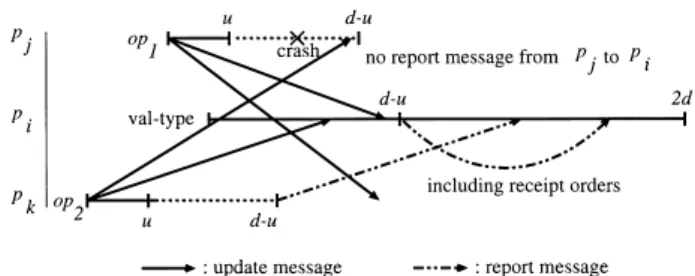
completed in the process. Once an ack-type operation is invoked at some process, the operation completes af- ter u since the invocation and the process broadcasts the corresponding report message after d − u from the invocation. If u < d − u holds and the process crashes after op1 completes but before it broadcasts the mes- sage, any other process is not informed of the prece- dence relation about this operation. In this case, when some process pi attempts to obtain a response value of its operation, pi may apply op1 to its local copy prior to some operation op2 that is really prior to op1 in a history. Such violation can be avoided as follows. If op2 precedes op1in a history as in Fig. 6, every process including pi receives an update message of op2prior to an update message of op1. In the modified implemen-
Fig. 6 Case where a process crashes before broadcasting a re- port message.
variables
op ts, type timestamp ;
local copy, type value of theobject, init initial value of the object;
update buffer, init empty;
transition functions of processpi
Invoke(pi, op) :
ReadClock(pi, local cl);
BroadCast(pi,update(op, (local cl, i))); /* update message */ ifopis ack-type then TimerSet(pi, u,ack);
else/* op is val-type */
op ts:= (local cl, i); TimerSet(pi, d+ u, val);
Receive(pi, pj,update(v, (recvd cl, recvd uid))) :
update buffer:= update buffer ∪ (op, (recvd cl, recvd uid)) Alarm(pi,ack) :
Response(pi, res) where res is a unique response value for current op;
Alarm(pi,val) :
whileop ts≥ min{ts|(op, ts) ∈ update buffer } do
smallest:= (op, ts) where ts is the smallest in update buffer ; apply smallest to local copy;
update buffer:= update buffer − {smallest }; Response(pi, res);
Stop(pi) :
No events can happen after this event.
Fig. 7 Implementation generalRB−uC. (The code for pi.)
tation, processes broadcast such receipt orders in their report messages. When a process applies operations to its local copy, if some report message brings that an update message of op2 is received before one of op1and no report message brings the reverse, the process ap- plies op2 prior to op1. This modification can achieve wait-freedom without additional response time. Theorem 9: The implementation generalRB−AC is a wait-free linearizable implementation of any deter- ministic object which achieves res time(opa) = u and res time(opv) = 2d on an asynchronous clock model using reliable broadcasts, where opais any ack-type op- eration and opv is any val-type operation. ✷
4.2 u-Synchronous Clocks
Next, we propose an implementation of a general ob- ject on u-synchronous clock model, which we call generalRB−uC. It achieves res time(opa) = u and res time(opv) = d + u. The program code for pi is given in Fig. 7.
In this implementation, the common order to all processes is decided only by a timestamp assigned to each operation. When an operation op is invoked at pi, pi assigns the value of its local clock as a times- tamp to op, and broadcasts an update message with the timestamp. When a process receives an update message, it stores the information in its update buf f er. Since the difference between any pair of local clock val- ues is at most u and message delays are at most d, the process does not receive an update message with smaller timestamp than an operation op after d + u since the invocation of the operation op. Therefore, if opis val-type, pi can decide the total order of opera- tions with smaller timestamp at that time and obtain its response value. And then, it returns the response. For an ack-type operation, the process need not ob- tain its returned value but need u for linearizability. If a process crashes while an operation, the operation is left pending. In such a case, all correct processes receive the update message, or no processes receive it because of a reliable broadcast. Therefore, the imple- mentation generalRB−uC works correctly in the case where a process gets faulty.
Theorem 10: The implementation generalRB−uC is a wait-free linearizable implementation of any deter- ministic object which achieves res time(opa) = u and res time(opv) = d+ u on a u-synchronous clocks model using reliable broadcasts, where opa is any ack-type op- eration and opv is any val-type operation. ✷
5. Conclusions
In this paper, we have presented wait-free linearizable implementations shown in Table 2, which are four im- plementations of read/write registers and two imple- mentations of general objects. In general, an imple- mentation on an asynchronous clock model needs longer worst-case response times than an implementation on a u-synchronous clock model if the other conditions are the same. In an asynchronous clock model, if processes in the system execute a synchronization procedure (e.g. procedure Synch[7] for a reliable broadcast model) to make the difference between any pair of local clock val- ues at most u, we can apply an implementation for a u-synchronous clock model. Taking costs of the syn- chronization procedure into consideration, implementa- tions for a u-asynchronous clock model is more effective in the case where operations are invoked many times in an asynchronous clock model.
Some open problems are left. Some lower bound results as to worst-case response times in linearizable implementations were presented [4]–[6] . There are gaps between their results and our results. The other open problem is about linearizable implementations of gen- eral objects on an unreliable broadcast model. We can easily construct a wait-free linearizable implementation
which provides operations with response time propor- tional to the number of processes. However, we do not know whether there exists a wait-free linearizable im- plementation which provides operations with shorter response time.
Acknowledgement
We thank the members of Fujiwara Lab. for their use- ful suggestions. This work is supported in part by the Scientific Research Grant-in-Aid from Ministry of Edu- cation, Science and Culture of Japan ((B-2)10205218).
References
[1] M. Herlihy and J. Wing, “Linearizability: A correctness con- dition for concurrent objects,” ACM Trans. Programming Languages and Systems, vol.12, no.3, pp.463–492, 1990. [2] M. Herlihy, “Wait-free synchronization,” ACM Trans. Pro-
gramming Languages and Systems, vol.13, no.1, pp.124–149, 1991.
[3] J. James and A. K. Singh, “Fault tolerance bounds for mem- ory consistency,” Proc. 11th Int. Workshop on Distributed Algorithms (LNCS1320), pp.200–214, 1997.
[4] M. Mavronicolas and D. Roth, “Efficient, strongly consis- tent implementations of shared memory,” Proc. 6th Int. Workshop on Distributed Algorithms(LNCS647), pp.346– 361, 1992.
[5] H. Attiya and J. L. Welch, “Sequential consistency versus lin- earizability,” ACM Trans. Computer Systems, vol.12, no.2, pp.91–122, May 1994.
[6] M. Inoue, T. Masuzawa, and N. Tokura, “Efficient lineariz- able implementation of shared fifo queues and general ob- jects on a distributed system,” IEICE Trans. Fundamentals, vol.E81-A, no.5, pp.768–775, May 1998.
[7] M. Mavronicolas and D. Roth, “Sequential consistency and lineariability:read/write objects,” Proc. 29th Annual Aller- ton Conf. on Communication, Control and Computing, pp.683–692, Oct. 1991.
Sen Moriya received the B.S. degree from Osaka University in 1995, and the M.E. and Ph.D. degrees from Graduate School of Information Science, Nara Insti- tute of Science and Technology (NAIST) in 1997 and 2000. Since 2000, he has engaged in NTT Communication Science Laboratories. His research interests in- clude distributed algorithms.
Katsuro Suda received the B.E. de- gree from Shinshu University in 1997, and the M.E. degree from Graduate School of Information Science, Nara Institute of Science and Technology (NAIST) in 1999. Since 1999, he has engaged in NTT Soft- ware Corporation.
Michiko Inoue received her B.E., M.E. and Ph.D. degrees from Osaka Uni- versity in 1987, 1989, and 1995 respec- tively. She is an instructor of Graduate School of Information Science, Nara Insti- tute of Science and Technology (NAIST). Her research interests include distributed algorithms, parallel algorithms, graph theory and design and test of digital sys- tems. She is a member of IEEE, IPSJ, and JSAI.
Toshimitsu Masuzawa received the B.E., M.E. and D.E. degrees in computer science from Osaka University in 1982, 1984 and 1987. He had worked at Ed- ucation Center for Information Process- ing, Osaka University between 1987–1990, and had worked at Faculty of Engineering Science, Osaka University between 1990– 1994. He is now an associate professor of Graduate School of Information Science, Nara Institute of Science and Technology (NAIST). He was also a visiting associate professor of Depart- ment of Computer Science, Cornell University between 1993– 1994. His research interests include distributed algorithms, paral- lel algorithms and graph theory. He is a member of ACM, IEEE, EATCS and the Information Processing Society of Japan.
Hideo Fujiwara received the B.E., M.E. and Ph.D. degrees in electronic en- gineering from Osaka University, Osaka, Japan, in 1969, 1971, and 1974, respec- tively. He was with Osaka University from 1974 to 1985 and Meiji University from 1985 to 1993, and joined Nara Institute of Science and Technology in 1993. In 1981 he was a Visiting Research Assistant Pro- fessor at the University of Waterloo, and in 1984 he was a Visiting Associate Pro- fessor at McGill University, Canada. Presently he is a Professor at the Graduate School of Information Science, Nara Institute of Science and Technology, Nara, Japan. His research interests are logic design, digital systems design and test, VLSI CAD and fault tolerant computing, including high-level/logic synthesis for testability, test synthesis, design for testability, built-in self-test, test pattern generation, parallel processing, and computational complexity. He is the author of Logic Testing and Design for Testability (MIT Press, 1985). He received the IECE Young En- gineer Award in 1977, IEEE Computer Society Certificate of Ap- preciation Award in 1991, Okawa Prize for Publication in 1994, and IEEE Computer Society Meritorious Service Award in 1996. He is an advisory member of IEICE Trans. on Information and Systems and an editor of IEEE Trans. Computers, J. Electronic Testing, J. Circuits, Systems, J. VLSI Design and others. Dr. Fu- jiwara is a fellow of the IEEE as well as a member of the Infor- mation Processing Society of Japan.