The linguistic integration of Japanese ideophones and its typological implications
Kimi Akita
Nagoya University
Abstract: This article proposes that two linguistic systems (i.e., two languages or registers) with different degrees of morphosyntactic integration of ideophones may apply the same re- strictions on ideophones in different ways. In Study 1, I quantitatively show that the sentence type restrictions reported for ideophones in several languages also constrain Japanese ideo- phones, but to a lesser extent. In Study 2, I argue that two previously identified restrictions on Japanese ideophonic verbs appear to apply only partially to ideophonic verbs in babytalk and highly playful discourse. It is concluded that the strength of these restrictions is negatively correlated with the overall degree of morphosyntactic integration of ideophones in the lan- guage or register.
Keywords: ideophone typology, morphosyntactic integration, sentence type restrictions, verb type restrictions, Japanese
1. Introduction
Different languages incorporate ideophonic elements in different ways. This article argues
An earlier version of section 4 was presented at the “Structuring sensory imagery: Ideo- phones across languages & cultures” workshop (University of Rochester, 2 May 2014). An earlier version of section 5 was presented at the “Typology of event semantics and argument encoding” workshop at the Thirtieth Conference of the English Linguistic Society of Japan (Keio University, Mita Campus, 11 November 2012). I thank both audiences for their in- sightful comments. My sincere gratitude also goes to the editors of this special issue as well as the two anonymous reviewers of CJL. Any remaining inadequacies are my own. This study was partly supported by three JSPS Grants-in-Aid (no. 24720179, no. 25370425, no. 15K16741) and a Spanish Ministry of Science and Innovation grant (no. FFI2013-45553-C3).
To appear in a special issue of Canadian Journal of Linguistics in the summer of 2017; a semi-final draft
that ideophones retain some of their prototypical features even when well integrated into a linguistic system. The data come from Japanese, which is known as a language with a huge ideophonic inventory (Kakehi et al. 1996, Hamano 1998). Japanese ideophones show a high degree of morphosyntactic integration compared to some other languages, particularly in their colloquial and childish uses. However, close investigations based on quantitative and qualitative methods show that ideophonic features and grammatical constraints are retained in integrated Japanese ideophones.
This article pursues the issue of linguistic integration of ideophones from two case studies in Japanese. One study focuses on sentence type restrictions on ideophones, which have been reported in some languages but are absent in Japanese at least in an explicit man- ner. The other case study takes a further step into the sentence structure, looking at the syn- tactic and semantic types of verbs that Japanese ideophones are allowed to form in normal and playful/childish discourse. These cases will lead us to the general typological implication that grammatical restrictions that yield clear contrasts in the well-formedness of sentences in one language or one register of a language may be found as preference in another.1 The em- pirical identification of grammatical phenomena of this type requires a large amount of lin- guistic data, which are often lacking in ideophone research.
The organization of this article is as follows. In section 2, I outline the major character- istics of Japanese ideophones with special attention to their morphosyntax. This overview allows me to formulate the hypotheses to be examined in this article. In section 3, corpus data are presented to identify weak sentence type restrictions on Japanese ideophones. In section 4, corpus- and questionnaire-based approaches are taken to examine the violability of the pre-
1 Similar cases include the typology of relativization. Relativizability is known to conform to the Accessibility Hierarchy (AH) of grammatical relations: subject > direct object > indirect object > oblique > genitive > object of comparison (Keenan and Comrie 1977). Typological investigations based on the AH primarily concern whether a construction can relativize each NP position. However, the AH also accounts for the frequency of relativization. The relativi-
viously identified syntactic and semantic restrictions on ideophonic verbs in Japanese. In sec- tion 5, I conclude this article by reviewing the present findings from the general perspective of ideophone typology. It is argued that great linguistic integration of ideophones weakens these grammatical constraints.
2. Preliminaries
2.1. Japanese ideophones
The Japanese lexicon has at least a thousand conventional ideophonic items (more commonly known as “mimetics” in Japanese linguistics) (Kakehi et al. 1996, Hamano 1998). They have a set of typical formal and functional features, such as monomoraic (e.g., pon ‘popping’) and bimoraic roots (e.g., poton ‘dropping’) (Hamano 1998), reduplicative (e.g., potopoto ‘drop- ping repeatedly’) and suffixal morphology (e.g., poton ‘dropping’) (Tamori and Schourup 1999, Akita 2009:Ch. 5), prosodic prominence (Kita 1997), dynamic semantics (Usuki and Akita 2015), and informality (Tamori and Schourup 1999). Japanese ideophones cover both auditory (e.g., piyopiyo ‘tweeting’, dosadosa ‘thudding’) and non-auditory eventualities, with the latter ranging from manner of motion (e.g., sutasuta ‘walking briskly’) to shine (e.g., kirakira ‘twinkling’), texture (e.g., sarasara ‘dry and smooth’), pain (e.g., zukizuki ‘one’s head throbbing’), and psychological experience (e.g., wakuwaku ‘excited’).
What is of particular relevance to the present article is the morphosyntax of Japanese ideophones. They have maximally five syntactic-categorial possibilities: acategorial, quota- tive-adverbial, bare-adverbial, verbal, and nominal-adjectival (or simply, nominal) (cf. Kita 1997; Kageyama 2007; Toratani 2013, 2015; Usuki and Akita 2015; Akita and Usuki 2016). Each of these categorial realizations is illustrated in (1).2
2 The abbreviations and symbols used in this article are as follows: ACC = accusative; CONJ =
(1) a. ?Nurunuru, unagi-wa subet-te it-ta. (acategorial)
IDPH eel-TOP slip-CONJ go-PAST
‘Slip-slip, the eel went slipping.’
b. Unagi-wa nurunuru-to subet-te it-ta. (quotative-adverbial) eel-TOP IDPH-QUOT slip-CONJ go-PAST
‘The eel went slipping slipperily.’
c. Unagi-wa nurunuru subet-te it-ta. (bare-adverbial) eel-TOP IDPH slip-CONJ go-PAST
‘The eel went slipping slipperily.’
d. Sono unagi-wa nurunuru-si-ta. (verbal) that eel-TOP IDPH-do-PAST
‘The eel felt slippery.’
e. Sono unagi-wa nurunuru-dat-ta. (nominal) that eel-TOP IDPH-COP-PAST
‘The eel was slippery.’
As illustrated in (1a), “acategorial” ideophones occur at the left or right edge of a sentence, prosodically separated from the rest of the sentence (cf. Tamori and Schourup 1999:84–88). This use is quite rare and essentially limited to onomatopoeic ideophones. Unlike syntacti- cally isolated ideophones prevalent in some languages (Voeltz and Kilian-Hatz 2001), acate- gorial ideophones in Japanese are only found in highly informal or poetic discourse. Adver- bial ideophones are marked with either a quotative or zero, as illustrated in (1b) and (1c), re- conjunctive; COP = copula; DAT = dative; GEN = genitive; IDPH = ideophone; IMP = impera- tive; NEG = negative; NML = nominalizer; NOM = nominative; NPST = nonpast; PASS = passive;
PAST = past; POL = polite; QUES = question; QUOT = quotative; SFP = sentence-final particle;
spectively. Bare-adverbial ideophones and their host verbs (e.g., nurunuru ‘slipping’ and sube- ‘slip’ in (1c)) together behave like loose complex predicates (Toratani 2006, Akita and Usuki 2016). Verbal and nominal uses, illustrated in (1d) and (1e), can also constitute predic- ative constructions. The verbal construction is primarily headed by the dummy verb su- ‘do’ (section 4), whereas the nominal construction involves a copula.
The five ideophonic constructions differ from each other in terms of the degree of mor- phosyntactic integration, as represented as a hierarchy in (2) (see Akita and Usuki 2016; Dingemanse and Akita 2016; cf. Kita 1997, 2001).
(2) The morphosyntactic integration of ideophones in Japanese:3
acategorial < quotative-adverbial < bare-adverbial < verbal < nominal
NON-INTEGRATED INTEGRATED
Acategorial ideophones are located at the low end of the hierarchy due to their obvious pro- sodic independence and their occasional holophrastic realization (i.e., occurrence without non-ideophonic elements). The morphosyntactic integration of other ideophone types is measured by a set of linguistic criteria, such as omissibility and indivisibility (Toratani 2015). Compare the following examples illustrating the two tests with the originals in (1). As (3) shows, acategorial and adverbial ideophones can be omitted without affecting the grammati- cality of the sentences where they belong, whereas verbal and nominal ideophones cannot.
(3) Omissibility:
a. Nurunuru, unagi-wa subet-te it-ta. (acategorial)
3 This hierarchy simply visualizes the degree of morphosyntactic integration of each ideo- phonic construction as measured by linguistic tests. It does not involve any implicational re- lationship about the crosslinguistic presence of the five constructions (cf. Akita 2009:Ch. 7).
IDPH eel-TOP slip-CONJ go-PAST
‘Slip-slip, the eel went slipping.’
b. Unagi-wa nurunuru-to subet-te it-ta. (quotative-adverbial) eel-TOP IDPH-QUOT slip-CONJ go-PAST
‘The eel went slipping slipperily.’
c. Unagi-wa nurunuru subet-te it-ta. (bare-adverbial) eel-TOP IDPH slip-CONJ go-PAST
‘The eel went slipping slipperily.’
d. *Sono unagi-wa nurunuru-si-ta. (verbal) that eel-TOP IDPH-do-PAST
‘The eel felt slippery.’
e. *Sono unagi-wa nurunuru-dat-ta. (nominal) that eel-TOP IDPH-COP-PAST
‘The eel was slippery.’
The sentences in (4) show that the ideophonic parts of verbal and nominal ideophones cannot be separated from their tensed parts (i.e., the verb su- ‘do’ and the copula -da) by intervening phrases or clauses. Bare-adverbial ideophones exhibit similar but weaker resistance to sepa- ration, suggesting that they are combined more tightly with their host predicates than quota- tive-adverbial ideophones (Akita and Usuki 2016).
(4) Indivisibility:
a. ?Nurunuru, [hure-ru-to] unagi-wa subet-te it-ta. (acategorial)
IDPH touch-NPST-when eel-TOP slip-CONJ go-PAST
‘Slip-slip, when [I] touched [it], the eel went slipping.’
b. Unagi-wa nurunuru-to [hure-ru-to] subet-te it-ta. (quotative-adverbial) eel-TOP IDPH-QUOT touch-NPST-when slip-CONJ go-PAST
‘The eel went slipping, when [I] touched [it], slipperily.’
c. ??Unagi-wa nurunuru [hure-ru-to] subet-te it-ta. (bare-adverbial) eel-TOP IDPH touch-NPST-when slip-CONJ go-PAST
‘The eel went slipping, when [I] touched [it], slipperily.’
d. *Sono unagi-wa nurunuru [hure-ru-to] si-ta. (verbal) that eel-TOP IDPH touch-NPST-when do-PAST
‘The eel felt, when [I] touched [it], slippery.’
e. *Sono unagi-wa nurunuru [hure-ru-to] dat-ta. (nominal) that eel-TOP IDPH touch-NPST-when COP-PAST
‘The eel was, when [I] touched [it], slippery.’
Another indivisibility test using focus particles diagnoses verbal ideophones as having looser structural unity than nominal ideophones, as illustrated in (5) (cf. Kageyama 2007).
(5) a. Sono unagi-wa nurunuru-wa si-ta. (verbal) that eel-TOP IDPH-TOP do-PAST
‘The eel indeed felt slippery.’
b. *Sono unagi-wa nurunuru-wa dat-ta. (nominal) that eel-TOP IDPH-TOP COP-PAST
‘The eel was indeed slippery.’
2.2. Hypotheses
In this article, I hypothesize and explore a negative correlation between the degree of mor-
phosyntactic integration of ideophones and the strength of grammatical restrictions on them. This hypothesis is motivated by the recent empirical investigations into the inverse correla- tion between the morphosyntactic integration of ideophones and their “expressiveness”. Ide- ophones are typically accompanied by a set of emphatic features, such as prosodic fore- grounding (Nuckolls 1996) and expressive morphology (e.g., vowel lengthening, partial re- duplication; Zwicky and Pullum 1987), and the frequency of these “expressive” features has been found to decrease as a function of the degree of morphosyntactic integration (Dingemanse 2011:Ch. 6, to appear; Akita 2013; Dingemanse and Akita 2016; see also Childs 2014). In fact, similar (and more general) discussion has been repeatedly made under somewhat impressionistic notions, such as “ideophonicity/lexicality” (Tamori and Schourup 1999; cf. Newman 2001) and “iconicity” (Akita 2009:Ch. 7). The discussion concludes that ideophones lose their ideophonic tone when they are formally integrated into the sentence structure or become part of the prosaic lexicon. These studies remain “somewhat impression- istic” because they fail to clearly define the key notions of “an ideophonic tone” and “mor- phosyntactic integration”.
I solve this general problem by focusing on two specific grammatical restrictions on typical ideophones: sentence type restrictions and verb type restrictions. These restrictions replace the vague dimension of “an ideophonic tone”. Moreover, our hierarchy of ideophonic constructions in (2) gives a specific picture to the notion of “morphosyntactic integration”. Thus, the specific hypotheses to be examined in this article can be stated as in (6).
(6) a. Hypothesis 1 (to be examined crosslinguistically in section 3):
Sentence type restrictions are weaker (or absent) in ideophones with higher morphosyntactic integration.
b. Hypothesis 2 (to be examined intralinguistically in section 4):
Verb type restrictions are weaker (or absent) in ideophones with higher mor- phosyntactic integration.
I examine these hypothesized negative correlations both intra- and cross-linguistically. It dif- fers both within and across languages how deeply ideophones are morphosyntactically inte- grated. First, Japanese has five major ideophonic constructions with different degrees of morphosyntactic integration (section 2.1). As I discuss in section 4, language-internal varia- tions in the morphosyntactic integration of ideophones are also found between different reg- isters (i.e., normal vs. colloquial, childish). Second, the “average” degree of morphosyntactic integration of Japanese ideophones appears to be higher than that of ideophones in languages like Semai (Austroasiatic; Diffloth 1976) and Kambera (Austronesian; Klamer 1999), which are known to have no ideophonic predicate (see Dingemanse, to appear). This idea is further corroborated by the abovementioned stylistic limitations on acategorial ideophones in Japa- nese.4 Based on these facts and assumptions, I examine Hypothesis 1 (sentence type re- strictions) in a crosslinguistic context and Hypothesis 2 (verb type restrictions) within Japa- nese.
3. Study 1: Sentence type restrictions
In this section, I quantitatively examine Hypothesis 1 by looking at how ideophones are dis- tributed across different types of sentences in a corpus of spoken Japanese, which is assumed to represent high linguistic integration of ideophones (section 2.2).
4 The stylistic limitations on acategorial ideophones are reflected in their low frequency. I found 582 ideophones in the 27 friendly conversations in Nagoya University Conversation Corpus, a conversation corpus of spoken Japanese (see section 3.2). The frequencies of the five ideophonic constructions were as follows: acategorial, 5.33%; quotative-adverbial, 37.97%; bare-adverbial, 14.78%; verbal, 31.27%; nominal, 10.65%.
3.1. Descriptions
Sentence type restrictions have been (sometimes partly and sometimes controversially) noted for ideophones in several languages, including Hausa (Afro-Asiatic; Newman 1968), Kisi (Niger-Congo; Childs 1994), KiVunjo Chaga (Niger-Congo; Moshi 1993), Khmu (Aus- troasiatic; Svantesson 1983), Korean (isolate; Diffloth 1972), and Chinese (Sino-Tibetan; Aihara and Han 1990, for certain reduplicative items with some ideophonic properties). The sentence type restrictions restrict the occurrence of ideophones in these languages to “basic” types of sentences—namely, affirmative-declarative sentences—and they cannot occur in
“non-basic”—namely, interrogative, imperative, and negative—sentences. For example, Newman (1968) observes that, in Hausa, ideophonic adverbs (termed “descriptive-adverbs”) illustrated in (7) are subject to the sentence type restrictions, whereas quasi-ideophonic ad- verbs (termed “verbal-intensifiers”) illustrated in (8) are not. Quasi-ideophonic items appear to have lost some of their ideophonic identity. As I describe in section 3.3, Japanese also has a set of quasi-ideophonic adverbs that are quite free from the sentence type restrictions.
(7) Ideophonic adverbs:
a. Ya faɗi sharap. (affirmative-declarative) he fall IDPH
‘He fell headlong.’
b. *Ya faɗi sharap? (interrogative) ‘Did he fall headlong?’
c. *Tashi farat! (imperative) get.up IDPH
‘Get up in a flash!’
d. *Bai tashi farat ba. (negative)
NEG get.up IDPH NEG
‘He didn’t get up in a flash.’
(Newman 1968:110–111)
(8) Quasi-ideophonic adverbs:
a. Ya ɦone ɦurmus. (affirmative-declarative) he burn completely
‘It burnt to the ground.’
b. Ya ɦone ɦurmus? ‘Did it burn to the ground?’ (interrogative) c. Cika ta pal! (imperative)
fill it full
‘Fill it full!’
d. Bai cika pal ba. (negative)
NEG fill full NEG
‘He didn’t fill it up completely.’
(Newman 1968:110–111)
On the other hand, Japanese ideophones can readily occur in both basic and non-basic sentences, as illustrated in (9).5
(9) a. Ai-wa nikoniko-to warat-ta. (affirmative-declarative) Ai-TOP IDPH-QUOT smile-PAST
‘Ai smiled brightly.’
5 Kita (1997:389–391) discusses sentence type restrictions on Japanese ideophones, arguing that only metalinguistic negation is available to sentences with manner-adverbial ideophones. However, he tests this with nominalized clauses, rather than normal clauses, and his judg- ments are not shared by many Japanese-speaking linguists, including myself.
b. Ai-wa nikoniko-to warat-ta-no? (interrogative) Ai-TOP IDPH-QUOT smile-PAST-QUES
‘Did Ai smile brightly?’
c. Ai, nikoniko-to warai-nasai! (imperative) Ai IDPH-QUOT smile-IMP
‘Ai, smile brightly!’
d. Ai-wa nikoniko-to warawa-nakat-ta. (negative) Ai-TOP IDPH-QUOT smile-NEG-PAST
‘Ai didn’t smile brightly.’
Thus, unlike the languages cited above, Japanese does not have obvious sentence type re- strictions on ideophones. Hypothesis 1 allows us to predict that even ideophones in Japanese, presumably a language with highly integrated ideophones, may exhibit some preference for
“basic” sentences (Prediction 1), and that the preference is greater in constructions with lower morphosyntactic integration (e.g., the quotative-adverbial construction) (Prediction 2). Such a preference will suggest the gradual nature of ideophone typology, in which acceptability con- trast in one linguistic system may be retained as frequency contrast.
3.2. Methods
I used 27 informal conversations between two to four (old) friends in Nagoya University Conversation Corpus. This subpart of the corpus contains 19 conversations between female speakers, one conversation between male speakers, and seven conversations between male and female speakers. The total length of the conversations was 21.88 hours, and they con- tained 28,277 sentences (507,208 morphemes). This corpus is appropriate for the present re- search purpose because, unlike corpora of monologues and written discourse, it contains
many interrogative and imperative sentences.
I obtained 582 tokens of ideophones and 339 tokens of “quasi-ideophones” (see Tamori 1980, Tamori and Schourup 1999, among others). I compared ideophones and qua- si-ideophones because of their minimal difference. Quasi-ideophones are degree, frequency, or intensity adverbs with putative ideophonic origin, such as dandan ‘gradually’, dondon ‘in- creasingly’, kit-to ‘surely’, kitin-to ‘properly’, sot-to ‘gently’, sukkari ‘completely’, and zut-to
‘all the time’. They are recognizable for their morphological and semantic characteristics. They have prototypical ideophonic shapes, such as reduplicative and suffixal shapes, and, due to their event-general semantics, they are as frequent as non-ideophonic adverbs (cf. Akita 2012, Toratani 2012). In the present corpus, the mean type-token ratios for ideophones and quasi-ideophones were 43.30% and 10.11%, respectively. I manually coded the type (i.e., af- firmative-declarative, interrogative, imperative, and/or negative) of the sentence to which each ideophonic/quasi-ideophonic token belongs. Prediction 1 leads us to expect that ideo- phones exhibit a greater preference for basic sentences than quasi-ideophones.
3.3. Results
Some instances are cited in (10) and (11). Construction types are coded within the sentences.
(10) Ideophones:
a. Demo gozyuu-en-kurai [Quot-adv babababat-te] oti-tyau-node but 50-yen-about IDPH-QUOT fall-end.up-because [V bikkuri-si]-ta-koto-ga aru-n-desu-kedo-ne. (032) (affirmative-declarative) IDPH-do-PAST-NML-NOM be-NML-COP.POL-but-SFP
‘But as [the payphone] consumed about ¥50 very quickly, [I] was astonished.’ b. Un, wasyoku-da-kedo [N kotekote-zya]-naku-tte. (080) (negative)
yeah Japanese.food-COP-but IDPH-COP.TOP-NEG-and
‘Yeah, [I want to have] a Japanese cuisine but not a Japanese-Japanese one.’
(11) Quasi-ideophones:
a. Yoosuruni, “[Bare-adv wazawaza] uke-ru-no?” -tte-i-u
in.short IDPH take-NPST-QUES -QUOT-say-NPST
sekai-dat-ta-n-da-kedo… (047) (interrogative) world-COP-PAST-NML-COP-but
‘In short, it was like “Do you bother to take [the entrance exam]?”’
b. Toriaezu, [Quot-adv zut-to] massugu it-tyat-te-kudasai. (004) (imperative) for.now IDPH-QUOT straight go-end.up-CONJ-POL.IMP
‘For now, please go straight on.’
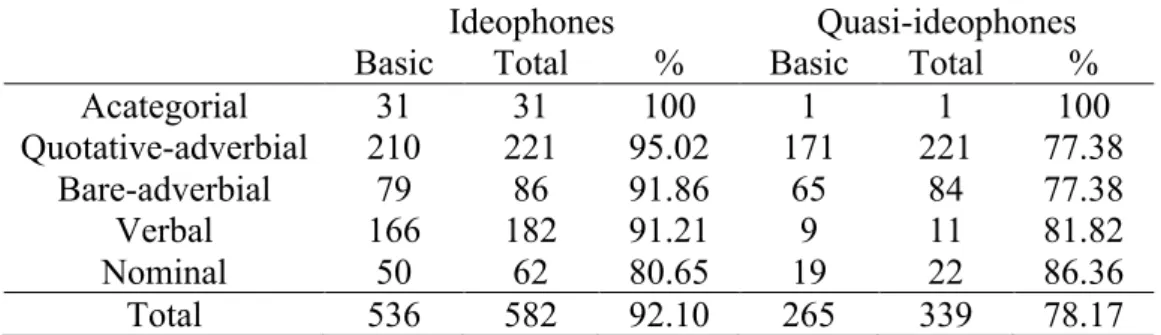
The present data were found to support both of our predictions. First, ideophones appeared more frequently (92.10%; e.g., (10a)) than quasi-ideophones (78.17%) in basic sentences (χ2(1) = 36.66, p < .001), supporting Prediction 1. The detailed distribution of non-basic sen- tences was not very striking in both ideophones (interrogative, 26; imperative, 3; negative, 17) and quasi-ideophones (interrogative, 39; imperative, 7; negative, 31).
Second, the data sorted by constructions in Table 1 give partial support to Prediction 2. The frequency of nominal ideophones in basic sentences is significantly lower than that of the other four categories (χ2(1) = 12.50, p < .001). This result makes nominal ideophones, which are highly morphosyntactically integrated (see (2)), similar to quasi-ideophones (cf. Kita 1997:391), which occur less frequently in basic sentences than ideophones (see (10b) and (11) for a nominal ideophone and quasi-ideophones occurring in non-basic sentences). In fact, there was no significant difference between the results for nominal ideophones and qua-
si-ideophones (χ2(4) = 1.28, p = .87) (the one acategorial use of quasi-ideophone was ex- cluded from the calculation).
Table 1. Ideophonic/quasi-ideophonic constructions and sentence types
Ideophones Quasi-ideophones
Basic Total % Basic Total %
Acategorial 31 31 100 1 1 100
Quotative-adverbial 210 221 95.02 171 221 77.38
Bare-adverbial 79 86 91.86 65 84 77.38
Verbal 166 182 91.21 9 11 81.82
Nominal 50 62 80.65 19 22 86.36
Total 536 582 92.10 265 339 78.17
The present results suggest that Japanese ideophones, less integrated ones in particular, are subject to the sentence type restrictions, but as a statistical preference. Therefore, aside from the difference between a tendency and grammatical contrast, both Japanese and the languages mentioned in section 3.1 (e.g., Hausa) conform to the same pattern in which higher morphosyntactic integration is associated with a less restricted linguistic behavior. In the next section, I argue that similar reasoning works for language-internal generalizations about ide- ophones, focusing on the restrictions on the types of ideophonic verbs in normal and babytalk/playful Japanese.
4. Study 2: Verb type restrictions
In this section, I discuss the linguistic integration of Japanese ideophones from another angle: their verb type restrictions in normal and babytalk/playful discourse. Unlike the crosslinguis- tic view in section 3, this section takes a close look at how the grammatical restrictions on ideophones differ between two different registers of one language. Specifically, by observing qualitatively and quantitatively how syntactic and semantic restrictions on ideophonic verbs are retained and violated in childish/colloquial Japanese, I examine Hypothesis 2: the verb
type restrictions are weaker (or absent) in ideophones with higher morphosyntactic integra- tion.
4.1. Descriptions
Japanese ideophonic verbs are highly morphologically integrated, as we saw in section 2. They are formed by two productive verbalizers. One is su- ‘do’, which incorporates non-onomatopoeic ideophones to form various types of complex verbs, as Kageyama’s (2007) classification cited in (12a) shows (see also Akita 2009:Ch. 6, Tsujimura 2014). The other verbalizer is iw- ‘say’, which combines with any onomatopoeic ideophones to represent the spontaneous emission of sounds, as illustrated in (12b) (Toratani 2015, Akita and Usuki 2016). Note that, as shown in (12), the two verbalizers are complementarily distributed. Su-
‘do’ can never be replaced by iw- ‘say’, and iw- cannot be replaced by su- without producing a playful or childish effect (marked “#”).6
(12) a. Ideophonic ‘do’-verbs (adapted from Kageyama 2007:44): Activity (e.g., akuseku-{su/*iw}- ‘work hard’)
Translational activity (e.g., urouro-{su/*iw}- ‘wander around’) Psychological (e.g., gakkari-{su/*iw}- ‘be disappointed’)
Physiological (e.g., zukizuki-{su/*iw}- ‘feel (one’s head/teeth) throb’) Physical perception (e.g., guragura-{su/*iw}- ‘wobble’)
Characterizing predication (e.g., assari-{su/*iw}- ‘taste light’) b. Ideophonic ‘say’-verbs:
6 As an anonymous reviewer pointed out, the complementary distribution in Japanese ideo- phonic verbs is particularly interesting when contrasted with the crosslinguistically more common transitive/intransitive alternation using ‘do’/‘say’-verbs (Cohen et al. 2002), such as the ones in Emai (Schaefer and Egbokhare 2002) and Somali (Dhoore and Tosco 1998). A
kyaakyaa-{iw/??su}- ‘scream’, buubuu-{iw/*su}- ‘oink, complain’, piy- opiyo-{iw/*su}- ‘tweet’, wanwan-{iw/*su}- ‘bark’; banban-{iw/#su}- ‘bang’, gatyagatya-{iw/#su}- ‘clatter’, gorogoro-{iw/*su}- ‘roar’, katakata-{iw/??su}-
‘clatter’, patapata-{iw/??su}- ‘flutter’, zyuuzyuu-{iw/*su}- ‘sizzle’
These highly morphosyntactically integrated uses of ideophones are subject to the fol- lowing two restrictions (Akita 2009:Ch. 6, Toratani 2015).
(13) a. The anti-transitivity restriction:
Ideophones cannot form highly transitive/causative verbs. b. The anti-motion restriction:
Ideophones for manner of motion cannot form verbs.
The existence of “the anti-transitivity restriction” is already suggested in the lists in (12), which only contain intransitive verbs. In fact, the verbalization of ideophones for highly causative events, such as causative change of state, results in clear unacceptability (e.g.,
*paripari-su- ‘crack (a pane of glass)’, *bokiboki-su- ‘crunch (a thick stick)’). These ideo- phones are instead realized as adverbs (e.g., paripari(-to) war- ‘break with a cracking sound’, bokiboki(-to) or- ‘break with a crunching sound’), which are located lower in the integration hierarchy in (2).
“The anti-motion restriction” works more narrowly and perhaps is subsumed under a more general constraint (cf. Akita 2009:Ch. 6). Japanese has a group of ideophones depicting manner of spatial motion, which cannot be verbalized with either su- ‘do’ or iw- ‘say’. If verbalized with su-, these ideophones would have a marginal and highly childish/colloquial tone. As illustrated in (14), this is true for manner-of-motion ideophones for both animate and
inanimate entities. They are always realized as adverbs (e.g., nosinosi(-to) aruk- ‘walk in a lumbering manner’, barabara(-to) kobore- ‘drop in a pattering manner’).
(14) a. Animate:
nosinosi-{*#su/*iw}- ‘lumber’, pyokopyoko-{*#su/*iw}- ‘hop’, soroso- ro-{*su/*iw}- ‘walk gingerly’, sugosugo-{*su/*iw}- ‘leave dejectedly’, suisui-{*#su/*iw}- ‘swim smoothly’, sutasuta-{*#su/*iw}- ‘walk briskly’, tekuteku-{*#su/*iw}- ‘walk lightly’, tobotobo-{*#su/*iw}- ‘plod’, toko- toko-{*#su/*iw}- ‘walk with short steps’, tukatuka-{*su/*iw}- ‘walk unre- servedly’
b. Inanimate or animacy-neutral:
barabara-{*#su/*iw}- ‘be scattered’, daradara-{*#su/*iw}- ‘drip’, dosadosa-{*su/*iw}- ‘thud’, gorogoro-{*#su/*iw}- ‘roll (of a heavy object)’, harahara-{*#su/*iw}- ‘flutter (of a leaf)’, horohoro-{*#su/*iw}- ‘run down (of teardrops)’, korokoro-{*#su/*iw}- ‘roll (of a light object)’, poro- poro-{*#su/*iw}- ‘fall (of light, small objects)’, potupotu-{*#su/*iw}- ‘begin to rain’, suton-to-{*#su/*iw}- ‘fall right on the ground’
Apparent counterexamples can be noted for both restrictions. First, some previous stud- ies on ideophonic verbs include impact/contact verbs and reflexive verbs listed in (14a) and (14b), respectively. Impact/contact verbs are transitive verbs that do not entail change of state (Kageyama 2007:53, Toratani 2013). Reflexive verbs cooccur with body-part NPs (see Tsu- jimura 2005:148–149, 2014; Kageyama 2007:47; cf. Toratani 2013:54–57).
(14) a. Impact/contact verbs:
#dondon-su- ‘pound’, #gosigosi-su- ‘scrub’, #gyut-to-su- ‘hold tightly’,
#huuhuu-su- ‘blow’, #kotyokotyo-su- ‘tickle’, #kutyakutya-su- ‘chew’,
#peropero-su- ‘lick’, #tonton-su- ‘tap’, #tuntun-su- ‘poke’ b. Reflexive verbs:
#(hane-o) batabata-su- ‘flap (one’s wings)’, #(asi-o) burabura-su- ‘swing (one’s legs)’, #(kuti-o) mogumogu-su- ‘move (one’s mouth) chewing food’,
#(kuti-o) pakupaku-su- ‘open and close (one’s mouth) repeatedly’, #(me-o) patikuri-su- ‘blink (one’s eyes) in wonderment’, #(me-o) patipati-su- ‘blink (one’s eyes)’
Crucially, both types of transitive verbs are low in transitivity (or causativity) and have a clear childish/playful tone (cf. Kageyama 2007:48–49). This stylistic property disappears when these ideophones are used adverbially (e.g., dondon(-to) tatak- ‘hit with a bang’, bura- bura(-to) yuras- ‘swing repeatedly’). Therefore, all these instances are compatible with the anti-transitivity restriction.
Next, one might regard the ideophonic translational activity verbs (originally termed
“manner-of-motion verbs” in Kageyama 2007) listed in (15) as exceptions to the anti-motion restriction. However, as Sugahara and Hamano’s (2015) corpus-based investigation suggests, these verbs appear to represent the whole activities involving motion, rather than particular rates or limb movements, and should be included in the “activity” class in (12a).
(15) burabura-su- ‘stroll’, ?nyoronyoro-su- ‘wriggle’, tyokomaka-su- ‘bustle around’, tyokotyoko-su- ‘run around busily’, tyorotyoro-su- ‘run around’, urotyoro-su- ‘run around’, urouro-su- ‘wander around’, yotayota-su- ‘totter’, yotiyoti-su- ‘toddle’
In summary, Japanese ideophonic verbs are incompatible with high transitivity and manner-of-motion meaning. Also important are the clear childish/playful tones of some ide- ophonic ‘do’-verbs, notably impact/contact verbs and reflexive verbs. Their existence indi- cates that the two restrictions do not hold for certain registers of Japanese—namely, babytalk and highly colloquial speech (Akita 2009:Ch. 6; Tsujimura 2009, 2014). Put differently, these special registers appear to integrate ideophones to a greater extent than the plain register of Japanese. This contrast between registers mirrors the crosslinguistic contrast in the “average” morphosyntactic integration of ideophones discussed in section 2.2. In what follows, I exam- ine Hypothesis 2: whether the two restrictions on ideophonic verbs in normal Japanese are weaker (or absent) in colloquial/childish Japanese. Study 2a is a corpus-based study that looks at how the two restrictions on ideophonic verbs are violated in actual informal dis- course, and Study 2b is a questionnaire-based study that tests how violable the two re- strictions can be.
4.2. Study 2a
I conducted a corpus-based investigation to see what types of unconventional ideophonic verbs (i.e., those violating the anti-transitivity restriction or the anti-motion restriction) are used in actual Japanese discourse. I used Balanced Corpus of Contemporary Written Japanese, which is a collection of about 100,000,000 words from not only relatively formal types of discourse (e.g., magazines, newspapers, textbooks, and minutes of the Diet) but also highly informal (e.g., online question-and-answer threads and blogs) and creative types of discourse (e.g., literary works). I searched 577 reduplicative ideophones from Kakehi et al. (1996) in the corpus via the NINJAL-LWP for BCCWJ system (ver. 1.00).
I obtained 23 types and 46 tokens of unconventional uses of ideophonic ‘do’-verbs. As the representative instances cited in (16) show, most of the unconventional ideophonic verbs
are the “childish/colloquial” types described in section 4.1 (i.e., (16a–c)). “Caused-motion” examples may be included in the impact/contact type. For example, kurukuru-su- in (16d) can be understood as representing a twirling action on spaghetti.
(16) a. Impact/contact (14 types, 26 tokens):
… karada-o gosigosi-su-ru-toki-ni … body-ACC IDPH-do-NPST-when-DAT
‘… when [my hamster] scrubs [its] body …’
(Yahoo! Answers, 2005) b. Reflexive (2 types, 11 tokens):
Tada kuti-o pakupaku-su-ru-dake-dat-ta. just mouth-ACC IDPH-do-NPST-only-COP-PAST
‘[He] only opened and closed [his] mouth repeatedly.’
(Hiroshi Ito, Abuku Akira-no awa-no tabi [Bubble Akira’s bubbly journey], 2005) c. Sound emission (1 type, 2 tokens):
Yure-ru-tabi-ni tiisa-na mado-ga gatapisi-si-ta. shake-NPST-whenever-DAT small-COP window-NOM IDPH-do-PAST
‘The small window rattled every time [it] shook.’
(Taeko Nakamura, trans., Tubasa-yo, kita-ni [North to the orient], 2002) d. Caused-motion (6 types, 7 tokens):
Sonnani kirei-ni kurukuru-si-naku-te i-i-ga … so neat-COP IDPH-do-NEG-CONJ good-NPST-but
‘Though [you] don’t need to twirl [the spaghetti] so neatly …’
(Yahoo! Answers, 2005)
Similar results were obtained from two smaller corpora—the Aozora Bunko Corpus (a literary corpus) and Nagoya University Conversation Corpus (see section 3.2): impact/contact, 2 tokens; reflexive, 2 tokens; sound emission, 4 tokens; caused-motion, 2 tokens. The Aozora Bunko Corpus also contained an instance of a manner-of-motion ideophonic verb, which is cited in (17).
(17) Sosite sore-wa, bon-no naka-de yoriwake-rare-ru and that-TOP tray-GEN inside-in assort-PASS-NPST
azuki-no-yoo-ni, korokoro-si-ta. adzuki.bean-GEN-like-COP IDPH-do-PAST
‘And it [post horse] rolled like an adzuki bean that were assorted on a tray.’
(Yoshiki Hayama, Umi-ni ikuru hitobito [Men who live on the sea], 1926)
The present corpus data suggest that the two restrictions on Japanese ideophonic verbs are not freely violable even in informal and creative registers (cf. Tsujimura 2009, 2013, 2014). Notably, the three corpora provided no single explicit instance of a causative change-of-state ideophonic verb that would clearly violate the anti-transitivity restriction. Likewise, the high exceptionality of (17) indicates the strength of the anti-motion restriction. Moreover, all unconventional sound-emission ideophonic verbs, such as gatapisi-su- ‘rattle’ in (16c), have natural-sounding ‘say’-verb counterparts (e.g., gatapisi-iw- ‘rattle’) and can safely be considered their ad hoc substitutes.
The limited size of the data prevents us from making any conclusive argument. In par- ticular, the present data tell us nothing about ideophonic verb forms that were not obtained. They might and might not be acceptable. Therefore, in the next section, I reinforce the present findings with a questionnaire-based introspective investigation.
4.3. Study 2b
For a better understanding of the violability of the two restrictions on Japanese ideophonic verbs, I conducted a follow-up study using 80 simple sentences with ideophonic verbs. The stimulus set contained 26 sentences with conventional ideophonic verbs that fall in Kageya- ma’s (2007) classes in (12a) and 24 instances of unconventional ideophonic verbs. Four sen- tences were made for each of the following six semantic types of unconventional ideophonic verbs on the basis of the discussion in section 4.2: impact/contact, reflexive, caused-motion, sound emission, causative change of state, and manner of motion. The remaining 30 sentenc- es were intended to be dummy stimuli that, I assumed, involved unambiguously ungrammat- ical semantic structures as verbs, such as Mai-ga neko-o nyaanyaa-si-ta ‘Mai meowed the cat’ with the intended reading ‘Mai made the cat meow.’ Two questionnaires with 40 stimuli were created from these sentences.
I asked 43 undergraduate students at Osaka University who are native speakers of Japa- nese (6 female, 37 male) to judge the naturalness of the 40 simple sentences in one of the two questionnaires. Based on the findings in section 4.2, I provided three choices: “natural”,
“babytalk”, and “unnatural”. Each questionnaire started with three practice sentences that were assumed to draw three different judgments.
The most “unnatural” sentence of each of the six types of unconventional ideophonic verbs is cited with the percentage of “unnatural” answers for the sentence in (18).
(18) a. Onnanoko-ga huton-o panpan-si-ta. (impact/contact, 8.70%) girl-NOM futon-ACC IDPH-do-PAST
‘A girl slapped the futon.’
b. Kodomo-ga yubi-o guruguru-si-ta. (reflexive, 29.17%)
child-NOM finger-ACC IDPH-do-PAST
‘The child whirled [his] (index) finger.’
c. Mai-ga tobotobo-si-te i-ta. (manner of motion, 44.44%) Mai-NOMIDPH-do-CONJ be-PAST
‘Mai was plodding.’
d. Kodomo-ga to-o garagara-si-ta. (caused-motion, 54.55%) child-NOM door-ACCIDPH-do-PAST
‘A child rattled the sliding door (shut).’
e. Onnanoko-ga mado-o baribari-si-ta. (causative change of state, 95.83%) girl-NOM window-ACC IDPH-do-PAST
‘A girl shattered the windows.’
f. Kuruma-ga buubuu-si-te i-ta. (sound emission, 57.89%) car-NOM IDPH-do-CONJ be-PAST
‘A car was zooming.’
Figure 1 presents the results.
Figure 1. Naturalness of ideophonic verbs
In accordance with the corpus study in section 4.2, both conventional ideophonic verbs (e.g., ukiuki-su- ‘feel happy’ [psychological]) and impact/contact (e.g., tuntun-su- ‘poke’) and re- flexive ideophonic verbs (e.g., (me-o) kyorokyoro-su- ‘move (one’s eyes) restlessly’), which mildly violate the anti-transitivity restriction, were found to be highly acceptable. Importantly, many participants judged impact/contact verbs as “babytalk”. It was also suggested that babytalk may even allow other unconventional types of ideophonic verbs, particularly man- ner-of-motion (e.g., pyokopyoko-su- ‘hop’) and caused-motion verbs (e.g., kurukuru-su-
‘twirl’). However, about half of the participants judged causative change-of-state verbs (e.g., bokiboki-su- ‘crunch (a thick stick)’) and onomatopoeic verbs for spontaneous sound emis- sion (e.g., kusukusu-su- ‘giggle’) as “unnatural” (even as child-directed words). Comparing the present perception data with the production data in section 4.2, the consistent disprefer- ence for causative change-of-state ideophonic verbs may reflect the relative precedence of the anti-transitive restriction over the anti-motion restriction. The low acceptability of sound-emission su-verbs appears to be attributed to the participants’ awareness of their con-
29
59
19 10 5 12
439 53
14
41 49
36 28
39
3 12
25 25
45 46
29
0% 10% 20% 30% 40% 50% 60% 70% 80% 90% 100%
Unnatural Babytalk Natural
ventional iw-verb counterparts.
In summary, the present observations of the syntactic/semantic restrictions on ideo- phonic verbs in Japanese can be rephrased in a similar way to the crosslinguistic discussion of sentence type restrictions on ideophones in section 3. The two restrictions on ideophonic verbs are weaker, rather than absent, in the babytalk and playful registers of Japanese, which generally integrate ideophones to a greater extent than normal Japanese. What is found as grammatical contrast in one register of a language may be found as preference in another.
5. Conclusion and typological implications
In this article, I have discussed the negative correlation between the degree of morphosyntac- tic integration of ideophones and the strength of grammatical restrictions on them. Study 1 argued that the sentence type restrictions reported for ideophones in several languages also apply to Japanese ideophones, but as a force that makes ideophones prefer affirma- tive-declarative sentences. Study 2 found that two semantic/syntactic restrictions on ideo- phonic verbs in the normal register of Japanese also apply to its babytalk and playful registers, but again to a lesser extent. Assuming that Japanese, particularly its babytalk/playful register, is a language with relatively highly integrated ideophones, the two sets of results support the inverse correlation between morphosyntactic integration and grammatical restrictions.7
One inevitable question that remains to be asked is what determines the degree of mor- phosyntactic integration of ideophones in each linguistic system. The century-long literature on ideophones does not provide a satisfactory answer to this question. I would like to con- clude this article by listing three possible factors in the morphosyntactic integration or inde-
7 Related observations have been made in recent phonological and semantic studies on Japa- nese ideophones. Nasu (2004) identifies some general phonological constraints remaining in the phoneme distribution of innovative ideophones in Japanese cartoons. Inoue (2010) argues that even creative ideophone uses in Japanese literary works follow the general patterns of
pendence of ideophones. The first factor is the so-called “framing typology” (Talmy 2000). Japanese normally encodes a core schema (e.g., Path of motion) in the main verb (e.g., arui-te hair- [walk-CONJ enter] ‘enter walking’), so Co-event (e.g., Manner of motion) ex- pressed by ideophones has to be encoded otherwise (e.g., as an adverb, as in sutasuta-to arui-te hair- [IDPH-QUOT walk-CONJ enter] ‘enter walking briskly’). However, some lan- guages (e.g., Newar, a Sino-Tibetan language) that typically encode a core schema outside the main verb also appear to make frequent use of ideophonic adverbs (Yo Matsumoto, per- sonal communication). Furthermore, languages like French lexicalize both core schemas and ideophony in verbs (Matsumoto 2003 [2011]). The existence of these exceptions suggests the involvement of multiple factors in the integration of ideophones. The second possible factor is the colloquial nature of a linguistic system. As we saw with the babytalk and playful regis- ters of Japanese, colloquial language tends to have high flexibility in grammar, and this flexi- bility may allow ideophones to gain various categories, including highly integrated ones. The third possibility is the quantitative and/or qualitative abundance of ideophonic inventories. A large ideophonic lexicon with various semantic types may call for grammatical distinctions (see Akita [2009:Ch. 7] for a related discussion). The last possibility (and perhaps the other two possibilities as well) may be found quite naïve but will still be important in light of their potential connection to the unsettled question about what makes a language rich in ideo- phones (Childs 1996, Kunene 2001, Nuckolls 2004).
The present study on Japanese ideophones locates itself in ideophone typology in pro- gress. Typological investigations along the lines discussed in this article can benefit from Japanese linguistics, which has both a long history of ideophone research and many well-designed corpora. As I have demonstrated in this article, these historical and technical advantages enable an effective combination of quantitative and qualitative approaches, which is not always easy in fieldwork studies.
References
Aihara, Shigeru, and Xiu-Ying Han. 1990. Gendai-tyuugokugo-ABB-gata-keiyoosi gya- ku-hairetu-yoorei-ziten [A counter-arranged dictionary of ABB-type adjectives in Modern Chinese]. Tokyo: Kurosio Publishers.
Akita, Kimi. 2009. A grammar of sound-symbolic words in Japanese: Theoretical approaches to iconic and lexical properties of mimetics. Doctoral dissertation, Kobe University. Akita, Kimi. 2012. Toward a frame-semantic definition of sound-symbolic words: A colloca-
tional analysis of Japanese mimetics. Cognitive Linguistics 23(1):67–90.
Akita, Kimi. 2013. Expressiveness of mimetic syntax: Quantitative evidence from Japanese and English. Paper presented at the Grammar of Mimetics Workshop, SOAS, Univer- sity of London, 10 May 2013.
Akita, Kimi, and Takeshi Usuki. 2016. A constructional account of the “optional” quotative marking on Japanese mimetics. Journal of Linguistics 52(2):245–275.
Childs, G. Tucker. 1994. African ideophones. In Sound symbolism, ed. Leanne Hinton, Jo- hanna Nichols, and John J. Ohala, 178–204. Cambridge: Cambridge University Press. Childs, G. Tucker. 1996. Where have all the ideophones gone?: The death of a word category
in Zulu. Toronto Working Papers in Linguistics 15(2):81–103.
Childs, G. Tucker. 2014. Constraints on violating constraints: How languages reconcile the twin dicta of “Be different” and “Be recognizably language”. Pragmatics and Society 5(3): Ideophones: Between grammar and poetry, ed. Katherine Lahti, Rusty Barrett, and Anthony K. Webster, 341–354.
Cohen, David, Marie-Claude Simeone-Senelle, and Martine Vanhove. 2002. The grammati- calization of ‘say’ and ‘do’: An areal phenomenon in East Africa. In Reported dis- course: A meeting ground for different linguistic domains, ed. Tom Güldemann and
Manfred von Rocador, 227–251. Amsterdam/Philadelphia: John Benjamins.
Dhoorre, Cabdulqaadir Salaad, and Mauro Tosco. 1998. 111 Somali ideophones. Journal of African Cultural Studies 11(2):125–156.
Diffloth, Gérard. 1972. Notes on expressive meaning. Papers from the Eighth Regional Meeting of the Chicago Linguistic Society, 440–447.
Diffloth, Gérard. 1976. Expressives in Semai. In Austroasiatic Studies, Part I, ed. Philip N. Lenner, Laurence C. Thompson, and Stanley Starosta, 249–264. Honolulu: The Uni- versity of Hawaii Press.
Dingemanse, Mark. 2011. The meaning and use of ideophones in Siwu. Doctoral dissertation, Max Planck Institute for Psycholinguistics/Radboud University Radboud.
Dingemanse, Mark. To appear. Expressiveness and system integration: On the typology of ideophones, with special reference to Siwu. STUF – Language Typology and Univer- sals.
Dingemanse, Mark, and Kimi Akita. 2016. An inverse relation between expressiveness and grammatical integration: On the morphosyntactic typology of ideophones, with spe- cial reference to Japanese. Journal of Linguistics (FirstView).
Hamano, Shoko. 1998. The Sound-Symbolic System of Japanese. Stanford, CA: CSLI Publi- cations.
Inoue, Kazuko. 2010. Onomatope-no retorikku: Giongo/gitaigo-hyoogen-no soohatu-ni kan- suru ninti-gengogaku-teki-kenkyuu [Rhetoric of onomatopoeia: Cognitive linguistic study on neologism of onomatopoeia and mimetics]. Doctoral dissertation, Osaka University.
Kageyama, Taro. 2007. Explorations in the conceptual semantics of mimetic verbs. In Cur- rent issues in the history and structure of Japanese, ed. Bjarke Frellesvig, Masayoshi Shibatani, and John Smith, 27–82. Tokyo: Kurosio Publishers.
Kakehi, Hisao, Ikuhiro Tamori, and Lawrence Schourup. 1996. Dictionary of iconic expres- sions in Japanese. Berlin/New York: Mouton de Gruyter.
Keenan, Edward L. 1975. Variation in universal grammar. In Analyzing variation in lan- guage, ed. Ralph W. Fasold and Roger W. Shuy, 136–148. Washington, DC: Georgetown University Press.
Keenan, Edward L., and Bernard Comrie. 1977. Noun phrase accessibility and universal grammar. Linguistic Inquiry 8(1):63–99.
Kita, Sotaro. 1997. Two-dimensional semantic analysis of Japanese mimetics. Linguistics 35(2):379–415.
Kita, Sotaro. 2001. Semantic schism and interpretive integration in Japanese sentences with a mimetic: A reply to Tsujimura. Linguistics 39(2):419–436.
Klamer, Marian. 1999. Austronesian expressives and the lexicon. In Proceedings of AFLA 6: Working papers in linguistics, ed. Catherine Kitto and Carolyn Smallwood, 201–219. Toronto: University of Toronto.
Kunene, Daniel P. 2001. Speaking the act: The ideophone as a linguistic rebel. In Ideophones, ed. Friedrich K. Erhard Voeltz and Christa Kilian-Hatz, 183–192. Amster- dam/Philadelphia: John Benjamins.
Matsumoto, Yo. 2003 [2011]. Typologies of lexicalization patterns and event integration: Clarifications and reformulations. In Empirical and theoretical investigations into language: A festschrift for Masaru Kajita, ed. Shuji Chiba et al., 403–417. Tokyo: Kaitakusha. (Republished: Cognitive linguistics, ed. Adele E. Goldberg, 422–439, London: Routledge.)
Moshi, Lioba. 1993. Ideophones in KiVunjo-Chaga. Journal of Linguistic Anthropology 3(2):185–216.
Nasu, Akio. 2004. Sinzoo-onomatope-no on’in-koozoo-to bunsetu-no muhyoosei [Phonolog-
ical structure of mimetic neologisms and segmental unmarkedness]. Japanese Lin- guistics 16:69–91.
Newman, Paul. 1968. Ideophones from a syntactic point of view. Journal of West African Languages 5:107–117.
Newman, Paul. 2001. Are ideophones really as weird and extra-systematic as linguists make them out to be? In Ideophones, ed. Friedrich K. Erhard Voeltz and Christa Kilian-Hatz, 251–258. Amsterdam/Philadelphia: John Benjamins.
Nuckolls, Janis B. 1996. Sounds like life: Sound-symbolic grammar, performance, and cogni- tion in Pastaza Quechua. Oxford: Oxford University Press.
Nuckolls, Janis B. 2004. To be or not to be ideophonically impoverished. Texus Linguistic Forum 47: Proceedings of the Eleventh Annual Symposium about Language and So- ciety:131–142.
Schaefer, Ronald P., and Francis O. Egbokhare. 2002. On the status of DO/SAY verbs with Emai ideophones. Anthropological Linguistics 44(3):278–295.
Sugahara, Takashi, and Shoko Hamano. 2015. A corpus-based semantic analysis of Japanese mimetic verbs. In Iconicity: East meets West, ed. Masako K. Hiraga, William J. Her- lofsky, Kazuko Shinohara, and Kimi Akita, 143–160. Amsterdam/Philadelphia: John Benjamins.
Svantesson, Jan-Olof. 1983. Kammu phonology and morphology. Lund: Gleerups.
Talmy, Leonard. 2000. Toward a cognitive semantics, volume II: Typology and process in concept structuring. Cambridge, MA: The MIT Press.
Tamori, Ikuhiro. 1980. Cooccurrence restrictions on onomatopoeic adverbs and particles. Papers in Japanese Linguistics 7:151–171.
Tamori, Ikuhiro, and Lawrence Schourup. 1999. Onomatope: Keitai-to imi [Onomatopoeia: Form and meaning]. Tokyo: Kurosio Publishers.
Toratani, Kiyoko. 2006. On the optionality of to-marking on reduplicated mimetics in Japa- nese. In Japanese/Korean linguistics 14, ed. Timothy J. Vance and Kimberly Jones, 415–422. Stanford, CA: CSLI Publications.
Toratani, Kiyoko. 2012. The role of sound-symbolic forms in Motion event descriptions: The case of Japanese. Review of Cognitive Linguistics 10(1):90–132.
Toratani, Kiyoko. 2013. Constructions in RRG: A case study of mimetic verbs in Japanese. In Linking constructions into functional linguistics: The role of constructions in grammar, ed. Brian Nolan and Elke Diedrichsen, 41–66. Amsterdam/Philadelphia: John Benjamins.
Toratani, Kiyoko. 2015. Iconicity in the syntax and lexical semantics of sound-symbolic words in Japanese. In Iconicity: East meets West, ed. Masako K. Hiraga, William J. Herlofsky, Kazuko Shinohara, and Kimi Akita, 125–141. Amsterdam/Philadelphia: John Benjamins.
Tsujimura, Natsuko. 2005. A constructional approach to mimetic verbs. In Grammatical con- structions: Back to the roots, ed. Mirjam Fried and Hans C. Boas, 137–154. Amster- dam/Philadelphia: John Benjamins.
Tsujimura, Natsuko. 2009. Onomatope-doosi-no imi/koo-koozoo-no iti-koosatu [Examina- tion of the meaning and argument structure of mimetic verbs]. KLS 29: Proceedings of the Thirty-Third Annual Meeting of the Kansai Linguistic Society, 334–343.
Tsujimura, Natsuko. 2013 What does mimetic meaning really mean? Paper presented at the Workshop on Grammar of Mimetics, SOAS, University of London, London.
Tsujimura, Natsuko. 2014. Mimetic verbs and meaning. In Morphology and meaning, ed. Franz Rainer, Francesco Gardani, Hans Christian Luschützky, and Wolfgang U. Dressler, 303–314. Amsterdam/Philadelphia: John Benjamins.
Usuki, Takeshi, and Kimi Akita. 2015. What’s in a mimetic?: On the dynamicity of its iconic
stem. In Iconicity: East meets West, ed. Masako K. Hiraga, William J. Herlofsky, Kazuko Shinohara, and Kimi Akita, 109–123. Amsterdam/Philadelphia: John Benja- mins.
Voeltz, Friedrich K. Erhard, and Christa Kilian-Hatz, eds. 2001. Ideophones. Amster- dam/Philadelphia: John Benjamins.
Watson, Richard L. 2001. A comparison of some Southeast Asian ideophones with some Af- rican ideophones. In Ideophones, ed. Friedrich K. Erhard Voeltz and Christa Kilian-Hatz, 385–406. Amsterdam/Philadelphia: John Benjamins.
Zwicky, Arnold M., and Geoffrey K. Pullum. 1987. Plain morphology and expressive mor- phology. In Proceedings of the Thirteenth Annual Meeting of the Berkeley Linguistics Society, 330–339.
Corpora
Aozora Bunko. <http://www.aozora.gr.jp> 6 March 2012.
Nagoya University Conversation Corpus. <https://dbms.ninjal.ac.jp/nuc/> 19 March 2014. NINJAL-LWP for BCCWJ. <http://nlb.ninjal.ac.jp> 3 September 2012.