A uthor(s )
Unami, K oichi; Mohawesh, Osama
C itation
S tochastic E nvironmental R esearch and R isk A ssessment
(2018)
Is s ue D ate
2018-03-05
UR L
http://hdl.handle.net/2433/229528
R ig ht
©
T he A uthor(s) 2018. T his article is distributed under the
terms of the C reative C ommons A ttribution 4.0 International
L icense (http://creativecommons.org/licenses/by/4.0/), which
permits unrestricted use, distribution, and reproduction in any
medium, provided you give appropriate credit to the original
author(s) and the source, provide a link to the C reative
C ommons license, and indicate if changes were made.
T ype
J ournal A rticle
ORIGINAL PAPER
A unique value function for an optimal control problem of irrigation
water intake from a reservoir harvesting flash floods
Koichi Unami1 • Osama Mohawesh2
ÓThe Author(s) 2018. This article is an open access publication
Abstract
Operation of reservoirs is a fundamental issue in water resource management. We herein investigate well-posedness of an optimal control problem for irrigation water intake from a reservoir in an irrigation scheme, the water dynamics of which is modeled with stochastic differential equations. A prototype irrigation scheme is being developed in an arid region to harvest flash floods as a source of water. The Hamilton–Jacobi–Bellman (HJB) equation governing the value function is analyzed in the framework of viscosity solutions. The uniqueness of the value function, which is a viscosity solution to the HJB equation, is demonstrated with a mathematical proof of a comparison theorem. It is also shown that there exists such a viscosity solution. Then, an approximate value function is obtained as a numerical solution to the HJB equation. The optimal control strategy derived from the approximate value function is summarized in terms of rule curves to be presented to the operator of the irrigation scheme.
Keywords Optimal control problemValue functionHamilton–Jacobi–Bellman equationViscosity solution Irrigation schemeReservoir operation
1 Introduction
A stock-and-flow structure is a key concept in economics as well as in water resource management. Stocks of water in reservoirs, such as dams, aquifers, lakes, ponds, and tanks, regulate flows of water, which are intrinsically uneven and uncertain (Borgomeo et al.2014; Zhang and Babovic 2011). Stochastic processes and control theories have been applied to water resource management problems in both the design and operation stages (Leroux and Martin
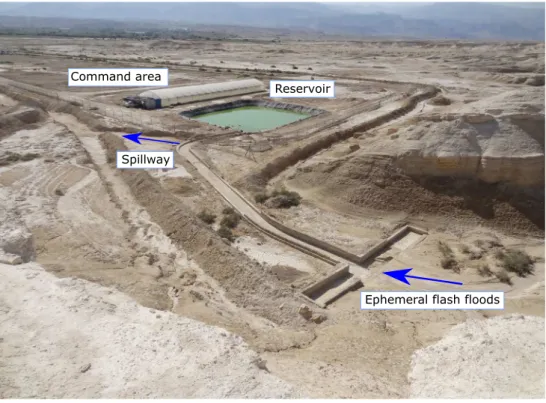
2016; Cui and Schreider2009; Zhao et al.2014; Pelak and Porporato2016; Basinger et al.2010). An extreme case is being studied in a harsh environment, where a small reservoir is constructed to collect ephemeral water flows from flash floods in order to fully irrigate perennial plants, as shown in Fig.1 (Unami et al. 2015). The structure
harvesting flash floods consists of a gutter cutting across a 16 m wide valley bottom and a conveyance channel of 60 m long to guide the water to the reservoir. The con-veyance channel is equipped with a spillway to release excess backwater from the reservoir. Operation of the reservoir involves an optimal control problem considering the inherently stochastic occurrence of flash floods, while the operator can make decisions on the intake flow rate from the reservoir for irrigation. The entire irrigation scheme, which consists of a reservoir with flash flood harvesting facilities and a command area of plant cultiva-tion, is so small that the decision maker has perfect information. The water dynamics in the irrigation scheme is modeled as a set of stochastic differential equations (SDEs) representing the water balance in the reservoir as well as the uncertain occurrence and intensity of flash floods and droughts. The performance index to be minimized is the expected deficiency of water in the future. In the present paper, we attempt to establish well-posed-ness for such an optimal control problem with mathemat-ical rigor, which is lacking in earlier practmathemat-ical papers on relevant topics (Unami et al. 2013, 2015; Sharifi et al.
2016).
& Koichi Unami
1 Graduate School of Agriculture, Kyoto University,
Kyoto 606-8502, Japan
2
Faculty of Agriculture, Mutah University, Karak 61710, Jordan
In the context of dynamics programming, the Hamilton– Jacobi–Bellman (HJB) equation governs the value function from which an optimal control strategy is derived for a time-continuous problem. The versatility of the HJB equation is evident as its industrial applications are so vast, covering the fields of population dynamics (Guo and Sun
2005), financial engineering (Junca 2012; Leach et al.
2007; Bo et al. 2013), aircraft flight mechanics (Almgren and Tourin2015), climate risk assessment (Chaumont et al.
2006), and energy systems (Sieniutycz2009,2012,2015). The notion of viscosity solutions is a powerful vehicle for approaching the HJB equation, which is nonlinear and degenerate in most cases, and comparison theorems are fundamental in discussing uniqueness and stability of solutions (Fleming and Soner 2006; Kawohl and Kutev
2007; Ishii1987; Ishii and Lions1990; Crandall and Lions
1983). Peron’s method is a standard means of constructing viscosity solutions (Crandall et al. 1992). However, the HJB equation derived from the optimal control problem considered herein encounters some difficulties. The com-parison theorems known thus far are not applicable because of irregular conditions imposed when the reservoir is empty or full. Therefore, special auxiliary functions are sought to establish a comparison theorem, which guaran-tees the uniqueness of a continuous viscosity solution to the HJB equation with a relaxed Hamiltonian. Another theo-rem is also proven to show the existence of the viscosity solution as well as to justify a numerical approach,
embedding a space of weak solutions into the space of viscosity solutions, in a manner analogous to a previous study dealing with one-dimensional stationary Hamilton– Jacobi equations of first order (Guermond and Popov
2008).
An approximate value function obtained as a numerical solution to the HJB equation yields the optimal control strategy in the real world. Concurrent use of the finite difference and finite element methods is a promising dis-cretization technique for nonlinear and degenerate partial differential operators. The optimal control strategy is the maximizer of a characteristic function depending on the value function. Assuming that the control strategy derived from the approximate value function is optimal, it is summarized in terms of rule curves for reservoir operation (Senga1991; Khan et al. 2012; Moghaddasi et al. 2013), and a simplified chart is presented to the operator for actual implementation. This is an innovative demonstration test in the prototype irrigation scheme based on a rigorous mathematical foundation.
As usual, the notationsC,C1,C2, andC1 shall be used for the sets of continuous and continuously differentiable functions.
2 Formulation of the optimal control
problem
A stochastic model is developed for water dynamics in the irrigation scheme. Then, an optimal control problem is formulated with a performance index to be minimized, in order to deduce the optimal control strategy for irrigation water intake from the reservoir harvesting flash floods.
2.1 Stochastic model for water dynamics
The dynamics of the storage volumeXt of the reservoir at
timet is governed by the water balance equation
dXt¼ðQin Qout uÞdt ð1Þ
whereQin is the inflow rate of the harvested flash flood,
which is equal to the runoff discharge of the flash flood after subtracting the rate of overflow from the spillway, Qoutis the outflow rate due to evaporation and seepage, and
uis the intake flow rate as a control variable constrained in a setUof admissible controls. A virtual variableYtreferred
to as the water flow index is considered to model the dynamics ofQin andQout. The one-dimensional Langevin
equation is assumed to governYt as
dYt¼ rYtdtþ
ffiffiffiffiffiffi
2D p
dBt ð2Þ
whereris a reversion coefficient,D is a diffusion coeffi-cient, andBt is the standard Brownian motion (Øksendal
2007). The advantages of using this virtual model (2) are capability in comprehensively representing the stochastic flow rate dynamics of flash floods as well as the occurrence of dry spells. A non-decreasing functionQinðyÞis assumed
to define the relationship betweenYtandQin, whileXtand
Yt determine Qout with another function Qoutðx;yÞ. The
storage volume Xt of the reservoir is assumed to almost
surely not exceed its capacity V, because of the well-functioning spillway. It is also trivial that Xt cannot
decrease when it is equal to 0. Consequently, the domain of Xtis restricted to the closed interval 0½ ;V, as is common in
most reservoir operation problems. Consequently, (1) is rewritten as
dXt¼a Xð t;Yt;uÞdt ð3Þ
with
a xð ;y;uÞ ¼
0^ðQinð Þy Qoutðx;yÞ uÞ ifx¼V
Qinð Þy Qoutðx;yÞ u if 0\x\V
0_ðQinð Þy Qoutðx;yÞ uÞ ifx¼0
8
<
:
ð4Þ
where^and_represent the minimum and the maximum, respectively. A target flow rateQtrgof irrigation water as a
function of the timet is set within the maximum capacity
of the intake facility, e.g., a pump. Depending on the fea-sibility of intake from the reservoir, the admissible setUis prescribed as
U¼ 0;Qtrg
ifXt[0 orQtrgQin Qout
0
f g ifXt¼0 andQtrg[Qin Qout
: ð5Þ
2.2 Performance index and HJB equation
The current timesis assumed to be in an irrigation period 0;T
½ Þ (T\1). The performance index Juðs;x;yÞ at time
t¼s with storage volume Xs¼x and water flow index
Ys¼yis defined as
Juðs;x;yÞ ¼Es;x;y
Z T
s
f tð;u tð;Xt;YtÞ;YtÞdtþV XT
ð6Þ
where Es;x;y represents the expectation with respect to the
probability law of the stochastic processes starting at point s;x;y
ð Þ, and f is a bounded non-negative penalty function evaluating the departure of the actual intake flow rate u from the target Qtrg. The value XT at the end of the
irri-gation period is the bequest to be maximized. The choice of u is optimized to attain the infimum of Juðs;x;yÞ. It is assumed thatuis a Markov control, the choice of which at timetdepends only on the current values ofXtandYt. The
infimum U¼Uðs;x;yÞ of Juðs;x;yÞ exists because f0 and 0V XTV, and is referred to as the value
func-tion. The controluattainingUis referred to as the optimal control. Therefore,
Uðs;x;yÞ ¼Juðs;x;yÞ
¼Es;x;y
Z T
s
f tð;uðt;Xt;YtÞ;YÞdtþV XT
:
ð7Þ
As mentioned in Chapters IV and V of Fleming and Soner (2006) including the verification theorem, the HJB equation
oU
os þa x;y;u
ð ÞooU
x ry
oU
oyþD
o2U
oy2 þf sð ;u;yÞ
¼inf
u2U
oU
os þa xð ;y;uÞ
oU
ox ry
oU
oyþD
o2U
oy2 þf sð ;u;yÞ
¼0
ð8Þ
governs the value functionUand the optimal controlufor s;x;y
ð Þ in the set G¼½0;TÞ ð0;VÞ R, with the ter-minal condition
UðT;x;yÞ ¼V x: ð9Þ
functionUshould be understood as a viscosity solution to the HJB Eq. (8), which is degenerating. The optimal con-trolu at any point inGis obtained as
u¼arg max
u2U
wðuÞ ð10Þ
wherewis the characteristic function defined by
wðuÞ ¼wðu;t;x;y;UÞ ¼uoU
ox fðt;u;yÞ: ð11Þ
Then, the HJB equation (8) is rewritten as
oU
os þDQ
oU
ox ry
oU
oyþD
o2U
oy2 wðu
Þ ¼0 ð12Þ
where
DQ¼
u^ðQin QoutÞ ifx¼V
Qin Qout
ð Þ if 0\x\V
u_ðQin QoutÞ ifx¼0
8
<
:
: ð13Þ
A penalty function is chosen as
fðt;u;yÞ ¼ cðyÞ ifu6¼QtrgðtÞ 0 ifu¼QtrgðtÞ
ð14Þ
where c is a positive bounded weight depending on the water flow indexy, which is assumed here to be
c¼ Qtrg
1þexpðy KÞ ð15Þ
whereK is a model parameter, which will be determined from physical data observed in the real world (Sect.5). For a feasible operational flow rateQpof the intake facility, the
irrigation period 0½ ;TÞis divided intoNþ1 non-irrigation hours I2i¼½t2i;t2iþ1Þ and N irrigating hours
I2iþ1 ¼½t2iþ1;t2iþ2Þ, where Qtrg¼0 and Qtrg¼Qp,
respectively, so that 0½ ;TÞ ¼½t0;t2Nþ1Þ ¼ [ 2N
k¼0Ik. This
par-tition of the entire irrigation period into a sequence of time intervals reduces the original problem into a sequence of the HJB equations with Hamiltonians independent of time. Under the above-mentioned conditions, it is easy to verify the boundedness ofU:
Remark 1 For anys2½0;TÞ, 0UðT sÞmax Qp
þV: ð16Þ
WhenQtrg¼Qp, (10) and (11) are reduced to
u¼
0 if Qp
oU
ox\ c
8u2U ifQp
oU
ox¼ c
Qp ifQp
oU
ox [ c
8
> > > > > <
> > > > > :
ð17Þ
and
w¼Qp
oU
ox_ c: ð18Þ
Otherwise, these two equations are reduced to
u¼0 ð19Þ
and
w¼ c: ð20Þ
The optimal control u may not be unique, as in (17). However, eliminating u reduces the HJB Eq. (12) with (18) and (20) to obtain
oU
os þð0^ðQin QoutÞÞ
oU
ox ry
oU
oyþD
o2U
oy2 þc¼0 if Qp
oU
ox c
oU
os þ 0^ Qin Qout Qp
oU
ox ry
oU
oyþD
o2U
oy2 ¼0 if Qp
oU
ox c
8
> > <
> > :
if x¼V; ð21Þ
oU
os þðQin QoutÞ
oU
ox ry
oU
oyþD
o2U
oy2 þc¼0 if Qp
oU
ox c
oU
os þ Qin Qout Qp
oU
ox ry
oU
oyþD
o2U
oy2 ¼0 if Qp
oU
ox c
8
> > <
> > :
if 0\x\V; ð22Þ
and
oU
os þð0_ðQin QoutÞÞ
oU
ox ry
oU
oyþD
o2U
oy2 þc¼0 if Qp
oU
ox c
oU
os þ 0_ Qin Qout Qp
oU
ox ry
oU
oyþD
o2U
oy2 ¼0 if Qp
oU
ox c
8
> > <
> > :
3 Uniqueness of viscosity solution
to the HJB equation
For each non-negative integerk2N, the temporal vari-able is inverted as
s¼tkþ1 s2ð0;tkþ1 tk; ð24Þ
and the value functionU¼Uðs;x;yÞis defined on the set Gk¼ð0;tkþ1 tk ½0;V R. Then, the HJB
equa-tions (21), (22), and (23) is further rewritten as
oU
osþHðs;x;U;rU;r rUÞ ¼0 ð25Þ
wherex¼ x y
, andH is the Hamiltonian defined as
Hðs;x;w;p;MÞ ¼Hðs;x;p;MÞ
¼H^ðs;x;y;pxÞ þrypy Dl
yy ð26Þ
with
^
Hðs;x;y;pxÞ ¼
aðx;y;0Þpx c if Qppxþc0
a x;y;Qp
px if Qppxþc0
ð27Þ
and
aðx;y;QÞ ¼
0^ðQinð Þy Qoutðx;yÞ QÞ if x¼V
Qinð Þy Qoutðx;yÞ Q if 0\x\V
0_ðQinð Þy Qoutðx;yÞ QÞ if x¼0
8
<
:
ð28Þ
where p¼ px py
and M¼ lxx lxy lyx lyy
. However, the
discontinuity appearing in (28) when x¼0 and x¼V hinders the comparison theorem, which holds if the func-tionaðx;y;QÞis relaxed as
agðx;y;QÞ
¼
V x
g aðV g;y;QÞ þ 1 V x
g
aðV;y;QÞ ifxV g
aðx;y;QÞ ifx¼g\x\V g
1 x
g
að0;y;QÞ þx
ga g;ð y;QÞ ifxg
8 > > > > > < > > > > > :
ð29Þ whereg is a small positive relaxation parameter, so that agðx;y;QÞ uniformly approaches aðx;y;QÞ as g!0.
Henceforth, thisagðx;y;QÞwill be used in (27) instead of
aðx;y;QÞ. The definitions of a xð ;y;uÞ and DQ will be accordingly revised asagðx;y;uÞandDQg in (4) and (13),
respectively. The assertion of Remark 1 is still valid for the relaxed case.
Remark 2 H^ðs;x;y;pxÞwith the relaxed (29) is Lipschitz
continuous in eachIkwith respect tos,x, andy.
Now, we move on to viscosity solution to the relaxed HJB equation. A real-valued functionUdefined on a setE is called upper semi-continuous, if for anyðs;xÞ 2ER3
and anye[0 there existsdsuch thatUðs0;x0Þ\Uðs;xÞ þ
e for all ðs0;x0Þ 2B
dðs;xÞ \E, where Bdðs;xÞ represents
the d-neighborhood ofðs;xÞ. Similarly, it is called lower semi-continuous in the case where the inequality is replaced by Uðs0;x0Þ[Uðs;xÞ e. Let USC Eð Þ and
LSC Eð Þ denote the sets of all upper and lower semi-con-tinuous functions defined onE, respectively. The upper and lower semi-continuous envelopes UU and UL of a real-valued functionUonGkare defined as
UUðs;xÞ ¼ lim sup
s0;x0
ð Þ!ðs;xÞU
s0;x0
ð Þ ð30Þ
and
ULðs;xÞ ¼ lim inf
s0;x0
ð Þ!ðs;xÞU s 0;x0
ð Þ; ð31Þ
respectively. Note thatUL
2USCð ÞGk andUL2LSCð ÞGk .
ForUU
2USCð ÞGk , being a viscosity sub-solution to (25)
implies that
ow
osþHðs;x;w;rw;r rwÞ 0 atðs;^x^Þ 2Gk ð32Þ
for any test functionw2C2ð ÞGk , such that
wUU inGk; w¼UU atðs;^x^Þ: ð33Þ
ForUL
2LSCð ÞGk , being a viscosity super-solution to (25)
implies that
ow
osþHðs;x;w;rw;r rwÞ 0 atðs;^x^Þ 2Gk ð34Þ
for any test functionw2C2 G
k
ð Þ, such that
wUL inG
k; w¼UL atðs;^ x^Þ: ð35Þ
If UU is a viscosity sub-solution and
UL is a viscosity super-solution, then Uis called a viscosity solution.
We firstly discuss the continuity of viscosity solutions, which are value functions of the optimal control problem, ats¼0.
Theorem 1 Suppose that Uv is a bounded viscosity
solution to(25)with(29)and thatUUvð0;xÞ ¼ULvð0;xÞfor x2½0;V R. If Uvð0;xÞ ¼UUvð0;xÞ ¼U
L
vð0;xÞ as a
function ofx is continuous in½0;V R, then lim
s0;x0
ð Þ!ð0;xÞUv s 0;x0
ð Þ Uvð0;xÞ
j j ¼0: ð36Þ
Proof For s02½0;tkþ1 tk andx02½0;V R, it holds
Uvðs0;x0Þ Etkþ1 s
0;x0 Z tkþ1
tkþ1 s0
f t;u;Yt0dtþUvð0;X0ð0;uÞÞ
ð37Þ
with
X0ðs;uÞ ¼ X 0
tkþ1 s
Yt0
kþ1 s
¼x0þ
Z tkþ1 s
tkþ1 s0
agðXt;Yt;uÞ
rYt
dt
þ
Z tkþ1 s
tkþ1 s0
0
ffiffiffiffiffiffi
2D p
dBt ð38Þ
for any admissibleu, becauseUvis a value function of the
optimal control problem. For any e[0, there exists an
admissibleu~such that
Uvðs0;x0Þ
þe[Etkþ1 s0;x0
Z tkþ1
tkþ1 s0
f t;u~;Yt0dtþUvð0;X0ð0;u~ÞÞ
:
ð39Þ
With the chosen penalty function (14), the first part of the expectation in the right hand side of (39) is evaluated as
Etkþ1 s0;x0
Z tkþ1
tkþ1 s0
f t;u~;Yt0dt
Qtrgs0; ð40Þ
and then subtractingUvð0;xÞfrom the inequalities (37) and
(39) leads to
Uvðs0;x0Þ Uvð0;xÞ
j j Etkþ1 s0;x0
Z tkþ1
tkþ1 s0
f t;u~;Yt0dt
þUvð0;X0ð0;u~ÞÞ Uvð0;xÞ
Qtrgs0þ Etkþ1 s
0;x0
Uvð0;X0ð0;u~ÞÞ Uvð0;xÞ
½
Qtrgs0þEtkþ1 s
0;x0
Uvð0;X0ð0;u~ÞÞ Uvð0;xÞ
j j
½
ð41Þ
for anyx2½0;V R. By the definition (38)
lim
s0;x0
ð Þ!ð0;xÞUv 0;X 0ð0;u~Þ
ð Þ Uvð0;xÞ
j j ¼0 ð42Þ
and therefore (36) holds. h
The following comparison theorem coupled with The-orem 1 proves the uniqueness of viscosity solutions of (25) with (29).
Theorem 2 Suppose that U12USCð ÞGk is a bounded
viscosity sub-solution to (25) with (29) and that U22
LSCð ÞGk is a bounded viscosity super-solution to(25)with
(29). Then,
sup
s;x
ð Þ2Gk
U1ðs;xÞ U2ðs;xÞ
ð Þ ¼ sup
n2½0;VR
U1ð0;nÞ U2ð0;nÞ
ð Þ:
ð43Þ
Proof We opt for proof by contradiction in two stages.
Firstly, an auxiliary functionWis defined as Wðs;x;r;nÞ ¼U1ðs;xÞ U2ðr;nÞ
1 2djs rj
2 1
2ekx nk
2
u rð Þ ð44Þ
wheren¼ n
f
, andu sð Þ 2C1ð½0;tkþ1 tkÞis a
func-tion satisfyingu sð Þ 0 andu sð Þ ¼0 ifs¼0. Two points
s;x
ð Þand r; nofGk are assumed to maximizeWas
W s;x;r; n
¼ sup
s;x
ð Þ;ðr;nÞ2GkW s;
x;r;n
ð Þ: ð45Þ
Then, the inequality
U1ðs;xÞ U2 r; n
1 2djs rj
2 1
2e x n
2
¼W s;x;r; n
þuð Þr W r; n; r; n
¼U1 r; n U2 r; n
ð46Þ
leads to evaluations
s r
j j ffiffiffiffiffiffiffiffiK1d
p
andx n
ffiffiffiffiffiffiffi
K1e
p
ð47Þ
whereK1 is a non-negative constant given by
K1¼4 max
s;x
ð Þ2GkðjU1ðs;xÞj;jU2ðs;xÞjÞ
\þ 1: ð48Þ
Assume that s[0 and r[0. We set a smooth function
vðs;xÞas
vðs;xÞ ¼ 1 2djs rj
2
þ1 2e x
n
2
ð49Þ
which turns out to be a test function for a viscosity sub-solution because
U1ðs;xÞ vðs;xÞ ¼W s;x;r; nþU2 r; nþuð Þr
ð50Þ
and therefore
s;x
ð Þ 2arg max
s;x
ð Þ2Gk
U1ðs;xÞ vðs;xÞ
f g: ð51Þ
ov
osþHðs;x;rv;r rvÞ ¼
1 dðs rÞ þH s;x;1
e x n ;1 eI
¼1dðs rÞ
þH^ s;x;1 e x
n
þry 1 e y
f
D
e 0 atðs;xÞ:
ð52Þ
An eligible functionu sð Þis chosen here as
u sð Þ ¼1 2bs
2
þ2De s ð53Þ
withb[0, to set another smooth functionv^ðs;xÞas
^
vðr;nÞ ¼ 21 djs rj
2
þ21
ekx nk
2
þu rð Þ
ð54Þ
which turns out to be a test function for a viscosity super-solution because
U2ðr;nÞ v^ðr;nÞ ¼ Wðs;x;r;nÞ þU1ðs;xÞ ð55Þ
and therefore
r;n
2arg min
s;x
ð Þ2Gk
U2ðr;nÞ v^ðr;nÞ
f g: ð56Þ
This implies that
ov^
orþHðr;n;rv^;r rv^Þ ¼ br
2D e þ
1 dðs rÞ þH r;n;1
eðx nÞ; 1 eI
¼ br 2D e þ
1 dðs rÞ þH^ r;n;1
eðx nÞ
þrf 1 eðy fÞ
þDe 0 at r; n
:
ð57Þ
Comparing (52) and (57) yields
brþ1 er y
f2
H^ r; n; 1 e x
n
^ H s;x;1
e x n
: ð58Þ
The left-hand side of (58) remains positive for any positive b,d, ande, while its right-hand side approaches to zero as d;e! þ0 because H^ is continuous, to yield a contradic-tion. Therefore,s¼0 orr¼0 or both.
Now, we prove
sup
s;x
ð Þ2Gk
U1ðs;xÞ U2ðs;xÞ
ð Þ sup
n2½0;VR
U1ð0;nÞ U2ð0;nÞ
ð Þ:
ð59Þ
Assume that (59) is not true. Then, there exists a point sM;xM
ð Þ 2Gksuch that
U1ðsM;xMÞ U2ðsM;xMÞ
¼ sup
s;x
ð Þ2Gk
U1ðs;xÞ U2ðs;xÞ
ð Þ
[ sup
n2½0;VR
U1ð0;nÞ U2ð0;nÞ
ð Þ;
ð60Þ
while one of the inequalities
U1ðs;xÞ U2ðs;xÞ sup
x2½0;VR
U1ð0;xÞ U2ð0;xÞ
ð Þ ifs¼0
U1 r;n U2 r;n sup
n2½0;VR
U1ð0;nÞ U2ð0;nÞ
ð Þ ifr¼0
8 > <
> :
ð61Þ
holds. By the evaluations (47), it is possible to chooseeand d such that js rj þx n
q for any q[0. Then,
considering the properties of upper and lower semi-con-tinuous functions,qis chosen so that
U2ðs; xÞ U2 r; n\e0 if s¼0
U1ðs; xÞ U1 r; n\e0 if r¼0
ð62Þ
for anye0[0. Adding (62) to (61) results in
U1ðs;xÞ U2 r; n sup
n2½0;VR
U1ð0;nÞ U2ð0;nÞ
ð Þ þe0
ð63Þ
to obtain
W s;x;r; n
¼U1ðs;xÞ U2 r; n
1 2djs rj
2 1
2e x n 2
uð Þr
sup
n2½0;VR
U1ð0;nÞ U2ð0;nÞ
ð Þ
þe0
1 2djs rj
2 1
2e x n
2
uð Þr
\ sup
s;x
ð Þ2Gk
U1ðs;xÞ U2ðs;xÞ
ð Þ þe0:
ð64Þ
On the other hand,
WðsM;xM;sM;xMÞ ¼U1ðsM;xMÞ U2ðsM;xMÞ u sð ÞM
¼ sup
s;x
ð Þ2Gk
U1ðs;xÞ U2ðs;xÞ
ð Þ u sð ÞM :
ð65Þ
W s;x;r; n
\ sup
s;x
ð Þ2Gk
U1ðs;xÞ U2ðs;xÞ
ð Þ þe0
¼WðsM;xM;sM;xMÞ þu sð Þ þM e0: ð66Þ
Another choice ofu sð Þas
u sð Þ ¼1 2bs
2 ð67Þ
withb[0 is also eligible and leads to
W s;x;r; n
\WðsM;xM;sM;xMÞ ð68Þ
as b;e0! þ0. However, (68) contradicts (45) and thus
(59) is true. Consequently, we reach to (43). h
Remark 3 If there is a viscosity solution to (25) with (29)
satisfying a specified continuous initial condition in the sense of Theorem 1, then its uniqueness and continuity are direct consequences of Theorem 2.
4 Existence of viscosity solution to the HJB
equation
A weak solution to the HJB equation (25) with (29) from a specified initial condition is considered in order to show the existence of a viscosity solution as well as to provide a framework for approximate numerical solution.
Transformation of the independent variableytozwith z¼tan 1 ffiffiffiffiffir
2D
p
y
makes the domain bounded. Indeed,Gk
is mapped to Gk¼ð0;tkþ1 tk XxXz, where Xx¼
0;V
ð ÞandXz¼ð p=2;p=2Þ. LetXsdenote 0ð ;tkþ1 tkÞ.
Then, the HJB equation (25) is formally transformed into
oU
osþH^ s;x;
ffiffiffiffiffiffi
2D r
r
tanz;oU
ox
!
þrsinzcosz 1þcos2zoU
oz
r 2cos
4zo 2
U
oz2
¼0; ð69Þ
but U at each s2ð0;tkþ1 tk shall be sought in the
function spaceH1
xz, which is completed with the norm
U k kH1
xz¼
Z
Xz
U k kH1X
x
ð Þdzþ
Z
Xx
U k kH1X
z
ð Þdx ð70Þ
where
U k kH1X
ð Þ¼
ffiffiffiffiffiffiffiffiffiffiffiffiffiffiffiffiffiffiffiffiffiffiffiffiffiffiffiffiffiffiffiffiffiffiffiffiffiffiffiffiffiffi Z
X
U2þ ooU 2! d* v u u
t ð71Þ
for ¼xorz, to satisfy the weak form
d ds Z Xx ^ wx Z Xz ^ wzUdzdx
¼ Z Xx ^ wx Z Xz
rw^zsin3zcoszþ
r 2cos
4zow^z
oz
o
U
oz
þw^zH^ s;x;
ffiffiffiffiffiffi
2D r
r
tanz;oU
ox
!!
dzdx
ð72Þ
for any weights w^x2H1ð ÞXx and w^z2H1ð ÞXz , where
H1ð ÞX is the Sobolev space equipped with the norm (71). For ¼sorxorz, it is known that there are embeddings H1ð Þ !X CBð ÞX and H1ð Þ !X C X, where CBð ÞX is the set of all bounded continuous functions on a domain X, and C X is the set of all bounded uniformly con-tinuous functions on a domain X. Both of CBð ÞX and
C X
are Banach spaces equipped with the uniform norm, and C X is a closed subspace of CBð ÞX (Adams and Fournier2003). LetCB Gk
denote the set of all bounded continuous functions on Gk, which is a Banach space equipped with the uniform norm k kU 1¼ sup
s;x;z
ð Þ2G
k
U j j.
Consider the function g of w^x, w^z, and UðjÞ with time incrementdsas
g w^x;w^z;UðjÞ¼
Z Xx ^ wx Z Xz ^
wzUðjÞdzdx
ds Z Xx ^ wx Z Xz
F w^z;UðjÞ
dzdx ð73Þ
where
Fðw^z;UÞ ¼ rw^zsin3zcoszþ
r 2cos
4zow^z
oz
o
U
oz
þw^zH^ s;x;
ffiffiffiffiffiffi
2D r
r
tanz;oU
ox
!
:
ð74Þ
For fixedw^zandUðjÞ,gis a continuous linear functional on H1ð ÞXx . For fixed w^x and UðjÞ, g is a continuous linear functional on H1ð ÞXz . Applying the Riesz representation
theorem (Adams and Fournier2003) twice, gis identified with another functionUðjþ1Þ2Hxz1. Starting from an initial
value Uð0Þ, iterations UðjÞ
j¼1;2;3... with ds¼s=Ns and
Ns1 yield the Riemann sum
Z Xx ^ wx Z Xz ^
wzUðNsÞdzdx¼ Z Xx ^ wx Z Xz ^
wzUð0Þdzdx
s 1 Ns
X
Ns 1
l¼0
Z Xx ^ wx Z Xz
F w^z;UðlÞ
dzdx:
ð75Þ
Z Xx ^ wx Z Xz ^
wzUdzdx¼
Z Xx ^ wx Z Xz ^
wzUð0Þdzdx
s Z Xx ^ wx Z Xz
Fðw^z;UÞdzdx ð76Þ
asNsapproaches þ1, which is consistent with (72).
Remark 4 There exists at least one solution Uw¼
Uwðs;x;zÞto the initial value problem (72) with an initial
valueUð0Þ2H1xz. Here,Uw2Hxz1 for anys2ð0;tkþ1 tk
andUw2CBð ÞXs for any ðx;zÞ 2XxXz, implying that
Uw2CB Gk
.
The following theorem asserts that the above-mentioned weak solution accords with the viscosity solution to (25).
Theorem 3 Suppose thatUv¼Uvðs;xÞ ¼Uvðs;x;yÞis a
bounded viscosity solution to(25)with(29)satisfying the initial condition Uvð0;xÞ ¼Uvð0;x;yÞ ¼
Uð Þ0 x;tan 1 ffiffiffiffiffiffiffiffi2rDy
p
for any xð ;zÞ 2XxXz and that
Uw¼Uwðs;x;zÞ is a weak solution to(72)with (29)
sat-isfying the same initial condition. Then,
Uvðs;x;yÞ ¼Uw s;x;tan 1
ffiffiffiffiffiffiffiffiffi r 2Dy r
ð77Þ
in Gk.
Proof LetUU
v andU
L
v be the upper and lower
semi-con-tinuous envelopes ofUv, respectively. Namely,UUv andU L v
are the viscosity sub-solution and the viscosity super-so-lution, respectively. From Theorem 1,
UUvð0;xÞ ¼U L
vð0;xÞ ¼Uvð0;xÞ 2CBð½0;V RÞ ð78Þ
whereCBð½0;V RÞis the set of all bounded continuous
functions on ½0;V R. There exists a sequence Uð Þnðs;x;zÞ
C1 Gk\C2ð ÞXz converging to Uw.
Namely, for anye[0, there exists a natural number N1
such that
Uwðs;x;zÞ Uð Þnðs;x;zÞ
H1
xz
\e ð79Þ
for any n[N1 at all s2ð0;tkþ1 tk. Because of the
embeddings H1ð Þ !Xx C Xx
and H1ð Þ !Xz CBð ÞXz ,
there exists another natural numberN2, such that
Uwðs;x;zÞ Uð Þnðs;x;zÞ
1\e ð80Þ
for any n[N2 at all s2 0;tk
þ1 tk
ð . Consequently, Uð Þnðs;x;zÞ
becomes a Cauchy sequence converging to a limit Ucðs;x;zÞ in CB Gk
, and thus Uwðs;x;zÞ ¼
Ucðs;x;zÞinGk. Furthermore, for anyd[0, there exists a
natural numberN3 such that
oUð Þn
os þH s;x;
ffiffiffiffiffiffi
2D r
r
tanz;Uð Þn;rUð Þn;r rUð Þn
! \d
ð81Þ
for anyn[N3inG
k. For eachn, letd n
ð Þ
i (i¼1;2) be real
numbers such that
dð Þ1n ¼inf d0d ffiffiffi
s
p
[UU v s;x;
ffiffiffiffiffiffi 2D r r tanz !
Uð Þnðs;x;zÞ ( )
ð82Þ
and
dð Þ2n ¼sup d0d ffiffiffi
s
p
\UL v s;x;
ffiffiffiffiffiffi 2D r r tanz !
Uð Þnðs;x;zÞ ( ) :
ð83Þ
Then, test functionswð Þin are chosen as
wð Þin ¼wð Þinðs;x;yÞ
¼Uð Þn s;x;tan 1
ffiffiffiffiffiffiffiffiffi r 2Dy r
þdð Þin
ffiffiffi
s p
ð84Þ
so that
wð Þ1n UUv inGk; w n
ð Þ
1 ¼U
U
v atðs^1;x^1Þ ð85Þ
and
wð Þ2n UL
v inGk; w
n
ð Þ
2 ¼U
L
v atð^s2;x^2Þ ð86Þ
for some ð^si;x^iÞ 2Gk. This implies that w n
ð Þ
i are indeed
eligible for test functions of viscosity sub-solutionUUv and
viscosity super-solutionUL
v, resulting in
owð Þn
1
os þH s^1;x^1;w
n
ð Þ
1 ;rw
n
ð Þ
1 ;r rw
n
ð Þ
1
¼oU ðnÞ
os þH s^1;x^1;U
ðnÞ;rUðnÞ;r rUðnÞ
þd n ð Þ 1 ffiffiffi s
p 0 ð87Þ
and
owð Þ2n
os þH s^2;x^2;w
n
ð Þ
2 ;rw
n
ð Þ
2 ;r rw
n
ð Þ
2
¼oU ðnÞ
os þH s^2;x^2;U
ðnÞ;rUðnÞ;r rUðnÞ
þd n ð Þ 2 ffiffiffi s
p 0 ð88Þ
at respectiveðs^i;x^iÞ. In order to satisfy (87) and (88),d n
ð Þ
i
UUvðs;x;yÞ ¼U L
vðs;x;yÞ ¼Uc s;x;tan 1
ffiffiffiffiffiffi
r 2D
r
y
ð89Þ inGk, and thus (77). h
5 Application with numerical demonstration
A prototype irrigation scheme including a reservoir for harvesting flash floods is being developed at the Agricul-tural Research Station of Mutah University, located in the Lisan Peninsula of the Dead Sea near the town of Ghor al Mazrah in Jordan. The model parameters are determined from the physical dimensions of the structures as well as from hydro-meteorological observation conducted from September 27th, 2014 through September 22nd, 2016. Indeed, the reservoir consists of two sections: a 300 m3 section enclosed in a greenhouse, and a 700 m3section, the surface of which is exposed to open air. Once a flash flood is harvested in the open section, the water is immediately transferred to the closed section if there is room. Therefore, the sections are regarded collectively as a single reservoir ofV = 1000 m3withQoutðx;yÞvarying in the x-direction.
The irrigation period 0½ ;TÞis set as 5.25609105min of a
non-leap year from May 1st through April 30th. No flash flood is expected during the months from May through October. The period from 08:00 a.m. through 08:12 a.m. is prescribed as the irrigation hours for every day throughout the irrigation period. Without loss of generality, the dif-fusion coefficient D is assumed to be unity. In the two consecutive winter rainy seasons of 2014–2015 and 2015– 2016 included in the observation period, there were 16 events of flash floods (10 events in 2014–2015 season and 6 events in 2015–2016 season), out of which 8 events (3 events in 2014–2015 season and 5 events in 2015–2016 season) yielded substantial harvesting. The model param-eter K represents the supremum of y, where there is no
inflow of flash flood to the reservoir, and its value is esti-mated to be 2.4165. The most likely value of the reversion coefficient in terms of the compatible transition probability density function is 0.0011421 per minute. The functions Qinð Þy and Qoutðx;yÞ are determined as shown in Fig.2.
The blue line in the figure indicatesQin in the unit of m3/
min during the wet months from November through April, identified from statistical analysis of the observed data as
Qinð Þ ¼y
60:000 if 58:181\y
18:305 logy 14:3833 if 3:7700\y58:181
27:641y 94:299 if 3:6000\y3:7700
3:6107ðy KÞ2:1767 ifK\y3:6000
0:0000 ifyK
8
> > > > <
> > > > :
;
ð90Þ whileQin0 during the dry months from May to October.
Seepage is negligible because of plastic sheets covering the bottom of the reservoir, and the closed section is free from evaporation. Evaporation from the water surface of the open section is estimated at 10=ð1þexpðy KÞÞmm/day., which is multiplied by the water surface area depending on x to yield Qoutðx;yÞ. Note that there is no significant
dif-ference in observed evaporation between the wet and dry months.
To approximately solve the HJB equation (72) with (29) from a specified initial condition and then to derive the optimal control strategy, a computational procedure is developed as follows. Thez-domainXz is divided into nz
sub-domains of equal lengthDz¼p=nz. Thex-domainXx
is also divided into nx sub-domains of equal length
Dx¼V=nx, and the unknownUis attributed to each node
x¼iDx;z¼kDz
f g as Ui;k. For discretization in the
z-di-rection, the finite element scheme developed by Unami et al. (2015) is applied to the weak form (72). For dis-cretization in the x-direction, the first-order upwind finite difference scheme is used. The mesh sizeDxis regarded as the relaxation parameter g. Then, the system of ordinary differential equations resulting from those discretization
Outflow discharge (m /day) Inflow dischar
g
e (m /min)
3 3
10
8
6
4
2
0
60
48
36
24
12
0
x x x x x
250 100 75 50 25 0 25 50 75 100 250
∞ ∞
− − − − − − K
y Q
Qout in
: = : = : = : = : =1000 m
800 m 600 m 400 m 0-300 m
3 3 3 3
3
schemes is numerically solved in thes-direction using the Runge–Kutta method with a constant time step Ds to update the value of eachUi;k. The optimal control strategy
u is derived from the computedUi;k, according to (10). A
computational run with nx¼100, nx¼120, and Ds¼
1=60 minutes was completed within nine days and four hours using the supercomputer system of the Academic Center for Computing and Media Studies, Kyoto Univer-sity. Distribution of computed optimal control u is delin-eated in Figs.3, 4,5, 6 and 7 for the irrigation hours of
Day 0
8:11
8:10 8:09
8:08 8:07
8:06 8:05
8:04
8:03
8:02 8:01
8:00 8:00 8:00 8:00 8:00 8:00 8:00 8:00 8:00 8:00 8:00 8:00 8:00 8:00 8:00 8:00 8:00 8:00 8:00 8:00 8:00 8:00 8:00 8:00 8:00 8:00 8:00 8:00 8:00 8:00 8:00 8:00 8:00 8:00 8:00 8:00 8:00
−∞ −250 −100 75− −50 −25 0 25 50 75 100 250 ∞
1000
800
600
400
200
K
x
y
Q
= =
0
(m )
3u
u
* *p Fig. 3 Distribution of computed
optimal controluduring irrigation hours on May 1st (Day 0)
Day 91
8:11
8:10 8:09
8:08 8:07
8:06 8:05
8:04
8:03
8:02 8:01
8:00
−∞ −250 −100 75− −50 −25 0 25 50 75 100 250 ∞
1000
800
600
400
200
K
x
y
Q
= =
0
(m )
3u
u
* *p Fig. 4 Distribution of computed
optimal controluduring irrigation hours on July 31st (Day 91)
Day 182
8:11
8:10 8:09
8:08 8:07
8:06 8:05
8:04
8:03
8:02 8:01
8:00
−∞ −250 −100 75− −50 −25 0 25 50 75 100 250 ∞
1000
800
600
400
200
K
x
y
Q
= =
0
(m )
3u
u
* *p Fig. 5 Distribution of computed
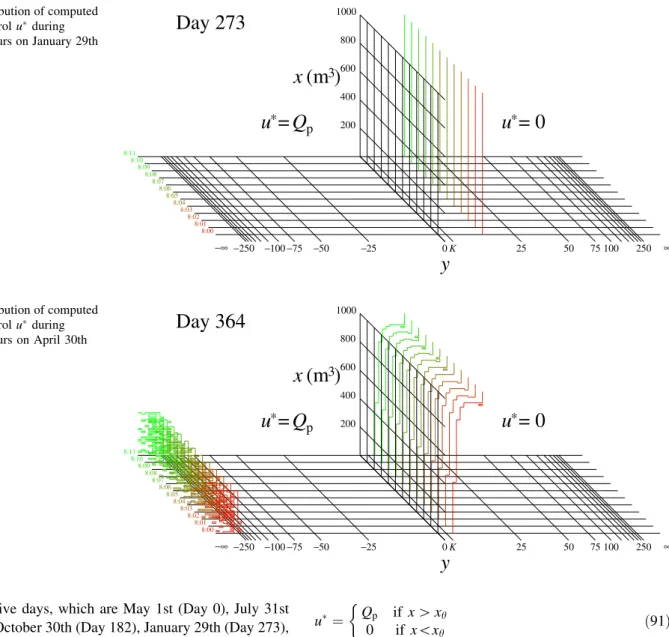
representative days, which are May 1st (Day 0), July 31st (Day 91), October 30th (Day 182), January 29th (Day 273), and April 30th (Day 364). The boundary between two adjacent cells ofu¼0 andu ¼Qpin thex-ydomain for
eachs2½0;t2iþ2 t2iþ1Þis marked as a segment in a
dif-ferent color at each time stage of 1-min intervals. If there is a surface ofxh such that
u¼ Qp if x[xh 0 if x\xh
ð91Þ
in thes–ydomain, the surface is referred to as a rule curve. Possibly due to the coarse discretization, oscillations in the delineated segments appear slightly in Figs. 3,4,5 and6
and more visibly neary¼ 1 in Fig.7. However, prac-tically significant rule curves can be extracted. The rule
Day 273
8:11
8:10 8:09
8:08 8:07
8:06 8:05
8:04
8:03
8:02 8:01
8:00
−∞ −250 −100 75− −50 −25 0 25 50 75 100 250 ∞
1000
800
600
400
200
K
x
y
Q
= =
0
(m )
3u
u
* *p Fig. 6 Distribution of computed
optimal controluduring irrigation hours on January 29th (Day 273)
Day 364
8:11
8:10 8:09
8:08 8:07
8:06 8:05
8:04
8:03
8:02 8:01
8:00
−∞ −250 −100 75− −50 −25 0 25 50 75 100 250 ∞
1000
800
600
400
200
K
x
y
Q
= =
0
(m )
3u
u
* *p Fig. 7 Distribution of computed
optimal controluduring irrigation hours on April 30th (Day 364)
MAY JUN JUL AUG SEP OCT NOV DEC JAN FEB MAR APR
Open part
Closed part
:Dry :Normal :Wet
curves are mostly monotonically increasing with respect to y, and, throughout the irrigation period, water should not be withdrawn from the reservoir under sufficiently wet con-ditions. The restriction on intake is strictest on Day 0 and is then relaxed as time evolves. Rule curves vanish after Day 182 under dry conditions.
The chart for the rule curves actually presented to the operator, which includes only three cases of water flow index y¼ 3:2935¼ 1:3629K¼pffiffiffiffiffiffiffiffiffiffiffi2D=rtanðp=40Þ andy¼0, is shown in Fig.8. The operator has also been told that irrigation should not be performed during flash floods. On the other hand, the rule curve fory¼ 3:2935 should be applied under much drier conditions.
6 Conclusions
A prototype irrigation scheme with a reservoir for har-vesting flash floods motivated the mathematical analysis of the present paper. A water dynamics model was con-structed based on practically acceptable assumptions, and the model parameters were determined from the observed data.
The optimal control problem formulated for the model was shown to have a unique value function, which solves the HJB equation in the viscosity sense. In other words, it was successfully demonstrated that the optimal control problem was well-posed. Skillful use of the properties of viscosity sub-solutions and viscosity super-solutions, as well as the choices of auxiliary functions, played key roles in the proofs of the non-trivial theorems. The innovative construction method for the weak solution rationalized the numerical approximation of the value function. The com-parison theorem, Theorem 2, is independent of Theorem 1 and is applicable to discontinuous viscosity solutions in general.
The rule curves for operation of the reservoir were numerically derived, suggesting that the optimal control is also unique. This is another remarkable outcome of the present study, because optimal control in a deterministic reservoir operation problem may be not unique, but may be arbitrary. Field verification of the optimal control strategy is being initiated in the real world, cultivating a perennial plant speciesPhoenix dactyliferain the irrigated command area.
Acknowledgements The authors are grateful to Prof. Hisashi Oka-moto at Gakushuin University for his valuable comments and sug-gestions. The present research was funded by Grants-in-Aid for Scientific Research Nos. 26257415 and 16KT0018 from the Japan Society for the Promotion of Science (JSPS).
Open Access This article is distributed under the terms of the Creative Commons Attribution 4.0 International License (http://
creativecommons.org/licenses/by/4.0/), which permits unrestricted use, distribution, and reproduction in any medium, provided you give appropriate credit to the original author(s) and the source, provide a link to the Creative Commons license, and indicate if changes were made.
References
Adams RA, Fournier JJF (2003) Sobolev spaces. Elsevier Science, Oxford
Almgren R, Tourin A (2015) Optimal soaring via Hamilton–Jacobi– Bellman equations. Optim Control Appl Methods 36:475–495 Basinger M, Montalto F, Lall U (2010) A rainwater harvesting system
reliability model based on nonparametric stochastic rainfall generator. J Hydrol 392:105–118
Bo L, Wang Y, Yang X (2013) Stochastic portfolio optimization with default risk. J Math Anal Appl 397:467–480
Borgomeo E, Hall JW, Fung F, Watts G, Colquhoun K, Lambert C (2014) Risk-based water resources planning: incorporating probabilistic nonstationary climate uncertainties. Water Resour Res 50(8):6850–6873
Chaumont S, Imkeller P, Mu¨ller M (2006) Equilibrium trading of climate and weather risk and numerical simulation in a Markovian framework. Stoch Environ Res Risk Assess 20(3):184–205
Crandall MG, Lions PL (1983) Viscosity solutions of Hamilton– Jacobi equations. Trans Am Math Soc 277(1):1–42
Crandall MG, Ishii H, Lions PL (1992) User’s guide to viscosity solutions of second order partial differential equations. Bull Am Math Soc 27(1):1–67
Cui J, Schreider S (2009) Modelling of pricing and market impacts for water options. J Hydrol 371(1):31–41
Fleming WH, Soner HM (2006) Controlled markov processes and viscosity solutions. Springer, New York
Guermond JL, Popov B (2008) L1-approximation of stationary Hamilton–Jacobi equations. SIAM J Numer Anal 47(1):339–362 Guo BZ, Sun B (2005) Numerical solution to the optimal birth feedback control of a population dynamics: viscosity solution approach. Optim Control Appl Methods 26:229–254
Ishii H (1987) A simple, direct proof of uniqueness for solutions of the Hamilton–Jacobi equations of Eikonal type. Proc Am Math Soc 100(2):247–251
Ishii H, Lions PL (1990) Viscosity solutions of fully nonlinear second-order elliptic partial differential equations. J Differ Equ 83(1):26–78
Junca M (2012) Optimal execution strategy in the presence of permanent price impact and fixed transaction cost. Optim Control Appl Methods 33:713–738
Kawohl B, Kutev N (2007) Comparison principle for viscosity solutions of fully nonlinear, degenerate elliptic equations. Commun Part Differ Equ 32(8):1209–1224
Khan NM, Babel MS, Tingsanchali T, Clemente RS, Luong HT (2012) Reservoir optimization-simulation with a sediment evac-uation model to minimize irrigation deficits. Water Resour Manag 26(11):3173–3193
Leach PGL, O’Hara JG, Sinkala W (2007) Symmetry-based solution of a model for a combination of a risky investment and a riskless investment. J Math Anal Appl 334:368–381
Leroux AD, Martin VL (2016) Hedging supply risks: an optimal water portfolio. Am J Agric Econ 98(1):276–296
Øksendal B (2007) Stochastic differential equations. Springer, Berlin Pelak N, Porporato A (2016) Sizing a rainwater harvesting cistern by
minimizing costs. J Hydrol 541(B):1340–1347
Senga Y (1991) A reservoir operational rule for irrigation in Japan. Irrig Drain Syst 5(2):129–140
Sharifi E, Unami K, Yangyuoru M, Fujihara M (2016) Verifying optimality of rainfed agriculture using a stochastic model for drought occurrence. Stoch Environ Res Risk Assessm 30(5):1503–1514
Sieniutycz S (2009) Dynamic programming and Lagrange multipliers for active relaxation of resources in nonlinear non-equilibrium systems. Appl Math Model 33:1457–1478
Sieniutycz S (2012) Maximizing power yield in energy systems: a thermodynamic synthesis. Appl Math Model 36:2197–2212 Sieniutycz S (2015) Synthesizing modeling of power generation and
power limits in energy systems. Energy 84(5):255–266
Unami K, Yangyuoru M, Alam AHMB, Kranjac-Berisavljevic G (2013) Stochastic control of a micro-dam irrigation scheme for dry season farming. Stoch Environ Res Risk Assessm 27(1):77–89
Unami K, Mohawesh O, Sharifi E, Takeuchi J, Fujihara M (2015) Stochastic modelling and control of rainwater harvesting systems for irrigation during dry spells. J Clean Prod 88:185–195 Zhang SX, Babovic V (2011) A real options approach to the design
and architecture of water supply systems using innovative water technologies under uncertainty. J Hydroinform 14(1):13–29 Zhao T, Zhao J, Lund JR, Yang D (2014) Optimal hedging rules for