Introduction of new members of GCOE -
RA in the 2012/2013 academic year
We have new members of GCOE-RA (Researchassistant) in this academic year. We asked them
for self-introduction.
Name: Furuichi Sho
Affiliation: Laboratory of Ecology, Department of
Biology, Faculty of Sciences, Kyushu University
“Introduction of myself and my research”
I am a first-year doctoral
student. I am Interested
in behavioral ecology,
especially in how prey
animals prevent
predation and how
predators attack the prey
that exhibits anti-predator
behavior. I am now studying how parents prevent
nest predation and how nest predators attack the
nest defended by parents, using a paper wasp
Polistes chinensis antennalis. P. chinensis
antennalis is a paper wasp common in urban
areas of Japan, with an annual colony cycle. A
foundress queen of the wasp founds a nest and
rears a brood alone in
spring. She needs to leave
the nest to gather
resources such as food for
larvae. However, when
she is absent from the nest,
there is a risk that larvae in
the nest are depredated by
conspecific females of other nests. The
conspecific female pulls out a single larva then
returns to her nest and feeds her own larvae with
it. When a foudress queen is present on the nest,
she can chase off attacking conspecific females.
Foundress queens face a conflict between
foraging and nest guard. I am now studying how
foundress queens detect predation risk and
prevent nest predation, and how conspecific
females attack other nests.
Name: Taisuke Kanao
Affiliation: Entomological laboratory, Bioresource
and Bioenvironmental Sciences
“Taxonomic revision and phylogenetic relationships of termitophilous rove beetles (Coleoptera: Staphylinidae)”
My study interests are taxonomy, phylogeny and
evolutional biology of termitophilous rove beetles.
Many insects, across 12 orders and
approximately 40 families, are known to have
association with termites, and they are called as
termitophiles. Among them, the most diversified
taxon is the subfamily Aleocharinae (Coleoptera:
Staphylinidae). More than 650 species at least in
17 lineages of termitophilous rove beetles are
described (Kanao, unpublished data). In addition,
it is considered that many undescribed species
remain especially in the tropical and subtropical
regions
As well as species diversity, morphological
diversity of termitophilous rove beetles is
particularly high. We can observe two unique
convergent characters, physogastry and limuloid
body form (photos). These are considered as
mimicry for their host termites and defensive form,
respectively. In addition, robe beetles exhibit
many apomorphic and other convergent
characters for each termitophilous lineage.
Such morphological diversity accompanies
lineages are assigned to particular higher-level
taxon, such as tribe and subtribe, due to their
convergent characters. Moreover, the
phylogenetic relationships between
termitophilous taxa and non-termitophilous
aleocharine taxa are almost not known because
quite modified morphologies make it difficult to
choose phylogenetically informative characters.
This situation prevents further studies on the
evolution of termitophilous rove beetles.
Phylogenetic analysis is essential to solve
this problem. Also, it is necessary to investigate
probable species diversity and get enough
materials for reliable estimation of phylogenetic
relationships. Therefore, I conduct the long-period
field research in the regions which have not been
studied ever as well as the regions which have
been already studied. Then, I analyze the
systematic position of termitophilous taxa in the
subfamily with morphological and molecular data.
My previous study indicates that the present
taxonomic system of aleocharine systematics
may tend to overemphasize the unique
characters of each termitophilous group. It is
possible that some termitophilous taxa will be
contained to other large and free-living taxa. I
inspect the possibilities and revise the
systematics of termitophilous robe beetles by
above methods. (Photo: Takashi Komatsu)
Name: Tatsuya Mishima
Affiliation: Department of International Society
and Culture, Graduate School of Social and
Cultural Studies, Kyushu University
“Food preference and morphology of
digestive tract in the larvae of lucanid beetles (Coleoptera)”
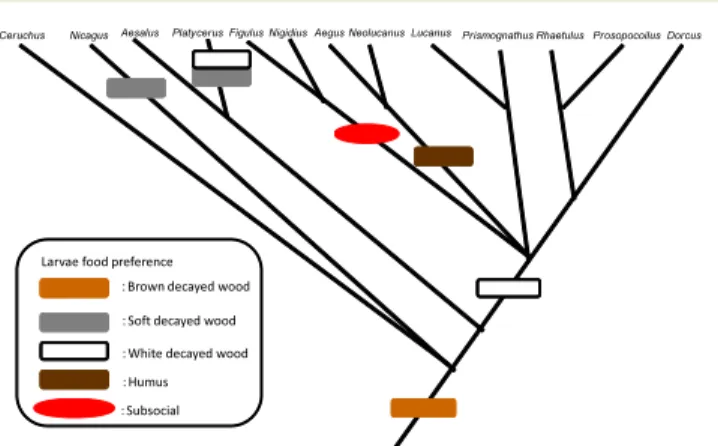
Research contents:Lucanid larvae show various
food preferences in woody materials (Figure 1).
On the other hand, the larvae have also various
body shapes especially in abdominal part
correlating with the morphology of digestive tract
inside (Figure 2).
In order to reveal evolution of food preference
and morphology of digestive tract in lucanid
larvae, I compare morphology of digestive tract
parts such as midgut and hindgut, digestive
enzyme systems for woody polysaccharides and
nitrogen fixation using larvae collected from
various diet habitats in the field.
Fig. 1 Phylogeny of Japanese stag beetles and the evolution of larval food preference (after Araya, 2005).
Name: Kazumasa Shirai
Affiliation: Graduate School of System of Life
Sciences, Kyushu University
“Evolutionary rates in the Cichlid Fishes of the Three Great Lakes in East Africa”
Many endemic cichlid species have evolved in
Lakes Victoria, Tanganyika and Malawi, and their
evolution has been affected by the history of each
lake. I estimated molecular evolutionary rates at
nuclear and mitochondrial protein coding genes in
cichlids of the three lakes using the maximum
likelihood method. My research revealed that
cichlids in Lake Victoria had significantly higher
molecular evolutionary rates than cichlids in the
other lakes at mitochondrial loci (Fig).
Now I’m examining the molecular evolution
of cichlids in Lake Victoria based on the
theoretical approach.
Name: Kenichi Shinozuka
Affiliation: Laboratory of Ecohydrology Kyushu
University Forest
“The effects of atmospheric nitrogen deposition on the nitrogen cycle in the areas around the Hakata basin”
In my master’s thesis, I evaluated the influence of
nitrogen load of the paddy field on a small river in
the Noto Peninsula. I found the nitrogen
concentration of the river was higher in the
agricultural off-season than that in the on-season.
My result also suggested that the nitrogen input in
the upper river basin is important as well as the
influence of a dam located upstream and should
be evaluated. The nitrogen concentration of
rainfall rises in winter on the Sea of Japan side,
and the highly concentrated nitrogen transported
from the continent seems as an important source.
Usually, the forests act as a sink of nitrogen.
However, well developed forest canopy has quite
larger surface area, e.g. 8-16m2/m2, in
comparison with other land cover and is expected
to capture atmospheric deposition efficiently. With
the increase of atmospheric nitrogen deposition,
the role of forest in the nitrogen cycle might be
change from sink to source. Previous research
suggested that the nitrogen retention capacity of
the old plantation is decreasing and the nitrogen
load from the forest areas is increasing. So I plan
to evaluate the effects of atmospheric nitrogen
deposition on the Tatara River. In order to identify
the source of nitrogen, various isotope analyses
will be applied.
Seminar Report:
9
thGCOE International Seminar, 10 April,
2012
Lina Kawaguchi
We invited Dr. Margaret Mayfiled (The University
of Queensland, Australia) for the first GCOE
International Seminar in this 2012/2013 academic
use change impacts species and functional
diversity: lessons from Australian and Pacific
island plant communities”. She presented a
conceptual model of how species and functional
diversity are expected to respond to land use
change and empirical results from plant
communities in Australia and the Solomon
Islands. Then she discussed the role of species
composition, abiotic factors and biogeography in
driving patterns of diversity in novel communities
and the types of communities likely (and unlikely)
to recover unassisted following major land use
change. Her researches would have important
implications for setting conservation priorities and
for deciding whether active restoration is needed
for a degraded system.
In the afternoon session of this seminar,
GCOE staffs introduced our research activities in
each core site: “Harmonizing development with
conservation: A challenge of Kyushu University in
a new campus” (Dr. Tetsukazu Yahara), “Plant
species richness, phylogenetic diversity and
functional diversity of Yakushima island” (Dr.
Yusuke Onoda), “Evaluation of biodiversity in
Cambodia” (Dr. Hironori Toyama), “Land use
change and freshwater fish diversity in East and
Southeast Asia” (Dr. Yuichi Kano). We also had
one more speaker: Dr. Akira Mori from Yokohama
National University. Dr. Mori introduced his work
on beta diversity in Shiretoko peninsula,
Hokkaido.
Approximately 25 people, including SRAs of
GCOE program, attended this seminar. Speakers
and audiences had fruitful discussions for all
topics.
Other Recent Activities
■
Field course
Cambodia field trip
Dr.Tsuyoshi Kajisa organized a field trip in
Cambodia from 7 to 23 May 2012. Trainees were
Mr. Tatsuya Mishima, Mr. Keniichi Shinozuka, Mr.
Kazuki Tagawa, and Mr. Meng Zhang. Other
attendees were Dr. Tetsukazu Yahara, Dr.
Fumiko Iwanaga, Dr. Shingo Hosoishi, Dr.
Shuichiro Tagane, Dr. Hironori Toyama, Dr.
Tsuyoshi Kajisa (Kyushu Univ.), Dr. Hidetoshi
Nagamasu and Dr. Ryo Tsujino (Kyoto Univ.).
Yakushima field trip
Dr. Yusuke Onoda and Dr. Shingo Hosoishi
organized a field course in Yakushima from 22 to
27 May.
■
Symposium, Meeting & Seminar
Dr. Tetsukazu Yahara had an introduction presentation: "Kyushu University projects fro
biodiversity conservation and sustainable forestry
in Cambodia" at a stakeholder meeting on
hydrology and water resource
(http://aqua.t.u-tokyo.ac.jp/REEL/project/safe/SA
FE_20110607.pdf) on 4th May. Dr. Tetsukazu
Yahara, Dr. Fumiko Iwanaga and Dr. Tsuyoshi
Kajisa visited GCOE experimental plots in Kg.
Chhnang province to introduce our activities to Dr
Toshio Koike’s research group (Tokyo Univ.),
and their study site in Pursat, Battanbang, Siem
Reap province to know the overview of their
researches related to meteo-hydrological
measurements.
■
Publications
Ng WL & Chan HT (2012) Further observations on a natural Rhizophora hybrid population in
Malaysia. ISME/GLOMIS Electronic Journal
10(1): 1-3
Ng WL & Chan HT (2012) Survey of Rhizophora stylosa populations in Peninsular10(2): 4-6
Murakami-Sugihara N, Furota T & Okamoto K (2012) Genetic structure of the exotic hardclam Mercenaria mercenaria in Tokyo Bay,
determined using mitochondrial DNA.
Fisheries Science 78(3): 569-575
Kaifu K, Miyazaki S, Aoyama J & Tsukamoto K (in press) Diet of Japanese eels Anguilla
japonica in the Kojima Bay-Asahi River system,
Japan. Environmental Biology of Fishes *This
study got mentioned on NHK’s program and
Osaka edition of Asahi Shimbun.
小島秀彰・海部健三・横内一樹・須藤竜介・吉
田丈人・塚本勝巳・鷲谷いづみ (In press) 「福
井 県 三 方 五 湖 ‐ 早 瀬 川 水 系 に お け る ニ ホ ン ウ
ナギ Anguilla japonica 生息状況の歴史的変遷
について」動物考古学
■
Others
Dr. Kazumi Tsukamoto gave his talk as one of the six keynote speakers at The 6th World
Fisheries Congress (7-11 May 2012,
Edinburgh, UK).
Dr. Kenzo Kaifu won the joint second prize of early career poster award at The 6th World
Fisheries Congress (7-11 May 2012,
Edinburgh, UK). The title of his poster
presentation was “Historical changes of
Japanese eel distribution in Japan revealed by
multidisciplinary approach” (authors: Kaifu K,
Miyazaki S, Aoyama J & Tsukamoto K).
Dr. Yukihiro Shimatani and Dr. Yuichi Kano visited China from 18 to 28 April 2012. They
had a meeting with the local government and
conducted taxonomic surveys on fresh water
fishes (Acheilognathus and Rhinogobius).
Upcoming Events
■
Symposium, Meeting & Seminar
Dr. Tetsukazu Yahara and Dr. Makiko Mimurawill attend DIVERSITAS bioGENESIS
scientific committee meeting (15-18 June 2012,
Bonito, Brazil)