advertise conspecifics in proboscis monkeys
A uthor(s )
K oda, Hiroki; Murai, T adahiro; T uuga, A ugustine; Goossens,
B enoit; Nathan, S enthilvel K .S .S .; S tark, D anica J .; R amirez,
D iana A . R .; S ha, J ohn C . M.; Osman, Ismon; S ipangkui, R osa;
S eino, S atoru; Matsuda, Ikki
C itation
S cience A dvances (2018), 4(2)
Is s ue D ate
2018-02-21
UR L
http://hdl.handle.net/2433/229414
R ig ht
©
2018 T he A uthors, some rights reserved; exclusive licensee
A merican A ssociation for the A dvancement of S cience. No
claim to original U.S . Government W orks. D istributed under a
C reative C ommons A ttribution NonC ommercial L icense 4.0
(C C B Y -NC ).
T ype
J ournal A rticle
E V O L U T I O N A R Y B I O L O G Y Copyright © 2018 The Authors, some rights reserved; exclusive licensee American Association for the Advancement of Science. No claim to original U.S. Government Works. Distributed under a Creative Commons Attribution NonCommercial License 4.0 (CC BY-NC).
Nasalization by
Nasalis larvatus
: Larger noses audiovisually
advertise conspecifics in proboscis monkeys
Hiroki Koda,1* Tadahiro Murai,1Augustine Tuuga,2Benoit Goossens,2,3,4,5
Senthilvel K.S.S. Nathan,2Danica J. Stark,3,4Diana A. R. Ramirez,2,3John C. M. Sha,6 Ismon Osman,7Rosa Sipangkui,2 Satoru Seino,8 Ikki Matsuda9,10,11,12*
Male proboscis monkeys have uniquely enlarged noses that are prominent adornments, which may have evolved through their sexually competitive harem group social system. Nevertheless, the ecological roles of the signals en-coded by enlarged noses remain unclear. We found significant correlations among nose, body, and testis sizes and a clear link between nose size and number of harem females. Therefore, there is evidence supporting both male-male competition and female choice as causal factors in the evolution of enlarged male noses. We also observed that nasal enlargement systematically modifies the resonance properties of male vocalizations, which probably encode male quality. Our results indicate that the audiovisual contributions of enlarged male noses serve as advertisements to females in their mate selection. This is the first primate research to evaluate the evolutionary processes involved in linking morphology, acoustics, and socioecology with unique masculine characteristics.
INTRODUCTION
Exaggerated male traits may have evolved as a consequence of sexual selection (1). This is no exception for primate lineages, including us humans. The males of several primate species have prominent morpho-logical adornments with marked sexual dimorphism (2). Facial colora-tion in mandrills (Mandrillus sphinx), cheek flanges in orangutans (Pongo pygmaeus), capes of white and silvery-gray hair in hamadryas baboons (Papio hamadryas), reddened chests in geladas (Theropithecus gelada), upper-lip warts in golden snub-nosed monkeys (Rhinopithecus roxellana), and beards in humans are all primate examples of male adornments. These specialized features play important roles in male-female and/or male-male communications. In primates, they serve as sex-ual signals for potential conspecific partners or rivals; however, the evolutionary causations differ among species. Theoretically, these exag-gerated male traits could serve one or both of the following two major
functions: as a“badge of male social status”(advertising competitive
potential with respect to other males) and/or as partner attraction signals [ultimately determined by female choice (3)]. Male adornments would convey sexual quality signals as a badge of status in a sexually
competitive society that probably advertise a male’s social status widely
to other rival males, thereby possibly avoiding critically fatal encounters. Mandrills provide a possible example of a badge of status trait. Adult mandrills show secondary sexual adornments, the signal strengths of
which differ depending on a male’s gains/loss of alpha social rank (2).
In contrast, male adornments could sometimes be carefully evaluated by females in their selection of appropriate partners and their decision to belong to a particular social group. The classical experiments on the extremely long tails of male window birds (Euplectes) clearly showed
that female preference is determined by the degree of tail length, empir-ically indicating the role of female choice in the evolution of male adorn-ments (4). Thus, both male-male competition and female choice could complexly shape the development of odd male characteristics. Of par-ticular importance in social animals such as primates is the remarkable correlation between sexual dimorphism and their social systems. Greater sexual dimorphism is often shown in primates living in more sexually competitive social systems, such as polygynous single male societies (ha-rem group). Thus, together with their unique social systems, the degree to which competition allows males to monopolize access to females, that is, male-male competition, female choice, or a combination of the two, probably determines both morphological and behavioral male charac-teristics and reliably indicates male sexual qualities (5). However, the evolutionary mechanisms underlying the development of male sexual adornments have remained inadequately explained primarily because of the difficulty of devising empirical approaches for the study of evo-lutionary phenomena.
Proboscis monkeys (Nasalis larvatus) are a typical example of a sex-ually dimorphic and primarily arboreal primate with a well-developed male adornment, namely, a conspicuous large nose. Among primates, larger noses with prominent sexual dimorphism are only seen in this species. Their characteristically large sexual dimorphisms in body mass may be caused by the sexually competitive nature in proboscis monkeys,
associated with their unique social system (6,7), in which smaller levels
of stable social organization (the harem group) aggregate into larger units, suggestive of a multilevel social system (8). Presumably, enlarged noses would be strongly exposed to sexual selection and are visually sa-lient cues to both males and females. Unlike in canines, however, in
pro-boscis monkeys, the enlarged nose does not serve as a“weapon,”and so
its true function is unclear. As simply predicted, it may have evolved in response to female preference for males with larger noses, which serve as an honest signal expressing male sexual quality or as a badge of social status (as in mandrills) advertised to conspecific neighbors during daily interactions within their habitat. Given their large sexual dimorphisms in body mass and their unique social system, we thus expect that sexual selection pressure plausibly shapes the sexual strategies of proboscis monkeys in a specialized way, that is, nose enlargement.
Nevertheless, thus far, the roles of the enlarged male nose have not been examined because of the difficulty in evaluating nose morphology 1Primate Research Institute, Kyoto University, Inuyama, Aichi 484-8506, Japan.2Sabah
Wildlife Department, Sabah, Malaysia.3Danau Girang Field Centre, Sabah Wildlife
De-partment, Sabah, Malaysia.4Organisms and Environment Division, Cardiff School of
Biosciences, Cardiff University, Cardiff, UK.5Sustainable Places Research Institute,
Car-diff University, CarCar-diff, UK.6School of Sociology and Anthropology, Sun Yat-sen
Univer-sity, Guangzhou, China.7Singapore Zoo, Wildlife Reserves Singapore, Singapore,
Singapore.8Zoorasia, Yokohama Zoological Gardens, Yokohama, Japan.9Chubu
University Academy of Emerging Sciences, 1200 Matsumoto-cho, Kasugai-shi, Aichi 487-8501, Japan.10Wildlife Research Center of Kyoto University, Kyoto, Japan.11Japan
Monkey Centre, Inuyama, Japan.12Institute for Tropical Biology and Conservation,
Uni-versiti Malaysia, Sabah, Malaysia.
*Corresponding author. Email: [email protected] (H.K.); ikki-matsuda@ isc.chubu.ac.jp (I.M.)
on February 25, 2018
http://advances.sciencemag.org/
and cognitive features in the wild. A direct way to evaluate the signal role of this adornment on sexual selection is to perform experiments such as those used to study female choice in window birds (4); however, it is not possible to apply these methods to investigate primate sexual strategies. An alternative approach has been to accumulate as much evidence as possible using multidimensional approaches. In mandrills, for example, physiological, morphological, behavioral, and socioecological field ob-servations have revealed that male facial colorations parallel testis vol-ume and social rank, suggesting that their adornment evolved as a badge of status (9). Likewise, morphological, acoustical, and social system
comparisons of howler monkey species (Alouattaspp.) have recently
indicated the trade-off between pre- and postcopulatory investments on male trait development, suggesting that the extraordinary size of the hyoid bone might have evolved as a result of female choice, partic-ularly within the context of harem groups, where intermale sexual com-petition is high (10). Thus, multidimensional approaches would be appropriate to test the theory of intra/intersexual selection of male or-naments in proboscis monkeys.
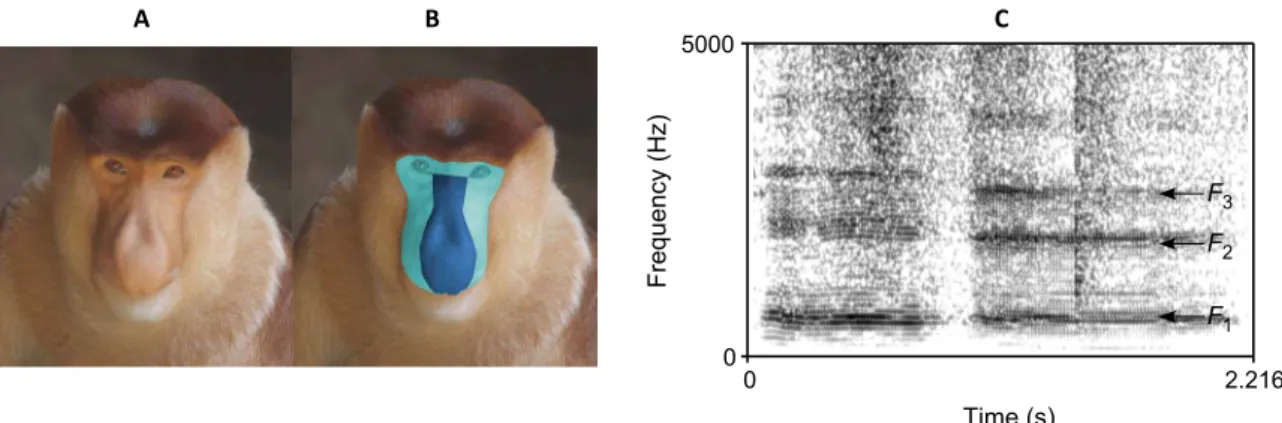
Here, we investigated the information encoded in the enlarged male nose to determine whether it contributes to sexual advertisement for male and/or females in both wild and captive males. To this end, we un-dertook morphological measurements of nose size, testis volume, and body size, evaluated harem group structures, and performed acoustical analysis of their nasalized male-specific vocalizations (Fig. 1).
Morpho-logical and social structure analysis could potentially reveal what“
qual-ity”enlarged noses advertise to rival males as well as partner females. To
date, there have been no empirical observations on the nose morphol-ogy, sexual quality, and social status success of proboscis monkeys, al-though Darwinian evolutionary theory would predict significant
interactions among these traits (2,8,11). Thus, we simultaneously
as-sessed the possible signals exposed to female choice, namely, a male-specific vocalization. Undoubtedly, females assess male qualities not only by nose size but also by other means such as vocalizations (12–14). In several mammalian species, including red deer, koalas, and giant pandas, females prefer certain male acoustic traits strongly coupled with body size cues, which suggests female choice for male
vocalizations as honest signals (10,15–19). The long-distance
vocal-izations in male howler monkeys, which is a recent example, may have specifically evolved to attract females. Their hyoid bones act as a vocal resonator to transmit their body size as a male sexual quality embedded in their long-distance calls, which would be an acoustic honest signal to
be preferentially selected by female choice (10). In this regard, a key acoustic property is resonance comprising formants, which are the
fre-quencies produced by the supraglottal vocal tract areas (20–23). In
animals, there is a significant correlation between body size and mor-phological features such as vocal resonators. These are used in vowel
discriminations as primary acoustic cues in human speech (20,23,
24). Male proboscis monkeys use“nasalized”long vocalizations,
re-ferred to as“brays”(25), and the nasal cavity can modify the resonance
properties to encode male nasal enlargement in a manner similar to hu-man nasalized vowels (26). An enlarged nose would multimodally con-vey male qualities in the form of resonance properties determined by the vocal tract and the nasal cavity. This study accordingly represents the first attempt to integrate multidimensional assessments of nose en-largements and thereby makes a practical contribution to studies of the evolution of the proboscis odd nose.
RESULTS AND DISCUSSION
We measured body mass, nose size, and testis volume in 18 free-ranging males and found significant correlations among the three parameters. A best-fit statistical model predicting proboscis monkey nose size included both body mass and testis volume and showed positive correlations [co-efficient and SE: 14.8 ± 5.09 (for body mass) and 0.44 ± 0.18 (for testis
volume),R2= 0.47, adjustedR2= 0.40,F= 6.67,P= 0.008; Fig. 2, A and
B]. The change in corrected version of the Akaike information criterion
for small sample size [DAIC(c)] value of the next model was >2.0 (see
table S1 for details). These findings suggest that nose enlargement is a reliable predictor of masculine characters typically associated with social dominance or high sperm counts. Recent frameworks of a trade-off
be-tween investments in pre- and postcopulatory traits in primates (10,27)
do not apply well to proboscis monkeys, that is, positive correlation be-tween pre- (nose size) and postcopulatory (testis volume) traits, or to certain other species, such as the coupling of facial coloration with testis size in mandrills (28). The reason for this discrepancy may be that trade-off phenomena are theoretically based on interspecies comparisons, where pre- and postcopulatory male traits among the closely related species are analyzed with a consideration of social and mating systems (for example, degree of female monopolization). However, the studies on proboscis monkeys and mandrills are focused on analyses within a single species. Little is known about intraspecific variation in testis size in primates, although our findings suggest that sperm competition
Time (s)
0 2.216
0 5000
Frequency (Hz)
F1
F2
F3
Fig. 1. Facial and vocal characteristics in a proboscis monkey male.Examples of (A) a male proboscis monkey face, (B) nasal/facial areas, and (C) sound spectro-gram of long calls. For (B), the areas shaded by light green and dark blue are facial and nasal areas, respectively. For (C), two sequential vocalizations were included (sounds are available online), and the arrows represent the positions of the three formant frequencies.
on February 25, 2018
http://advances.sciencemag.org/
occurs within the species as theoretically predicted. Larger testes pro-duce more sperm than small testes and thus may provide a selective advantage associated with multiple inseminations and sperm
competi-tion (29). In proboscis monkeys, harem groups (and all-male groups in some cases) assemble with each other on a regular basis at their sleeping sites, and female dispersal among the harem groups is a typical pattern
56 58 60 62 64
2.70 2.75 2.80 2.85 2.90 2.95
Body mass (3kg, cube root)
Nose siz
e (mm, square root)
57.5 60.0 62.5
16 18 20 22 24
Testis volume (mm, cube root)
Nose siz
e (mm, square root)
B A
0.0 2.5 5.0 7.5 10.0
0.45 0.50 0.55 0.60 0.65 0.70
N/F ratios(square root)
# F
e
males per a group
C
0.45 0.50 0.55 0.60 0.65 0.70
2.3 2.4 2.5 2.6 2.7 2.8
Body mass (3kg, cube root)
N/F r
a
tios (square root)
D
800 1000 1200 1400
2.4 2.6 2.8
Body mass (3kg, cube root)
F
o
rm
ant dispersions (Hz)
E
3 4 5
0.45 0.50 0.55 0.60 0.65 0.70
N/F ratios (square root)
F3 F1
F
Fig. 2. Significant correlations between body mass, facial characteristics, testicular volume, vocalizations, and number of harem females in proboscis monkeys.Bivariate plots representing the correlations between (A) the cube roots of the body mass and the square roots of the nose-to-face (N/F) ratios and (B) the testis sizes of the 18 wild males. Blue lines and shaded areas represent the linear regressions estimated by the“lm”method in R for the observed samples and their 95% confidence interval ranges, respectively. (C) Plots of the number of females belonging to eight harem groups, with theN/Fratios of the core males in the group (circles). The triangle represents theN/Fratio of one male of an all-male group (see main text for a detailed description). (D) Plots representing the correlations between the cube roots of the body mass and the square roots of theN/Fratios of the six captive males. (E) Box plot of the formant dispersion parameters (Dfs) with the body masses of six captive males. (F) Box plot ofF3/F1
parameters with theN/Fratios of seven captive males. Box plots represent the medians (horizontal bold lines), 25th and 75th percentiles (bottom and top of the box), and the 1.5× interquartile ranges (whiskers). All observed data were plotted with jitter effects on thexaxis.
on February 25, 2018
http://advances.sciencemag.org/
(30,31) [suggestive of a multilevel social system (6,7)], potentially in-dicating the possibility of the high male-male competition for females. Thus, the high levels of sexual competition could promote the evolution of both pre- and postcopulatory male traits.
To understand the potential influence of female selection on male nose size, we attempted to correlate the numbers of adult females per
wild harem group with the degree of nasal enlargement (N/Fratios; see
Materials and Methods for details) in the core males. We found that the
number of females (n= 8, mean = 5.0, SD = 2.9, range = 2 to 10) was
positively correlated with theN/Fratio (r= 0.91,P= 0.001; Fig. 2C).
Furthermore, we noted that the nose size of the largest male in an all-male group consisting of 27 to 30 all-males (32) was considerably smaller than that of harem males (that is, 0.21 versus 0.44 ± SD: 0.05), suggest-ing that the male nose functions as a badge of status for the core males in harem groups. These results imply that larger male noses play a role in both female attraction and male-male competition, advertising group-holding status in wild populations, similar to the facial coloration in mandrills (33), male lip color in snub-nosed monkeys (11), and chest color in geladas (34).
Next, we investigated other masculine signals such as audiovisual characteristics by analyzing facial photographs and recording vocaliza-tions in seven captive males (see Materials and Methods for details). On the basis of facial analyses of the captive males, we identified two nasal
enlargement groups (see fig. S1 for facial images): full adults [meanN/F
ratio = 0.47 (SD = 0.03)] and young adults [meanN/Fratio = 0.22 (SD =
0.03)]. In addition, theN/Fratio in each of the six males was
signifi-cantly and positively correlated with body mass (rs= 0.886,P= 0.033;
Fig. 2D). Therefore, theN/Fratio is a reliable indicator of male body
size. This finding is consistent with the analyses of the wild males. We obtained 104 analyzable loud calls (brays) from seven males (range, 5 to 40 calls; median, 11.5 calls; see table S2 for details). A comparison of the generalized linear mixed model (GLMM) revealed that the formant dispersion parameters (see Materials and Methods for details) were bet-ter explained by the model that included the body mass than the null model [body mass model, AIC(c) = 2015.5; null model, AIC(c) = 2036.0; Fig. 2E, but see table S3 for details]. Formant dispersion param-eters are precise predictors of vocal tract length and may be strongly correlated with body mass in many mammals. We then analyzed the
F3/F1ratios (the ratio of the first formant to the third formant; see
Materials and Methods for details), which are, in theory, independent of vocal tract length but may be influenced by vocal tract shape. Vocal
tract lengths andF3/F1ratios are, in theory, independent of each other.
This study, however, indicated that theF3/F1ratios were probably
correlated with theN/Fratios (Fig. 2F). When we compared the
GLMM that included theN/Fratio with the null model, we found
that the former showed a better fit than the latter [N/Fratio model,
AIC(c) = 100.3; null model, AIC(c) = 103.3; Fig. 2F, but see table S4
for details]. Therefore,F3/F1ratios may encode nasal enlargement
information.
To our knowledge, this is the first evidence of significant correlations among body mass, facial characteristics, testis volumes, and vocaliza-tions in primate lineages. The relative size of an enlarged nose would act as an advertisement signal for conspecific male rivals and an inform-ative visual signal for the recognition of male qualities, such as physical strength (body mass) and reproductive ability (testis size), by females. Androgen (testosterone) levels would primarily determine the traits re-flecting male social status and quality and accentuate the variations
be-tween individual males. Therefore, theN/Fratio is a robust and reliable
signal for rapid evaluation of male status and quality. Given that the
nose size of the core male in harem groups is likely to be larger than that of males in all-male groups, nose enlargement would serve as a badge of status that may directly deter other rival males from attacking or gain access to harem groups. The interactions between harem groups and between harem and all-male groups are relatively peaceful without
any evidence of direct fighting in general (7,32). Male nose size would
be much more evident to females than other masculine traits for partner attraction and may confer a selective advantage in contests between males for access to females, although further longitudinal field demographic data would be necessary to clarify the mating success of males with dif-ferent nose size in terms of the possible effects on their social status (for example, dominance rank).
Acoustic cues (formants) may contribute to female mate selection. A novelty of our findings is the duality of formants as sexual advertise-ment cues. Formant dispersion parameters are indicative of body mass
and are, in theory, mediated by vocal tract length. In contrast, theF3/F1
ratios represent nose size. Because the nasal cavity acts as an antireso-nance filter, nose size overrides body mass as a cue for other masculine traits and could be selected in parallel by females. Vocalizations would transmit sexual signals more effectively than visual cues in a dense rain-forest with poor visibility (5). In these habitats, obstructions limit visual conspecific recognition, whereas vocalizations are transmitted over a long range (that is, ca. 100 to 200 m depending on forest conditions based on our field experience) to ensure effective communications among group members rarely moving >50 m away from the core male of harem groups (35). Therefore, male vocalizations may be a truer re-presentation of male quality than visual cues, and the former could more effectively help to ensure offspring survival than the latter. This phenom-enon has been demonstrated in other animals (12), even though formant structures are by-products of enlarged noses. As a result, nasal enlarge-ments, which may initially have evolved as a visual badge of status sex-ual trait, are multimodally subjected to female selection.
Collectively, all evidence here supports the strong sexual selection on enlargement of nose size in relation to the unique social systems of pro-boscis monkeys. Although they form harem groups, there is surprisingly no evidence of strong male-male antagonistic interactions with core-male replacements or infanticide in proboscis monkeys within their natural habitat (32), which, in contrast, is commonly observed in pri-mates forming sexually highly competitive societies, particularly ha-rem groups, as in the cases of howler monkeys and langurs (36).
Their“peaceful”social system can plausibly be explained by the flexible
group organization in the multilevel society of proboscis monkeys at their sleeping trees. Because the sleeping sites of harem groups are often closely located within 50 m, with occasional occurrences of sharing the same tree (35), showing their badge of social status may lessen male-male physical antagonistic interactions, thereby avoiding seriously wounding each other. In addition, adult females seemingly often transfer from one
harem to another, sometimes with a newborn infant (30,31), and thus,
core males in harem groups may not be able to maintain stable rela-tionships with females over a long period. Consequently, these high rates of female migration would inhibit the risk of infanticide. Without any direct battle for female guarding, larger noses as male adornments would ecologically act as signals strongly audiovisually exposed to fe-male choice.
This study may shed light on the hypothesis of audiovisual co-evolution of exaggerated male traits in primate lineages and provide fur-ther evidence for the evolutionary pathway of enlarged noses in proboscis monkeys. However, we should acknowledge the current re-search limitation. Our promising observations strongly suggest sexual
on February 25, 2018
http://advances.sciencemag.org/
selection, although all were based on indirect correlations and thus must be regarded as potentially biased. Without direct experimentation, it is difficult to conclude from our study whether the secondary sexual trait of males (enlarged noses) is solely a badge of status, solely a sexually attractive signal, or some combination of the two possibilities. More detailed studies are definitely required to assess the cognition of male reactions or female preferences for enlarged noses and to determine how the enlarged male nose ecologically contributes to mating success in the unique social system of proboscis monkeys.
MATERIALS AND METHODS
Measuring body characteristics in free-ranging proboscis monkeys
Between July 2011 and December 2015, we captured 18 free-ranging adult male proboscis monkeys in the lower Kinabatangan area, Sabah,
Borneo, Malaysia (5°18′N to 5°42′N and 117°54′E to 18°33′E), as
de-scribed in detail in the methods and ethical statement of Starket al. (37).
We recorded body mass, nose size (length × width), and testis volume
(using the formula for a regular ellipsoidV= 1/6 ×pW2L, whereWis
the average width of both testes andLis the length of the longer testis).
A linear model was used to establish whether the nose size was related to other physical properties such as body mass and testis volume. Nose
sizes were square root–transformed, and the other factors were cube
root–transformed to generate response and explanatory variables,
re-spectively. In theory, nose size and body mass should be proportional to the square and cube of a linear dimension, respectively. The variance inflation factors were 1.18 for body mass and 1.01 for testis volume, which were less than the cutoff value, that is, 10 (38); therefore, colli-nearity among independent factors did not affect the results. We examined a set of models accounting for all possible combinations of the explanatory variables and ranked them using the AIC(c) (39). Following guidelines published for wildlife research, we selected the
models withDAIC(c)≤2, whereDAIC(c) = AIC(c)−minimum AIC
(c) within the candidate model set (39).
Adult female enumeration and male nose size evaluation in free-ranging proboscis monkeys
Between January 2000 and March 2001, and again between May 2005 and 2006, we observed proboscis monkeys along a tributary of the
Kinabatangan River (118°30′E, 5°30′N). We identified eight harem
groups totaling 45 adults, 12 subadults, 30 juveniles, and 41 infants (30,31), and thus, the exact number of adult females in each group was determined. Male noses were measured while the monkeys were being observed. To evaluate the extent of nose enlargements, we took photo-graphs of the frontal facial views of each male. Images were digitized at
the pixel resolution level. The pixel sizes of the facial areas (Sface)
(defined as the areas of bare facial skin) and those of the nasal areas
(Snose) (defined as the areas of the noses) were calculated using the
pictures. The facial areas were defined as the facial beard skin area sur-rounded by the circulate boundary edge between the bare skin and the facial fur (see Fig. 1, A and B). The nasal areas were defined as the facial regions bounded by the two eye base corners and the nasal lines (see Fig.
1, A and B). TheN/Fratio is defined asSnose/Sface. We used GNU Image
Manipulation Program (GIMP) v. 2.8 (available from The GIMP Team, www.gimp.org) for pixel scaling. We performed a simple correlation analysis of the number of adult females per harem group and square
root–transformed theN/Fratios for eight subjects using Pearson’s
product-moment correlation coefficients.
Male call characteristics
Between May and September 2014, we recorded proboscis monkey vo-calizations in the exhibition and/or backyard areas at three different zoos using a Roland Edirol R05 solid state recorder (Roland Corp.) con-nected to Sony ECM-674 microphones (Sony Corp.). We used a sampling rate of 48 kHz and a 16-bit resolution. We took facial photo-graphs and recorded the vocalizations of seven captive male monkeys (see table S2). We were unable to measure the body mass of one young male in the Lok Kawi Wildlife Park. For the body mass analysis, we used
six monkeys, whereas theN/Fratios and vocalizations were determined
for seven monkeys. In our recordings, we focused on the“brays,”which
are loud male calls (hereafter,“loud call”) that are typically heard in the
vocal exchanges among group members and possibly between groups (25). Only loud calls recorded with no sound clipping and high signal-to-noise ratios were used. They were analyzed using Praat v. 5.3.52 software (avail-able from Paul Boersma and David Weenink, www.praat.org). For the resonance properties of individual vocalizations, we measured the first,
second, and third formant frequencies using Burg’s algorithm in Praat
(maximum number of formants = 4, maximum formants = 4500 or 5000 Hz, window length = 0.025 s, preemphasis = 50 Hz). We calculated
the formant dispersion parameters (Df) and theF3/F1ratios. TheDfis the
average distance between each adjacent pair of formants and is calculated
asDf= {(F3−F2) + (F2−F1)}2, whereDfis the formant dispersion, and
F1,F2, andF3are the first, second, and third formant frequencies,
respec-tively. Theoretically, the formant frequencies produced by the mammalian
vocal tract are given byFi= (2i−1) ×c/4L, wherei= 1, 2, 3…,Lis the vocal
tract length, andcis the speed of sound. Therefore,Dfis represented as
c/2Land is negatively correlated with the vocal tract length. This
formula has been commonly used to evaluate resonance properties in
nonhuman mammalian vocalizations (40). In contrast,F3/F1should, in
theory, always be ~5 [that is, (5 ×c/4L)/(c/4L)] and independent of vocal
tract length. In practice, however, variations inF3/F1could be caused by
fluctuations in vocal tract shape. Therefore,F3/F1would most probably
reflect these shapes, which are determined by the topological
configura-tions formed by the larynx, tongue, lips, and nasal cavity. Using Spearman’s
method, we initially validated the correlations between body mass andN/F
ratios for six subjects to ensure consistent results in our field subjects. GLMMs including the body mass alone were then constructed and
com-pared with the null models forDfs in the six males. GLMMs including the
N/Fratio alone were compared with the null models forF3/F1ratios in
the seven males. The body masses and theN/Fratios were cube root–
and square root–transformed, respectively. All procedures were
ap-proved by the institutional zoo committees and were conducted in accordance with national guidelines or legal requirements.
SUPPLEMENTARY MATERIALS
Supplementary material for this article is available at http://advances.sciencemag.org/cgi/ content/full/4/2/eaaq0250/DC1
table S1. AIC(c) selection of the linear models accounting for theN/Fratios using the“lm”and
“degrade”functions in the“MuMIn”packages of R. table S2. List of subject information.
table S3. AIC(c) comparisons of the GLMMs accounting forDfs with and without body mass, using the“lmer,” “lme4,”and“degrade”functions in the“MuMIn”packages of R. table S4. AIC(c) comparisons of the GLMMs accounting for theF3/F1ratios with and without theN/F
ratios using the“lmer,” “lme4,”and“degrade”functions in the“MuMIn”packages of R. fig. S1. Photographs of captive monkeys.
REFERENCES AND NOTES
1. C. Darwin,The Descent of Man, and Selection in Relation to Sex(John Murray, 1871). 2. A. F. Dixson,Primate Sexuality(Oxford Univ. Press, ed. 2, 2012).
on February 25, 2018
http://advances.sciencemag.org/
3. M. Andersson,Sexual Selection(Princeton Univ. Press, 1994).
4. M. Andersson, Female choice selects for extreme tail length in a widowbird.Nature299, 818–820 (1982).
5. J. W. Bradbury, S. Vehrencamp,Principles of Animal Communication(Sinauer Associates, 1998). 6. C. P. Yeager, Proboscis monkey (Nasalis larvatus) social organization: Intergroup patterns
of association.Am. J. Primatol.23, 73–86 (1991).
7. I. Matsuda, T. Kubo, A. Tuuga, S. Higashi, A Bayesian analysis of the temporal change of local density of proboscis monkeys: Implications for environmental effects on a multilevel society.Am. J. Phys. Anthropol.142, 235–245 (2010).
8. C. C. Grueter, C. P. van Schaik, Sexual size dimorphism in Asian colobines revisited.
Am. J. Primatol.71, 609–616 (2009).
9. A. F. Dixson,The Mandrill: A Case of Extreme Sexual Selection(Cambridge Univ. Press, 2015).
10. J. C. Dunn, L. B. Halenar, T. G. Davies, J. Cristobal-Azkarate, D. Reby, D. Sykes, S. Dengg, W. T. Fitch, L. A. Knapp, Evolutionary trade-off between vocal tract and testes dimensions in howler monkeys.Curr. Biol.25, 2839–2844 (2015).
11. C. C. Grueter, P. Zhu, W. L. Allen, J. P. Higham, B. Ren, M. Li, Sexually selected lip colour indicates male group-holding status in the mating season in a multi-level primate society.R. Soc. Open Sci.2, 150490 (2015).
12. M. J. Ryan, Female mate choice in a neotropical frog.Science209, 523–525 (1980). 13. R. C. Taylor, M. J. Ryan, Interactions of multisensory components perceptually rescue
túngara frog mating signals.Science341, 273–274 (2013).
14. C. K. Catchpole, J. Dittami, B. Leisler, Differential responses to male song repertoires in female songbirds implanted with oestradiol.Nature312, 563–564 (1984).
15. B. D. Charlton, D. Reby, K. McComb, Female perception of size-related formant shifts in red deer,Cervus elaphus.Anim. Behav.74, 707–714 (2007).
16. B. D. Charlton, D. Reby, K. McComb, Female red deer prefer the roars of larger males.
Biol. Lett.3, 382–385 (2007).
17. W. T. Fitch, D. Reby, The descended larynx is not uniquely human.Proc. R. Soc. Biol. Sci. 268, 1669–1675 (2001).
18. B. D. Charlton, W. A. H. Ellis, J. Brumm, K. Nilsson, W. T. Fitch, Female koalas prefer bellows in which lower formants indicate larger males.Anim. Behav.84, 1565–1571 (2012). 19. D. Reby, K. McComb, B. Cargnelutti, C. Darwin, W. T. Fitch, T. Clutton-Brock, Red deer stags
use formants as assessment cues during intrasexual agonistic interactions.Proc. R. Soc. Biol. Sci.272, 941–947 (2005).
20. G. Fant,Acoustic Theory of Speech Production(Walter de Gruyter, 1970).
21. W. T. Fitch, The evolution of speech: A comparative review.Trends Cogn. Sci.4, 258–267 (2000). 22. W. T. Fitch,The Evolution of Language(Cambridge Univ. Press, 2010).
23. I. R. Titze,Principles of Voice Production(Prentice Hall, 1994).
24. T. Chiba, M. Kajiyama,The Vowel: Its Nature and Structure(Tokyo-Kaiseikan, 1941). 25. K. M. Röper, M. Scheumann, A. B. Wiechert, S. Nathan, B. Goossens, M. J. Owren,
E. Zimmermann, Vocal acoustics in the endangered proboscis monkey (Nasalis larvatus).
Am. J. Primatol.76, 192–201 (2014).
26. J. Dang, K. Honda, Acoustic characteristics of the human paranasal sinuses derived from transmission characteristic measurement and morphological observation.J. Acoust. Soc. Am. 100, 3374–3383 (1996).
27. S. Lüpold, J. L. Tomkins, L. W. Simmons, J. L. Fitzpatrick, Female monopolization mediates the relationship between pre- and postcopulatory sexual traits.Nat. Commun.5, 3184 (2014). 28. J. M. Setchell, A. F. Dixson, Changes in the secondary sexual adornments of male
mandrills (Mandrillus sphinx) are associated with gain and loss of alpha status.Horm. Behav.39, 177–184 (2001).
29. A. P. Møller, Ejaculate quality, testes size and sperm competition in primates.J. Hum. Evol. 17, 479–488 (1988).
30. T. Murai, M. Mohamed, H. Bernard, P. A. Mahedi, R. Saburi, S. Higashi, Female transfer between one-male groups of proboscis monkey (Nasalis larvatus).Primates48, 117–121 (2007).
31. I. Matsuda, A. Tuuga, H. Bernard, T. Furuichi, Inter-individual relationships in proboscis monkeys: A preliminary comparison with other non-human primates.Primates53, 13–23 (2012).
32. T. Murai, Social behaviors of all-male proboscis monkeys when joined by females.
Ecol. Res.19, 451–454 (2004).
33. J. M. Setchell, T. Smith, E. J. Wickings, L. A. Knapp, Social correlates of testosterone and ornamentation in male mandrills.Horm. Behav.54, 365–372 (2008).
34. T. J. Bergman, L. Ho, J. C. Beehner, Chest color and social status in male geladas (Theropithecus gelada).Int. J. Primatol.30, 791–806 (2009).
35. I. Matsuda, A. Tuuga, S. Higashi, Effects of water level on sleeping-site selection and inter-group association in proboscis monkeys: Why do they sleep alone inland on flooded days?Ecol. Res.25, 475–482 (2010).
36. T. Q. Bartlett, R. W. Sussman, J. M. Cheverud, Infant killing in primates: A review of observed cases with specific reference to the sexual selection hypothesis.Am. Anthropol. 95, 958–990 (1993).
37. D. J. Stark, I. P. Vaughan, D. A. Ramirez Saldivar, S. K. S. S. Nathan, B. Goossens, Evaluating methods for estimating home ranges using GPS collars: A comparison using proboscis monkeys (Nasalis larvatus).PLOS ONE12, e0174891 (2017).
38. G. P. Quinn, M. J. Keough,Experimental Design and Data Analysis for Biologists(Cambridge Univ. Press, 2002).
39. K. P. Burnham, D. R. Anderson,Model Selection and Multimodel Inference: A Practical Information-Theoretic Approach(Springer, Verlag, ed. 2, 2002).
40. W. T. Fitch, Vocal tract length and formant frequency dispersion correlate with body size in rhesus macaques.J. Acoust. Soc. Am.102, 1213–1222 (1997).
Acknowledgments:We thank the Singapore Zoo, the Yokohama Zoo, the Lok Kawi Wildlife Park, and our colleagues for their assistance, particularly A. Toyoda, T. Kubo, T. Nishimura, S. Luz, Asnih, and S. Higashi.Funding:Primate Origins of Human Evolution and Human Evolution Project of Primate Research Institute of Kyoto University, Japan Society for the Promotion of Science KAKENHI (#15K0030, #16H04848, and #16H02058 to H.K.; #15K14605 and #21770261 to I.M.), the National Geographic Society (#9254-13 to I.M.), the Wildlife Reserves Singapore (Exp14/10 to I.M.), the Inamori Foundation (to I.M.), Ono Acoustic Grant-in-aid (to H.K.), Yayasan Sime Darby (to B.G., S.K.S.S.N., D.A.R.R., and D.J.S.), Ministry of Education, Culture, Sports, Science and Technology Grant-in-aid for Scientific Research on Innovative Areas #4903 (Evolinguistic), 17H06380, and Japan Science and Technology Agency Core Research for Evolutional Science and Technology 17941861 (#JPMJCR17A4).Author contributions:H.K. and I.M. conceptualized the initial idea, recorded the vocalizations, performed and interpreted the statistical analysis, and drafted the manuscript; S.K.S.S.N., D.J.S., and D.A.R.R. performed the wild morphology sampling; I.M. and T.M. observed the wild groups; A.T., B.G., S.K.S.S.N., D.J.S., D.A.R.R., J.C.M.S., I.O., R.S., and S.S. arranged the sampling in the wild/zoo; H.K. performed the acoustic analyses; and I.M. organized the projects. All authors contributed to the final version of the manuscript. I.M. claims responsibility for all figures in the main text and the Supplementary Materials.Competing interests:The authors declare that they have no competing interests.
Data and materials availability:All data needed to evaluate the conclusions in the paper are present in the paper and/or the Supplementary Materials. Additional data related to this paper may be requested from the authors.
Submitted 22 September 2017 Accepted 23 January 2018 Published 21 February 2018 10.1126/sciadv.aaq0250
Citation:H. Koda, T. Murai, A. Tuuga, B. Goossens, S. KSS. Nathan, D. J. Stark, D. A. R. Ramirez, J. C. M. Sha, I. Osman, R. Sipangkui, S. Seino, I. Matsuda, Nasalization byNasalis larvatus: Larger noses audiovisually advertise conspecifics in proboscis monkeys.Sci. Adv.4, eaaq0250 (2018).
on February 25, 2018
http://advances.sciencemag.org/
Ramirez, John C. M. Sha, Ismon Osman, Rosa Sipangkui, Satoru Seino and Ikki Matsuda
Hiroki Koda, Tadahiro Murai, Augustine Tuuga, Benoit Goossens, Senthilvel K.S.S. Nathan, Danica J. Stark, Diana A. R.
DOI: 10.1126/sciadv.aaq0250 (2), eaaq0250.
4 Sci Adv
ARTICLE TOOLS http://advances.sciencemag.org/content/4/2/eaaq0250
MATERIALS
SUPPLEMENTARY http://advances.sciencemag.org/content/suppl/2018/02/16/4.2.eaaq0250.DC1
REFERENCES
http://advances.sciencemag.org/content/4/2/eaaq0250#BIBL
This article cites 29 articles, 6 of which you can access for free
PERMISSIONS http://www.sciencemag.org/help/reprints-and-permissions
Terms of Service
Use of this article is subject to the
registered trademark of AAAS.
is a Science Advances Association for the Advancement of Science. No claim to original U.S. Government Works. The title
York Avenue NW, Washington, DC 20005. 2017 © The Authors, some rights reserved; exclusive licensee American (ISSN 2375-2548) is published by the American Association for the Advancement of Science, 1200 New Science Advances
on February 25, 2018
http://advances.sciencemag.org/