Singapore
Bond Market Guide
Acknowledgement ... vii
I. Structure, Type and Characteristics of the Bond Market ...1
A. Overview ... 1
B. Descriptions for the Bond Market in Singapore ... 2
C. The Securities and Futures Act 2001 ... 5
D. Definition of Relevant Person ... 8
E. Definition of Accredited Investor, Expert Investor, and Institutional Investor ... 8
F. Descriptions of Public Offering ... 10
G. Provisions on Private Placement ... 12
H. Brief Summary of Exemptions from Prospectus Requirements ... 14
I. Overview of the Singapore Exchange Bond Listing Criteria ... 15
J. General Guide for Singapore Exchange Bond-Listing Requirements ... 15
K. Summary of Listing Criteria of Foreign Debt Securities on the Singapore Exchange ... 16
L. General Listing Procedures ... 18
M. Reference for Singapore Government Securities Listing ... 20
N. Singapore Exchange Rulebook on Debt Securities ... 20
O. Placement of Bonds in the Primary Market ... 20
P. Secondary Market Trading ... 21
Q. Methods of Issuing Bonds ... 22
R. Credit Rating Agencies and the Credit Rating of Bonds ... 23
S. Bond Related Systems for Investor Protection ... 24
T. Trustee System ... 25
U. Governing Laws on Bond Issuance... 26
V. Definition of Securities ... 27
W. Related Legal and Regulatory Issues Behind the Market ... 29
X. Self-Governing Rules Behind the Market ... 30
Y. Bankruptcy Procedures ... 31
II. Primary and Secondary Markets Regulatory Framework ...32
A. Regulations and Rules on Issuing Debt Instruments ... 32
B. Secondary Market-Related Regulations and Rules on Buying Debt Instruments ... 33
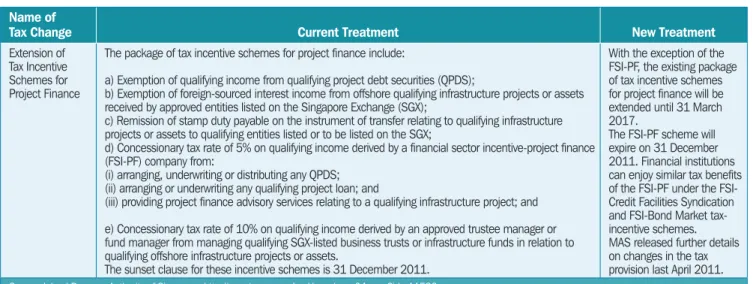
C. Financial Sector Incentive Tax Regimes ... 34
D. Taxation Framework and Tax Requirements ... 36
Contents
Section 9: Singapore Bond Market Guide
ASEAN+3 Bond Market Guide | Volume 1 | Part 2
iv
III. Trading of Bonds and Trading Market Infrastructure ...39
A. Exchange Trading and Over-the-Counter Trading ... 39
B. Exchange Trading of Bonds ... 40
C. Primary Dealer System ... 42
D. Bond Repurchase Market ... 43
E. Transparency in Bond Pricing ... 44
IV. Description of the Securities Settlement System ...46
A. Dematerialization or Immobilization versus Physical Securities ... 46
B. Clearing and Settlement System in Singapore ... 46
C. The Monetary Authority of Singapore Electronic Payment System ... 47
D. Bond Market Infrastructure Diagram ... 48
E. Business Process Flowchart Level 2: Singapore Bond Market and Delivery versus Payment ... 48
F. Over-the-Counter Bond Transaction Flow for Foreign Investors ... 50
G. Settlement Schemes for Government Bonds, Corporate Bonds and Other Bonds ... 51
VI. Costs and Charging Methods ...52
A. Exchange Fees ... 52
VII. Market Size and Statistics ...54
A. Size of Local Currency Bond Market in Percentage of Gross Domestic Product
(Local Sources) ... 54
B. Issuance Volume of Local Currency Bond Market ... 55
C. Bond Trading Volume ... 56
D. Breakdown of Local Currency Government Bond Market Issuance ... 57
E. Size of Foreign Currency Bond Market ... 59
F. Size of Foreign Currency Bond Market (Local Sources) ... 60
G. Domestic Financing Profile ... 61
VIII. Next Step Future Direction ...62
A. Future Direction ... 62
B. Group of 30 Compliance ... 63
C. Group of Experts Final Report: Summary of Barriers Market Assessment (April 2010) ... 64
Appendixes ...66
Boxes, Figures, and Tables
Boxes
Box 1.1 Part XIII of the Securities and Futures Act 2001 ...5
Box 1.2 Article on the Launch of the OPERA ...11
Box 1.3 Provisions on Private Placement in the Securities and Futures Act ...13
Box 1.4 Duties of Trustees ...25
Box 1.5 Provisions on the Amendment to the Definition of Securities ...29
Box A1.1 Securities and Futures Act (SFA) 2001 (CHAPTER 289) ...66
Box A2.1 Singapore Exchange Rulebook ...156
Figures
Figure 1.1 Timeline of Registration Process ...12
Figure 1.2 General Listing Procedure ...19
Figure 3.1 Changes in the Singapore Exchange Trading Hours ...42
Figure 4.1 Bond Market Infrastructure ...48
Figure 4.2 Business Process Flowchart Level 2 ...49
Figure 4.3 Over-the-Counter Bond Transaction Flow for Foreign Investors ...50
Tables
Table 1.1 Characteristics of Singapore Government Securities ...3
Table 1.2 Criteria for Listing ...15
Table 1.3 Auction Information ...21
Table 1.4 Secondary Market Information ...21
Table 1.5 Auction Conduct ...22
Table 1.6 Definitions of Securities under the Securities and Futures Act 2001 ...28
Table 1.7 Singapore Exchange Monthly Market Statistics, October 2011 ...31
Table 2.1 Details of the Approved Special Purpose Vehicles ...35
Table 2.2 Details on the Tax Change Provisions ...36
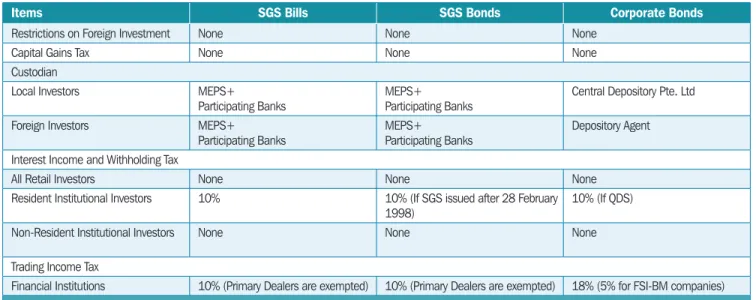
Table 2.3 Summary of Regulatory and Tax Information ...38
Table 3.1 Fixed Income Products on the Singapore Exchange ...39
Table 3.2 Minimum Bid Size for Debentures ...40
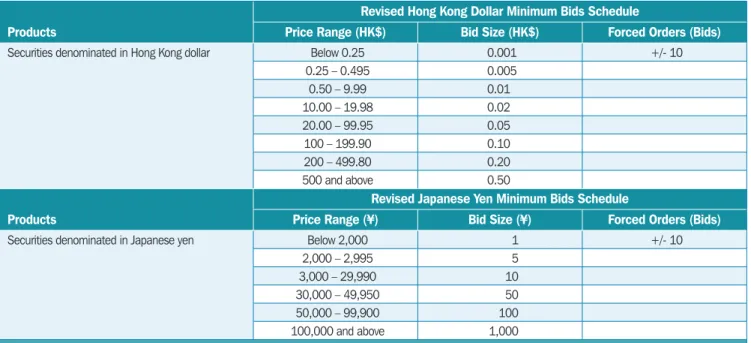
Table 3.3 Revised Hong Kong Dollar and Japanese Yen Minimum Bids Schedule ...40
Table 4.1 Main Changes to Settlement Timings ...47
Table 5.1 Selected Costs and Charging Methods in the Singapore Bond Market ...53
Table 6.1 Size of Local Currency Bond Market (% GDP) ...54
Table 6.2 Issuance Volume of Local Currency Bond Market ($ billions) ...55
Table 6.3 Trading Volume ($ billions) ...56
Table 6.4 Government Issuance Breakdown ($ billions) ...57
Table 6.5 Foreign Currency Bonds to Gross Domestic Product Ratio ($ billions) ...59
Table 6.6 Foreign Currency Bonds Outstanding ($ billions) ...60
Table 6.7 Domestic Financing Profile ...61
Table 7.1 Group of 30 Compliance ...63
Table 7.2 Group of Experts Summary of Barriers Market Assessment – Singapore ...64
T he Asian Development Bank (ADB) Team, comprising Satoru Yamadera
(Economist, ADB Office of Regional Economic Integration, September 2011),
Seung Jae Lee (Principal Financial Sector Specialist), Shinji Kawai (Senior
Financial Sector Specialist, Banking), Shigehito Inukai (ADB consultant), Taiji Inui
(ADB consultant), and Matthias Schmidt (ADB consultant), would like to express
our sincere gratitude to Citibank, Deutsche Bank AG, Hongkong Shanghai Banking
Corporation, J.P. Morgan, and State Street for their contribution as international
experts, for providing information from their own market guides, as well as their
valuable expertise. Particular thanks to DBS Bank for providing us with the “Securities
Market Guide.” Because of their cooperation and contribution, the ADB Team started
the research on solid ground.
We would also like to express special thanks to the team at the Monetary Authority
of Singapore (MAS) for repeatedly reviewing the draft versions of the market guide.
It should be noted that any part of this report does not represent official views and
opinions of any institution that participated in this activity as members and experts
of the ASEAN+3 Bond Market Forum.
The ADB Team has sole responsibility for the contents of this report.
February 2012
Asian Development Bank (ADB) Team
Acknowledgement
A. Overview
Singapore has one of the most developed bond markets in Asia. The Singapore bond
market has become an open capital market in Asia over the past decade and a half. As
of the second quarter of 2011, market capitalization was around SGD250.5 billion, of
which 60% was in Singapore dollars and the rest mostly in US dollar, euro and yen.
Sovereign bonds and statutory board bonds are vital features of the market, despite
the government’s strong fiscal position that does not require deficit financing.
Singapore Government Securities (SGS)—comprising Treasury bills and bonds—are
issued primarily to stimulate market activity and provide a benchmark for corporate
issues. SGS are also targeted to satisfy reserve requirements for Singapore-based
financial institutions (both banks and non-banks), and are sought-after as collateral
for repurchase transactions.
The Singapore dollar bond market comprises SGS, statutory board bonds, corporate
bonds, and structured securities. Statutory board papers, issued by autonomous
government agencies, are considered relatively liquid among debt instruments on
the Singapore corporate bond market. As for issuance by corporates, property-related
companies continue to be key issuers of Singapore dollar denominated corporate debt
securities, while structured products include equity-linked notes, convertible bonds,
credit-linked notes, and asset securitization transactions.
Islamic finance is growing as well. In 2005, Singapore was accepted as a full member of
the Islamic Financial Services Board (IFSB), an international body based in Malaysia
that defines regulatory and supervisory standards governing Islamic financial
services. In January 2009, Singapore launched its first Islamic bond program worth
SGD200 million. Market capitalization was around SGD250.5 billion, as of the second
quarter of 2011, of which 60% was in Singapore dollars and the rest mostly in US
dollars, euro and yen.
To attract greater foreign interest, the Monetary Authority of Singapore (MAS) began
internationalizing the Singapore dollar in 1998, with foreign entities allowed to issue
I. Structure, Type and
Characteristics of the
Bond Market
Section 9: Singapore Bond Market Guide
ASEAN+3 Bond Market Guide | Volume 1 | Part 2
2
Singapore dollar-denominated bonds. Singapore’s debt market has grown to become
a source of financing for local and foreign corporations, international organizations,
and governments.
In January 2005, Singapore was the first Asian nation outside of Japan to join the
widely-followed Citigroup World Government Bond Index (WGBI). SGS are also
included in other leading indices such as the J.P. Morgan World Government Bond
Index and the HSBC Asian Local Bond Index.
From 8 July 2011, individual investors were able to trade SGS bonds in the secondary
market on the Singapore Exchange. Market makers, who are also SGS primary dealers,
committed to provide two-way prices for the SGS bonds traded on the Exchange.
With the new offering by SGX, investors were able to access SGS bond prices on SGX’s
website or through their brokers, and trade SGS bonds through their brokers in a
manner similar to the way stocks are traded. Trading of SGS and corporate bonds
remains over-the-counter (OTC) for institutional investors.
A total of 20 SGS bonds amounting to SGD82.3 billion are currently traded on the
SGX, with maturities of 2 years or more. SGX’s Central Depository (Pte.) Limited
(CDP) acts as the custodian of SGS bonds traded on the exchange.
B. Descriptions for the Bond Market in Singapore
1. Description of Each Bond
a. Singapore Government Securities
Singapore Government Securities (SGS) were initially issued to meet banks’ needs
for a risk-free asset in their liquid asset portfolios. In 1998, MAS spearheaded efforts
to enhance the efficiency and liquidity of the SGS market as part of its strategy to
develop Singapore as an international debt hub. This was further refined in May
2000 with the introduction of a focused issuance program aimed at building large and
liquid benchmark bonds, primarily through larger issuance of new SGS bonds and
re-opening of existing issues, to enlarge the free float and occasional bond purchase
programs to re-channel liquidity from off-the-run issues to benchmark bonds. Since
then, the SGS market has grown significantly.
MAS is the fiscal agent of the Singapore Government. As such, it is empowered by the
Development Loan Act and the Government Securities Act to undertake the issuance and
management of securities on behalf of the government. The amount of SGS issued
is authorized by a resolution of Parliament and with the President’s concurrence.
Each year, MAS seeks approval from the Minister for Finance for the total amount of
SGS issuance for the new financial year. MAS decides, in consultation with the SGS
primary dealers, the timing and amount of individual bond issues.
11 Detailed information on Singapore Government Securities market can be found at the SGS website. http:// www.sgs.gov.sg/index.html
SGS are issued by the MAS, on behalf of the Government of Singapore. Unlike many
other countries, the Singapore Government does not need to finance its expenditures
through the issuance of government bonds as it operates a balanced budget and often
enjoys budget surpluses. This allows the government to focus on the development of
Singapore’s capital markets instead, and the issuance of SGS serves primarily to:
(i) Build a liquid SGS market to provide a robust government yield curve for the
pricing of private debt securities;
(ii) Foster the growth of an active secondary market, both for cash transactions and
derivatives, to enable efficient risk management; and
(iii) Encourage issuers and investors, both domestic and international, to participate
in the Singapore bond market.
SGS comprise marketable short-term T-bills and medium- and long-term bonds.
SGS T-bills are zero-coupon, and issued and traded on a discount basis. On the other
hand, SGS Treasury bonds carry a fixed semi-annual coupon paid on the first and
15th of the particular month. They are non-callable or non-puttable bonds with bullet
redemptions.
SGS T-bill and bond auctions are held on a regular basis. Three-month T-bills are
issued weekly, while 1-year T-bills and bonds are issued according to an annual
issuance calendar.
The key characteristics of both securities are summarized in Table 1.1.
Table 1.1 Characteristics of Singapore Government Securities
Treasury bills Bonds
Issuer Singapore Government Singapore Government
Tenor 3M and 1Y 2Y, 5Y, 10Y, 15Y, 20Y
(7Y non-benchmark)
Interest Rate Discount Fixed Coupon
Coupon Payments N/A Semi-annual
(Every 6 months)
Minimum Denomination SGD1,000 SGD1,000
Typical Issue Size SGD2.3 billion–SGD4.0 billion SGD2 billion–SGD3 billion for benchmark issues M = months, Y = years
Source: Monetary Authority of Singapore. www.sgs.gov.sg/market_characteristics/mktchar_auctions.html
b. Corporate Bonds
Singapore’s corporate bond market is mainly composed of statutory board bonds,
domestic bonds, and non-domestic bonds open to both local and foreign investors.
Corporate bonds are generally bought and traded over the counter.
i. Statutory Board Bond Issuers
Statutory boards of the Singapore Government are autonomous organizations whose
issues generally imply good credit ratings even though there may not be an explicit
guarantee given by the government. Statutory board papers are considered the most
Section 9: Singapore Bond Market Guide
ASEAN+3 Bond Market Guide | Volume 1 | Part 2
4
liquid among debt instruments on the Singapore corporate bond market. The three
largest statutory board issuers are:
(a) The Housing Development Board, the public housing authority that plans
and develops public housing, under the Ministry of National Development;
(b) The Land Transport Authority, a statutory board under the Ministry of
Transport, which leads land transport developments; and
(c) The PUB, the national water agency responsible for collection, production,
distribution and reclamation of water.
ii. Domestic Corporate Bond Issuers
Domestic corporate bond issuers are mainly composed of property-related companies,
statutory boards, financial institutions, Government-linked companies (GLCs),
and other non-property related companies. The GLCs include companies such as
Singapore Airlines, SingTel, DBS Bank, SMRT Corporation, and PSA Corporation.
iii. Non-Domestic or Foreign Bond Issuers
The Singapore dollar bond market is fully accessible to all issuers globally. There are no
capital controls, hedging restrictions or withholding taxes. Non-domestic Singapore
dollar corporate bond issues are composed of supranational, quasi-sovereign agencies,
banks, and other corporations. The market’s profile is international in nature, with
foreign entities accounting for more than a quarter of bond issuance annually.These
include the Asian Development Bank, Cheung Kong Holdings and Export-Import
Bank of Korea among others.
Non-domestic Singapore dollar corporate bond issues are, for the most part, composed
of supranational agencies, foreign banks, and foreign corporations from the United
States, Europe, and Asia. These include Citigroup, Merrill Lynch & Company, and
the Asian Development Bank, among others. Some, but not necessarily all, of these
non-domestic Singapore dollar corporate bond issues are issued under the SGX
Listed Euro-Medium Term Note (EMTN) Programme. The Singapore corporate bond
market uses a wide range of debt structures that include fixed- and floating-rate notes
(FRN), asset-backed securities (ABS), equity-linked notes, mortgage-backed securities
(MBS), and many other structured products. If an issuer intends to use the proceeds
outside Singapore where a currency swap facility exists, the swap tenure must match
the bond tenure.
The structured note market continues to grow and comprises about half of the
outstanding corporate issuance. The number of SPVs illustrates the importance of
structured notes to the Singapore dollar market. The commercial mortgage-backed
securities (CMBS) market has taken off largely through real estate investment trusts
(REITs), which have been large issuers of CMBS. REITs offer investors access to a
portfolio of property assets including commercial, retail, industrial and residential
properties; and usually pay a dividend based on net proceeds from the property
portfolio, rather than a coupon.
22 Monetary Authority of Singapore. Overview of the Singapore Corporate Bond Market. http://www.mas.gov. sg/fin_development/debt_market/The_Singapore_Corporate_Bond_Market.html
C. The Securities and Futures Act 2001
The Securities and Futures Act 2001 (the SFA) is the single key piece of securities
market regulation that integrates provisions on investors, issuers and issuance types,
investor protection as well as market conduct. It, hence, has significance across all
aspects of the securities market and will be referred to frequently in the course of this
document. Additional laws and regulations effectively supplement the SFA, and are
detailed further in Chapter II, sections A. and B. Box 1.1 shows the different articles
contained under Part XIII of the Securities and Futures Act 2001 (SFA).
3Box 1.1 Part XIII of the Securities and Futures Act 2001
3 A full version of the Securities and Futures Act (SFA) can be found in Appendix 1. Securities and Futures Act (SFA) 2001
CHAPTER 289 2006 REVISED EDITION
PART XIII
OFFERS OF INVESTMENTS Division 1—Shares and Debentures SUBDIVISION (1)—Interpretation 239 Preliminary provisions
239A Authority may disapply this Division to certain offers 239B Modification of provisions to certain offers SUBDIVISION (2)—PROSPECTUS REQUIREMENTS
240 Requirement for prospectus and profile statement, where relevant 240A Debenture issuance programme
241 Lodging supplementary document or replacement document 242 Stop order for prospectus and profile statement
243 Contents of prospectus 244
245 Retention of over-subscriptions and statement of asset-backing in debenture issues 246 Contents of profile statement
247 Exemption from requirements as to form or content of prospectus or profile statement
248 Exemption for certain governmental and international entities as regards signing of copy of prospectus or profile statement by all directors or equivalent persons
249 Expert’s consent to issue of prospectus or profile statement containing statement by him 249A Consent of issue manager and underwriter to being named in prospectus or profile statement 250 Duration of validity of prospectus and profile statement
251 Restrictions on advertisements, etc.
252 Persons liable on prospectus or profile statement to inform person making offer about certain deficiencies 253 Criminal liability for false or misleading statements
254 Civil liability for false or misleading statements 255 Defences
256
257 Document containing offer of securities for sale deemed prospectus
258 Application and moneys to be held in trust in separate bank account until allotment 259 Allotment of securities where prospectus indicates application to list on securities exchange 260 Prohibition of allotment unless minimum subscription received
continued on next page
Section 9: Singapore Bond Market Guide
ASEAN+3 Bond Market Guide | Volume 1 | Part 2
6
SUBDIVISION (3)—DEBENTURES 261 Preliminary provisions 262 Offer of asset-backed securities 263
264
265 Power of court in relation to certain irredeemable debentures 266 Duties of trustees
267 Powers of trustee to apply to court for directions, etc.
267A Right of Authority, securities exchange and holders of debentures to apply to court for order 268 Obligations of borrowing entity
269 Obligation of guarantor entity to furnish information
270 Loans and deposits to be immediately repayable on certain events 271 Liability of trustees for debenture holders
SUBDIVISION (4)—EXEMPTIONS
272 Issue or transfer of securities for no consideration 272A Small offers
272B Private placement
273 Offer made under certain circumstances 274 Offer made to institutional investors
275 Offer made to accredited investors and certain other persons 276 Offer of securities acquired pursuant to section 274 or 275 277 Offer made using offer information statement
278 Offer in respect of international debentures
279 Offer of debentures made by Government or international financial institutions 280 Making offer using automated teller machine or electronic means
281 Revocation of exemption
282 Transactions under exempted offers subject to Division 2 of Part XII of Companies Act and Part XII of this Act DIVISION 1A—BUSINESS TRUSTS
SUBDIVISION (1)—INTERPRETATION 282A Preliminary provisions
282B Division not to apply to certain business trusts which are collective investment schemes 282BA Modification of provisions to certain offers
SUBDIVISION (2)—PROSPECTUS REQUIREMENTS
282C Requirement for prospectus and profile statement, where relevant 282D Lodging supplementary document or replacement document 282E Stop order for prospectus and profile statement
282F Contents of prospectus 282G Contents of profile statement
282H Exemption from requirements as to form or content of prospectus or profile statement 282I Expert’s consent to issue of prospectus or profile statement containing statement by him 282J Consent of issue manager and underwriter to being named in prospectus or profile statement 282K Duration of validity of prospectus and profile statement
282L Restrictions on advertisements, etc.
282M Persons liable on prospectus or profile statement to inform person making offer about certain deficiencies 282N Criminal liability for false or misleading statements
282O Civil liability for false or misleading statements 282P Defences
282Q Document containing offer of units or derivatives of units for sale deemed prospectus 282R Application and moneys to be held in trust in separate bank account until allotment
282S Allotment of units or derivatives of units where prospectus indicates application to list on securities exchange 282T Prohibition of allotment unless minimum subscription received
Box 1.1 continuation
continued on next page
continued on next page Box 1.1 continuation
SUBDIVISION (3)—EXEMPTIONS
282U Issue or transfer of units or derivatives of units for no consideration 282V Small offers
282W Private placement
282X Offer made under certain circumstances 282Y Offer made to institutional investors
282Z Offer made to accredited investors and certain other persons 282ZA Offer of securities acquired pursuant to section 282Y or 282Z 282ZAA Offer of units converted from debentures
282ZB Offer made using offer information statement
282ZC Making offer using automated teller machine or electronic means 282ZD Revocation of exemption
282ZE Transactions under exempted offers subject to Division 2 of Part XII of Companies Act and Part XII of this Act SUBDIVISION (4)—DEBENTURES
282ZF Applicability of provisions relating to prospectus requirements DIVISION 2—COLLECTIVE INVESTMENT SCHEMES
SUBDIVISION (1)—INTERPRETATION 283 Interpretation of this Division
283A Use of term “real estate investment trust” 284 Code on Collective Investment Schemes
284A Authority may disapply this Division to certain offers and invitations
284B Division not to apply to certain collective investment schemes which are business trusts 284C Modification of provisions to certain offers
SUBDIVISION (2)—AUTHORISATION AND RECOGNITION 285 Requirement for authorisation or recognition
286 Authorised schemes 287 Recognised schemes
288 Revocation, suspension or withdrawal of authorisation or recognition 289 Approval of trustees
290 Inspection of approved trustees
291 Duty of trustees to furnish Authority with such return and information as Authority requires 292 Liability of trustees
293 Authority may issue directions 294 Service
295 Winding up
295A Power to acquire units of participants of real estate investment trust in certain circumstances 295B Unclaimed money to be paid to Official Receiver
295C Remedies in cases of oppression or injustice SUBDIVISION (3)—PROSPECTUS REQUIREMENTS
296 Requirement for prospectus and profile statement, where relevant 297 Stop order for prospectus and profile statement
298 Lodging supplementary document or replacement document 299 Duration of validity of prospectus and profile statement 300 Restrictions on advertisements, etc.
301 Issue of units where prospectus indicates application to list on securities exchange 302 Application of provisions relating to securities
SUBDIVISION (4)—EXEMPTIONS 302A Issue or transfer for no consideration 302B Small offers
302C Private placement
Section 9: Singapore Bond Market Guide
ASEAN+3 Bond Market Guide | Volume 1 | Part 2
8
303 Offer or invitation made under certain circumstances 304 Offer made to institutional investors
304A First sale of units acquired pursuant to section 304 305 Offer made to accredited investors and certain other persons 305A First sale of units acquired pursuant to section 305 305B Offer made using offer information statement
305C Making offer using automated teller machine or electronic means 306 Power of Authority to exempt
307 Revocation of exemption
308 Transactions under exempted offers subject to Division 2 of Part XII of Companies Act and Part XII of this Act DIVISION 3—SECURITIES HAWKING
309 Securities hawking prohibited
Note: Emphases added by author.
Source: Attorney-General’s Chamber. http://statutes.agc.gov.sg Box 1.1 continuation
D. Definition of Relevant Person
A “relevant person” is defined under section 275(2) of the SFA to mean the following:
(i) an “accredited investor”;
4(ii) a corporation whose sole business is to hold investments and whose entire
share capital is owned by one or more individuals, each of whom is an accredited
investor;
(iii) a trustee of a trust whose sole purpose is to hold investments, and each beneficiary
of which is an individual who is an accredited investor;
(iv) an officer or equivalent person of the person making the offer (such person being
an entity), offeror (if it is an entity), or a spouse, parent, brother, sister, son or
daughter of that officer, or equivalent person; or
(v) a spouse, parent, brother, sister, son or daughter of that officer, or equivalent
person, or of the person making the offer (if such person is an individual).
E. Definition of Accredited Investor, Expert Investor, and Institutional Investor
Section 4A of the SFA (Chapter 289) provides for the definitions for specific classes
of investors.
54 Section 4A of the SFA also provides for a more detailed definition of “accredited investor.” Also, see discussion in I.E.1.
5 Attorney-General’s Chamber. 2006. Securities and Futures Act, Chapter 289 (SFA), as amended, sec. 4A: Specific Classes of Investors. http://statutes.agc.gov.sg/non_version/cgi-bin/cgi_retrieve.pl?actno=REVED- 289&doctitle=SECURITIES%20AND%20FUTURES%20ACT%0a&date=latest&method=part
1. Accredited Investor
An “accredited investor” is defined as:
(i) an individual whose net personal assets exceed SGD2 million, or whose income
in the preceding 12 months is not less than SGD300,000;
(ii) a corporation with net assets exceeding SGD10 million in value as determined
by the most recent audited balance sheet of the corporation, or where the
corporation is not required to prepare an audited account regularly, a balance
sheet of the corporation certified by the corporation as giving a true and fair view
of the corporation’s state of affairs;
(iii) the trustee of a trust; or
(iv) such other person as the MAS may prescribe.
2. Expert Investor
An “expert investor” is defined as:
(i) a person whose business involves the acquisition and disposal, or the holding, of
capital markets products, whether as principal or agent;
(ii) the trustee of a trust; or
(iii) such other person as the MAS may prescribe.
3. Institutional Investor
An “institutional investor” is defined as:
(i) a bank that is licensed under the Banking Act;
(ii) a merchant bank approved as a financial institution under section 28 of the
Monetary Authority of Singapore Act;
(iii) a finance company licensed under the Finance Companies Act;
(iv) a company or society registered under the Insurance Act as an insurer;
(v) a company licensed under the Trust Companies Act;
(vi) the government;
(vii) a statutory body;
(viii) a pension fund or collective investment scheme;
(ix) the holder of a capital-markets services licence for dealing in securities, fund
management, providing custodial services for securities, real estate investment
trust management, securities financing, or trading in futures contracts;
Section 9: Singapore Bond Market Guide
ASEAN+3 Bond Market Guide | Volume 1 | Part 2
10
(x) a person (other than an individual) who carries on the business of dealing in bonds with
accredited investors or expert investors;
(xi) the trustee of a trust; or
(xii) such other person as the MAS may prescribe.
F. Descriptions of Public Offering
1. General Explanation on Public Offering
Public offering is the selling of registered securities to the broad market rather than to
a select group of investors. In Singapore, a public offer of bonds must be accompanied
by a prospectus that is lodged with and registered by MAS, unless an exemption
applies. The exemptions to the prospectus requirements include those for offers
that are made only to institutional investors and accredited investors, and personal
offers where the total amount raised within any 12-month period does not exceed
USD5 million.
6Issuers of bonds that are offered to retail investors would normally seek a listing of
these bonds on SGX, and the bonds are normally issued in small denominations.
Notices of bond offerings by statutory boards, domestic and foreign issuers are
generally published in the newspapers or on the issuer’s website. They outline issuance
details such as auction dates, size and type of issue.
Bids are submitted through managing banks and the results—specifying the amount
applied for, coupon rate, average yield and percentage allotted—are also publicly
announced.
2. Offers and Prospectuses Electronic Repository and Access
General public offerings can be accessed through a prospectus database available in
MAS’ website under the Offers and Prospectuses Electronic Repository and Access
(OPERA) tab. MAS launched OPERA in the context of making available more online
services to market participants, as explained in the excerpt from the MAS Annual
Report 2002/2003 in Box 1.2.
6 A detailed discussion on exemptions is found in I.H: Exemptions from Prospectus Requirements.
Box 1.2 Article on the Launch of the OPERA
OPERA is available for viewing of all relevant offer information everyday including
Sundays, with the exception of its daily scheduled downtime between 4am and
7:30am Singapore Time (GMT+8).
73. Prospectus Registration Process
A prospectus can consist of a base prospectus (valid for 2 years) and a pricing
statement. The base prospectus is valid for all offers under the same program, and
subsequent offers require only that a pricing statement be lodged and registered with
the MAS.
A preliminary prospectus may be distributed to institutional and accredited investors
only, to determine the appropriate amount and price of the securities to be offered,
even before registration of the prospectus itself. Upon lodgment of the prospectus, the
7 Monetary Authority of Singapore. http://masnet.mas.gov.sg/opera/sdrprosp.nsf July 2002
Launch of OPERA
MAS ANNUAL REPORT 2002 / 2003 ORGANISATIONAL INITIATIVES
INFORMATION TECHNOLOGY DEPARTMENT New Era of Easy Access to E-services
Our move towards the disclosure-based regime took a big step forward in July 2002 with the launch of OPERA, the Offers and Prospectuses Electronic Repository and Access system.
OPERA gives the public easy access via the internet to prospectuses and offers of investments lodged to MAS as well as a feedback channel. An online Minimum Liquid Assets (MLA) returns system was set up for banks.
Under the risk-based Liquidity Supervision Framework, banks with stronger liquidity risk management have lower MLA requirements. The new system gives banks a convenient and secure channel to submit MLA.
The MAS website was revamped to improve usability and accessibility. Content was reorganised and navigation flow improved. An enhanced integrated search engine gives the public easy access to information on the MAS, OPERA and Singapore Government Securities websites.
A link is being built from the MAS Electronic Payment System (MEPS) to the Continuous Linked Settlement System (CLS) to prepare for the inclusion of the Singapore Dollar as a CLS settlement currency. This link will greatly reduce the settlement risk for foreign exchange transactions involving the Singapore Dollar. Work has also begun on the next generation of the Real-Time Gross Settlement system. Based on SWIFT standards, this system will enable the industry to meet new commercial and regulatory challenges.
With the merger of BCCS with MAS, IT systems and network infrastructures were smoothly integrated. A high-speed link gives staff at Currency House access to all IT facilities at MAS Building. A knowledge management portal is being built to improve operational effectiveness and efficiency, and to create a culture of shared purpose and team collaboration. A group of pilot users are testing the system, which will include a strong search engine that provides the ability to quickly find relevant information and knowledge assets.
Source: Monetary Authority of Singapore. MAS Annual Report 2002/2003. Singapore. http://www.mas.gov.sg/about_us/annual_reports/annual20022003/f_organisational/ organisational_f.html
Section 9: Singapore Bond Market Guide
ASEAN+3 Bond Market Guide | Volume 1 | Part 2
12
issuer can conduct roadshow presentations to institutional and accredited investors,
as well as commence book-building exercises. After lodgment, the prospectus is put
up for public viewing and comment on the MAS website’s OPERA portal.
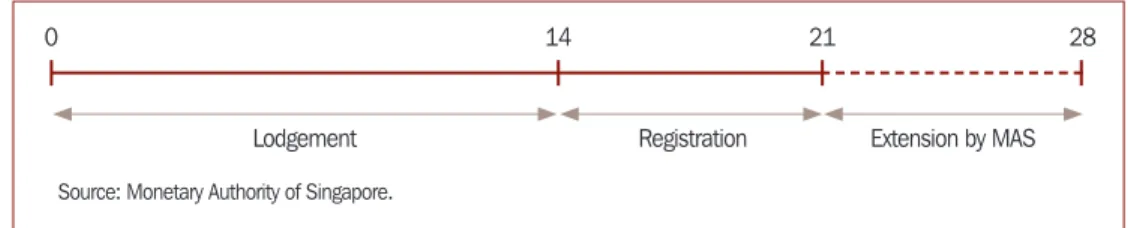
A regulatory review is conducted by the MAS. The MAS will register the prospectus
within 14 to 21 days, unless the period is extended for a maximum of 28 days, or the
issuer requests a later registration date. The issuer can then launch the public offer
and distribute the registered prospectus after registration.
The timeline of the registration process for a prospectus is further illustrated in
Figure 1.1. for easy reference.
Figure 1.1 Timeline of Registration Process
Source: Monetary Authority of Singapore.
Lodgement Registration
0 14 21 28
Extension by MAS
G. Provisions on Private Placement
Private placement (PP), or non-public offering, is the selling of unregistered securities
directly, where an offer is made to not more than 50 investors within a 12-month
period. Private bond placements sometimes are not listed on a stock exchange. An
issuer who offered the bonds through private placement can still seek a listing on
SGX.
Many primary issuances are made in the form of PP offers. Many Singapore dollar
corporate bonds are placed privately at the issuer’s or investor’s (reverse enquiry)
initiative.
8The SFA contains a number of specific provisions for Private Placement which are
detailed in Box 1.3 for easy reference.
8 Government of Singapore. Monetary Authority of Singapore. 2007. Singapore Bond Market Guide. http:// www.sgs.gov.sg/resource/pub_guide/guides/Bond_Market_Guide_Mar_2007.pdf
Private placement:
272B.—(1) Subdivisions (2: Prospectus requirements) and (3: DEBENTURES) of this Division (1: Shares and Debentures) (other than section 257) shall not apply to offers of securities of an entity that are made by a person if—
(a) the offers are made to no more than 50 persons within any period of 12 months;
(b) none of the offers is accompanied by an advertisement making an offer or calling attention to the offer or intended offer;
(c) no selling or promotional expenses are paid or incurred in connection with each offer other than those incurred for administrative or professional services, or by way of commission or fee for services rendered by—
(i) the holder of a capital markets services licence to deal in securities; (ii) an exempt person in respect of dealing in securities; or
(iii) a person who is licensed, approved, authorised or otherwise regulated under the laws, codes or other requirements of any foreign jurisdiction in respect of dealing in securities, or who is exempted therefrom in respect of such dealing; and
[1/2005]
(d) no prospectus in respect of any of the offers has been registered by the Authority or, where a prospectus has been registered— (i) the prospectus has expired pursuant to section 250; or
(ii) the person making the offer has before making the offer—
(A) informed the Authority by notice in writing of its intent to make the offer in reliance on the exemption under this subsection; and
(B) taken reasonable steps to inform in writing the person to whom the offer is made that the offer is made in reliance on the exemption under this subsection.
(2) The Authority may prescribe such other number of persons in substitution for the number specified in subsection (1) (a). [1/2005]
(3) In determining whether offers of securities by a person are made to no more than the applicable number of persons specified in subsection (1) (a) within a period of 12 months, each person to whom—
(a) an offer of securities issued by the same entity is made by the first-mentioned person; or
(b) an offer of securities of an entity, units or derivatives of units in a business trust, or units in a collective investment scheme, is made by the first- mentioned person or another person where such offer is a closely related offer,
if any, within that period in reliance on the exemption under this section, section 282W or 302C shall be included. [1/2005]
(4) Whether an offer is a closely related offer under subsection (3) shall be determined by considering such factors as the Authority may prescribe. [1/2005]
(5) For the purposes of subsection (1)—
(a) an offer of securities to an entity or to a trustee shall be treated as an offer to a single person, provided that the entity or trust is not formed primarily for the purpose of acquiring the securities which are the subject of the offer;
(b) an offer of securities to an entity or to a trustee shall be treated as an offer to the equity owners, partners or members of that entity, or to the beneficiaries of the trust, as the case may be, if the entity or trust is formed primarily for the purpose of acquiring the securities which are the subject of the offer;
(c) an offer of securities to 2 or more persons who will own the securities acquired as joint owners shall be treated as an offer to a single person; (d) an offer of securities to a person acting on behalf of another person (whether as an agent or otherwise) shall be treated as an offer made to that
other person;
Box 1.3 Provisions on Private Placement in the Securities and Futures Act
continued on next page
Section 9: Singapore Bond Market Guide
ASEAN+3 Bond Market Guide | Volume 1 | Part 2
14
(e) offers of securities made by a person as an agent of another person shall be treated as offers made by that other person;
(f) where an offer is made to a person with a view to another person acquiring an interest in those securities by virtue of section 4, only the second- mentioned person shall be counted for the purposes of determining whether offers of the securities are made to no more than the applicable number of persons specified in subsection (1) (a); and
(g) where—
(i) an offer of securities is made to a person in reliance on the exemption under subsection (1) with a view to those securities being subsequently offered for sale to another person; and
(ii) that subsequent offer—
(A) is not made in reliance on an exemption under any provision of this Subdivision; or (B) is made in reliance on an exemption under subsection (1) or section 280,
both persons shall be counted for the purposes of determining whether offers of the securities are made to no more than the applicable number of persons specified in subsection (1) (a).
[1/2005]
(6) In subsection (1) (b), “advertisement” has the same meaning as in section 272A (10).
Note: Similarly, private placements are stipulated in sec. 282W and 302C of SFA.
Source: Attorney-General’s Chamber. Securities and Futures Act, sec. 272B. http://statutes.agc.gov.sg/non_version/cgi-bin/cgi_retrieve.pl?actno=REVED-289 Box 1.3 continuation
H. Brief Summary of Exemptions from Prospectus Requirements
As previously mentioned, a number of exemptions from prospectus requirements
exist, particularly for the specific categories of investors detailed in I.E. These
exemptions can be summarized as:
a. Offers made to institutional investors or accredited investors, and need to be
accompanied by public advertisements.
9b. Private placement offers made to no more than 50 persons.
10c. An entity whose shares are already listed on the SGX may use an Offer Information
Statement (OIS), instead of a prospectus, when issuing new types of securities
such as bonds. An OIS has fewer disclosure requirements.
d. Institutions offering continuously issued structured notes do not need to lodge
and register a pricing statement with the MAS; the base prospectus, a transaction
note setting out the offer details prior to the purchase or subscription, and a
confirmation receipt to the investors at the time of offer, are sufficient.
e. Small Offer: the total amount raised by the person from such offers within any
period of 12 months does not exceed SGD5 million, or its equivalent in a foreign
currency.
119 Footnote 5, sec. 274 and 275.
10 Footnote 5, sec. 272B.
11 Footnote 5, sec. 272.
These exemptions can also be found in the “2007 Singapore Bond Market Guide”.
12I. Overview of the Singapore Exchange Bond Listing Criteria
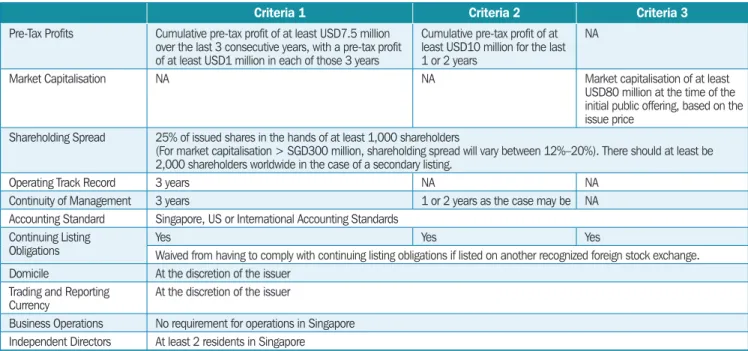
1. Criteria for Listing: A General Guide for Bonds
For primary listing, companies must meet SGX’s initial listing requirements outlined
in Table 1.2. After listing, companies have to comply with all of SGX’s continuing listing
obligations. For secondary listing, companies already listed on another exchange of
equivalent rules as SGX are able to seek secondary listing on SGX without having to
comply with SGX’s continuing listing obligations.
2. Mainboard Requirements
A company may list on the mainboard under any of the three criteria below, which
cater to a wide spectrum of companies with different business models.
Table 1.2 Criteria for Listing
Criteria 1 Criteria 2 Criteria 3
Pre-Tax Profits Cumulative pre-tax profit of at least USD7.5 million over the last 3 consecutive years, with a pre-tax profit of at least USD1 million in each of those 3 years
Cumulative pre-tax profit of at least USD10 million for the last 1 or 2 years
NA
Market Capitalisation NA NA Market capitalisation of at least
USD80 million at the time of the initial public offering, based on the issue price
Shareholding Spread 25% of issued shares in the hands of at least 1,000 shareholders
(For market capitalisation > SGD300 million, shareholding spread will vary between 12%–20%). There should at least be 2,000 shareholders worldwide in the case of a secondary listing.
Operating Track Record 3 years NA NA
Continuity of Management 3 years 1 or 2 years as the case may be NA
Accounting Standard Singapore, US or International Accounting Standards Continuing Listing
Obligations YesWaived from having to comply with continuing listing obligations if listed on another recognized foreign stock exchange.Yes Yes Domicile At the discretion of the issuer
Trading and Reporting Currency
At the discretion of the issuer
Business Operations No requirement for operations in Singapore Independent Directors At least 2 residents in Singapore Note: NA = not applicable
Source: Singapore Exchange. http://www.sgx.com/wps/portal/sgxweb/home/listings/listing_products/!ut/p/c5/DcrddoIgAADgZ9kD7IDMCi8xzuYfeMotlZuOaFHBYM 5M59Ov891-QIAn2zyuqrlfnW0MqIBYH7Mc-hHyYQDf-AbGUbpPimIbpoEHEiCUcfI5S1pPKzrsFCX0rIfEqHHEImOcjPF74S3b23BbDOr1R2mZaNYa6YBM1NpJ-q3bV-T- uutVhOBprv7ghfGyj3lX2RkLQzvMDqw7jjz32jP2MKF51jqEDsVjDuWS9PNXuqDQlCb_9DcyIFVd97_sBfDIfZ_Aj5bTP7hCuE8!/dl3/d 3/L0lDU0lKSWdra0EhIS9JTlJBQUlp Q2dBek15cUEhL1lCSlAxTkMxTktfMjd3ISEvN19MTzA0SDI0MDkwM043MElIS1JKU1NDQktENg!!/?WCM_PORTLET=PC_7_LO04H240903N70IHKRJSSCBKD6017268_ WCM&WCM_GLOBAL_CONTEXT=/wps/wcm/connect/sgx_en/home/listing_on_sgx/overview/
J. General Guide for Singapore Exchange Bond-Listing Requirements
Listing requirements for bonds are set out in the chapter on debt securities of the
“Main Board Rules” in the SGX Rulebook.
13Prospective issuers must fulfill the stated
requirements before they are eligible to issue bonds.
12 Footnote 8.
13 Singapore Exchange Securities Trading. Singapore Exchange Rulebook, chapter 3, “Debt Securities.” http:// rulebook.sgx.com/en/display/display_main.html?rbid=3271&element_id=4949
Section 9: Singapore Bond Market Guide
ASEAN+3 Bond Market Guide | Volume 1 | Part 2
16
Additional listing requirements for retail fixed-income securities are set out in the
chapter on prospectus, offering memorandum, and introductory document of the
SGX “Main Board Rules.”
14Prospective issuers must fulfill the stated requirements
before they are eligible to issue retail fixed income securities.
The SGX Rulebook likewise provides for the general requirements for debt securities
listing. These include:
151. Paying Agent. A foreign issuer is normally required to appoint a paying agent in
Singapore or in the Central Depository (Pte.) while the debt securities are quoted
on the exchange and upon the issue of debt securities in definitive form. The
exchange may accept other arrangements to enable definitive certificate holders
of the bearer debt securities in Singapore to be paid promptly.
2. Appointment of Trustee and Trust Deed and Exempt Issue. An issuer
must appoint a suitable trustee to represent the holders of its debt securities
listed on the exchange. However, a trustee is not required for a debt issue that is
offered only to sophisticated investors or institutional investors and is traded in
a minimum board lot size of SGD200,000 or its equivalent in foreign currencies
following listing.
163. Content of Offering Memorandum or Introductory Document
(Prospectus Exempt). For debt securities issued by an entity whose equity
securities are listed on SGX, or debt securities offered primarily to sophisticated
investors or institutional investors, a prospectus is not required. Instead, an
offering memorandum or introductory document containing the information
that investors would customarily expect to see in such documents would suffice.
4. Continuing Obligations. In general, a debt issuer must immediately disclose to
the exchange through SGXNet any information which may have a material effect
on the price or value of its debt securities or on an investor’s decision whether to
trade in such debt securities.
17K. Summary of Listing Criteria of Foreign Debt Securities on the Singapore Exchange
1. Listing Criteria
One of the following listing criteria must be met for the listing of foreign debt
securities:
14 Footnote 13, chapter 6, “Prospectus, Offering Memorandum and Introductory Document.” http://rulebook. sgx.com/en/display/display_main.html?rbid=3271&element_id=5034
15 Singapore Exchange Securities Trading. Singapore Exchange Rulebook. http://rulebook.sgx.com/en/display/ display_viewall.html?rbid=3271&element_id=4953
16 Refer to art. 308, part IV (Trustee and Trust Deed) of chapter 3 (Debt Securities) of the SGX “Main Board Rules” for detailed information on the suitability of the trustee and the provisions to be included in the trust deed.
17 Refer to art. 316, part VI (Continuing Listing Obligations) of chapter 3 (Debt Securities) of the SGX “Main Board Rules” for more detailed information on continuing disclosures.
(i) The issuer must be:
(a) a supranational body;
(b) a government, or a government agency whose obligations are guaranteed
by a government;
(c) an entity whose equity securities are listed on the SGX;
(d) a corporation which meets the following requirements:
(d.1) Rules 210 (2), (3), (4), and (5) of the SGX Listing Rules for listing of
equity securities; or
(d.2.1) a cumulative consolidated pre-tax profit of at least SGD50 million
for the last 3 years, or a minimum pre-tax profit of SGD20 million for any
one of those 3 years; and
(d.2.2) a consolidated net tangible assets of at least SGD50 million; or
(e) a corporation whose obligations under the issue of the bonds are guaranteed
by any of the entities in (a), (b), (c) or (d) above;
(ii) The issue of the bonds must be at least 80% subscribed by institutional investors
and/or sophisticated investors; or
(iii) The issue of the bonds must have a credit rating of investment grade and above.
2. Other Requirements
While the SGX Rulebook stipulates certain trust deed and report releasing requirements,
these requirements will not be applicable to:
(i) An issuer who has been declared a “prescribed corporation” for the purpose of
section 239(4) of the SFA; or
(ii) (a) an issue of bonds that is offered only to institutional investors and/or
sophisticated investors; and
(b) bonds are traded in a minimum board lot size of SGD200,000 or its
equivalent in foreign currencies following listing.
In connection with the listing of bonds on the exchange, the other principal
requirement under the Listing Rules is that the issuer would be required to appoint a
paying agent in Singapore upon the issue of the bonds in definitive form.
3. Content of Offering Document
3.1 Where the offering of the bonds is made primarily to institutional investors and/
or sophisticated investors, there is a general disclosure requirement that the
offering memorandum or introductory document must contain the information
Section 9: Singapore Bond Market Guide
ASEAN+3 Bond Market Guide | Volume 1 | Part 2
18
that such investors would customarily expect to see in such documents. Apart
from the above general requirement, there are no specific disclosure requirements,
whether relating to the financial information of the issuer or otherwise, set out
in the SGX Listing Rules for such an offering.
3.2 While “institutional investors” and “sophisticated investors” are not specifically
defined in the SGX Listing Rules, a general understanding is that the exchange
would generally construe “institutional investors” and “sophisticated investors”
to mean:
(i) persons as specified under section 274 and 275 of the SFA, in relation to
investors in Singapore; and
(ii) such equivalent terms in the relevant jurisdictions outside Singapore where
the bonds are offered, in relation to investors outside Singapore.
3.3 Section 274 of the SFA provides that the prospectus requirements of the SFA
shall not apply to an offer of securities made to institutional investors.
3.4 Section 275 of the SFA provides that the prospectus requirements of the SFA
shall not apply to an offer of bonds to a relevant person.
(a) Section 275(1) provides that the prospectus requirements shall not apply to
an offer of securities to a person who acquires the bonds as principal, if:
(i) the offer is on terms that the bonds may only be acquired at a
consideration of not less than SGD200,000 (or its equivalent in foreign
currencies) for each transaction, whether such amount is to be paid in
cash or by exchange of securities or other assets;
(ii) the offer is not accompanied by an advertisement making an offer or
calling attention to the offer;
(iii) no selling or promotional expenses are paid or incurred in connection
with the offer other than those incurred for administrative or
professional services; and
(iv) no prospectus in respect of the offer has been registered by MAS.
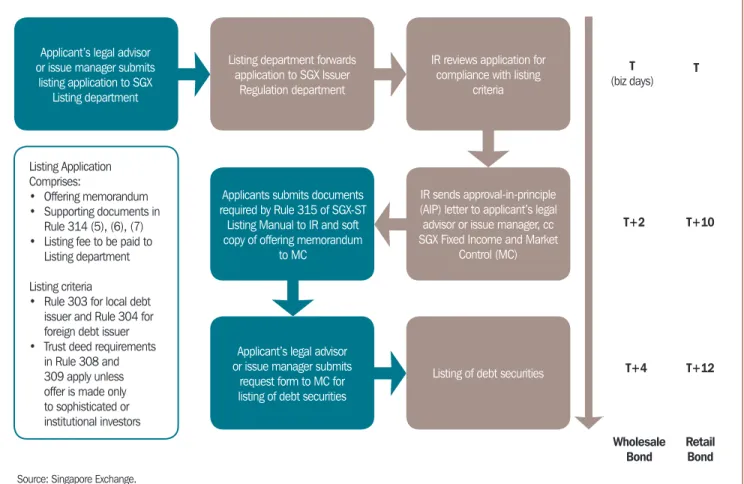
L. General Listing Procedures
The general procedure for the listing of debt securities on SGX is illustrated in Figure 1.2
and followed by a more detailed description of the individual steps thereafter.
Figure 1.2 General Listing Procedure
Applicant’s legal advisor or issue manager submits
listing application to SGX Listing department
Listing Application Comprises:
• Offering memorandum
• Supporting documents in Rule 314 (5), (6), (7)
• Listing fee to be paid to Listing department Listing criteria
• Rule 303 for local debt issuer and Rule 304 for foreign debt issuer
• Trust deed requirements in Rule 308 and 309 apply unless offer is made only to sophisticated or institutional investors
Listing department forwards application to SGX Issuer
Regulation department
Applicants submits documents required by Rule 315 of SGX-ST
Listing Manual to IR and soft copy of offering memorandum
to MC
Applicant’s legal advisor or issue manager submits
request form to MC for listing of debt securities
IR reviews application for compliance with listing
criteria
IR sends approval-in-principle (AIP) letter to applicant’s legal advisor or issue manager, cc SGX Fixed Income and Market
Control (MC)
Listing of debt securities
Wholesale Bond T+4 T+2 T (biz days)
Retail Bond T+12 T+10
T
Source: Singapore Exchange.
1. A listing application, comprising the final form of the prospectus, offering
memorandum, or introductory document prepared in compliance with Rules 312
to 313 and supporting documents set out in Rule 314, is to be submitted to the
Listings Function of the SGX.
2. Upon satisfaction of the listing requirements set out in the application, the SGX
will issue an eligibility-to-list letter for listing, with or without conditions.
3. More information on listing requirements can be obtained from the SGX Listing
Rules, available online at www.sgx.com.
4. The issuer will lodge the prospectus, offering memorandum, or introductory
document with the MAS and other relevant authorities, if applicable, and will
submit a copy to the SGX.
5. Should the prospectus, offering memorandum, or introductory document be
materially different from that on which the eligibility-to-list letter was issued,
the issuer must submit a written confirmation to the SGX to this effect.
Section 9: Singapore Bond Market Guide
ASEAN+3 Bond Market Guide | Volume 1 | Part 2
20
6. The SGX will inform the issuer of any further information that is required to
be disclosed prior to commencement of trading. The issuer may include this
information in its prospectus, offering memorandum, or introductory document,
or to make a pre-quotation disclosure through an announcement to the SGX.
The pre-quotation disclosure must be made no later than the market day before
commencement of trading.
7. The issuer’s debt security will be listed and quoted on the SGX after the conditions
expressed in the eligibility-to-list letter are satisfied.
M. Reference for Singapore Government Securities Listing
SGX commenced the listing of SGS on 8 July 2012, initially selecting 19 SGS issues
with maturities of at least 2 years and the farthest maturity on 1 September 2030.
There is no listing requirement for SGS since they are issued by the government.
18N. Singapore Exchange Rulebook on Debt Securities
The SGX Rulebook details the “Main Board Rules” with its third chapter devoted
to provisions on debt securities.
19Please see Appendix 2 for Chapter 3 of the
SGX Rulebook.
O. Placement of Bonds in the Primary Market
Primary issuance can be in the form of a public offering or a private placement. Public
offering is the selling of registered securities to the broad market, rather than to a
select group of investors. Public bond offerings are usually listed on a stock exchange
in relatively small denominations, and a prospectus is required to be lodged.
A private placement, on the other hand, is the selling of unregistered securities directly,
where offer is made to not more than 50 investors within a 12-month period. Private
bond placements are not listed on a stock exchange, do not require a prospectus, and
consequently cost less than a public offering.
Medium-term note (MTN) programs and reverse enquiries are quite common in the
Singapore debt market. MTNs can be offered continuously through agents or dealers
on a best effort rather than on an underwritten basis, allowing issuers to meet
investors’ demand as it emerges.
There are three types of methods available for primary market placement:
(i) public issue;
18 Singapore Exchange Securities Trading. Singapore Exchange Rulebook. http://rulebook.sgx.com/en/display/ display_viewall.html?rbid=3271&element_id=4953
19 Footnote 14.
(ii) private placement; and
(iii) continuous placement.
Licensed securities dealers and exempt dealers (e.g., banks and merchant banks) are
permitted to engage in primary market transactions as agents of the issuer. Every
public offering of securities requires a prospectus for offering unless it qualifies for
one of the legally defined exemptions. Whenever such exemption is applicable, an
information memorandum or a statement of material facts is to be issued. All issue
managers are required to comply with the requirements in the laws and regulations
(e.g., Banking Act, Securities and Futures Act, and Companies Act, and their corresponding
regulations).
The most common issuance method for bonds in the Singapore market is via
auction. Singapore government securities are issued via auctions conducted by MAS.
Underwriters for corporate bonds may conduct bookbuilding exercises for their
issuers. Some of the salient auction information is provided in Table 1.3.
Table 1.3 Auction Information
SGS Bills SGS Bonds Corporate Bonds
Auction Technique Uniform Pricing (with competitive or noncompetitive bidding)
Uniform Pricing (with competitive or noncompetitive bidding)
Private placement or public offering with appointed financial institutions Auction Frequency Weekly for 3-month T-bills; twice a year for
1-year T-bills
Depends on issuance calendar NA
Typical Issue Size SGD2.3 billion–SGD4.0 billion SGD2 billion–SGD3 billion for benchmark issues NA = not applicable
Source: Monetary Authority of Singapore.
P. Secondary Market Trading
SGS primary dealers also participate in the secondary bond market, including the
trading of corporate bonds through their respective group entities with an SGX
trading seat, as may be applicable.
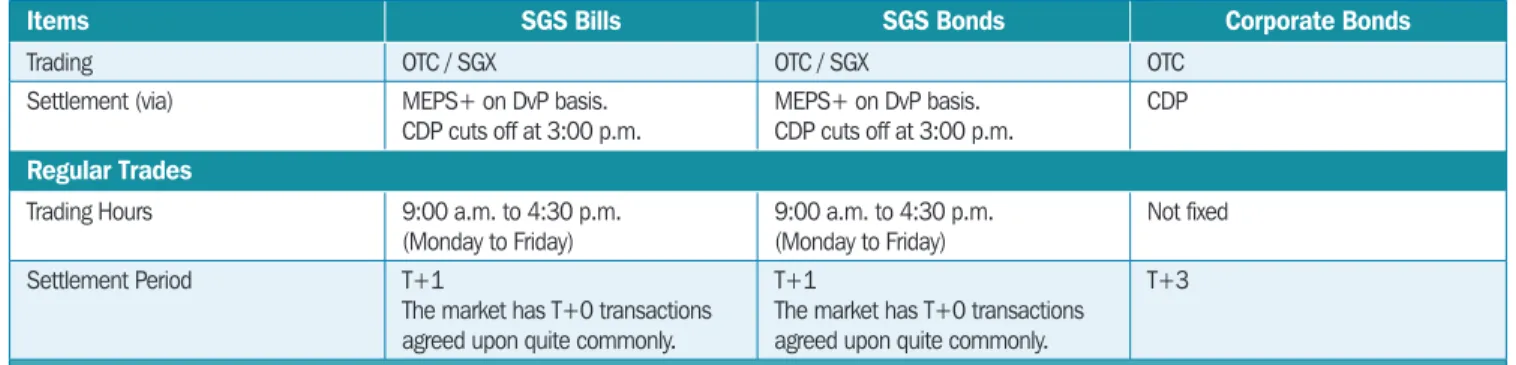
Table 1.4 provides an overview of some of the more general trading and settlement
parameters of the different secondary bond market segments.
Table 1.4 Secondary Market Information
Items SGS Bills SGS Bonds Corporate Bonds
Trading OTC / SGX OTC / SGX OTC
Settlement (via) MEPS+ on DvP basis.
CDP cuts off at 3:00 p.m.
MEPS+ on DvP basis. CDP cuts off at 3:00 p.m.
CDP
Regular Trades
Trading Hours 9:00 a.m. to 4:30 p.m.
(Monday to Friday)
9:00 a.m. to 4:30 p.m. (Monday to Friday)
Not fixed
Settlement Period T+1
The market has T+0 transactions agreed upon quite commonly.
T+1
The market has T+0 transactions agreed upon quite commonly.
T+3
CDP = Central Depository Pte.; DVP = delivery versus payment; MEPS+ = Monetary Authority of Singapore (MAS) Electronic Payment System; OTC = over the counter; SGX = Singapore Exchange; T = time
Source: Monetary Authority of Singapore
Section 9: Singapore Bond Market Guide
ASEAN+3 Bond Market Guide | Volume 1 | Part 2
22
Q. Methods of Issuing Bonds
1. Methods of Issuing Government Bonds
SGS are issued in the primary market through auction according to a pre-announced
issuance calendar in the MAS website. Three-month T-bills are issued weekly, while
1-year T-bills and bonds are issued according to an annual issuance calendar. All
applications for SGS allocations must be submitted through any of the approved SGS
primary dealers. SGS primary dealers will then apply for the book-entry SGS on offer
at primary auctions by way of the SGS electronic applications service (SGS eApps)
available on the SGS website.
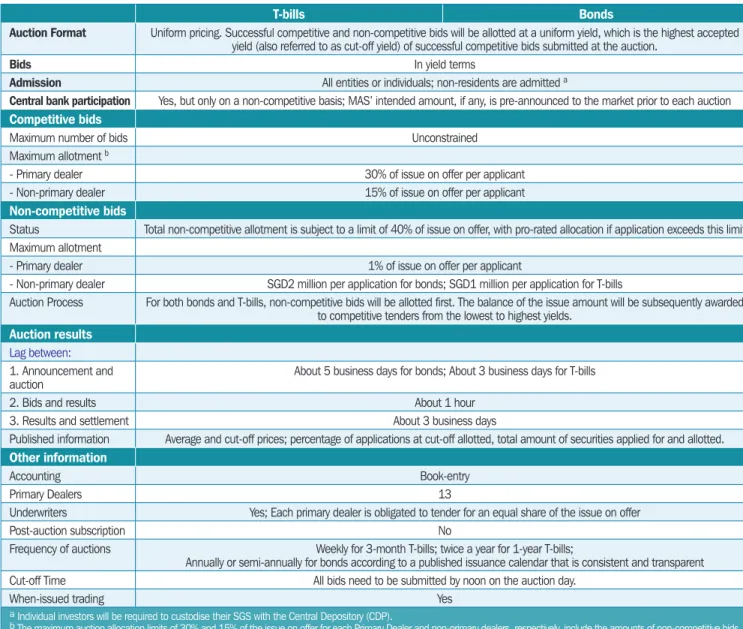
Details of the auction conduct for both Treasury bills and SGS bonds are described in
Table 1.5 below.
Table 1.5 Auction Conduct
T-bills Bonds
Auction Format Uniform pricing. Successful competitive and non-competitive bids will be allotted at a uniform yield, which is the highest accepted yield (also referred to as cut-off yield) of successful competitive bids submitted at the auction.
Bids In yield terms
Admission All entities or individuals; non-residents are admitted a
Central bank participation Yes, but only on a non-competitive basis; MAS’ intended amount, if any, is pre-announced to the market prior to each auction Competitive bids
Maximum number of bids Unconstrained
Maximum allotment b
- Primary dealer 30% of issue on offer per applicant
- Non-primary dealer 15% of issue on offer per applicant
Non-competitive bids
Status Total non-competitive allotment is subject to a limit of 40% of issue on offer, with pro-rated allocation if application exceeds this limit Maximum allotment
- Primary dealer 1% of issue on offer per applicant
- Non-primary dealer SGD2 million per application for bonds; SGD1 million per application for T-bills
Auction Process For both bonds and T-bills, non-competitive bids will be allotted first. The balance of the issue amount will be subsequently awarded to competitive tenders from the lowest to highest yields.
Auction results Lag between: 1. Announcement and
auction About 5 business days for bonds; About 3 business days for T-bills
2. Bids and results About 1 hour
3. Results and settlement About 3 business days
Published information Average and cut-off prices; percentage of applications at cut-off allotted, total amount of securities applied for and allotted. Other information
Accounting Book-entry
Primary Dealers 13
Underwriters Yes; Each primary dealer is obligated to tender for an equal share of the issue on offer
Post-auction subscription No
Frequency of auctions Weekly for 3-month T-bills; twice a year for 1-year T-bills;
Annually or semi-annually for bonds according to a published issuance calendar that is consistent and transparent
Cut-off Time All bids need to be submitted by noon on the auction day.
When-issued trading Yes
a Individual investors will be required to custodise their SGS with the Central Depository (CDP).
b The maximum auction allocation limits of 30% and 15% of the issue on offer for each Primary Dealer and non-primary dealers, respectively, include the amounts of non-competitive bids. Source: Singapore Government Securities. http://www.sgs.gov.sg/market_characteristics/mktchar_auctions.html