INTRODUCTION
Inguinal hernias are common, with a lifetime risk of 27% for men and 3% for women (1). Inguinal her-nia surgery is one of the most common surgical pro-cedures performed worldwide (2). The standard method for inguinal hernia repair had changed lit-tle during the 100 years before the introduction of
synthetic mesh. This mesh can be placed using either an open approach or a minimal access laparo-scopic technique. Compared with open repairs, la-paroscopic inguinal hernia repair has some advan-tages, including less postoperative pain, a shorter recovery period, earlier return to daily activities and work, and better cosmetic results (3-5).
Currently, most laparoscopic inguinal hernia re-pairs are performed with placement of a synthetic mesh into the pre-peritoneal space, which can be accomplished in one of two ways : the transabdomi-nal pre-peritoneal (TAPP) approach or the totally extra-peritoneal pre-peritoneal (TEPP) approach. Of the two approaches, TAPP is easier to learn and
ORIGINAL
The safety and usefulness of the single incision,
transabdominal pre-peritoneal (TAPP) laparoscopic
technique for inguinal hernia
Hirohiko Sato, Mitsuo Shimada, Nobuhiro Kurita, Takashi Iwata, Masanori Nishioka,
Shinya Morimoto, Kozo Yoshikawa, Tomohiko Miyatani, Masakazu Goto,
Hideya Kashihara, and Chie Takasu
Department of Surgery, Institute of Health Biosciences, the University of Tokushima, Tokushima, Japan
Abstract : Background : The safety and usefulness of the SILS-TAPP (transabdominal pre-peritoneal) procedure remain unclear. The aim of this study was to clarify the safety and usefulness of the SILS-TAPP procedure compared with standard laparoscopic TAPP and TEPP (totally extra-peritoneal pre-peritoneal) procedures. Patients and methods : 85 tients underwent laparoscopic inguinal hernia repairs (TEPP, 30 patients ; TAPP, 20 pa-tients ; SILS-TAPP, 35 papa-tients) from 2007 to 2011. The operative outcomes of the three groups were compared. Results : There was no difference in the patients’ characteristics among the three groups. The TEPP Group had a longer operation time. One patient in the SILS-TAPP group had an intraoperative complication. One patient in the TAPP group had a postoperative complication, and one patient had ileus and one had an umbilical hernia in the SILS-TAPP group. The postoperative hospital stay was not significantly different among the three groups. There were no recurrences in the TEPP group, 1 case of recurrence (5.0%%) in the TAPP group, and 1 case (2.9%%) in the SILS-TAPP group. Con-clusions : The present findings show that the SILS-TAPP repair is safe and feasible for the repair of adult inguinal hernia. J. Med. Invest. 59 : 235-240, August, 2012
Keywords : single incision, transabdominal pre-peritoneal (TAPP), inguinal hernia
Received for publication December 26, 2011 ; accepted January 25, 2012.
Address correspondence and reprint requests to Mitsuo Shimada, Department of Surgery, Institute of Health Biosciences, the University of Tokushima, 3 - 18 - 15 Kuramoto - cho, Tokushima, 770 - 8503, Japan and Fax : + 81 - 88 - 631 - 9698.
may be associated with a shorter learning curve (6). This is largely related to the small working space in TEPP compared with TAPP repairs (7, 8).
As a bridge between traditional laparoscopy and natural orifice transluminal endoscopic surgery (NOTES), the recent focus has been on the develop-ment of single-incision laparoscopic surgery (SILS) to further minimize the invasiveness of laparoscopy by reducing the number of incisions and, hopefully, the pain and complications associated with them (9). The main reasons for reducing the number of incisions include each incision risks the morbidity of bleeding, incisional hernia, and organ damage, and decreases cosmesis.
Recently, SILS has been used in several opera-tions, including various urologic and upper gastro-intestinal and lower gastrogastro-intestinal operations (10-13). The SILS technique has the potential to disrupt the current laparoscopic surgical field similar to the way that laparoscopy challenged open surgery 20 years ago.
In this study, the feasibility and safety of SILS-TAPP hernia repair were compared with those of standard laparoscopic TAPP and TEPP repairs by analyzing the operation time, postoperative hospital stay, conversion to conventional methods, intra- and postoperative complications, and recurrence.
PATIENTS AND METHODS
A total of 85 patients who underwent an elective laparoscopic inguinal hernia repair in the Depart-ment of Tokushima University Hospital since Janu-ary 2007 through December 2011 was prospectively enrolled in this study. All patients diagnosed pre-operatively with inguinal hernia were included, while patients with previous lower abdominal and pelvic surgery were excluded.
Patients’ demographic data, operative and post-operative course, and outpatient follow-up were studied. The following data were collected prospec-tively : age, sex, duration of surgery, intraoperative complications, postoperative complications, hospital stay, recurrence, and distant events. All data were compared among the three groups (TEPP, 30 pa-tients ; TAPP, 20 papa-tients ; SILS-TAPP, 35 papa-tients). Statistical analysis was performed using the un-paired Student’s t-test and the Mann-Whitney U-test for continuous variables, and the Chi-square test for categorical variables. For all three tests, P! 0.05 was interpreted as being significantly different.
Values for all continuous variables were expressed as means"standard deviation (SD).
OPERATIVE TECHNIQUE FOR SILS-TAPP
Under general anesthesia in the supine position, a single, 15-mm, completely transumbilical skin in-cision and a 15- to 20-mm rectus fasciotomy were made to enter the peritoneal cavity. An EZ trocar (Hakko Medical, Nagoya, Japan) device was placed in position through the incision.Through this EZ access port, three 5-mm trocars were introduced. The pre-peritoneal space was in-flated with carbon dioxide (CO2) gas, and a flex-ible camera was inserted through the 5-mm trocar. The intra-abdominal pressure was maintained at 12 mmHg. The surgical technique was the same as that described for a laparoscopic TAPP repair. The peri-toneum was incised over the hernia and extended laterally using the Harmonic ACETM(Ethicon Endo Surgery). The hernial sac was reduced meticulously, carefully preserving the epigastric vessels and vas deferens using a combination of Roticulator Endo DissectorTM(Covidien) and Harmonic ACETM (Ethi-con Endo Surgery). The pubic tubercle was then clearly defined. Once the dissection was complete, the EZ access was removed, a 15
!
11-cm polypro-pylene mesh was inserted into the abdominal cavity, and no gas leak was observed. The mesh was fixed medially over the pubic tubercle and superiorly to the abdominal wall using ProTackTM(CovidienTM). The peritoneum was closed over the mesh by 3-0 V-LocTM(Covidien absorbable) 180. The pneumop-eritoneum was then released under vision to en-sure that the repair remained firm. The fascial and skin incisions were closed using 1-0 and 4-0 PDS (Ethicon) sutures, respectively.RESULTS
Patients’ demographics and hernia characteristics
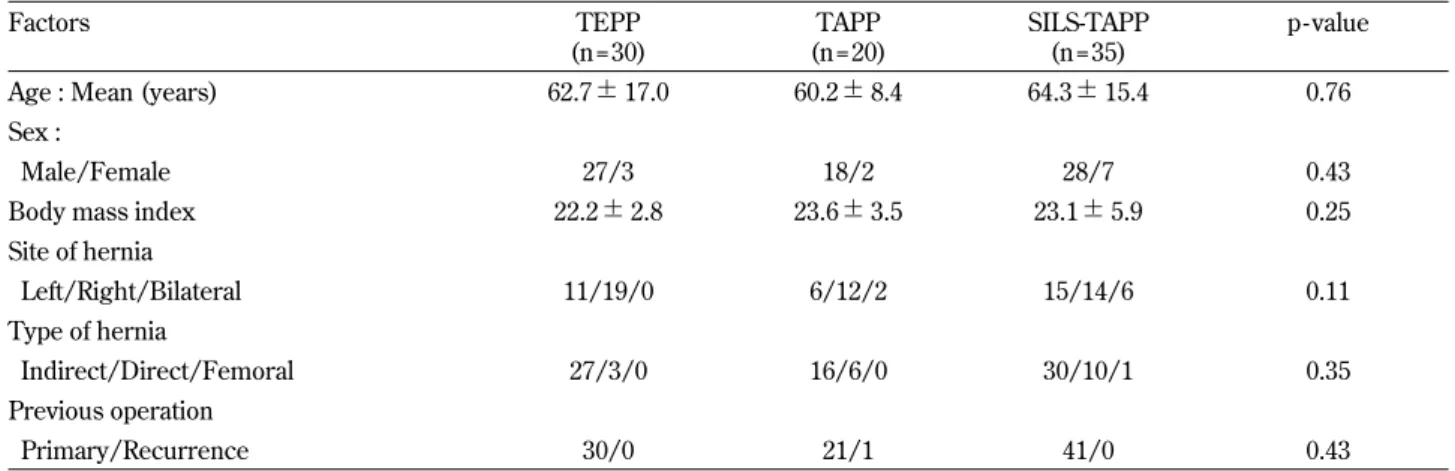
The patients’ demographic, site and type of her-nia are shown in Table 1. Patient age, sex ratio, body mass index (BMI), site of hernia, and type of hernia were similar among the three groups. Most patients were males. A total of 93 was included in the study ; 77 patients had unilateral (32 right and 46 left), while 8 patients had bilateral hernias. Over-all, 73 patients had indirect hernias, 19 had direct hernias, and 1 patient had a femoral hernia. One
patient underwent TAPP repair for recurrence after TAPP repair.
Perioperative data
The perioperative data are summarized in Table 2. Preoperative risk was evaluated according to the American Society of Anesthesiologists (ASA) physi-cal status score. The mean operation time for unilat-eral hernias was 94.1!35.4 min for TEPP, 86.1! 42.0 min for TAPP, and 91.2!24.6 min for SILS-TAPP. There was no significant difference among the three groups in operative time. The mean opera-tion time for bilateral hernias was 145.0!7.1 min for TAPP and 136.0!46.3 min for SILS-TAPP. There was no significant difference between the two groups. One (2.9%) intraoperative complication oc-curred in the SILS-TAPP group (bleeding from epi-gastric vessels) ; it was treated laparoscopically by clip application. There was no significant difference in intraoperative complications among the three groups. Two hernias (1 TEPP, 1 TAPP) required conversion to conventional repair. The conversion in the TEPP group was due to a huge hernia sac, while
in the TAPP group it was due to a pre-peritoneal adhesion associated with a previous TAPP repair. There was no significant difference in the conversion rate among the three groups. The mean hospital stay was 3.6!1.4 days for TEPP, 4.2!1.7 days for TAPP, and 4.5!1.7 days for SILS-TAPP. There was no significant difference among the three groups. Postoperative complications were reported in 3 pa-tients : 1 patient (5%) developed a seroma in the TAPP group, which was resolved by aspiration ; 1 patient (2.9%) developed ileus in the SILS-TAPP group, which was resolved laparoscopically ; and 1 patient (2.9%) in the SILS-TAPP group developed a postoperative umbilical hernia arising from the umbilical port site and underwent re-operation six months after the hernia repair. There was no signifi-cant difference among the three groups in the post-operative complication rate. There was no chronic pain or infection in the three groups. One patient (5.0%) after TAPP and one patient (2.9%) after SILS-TAPP developed recurrences ; there was no signifi-cant difference among the three groups in the recur-rence rate.
Table 1 :Patients’ clinicopathological characteristics (n= 74)
Factors TEPP (n = 30) TAPP (n = 20) SILS-TAPP (n = 35) p - value
Age : Mean (years) 62.7!17.0 60.2!8.4 64.3!15.4 0.76
Sex :
Male/Female 27/3 18/2 28/7 0.43
Body mass index 22.2!2.8 23.6!3.5 23.1!5.9 0.25
Site of hernia Left/Right/Bilateral 11/19/0 6/12/2 15/14/6 0.11 Type of hernia Indirect/Direct/Femoral 27/3/0 16/6/0 30/10/1 0.35 Previous operation Primary/Recurrence 30/0 21/1 41/0 0.43
Table 2 :Summary of perioperative data (n = 74)
Factors TEPP (n = 30) TAPP (n = 20) SILS - TAPP (n = 35) p - value
Operation time (min)
Unilateral 94.1!35.4 86.1!42.0 91.2!24.6 0.73
Bilateral 145.0!7.1 136.0!46.3 0.80
Intraoperative
Complications (%) 0 0 2.9 0.59
Conversions (%) 3.3 5.0 0.0 0.44
Hospital stay (days) 3.6!1.4 4.2!1.7 4.5!1.7 0.08
Postoperative
Complications (%) 0.0 5.0 5.7 0.99
DISCUSSION
Minimally invasive surgery has been widely viewed as superior to traditional surgery in many gastrointestinal fields. The major advantages include postoperative pain reduction, shorter hospital stay, and earlier return to work (14-16).
Concerning hernia repair, in the beginning of the 1990s, laparoscopic hernia repair was controversial because various studies reported early recurrence rates as high as 25% (17, 18).
However, after a decade of experience in laparo-scopic hernia surgery, this method had made sig-nificant strides and has become the first choice for inguinal hernia repair in many centers (19, 20). In terms of recurrence rates alone, laparoscopic tech-niques are superior to anterior suture repairs, as confirmed by a systematic review of randomized, controlled trials. A comparison of mesh procedures showed no significant differences with regard to recurrences between open and laparoscopic ap-proaches in the case of primary hernias (21).
Several laparoscopic techniques to manage groin hernias have been described (22-28). Two laparo-scopic techniques have become the most common procedures to repair groin hernias : TAPP and TEPP repairs. In both methods, a mesh prosthesis is im-planted into the pre-peritoneal space dorsal to the transversalis fascia. The TEPP procedure combines the advantages of tension-free mesh reinforcement of the groin with those of laparoscopic surgery, with its low postoperative pain and shortened recovery time, while obviating the need for a transabdominal approach.
In addition to its well-known benefits of decreased postoperative pain and shorter recovery time, laparo-scopic hernia repair has the major advantage of al-lowing the surgeon to explore the side contralateral to the clinically diagnosed hernia, therefore diagnos-ing and repairdiagnos-ing any unsuspected contralateral her-nia encountered. While laparoscopic TAPP herher-nia repair allows easy identification of the hernia sac without any need to dissect the spermatic cord, TEPP repair requires additional dissection to make the diagnosis of a contralateral hernia.
Sayad et al. (29) and Koehler (30) have previ-ously reported the rate of occult contralateral her-nias found during TEPP repair to be 11% and 13%, respectively. They concluded that systematic con-tralateral exploration using the TEPP approach is safe and does not greatly increase operating time, while the patient can avoid re-operation, exposure
to second anesthesia, and another period of work loss.
Traditionally, the operation involves inserting three ports : the camera port below the umbilicus, and two ports bilaterally, just lateral to the rectus muscle, resulting in three surgical scars (31). The development of SILS has the aim of reducing the invasiveness of traditional laparoscopy and improv-ing the cosmetic outcome. The main reasons for re-ducing the number of incisions and trocar place-ments include that each incision risks the morbid-ity of bleeding, incisional hernia, and organ damage, and decreases cosmesis (32).
Different methods are used for port access to per-form SILS. Multiple fascial punctures have been performed through one skin incision (33). Recent advances in laparoscopic surgery include single-port access devices that facilitate a single incision and single-site ports that include multiple chan-nels to accommodate multiple surgical instruments through one access site. These channels provide a pathway to the abdomen, thus eliminating the re-quirement for multiple incisions and multiple ports (34). For these reasons, the EZ access port was used for all patients in the present study. It did not add new risks, and in the present series it provided an operating view that was the same as in standard laparoscopic TAPP. In addition, the mesh can be easily inserted by removing the EZ access, which is an advantage of EZ access.
The cosmetic outcomes of SILS are expected to be better when the operation is performed through the umbilicus because the surgical wound is hidden within the umbilicus, leaving no visible abdominal scars (35). Apart from cosmesis, the only other pro-posed benefits of SILS include less incisional pain. Over the past 2 years, numerous reports of transum-bilical SILS application have been published, show-ing the feasibility of this approach for even com-plex urologic, gynecologic, and visceral procedures (10-13).
Based on the present results, all procedures could be performed successfully using conventional instru-ments, although one patient underwent conversion to conventional repair. The mean operative time was no longer than for standard TEPP and TAPP, and a trend of decreasing operative time with increas-ing experience was found. The cosmetic results were excellent, with the single incision placed inside the natural fold of the umbilicus. The length of hos-pital stay was comparable with that for standard TEPP and TAPP repair.
The difficulty of this procedure lies in avoiding conflict amongst the instruments when operating in such a confined space. The roticulated dissector forceps is useful to avoid interference. There are three main methods of using forceps : the cross method using two roticulated dissectors with both hands ; the combined method using one roticulated dissector and one straight dissector ; and the par-allel method using two straight dissectors. In our experience, the cross method is the best method. Though the specialized instruments, either bent or flexible, could facilitate viewing and dissection, the crossed instrument technique is useful. We believe that good coordination between the surgeon and the camera assistant could reduce clashing of the instruments and the laparoscope during the surgery. We would recommend closing the peritoneum over the mesh using intracorporeal suturing, as direct contact with the bowel increases the incidence of adhesive obstruction. The absorbed suture of 3-0 V-LocTM180 is very useful for peritoneal suture be-cause no loosening occurs.
Although our operative time was 91.2 min for uni-lateral hernias and 136.0 min for biuni-lateral hernias, we believe that further refinement of the technique and modification of the instruments will consider-ably reduce this. The results of the present study suggest that SILS-TAPP can be extended safely to the TAPP approach for inguinal hernia repair. The advantage of such an approach above and beyond cosmesis remains to be evaluated.
CONCLUSIONS
The present findings show that SILS-TAPP repair using the EZ access port and standard instruments is safe and feasible for the repair of adult inguinal hernia and provides excellent cosmetic outcomes. A prospective, randomized study should be con-ducted to confirm the efficacy and safety of this procedure.
DISCLOSURES
Drs. Sato, Shimada, Kurita, Iwata, Nishioka, Morimoto, Yoshikawa, Miyatani, Goto, Kashihara, and Takasu have no conflicts of interest or financial ties to disclose.
REFERENCES
1. Gray SH, Hawn MT, Itani KM : Surgical pro-gress in inguinal and ventral incisional hernia repair. Surg Clin North Am 88 : 17-26, 2008 2. Rutkow IM : Demographic and socioeconomic
aspects of hernia repair in the United States in 2003. Surg Clin North Am 83 : 1045-1051, 2003 3. Memon MA, Cooper NJ, Memon B, Memon MI, Abrams KR : Metaanalysis of randomized clinical trials comparing open and laparoscopic inguinal hernia repair. Br J Surg 90(12) : 1479-1492, 2003
4. McCormack K, Scott N, Go PM, Ross SJ, Grant A, Collaboration the EU Hernia Trialists : La-paroscopic techniques versus open techniques for inguinal hernia repair. Cochrane Database Syst Rev 1 : CD001785, 2003
5. Takata MC, Duh QY : Laparoscopic inguinal hernia repair. Surg Clin North Am 88 : 157-178, 2008
6. Leibl BJ, Jager C, Kraft B, Kraft K, Schwarz J, Ulrich M, Bittner R : Laparoscopic hernia re-pair : TAPP or/and TEP? Langenbecks Arch Surg 390 : 77-82, 2005
7. Rosen MJ : Laparoscopic transabdominal preperi-toneal inguinal hernia repair. Operat Tech Gen Surg 8 : 45-51, 2006
8. Novitsky YW, Czerniach DR, Kercher KW, Kaban GK, Gallagher KA, Kelly JJ, Heniford BT, Litwin DE : Advantages of laparoscopic transabdominal preperitoneal herniorrhaphy in the evaluation and management of inguinal her-nias. Am J Surg 193 : 466-470, 2007
9. Chamberlain RS, Sakpal SV : A comprehensive review of single-incision laparoscopic surgery (SILS) and natural orifice transluminal endo-scopic surgery (NOTES) techniques for chole-cystectomy. J Gastrointest Surg 13 : 1733-1740, 2009
10. Bucher P, Pugin F, Morel P : Single-port ac-cess laparoscopic right hemicolectomy. Int J Colorectal Dis 23 : 1013-1016, 2008
11. Barbaros U, Dinccag A : Single-incision laparo-scopic splenectomy : the first two cases. J Gas-trointest Surg 13 : 1520-1523, 2009
12. Reavis KM, Hinojosa MW, Smith BR : Single-laparoscopic incision transabdominal surgery sleeve gastrectomy. Obes Surg 18 : 1492-1494, 2008
13. Irwin BH, Rao PP, Stein RJ, Desai MM : La-paroendoscopic single-site surgery in urology.
Urol Clin North Am 36 : 223-235, 2009
14. Shimizu S, Uchiyama A, Mizumoto K : Laparo-scopically assisted distal gastrectomy for early gastric cancer. Is it superior to open surgery? Surg Endosc 14 : 27-31, 2000
15. Lacy AM, Garcia-Valdecasas JC, Delgado S : Laparoscopic-assisted colectomy versus open colectomy for treatment of non-metastatic colon cancer : a randomized trial. Lancet 359(9325) : 2224-2229, 2002
16. Reyes CD, Weber KJ, Gagner M : Laparoscopic versus open gastrectomy. A retrospective re-view. Surg Endosc 15(9) : 928-931, 2001 17. Fitzgibbons RJ, Camps J, Cornet DA :
Laparo-scopic inguinal herniorrhaphy : results of a mul-ticenter trail. Ann Surg 221 : 3-13, 1995 18. Vogt DM, Curet MJ, Pitcher DE : Preliminary
results of a prospective randomized trial of la-paroscopic versus conventional inguinal hernior-rhaphy. Am J Surg 169 : 84-89, 1995
19. Dulucq JL, Wintringer P, Mahajna A : Laparo-scopic totally extraperitoneal inguinal hernia re-pair : lessons learned from 3,100 hernia rere-pairs over 15 years. Surg Endosc 23(3) : 482-486, 2008
20. Ramshaw B, Shuler FW, Jones HB, Duncan TD, White J, Wilson R, Lucas GW, Mason EM : Laparoscopic inguinal hernia repair : lessons learned after 1224 consecutive cases. Surg En-dosc 15(1) : 50-54, 2001
21. EU Hernia Trialists Collaboration : Laparoscopic compared with open methods of groin hernia repair : systematic review of randomized con-trolled trials. Br J Surg 87 : 860-867, 2000 22. Liem MSL, van der Graaf Y, van Steensel CJ :
Comparison of conventional anterior surgery for inguinal hernia repair. N Engl J Med 336 : 1541-1547, 1997
23. Camps J, Nguyen N, Annabali R : Laparoscopic inguinal herniorrhaphy : transabdominal tech-niques. Int Surg 80 : 18-25, 1995
24. Felix EL, Michas CA, Gonzalez MHJ : Laparo-scopic hernioplasty. Surg Endosc 9 : 984-989, 1995
25. Sosa JL, Puente I, Markley M : A modified technique of laparoscopic herniorrhaphy : op-erative approach and early results. Int Surg 79 : 300-303, 1994
26. Wishart GC, Wright D, O’Dwyer PJ : Use of a Foley catheter to dissect the preperitoneal space for extraperitoneal endoscopic hernia re-pair. J Laparoendosc Surg 5 : 27-29, 1995 27. Dulucq JL : Treatment of inguinal hernias by
insertion of mesh through retroperitoneoscopy. Post Grad Gen Surg 4 : 173-174, 1992
28. Dulucq JL : Pre-peritoneal approach in laparo-scopic treatment of inguinal hernia. J Chir 137 (5) : 285-288, 2000
29. Sayad P, Abdo Z, Cacchione R, Ferzli G : Inci-dence of incipient contralateral hernia during laparoscopic hernia repair. Surg Endosc 4(6) : 543-545, 2000
30. Koehler RH : Diagnosing the occult contralat-eral inguinal hernia. Surg Endosc 16(3) : 512-520, 2002
31. Brunicardi FC : Inguinal hernias. In : Brunicardi FC (ed) Schwartz’s Principles of Surgery, 9th edn. McGraw-Hill, New York, pp.2514-2586, 2010
32. Filipovic-Cugura J, Kirac I, Kulis T, Jankovic J, Bekavac-Beslin M : Single-incision laparoscopic surgery (SILS) for totally extraperitoneal (TEP) inguinal hernia repair : first case. Surg Endosc 23 : 920-921, 2009
33. Merchant AM, Cook MW, White BC, Davis SS, Sweeney JF, Lin E : Transumbilical Gelport ac-cess technique for performing single-incision laparoscopic surgery (SILS). J Gastrointest Surg 13 : 159-162, 2008
34. Pryor AD, Tushar JR, DiBernardo LR : Single-port cholecystectomy with the TransEnterix SPIDER : simple and safe. Surg Endosc 24 : 917-923, 2010
35. Huang CK, Tsai JC, Lo CH, Houng JY, Chen YS, Chi SC, Lee PH : Preliminary surgical results of single - incision transumbilical la-paroscopic bariatric surgery. Obes Surg. doi : 10.1007/s11695-009-0071-9, 2010