Title
Disappearance of the Self-Interstitial during Diffusion of the
Phosphorus-Self-Interstitial Pair in Silicon on the Basis of
One-Bond-Type Migration
Author(s)
田中秀司, 師岡正美, 吉田正幸
Citation
福岡工業大学研究論集 第45巻2号(通巻69号) P47-P49
Issue Date
2013-2
URI
http://hdl.handle.net/11478/1271
Right
Type
Departmental Bulletin Paper
Textversion Publisher
福岡工業大学 機関リポジトリ
FITREPO
Disappearance of the Self-Interstitial during Diffusion of the
Phosphorus-Self-Interstitial Pair in Silicon on the Basis of
One-Bond-Type M igration
Shuji T
ANAKA(Department of Information Electronics)
Masami M
OROOKA(Department of Electrical Engineering)
Masayuki Y
OSHIDA(Yoshida Semiconductor Laboratory)
Abstract
In the interstitialcy mechanism of diffusion of phosphorus-self-interstitial pairs on the basis of one-bond-type migration,the split-<100> configuration and the bond-centered configuration are repeated. This is studied theoreti-cally using three dimensional schemata. It is found that the self-interstitial disappears in the bond-centered configura-tion. This finding contrasts with that of Fahey,Griffin,and Plummer,who reported that,probably on the basis of two-bond-type migration, the interstitialcy mechanism will operate only if the diffusing defect, the phosphorus-self-interstitial pair, does not dissociate.
Keywords:interstitialcy mechanism, one-bond-type migration, disappearance of self-interstitial
1. Introduction
Watkins and Corbett 1)experimentally studied the
reor-ientation of the phosphorus-vacancy pair, that is, the diffu-sion of the pair. They proposed that,in the reorientation, a vacancy located at the normal nearest neighbor site of phosphorus atom makes four consecutive jumps, two away from the phosphorus atom and then two back. Note that the phosphorus-vacancy pair must partially dissociate through these jumps. The largest separation between the phosphorus atom and the vacancy during dissociation occurs at the third nearest neighbor site.
Fahey et al.2)
theoretically studied the interstitialcy mechanism of impurity diffusion, using two dimensional schemata,and reported the following: An important differ-ence exists between the interstitialcy diffusion mechanism and the vacancy diffusion mechanism. Whereas migration of a dopant atom (A) by the vacancy mechanism requires that the diffusing defect (AV pair) must at least partially dissociate, the interstitialcy mechanism will operate only if the diffusing defect (AI pair) does not dissociate.
Yoshida et al.3,4) theoretically studied the interstitialcy
mechanism of diffusion of the phosphorus-self-interstitial pairs on the basis of one-bond-type migration, using three dimensional schemata. The purpose of the present work is to comment on the work of Fahey et al.2)based on Yoshida
et al.4)
In the present work,migration and diffusion have the same physical meaning.
2. Interstitialcy mechanism
Group-V impurities in silicon are located at substitutional sites.5) Therefore their diffusion is assisted by vacancies
and self-interstitials located at the impurities nearest neigh-bor sites. These types of diffusion are called the vacancy mechanism6)
and the interstitialcy mechanism,7,8)
respective-ly.
Following Seeger and Chik8)
the interstitialcy mechanism is explained by using Fig. 1.
Fig.1 a:Just before diffusion,a self-interstitial is located at an interstitial site next to a substitutional impurity atom. Fig. 1 b: The self-interstitial next to the substitutional impurity atom displaces the impurity atom into an
inter-47 福岡工業大学研究論集 Res. Bull. Fukuoka Inst. Tech., Vol.45 No.2(2012)47−49
平成24年10月29日受付
○ lattice atom ⃝I self-interstitial ● impurity atom Fig. 1. Interstitialcy mechanism of impurity diffusion. a just before diffusion b diffusion c just after diffu-sion
stitial site, occupying itself the lattice site. The impurity atom subsequently displaces a silicon atom on a neighbor-ing lattice site into an interstitial site. The impurity atom takes up its original nearest neighbor site.
Fig. 1 c:As a result, the impurity atom has moved by one interatomic distance.
3. Disappearance of self-interstitial
For the explanation of disappearance of self-interstitial in Fig.1 b,Fig.1 b is divided into three parts and is shown in Fig. 2.
Fig. 2 a: The self-interstitial next to the substitutional impurity atom displaces the impurity atom into an inter-stitial site, occupying itself the lattice site.
Fig. 2 b: As a result of Fig. 2 a, the self-interstitial disappears and the impurity atom moves into an interstitial site. The explanation of Fig. 2 b the self-interstitial disappears will be presented again in the final part of the present work.
Fig. 2 c: The impurity atom, which is located at the interstitial site in Fig.2 b,subsequently displaces a silicon atom on a neighboring lattice site into an interstitial site. The impurity atom takes up its original nearest neighbor site.
Watkins et al.9)
theoretically studied four different self-interstitial configurations of carbon in diamond and con-cluded that the split-<100> and bond-centered configura-tions have nearly the same energies and are more stable than the tetrahedral and hexagonal configurations. Although Car et al.10)
proposed that the split interstitial configuration lies somewhat higher in energy,the idea of Watkins et al.9)
mentioned above is adopted in the present work. The split-<100> and bond-centered configurations are called the interstitialcy configuration.9)
Yoshida et al.3) proposed two types of migration that
occur in the interstitialcy configuration, that is, bond-type migration and two-bond-bond-type migration. In one-bond-type migration, one bond is first broken and then
another new bond is formed. In two-bond-type migration, two bonds are broken simultaneously and then two new bonds are formed simultaneously. It was concluded3)
that one-bond-type migration is more likely to occur,because in two-bond-type migration two bonds have to be broken and formed simultaneously. One-bond-type migration is the repetition of the split-<100> (SP)and bond-centered (BC) configurations. Two-bond-type migration is the repetition of only the split-<100> configuration or only the bond-centered configuration.
Prior to Fahey et al.2)
Mathiot 11)
schematically showed the interstitialcy mechanism for impurity diffusion in two dimensions. They2,11)
showed the migration of the split configuration without showing the migration of the bond-centered configuration. Therefore their result was most likely caused by two-bond-type migration.
Yoshida et al.4)
studied one-bond-type migration of phosphorus-self-interstitial pairs in silicon. Because the first half of Fig. 1 of Yoshida et al.4)shows the shortest
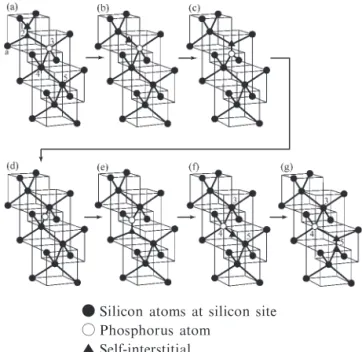
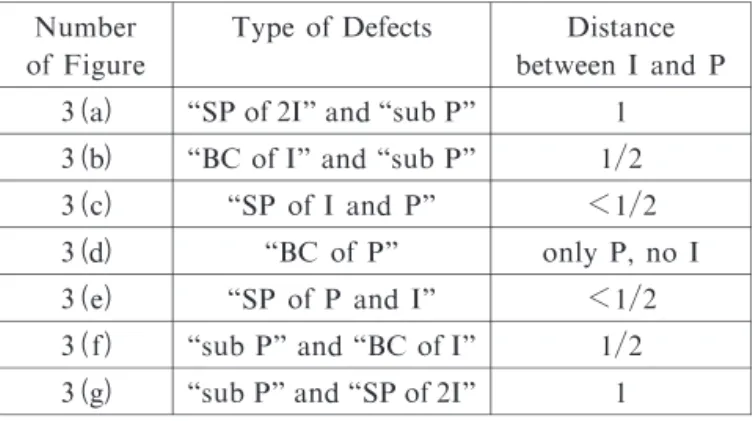
migration process for substitutional P to migrate by one interatomic distance, this is shown in Fig.3. The types of defects shown in Fig. 3 are listed in Table I, where the self-interstitial is denoted by I.
Figure 3 a shows the arrangement of the SP configura-tion of two self-interstitials(I)and the substituconfigura-tional P (sub P) before the diffusion of the phosphorus-self-interstitial pair. This is marked in Table I as SP of 2I and sub P . In Fig. 3 a, SP of 2I is located one interatomic distance
DisappearanceoftheSelf-Interstitial during Diffusion ofthePhosphorus-Self-Interstitial Pairin Silicon on theBasisofOne-Bond-TypeMigration(TANAKA・MOROOKA・YOSHIDA)
Fig. 2. Division of Fig. 1 b into three parts for the explanationof disappearance of self-interstitial.
● Silicon atoms at silicon site ○ Phosphorus atom
▲ Self-interstitial
Fig. 3. One-bond-type migration of the phosphorus-self-interstitial pair. (After Yoshida et al.4))
away from sub P in the opposite direction of the diffusion. Figure 3 b shows the arrangement of the atoms just before the diffusion of the pair. By breaking the a-2 bond and forming a new bond,a-1,in Fig.3 a,or by one-bond-type migration,we have Fig.3 b,where the BC configura-tion of I is located 1/2 of an interatomic distance away from
sub P in the direction opposite to the diffusion. This is marked in Table I as BC of I and sub P .
In Fig.3 c we have a SP configuration that consists of I and P. The distance between them is less than 1/2 of an interatomic distance.
Note that in Fig. 3 d only the BC configuration of P exists. There is no I in the migration of the phosphorus-self-interstitial pair.
In this way,SP and BC configurations repeat. This is a feature of one-bond-type migration. Through the repeti-tion of one-bond-type migrarepeti-tion from Fig.3 a to Fig.3 g , the substitutional P migrates by one interatomic distance.
In the present work, the interstitialcy mechanism of diffusion of phosphorus-self-interstitial pairs on the basis of one-bond-type migration, that is, the repetition of SP and BC configurations, was studied theoretically using three dimensional schemata.
As described already, Fahey et al.2)
reported, using two dimensional schemata,that the interstitialcy mechanism will operate only if the diffusing defect (AI pair) does not dissociate. Their report was most probably based on a study using two-bond-type migration,because BC configura-tion was not shown in their report.
We emphasize that,in the theoretical study of diffusion of phosphorus-self-interstitial pairs on the basis of one-bond-type migration using three dimensional schemata, we find only the BC configuration of P and no I as shown in Fig. 3 d. This finding contrasts with that of Fahey et al.2)and
corresponds to the self-interstitial (I) disappears in the final part of the description in Fig. 2 b. These are the
comment on the work of Fahey et al.2)based on Yoshida et
al.4)
References
1) G.D.Watkins and J.W.Corbett:Phys.Rev.134(1964) A1359.
2) P. M. Fahey, P. B. Griffin, and J. D. Plummer: Rev. Mod. Phys. 61 (1989) 289.
3) M. Yoshida, R. Tsuruno, Y. Kamiura, M. Takahashi, and H. Tomokage:Jpn. J. Appl. Phys. 36 (1997) 7156. 4) M. Yoshida, Y. Kamiura, R. Tsuruno, M. Takahashi,
and H. Tomokage: Jpn. J. Appl. Phys. 37 (1998) 6376. Erratum, Jpn. J. Appl. Phys. 38 (1999) 1596.
5) N. B. Hannay: Semiconductors, ed. N. B. Hannay (Reinhold, New York, 1959) Chap. 1, p. 17.
6) C. Kittel: Introduction to Solid State Physics (John Wiley and Sons, New York and Maruzen, Tokyo, 1956) p. 488.
7) F. Seitz:Acta Cryst. 3 (1950) 355.
8) A.Seeger and K.P.Chik:phys.stat.sol.29 (1968)455. 9) G.D.Watkins,R.P.Messmer,C.Weigel,D.Peak,and
J. W. Corbett: Phys. Rev. Lett. 27 (1971) 1573.
10) R. Car, P. J. Kelly, A. Oshiyama, S. T. Pantelides: Phys. Rev. Lett. 52 (1984) 1814.
11) D. Mathiot:L Echo Rech. 117 (1984) 57. Table I. Types of defects shown in Fig. 3.
(Unit of distance between I and P:interatomic distance) Number
of Figure
Type of Defects Distance between I and P 3 a SP of 2I and sub P 1 3 b BC of I and sub P 1/2 3 c SP of I and P <1/2 3 d BC of P only P, no I 3 e SP of P and I <1/2 3 f sub P and BC of I 1/2 3 g sub P and SP of 2I 1 49 DisappearanceoftheSelf-Interstitial during Diffusion ofthePhosphorus-Self-Interstitial Pairin Silicon on theBasisofOne-Bond-TypeMigration(TANAKA・MOROOKA・YOSHIDA)