
IRUCAA@TDC : Effectiveness of dental checkups incorporating tooth brushing instruction
6
0
0
全文
(2) 129. Bull Tokyo Dent Coll (2011) 52(3): 129–133. Original Article. Effectiveness of Dental Checkups Incorporating Tooth Brushing Instruction Masahiro Furusawa, Jun-ichi Takahashi*, Motoko Isoyama**, Yoshiko Kitamura**, Tomoko Kashima**, Fumie Ueshima**, Noriko Nakahama**, Misako Araki**, Yasuko Rokukawa**, Yoshikazu Takahashi***, Takemi Makiishi* and Ken-ichi Yatabe** Division of General Dentistry, Department of Clinical Oral Health Science, Tokyo Dental College, 2-9-18 Misaki-cho, Chiyoda-ku, Tokyo 101-0061, Japan * Division of Conservative Dentistry, Department of Clinical Oral Health Science, Tokyo Dental College, 2-9-18 Misaki-cho, Chiyoda-ku, Tokyo 101-0061, Japan ** Division of Dental Hygiene of Suidobashi Hospital, Department of Clinical Oral Health Science, Tokyo Dental College, 2-9-18 Misaki-cho, Chiyoda-ku, Tokyo 101-0061, Japan *** Department of Social Dentistry, Tokyo Dental College, 1-2-2 Masago, Mihama-ku, Chiba 261-8502, Japan. Received 21 February, 2011/Accepted for publication 24 June, 2011. Abstract The purpose of this study was to compare the effectiveness of dental checkups incorporating tooth-brushing instruction (TBI) with that of conventional dental checkups. A team consisting of one dentist and three dental hygienists saw an average of 60 employees per day on-site at an airline company. The patient’s teeth were stained with a disclosing tablet and the results recorded on a Plaque Control Record (PCR) chart. The patient was then given TBI. After recording the relevant data, including TBI given and PCR scores, the charts were stored. Checkups were performed in a total of 3,854 patients between 2001 and 2005 and changes in annual scores investigated. In addition, annual shifts in mean score in patients receiving checkups over all five years were compared with those in patients receiving checkups for the first time in each of the five years. The mean score in patients receiving a checkup in 2001 was 35.1%, declining by 2.6 points to 32.5% in 2005. Among patients receiving checkups over all five years, the mean score in 2001 was 34.0%, declining by 11.2 points to 22.8% in 2005. Over the five-year period, the mean score in patients receiving checkups was 34.1%. In patients receiving checkups over all five years, the proportion with PCR scores ⬍30% increased each year. This was because the number of patients with PCR scores ⱖ60% decreased each year. These findings suggest that TBI is effective in reducing poor plaque control. When compared with in patients who had not received TBI, five consecutive years of checkups was clearly effective. These results indicate that checkups incorporating TBI are more effective than A summary of this paper was published in the Shikwa Gakuho (106:500–504, 2006).. 129.
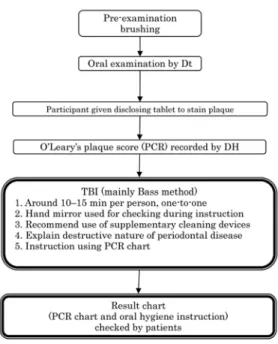
(3) 130. Furusawa M et al.. conventional dental checkups that simply check for caries. In future, this type of checkup should contribute to improved preventative dentistry with minimal intervention. Key words:. Dental checkups—TBI— PCR—Community periodontal index— Preventative dentistry. Introduction Regular dental checkups which included monitoring for caries, periodontal disease, occlusal problems, and temporomandibular disorders would help maintain the oral health of the general population. Schoolchildren of all age groups receive dental checkups under the School Health Law. Implementation in the adult population, however, is less consistent and depends on the level of awareness in the workplace. In recent years, however, increased public awareness of preventive dentistry together with its role in general health has resulted in zealous implementation of oral health checkups by an increasing number of companies1–3,6). At the request of a health insurance group associated with an airline company, we carried out oral health screening as part of a unique health program that included preventive dentistry as part of its general health concept, with the aim of improving the employees’ awareness and oral hygiene practices. The purpose of this study was to compare the effectiveness of dental checkups incorporating tooth-brushing instruction (TBI) with that of conventional dental checkups by investigating their implementation at a single company over five consecutive years.. the patient had brushed their teeth, oral hygiene instruction was provided by the method shown in Fig. 1. Initially, each patient was given a disclosing tablet and instructed to chew it. After the teeth were stained, one of the dental hygienists filled in a Plaque Control Record (PCR) chart5) and TBI was given (mainly the Bass method) depending on the patient’s oral condition. The time allotted for TBI was between 10 and 15 min per patient, and a hand mirror was used for checking according to the standard method. The use of auxiliary cleaning devices such as interdental brushes and dental floss was recommended in patients with malaligned teeth, isolated teeth, or exposed furcation, and a brief explanation. Materials and Methods The team consisting of one dentist and three dental hygienists examined an average of 60 employees per day. First, the patient was required to complete a medical history questionnaire. The patient was then given regular dental checkups by a dentist and the Community Periodontal Index score4) recorded. After. Fig. 1 Checkup method: 60 patients seen on average each day by one dentist (Dt) and three dental hygienists (DH).
(4) 131. Effectiveness of Dental Checkups Incorporating TBI. regarding periodontal disease was also given. After recording data on TBI and PCR scores, the charts were stored. A copy of their chart was given to each patient so that they could check their own details and dental hygiene instructions. Follow-up sessions were held for patients with PCR scores ⱖ60%, to motivate them towards improving their oral hygiene. This study was approved by the Ethics Committee of Tokyo Dental College (approval no. 287).. over all five years. A cumulative total of 3,854 patients received checkups over the five-year period, of which 284 received checkups every year. Figure 3 shows changes in PCR scores in patients receiving checkups for the first time in each of the five years and in those received checkups over all five years. There were no major changes in PCR score among those who received checkups for the first time each year, but the scores for those who received checkups over all five years decreased yearon-year. Scores in the fourth and fifth years, in particular, tended to decline significantly. According to O’Leary’s plaque index, a score of ⱕ10% is regarded as good, but as this study concerned mass instruction we categorized scores of ⬍30% as good, ⱖ30% but ⬍60% as moderate, and ⱖ60% as poor plaque control. Based on these results, the PCR score distribution obtained is shown in Figs. 4-1 to 4-3.. Results Table 1 and Fig. 2 show the numbers of patients receiving checkups each year, as well as the percentages of patients receiving checkups for the first time in each of the five years and those who received checkups. Table 1 Number of patients Year. 2001. 2002. 2003. 2004. 2005. Total number of patients. 781. 676. 819. 774. 804. First-time patients. Number Percentage. 781. 165 24.4%. 188 23.0%. 119 15.4%. 121 15.0%. Patients receiving checkups over all five years. Number Percentage. 284. 284 42.0%. 284 34.7%. 284 36.7%. 284 35.3%. Other*. Number Percentage. 0. 227 33.6%. 347 42.4%. 371 47.9%. 399 49.6%. * “Other” refers to patients who were neither first-time patients nor patients receiving checkups over all five years. As program was initiated in 2001, all patients were taking part for first time that year and there was no “other”.. Fig. 2 Numbers and percentages of first-time patients, patients receiving checkups over all five years, and other. Fig. 3 Comparison of mean PCR scores (2001–2005).
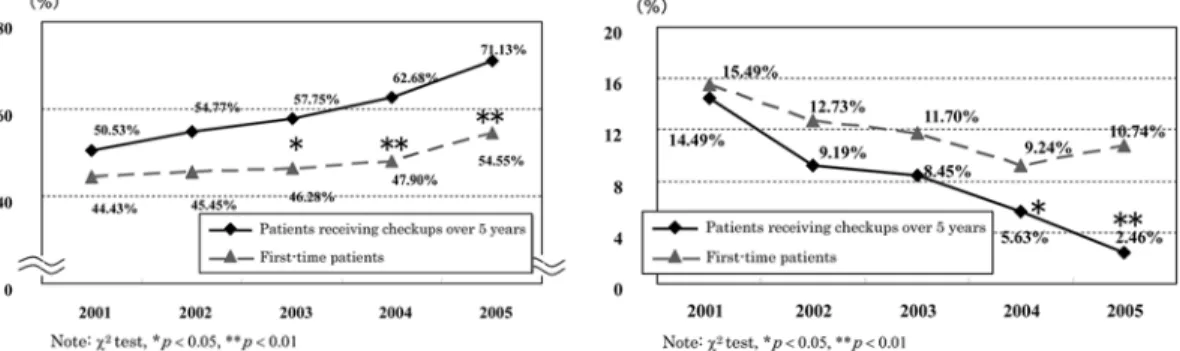
(5) 132. Furusawa M et al.. Figures 5-1 and 5-2 show changes in the mean PCR scores in patients who received checkups over all five years and those who received a checkup for the first time each year.. Discussion 4-1 All patients. 4-2 First-time patients. 4-3 Patients receiving checkups over all five years Fig. 4 PCR score distribution. 5-1 Changes in percentage of patients with good plaque control scoring ⬍30%. In this study, we investigated the effectiveness of checkups incorporating TBI carried out on-site at a single company over five consecutive years. We found that not only did the PCR scores of those patients who received checkups over all five years, who accounted for approximately 37% of the total number of patients, decrease year-on-year, but also that the number of patients who scored ⬍30% and were judged to have good plaque control increased year-on-year. By the fifth year, around 70% of patients who had received checkups over all five years fell into this category. This confirmed that regular checkups over a five-year period yielded better results than checkups carried out over a three-year period6). The mean PCR score in patients receiving their first checkup was 34%, and when subsequent results each year were compared with those in patients receiving checkups over all five years, it was clear whether or not they had followed the TBI. We conjectured that implementation of one-to-one instruction depending on the patient’s oral environment had. 5-2 Changes in percentage of patients with poor plaque control scoring ⱖ60%. Fig. 5 Changes in percentage of patients with good or poor.
(6) Effectiveness of Dental Checkups Incorporating TBI. improved tooth-brushing technique. Among patients receiving checkups over all five years, the proportion with PCR scores ⬍30%, indicating good plaque control, increased each year, while the proportion with PCR scores3) 60%, indicating poor plaque control, decreased each year, with a significant difference between this group and patients receiving their first checkup in the fourth or fifth years. This indicated that the effectiveness of this checkup program improved with increase in the number of years and that it raised the level of oral health awareness among the patients who participated. The follow-up sessions for patients with poor plaque control who scored ⱖ60% were intended to motivate them, leading directly to improved results. These findings indicate that incorporation of TBI into conventional dental checkups significantly improves oral health. This type of checkup would also contribute to improved preventive dentistry with minimal intervention.. References 1) Nakahama N, Isoyama M, Araki M, Rokukawa Y, Makiishi T, Yatabe K (2004) The effectiveness of mass oral health screening at an airline company—Individuals who participated all. 2) 3). 4). 5). 6). 133. three years—. Shikwa Gakuho 104:389. (in Japanese) Sakakibara Y, Eshima F, Nishioka K (1987) Shin-Shikaeiseishi-Gairon, Ishiyaku Publishers, Tokyo. (in Japanese) Takahashi Y, Matsuki K, Kubo S, Muramatsu J (2004) Changes in periodontal condition and acceptance of dental health program in the workplace in company employees aged 20–39 yr. J Occup Hlth 46:115–116. (in Japanese) Takahashi Y, Ookawa Y, Okada M, Ishii T, Miyatake M, Suyama Y, Matsuki K (1996) Effects of oral health programme for company employees on oral health—Two-year reports on changes in oral health status—. J J Dent Pract Admini 31:134–141. (in Japanese) Takahashi Y, Ookawa Y, Okada M, Matsuki K, Ishii T, Miyatake M (1999) Effects of oral health programme for company employees on oral health. J Dent Hlth 49:572–573. (in Japanese) Ueshima F, Kashima T, Kitamura Y, Rokukawa Y, Makiishi T, Yatabe K (2004) The effectiveness of mass oral health screening at an airline company-PCR score. Shikwa Gakuho 104:388. (in Japanese). Reprint requests to: Dr. Masahiro Furusawa Department of Clinical Oral Health Science, Tokyo Dental College, 2-9-18 Misaki-cho, Chiyoda-ku, Tokyo 101-0061, Japan Tel: +81-3-3262-3421 Fax: +81-3-3262-3420 E-mail: [email protected].
(7)
図

関連したドキュメント
initial functions are proved in the form of an integral maximum principle and conditions of transversality for nonlinear systems with a variable structure, delays and a
The recurrent states are the secure states (we might or might not restrict to only these states.) From the pigeon hole principle we can deduce that the greedy algorithm, started at
In this section we show that given a monoidal control space (Z, P, M ) the sym- metrized monoid elements induce boundedness control structures on Z in the sense of [1].. It is in
If Φ is a small class of weights we can define, as we did for J -Colim, a2-category Φ- Colim of small categories with chosen Φ-colimits, functors preserving these strictly, and
Many authors argue that as the investment horizon increases, an investment portfolio with a higher proportion of assets will dominate, or will be preferred over a portfolio
As far as local conditions at infinity are concerned, it is shown that at energy zero the Dirac equation without mass term has no non-trivial L 2 -solutions at infinity for
We list in Table 1 examples of elliptic curves with minimal discriminant achieving growth to each possible torsion group over Q
In SLBRS model, all the computers connected to the Internet are partitioned into four compartments: uninfected computers having no immunity S computers, infected computers that
