
IRUCAA@TDC : Orthodontic treatment for jaw deformities in cleft lip and palate patients with the combined use of an external-expansion arch and a facial mask
8
0
0
全文
(2) Bull. Tokyo dent. Coll., Vol. 43, No. 4, pp. 223⬃229, November, 2002. Original Article. ORTHODONTIC TREATMENT FOR JAW DEFORMITIES IN CLEFT LIP AND PALATE PATIENTS WITH THE COMBINED USE OF AN EXTERNAL-EXPANSION ARCH AND A FACIAL MASK TERUO SAKAMOTO, SATOMI SAKAMOTO*, MORIHIRO HARAZAKI, YASUSHIGE ISSHIKI and HIDEHARU YAMAGUCHI Department of Orthodontics, Tokyo Dental College, 1-2-2 Masago, Mihama-ku, Chiba 261-8502, Japan * Sakamoto Dental Clinic, 3363 Nemachi, Ryugasaki, Ibaraki 301-0837, Japan. Received 20 June 2002/Accepted for Publication 2 September, 2002. Abstract Patients with cleft lip and palate can suffer from contraction of the maxillary arch and anterior cross-bite accompanied by skeletal growth retardation. We use an appliance called an external-expansion arch and induce maxillary protraction using a facial mask in order to correct the anterior cross-bite and maxillary retrusion. In this paper, the method of application of these appliances and the effects of this therapy are reported here. The external-expansion arch consists of a labial wire, bands and a sectional arch. The 0.045-inch stainless steel wire extends along the maxillary dental arch. Hooks are soldered immediately distal to the lateral incisor and the distal leg of the vertical loop. The brackets are bonded to the maxillary anterior teeth, and a 0.016⳯0.016 inch sectional arch is set. The external-expansion arch is inserted into the headgear tube and ligated with the sectional arch using elastic thread. The maxillary bone is pulled by use of the facial mask and the elastic band. For traction, the force is about 300 g on each side, applied parallel to the occlusal plane or slightly downward. The duration of use is 8 to 12 hours per day. The external-expansion arch has several advantages: it can be applied from the early period of Hellman’s dental age IIIA or IIC to improve anterior cross-bite. As it is easy to expand the anterior teeth and move individual teeth to the labial and buccal sides, establishment of a dental arch from severe collapse is not difficult. When an expanding device such as the Quad-helix is incorporated, lateral expansion becomes easier. Furthermore, it is easy to control the teeth vertically, and patient compliance is not necessary. Hence, this method is effective as a phase 1 treatment for orthodontic patients with cleft lip and palate characterized by maxillary retardation. Key words:. Cleft lip and palate —External-expansion arch —Facial mask— Early treatment. 223. 223.
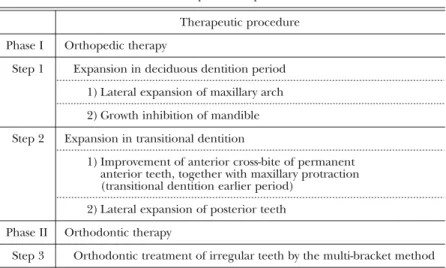
(3) 224. T. SAKAMOTO et al.. INTRODUCTION Patients with cleft lip and palate can suffer from contraction of the maxillary arch and anterior cross-bite accompanied by skeletal growth retardation due to the effects of cheiloplasty and palatoplasty1,7). We treat these patients using a 2-phase 3-steps method3) (Table 1). As the phase 1 therapy, we use an appliance called the “external and expansion arch” (hereinafter “external-expansion arch”) and maxillary protraction using a facial mask in order to correct the anterior cross-bite and maxillary retrusion from the early period of Hellman’s dental age IIIA. The method of application of these appliances and the effects of this therapy are reported here.. METHODS 1. Fabrication of the external-expansion arch (Fig. 1) The external-expansion arch consists of a labial (buccal) wire, bands and a sectional arch. The 0.045-inch stainless steel wire extends along the maxillary arch, and its anterior portion is located 4–5mm away from the incisors. The vertical loop is bent at the mesial point of the buccal molar tube for adjusting the length of the external-expansion arch. The. brackets are bonded to the maxillary anterior teeth, and a 0.016⳯0.016 inch sectional arch is set. The bands with a headgear tube are cemented to the maxillary first molar or second deciduous molar. If maxillary lateral expansion is needed, a removable or fixed Quad-helix appliance6) is incorporated at the same time. 2. External-expansion arch placement The external-expansion arch is inserted into the headgear tube and ligated with the sectional arch using elastic thread. First, the elastic thread is wound one turn around the external-expansion arch and orthodontic wire. Second, the elastic thread emerging on the cervical side is wound two turns around the external-expansion arch. Third, the elastic thread emerging on the occlusal side is wound one turn around the externalexpansion arch. Finally, the elastic thread is activated and double knotted (Fig. 2). When activated, it will exert about 200 g of force and move the incisors labially. Ligation of the elastic thread is performed between brackets. The patient is checked every four weeks, and the elastic thread is reactivated. If the anterior teeth are to be moved labially, the vertical loop is opened to adjust the length of the external-expansion arch. When a Quadhelix appliance is used, this is also adjusted.. Table 1 2-phase 3-steps method Therapeutic procedure Phase I Step 1. Orthopedic therapy Expansion in deciduous dentition period 1) Lateral expansion of maxillary arch 2) Growth inhibition of mandible. Step 2. Expansion in transitional dentition 1) Improvement of anterior cross-bite of permanent anterior teeth, together with maxillary protraction (transitional dentition earlier period) 2) Lateral expansion of posterior teeth. Phase II Step 3. Orthodontic therapy Orthodontic treatment of irregular teeth by the multi-bracket method.
(4) TREATMENT BY EXTERNAL-EXPANSION ARCH. Fig. 1 Fabrication of the external-expansion arch. Fig. 2 Method of ligating the external-expansion arch with the elastic thread A: The elastic thread is wound one turn around the external-expansion arch and orthodontic wire B: The elastic thread emerging on the cervical side is wound two turns around the external-expansion arch C: The elastic thread emerging on the occlusal side is wound one turn around the external-expansion arch D: The elastic thread is activated and double knotted. A. B. C. Fig. 3 Maxillary protraction by combined use of the external-expansion arch and the facial mask A: External-expansion arch B: Schema of the external-expansion arch and facial mask C: Facial mask. 3. Maxillary protraction by combined use of the external-expansion arch and the facial mask The application method for the externalexpansion arch and facial mask is as follows (Fig. 3). Hooks are soldered immediately distal to the lateral incisor and the distal leg of the vertical loop. The external-expansion arch is. 225. inserted into the headgear tube of the molar, and the external-expansion arch and molar are tied back. The maxillary bone is pulled by use of the facial mask and elastic band. For traction, the force is about 300 g on each side, applied parallel to the occlusal plane or slightly downward. The duration of use is 8 to 12 hours per day..
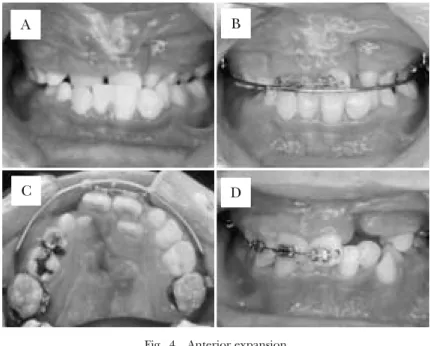
(5) 226. T. SAKAMOTO et al.. A. B. C. D. Fig. 4 Anterior expansion A: Pretreatment, B: During treatment (Frontal view), C: During treatment (Occlusal view), D: Posttreatment. A. B. C. D. Fig. 5 Lateral expansion A: Pretreatment, B: During treatment (Occlusal view), C: Posttreatment (Frontal view), D: Posttreatment (Occlusal view). RESULTS The external-expansion arch can be used as follows.. 1. Case 1: Anterior expansion (Fig. 4) The case was a 9 year and 7 month old boy with left unilateral cleft lip and palate and anterior cross-bite. By using the externalexpansion arch, the anterior teeth were.
(6) TREATMENT BY EXTERNAL-EXPANSION ARCH. A. 227. B. C. Fig. 6 Movement of individual teeth A: Pretreatment B: During treatment C: Posttreatment. A. B. C. Fig. 7 Establishment of arch form A: Pretreatment B: During treatment C: Posttreatment. expanded anteriorly after three months. 2. Case 2: Lateral expansion (Fig. 5) The case was an 11 year and 4 month old boy with bilateral cleft lip and palate and total cross-bite. By combined use of the externalexpansion arch and Quad-helix for six months, the maxillary arch was expanded laterally. 3. Case 3: Movement of individual teeth (Fig. 6) The case was a 12 year and 3 month old boy. with left unilateral cleft lip and palate and 2nd premolar palatal displacement. They were moved into the maxillary arch by an externalexpansion arch and elastic thread. 4. Case 4: Establishment of arch form (Fig. 7) The case was a 22 year and 5 month old male with left unilateral cleft lip and palate and collapse of maxillary arch. The right and left first premolar and first molar were displaced lingually. After extraction of the right.
(7) 228. T. SAKAMOTO et al.. A. B. C. Fig. 8 Vertical control of teeth A: Pretreatment B: During treatment C: Posttreatment. and left first premolars, the maxillary arch form was established by an external-expansion arch and elastic thread. 5. Case 5: Vertical control of teeth (Fig. 8) The case was a 10 year and 4 month old boy with bilateral cleft lip and palate and infraversion of the canines. After five months, his submerged canines were moved to the level of the occlusal plane.. Fig. 9 External-expansion arch A: When using Ni-Ti wire, there is no benefit of arch expansion by the counter-force as indicated by the arrow. B: The addition of the external-expansion arch assures expansion.. DISCUSSION The external-expansion arch was modified from Angle’s expansion arch (E-arch)4) and was so named because it is located external to the teeth and used to expand the maxillary dental arch. When the dental arch is expanded by using a leveling wire such as a nickel-titanium wire, teeth located lingually are moved labially. However, adjacent teeth are moved lingually by reciprocal force. On the other hand, by ligating the orthodontic arch wire along the external-expansion arch using an elastic thread, the mutual reaction force acts as the expanding force in the labial and buccal directions, so that the dental arch can be efficiently expanded (Fig. 9).. Orthodontic patients with cleft lip and palate are characterized morphologically by anterior cross-bite, contraction of the maxillary arch, and maxillary retardation. During the period of transitional dentition, the purposes of treatment are achievement of proper anterior and lateral overjet and correction of the antero-posterior skeletal discrepancy. In most cases, RPE (rapid palatal expansion)2) is suggested for maxillary palatal expansion. However, it has certain drawbacks in that the appliance cannot improve the anterior crossbite or be used until the maxillary first molar fully erupts. The external-expansion arch has several advantages: it can be applied from the early period of Hellman’s dental age IIIA or IIC.
(8) TREATMENT BY EXTERNAL-EXPANSION ARCH. and improve anterior cross-bite from the early period of transitional dentition. Early correction of anterior cross-bite can provide a favorable environment for maxillary growth5). As it is easy to expand the anterior teeth and move individual teeth to the labial and buccal side, establishment of a dental arch with severe collapse is not difficult. When an expanding device such as the Quad-helix is incorporated, lateral expansion becomes easier, and the united bilateral molars provide a strong anchorage. Furthermore, it is easy to control the teeth vertically, and patient compliance is not necessary. This apparatus also has functions as a lip and buccal bumper to isolate these muscle functions. Combined use of the external-expansion arch and a facial mask allows simultaneous improvement of the anterior cross-bite and lateral expansion of the maxillary arch and maxillary protraction. Tieback of the externalexpansion arch and first molars prevents the side effect of molar movement and the distal inclination that may aggravate the class III relation of the molars. In addition, this method allows not only advancement of maxillary growth, but also backward and downward mandibular movement8).. CONCLUSION This method of treatment by maxillary protraction with combined use of an externalexpansion arch and facial mask improves the anterior cross-bite from the early period of transitional dentition and allows simultaneous lateral expansion of the maxillary arch and. 229. maxillary protraction. Hence, it is especially effective as a treatment of step 2 of phase 1 for orthodontic patients with cleft lip and palate characterized by maxillary retardation.. REFERENCES 1) Bishara, S.E., Sierk, D.L. and Huang, K. (1979). Longitudinal changes in the dentofacial relationships of unilateral cleft lip and palate subjects. Cleft Palate J 16, 391–401. 2) Haas, A.J. (1961). Rapid expansion of the maxillary dental arch and nasal cavity by opening the midpalatal suture. Angle Orthod 31, 73–90. 3) Isshiki, Y. and Kitafusa, Y. (1989). E-arch technique for orthodontic treatment of skeletal class III cases. J Jpn Orthod Soc 48, 168. 4) Dewey, M. (1917). Practical Orthodontia. 3rd revised ed., pp.187–200, C.V. Mosby, St. Louis. 5) Proffit, W.R. (1992). Contemporary Orthodontics. 3rd ed., pp.270–271, C.V. Mosby, St. Louis. 6) Ricketts, R.M., Bench, R.W., Gugino, C.F., Hilgers, J.J. and Schulhof, R.J. (1979). Bioprogressive Therapy. pp.186–188, Rocky Moutain Orthodontics, Denver. 7) Ross, R.D. (1970). The clinical implications of facial growth in cleft lip and palate. Cleft Palate J 7, 37–49. 8) Yan, G., Bakr, M.R. and Hagg, U. (2000). Treatment effects of simple fixed appliance and reverse headgear in correction of anterior crossbite. Am J Orthod Dentfacial Orthop 117, 691–619. Reprinted requests to: Dr. Teruo Sakamoto Department of Orthodontics, Tokyo Dental College, 1-2-2 Masago, Mihama-ku, Chiba 261-8502, Japan.
(9)
図


+2

関連したドキュメント
Standard domino tableaux have already been considered by many authors [33], [6], [34], [8], [1], but, to the best of our knowledge, the expression of the
The aim of Colombeau’s paper [5] was to avoid the drawback that the embed- ding of the space D ′ of the Schwartz distributions into the algebra (and sheaf) of Colombeau
H ernández , Positive and free boundary solutions to singular nonlinear elliptic problems with absorption; An overview and open problems, in: Proceedings of the Variational
Keywords: Convex order ; Fréchet distribution ; Median ; Mittag-Leffler distribution ; Mittag- Leffler function ; Stable distribution ; Stochastic order.. AMS MSC 2010: Primary 60E05
In other words, the aggressive coarsening based on generalized aggregations is balanced by massive smoothing, and the resulting method is optimal in the following sense: for
pole placement, condition number, perturbation theory, Jordan form, explicit formulas, Cauchy matrix, Vandermonde matrix, stabilization, feedback gain, distance to
Inside this class, we identify a new subclass of Liouvillian integrable systems, under suitable conditions such Liouvillian integrable systems can have at most one limit cycle, and
Applications of msets in Logic Programming languages is found to over- come “computational inefficiency” inherent in otherwise situation, especially in solving a sweep of
