Methodological Study on Fisheries planning in
the Developing Countries
著者
IWAKIRI Shigero, NEAZ Mowla
journal or
publication title
鹿児島大学水産学部紀要=Memoirs of Faculty of
Fisheries Kagoshima University
volume
31
page range
35-56
別言語のタイトル
発展途上国漁業計画の方法論的研究
Mem. Fac. Fish., Kagoshima Univ. Vol. 31 pp. 35~56 (1982)
Methodological Study on Fisheries planning
in the Developing Countries
Shigero Iwakiri* and Mowla Neaz*
Abstract
In the present study an approach to fisheries development and planning have been described. Considering the impacts of fishery development on the employment situation with its social effects in rural areas as well as its more general effect on the economy as a whole, development of fisheries was considered as a measure of breakthroughing the stagnating situation and to improve the socio-economic conditions in the rural areas and a more balanced development among regions.
This study focuses on the problem areas shared among many developing countries and a possible approach for a fisheries development program have been presented in consideration to the constraints and impediments to fisheries development in the developing countries. Emphasis is placed on the need to develop infrastructural facilities including marketing system as well as institutional framework and to create new institution where necessary.
I. Introduction
It has been recognized that the benefits of economic development are not equally distributed throughout all class of citizens and that during the past fewdecades the gap between the rich and the poor in the developing countries has widened due to the economic development policies and activities. Additionally, the fact that the development of western type industrial activity has resulted, in many cases, in further deterioration of quality of life has recently become the concern
of the economists as well as the politicians0.
As a result of the generally unsatisfactory experience in the development of western type industrial activity which uses modern advanced technology, it has come to be recognized that it is
neither desirablenor adequate for a developing country to give first priorityto the development of
its heavy industry or increased production ofadvanced merchandise as a means of improving its
economy. Instead, it is important for the developing countries, especially those has a
predominantly agricultural economy, to place emphasis on the development of its primary
industries such as agriculture, fishery and forestry as well as other sectors of secondary industry
which bears close association with primary industries as they have ready access to these
resources2).
So far, the modern industrial sector has been almost entirely cut off from the traditional and small scale businesses. Imported advanced technology has developed in an enclave and has had
* Laboratory of International Marine Policy, Faculty of Fisheries, University of Kagoshima ** Department of Agricultural and Forestry Economics, Faculty of Agriculture, Kyoto University.
no impact in pulling out primitive and intermediate technologies which is struggling into the 20th
century. Consequently, dual economies have emerged and dual societies: urban versus rural, modern versus traditional and this has led to many social problems. As such there is an urgent need to stop this unbalanced economic development. Realization of this need has been reflected in the fact that many developing countries has recently accorded high priority in their development plan to improve the socio-economic conditions in the rural areas and to promote more balanced development among regions3).
In line with this priority development plan to improve the socio-economic conditions in the rural areas by creating better employment opportunities and improved living condition and to promote more balanced development among regions, we shall refer to the development of fishing industry which has a multiplying effect on an economy in a variety of ways.
One of the ways in which the primary activity of fishing can help in the development of an economy is through the inducements it provides for the establishment of other industries, such as processing and distribution of fish as well as the manufacture of boats and gear and associated industries. The other way the fishing industry can effect an economy is by increasing output, contribute to the growth of the economy through an enlargement of the gross national product. It can also, as a source of food supply, play an important role in the process of balanced economic development by helping to feed the growing urban population who are becoming divorced from the means of production4). Further, the contribution of fishing industry in adjusting the balance of payment is of much importance to many countries. As we will find in the later chapters that a growing number of developing countries are deriving significant foreign exchange earnings from the export of fishery products to developed countries. Again as mentioned above that the fishing industry provides inducements to establish other industries, therefore it is likely that the development of fisheries will not only create employment opportunities within the fishery industry itself but will also create opportunity in other related industries and will thus help to improve the living standard of the rural inhabitants who form the majority of population in the developing countries.
Considering these impacts of fishery development on the employment situation with its social effects in rural areas as well as as its more general effect on the economy as a whole, we take up fisheries development as a measure to improve the socio-economic conditions in the rural areas and a more balanced development among regions. But there are considerable differences between the charcteristics of the fishing industries of the developing countries in respect of size of fleet, quantity landed, methods of fishing, number of people employed, economic status of the fishing communities. At the same time individual countries are at different levels of economic development and fisheries play different role in each economy. Therefore it is not surprising that there are many different views on fisheries development and planning. However, in terms of the principal objectives of fisheries development policy and the nature of the problems that confront most of the developing countries, we can see some common points. These common points corresponds to one broad observation: there are serious deficiencies in marketing,
IWAKIRI • Neaz : Fisheries Planning in Developing Countries 37 processing, storage, distribution and in the institutional and infrastructural framework. In the
following chapters the principal objectives of fishery development and the constraints and impediments thereof have been discussed. Considering these objectives and the constraints and impediments, a possible approach for a fisheries development programme have been studied. Emphasis is placed on the need to develop infrastructural facilities including marketing system as well as institutional framework, and to create new institution where necessary in the best interest of the fisheries sector. The present study has centered mainly around the South and Southeast
Asian Fisheries while it has attempted to take a general view of the fisheries of other developing
countries.
II. Social Circumstances Relating to Fisheries and the Objectives of Fishery Development Program.
(i) Social circumstances relating to fisheries
In majority of the developing countries fishing is generally carried on by traditional and often primitive methods. Same is the case for processing and preservation of fish. Working fishermen are quite often among the least educated people in the country. They are the most socially helpless members of the community engaged in what is regarded as a "lower class
occupation" involving the whole family. Fishing villages are located far away from the urban and industrial centres. Because of inadequate transport facilities, they have little and in some cases no contacts with the towns and cities. The fishing centres are often so isolated from the parent rural or urban communities that their problems fail to receive sufficient attention from the
local authorities. Many fishermen are without any possession. Some fishermen are migrants livingon their boats. Very few are in a position to raise capital and few have anything they can pledge in security for a loan except their catches. Lack of capital prevents improvementsin, and proper maintenance of, craft and gear. In absence of government small scale credit for fishermen, they have to borrow most capital from the local money lenders, middlemen, fish traders on pledgeing the catch. The middlemen or the money lenders are not, of course, interested in the supply of capital indespensible for the development of the industry. They advance only short-term loans which can be recovered during the season. Medium and long-term credit for mechanization, purchase of new boats, etc. are not provided by them. Moreover, various malpractices are commonly associated with the loans advanced to the fishermen. It has been stated above that the fishermen are among the least educated members
of the community and therefore, the money lenders or the middlemen finds it very easy to
manipulate their accounts. Fishermen often complains that their accounts are manipulated in such a way that at the end of the season they always remain in debt to the financiers. As a result, once the fishermen borrows from a money lender or middlemen he can hardly free himselffrom
the economic dependence.
The above situation indicates that fishermen in most of the developing countries are cruelly
relating to the fisheries of developing countries has been reported by many researchers5* ~7). (ii) Objectives of Fishery Development Program:
(a) Improvement of Socio-economic Condition of the Fishermen.
As far as fisheries development policy is concerned, it has been noticed that a few countries have the principal objectives as to improve the socio-economic condition of the hundreds of
thousand of fishermen, who dwelling all around the area forms the backbone of the industry. The fisheries of South and Southeast Asian countries and for that matter most developing
countries are mostly traditional, small-scale fisheries operating mostly with inefficient and obsolete methods of production. This type of fishery which is more or less a subsistence operation, is carried on by several millions of fishermen. Over much of this type of fisheries sector the fishermen do not have their own marketing channels to the consumers. They are just happy to get rid of their catch as soon as possible in return for anything they could use to support their families. This weakness in them is being exploited in full by the fish traders and middlemen for their own benefit. Fish prices are very low at the point of production, but retail prices to the consumers are rather high. Because of their financial strength, the fish traders and middlemen provides to the fishing population the bulk of the working capital as well as consumer goods, insisting on the mortgage of catches. It has been stated earlier that the fishermen in most developing countries do not have their own marketing channels to the customer. The marketing is taken charge by the fish traders and middlemen. In absence of any other arrangement, they have the complete control over the marketing offish which enables them to recover the loans from the proceeds of sale. The middlemen charge for providing the financing and marketing
services. In addition to this, the fishermen in many cases have to bear the cost of transport, storage and taxes, so that little or nothing is left for saving and investment. This practice has
made the fishermen more and more dependent on the fish traders and middlemen, making them reluctant to initiate any kind of development which, in their opinion, would only benefit the fish traders8'"10*. This observation suggests that the pattern of marketing has a direct influence on the pattern of production. As the middlemen are able to maintain low purchasing prices at the
landing places, the fishermen are unable to develop their enterprises. Therefore existing fishing
methods remain simple, mostly using sail boats with simple gears. In this way internal constraints have developed in the fisheries sector which has resulted into the static and traditional attitude of the fishermen we know today in many developing countries.
Under the above situation, the need to introduce a sound marketing system, to improve the fishing method, to raise the standards of living and inject new motivation into traditional fishermen's communities is of great importance. Therefore the objective of improving the income and welfare of the fishing communities is given priority for fishery development program in this report.
IWAKIRI • Neaz : Fisheries Planning in Developing Countries
Table 1. Dietary Energy Supply in Selected Developing Countries.
1969-1971* Countries Bangladesh Burma India Indonesia Malaysia (west) Nepal Philippines Srilanka Thailand
Calories per Percentage of capita per day requirements
1840 80 2210 102 2070 94 1790 83 2460 110 2080 95 1940 86 2170 98 2560 115
* Total food, including fish.
Source: Rural Asia, Challenge and Opportunity, Asian Development Bank, Praeger Publishers, New York, page 45, 1977.
39
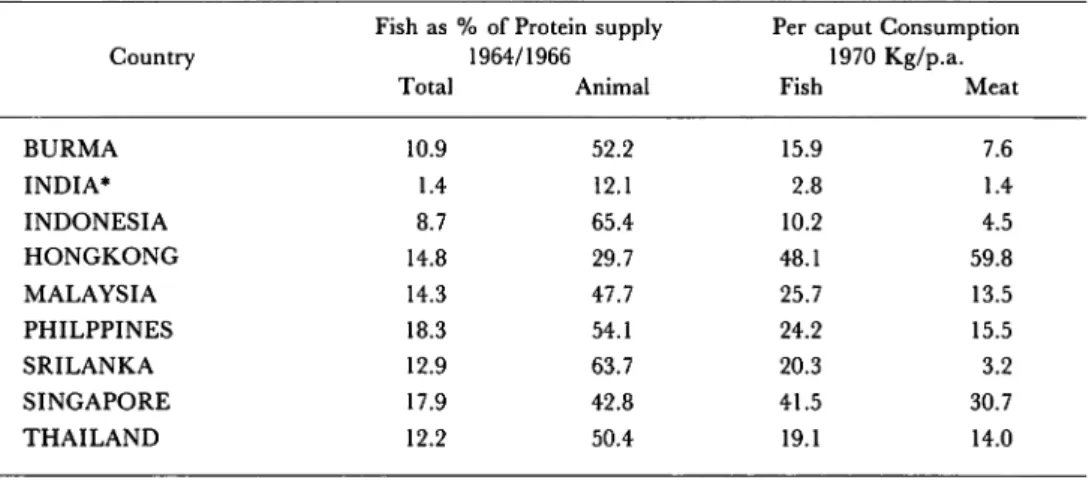
Table 2. Relative Importance of Fish in Food Supply in Some Selected Developing Countries.
Country BURMA INDIA* INDONESIA HONGKONG MALAYSIA PHILPPINES SRILANKA SINGAPORE THAILAND
Fish as % of Protein supply 1964/1966
Total Animal
Per caput Consumption 1970 Kg/p.a. Fish Meat 10.9 52.2 15.9 7.6 1.4 12.1 2.8 1.4 8.7 65.4 10.2 4.5 14.8 29.7 48.1 59.8 14.3 47.7 25.7 13.5 18.3 54.1 24.2 15.5 12.9 63.7 20.3 3.2 17.9 42.8 41.5 30.7 12.2 50.4 19.1 14.0
Source : FAO Fisheries Circular no. 314, pp. 3—5, 1973.
* It should be noted that expressing fish consumption in terms of national averages often masks con siderable variations in consumption levels between different geographical areas and different social sectors within a country. In India, for example, which in 1970 had a level of consumption averag ing 2.8 Kg/per caput/ year, a large proportion of the population is not fish eating but is vegetarian, and low average for the conntry conceals the great importance of fish as a source of protein for
people living in coastal areas.
(b) Acquirement of Self-sufficiency in Food and Improvement of Nutritional Food Supply. One of the basic objectives of national policy is to provide adequate food for the country's population. But food production in the developing countries has barely kept pace with their rising
populations, and in some countries, despite introduction of the new foodgrain technology, per capita food production has shown a decline10. The grave consequences that results from
shortfalls in food production is easy to imagine.
Further, the average per capita energy intake remains at close to 2000 calories per day in most
developing countriesof South and SoutheastAsia, indicating that the bulk of the population does not consume the minimum dietary requirements for normal health. Table 1. shows the dietary
energy supply in some selected developing countries of Asia. FAO estimated that in 1970 some
300 million people or 30% of the population in Asian countries had an insufficient protein/energy
supply. The proportion of the population in the developing world subject to food deficiencies ranges up to 30% (higher in some areas) and amounts to over 400 million people in total. The Asian region accounted for 300 million of that total. It had the highest percentage with
inadequate protein/energy supply among all developing regions of the world12).
Therefore, in the face of declining growth in food production and low protein/energy supply, to provide food for domestic needs and improve nutritional food supply seems to be the most important national objective for fishery development. An increasing number of countries have recognized the importance of fish as a factor to improve the nutritional standards of its
population. Since fish is rich in protein and in certain important vitamins and minerals, it is often selected as a priority item in national food development plans. In many countries, specially in the South and Southeast Asian countries, fish supplies contribute between 10 and 20% of total protein and over half of the total animal portein supplies (Table 2.). (In some countries, e. g., India, low average per caput consumption figures tend to conceal the fact that fish is a major source of protein for a large population living in coastal areas). Through the development of fishery resources, countries with shortage in food supply will be able to provide more food for domestic needs and cease to rely on imported food. The reduction in grain imports will obviously help to reduce the outflow of foreign exchange. Such savings in foreign exchange could be used to develop other sectors which are of high national importance,3).
However, although fish has great role to play as a supplier of food, rational economic planning will have to recognize that there are other alternative ways of supplying protein, minerals etc. * If the poultry or the stock-raising sectors can produce animal portein at a much lower cost than
fisheries (the majority of the developing countries in South and Southeast Asia, however, do not
seem to have this option), it might not make sense to sanction large subsidy, scarce capital to
provide costly infrastructure, etc. to the fisheries sector. (c) Creation of Employment
Of the various possible national objectives, it appears that the employment creation objective has assumed increased importance in recent times. The rapid increase in population coupled with the drift of people to urban centres and the overall disappointing experience from providing employment through the industrialization process, has led many developing countries to take a new look at creating job opportunities in the traditional agricultural and fisheries sector'4).
Iwakiri • Neaz : Fisheries Planning in Developing Countries 41 It is true that small-scale fisheries sector in general has been neglected in some developing
countries and that there is scope for considerable employment creation in fisheriesl5). The effect which the fisheries development will have in creating employment in the country can be
considered as two-fold. The first is the effect it has on the fish catching occupations and secondly
its effects in creating employment in ancillary and related business. A modernized fishing
industry with its attendant requirements for port and harbour facilities and its larger fish landings will generate employment in other sectors of the economy, for example, in boatbuilding and repairs, in processing and packaging, in ice plants, net manufacture, marketing and transport, and these in turn may have a further effect in multiplying employment in a wider range of occupations. However, experience shows that a modernized fishing industry results in the centralization of the industry around urban areas with the adverse socio-political effects which often follows. Therefore, special attention should be paid so that social and political disruption does not arise due to modernization of the fishing industry.
(b) To Develop Exports.
To increase foreign exchange earnings through the development of fishery products has
recently become one of the main objectives of any major fisheries development program in most
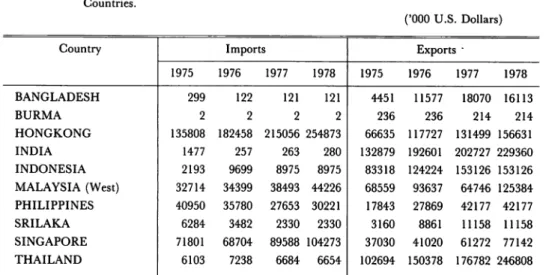
South and Southeast Asian countries16). An indication of the relative importance in foreign exchange earnings in these countries can be gauged from Table 3. Earnings from export offish has increased significantly in India, Indonesia, Malaysia and Thailand. Other countries like
Hongkong and Singapore are although net importers offish, but rising trend in their fish exports
has been observed. Philippines and Sri Lanka, which were net importers offish until recently, have been able to reduce imports of fish while boosting the exports of fish products to such an extent that they have now become net exporters. The main purpose of developing export is that in capital scarce developing countries earning of foreign exchange through the export would greatly help to boost the national economy.
Nearly all countries listed under the Table 3. carry on import and export trade in fish simultaneously, exporting high value fish which is not consumed domestically and which is fished usually by commercialized operation, e.g., shrimp, lobster and other crustaceans, tuna etc., and at the same time importing fish which is of lower quality and price.
However, with the declaration of new 200 mile economic zone, it has become possible for many coastal states to earn foreign exchange from their fish resources without becoming involved in organizing and financing large fishing industry. For example, a coastal state with a relatively unexploited fish resource within its coastal waters can make concessionary arrangements with foreign vessel owners to allow them to fish in its waters on payment of a license fee, other payments and this could yield the coastal states a high proportion of the economic rent accruing to its fish resource17). Joint enterprises in fisheries are another alternative to earn foreign exchange through exploitation offish resources. However, the form of using fish resources as a earner of foreign exchange depends on individual state preferences.
Table 3. Relative Importance of Trade in Fishery Products in some selected Developing
Countries.
('000 U.S. Dollars)
Country Imports Exports *
1975 1976 1977 1978 1975 1976 1977 1978 BANGLADESH 299 122 121 121 4451 11577 18070 16113 B U R M A 2 2 2 2 236 236 214 214 H O N G K O N G 135808 182458 215056 254873 66635 117727 131499 156631 INDIA 1477 257 263 280 132879 192601 202727 229360 INDONESIA 2193 9699 8975 8975 83318 124224 153126 153126 MALAYSIA (West) 32714 34399 38493 44226 68559 93637 64746 125384 PHILIPPINES 40950 35780 27653 30221 17843 27869 42177 42177 SRILAKA 6284 3482 2330 2330 3160 8861 11158 11158 SINGAPORE 71801 68704 89588 104273 37030 41020 61272 77142 THAILAND 6103 7238 6684 6654 102694 150378 176782 246808
Source: Fao Yearbook of fishery statistics, Vol. 47. 1978, pp. 20-25
(e) Promotion of Regional Development and Improvement of Technological Know-how. It has been stated earlier that the fisheries of almost all the developing countries in Asia are mostly traditional, small scale fisheries scattered all over the country. Therefore, any fishery development program directed towards the establishment of landing base, wholesale market, development of communication network, modernize fishing methods and equipments, motoriza tion of fishing boats etc., will promote development of surrounding rural areas, and through the power and water supply etc., will improve the quality of rural population significantly contributing to regional development.
Improvement of technological know-how among the mass of rural people is yet another effects of any fisheries development program. In the South and Southeast Asian countries the general level of literacy ranges between 40 and 70% for males and between 8 and 50% for females. This literacy in many cases takes in to account of people who can read and write with not enough
ability so as to makethem put theirskills to practical use. The ability not only to read and write
figures accurately, but also to use them practically in simple addition, substraction and mutiplication is of importance in agriculture, fisheries as well as in all industrial work. Considering this, it is expected that through fishery development the technological know-how and practical technique of significant number of people will be gradually improved.
Further, because fishery development will promote the people's interest, management, planning and the ability to accomplish the task will be aided. In the development of fisheries, it is expected that people, when they are given a purpose will endeavour to overcome their limitations and develop the ability to recognize and define the tasks they face and accomplish them. We can expect people to learn not only natural science, technical maintenance
IWAKIRI • NEAZ : Fisheries Planning in Developing Countries 43
techniques and engineering skills, but also social sciences such as planning, management, organization and systemization18).
III. Constraints and Impediments to Fisheries Development. (i) Inadequate Marketing and Transport Facilities.
Fisheries in most developing countries of South and Southeast Asia are traditional and small-scale fisheries operating on subsistence level. In general, in the developing countries, marine and inland fish production is based on the small scale operations of very large numbers of individual fisherman scattered all over the country wherever there is scope of fishing and in some countries there is little by way of organized commercial enterprise. The main difficulties connected with the marketing of fish in the developing countries arises from the geographical dispersion of fishing centers, high perishabiliy of the product, and inadequacy of transport, cold storage and preservation facilities. These factors have favoured the entry of numerous middlemen in the industry. Moreover, uncertainity of catches and extreme poverty of the fishermen give rise to the need of loans to finance their production and consumption. But small scale credit facilities for the fishermen has not yet been well established in many developing countries. In the absence of any other source of finance, the above situation calls for fishermen's heavy financial dependence on the middlemen or fish traders. Because of their financial strength, the middlemen provide to the fishing population the bulk of the working capital and in many cases, consumer goods, insisting on the mortgage of the catches. This is one aspect of the marketing system prevailing in many developing countries.
Further, the highly perishable nature of the fish product, which in the absence of investment in fairly sophisticated preservation and transportation facilities results in high losses in product value, is another factor that is contributing in the present inadequacy of the marketing system. As stated above, due to perishable nature of fish products, it requires good and quick
transportation to market centres. But fishing ground in most of the countries are scattered and
the fishing centres are generally located far away from the urban and industrial centres. This situation calls for well established transport facilities for collecting and distribution of fish products to the marketing centres. Although a great development has been made in the transport system in many countries, but in usually, small scale coastal shipping and movement by draft animal, sail boats are still important forms of the transport in South and Southeast Asia. It does not need to say that the above mentioned mode of transport is time consuming as well as costly. Time is an important factor in the tropical climate as far as fish products are concerned. Fish taint very quickly, certain fishes quicker than others under tropical climate. In the tropics and subtropics, fish must generally be treated in order to maintain quality. But
very inadequate quantity of ice is used and in some cases ice is rarely used as a means of
preservation. Under this condition of inadequate supplies of ice and slow transportation to market centres results in fear of spoilage of catches among the fishermen. They try to dispose of
their catch as soon as possible in return for anything they could use to support their families. Therefore, the inability to market their catch by themselves and the financial indebtness to the middlemen and fish traders, causes the fishermen to loose their strength of bargaining for reasonable price of their products. At this point it should be mentioned here that fish are collected from the fishermen, in most cases, by way of purchase on the basis of previously arranged prices by the middlemen or fish merchants. In a very few cases the fishermen get the benefit of direct auction in the wholesale market either in the production area or in the consumption area. As a result, prices which the fishermen get for their fish are pitiably low when compared with the price the merchants get for the fish at the consuming market.
However, the reason which does not allow the middlemen to offer better prices to the fishermen is that during the marketing process the fish passes through so many hands before it reaches the consumers. The middlemen or the fish assemblers collects the fish from the, fishermen and transports the fish to the wholesaler or commission agent at the consuming centres where it is auctioned in the wholesale market. The retailers bid for the fish and take it to the retail market where they sell it to the consumers. Meanwhile, the fish is transported usually, in transports owned by third persons. Similarly, processing and preservation facilities are also owned by different persons. It would appear from the above that about five to six intermediaries are involved in the process of collection, distribution and marketing offish in the developing countries who actually siphons out the major portion of the profit in the form of securing their intermediate commission, margin, etc.
Thus the main defects in the marketing system of fish in the developing countries are : (1) Lack of credit facilities for the fishermen which is traditionally afforded by the fish traders; (2) Lack of good and quick transportation and storage facilities;
(3) Involvement of too many intermediaries in the business which unnecessarily increases overhead expenditure that the fishermen have to bear;
(4) Lack of facilities for the seller to safeguard his interest in the event of dispute; (5) The price policy of the traders are such that the fishermen have no incentive to increase
their output;
There is therefore an urgent need to improve the marketing system so that fishermen can be assured of a fair and equitable return for their efforts and that consumers do not have to pay high prices.
(ii) Lack of Proper Infrastructure Specially Harbour Facilities and Storage Facilities. Fishing port is the primary basis of fisheries, to ensure successful fishing activity, it is of vital importance for facilitating the development of the fishing industry to provide efficient fishing ports and to carry out their proper maintenance and management.
The modernization of the fishing industry in developing countries is largely hampered by a lack of the essential facilities such as landing centres, wholesale markets, ice supplies, repair and maintenance services, navigational aides etc. Although there are many differing types of
IWAKIRI • NEAZ : Fisheries Planning in Developing Countries 45 landing places in the South and Southeast Asian developing countries, but there exists one
common factor that there are practically very few port facilities. In these countries, the fishing activity is widely scattered and majority of the craft employed are small and normally do not draw more than 1.5 meter. Further, although a good percentage of the craft are motorized but oar and sail propelled craft still predominate in many of the countries. These small fishing boats do not normally sail to the more distant but productive grounds because of lack of shore-based
navigation and communication aids. They are engaged mainly in the exploitation of the inshore resources and land their catch at improvised points such as river mouths or small coves which
have no facilities for on-the-spot handling or marketing. At most of these places, landing is generally possible only during the high tide and in most cases, fish have to be transhipped to shallow draft burges for landing,9).
In all these fish landing places, there are not good facilities for handling the fish consignment. Considerable time is lost in transhipment offish and much damage is done to the fish due to rough handling and long exposure during transportation. Icemaking plant, freezing plant etc., are absent in these landing places and as such surplus production can not be stored in these places. Due to the shortage of freezing and cold storage facilities, the fishermen becomes the victim of price fluctuations particularly during times of good harvest and also quality of fish deteriorates much often to the point of inedibility. Further, because of the lack of facilities for beaching the fishing crafts, much damage is done to the craft and gears during natural disasters like typhoon cyclones and the industry suffers many losses. In some countries, the fishermen themselves, within the limits of their resources, have improved their own landing places, but devlopment of a fishing port with all the facilities needed is beyond fishermen's capacity.
Therefore measures should be accorded by the goverment to provide necessary provisions such as modern fish harbours and ancillary facilities to assist the development of the fishing industry by way of developed handling and storage facilities.
(iii) Deficiency in Institutional Framework.
Deficiency in institutional frame work is yet another reason hindering the development of fishing sector in most developing countries. By tradition, fishery administration in most developing countries are weak. In many countries there are shortage of managerial and skilled government manpower to undertake any high level planning. Also in many countries, fisheries department are small, under equipped department receiving only a small budget and in some cases suffering from continual changes in non-technical staff as well as being ignored by politicians, and the civil service, in general.
Further, in some countries fisheries is controlled directly or indirectly by different organizations. There is little cooperation or coordination among these different organizations controlling the fisheries sector. Therefore, the coordination of plans for investment and operation is frustrated by lack of cooperation between different goveonment department and lack of consultation with various sectors involved in fisheries, e.g., the private fishing sector, private
boat builders and importers of gear, engines etc., the cooperative sector and the state fishing corporation and state marketing organization, where exists. This lack of communication is very common and develops from a number of factors, some political, some historical and some purely personal between senior government officers.
Thus this lack of coordination and cooperation between different government organizations
multiplied by the shortage of managerial and skilled government manpower has rendered effective functioning and development of fisheries activities very complicated.
(iv) Lack of Enterpreneurs or Efficient Management.
In all spheres of business, there are risks and uncertainities. While the risks are high in all lines of production, they are particularly high in the fishing sector, because of the high perishability of fish products, fluctuation in fish landings as well as the fluctuations in fish price. These risks have made it difficult to encourage investment and as such the fishing industry has continued to lag behind in economic development. Private initiative in the economic field is therefore restricted in such activities because of the high degree of risks involved. Even if private help comes, it is one sided. The private enterpreneurs, while trying to safeguard their own interest, have no sustaining interest in the welfare of the fishermen or in developing the industry. However, in some countries for example, West Malaysia and South Thailand, the fishing industry has been largely financed by the private sector, which through it own initiative and enterprise has produced rapid progress. But in most countries scarcity of private enterpreneurship or private capital is considered as one of the major constraints to the development of fisheries. This necessitates the government playing a more active role in promoting the private capital investment and private enterpreneurship by providing incentives, tax exemption and other facilities.
However, apart from the above mentioned major constraints, individual countries have further additional constraints and impediments toward fisheries development. Those are lack of diversity in fishing effort, inland waters not fully utilized, lack of skilled manpower including fisheries biologists, lack of extension service and lack of foreign exchange.
IV. Approaches to Fisheries Development Planning.
(i) Establishment of Infrastructure and other Physical Facilities Geared Towards the Development of the Fishing Industry.
Due to the special characteristics of the fishing industry any kind of development approach is largely hampered by the inefficiency in the infrastructural facilities prevailing in many developing countries of South and Southeast Asia. Infrastructure has been defined to be composed of marketing, distribution systems, ice making and storage facilities, processing facilities, transportation services, fishing ports and harbours, maintenance services, credit, cooperatives, extension services, research and training institution and other government assistance. The lack
IWAKIRI • Neaz : Fisheries Planning in Developing Countries 47 of infrastructure has been a problem in the developing countries in developing the fisheries. From previous discussions of the constraints and impediments to fisheries development it appears that among the components of infrastructural facilities, lack of efficient marketing and distribution systems are the major problems that is hindering the growth of fisheries in most of the developing countries. As such development of marketing system has been given priority in this study, considering the immediate contribution of improved marketing system. Next to this, development of physical infrastructure i.e., harbour facilities, wholesale market, ice making and storage facilities, processing facilities and other ancillary facilities has been given importance.
Improvement of institutional framework was also considered important. In the following
pages some development strategies have been suggested.
(a) Development of fish marketing system including distribution system.
Fish marketing is the basic problem for fishery development because almost all of the fishery products are not for self-consumption but for marketing. But inefficiencies and bottlenecks in the distribution of fish from the point of landing, often constitute the main obstacle to the improvement of fishermen's living standard and of their methods of catching. As mentioned earlier fish marketing in the developing countries has been taken charge by premodernise fish brokers and middlemen. This situation is the result or reflex of small and scattered units of production. Under this situation it is considered difficult to stop the function offish brokers and middlemen by administrative power20'.
An improvement in the arrangement of marketing fish may be inflicted in the form ofjoint-sales through cooperative action which will make the greatest immediate contribution to improving the economic position of the fishermen, since it takes the form of straight forward increase in earnings. A well-run marketing organization may reasonably hope to improve the existing practice of handling fish, cut out unnecessary intermediaries, reduce transportation cost by bulk deliveries and other devices, and widen the choice of buyers, thus making the prices more
competitive. Such kind of marketing organization should be able to increase the bargaining
power of fishermen through the use of market intelligence and the ability to handle a substantial
volume of fish products. An organization of this type will have much more scope than the
individual fisherman in gaining access to markets, local or foreign as well. If that organization is a cooperative then it may also be able to create more valuable products through processing and by means of both processing and preservation it will be able to spread sales more evenly
throughout the year with eventual diffusionof earnings among the fishermen. That is to say that
by doing this things it will allow the fishermen to participate in different operations like wholesaling, processing, and possibly export instead of merely in the catching of fish.
Considering the above aspects, it has been recognized that the ideal solution to the problem of
developing marketing system would be for the fishermen themselves to unite and operate their own wholesale markets as a cooperative enterprise. But then again it is considered that such a solution may not be immediately attainable due to the powerful middlemen and fish
merchants. Therefore it is suggested that initially pilot marketing operation should be build up in cooperation with the private traders since without their cooperation it will be very difficult to run the operation satisfactorily. At the same time the active and flexible private operators in the marketing sector should be assisted to improve their performances for the benefit of producers as well as consumers. Meanwhile, the main functions of the pilot operation would be to ensure that the fishermen receive a fair price for their catches that would encourage the fishermen to increase their production. In doing so, the marketing service of this pilot operation should be connected with the provision of flexible credit as well as cheap transportation facilities. The introduction of such an organization would contribute to the improvement of the fishermen by providing them with an efficient and cheap marketing system, including credit and good transportation facilities. This pilot organization should be planned in such a way that it could be taken over eventually by the fishermen themselves and run as a cooperative organization.
(b) Expansion of market through consumer education.
Most developed countries have attempted to maintain the living standards of fishermen and the ability of their fishing industries to compete effectively by providing price supports, subsidies, tariff protection and other advantages. Assistance in development efforts has usually been based on programs for market expansion, increased productivity, exploration of fishing grounds etc. Considerable efforts have been made to increase the demand for fish through advertising and marketing campaigns
In developing countries, in general, the size of the market is small. Fish is marketed mainly in fresh form, although in some places salted and dried fish is also equally preferred. The small size of market discourages an increase of supplies so that risks could be kept down.
The reason of small size of market for fish and fish products are many. Taboos and superistitions, encountered regionally or locally are minor factors in fish consumption patterns. "Old wives tales" in certain cases, account for the rejection of specific commodities. And also, many illiterate consumers have no information on the nutritional value of fish and that many consumers have no idea of preparation for certain types offish. Considering this, it is suggested that a program for market expansion may be adopted in the developing countries.
Consumer education is a vital element in any program of market expansion. Information on the nutritional value offish and preparing fish for the table may be provided in schools and in the community. Special attention should be given to women's groups. Various educational methods may be used, including lectures, displays and exhibits and T.V. and Radio programs. Demonstrations of the preparation, storage and preservation of fish in the market places and shops will be very useful. Phamphlets, bulletins, and films may be used and pictorial materials would be much effective in reaching the illiterate consumers.
In some instances, fish-eating has been popularized through institutional feeding programs. In Mexico, the problem offish consumption was very great because the people did not have very strong preferences for fish. A government organization handling distribution offish products in
Iwakiri • Neaz : Fisheries Planning in Developing Countries 49 Mexico city recently introduced an education program, not only by distributing cabinets for frozen fish in various shops but also by opening a restaurant where all kind of Mexican dishes were served, replacing meat by fish or turtle. The results obtained had been very good. A recipe book is prepared which includes all types of recipes based on fish so that housewives might cooperate in promoting fish consumption in Mexico21 K
Cardoso of Portugal reported that the consumption of fish by people living by the sea was already high, and was increasing even there, due to the fact that people were taught better ways of preparing and serving fish. However, the greatest improvement in fish consumption was
occuring inland where fresh fish was previously seldom available.
The diet of the people was
improving due to the promotion scheme introduced by the DOCAPESCA (Department of
Fisheries)22).
Consumer education is therefore considered important for the expansion of market which
would help to boost demand for fish and fish products encouraging the fishermen to increase their production and would inturn help to contribute in the improvement of the fishermen's income
level as well as in the improvement of the nutritional standards of the population.
(ii) Establishment of Physical Infrastructure.
Establishment of physical infrastructure is one of the prerequisites for the development of the fishing industry. Physical infrastructure includes ports and harbour facilities, wholesale market, ice making and storage facilities, processing facilities and other ancillary facilities.
As the fishing port is the primary basis of fisheries, to ensure succesful fishing activity, it is of
vital importance for facilitating the development of the fishing industry to provide efficient fishing
ports and to carry out their proper maintenance and management. With this end in view many countries have taken up plans for the development of fishing port facilities to accomod
ate the increased supply offish and other aquatic products. During the period from 1953 up to
1968, 26 fish landing ports of various sizes have been constructed in Thailand.
However, construction of modern fishing ports and harbours requires huge sum of fund
including foreign exchange and many countries may not be in a position to spare such huge sum
of funds.
In such a situation creation of a small and medium sized quays or jetties at major
fishing villages along the coast or at a river mouth may be taken into consideration. In a modern fishing industry, ice and refrigeration facilities are very important. In the
developing countries, specially in rural fishing areas, the prices of ice are high owing to the
monopoly practices among the manufacturers. There is a need to rectify such practices so as to reduce the priceof ice and encourage greater use of ice among the fishermen. Availability of cold storage facilities at reasonable prices would enable fishermen to store that part of their catch which can not be disposed of immediately. In this way fishermen would be less vulnerable to low prices and market fluctuations.
A large proportion offish landed by trawlers consists of trash and unedible fish which could be processed into fish meal for use in animal feed. The manufacture of fishing gears to meet local
demand constitute in the modernization of the fishing industry. Local manufacture of nets and gears, apart from creating jobs, would also reduce the cost of fishing gears to the fishermen.
Considering the above, it is considered important that the shore facilities of the landing quays or jetties should be provided with a small scale ice plant, a cold storage, a net making and drying facilities, roads, hygienic fish curing yards, and where necessary, a small wholesale market which can be run by the fishermen's association or a cooperative.
(iii) Institutional.
(a) Promotion and encouragement, guidance and financial aid to the organization of fishermen's associations and cooperatives.
Cooperative movement for fishermen endeavours to strengthen the economic independence of its members by increased production of fish, its better distribution and promotion of organized methods of marketing of fish. It also aims at the promotion of all possible improvements, whether in social welfare, education and sanitation or at the removal of all disabilities which hamper the uplift of the standard of living of the fishermen. Such cooperatives are the means through which the main developmental activities of fisheries could be channelled.
Cooperation among fishermen is today farely widespread in the leading fishing countries of Europe, in North America, Japan and Australia. In Norway, the fisheries cooperatives handle 95% of the total catch. In Sweden, cooperatives handle 60% of exported fish. In Spain, where membership of the fishermen's guild in each port is obligatory, they handle 75% of total catch. In Federal Republic of Germany, it is 60%. Outside Europe the most important cooperative movement is that of Japan, where cooperation has had govermental financial support, handles approximately 65% of the total catch23).
However, cooperation among fishermen are not so widespread in the developing countries. There is a common misconception that cooperatives are non-profit concerns. This is perhaps one of the reasons for the relative lack of success of the movement in some places. In most of the developing countries fishing is commonly pursued on subsistence basis. As such, unless fisheries cooperative make profits, they can not prosper, by building the necessary resources for expansion
of their activities.
Further, in the developing countries, the marketing as well as the credit business is taken charge by the middlemen and fish traders. The distribution channel is such that between the primary producers and ultimate consumers, there are about 5 to 6 intermediaries who, while securing their intermediate commision, profit etc. makes large difference between the producer price and the ultimate consumer price. It is only a cooperative society that can bridge the gap by undertaking all activities performed by the middlemen.
However, the first and foremost task of the cooperative society would be to free the fishermen from the grip of the money lenders and middlemen. Today, fishermen all over the developing countries are often at the mercy of powerful merchants, because of their mounting debts. Fishermen should be freed from these merchants and by placing power in hands of the fishermen
IWAKIRI • NEAZ : Fisheries Planning in Developing Countries 51 themselves, they would no longer be manipulated by these merchants. A fishermen's
cooperative association is the only way to achieve freedom of the fishermen.
Improvements in
the fishermen's economy could be achieved by combining the small power of each fishermen in to
onelarge organization for the purpose ofcredit and technological assistance.
But fishermen are
generally poorand do not have adequate savings to meet their occupational expenses. Soeven if
the fishermen are combined together to form cooperative association, they have therefore, to borrow most of the working capital from outside sources. The primary requirement of fishermen's cooperatives is financial aid. The survival and growth of any cooperative association is largely dependent on financial aid. The financial needs may be classified into
three catagories, viz.,
(1) Short-term credit for advancing to the fishermen for repair of boats, nets, and
subsistence during off-season and other emergency expenses;
(2) Medium-term loans for advancing to the fishermen for preparation of fishing gear and other accessories;
(3) Long-term loans for advancing to the fishermen for construction of new boats, purchase
of engines for motorization of boats, etc.
For this purpose it is necessarythat the state should comeforward and take adequate measures for financial and technical assistance to cooperative to help them in securing occupational
requirements, operating ice and cold storage plants, purchasing transport vessels and trucks and
marketing of fish. Government policies directed towards cooperative should be aimed at improv ing the economic activities of the fishermen's cooperatives. Governments should emphasize the identity of cooperative as a body for strengthening economically weak small holders. Further, the main weakness that prevails in fisheries cooperatives in the developing countries arethe management structure and their activities, which are not directed towards the aim of developing the cooperatives into sound economic units. Therefore rehabilitation and
consolidations of cooperatives should be conducted as a initial step towards fisheries development
followed by financial and technical assistance. When this is successful, the role of the cooperatives can be uplifted to become the nucleus for development of the rural small scale
fisheries sector. The functions of such cooperative societies would be to offer credit, supply goods, provide welfare services, promote thrift and help the members to market and distribute fish.
(b) Creation of Credit project for small scale fishermen.
Fishing in many developing countries is a more or less seasonal occupation due to monsoon etc. As such there are time when no fishing is carried out but the fishermen and their family must maintain their living. Moreover, there are also considerable expenses which must be met before it is possible to go fishing. For example, boats must be repaired, nets and other gear must be renewed, provisions must be purchased. Traditionally such goods are supplied on credit by local merchants, but the margin in such circumstances is obviously high and the only way of
discharging such debts, is through the sale of the fishermen's catch to the same merchant, often at
unfavourable prices. If due to uncertainity of the fishing business, the fishermen fails to repay,
the possibility of abuse is obvious.
In the developing countries, the main source of credit is the commercial banks. But the commercial banks do not normally lend to the fishing sector, specially for long-term or fixed capital. The conditions of the fishing industry, which is universally characterized by high degree of uncertainity, may make it difficult or impossible for fishermen to make regular repayments and the payment of pre-arranged rates of interest as required by commercial banking practice. Therefore the fishermen have no alternative but to borrow from the merchants with all the undesirable effects arising from such a situation.
However, in some countries several steps have been taken to tackle this problem. One of them is establishment of a special government bank for providing small credit to the fishermen. But it is still difficult for fishermen to utilize the credit system developed by those banks since there are certain prerequisites such as collaterals and credit equities. Also, there are certain administra tive procedures which have to be followed to obtain credits. Whereas the fishermen are not generally literate and as such they do not want to go through much paper works involving legal procedures which they do not understand. They do not want to wait for months for loans when they need immediate capital to repair their boats and go to sea again. Their need does not know day or night. These are the few reasons which makes the commercial loans unattractive to the fishermen compared to those of the local merchants.
Policies needed to provide credit for the fishermen should be developed from two directions. First, pre-requisites and administrative procedures in obtaining credits from banks should be made easier for the fishermen. Second, the prospective credit receipient should be prepared in terms of improved technical skills and activities, so that credits received can be more efficiently
absorved and utilized.
Therefore it is suggested that a liberized credit plan foregoing any collateral requirement may be established which should include the following conditions:
(1) The fisherman receiving credit should be a bonafide member of a fisheries cooperative, (2) A maximum amount of loan should be fixed and the object of the loan should be limited to
fishing boat and gears.
(3) The credit plan should incorporate a marketingagreement to the effect that all catches of fishermen members must be sold through the cooperative or marketing organization and a pre-determined amount of the net profit of daily catch should be deposited to the cooperative or marketing organization to allow for the loan repayment.
(4) As regards real state collateral, the ownership of the object of the loan may be kept with the crediting organization granting the loan until such period when the loan repayment exceeds two third of the loan amount, and the remaining one third is granted by a third
person.
IWAKIRI • NEAZ : Fisheries Planning in Developing Countries 53
However there is an universal problem inherent to any policy directed towards the improvement of the condition of small operators who are also poor. It should be stressed here that such a credit system should not become separated from the structural and functional overall development pattern of the fisheries.
(c) Taking up field level rural extension service.
Fisheries extension is essentially a means of communication, education and guidance of the fishermen and fish farmers. Through adequate extension education projects aimed at
promoting voluntary activities in fishermen's villages, we canexpect the way oflife in the fishing
communities to become improved leading to progress and social welfare in the rural areas. The internal constraints that have developed in the small scalefisheries has resulted into the static and traditional attitudes of the fishermen in many developing countries we know today. Fisheries
extension will provide proper motivation to breakthevicious circle which has held the artisanal
fishermen in a perpetual state of backwardness, and the stimulations given to the fishermen
leading to realistic expectations for profits proportional to their efforts will awaken their business mindness so that adaptations to new conditions will happen voluntarily. Therefore, the aim of
the fisheries extension service will be to improve the fishermen's social position and encourage
him to enjoy a high standard of living by bringing to the fishing communities practical advice and technical assistance which has immediate and direct benefit to the fishermen. The immediate help which most of the fishermen want most is how to increase catch and earn better returns. The extension service must first prove effective in these areas offish capture, use of fishing gear,
fish handling and processing etc. Once the extension service becomes effective in these areas,
fishermen will come forward and will start accepting help from the extension service on other areas such as maintenance of records offish catch, sale price, operating costs, etc. It should be mentioned here that there is no standard work plan for the extension service that can be adopted in all areas and situations. The extension service has to formulate its own plan for each area and on the basis of the problems and particular conditions of that area.
(d) Development of the Fisheries Administration Specially Statistical System.
The planning and implementation of the fisheries development program requires the backing and support of an effective and efficient government apparatus. Technical and administrative
personnel should be given the opportunity to attend courses to keep them up-date with
development in their field so that they can meet the changing situation effectively. It has been said earlier that fisheries in many countries are controlled simultaneously by several government departments. In this situation plans for investment and operation becomes frustrated by lack of cooperation between different government departments. Measures should be taken for improvement in the level of coordination between the various organizations and government departments concerned with fisheries.
Better fishery dicision making and fishery management requires good fish statistics, collection,
compilation and tabulation ofcatch. Statistical information is carriedout by various nationsfor
their own fleets at much different levels of coverage and sophistication.
As this has proven
inadequate, some other system is needed. This system should include some central institution tocoordinate, and perhaps supervise or execute, the collection of data. This would require fund, of
course, but it would seem appropriate, since the countries involved in the fisheries would benefit from such institution, that they would want to pay for the service.
(e) Development and provision of Financial, Technical assistance for relative supporting
industries.
The development of fishery is largely dependent to the supporting industries, e.g. boat
building, engine making and repair, cold storage, processing and net manufacturing etc. Unless these supporting industries develop, fisheries development will be difficult. On the other hand, the direct advantage to the country through the development of fishery industry will be small if the country has to import most of the capital equipment necessary for the fishing industry. The
most favourable effect from the fisheries will arise if the country can supply its own fishing
ancillary industries. This could be achieved through the development and provision of financial and technical assistance for relative industries, e.g., boat building, engine making and repair, cold storage, net making and processing etc.
(f) Creation of Fisheries Education System.
Given the general state of economic development many of the problem areas described in previous pages relate in some way to the need to apply mush greater quantities of talent to the fishery development problem. A much greater number of skilled individuals in the development of harbour facilities, in marine engineering, in boat building, in processing, in marketing, in business administratration and in fishery research and management is needed in the developing countries. Therefore an educational institution which can provide explicit fishery subjects like fisheries planning, population dynamics, marine engineering, processing technology etc. may be established at regional level. Such an educational system would develop middle and high level skills and through the development of these skills there will emerge a cadre of fisheries expertise regionally.
(g) Creation of Fishermen's Training Centre.
Fishing activity requires special techniques, whether in artisanal or modern. In case of artisanal fisheries, fishing techniques are usually transferred through inheritance. But when it comes to modern fishing, techniques of operation must be introduced otherwise it will not be possible to use modern fishing gear and equipment. In the developing countries there is a shortage of skilled fishermen who could operate modern gear and equipment. As a result, usually private investers would be hesitating to invest in expensive gear and equipment when
IWAKIRI • NEAZ : Fisheries Planning in Developing Countries 55 there is a lack of trained fishermen capable of using such equipment.
Creation of fishermen's training centre would overcome,the lack of skilled manpower in the fishing sector. Such training should conduct training of fishermen on methods of fish capture, operation and maintenance of fishing gears, radio communication, cooperative principles etc. (h) Development of Regional Cooperation in the Field of Fisheries Researcch.
In many developing countries of South and Southeast Asia, fisheries research on biological, processing, preservation and handling of fish are being carried out. But capital cost in marine research is very high and also there are not enough scientists to carry out fisheries research. Further, many countries are interested in doing similar research e.g., into aquaculture, deep sea resources, fishing craft and gears etc. In that situation, duplication of research is much likely,
unless research work is coordinated.
There are many advantages of coordinated bio-sociological research in the regional level. First are the economies of scale which arises from coordinated scientific research, owing to the high cost of marine research. Secondly, without coordination research could well be duplicated. Further, a regional project operates at a much lower cost than a series of independent projects, many of which may depend on the seme source of international research
funding and technical assistance. Therefore, it is considered important that countries, at least
those that are exploiting the same resource, should agree on arrangements for technical cooperation and coordination of development plans.
V. Conclusion.
Throughout the preceding chapters we have discussed some of the major objectives of fishery development as well as constraints and impediments that are prevailing in most of the developing countries of South and Southeast Asia, and finally we have tried to present an approach to fisheries development in consideration to those constraints and impediments. However, there exists many social and economic factors and conditions that affect the attempt of development by means of planning. The various social and economic limitations and faults of fisheries discussed in earlier chapters should be remedied in conjunction with the systematic arrangement and legislative actions. So far we have not dicussed about legislation. But there is a necessity of enacting various laws, e.g., Fishery Act, The Conservation of Resources Act etc. for proper management and exploitation of fishery resources. Establishment of fishing rights and license system is also important which will provide a means to control and direct fishing pressure on the coastal aquatic resources, protect the local fishermen and communities from being impoverished by outside operators.
It would appear from the socio-economics discussed so far that this study attempted to draw on rather fragmented information in order to present some economic and social conclusions that could be considered in any fisheries development program.
References
1) Rural Asia, Challenge and Opportunity, Asian Development Bank, Praeger Publisher, New York, 1977, pp.
46-61.
2) SHIGERO IWAKIRI, Preliminary Study on Economic Aspects for Fisheries Planning in the Developing Countries, Mem. Fac. Fish., Kagoshima University, Vol. 26, 1977, pp.216—217.
3) Asian Development Bank News Release Nos. 39/74, 70/74, 63/74, 66/74, 67/74, 38/75, 37/76, 88/77, 95/77, 97/77, 52/78.
4) FAO Fisheres Circular No. 314, 1973, p. 1. 5) IWAKIRI: op.cit., 1977, pp. 218-220.
6) Margarete Digby, Cooperation for Fishermen, FAO Fisheries Working Paper, 1959, pp. 39-40. 7) Report on a Survey ofFisheries ofBengal, Government of Bengal (Bangladesh), Department ofAgriculture
and Industries, 1953, pp. 16-17.
8) SHIGERO IWAKIRI, Approaches to Economic Progress ofRural Fisheries in the Developing Countries., Mem. Fac. Fish., Kagoshima University, Vol. 23, 1974, pp. 89-92.
9) The Economic Role of Middlemen and Cooperatives in lndo-Pacific Fisheries, FAO, 1960, pp. 8-9. 10) SUNYOTO Darmorejo, Fisheries as a Source ofProtein, Income and Employment, IPFC proceedings, 16th
session, sec. Ill, 1974, pp. 170-172.
11) SAYED A. MAREI, "Agriculture inTransition", in Richard G.Woods ed.,Future Dimensions ofWorld Food
and Population, West View Press, Colorado, 1981, pp. 261-280.
12) Rural Asia; op. cit. pp. 46—47. 13) Iwakiri: op. cit. 1977, p. 217. 14) Rural Asia: op. cit., pp. 58—61.
15) IBRD, Land and Water Resources Study, Vol. IV, TR. no 11., 1972, p. 8. 16) ADB News Release Nos. 84/77, 2/78, 71/74, 59/73, 31/77, 56/77.
17) MANJULA Shyam, Rights of the Coastal States to Fisheries Resources in the Economic Zone: An Empirical Analysis ofState Preferences, Ocean Management, Vol. 3, 1976, pp. 27-29.
18) Iwakiri: op. cit., 1977, pp. 217-218.
19) G.N. Subba Rao, Development of Fishing Ports and Port Markets in the Indo-Pacific Area, Fishing Ports
and Markets, FAO, 1968, pp. 89-91.
20) Iwakiri: op. cit., 1974, p. 84.
21) Fishing Ports and Markets, FAO, 1968, p. 333. 22) ibid.