The Socio-Ecological Study of Orangutans and
the Forest Conditions after the Big Forest
Fires and Drought, 1983, in Kutai National
Park, Indonesia
著者
SUZUKI Akira
journal or
publication title
南方海域調査研究報告=Occasional Papers
volume
14
page range
117-136
URL
http://hdl.handle.net/10232/16247
THE SOCIO-ECOLOGICAL STUDY OF ORANGUTANS AND THE FOREST CONDITIONS AFTER THE BIG FOREST FIRES AND DROUGHT, 1983, IN KUTAI NATIONAL PARK, INDONESIA
Akira SUZUKI
Primate Research Institute, Kyoto University, Kanrin,Inuyama, Aichi, 484, Japan
I INTRODUCTION
The big forest fires which occured in East Kalimantan, Indonesia in 1983 damaged the vast wide areas of the lowland
Dipterocarpus forests in hilly and swamp areas, but the damages of
the forests had been also driven by the draught which was succeeded for a year since May or June 1982 before the fires ( A. Suzuki 1984, 1986, N. Wirawan 1985 ).
The lifes of animals might have been affected directly or
indirectly by the forest damages and fires. The author has surveyed
on the ecology of orangutans and the forest conditions in Kutai national park, East Kalimantan after the big forest fires ( A. Suzuki 1984, 1986 ). The periods of the surveys were 1) August 1983 - February 1984, 2) September 1985 - March 1986 and 3) August -October 1986. Depending on the increasing of forest damages in
tropical forests, the lifes of large sized animals such as orang
utans and others have been suffered with much difficulties. This
study will make clear the changes of the lifes of them in the condi
tions of recovering of the forests after the big forest fires.
II LOCALITY AND METHODS
The forest conditions after the fires 1983 have been surveyed
as the following places (see Fig. 1 ). The observations of orang
utans were carryed out in Mentoko - Bt. Sinara area since 1983.
1. Mentoko - Bt. Sinara area on Aug. 1983 - Jan. 1984, Sept. 1
985 - Feb. 1986, and Aug. - Oct. 1986.
Main study site of this area is Mentoko camp which was built by
the members of California University, U. S. A. in 1983. The author
has extended this study area to the east and called it " Mentoko
-Bt. Sinara extended study area on orangutans" since 1983. Small palm
leaves thached huts were built for the field station at the foot
-117-of Bt. Sinara along S. Sangata river in 1985 and 1986. The surveys on orangutans have been carryed out in this area with the assistan ces of rocal peoples, Sangata villagers. The observation passes were opened total about 60 km long in the forests since 1983 ( Fig. 2 ).
The observations of orangutans were made nearly every days on
foot and by small boats ("kutingting" engine boats), using binocu
lars and cameras. The forest conditions were surveyed along each small streams of Sangata river on foot since 1983.
2. Sylva Duta road (upto 42 km from sangata) and Kayumas road ( upto 37 km camp from the north) in the central part of Kutai nati onal park on 13 Dec. 1983 - 5 Jan. 1984.
This survey was done in the early stage after the fires by the author with 15 peoples of Sangata villagers in Dec. 1983 and Jan.
1984 (A. Suzuki 1984).
3. The upper streams of S. Sangata river in 9 — 21 Oct. 1985.
This survey was carryed out by the author with the assistances of 12 peoples of Sangata villagers and 3 boats in 1985 (A. Suzuki 1986) .
4. Kayumas 37 km camp — 45 km — S. Sangata river in 1986. This survey was done from the air by a helicopter with the mem bers of NHK Japan broad casting groups ( the leader of the team is
Mr. Suguru Ikeo ) on Aug. and Sept. 1986.
Ill RESULTS AND DISCUSSION
1. Forest conditions.
a). The damages of forests by the fires and droughts in 1983.
In 1983 and 1985 the author surveyed on the fires effects to
the forests in Kutai national park ( the nature reseave before 1985
) in East Kalimantan, Indonesia after the big forest fires and drou ghts in 1983.
The burnt and the unburnt zones by the forest fires in Kutai
national park could be estimated as Fig. 1 , judgeing from the resu lts of my previous surveys (A. Suzuki 1984, 1986 ) and the observa
tions from the air by the helicopter in 1986. In 1986 the burnt zone of the forestscould not be recognized clearly by the recovering of
the secondary grouthes, it could be identified by the existences of the leafless or dead trees which were still standing as the first layers trees. Even though there were dead trees of the first layers
in the unburnt forests, we could recognize the burnt or the unburnt
by the abundances of the dead trees. Even in the unburnt forests
-118-+ <*$
* by heiicopter in 1 986 i on foot in 1 983 -- 4 by boats in 1985 unburnt forests •a"jt> ;*'•Fig.1.
Maps of Kutai national park,
the unburnt area and survey
courses in this study.
; research station ; ridge observation pass old timber road ;unburnt forest ;less damaged forest All other forests were burnt. Fig. 2 Map of Mentoko -Bt. Sinara extended study area, and the unburnt forests.
Phot. 2. S. Sangata
river and the second ary forests along
river.
Phot. 3. Entang,
the biggest male
in the study area.
121-Parts of foods Chimpanzees Crangutans inKutai N. P. Aug. —Feb. 1983 1984 Aug. —Feb. 1985 1986 Aug.-Oct. 1986 Barks / trees + < +++ > + + [.vines + < +++++ > + + + + Stems J" trees &Shoots \ herbs + + ++ + < < ++++ + + + < + + ++++ Leaves / young +++ < ++++ > ++ + + [hard + + +++ + + ++ Flowers + + + + — Fruits +++++ > +++ + + + + + + Insects + > - — Animals + > — — —
15-^
(ID-Hights of the secondary 10— grouth Forest Fires ^\ in 19831
(I) 5 -m1
R*3?Sk vXv: T 1983 I 1984 | 1985 | 1986 1Fig. 3. The grouth rates of the secondary trees after the forests fires and food items of orangutans in Kutai n. p..
3 years 3 years 4 years 3 years
old old old old
.: \
• • > 3 years 3 years
'old
Juvenile & young adult
Adult female
Move together Willi
Situated not so far
Close relationship in 1983
Copulation
Mother — infant
Fig.
4. The individuals and their relationships of orangutans
in Mentoko - Bt. Sinara study area, in Kutai national park (A. Suzuki 1986 ).
-122-we could find some of the dead trees, it would tell us that they might have been died not only by the fires, but also by the long
term droughts in 1981 - 1983 before the fires.
The intesities of the forest damages by the forest fires and the survey routs in Mentoko - Bt. Sinara extended study areas are shown in Fig. 2. There remains unburnt good forest patches around Bt. Sinara and S. Entang and S. Sericum rivers were surveyed inten sively. Several kinds of interesting birds and butterflies which
have not occured in the burnt area after the fires were observed in
this area.
b). The growths of the secondary forests in the burnt areas. When the author arrived in Kutai forest reserve, East Kalimant an on Aug. 1983, it had passed for three months after the big forest fires. The fires had come to the end by the first rain on the middle of May 1983 after the several consecutive months drought. The fires sweept away the forest floors and the first germinations had been seen on the forest ground on the middle of August 1983, but almost of the first germinations were died by strong sunshines and drou ghts. The second germinations of several tree species which consist
of the secondary vegetations sprouted up as the pioneering species
on November 1983 at the beginning of the first rainy season after the forest fires. (Fig. 3).
They grown up 100 - 130 cm high on February 1984, 5 - 6 m high
on September 1985, 7 - 8 m high on February 1986 and 12 - 14 m high on August 1986. The growth rates of the secondary trees were very
high during of this period. They grown up about 15 m for three years.
2.The ecology of orangutans.
a). Population of orangutans.
Fig. 4 shows the individuals which were observed in the Mento
ko - Bt. Sinara extended study area since 1983. A few individuals of
males may be visitors, but many of them are permanent dwellers in the area.
The total numbersof individuals are 18 heads including with in fants, and the area where the author walked for observations is
2
about 11 km . So the density of orangutans in this area can be
calcu-2
lated as 1.6 heads per 1 km . Several individuals had been observed
outside of the area or the marginal areas. Total number of orang
utans is about 30 individuals in about 30 km of the southern bank
of S.Sangata river between Sangata — Mentoko in the previous report
-123-Fig. 5. The observation sites of main adult males of orangutans.
(A. Suzuki 1984).
b). Social relations of orangutans.
After extending the study area to Bt. Sinara in 1985, a big full adult male, "Entang", was observed in Bt. Sinara — S.Entang area. Several couples of adult females and their infants were also settledin their own areas. But in 1985 and 1986 Sindora that had been staying in Mentoko area in 1983 —1984 moved out to the eastern other area and was observed only several times in Mentoko area in 1985 and 1986. Duke (young adult male),Sony (adult female) and Sandy (5 years old juvenile of Sony) were also moved out from Men toko area,and Duke and Sandy were found togerther at the side of S. Entang, about 2.5 km apart from Mentoko on 16 Dec. 1985, but
Sony could not be found in observation area in 1986. Fig. 8 shows
the relation-ships of each individuals observed on the period between 18 Sept. and 17 Dec. 1983 in Mentoko area.
After all 5 adult females with their infants scattered separat ly along the southern bank of S. Sangata river as Fig. 6 . in the study area. The total number of adult males in the area is also
five as Entang, Don, Duke, and Pinchang.Other few individuals are observed in Mentoko area in 1983, but they disapeared afterward,
-124-© : Don
Fig. 6. Individuals' dispositions of female orangutans and the
observation points of "Don", a big adult male.
Fig. 7. Distributions of " Sengkuwang " trees, black marks mean damaged trees by the feeding of orangutans in July — Aug,
1986.
-125-Name o f orangutan 1983 Sep. 18 23 28 29 30 1 Oct. Nov. Dec. 2 3 4 5 6 6 7 8 9 10 11 12 13 14 15 16 17 18 19 20 21 22 23 24 25 26 27 28 29 30 1 2 3 4 5 6 7 8 9 10 11 17 Don Leroi « Adult male— O O Total no. of 4 encounters Duke O o
Sindora Sony Raul Sandy Whiny x—Mother —•- •* Juvenile
-S
t
OO o o§
o§
o o o o o o c o o 0 o o 23 o o * o * o * 0 * 0 * o ¥ o:
i
41 28 * * *I
o o 16 O 76Fig. 8. The relation ships of individuals of orangutans at Mento
ko area in 1983. (Black marks means the coexistences of
plural individuals).
126-so they might be just visiters at that times.
Raul was only staying regularly in Mentoko area same as before.
So total number of orangutans in the area is 18 individuals ( 5 adult males, 5 adult females, 2 juveniles and 6 infants ).
Muka was observed to copulate with Entang and Duke in 1985 — 1986. Muka followed Entang, but Entang was also observed to follow Muka. In 1985 Entang had visited often in the valley of S. Entang and Bt. Sinara area, and not visited in Mentoko area, but in August
1986 was observed at Mentoko ( Fig. 5 ).
Since 1983 Entang and Don who are both big males in the popula tion are moved wide ranges from Mentoko to Bt. Sinara. So adult males are observed to relate with several females in their ranges.
Fig. 4 illustrates the results of observations on the relationships
between each individuals.
c). Food habits and utilizations of the lands.
The author observed the behavior of orangutans nearly every
days .for the analysis of changing habits and the utilizations of
lands. The datas which are used in this report were collected in
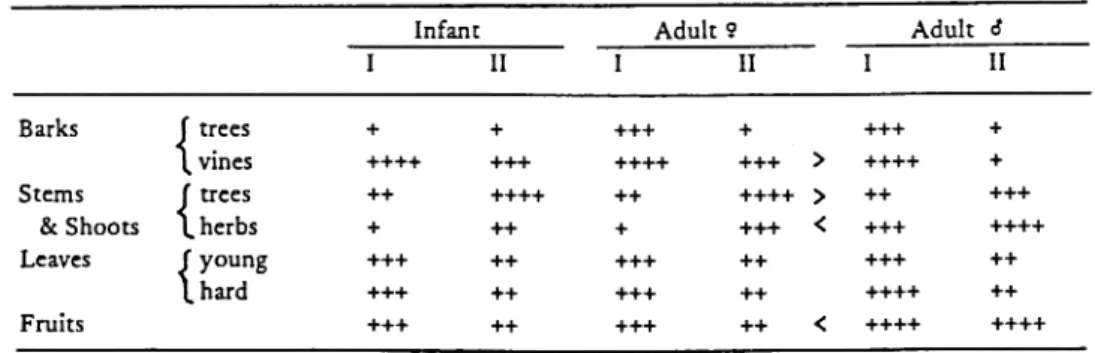
1985 and 1986. The total observation times in witch the behaviors of orangutans were recorded is 26586 minutes ( 443 hours and 6 minu-ts, 69 days ). The 65.2 % ( 17342 minutes, 289 hours and 2 minutes, 29 days ) of it is the time which the author could trace their beha viors and land usings during the full days since morning to the bed making times in the evening (Table 2). We can compare the differenc
es between adult males, adult females and juveniles (Table 1). The results of the observations are as follows.
Table 1 . The degrees of foods dependences of Orangutans after the big forest fires in Kutai N. P.
Infant Adult 9 Adult 6
I II I II I II
Barks f trees + + +++ + +++ +
\ vines
++++ +++ ++++ +++ > ++++ +Stems f trees ++ ++++ ++ ++++ > ++ +++
& Shoots \ herbs + ++ + +++ < +++ ++++
Leaves f young +++ ++ +++ ++ +++ ++
\hard
+++ ++ +++ ++ ++++ ++Fruits +++ ++ +++ ++ < ++++ ++++
I : Stage 1 after the fires in 1983.
II: Stage 2 after the fires in 1985 and 1985.(see Fig.3)
127-Table 2. Daily activity and food habits of orangutans in 1985 and 1986 .
Name of
Observation
Day time Travel
place
individual
day
(min.) per a day distances high middlelow ground"
(min) per a day % % % %
- _ _ _ « _ _ _ . (m). , Entang 8 3698 655 430 63.4 20.2 8.6 7.8 ( 3 ) (1965)
Adult males 1
27
7840
656
329
45.6 43.0
5.7
5.6
( 5 inds.) ( 5 )(2156) Raul(5 years r old)jnon-fruits
1 season 17 8763 583 296 29.6 41.0 28.6 0.8 (14) (8156) total 25 13408 V (19)(10783) *2 Juveniles 27 14243 (20)(11413) 568 213 44.9 34.4 20.1 0.6 571 250 41 .4 39.6 18.5 0.5 Adult females 15 4503 663 373 22.6 68.6 8.5 0.3 3 individuals; 4) (2651) (Sindora Muka Muda Total 69 26586 630 317 36.3 50.4 10.9 6.4 (29) (17342)*1 ; Entang, Don, AW, Prodisa and Duke. *2 ; Raul and Pinchang.
( ) ; observe an individual of orangutan during a full day.
1). Active hours per a day is about 10 hours ( m. 629 minutes, adult males 656 mins., adult females 663 mins., and juveniles
571 mins.).
2). Moving distances per a day is 317 m. ( adult males 329 m.,
adult females 373 m. and juveniles 250 m. ).
3). Adult males and juveniles use heigh places in the forests for
45.6 % and 41.4 % of the day times, but adult females use only for 22.6 %. High place means heigher than 20 m.. Adult females use a middle layer of the forests ( 10 — 20 m. height in the forest ) for much time (68.6 % ), but adult males and juvenil
es were 43.0 % and 39.8 %. using on the ground is 5.6 % of the day time by adult males, but in adult females and juveniles 0.5 % and 0.3 % only. Those results are related with the
-128-Table 2. (continued)
Moving Moving Feeding Feeding Rest Feeding time
& & •
Feeding B^st Fruits Barks StemsLeavesFlowers
11.6
0
39.0
24.4
24.3*1
75.5
3.1
4.4
17.1
0
13.3
0
37.1
20.2
28.5*1
82.1
4.3
5.0
8.5
0
2.5 27.0 33.5 17.6 19.3 37.0 7.9 49.5 2.3 3.3 5.2 19.6 34.3 26.8 14.0 58.5 5.2 32.6 1.5 2.26.2
18.1
33.9
25.9
15.9*2
58.8
5.0
31.1
3.1
2.0
5.1 15.6 16.5 15.2 46.0 31.0 29.7 34.5 4.8 0 8.2 11.2 29.2 20.4 30.1 57.3 13.0 23.5 5.5 0.7*1 : copulations' times of male ; 0.9%,( 0.6% by Entang )
*2 : copulations*times of females ; 1.6%
ing styles and the feeding habits after the fires.
4). Adult males spend 13.3 % of the day times for the moving, 57.3 % for the feeding ( but 20.2 % for the feeding while resting), 28.5% for the resting, but juveniles spend much
times for the feedings (juveniles for the feeding, 77.9 % while adult males ,57.3 % and adult females, 47.3 % ).
Adult females use much more times for the resting ( adult
females, 46.0 % while adult males, 28.7 %, juveniles*, 15.9% ,)
5). Adult males depend upon much fruits for their foods ( 75.5 % of the feeding times), while adult femalesdepend on the
fruits for only 31.0 % of their feeding times and use more barks and stems.( see Table 1 and Fig. 3.).
-1Z9-Phot. 4. A big male moved on the ground, observed clearly even on the forest floor after the fires.
f nifW
r
Phot. 5. Syndora, an adult female, standing up on the fallen tree
trunk for looking around her moving direction with her new
born baby(one month old), hanging on her hip.
-130-Phot.6. Syndola, an adult female, eating young leaves, phot on Nov.
1 983.
/ •! *"' fi
Phot. 7. Duke, a young adult male, drinking water at a small stream in the evening before making the bed. It was very right in the forest floor after the fires.
-131-Phot.8. Raul, a juvenile of 5 yeas old.
Phot. 9. The first new born baby after the fires with her mother,
Syndora. phot on Nov. 1983
•
£
132-Phot. 10. An adult male, Don.
Phot. 11. The infant of Syndora had grown up after 2 years, phot on Oct. 1985.
-133-Phot. 12. The copulation on
a tree between
Entang and Muka.
6). The copulations are observed three times. It takes for 10 or 20 minutes in each copulations. This behavior took 0.9 % (ad
ult males) and 1.6 % (adult females) of total activity times.
The fruits productions have been low down after the forest fires without few fig trees. But the Sengkuwang trees which grew along river sides raipened abundant fruits and were feeded and damag
ed by orangutans on July and August 1986 (Fig.7). After the Sengkuwa ng fruits finished they depended upon stems and young leaves of Ginger harbs on the forest grounds in 1986.
IV SUMMARY
The 1983 forest fires affects on the lifes of orangutans were studyed since 1983 upto 1986 in Kutai national park, East Kalimantan
, Indonesia. The burnt and the unburnt areas are illustrated on the maps by the results of the authors surveys. The secondary trees gro wn up very quickly and reached about 13—15 meters heigh after the
fires.
The fruits productions have been very low, so orangutans have depended upon at first barks and young leaves of the trees after the fires and then young stems and new buds and leaves of the seco ndary trees that grownup afterward in 1985 and 1986.
Total 18 individuals of orangutans were observed in the study
area. The population density is estimated as 1 .8 individuals per 1
-134-Phot. 13. Young
adult male, Duke.
Phot.14. Sandy, 5 years old juvenile
removed to Sinara
area from Mentoko
area in 1985.
Phot. 15. Pinchang
, 7 years old male ,hanging a string of animal traps on his right leg.
-135-2
km in the study area, and roughly estimated as 1 individual per
2
1 km in all north — easternpart of Kutai national park(A.Suzuki
19-84) .
Several couples of mothers and infants occupied in their ranges
ranges, and several adult males moved widely plural females' ranges. Daily activity patterns were recorded in each individuals.
V REFERENCE
Azuma S., Suzuki, A and R. Yayat, 1985. Socio-Ecological Studies on the Cercopithecoid
Primates in Kalimantan. The report to LIPI. (The typed one).
Cockburn P. R. and E. A. Sumardja, 1979. Proposed management plan for Kutai Nature
Reserve, East Kalimantan, Indonesia. P. P. A., Bogor.
Reksodihardjo et al., 1974. Preliminary report on the investigation of the Kutai National
Reserve, East Kalimantan. Indonesia, Bogor, Biotrop, 33pp.
Suzuki, A., 1984. The distribution of primates and the survey on the affection of forest fires,
1983, in and around Kutai Nature Reserve of east Kalimantan, Indonesia. Kyoto Uni
versity Overseas Research Report of Studies on Asian Non-Human Primates, No. 3,
55-65.
, 1984. The socio-ecological study on orangutans in Kutai Nature Reserve of east
Kalimantan, Indonesia.
Kyoto University Overseas Research Report of Studies on
Asian Non-Human Primates, No. 3, 67-76.
, 1986. The ecological survey on the effects of the forest
fires and droughts in 1982 - 1983, and the distributions and
populations of primates along the middle — upper streams of
S. Sangata in Kutai national park, East Kalimantan, Indonesia. Kyoto Univ. Overseas Report of Studies on Asian Non—Human Primates, No. 5, 13- 22.
, 1986. The socio—ecological study on the orangutans in the Mentoko — BT. Sinara study area, in Kutai national park,
E. Kalimantan. Kyoto Univ. Overseas Report of Studies on Asian
Non—Human Primates, No. 5, 23—28.
Transmigration Area Development Project, 1982. Rainfall records, East Kalimantan, report
Analysis Summaries and Histogram. TAD. Samarinda, INDONESIA.
Wirawan N., and Ir. Hudiyono, 1983. Survey to the Eastern part of the Proposed Kutai Natio nal Park. (The typed report).
, 1985. Kutai National Park, Management Plan 1985-1990.
WWF/IUCN Report,
No. 10, Pp. 124.