Myanmar and Japan: How Close Friends Become
Estranged
著者
Kudo Toshihiro
権利
Copyrights 日本貿易振興機構(ジェトロ)アジア
経済研究所 / Institute of Developing
Economies, Japan External Trade Organization
(IDE-JETRO) http://www.ide.go.jp
journal or
publication title
IDE Discussion Paper
volume
118
year
2007-08-01
INSTITUTE OF DEVELOPING ECONOMIES
IDE Discussion Papers are preliminary materials circulated
to stimulate discussions and critical comments
IDE DISCUSSION PAPER No. 118
Myanmar and Japan: How Close
Friends Become Estranged
Toshihiro KUDO*
August 2007
Abstract
Independent Myanmar and Japan had long held the strongest ties among Asian countries, and they were often known as having “special relations” or a “historically friendly relationship.” Such relations were guaranteed by the sentiments and experiences of the leaders of both countries. Among others, Ne Win, former strongman throughout the socialist period (1962-1988), was educated and trained by the Japanese army officers of the Minami Kikan, leading to the birth of the Burma Independence Army (BIA). Huge official development assistance provided by the Japanese government also cemented this special relationship.
However, the birth of the present military government (SLORC/SPDC) in 1988 drastically changed this favorable relationship between the two countries. When the military seized power in a coup, Japan was believed to be the only country that possessed sufficient meaningful influence on Myanmar to encourage a move toward national reconciliation between the junta and the opposition party led by Aung San Suu Kyi. In reality, Japan failed to exert such an influence due to its sour relations with the military government and reduced influence in the new international and regional political landscape. What is worse, Japan seems to be losing its say on Myanmar issues in the international political arena, as it has been wavering in limbo
Keywords: Myanmar (Burma), Japan, China, ODA, Foreign Relations, Cold War
JEL classification: F14, F35, N45
* Director, Southeast Asian Studies Group II, Area Studies Center, IDE ([email protected])
The Institute of Developing Economies (IDE) is a semigovernmental,
nonpartisan, nonprofit research institute, founded in 1958. The Institute
merged with the Japan External Trade Organization (JETRO) on July 1, 1998.
The Institute conducts basic and comprehensive studies on economic and
related affairs in all developing countries and regions, including Asia, the
Middle East, Africa, Latin America, Oceania, and Eastern Europe.
The views expressed in this publication are those of the author(s). Publication does not imply endorsement by the Institute of Developing Economies of any of the views expressed within.
INSTITUTE OF DEVELOPING ECONOMIES (IDE), JETRO 3-2-2, WAKABA,MIHAMA-KU,CHIBA-SHI
CHIBA 261-8545, JAPAN
Myanmar and Japan:
How Close Friends Become Estranged
[Contents] Introduction
1. The Era of Close Friends
2. The New International and Regional Landscape 3. How Close Friends Become Estranged
(1) Changes in Japan’s ODA Policy
(2) Myanmar’s Open-door Policy and Regionalization of Trade (3) China’s Rise as Economic Partner
(4) Gas Money
Conclusion: The Role of Japan References
Tables and Figures
Introduction
When the residence of Ne Win, former strongman throughout the socialist period, was surrounded by a military squad on March 4, 2002, he told his favorite daughter Sandar Win to call the Japanese ambassador in Yangon for help. Eventually, an alleged plot to overthrow the State Peace and Development Council (SPDC)1 by Sandar Win’s husband was uncovered. Ne Win was put under house arrest and died nine months later. At the last moment, when he stood on the brink of a precipice, Ne Win sought help from the Japanese government. The anecdote implies an extremely close relationship between the two parties.
In contrast, the SPDC reproached the Japanese government for its vote together with the United States, the United Kingdom and others in favor of putting Myanmar issues2 on the United Nations Security Council (UNSC)’s agenda on September 15, 2006. The Myanmar state-run newspaper furiously condemned the Japanese government by
1 The military took power in a coup in September 1988 and established the State Law and Order Restoration Council (SLORC), which was re-constituted as the SPDC in November 1997.
2 Myanmar issues include the military government’s violation of human rights, including the detention of Aung San Suu Kyi, and a delay in democratization.
referring to human rights abuses by the Japanese army during the World War II.3 So-called historical issues were rarely raised by the Ne Win regime. Even when the Japanese Ministry of Education issued revised guidelines for modern history textbooks in the 1980s, the Ne Win regime did not join China, South Korea and other Asian countries in criticizing the guidelines for whitewashing Japan’s wartime outrages in Asian countries (Seekins [1992:254]). The bilateral relations between Myanmar and Japan seem to have currently reached an all-time low for the last five decades. Furthermore, not only political and diplomatic relations but also economic ties have become relatively weaker since 1988.
The birth of the military government in Myanmar and the Japanese response to it apparently marked a watershed in their relations. Japan was then believed to be the only country that possessed sufficient meaningful influence on Myanmar to encourage a move toward national reconciliation between the newly-born military government and the opposition party led by Aung San Suu Kyi. However, Japan failed to exert such an influence successfully on either side due to its reduced leverage in a new political and economic reality. Why and how have the close friends, Myanmar and Japan, become estranged? This paper examines factors that have contributed to putting them at a distance since 1988.
The first section reviews the history of relations between the two countries in the post-World War II period with special reference to Japan’s official development assistance (ODA) provided to Myanmar. The provision of Japanese ODA had cemented the close ties between Ne Win and the Japanese government throughout the socialist period. The second section reviews the new international and regional reality surrounding Myanmar. The Cold War ended almost at the same time as the military government took power in Myanmar. The birth of the military government itself perhaps simply coincided with the end of the Cold War. However, the end of the Cold War brought about a new international and regional reality, and events that eventually put Myanmar and Japan at a distance occurred in this new environment. The third section examines four events and/or factors that resulted in an estrangement of the relationship between the two countries. The four events include changes in Japanese ODA policy, Myanmar’s open-door policy and the attendant regionalization of trade,
China’s rise as an economic partner and increased revenues from natural gas extraction. In conclusion, the author envisages a prospect of the relationship between the two countries in the future, and deliberates on a new role for Japan in international society, which would promote national reconciliation and economic development in Myanmar.
1. The Era of Close Friends
Myanmar and Japan had long held strong ties in the post-World War II period, and they were often known as having a “special relationship” or a “historically friendly relationship.”4 Such a relationship was established through the personal experiences and sentiments of Ne Win and others in the military and political elite of independent Myanmar. Aung San, Ne Win and other leaders of Myanmar’s independence movement were members of the “Thirty Comrades,” who were educated and trained by Japanese army officers.5
The personal ties between national leaders of Myanmar and Japanese army officers were certainly instrumental in the formation of favorable bilateral relations between the two countries, in particular during the Ne Win era (1962-1988). Throughout the critical economic periods following the military coup of 1962, only the Japanese ambassador out of the whole diplomatic corps had continuous access to Ne Win (Steinberg [1990:57]; Nemoto [2007:103]). In addition to the “Thirty Comrades,” many ministers and higher-ranking government officials in the Ne Win regime were also educated by Japanese army officers and civilians, and spoke Japanese to varying degrees. For example, Sein Lwin, who succeeded Ne Win in July 1988 and took the office of president for only 17 days, also spoke Japanese to a fair degree.
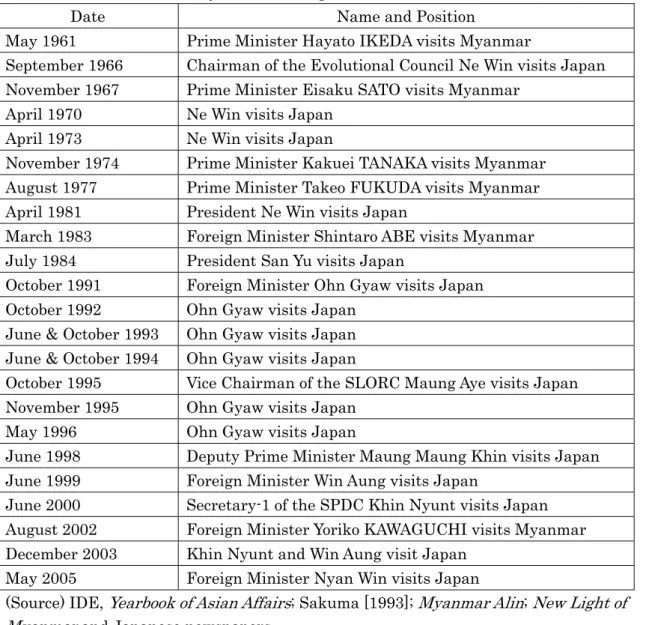
On the Japanese side, there was what had been informally called a “Burmese lobby” in Tokyo (Steinberg [1990:59]). The Burmese lobby included such figures as Nobusuke Kishi, a former Prime Minister; Shintaro Abe, a former Foreign Minister; Watanabe Michio, successor to the Nakasone faction of the ruling Liberal Democratic Party (LDP); and Yoshiko Yamaguchi, an LDP member and close friend of Ne Win. Four Japanese prime ministers officially visited Myanmar in the 1960s and 1970s, while Ne Win
4 See Nemoto [1993:12-14] and [2007:100-103] for details on the special relationship between Myanmar and Japan. Takashi Suzuki, former Japanese ambassador to Myanmar from January 1971 to June 1974, also wrote in his book that Japan had a sort of special historical relationship with Burma (Suzuki [1977:214]).
visited Japan several times (Table 1).
In reality, huge ODA provided by the Japanese government to Myanmar cemented this special relationship, which was based on the personal sentiments of political elites in the two countries. ODA played a leading role in both economic and diplomatic relations between the two countries.
Japanese economic assistance to Myanmar began in the form of war reparations in 1955.6 Japan paid US$200 million (equivalent to 72 billion yen at the then exchange rate of 360 yen per US dollar) in Japanese goods and services over a period of ten years from 1955 to 1965. At the same time, Japan provided technical assistance, the value of which was US$50 million (equivalent to 18 billion yen). In 1963 Japan decided to provide another US$140 million (equivalent to 50.4 billion yen) to Myanmar in economic and technical cooperation, which was actually quasi-reparations. In 1968 Japan provided for the first time a yen loan of 10.8 billion yen as more genuine economic assistance. Since then, Japan has introduced more diversified modes of economic assistance to Myanmar, such as general grants in 1975, cultural grants in 1976, grants for increased food production in 1977, and debt relief in 1979.
Japan’s ODA to Myanmar rapidly increased from the latter half of the 1970s, when the Ne Win government relaxed its strict neutralist foreign policy and opened up to more official overseas assistance in order to overcome the country’s economic and political crisis of the mid-1970s. In 1976 the Burma Aid Group7 met for the first time in Tokyo, where the Ne Win government requested an annual aid of US$200 million based on its proposed five-year economic development plan. Following the donors’ meeting, official inflows to Myanmar increased sharply (Figure 1). Between 1978 and 1988, Myanmar received US$3712.3 million in assistance, a sum equivalent to 15.1% of Myanmar’s total imports for the same period (Kudo and Mieno [2007:5]). It is widely believed that without such huge aid the Ne Win regime could not even have survived the several economic crises of the 1970s and 1980s.
Japan’s aid, especially ODA yen loans, contributed most to this rapid increase. Table 2 shows the provision of yen loans to Myanmar. Until 1975, yearly provision of yen loans
6 See Steinberg [1990] and Kudo [1993] and [1998e:161-169] regarding Japan’s ODA policy and performance toward Myanmar.
7 Japan, then West Germany, the United States, the United Kingdom, France, Canada, Australia and major international development banks and organizations held the first donors’ meeting in Tokyo in 1976 under the auspices of the World Bank.
ranged from 5 to 10 billion yen; in 1976 it showed a jump to almost 30 billion yen; in 1982 it reached 40 billion yen; in 1984 it recorded a peak of 46 billion yen. It remained over 30 billion yen in 1985 and 1987 and faced an abrupt suspension in 1988. Japan’s ODA accounted for 66.7% of the total bilateral ODA received by Myanmar between 1976 and 1990. Myanmar had also long been one of the largest recipients of Japanese ODA. It consistently ranked within the top ten recipients and often ranked within the top five.8 Thus, Japan’s ODA strengthened its bilateral relations with Myanmar.9
2. The New International and Regional Landscape
The birth of the military government in 1988, however, drastically changed this favorable relationship between Myanmar and Japan. Japan suspended its ODA to Myanmar on account of the junta’s poor human rights record and delay in democratization. Moreover, the open-door policy adopted by the military government strengthened Myanmar’s economic relations with its neighboring countries including China, Thailand and India, while reducing the importance of those with former major donor countries such as Japan and West Germany. All these events occurred in the new international reality following the end of the Cold War.
In the midst of the Cold War, the Ne Win government had long pursued a strict neutralist foreign policy, and refused to ally itself with any bloc.10 The United States was of course unhappy about Ne Win’s xenophobic policy. However, his visit to Washington in September 1966, presumably to counterbalance his trips to Beijing and Moscow in the previous year, improved their relations (Liang [1990:164]).
Myanmar had never been a major object of the United States’ attention since the establishment of formal diplomatic relations between the two countries in 1948 (Liang [1990:233]). Nevertheless, the United States government regarded the nationalist Myanmar armed forces led by Ne Win as a countervailing power against Communist
8 Myanmar’s ranking in Japan’s ODA recipients is as follows: 9th in 1976, below 10th in 1977, 4th in 1978, 1979 and 1980, 6th in 1981, 1982 and 1983, 7th in 1984, 5th in 1985 and 1986, 8th in 1987 and 7th in 1988.
9 It is an anomaly that such a huge amount of Japanese ODA was provided to an underdeveloped economy with little Japanese commercial interests. There are several reasons for this besides the “special relationship.” See Steinberg [1990], Seekins [1992] and Kudo [1998j] for these reasons.
10 See Liang [1990] and Sakuma [1993] for Myanmar’s foreign policy after independence.
China.11 Such recognition by the United States was then enough for Japan, West Germany and international development banks to support the Ne Win regime on behalf of the Western bloc. The United States had tolerated the Ne Win government, as it had many other authoritarian, repressive and corrupt regimes, simply because the leaders of those regimes were willing to oppose the Communist allies.
However, the end of the Cold War dramatically changed the international and regional political landscape surrounding Myanmar just as the military government was coming into power. First of all, the United States ceased to prop up allied authoritarian governments in order to spur on democratization in less developed countries (Cingranelli and Richards [1999:513]). In 1992 Japan also adopted the ODA Charter, which placed a greater emphasis on universal values of human rights and democracy.
Second, China relented on its dual-track foreign policy toward Myanmar, in which it had formerly endorsed party-to-party relations between the China Communist Party (CCP) and the Burma Communist Party (BCP) in addition to state-to-state relations (Kudo [2006:5]). The BCP, which was deployed alongside the border areas between Myanmar and China, had long fought against the Myanmar army since independence. However, having lost Beijing’s backing, the BCP collapsed and split into four ethnic armed groups in 1989. Khin Nyunt, then Secretary One of the SLORC, wasted no time in going to the Chinese border, successfully achieving a ceasefire with these groups.12 This event paved the way for a later strengthening of political and economic relations between Yangon and Beijing.
Third, Thailand also strengthened its ties with the newly-born military government, by abandoning its secret strategy of using the Karen and other ethnic insurgents deployed alongside the border areas as a buffer against the Myanmar army and the BCP. Just before the end of the Cold War, Chatichai Choonhavan, then Thai Prime Minister, stated before the Foreign Correspondents’ Club in December 1988 that Indochina must be transformed from a war-zone to a peace-zone linked with Southeast Asia through trade ties, investment, and modern communications (Buszynski [1989:1059]). “Change the battle field to a commercial field” had become a Thai vision for regional cooperation in mainland Indochina. Thus, two big neighbors, China and Thailand, welcomed the
11 China also regarded the Myanmar armed forces as anti-Communist (Sakuma [1993:185]).
birth of the military government in Myanmar.
Fourth, the SLORC initiated an open-door policy by liberalizing external trade, legalizing cross-border trades with neighbors13 and accepting foreign direct investment on Myanmar soil, and officially abandoned the “Burmese Way to Socialism.” Myanmar opened its door to the rest of the world in the midst of globalization, which was one of the direct effects of the end of the Cold War (Cingranelli and Richards [1999:515]).
3. How Close Friends Become Estranged
The new international and regional reality following the end of the Cold War was responsible for such events as changes in Japan’s ODA policy, Myanmar’s open-door policy, strengthened economic ties with its neighbors and China’s emergence as an economic partner. All of these events, however, eventually impaired the special relationship between Myanmar and Japan. How did these events cause the estrangement of these two close friends?
(1) Changes in Japan’s ODA Policy
Japan suspended its foreign aid to Myanmar following the military coup in March 1988, as other major donors did. Since Japan had been by far the largest donor during the socialist period, the suspension of Japanese aid had also by far the most serious impact on the Myanmar economy. Even though Japan resumed small-scale humanitarian and basic human needs assistance, it did not provide new yen loans, the previous main channel of ODA money to Myanmar. Japanese aid was provided to Myanmar at the average annual amount of US$154.8 million for the period from 1978 to 1988. The average annual amount of Japanese aid declined to US$86.6 million for the period from 1989 to 1995, and further to 36.7 million for the period from 1996 to 2005.
Why did Japan not resume fully-fledged foreign aid to Myanmar? Some say that the Japanese government did not have freedom to act independently and had no choice but to suspend its ODA provision to Myanmar under pressure from the Western allies, in particular the United States, which had persistently opposed any measures that
13 Insurgent ethnic minorities, in particular Karen rebels, had played a major role in smuggling through cross-border transactions between Myanmar and Thailand during the socialist period. The legalization of cross-border trade between the two countries was made possible by the Thai government’s policy shift in favor of Yangon over ethnic rebels in border areas.
appeared to benefit the military government. This must be at least partly true. For example, when the Japanese government decided on its own in May 2002 to provide a 628 million yen grant for the repair of the Baluchaung hydropower plant, a symbolic Japanese ODA project, in response to the release of Aung San Suu Kyi from house arrest, this move was severely criticized by not only Aung San Suu Kyi but also the United States government. Whenever the Japanese government tried to send a positive message to the military government by a partial resumption of ODA, such an effort was often interrupted by the United States, rendering it ineffective (Oishi and Furuoka [2003:904-906]).
However, Japan is not simply a visionless follower of the United States. The Japanese ODA policy has also changed in the post-Cold War era to be more sensitive to so-called universal values such as human rights, freedom, the rule of law, democracy and the market economy. The ODA Charter was approved by the Cabinet in 1992, stating that ODA shall be provided in accordance with the principles of the United Nations (especially sovereign equality and non-intervention in domestic matters), as well as a) environmental conservation, b) avoidance of military usage of ODA funds, c) attention to the recipients’ military expenditures and production and export/import of arms and weapons and d) consideration of recipients’ democratization, basic human rights and market economy.14
The suspension of Japanese ODA to Myanmar was one of the earliest applications of the ODA Charter. Japan suspended the ODA provision to Myanmar of its own accord based on the new policy. The newly-born military government, which was ignorant of such a policy shift on the Japanese side, must have hardly comprehended in their early days why Japan would not resume aid to Myanmar.15 In fact, so far as human rights conditions in Myanmar were concerned, the actual situation may not have significantly deteriorated following the military coup, although this is perhaps arguable. The military’s atrocities against the minority insurgencies were even more dreadful before the SLORC initiated the ethnic ceasefire policy in 1989.16 What had changed more than
14 The ODA Charter was revised in August 2003. The English translation is available at the website of the Japanese Ministry of Foreign Affairs (http://www.mofa.go.jp/policy/oda/reform/charter.html).
15 Personal communication with a Japanese diplomat with responsibility for Myanmar on June 21, 2007.
the actual human rights conditions in Myanmar were the international and Japan’s criteria on human rights. Of course, there exist many political prisoners in Myanmar and Nobel Prize Laureate Aung San Suu Kyi has long been under house arrest as of August, 2007. This is surely a salient violation of human rights. However, during the Ne Win regime there existed no opposition forces and figures to be put in prison or kept under house arrest.
Recently, the Japanese Ministry of Foreign Affairs has coined some new slogans, namely, “value-oriented diplomacy” and “the arc of freedom and prosperity,” by which Japanese diplomacy has put even more emphasis on universal values, including human rights and democracy.17 Thus, the “special relationship” between Myanmar and Japan was replaced by a more basic principle based on universal values.
(2) Myanmar’s Open-door Policy and Regionalization of Trade18
The open-door policy adopted by the military government substantially increased Myanmar’s external trade throughout the 1990s and the first half of the first decade of the twenty-first century. Its exports increased by 14.4 times for the period between 1985 and 2006, imports growing by 13.8 times over the same period (IMF DOT).
As Myanmar’s trade volume grew, its geographical trade pattern changed. Myanmar has strengthened its trade relations with neighboring countries, in particular China and Thailand. During the socialist period, donor countries such as Japan and West Germany were Myanmar’s major trading partners due to aid-driven trade. However, it is natural that given the distances involved, Myanmar should trade with its immediate neighbors rather than with far-off western countries. Myanmar shares long borders with five neighboring countries, namely China (a border of 1357 miles), Thailand (1314 miles), India (857 miles), Bangladesh (152 miles) and Laos (128 miles). Among these various countries and regions, there are differences in natural resource endowments and in industrial development stages. Such economic and industrial complementarities have contributed to the enhanced trade between Myanmar and its neighbors. For their
17 See the speech “Arc of Freedom and Prosperity: Japan’s Expanding Diplomatic Horizons” by Mr. Taro Aso, Minister for Foreign Affairs, on the Occasion of the Japan Institute of International Affairs Seminar on November 30, 2006. The text of the speech is available at the website of the Japanese Ministry of Foreign Affairs (http://www.mofa.go.jp/announce/fm/aso/speech0611.html).
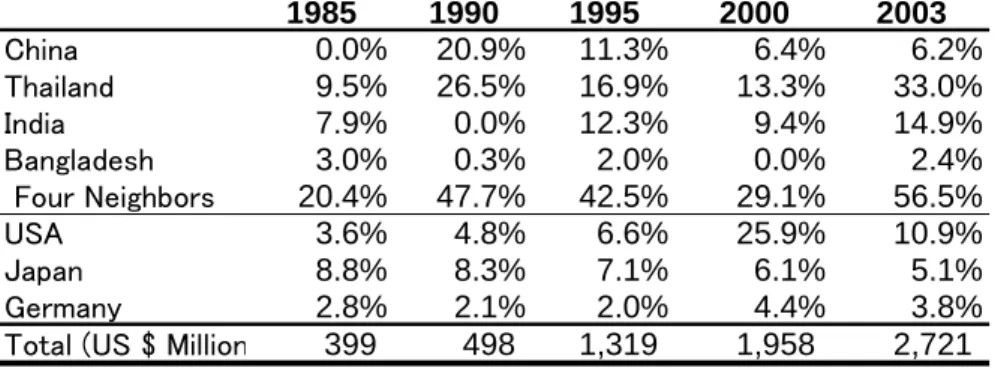
part, neighboring countries welcomed Myanmar’s open-door policy, as mentioned above. The trade shares of the four neighboring countries of China, Thailand, India and Bangladesh accounted for 56.5% of Myanmar’s exports and 52.7% of its imports in 2003, compared with only 20.4% and 2.7% respectively in 1985 (Table 3). Myanmar also joined in regional cooperation schemes such as the Greater Mekong Sub-region (GMS) Economic Cooperation in 1992, the Association of Southeast Asian Nations (ASEAN), the Bay of Bengal Initiative for Multi-Sectoral Technical and Economic Cooperation (BIMSTEC) in 1997 and the Ayeyawady, Chao Phraya, Mekong Economic Cooperation Strategy (ACMECS) in 2003. As Myanmar’s trade relations with neighboring countries have strengthened, Japan has receded into the background.19
(3) China’s Rise as Economic Partner
Among the neighboring countries, China is by far the most important to Myanmar. China now is awarded the special status that was previously enjoyed by Japan. For example, China has replaced Japan as a supply source of imports for Myanmar. During the socialist period, Japan constituted nearly 40% of Myanmar’s total imports, while China accounted for less than 5% (Figure 2). Since the open-door policy was introduced, the Chinese share of Myanmar’s imports has shot up, reaching nearly 35% in 2006, while that of Japan dramatically declined to less than 5% in 2002 and thereafter.
Another example is the Chinese provision of huge economic cooperation to Myanmar.20 China’s economic cooperation with Myanmar seems to have expanded around 1997 when the United States government imposed the first economic sanctions that banned new foreign investments by United States firms. Moreover, Senior General Than Shwe’s state visit to Beijing in January 2003 seemingly marked the beginning of another epoch, when China offered Myanmar a preferential loan amounting to US$200 million and a RMB 50 million grant (equivalent to US $ 6.25 million). Just after China’s commitment, the so-called “Black Friday” of May 30, 2003 occurred and this event
19 As bilateral trade relations have weakened, the number of Japanese-affiliated firms in Myanmar has also declined. The membership of the Japanese Chamber of Commerce in Yangon has decreased from about 80-90 firms in the latter half of the 1990s to less than 60 firms as of August 2007.
20 China does not disclose its economic cooperation programs. The information here is based on news and press reports. Note also that some Chinese economic cooperation programs are merely commercial-based businesses. See Kudo [2006:12-17] for more on Chinese economic cooperation in Myanmar.
provoked the United States to impose a second round of sanctions in July 2003, including an import ban on all Myanmar-made products. Thus, China stepped into and filled the vacuum that was created by Western sanctions and Japan’s suspension of ODA.
(4) Gas Money
Myanmar’s natural gas exports brought huge foreign currency revenues to the military government in the early years of the twenty-first century. The two large gas fields named Yadana and Yetagun in the Gulf of Martaban have been developed, and gas from these fields is exported to Thailand by pipelines. The value of gas exports to Thailand increased from US$114.2 million in 2000 to US$1497.4 million in 2005 and further to US$2062.2 million in 2006, and accounted for 88% of Myanmar’s exports to Thailand.
All the revenues go into the national treasury since the gas reserves have been explored and exploited in the form of production-sharing between the Myanmar Oil and Gas Enterprise (MOGE), a State-owned Economic Enterprise (SEE) under the jurisdiction of the Ministry of Energy, and foreign developers. Due to the gas exports, the public sector of Myanmar recorded a trade surplus of 7675 million kyat (equivalent to US$1321 million at the official exchange rate) in FY 2005 (CSO SMEI). Supposing that one fourth of the total export value is claimed by MOGE for its share, more than US$500 million went to the Myanmar treasury in 2006. This amount of money is more than comparable with foreign aid given during the Ne Win regime.21 The military government thus obtained an alternative revenue source in lieu of foreign aid.
Conclusion: The Role of Japan
The birth of the military government in 1988 drastically changed the traditionally friendly relationship between Myanmar and Japan. In the new international and regional reality following the end of the Cold War, such events as changes in the Japanese foreign aid policy, Myanmar’s open-door policy and attendant enhanced trade relations with neighbors, China’s emergence as supporter of the Myanmar economy and
21 The Ne Win government received an annual average of US$337.5 million for the period between 1978 and 1988, the most active period for foreign donors providing aid to Myanmar.
huge gas revenues eventually resulted in an estrangement between the two counties. On one hand, the military government of Myanmar is no longer dependent on Japan’s ODA for its survival. They have the alternative financial resources of Chinese economic cooperation and gas money. On the other hand, the Japanese government is no longer willing to provide foreign aid to the military government under the new ODA guidelines that place a high value on human rights, democracy, the rule of law and the market economy. Myanmar’s open-door policy significantly increased trade between Myanmar and its neighbors, in particular China and Thailand, while reducing the importance of Japan as a supply source of imports. Under the new hostile international environment, the Myanmar economy has become more and more dependent on China and Thailand. What prospects can we then envisage for a future relationship between Myanmar and Japan? Unfortunately, there is little expectation that the military government will change their authoritarian attitudes in favor of a more democratic polity and more respect for human rights and political freedom. Unless the military government changes, Japan’s foreign policy toward Myanmar will not change, either. The bilateral relationship between the two countries, therefore, may not dramatically improve in the foreseeable future.
Worse still, Japan seems to be losing its influence on Myanmar issues in international society, as it has occupied a vague position between the sanctionist allies such as the United States and the European Union and the constructive and economic engagement allies such as China, India and Thailand. Japan tried to bridge the gap between them. However, Japan was caught in the gap rather than filling it. Instead of acting as a mediator, the Japanese government sometimes wavered from one camp to the other.
For example, the Japanese government apparently objected to the United States and United Kingdom’s motion to put the Myanmar/Burma issues on the UNSC’s agenda by saying at the second UNSC’s unofficial briefing on May 31, 2006 that Myanmar’s situation will not pose a serious threat to international peace and security. Nevertheless, as mentioned at the beginning of this paper Japan voted in favor of the motion less than four months later on September 15, 2006. Such a change in the Japanese attitude on the motion is believed to be attributable to United States pressure. Under such circumstances, Japan will not be able to take a leading role in either the Western allies or the Eastern allies.
contrary, Japan has its own important role to play, that is, to provide accurate information on Myanmar’s politics, economy, society and history to international society. The Japanese government, business circles and academics have accumulated knowledge on Myanmar studies since as early as the pre-World War period. Such knowledge will definitely contribute to a better understanding of Myanmar issues, and may moderate some extreme opinions and policies.
For example, the import ban of the United States against Myanmar appears to be an anomaly in my eyes. As discussed in my previous paper, the United States sanctions not only failed to change the behavior and attitudes of the military government, but also had a disproportionately greater impact on the people than it did on the military regime (Kudo [2005:25-26]). On the other hand, the Chinese economic cooperation bailed the military government out of an economic predicament and allowed them to forgo economic reforms, which were necessary for a long-term and broad-based economic development of Myanmar. For instance, many of the SEEs were revived, rather than privatized, by Chinese economic cooperation funds (Kudo [2006:15-16]).
Two extremes, that is, economic sanctions and economic cooperation without considering the governance of the recipient, promoted neither economic development nor national reconciliation. Japan can provide rich and objective knowledge to both extremes, and possibly moderate them. The role of Japan is therefore to function as an information source and to contribute to producing a moderate, constructive and consistent policy consensus on Myanmar issues in international society.
Last but not least, human, cultural, sports and academic exchanges should be continuously encouraged, even though the relationship between the governments is not particularly smooth. The Myanmar people are still very friendly to the Japanese. The Japanese language is one of the most popular languages for Myanmar people to learn. Japanese products from Toyota cars to TV dramas are well favored by Myanmar consumers. Such friendship between the populations is a precious asset for the two countries, in particular Japan.
REFERENCES
English
Buszynski, Leszek [1989] “New Aspirations and Old Constraints in Thailand’s Foreign Policy,” Asian Survey, Vol.29, No.11, November 1989, pp.1057-1072.
Cingranelli, David L. and Richards, David L. [1999] “Respect for Human Rights after the End of the Cold War,” Journal of Peace Research, Vol.36, No.5 (September, 1999), pp.511-534.
Kudo, Toshihiro [1998e] “Political Basis of Economic Policies under Burmese Socialism,”
Southeast Asian Studies, No.4, Tokyo University of Foreign Studies, pp.139-177.
--- [2005] “The Impact of United States Sanctions on the Myanmar Garment Industry.” IDE Discussion Paper Series No.42, Institute of Developing Economies, JETRO, available at http://www.ide.go.jp/English/index4.html.
--- [2006] “Myanmar’s Economic Relations with China: Can China Support the Myanmar Economy?” IDE Discussion Paper Series No.66, Institute of Developing Economies, JETRO, available at http://www.ide.go.jp/English/index4.html.
Kudo, Toshihiro and Mieno, Fumiharu [2007] “Trade, Foreign Investment and Myanmar’s Economic Development during the Transition to an Open Economy,” IDE Discussion Paper Series No.116, Institute of Developing Economies, JETRO, available at http://www.ide.go.jp/English/index4.html.
Liang, Chi-shad [1990] Burma’s Foreign Relations: Neutralism in Theory and Practice, New York: Praeger Publishers.
Lintner, Bertil [1990] The Rise and Fall of the Communist Party of Burma (CPB), Ithaca: Southeast Asian Program, Cornell University.
--- [1994] Burma in Revolt: Opium and Insurgency since 1948, Boulder, San Francisco, Oxford and Bangkok: Westview Press and White Lotus.
--- [1998] “Drugs and Economic Growth: Ethnicity and Exports” in Rotberg, Robert I. ed., Burma: Prospects for a Democratic Future, The World Peace Foundation and Harvard Institute for International Development, Washington D.C.: Brookings Institution Press.
Ministry of Foreign Affairs (MOFA) [2003] Japan’s Official Development Assistance Charter (Unofficial Translation), available at the website of the Japanese Ministry of Foreign Affairs (http://www.mofa.go.jp/policy/oda/reform/charter.html).
Nemoto, Kei [2007] “Between Democracy and Economic Development: Japan’s Policy toward Burma/Myanmar Then and Now,” in Ganesan N. and Kyaw Yin Hlaing eds.,
Myanmar: State, Society and Ethnicity, Institute of Southeast Asian Studies (ISEAS) and Hiroshima Peace Institute (HPI), Singapore: ISEAS Publishing, pp.96-108.
Oishi, Mikio and Furuoka, Fumitaka [2003] “Can Japanese Aid Be an Effective Tool of Influence? Case Studies of Cambodia and Burma,” Asian Survey, Vol.43, No.6, November-December 2003, pp. 890-907.
Seekins, Donald M. [1992] “Japan’s Aid Relations with Military Regimes in Burma, 1962-1991: The Kokunaika Process,” Asian Survey, Vol.32, No.3, March 1992, pp.246-262.
Smith, Martin T. [1999] Burma: Insurgency and the Politics of Ethnicity, Dhaka, Bangkok and London: The University Press Ltd., White Lotus and Zed Books.
--- [2005] “Ethnic Politics and Regional Development in Myanmar: The Need for New Approaches,” in Kyaw Yin Hlaing, Taylor, Robert H. and Tin Maung Maung Than eds., Myanmar: Beyond Politics to Societal Imperatives, Singapore: Institute of Southeast Asian Studies (ISEAS), pp. 56-85.
Steinberg, David I. [1990] “Japanese Economic Assistance to Burma: Aid in the “Tarenagashi” Manner?” Crossroads, Volume 5, Number 2, Center for Southeast Asian Studies, Northern Illinois University, pp. 51-107.
Japanese
アジア経済研究所編 [各年版]『アジア動向年報』アジア経済研究所。
Institute of Developing Economies ed., Year Book of Asian Affairs, various numbers, Tokyo: Institute of Developing Economies.
工藤年博 [1993]「日本の対ビルマ援助政策の変遷と問題点」(『通信』79 号、東京外国語大 学アジア・アフリカ言語文化研究所、1993 年)
Kudo, Toshihiro [1993] “Japan’s ODA Policy toward Myanmar: Changes and Challenges,” Tsushin, Research Institute for Languages and Cultures of Asia and Africa (ILCAA), Tokyo University of Foreign Studies (TUFS).
―――― [1998j]「ミャンマー援助の実態と問題点」(『アジ研ワールド・トレンド』第 37 号、42~50 ページ)。
Kudo, Toshihiro [1998j] “Japan’s ODA to Myanmar: Present Situation and Problems,”
IDE World Trend, No.37, pp.42-50, Institute of Developing Economies, JETRO.
佐久間平喜 [1993]『ビルマ(ミャンマー)現代政治史(増補版)』第三世界研究シリーズ、 勁草書房。
Sakuma, Hirayoshi [1993] Political History of Modern Burma/Myanmar (Revised Version), Study Series of the Third World, Tokyo: Keiso Shobo.
鈴木孝 [1977]『ビルマという国―その歴史と回想―』国際 PHP 研究所。
Suzuki, Takashi [1977] A Country Called Burma: Its History and Memoir, Tokyo: PHP Research Institute.
田辺寿夫 [1990]『アウンサン将軍と三十人の志士―ビルマ独立義勇軍と日本―』中公新書。 Tanabe, Suzuo [1990] General Aung San and Thirty Comrades: Burma Independence
Army and Japan, Tokyo: Chuko-Shinsho.
根本敬 [1993]「「日本とビルマの特別な関係」?―対ビルマ外交に影を落としてきたもの―」 (『通信』77 号、東京外国語大学アジア・アフリカ言語文化研究所、1993 年)。
Nemoto, Kei [1993] “Special Relationship between Japan and Burma: An Influence on Japan’s Diplomacy toward Burma?” Tsushin, Research Institute for Languages and Cultures of Asia and Africa (ILCAA), Tokyo University of Foreign Studies (TUFS).
Newspapers
Myanmar Alin (the state-run daily Burmese newspaper)
New Light of Myanmar (the state-run daily English newspaper)
Statistics
Central Statistical Organization (CSO), Selected Monthly Economic Indicators (SMEI). Central Statistical Organization (CSO), Statistical Yearbook (SY).
TABLES AND FIGURES
Table 1: VIP Visits between Myanmar and Japan
Date Name and Position
May 1961 Prime Minister Hayato IKEDA visits Myanmar
September 1966 Chairman of the Evolutional Council Ne Win visits Japan November 1967 Prime Minister Eisaku SATO visits Myanmar
April 1970 Ne Win visits Japan April 1973 Ne Win visits Japan
November 1974 Prime Minister Kakuei TANAKA visits Myanmar August 1977 Prime Minister Takeo FUKUDA visits Myanmar April 1981 President Ne Win visits Japan
March 1983 Foreign Minister Shintaro ABE visits Myanmar July 1984 President San Yu visits Japan
October 1991 Foreign Minister Ohn Gyaw visits Japan October 1992 Ohn Gyaw visits Japan
June & October 1993 Ohn Gyaw visits Japan June & October 1994 Ohn Gyaw visits Japan
October 1995 Vice Chairman of the SLORC Maung Aye visits Japan November 1995 Ohn Gyaw visits Japan
May 1996 Ohn Gyaw visits Japan
June 1998 Deputy Prime Minister Maung Maung Khin visits Japan June 1999 Foreign Minister Win Aung visits Japan
June 2000 Secretary-1 of the SPDC Khin Nyunt visits Japan August 2002 Foreign Minister Yoriko KAWAGUCHI visits Myanmar December 2003 Khin Nyunt and Win Aung visit Japan
May 2005 Foreign Minister Nyan Win visits Japan
(Source) IDE, Yearbook of Asian Affairs; Sakuma [1993]; Myanmar Alin; New Light of Myanmar and Japanese newspapers.
FY Total (BillionYen) FY Total (BillionYen)
1968 10.80 1979 26.96 1969 0.00 1980 31.50 1970 0.00 1981 34.52 1971 8.22 1982 40.25 1972 6.65 1983 43.02 1973 4.62 1984 46.14 1974 0.00 1985 36.15 1975 6.50 1986 0.00 1976 29.95 1987 32.90 1977 28.54 1988-present 0.00 1978 16.25 Total 402.97
(Note) FY stands for Fiscal Year.
(Source) MOFA,
Japan's ODA
, various numbers. Table 2: Japan's ODA Loans to MyanmarExports 1985 1990 1995 2000 2003 China 0.0% 20.9% 11.3% 6.4% 6.2% Thailand 9.5% 26.5% 16.9% 13.3% 33.0% India 7.9% 0.0% 12.3% 9.4% 14.9% Bangladesh 3.0% 0.3% 2.0% 0.0% 2.4% Four Neighbors 20.4% 47.7% 42.5% 29.1% 56.5% USA 3.6% 4.8% 6.6% 25.9% 10.9% Japan 8.8% 8.3% 7.1% 6.1% 5.1% Germany 2.8% 2.1% 2.0% 4.4% 3.8%
Total (US $ Million 399 498 1,319 1,958 2,721 Imports 1985 1990 1995 2000 2003 China 0.0% 20.8% 25.0% 19.5% 33.3% Thailand 2.2% 4.7% 14.2% 19.8% 16.1% India 0.1% 0.0% 1.2% 2.1% 3.2% Bangladesh 0.3% 0.1% 0.2% 0.0% 0.1% Four Neighbors 2.7% 25.6% 40.6% 41.3% 52.7% Singapore 11.5% 25.0% 25.8% 17.1% 23.8% Korea 3.1% 4.3% 3.5% 11.4% 6.7% Malaysia 2.5% 5.8% 9.3% 9.1% 5.1%
Total (US $ Million 524 913 2484 2677 2904 (Source) UN Comtrade.
Table 3 Myanmar's Trade with Neighboring Countries: Exports and Imports 1985-2003
Figure 1: Japanese ODA received by Myanmar 0 50 100 150 200 250 300 350 400 450 500 1963196419651966196719681969197019711972197319741975197619771978197919801981198219831984198519861987198819891990199119921993199419951996199719981999200020012002200320042005
(Note) Total figures only for 1963 - 1970. Japan's ODA only for 2005. (Source) MOFA, Japan's ODA, various numbers.
Multilateral
Bilateral excl Japan Japan
(US$ Millions)
Total ODA Received
1st Donors' Meeting at Tokyo
Figure 2: Myanmar's Imports from China and Japan, Share (%) 0% 5% 10% 15% 20% 25% 30% 35% 40% 45% 50% 19 80 19 81 19 82 19 83 19 84 19 85 19 86 19 87 19 88 19 89 19 90 19 91 19 92 19 93 19 94 19 95 19 96 19 97 19 98 19 99 20 00 20 01 20 02 20 03 20 04 20 05 20 06
(Source) IMF, DOT.