What motivates female operators to enter the
garment industry in Pakistan in the post-MFA
period?
著者
Makino Momoe
権利
Copyrights 日本貿易振興機構(ジェトロ)アジア
経済研究所 / Institute of Developing
Economies, Japan External Trade Organization
(IDE-JETRO) http://www.ide.go.jp
journal or
publication title
IDE Discussion Paper
volume
374
year
2012-12-01
INSTITUTE OF DEVELOPING ECONOMIES
IDE Discussion Papers are preliminary materials circulated to stimulate discussions and critical comments
Keywords: Garment industry, post-MFA, female labor participation, Pakistan JEL classification: D22, F16, F66, J16, O53
* Research Fellow, South Asia Study Group, Area Studies Center, IDE ([email protected])
IDE DISCUSSION PAPER No. 374
What Motivates Female Operators
to Enter the Garment Industry in
Pakistan in the Post-MFA Period?
Momoe MAKINO*
December 2012
AbstractPakistan's knitwear exports had been struggling since the quota phase-out until 2009. A particular feature of Pakistan's garment industry is that hiring more male sewing operators at piece rates. Recently, a few surviving knitwear factories have adopted a strategy of shifting from male piece-rate operators to salaried female operators. In Pakistan, female participation in general workforce is very limited and hiring salaried female operators requires management effort and expertise. However, even in the factories with such management skills, household factors prevent females from working outside because Pakistani culture disrespects women working in factories. Our survey reveals that financial motives compel female household members to work outside their homes and that female operators contribute substantially to their households' finances.
The Institute of Developing Economies (IDE) is a semigovernmental, nonpartisan, nonprofit research institute, founded in 1958. The Institute merged with the Japan External Trade Organization (JETRO) on July 1, 1998.
The Institute conducts basic and comprehensive studies on economic and related affairs in all developing countries and regions, including Asia, the Middle East, Africa, Latin America, Oceania, and Eastern Europe.
The views expressed in this publication are those of the author(s). Publication does not imply endorsement by the Institute of Developing Economies of any of the views expressed within.
INSTITUTE OF DEVELOPING ECONOMIES (IDE), JETRO 3-2-2, WAKABA,MIHAMA-KU,CHIBA-SHI
CHIBA 261-8545, JAPAN
©2012 by Institute of Developing Economies, JETRO
No part of this publication may be reproduced without the prior permission of the IDE-JETRO.
What Motivates Female Operators to Enter the
Garment Industry in Pakistan in the Post-MFA
Period?
∗
Momoe Makino
†December, 2012
Abstract
Pakistan’s knitwear exports had been struggling since the quota phase-out until 2009. A particular feature of Pakistan’s garment industry is that hiring more male sewing operators at piece rates. Recently, a few surviving knitwear factories have adopted a strategy of shifting from male piece-rate operators to salaried female op-erators. In Pakistan, female participation in general workforce is very limited and hiring salaried female operators requires management effort and expertise. However, even in the factories with such management skills, household factors prevent females from working outside because Pakistani culture disrespects women working in fac-tories. Our survey reveals that financial motives compel female household members to work outside their homes and that female operators contribute substantially to their households’ finances.
Keywords: Garment industry, post-MFA, female labor participation, Pakistan JEL classification: D22, F16, F66, J16, O53
∗I thank Fukunishi Takahiro, Tatsufumi Yamagata, and seminar participants at IDE for valuable
comments and suggestions. My special thanks go to Tariq Munir and his assistants at the Faizan Data Analysis and Research Centre for their sincere efforts in conducting the field surveys in Faisalabad, Pakistan. The financial support of IDE-JETRO for the field survey is gratefully acknowledged. Any errors, omissions, or misrepresentations are, of course, my own.
†Institute of Developing Economies (IDE-JETRO), 3-2-2 Wakaba Mihama-ku, Chiba-shi, Chiba
1
Introduction
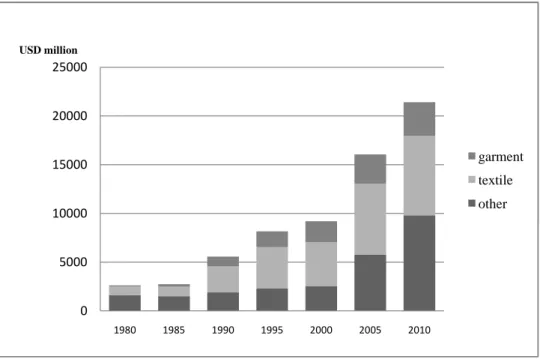
The textile and garment industry in Pakistan is important in two respects: foreign ex-change earnings and employment creation. Textiles and garments constitute roughly 60% of Pakistan’s total exports, and the proportion of garments, in particular, has been grow-ing in export earngrow-ings. Because the garment industry is labor intensive as compared to the textile industry, it is more important in employment creation. Because of its impor-tance, Pakistan was greatly concerned with the quota phase-out, which began in January 2005. Specifically, Pakistan was alarmed by the potential for Chinese garment exports to dominate the international market.
As expected, China has experienced a spike in its garment exports since the quota phase-out. Garment exports from Vietnam, India, and Bangladesh have also expanded rapidly, following China. Pakistan’s garment exports, especially woven wear exports, have shown consistent growth; however, its knitwear exports have grown at a sluggish pace in the post-Multi-Fiber Arrangement (MFA) period, especially until the year 2009. An estimated 90% of Pakistan’s knitwear factories have been closed since 2005. A distinct feature of Pakistan’s garment industry, in contrast with its international competitors, is that the majority of sewing operators are males hired at piece rates. Interestingly, the author’s interviews reveal that a common feature of surviving knitwear factories is that they hire and intend to hire more salaried female sewing operators. It seems that the shift from male to female sewing operators is closely related to factory survival in the intensified international competition, and one of the two objectives of this study is to explore the reason behind this relationship.
In Pakistan, female labor force participation is low overall. To hire female workers, business managers/owners must provide special facilities such as transportation. Labor-supply-side factors also prevent women from working outside their homes. In fact, house-hold factors seem stronger because even factories with sufficient management skills to hire female workers encounter difficulty in increasing the proportion of female workers. Another objective of this study is to explore the household-specific factors that cause Pakistani women to work outside their homes. For this purpose, the study includes a household survey conducted in Faisalabad, Pakistan’s premier textile-producing city, from May to July, 2012.
The rest of the paper is structured as follows. Section 2 overviews the trade perfor-mance of Pakistan’s garment sector and its change after the quota phase-out. Section 3 describes the characteristics of Pakistan’s garment industry. Section 4 presents the au-thor’s interviews with the owners/managers of garment manufacturers-exporters, which reveal the gradual shift that has occurred in Pakistan’s garment industry in the post-MFA period and the difficulty in making such a change. Section 5 analyzes the
household-specific factors underpinning Pakistan’s female labor participation on the basis of the household survey. In addition, this section reveals female sewing operators’ substantial financial contribution to their households. Section 6 concludes the study.
2
Overview of Pakistan’s Garment Sector Trade
Per-formance and its Change in the Post-MFA Period
Figure 1 depicts the size of Pakistan’s garment exports in terms of world-wide exports as well as its South Asian and South East Asian competitors in 2011. The figures are taken from the import data of US, EU, Canada, and Japan.1 Figure 2 compares the year-to-year growth of Pakistan’s garment exports and those of its major competitors to these four countries since 2004. As expected, Chinese garment exports of both knitwear and woven wear drastically increased in 2005. Among South Asian countries, India and Bangladesh garment exports have expanded rapidly since 2005 despite the fact that both countries were concerned about Chinese dominance over the garment export market after the quota phase-out. Bangladesh’s growth is, in fact, outstanding. In contrast, Pakistan’s garment exports, especially those of knitwear, experienced the most sluggish growth among the major competitors from 2005 to 2009. It has been estimated that 90% of knitwear factories have closed since the quota phase-out. However, in 2010 and 2011, the knitwear exports of Pakistan recorded an equivalent or higher growth than that of India and Bangladesh. We may attribute Pakistan’s substantial performance in 2010 and 2011 to the higher interna-tional price of cotton; increase in labor costs, especially in China and other countries; and the Pakistan rupee’s depreciation. However, considering the similar competitive environ-ment among Pakistan, India, and Bangladesh, that is, facing a higher international price of cotton and currency depreciation, these factors cannot sufficiently explain the better performance of Pakistan’s knitwear industry.
Pakistan’s performance in 2010 and 2011 may also reflect a change observed in the few surviving knitwear factories in Pakistan since 2005. Specifically, these factories are gradually shifting from male piece-rate to salaried female sewing operators. In these factories, the current proportion of female operators is 15%-25% of the total sewing op-erators, whereas their proportion was less than 10% in 2005, when the author conducted the 2005-2006 survey on the garment manufacturers-exporters in Lahore. Furthermore, the employers are planning to increase the proportion of female operators.
1There are three main reasons for using these four countries’ import data instead of garment exporting countries’ export data: (1) the latest export data of some garment-exporting countries such as Bangladesh are not yet reported, (2) these four countries’ import data are generally more reliable than those of garment-exporting countries, and (3) these four countries constitute over 90% of the export destinations of all these garment exporting countries except for China.
This recent change in Pakistan’s knitwear sector employment strategy seems to have also contributed to the change in their product quality. Figure 3 depicts the change in unit prices in the EU market measured by price over weight2 between 2004 and 2011. The knitwear unit price of Pakistan in the EU market was higher than that of Bangladesh and Vietnam in 2004, but it became the lowest in 2011. Unit prices do not necessarily measure the quality of products as unit prices can be low because of low production costs.3
However, the fact that Pakistan has the lowest unit price is unlikely to result from low production costs because its production costs are not the lowest, as discussed in detail in Section 3. Also, the increase in Bangladesh and Vietnam knitwear unit prices in the EU market is unlikely to have resulted from increased production costs because these countries have enjoyed the best performance in garment exports since 2004. With the caveat of interpreting unit prices in mind, Pakistan’s knitwear industry has apparently focused on price competition without attempting to improve its product quality in the post-MFA period. However, along with the recent shift from male to female sewing operators, a gradual upgrade in product quality has been observed in Pakistan. This quality improvement seems to have influenced the greater growth of Pakistan knitwear unit prices in 2010 and 2011 (Figure 4(a)). Interestingly, Pakistan’s woven wear products’ unit price has increased more rapidly than that of the competitors’ average (Figure 4(b)), although the level of unit prices has remained the lowest (Figure 3(b)). The difference between these two industries’ performance may be related to the fact that Pakistan’s woven wear industry has grown in the post-MFA period, whereas its knitwear industry remained stagnant until 2009.
3
Features of Pakistan’s Garment Industry
3.1
Low Profit Margin
Traditionally, Pakistan’s textile industry (in the broad sense, including both upstream textile industry and downstream garment industry) has grown with the upstream textile industry, such as cotton yarn and fabric, by using its main agricultural product, raw cotton. In made-ups, Pakistan has been better at producing towels, bed sheets, and home textiles (curtains, furniture fabrics, etc.) than garments. Among garments, Pakistan’s garment exports chiefly consist of woven wear such as denims and chinos, and low-priced knitwear such as polo-shirts and T-shirts, typically sold at discount stores like Walmart. 2The quantities are not available for several categories of products, and thus the unit price is calculated by price over weight, not over quantity. Unit prices are taken from the EU market because those in the US market seem to have measurement errors in 2008. Except for the year 2008, the trend in unit prices in the US market is similar to, though not as obvious as, that in the EU market.
These low value-added garment products are relatively cheap and have the lowest profit margin among garment products. Because of the low profit margin, Pakistan’s garment industry has been struggling against intensified price competition in the international market following the quota phase-out.
The reasons for Pakistan’s garment products’ low profit margin lie in high production costs as well as low-priced products. First, fabric is not necessarily cheaper in Pakistan than in other competing countries despite the fact that Pakistan produces raw cotton (as the 4th largest cotton producer in the world). Fabric constitutes 50%-60% of garment production cost, and thus manufacturers must procure fabric at a cheap price. Pakistan’s raw cotton is short fiber, which is used for producing coarse-count yarn. Coarse-count yarn can be used in towels, bed sheets, denims, chinos, and low-priced T-shirts, but not in high-priced garments such as ladies’ blouses and fashionable shirts, for which manufacturers must import fine-count yarn/fabric from the US, Egypt, or China.
Second, Pakistan’s labor cost seems higher than that of other garment exporting coun-tries. Although labor cost constitutes only 10%-20% of garment production costs, it is an important factor in determining international competitiveness, because the garment industry is highly labor intensive. In fact, China’s recent wage increase is the main reason for international buyers to begin looking to other countries as garment suppliers (”China-Plus-One”). Table 1 compares wages in the garment industry across countries in 2006.4 Pakistan’s high wage compared to that of other garment-exporting countries is striking, given that Pakistan’s unit price of garments for export is the lowest, as shown in Section 3 (Figure 3). The high labor cost in Pakistan’s garment industry seems closely related to a specific employment characteristic of that industry. The majority of Pakistan’s sewing operators are males hired at piece rates, while that in other garment exporting countries such as Bangladesh and China are salaried females.
3.2
Male Piece Rate Sewing Operators
A distinct feature of Pakistan’s garment industry, in contrast to its international com-petitors, is that a majority of its sewing operators are males hired at piece rates. Overall, female labor force participation is very low in Pakistan. According to the Labour Force Survey of Pakistan 2010-2011, the percentage of female workers, excluding unpaid family workers, is only 7.2% of the total females aged 10 and above. Furthermore, most working women engage in agriculture, and the manufacturing sector accounts for only 10.9% of all working women. Male workers dominate the manufacturing sector, at 82.1%. Among manufacturing sectors, the garment sector, especially the sewing department, hires
rela-4Because of data availability, it is possible to compare only 2006 data across garment-exporting coun-tries.
tively more female workers than do other manufacturers. Nonetheless, the Haque’s (2009) study, based on 150 factories, reports that the proportion of female sewing operators was 12% and 16% of the total sewing operators in Lahore and Faisalabad, respectively.5 The study remarks that this figure may be an over-estimation resulting from purposive sam-pling to limit all male units to 20% or less, and that the dispersion is skewed toward the lower end (for the proportion of female workers), with very few firms having a high proportion of female workers. Low female labor participation is often attributed to the Muslim culture and the purdah6 practice observed in South Asian countries.
In addition to this cultural environment, Pakistan’s garment manufacturers-exporters largely hire male sewing operators at piece rates because of the historical development of Pakistan’s garment industry. Pakistan’s industrialization began with the development of its upstream textile industry, such as spinning and weaving, shortly after its indepen-dence in 1947. Pakistan’s downstream garment industry is relatively young (with the major surviving factories established after 1990), as Figure 5 shows. The garment in-dustry was started mainly by the owners of the upstream textile inin-dustry.7 However,
as the upstream textile industry is capital intensive, those owners did not know how to manage production workers in the labor-intensive garment industry. The easiest way for them to deal with the garment industry’s labor-intensive nature was to outsource such management rather than manage workers, and so they put subcontractors in charge of finding and supervising operators. Owners provided subcontractors with fabrics and sewing machines, and in return for a lump-sum remuneration, subcontractors performed cut, make, and trim (CMT) processes for the owners. Subcontractors were usually skilled operators8and knew and/or trained other sewing operators in their neighborhood. They
also functioned as teachers for other sewing operators, and their relationship with op-erators followed a form of apprentice system.9 These subcontractor/teachers hired and
5The proportion of female sewing operators is 36% in Karachi, which is understandable in this large, cosmopolitan city. It is difficult to conduct surveys in Karachi because of its uncertain law and order conditions, and the present study does not consider Karachi a feasible location for its survey.
6Purdah literally means ”curtain” in Urdu. Purdah is the practice of gender segregation and the seclusion of women in public, observed in South Asian countries.
7A typical case is the establishment of the garment division of Masood Textile Mills, Ltd., Pakistan’s leading textile and knitwear factory. The manager stated that they started their garment division in 1995, intending to expand into a value-added field.
8These skilled sewing operators can be traced back to tailors in the caste system, though sewing operators in the current garment industry are not necessarily from the tailor caste. Muslims deny the caste system, but castes do exist as a biradari or seyp system in Pakistan. Biradari literally means brotherhood and is a group of male kin in the patrilineal society. It used to (and to some extent, continues to) determine one’s profession in the village society. Seyp describes the hierarchical relationship between land-owning farmers (zamindar) and landless people (kammee), who serve as carpenters (tarkhan), barbers (nai), blacksmiths (lohar), tailors (darzi), etc., providing various services to zamindars in the village society (Hirashima 1977). Seyp is conceptually different from biradari, but both indicate social class and effectively mean caste or sub-caste.
9This informal relationship is called ustaad-shagrid, which literally means teacher-student. According to Amjad (2005), ustaad-shagrid is observed in most industries in Pakistan. Although ustaad-shagrid can
supervised operators to complete subcontracted work, and then took commission from the lump-sum remuneration and paid each operator piece rates from the remainder. In this so-called cell-manufacturing system, where a complete garment product is made by a team of five to six operators, certain experienced operators had the skill to complete a finished garment product, such as a shirt or a pair of trousers.
Pakistan’s current garment industry remains largely tied to this tradition. When gar-ment factories began exporting, they were forced to hire these operators directly, not via subcontractors-supervisors, because of the quality and labor compliance required by in-ternational buyers. However, note that this change only had a small impact, altering only the method of operator payment from indirect to direct payment, because the supervisor’s job continues to entail finding, training if necessary, and placing operators in the factory. Most exporting manufacturers have also adopted the assembly-line system to replace the cell-manufacturing system. Even so, they continue to hire operators at piece rates in that the number of pieces completed determines operators’ earnings.10
Factory owners who continue to hire male sewing operators at piece rates often com-plain about the lack of quality operators. The literature reveals that it is difficult to control products’ quality with a piece-rate remuneration system (Lazear 1986, Freeman and Kleiner 1998, Baland et al. 1999). Contract theory states that although the piece-rate remuneration system is optimal for types of work completed individually and identical across individuals, the salaried (fixed-rate) remuneration system is optimal for types of work performed by a team and different across individuals (Itoh 1991, Bolton and De-watripont 2005). Applying this theoretical system to Pakistan’s garment industry, salary payment seems optimal for current exporting manufacturers because they have adopted the assembly-line system, whereas piece-rate payment was optimal for the industry’s early cell-manufacturing system. The piece-rate operators do have experience in stitching but do not fit into assembly line work. Then why do factory owners not switch from piece rates to a salaried system? They maintain the piece-rate remuneration system because it is an easy way to incentivize workers when human-resource-management skills are insuf-ficient. Also, it is easier to hire piece-rate operators when there is deficient supply-chain management, which is necessary to secure constant orders. With the piece-rate system, owners can easily lay off piece-rate workers with no payment obligation when they have
provide cheap on-the-job training, it sacrifices quality and productivity.
10The number of pieces completed depends on other operators in the same assembly line, and is identical across all operators in the same line. In this sense, it is different from the piece-rate system in the conventional sense (i.e., the number of pieces completed by piece-rate workers does not depend on other operators). However, it is still called a ”piece-rate” system, in which the operators’ earnings are determined by the number of pieces completed, not by the time they work. In this so-called ”piece-rate” system in Pakistan’s garment industry, the piece rate is typically determined by an operator’s level of stitching work and sewing speed, which is tested on the day he starts working. For example, if Operator A sews twice as fast as Operator B, the piece rate of Operator A is twice that of Operator B.
no orders.
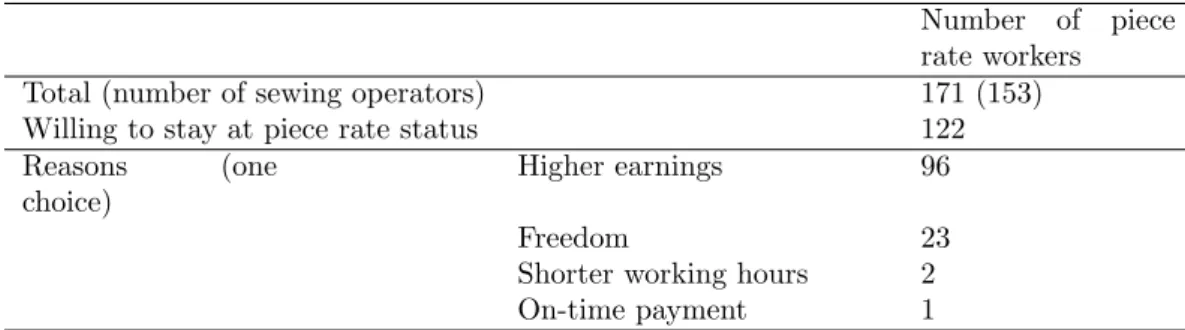
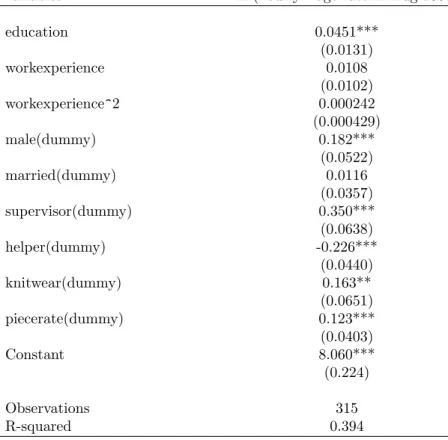
The author’s 2005-2006 survey revealed that sewing operators could earn more under the piece-rate system (Table 2); therefore, they preferred being hired at piece rates (Table 3). Estimation of the Mincer-type earnings equation supports this finding with a signifi-cantly positive effect of piece-rate status on earnings (Table 4; for summary statistics, see Appendix Table A1).11 The fundamental reason for the difference in earnings may not be
the payment system itself but the type of work that is closely linked with the piece-rate system. The typical work assigned to an individual operator in the factories that adopt the salaried system is simpler, and thus a salaried operator earns less. The piece-rate remuneration system is very closely connected with male operators in the apprentice sys-tem, and thus hiring female operators is necessary to achieve the shift from a piece-rate to a salaried remuneration system.
4
Interviews: Gradual Shift in Pakistan’s Knitwear
Industry in the Post-MFA Period
The focus of this section is the knitwear industry, which accounts for 60% of Pakistan’s garment exports. Pakistan’s knitwear industry can provide a useful case study for clearly understanding the features and problems in Pakistan’s garment industry. The knitwear industry recorded sluggish growth in the post-MFA period. However, as mentioned in Section 2, Pakistan’s knitwear exports performed equivalently well or even better in 2010 and 2011 as compared with Bangladesh and India, whose exports have continued to record high growth since the quota phase-out. To explore the reasons underpinning the 2010 and 2011 growth and the poor performance after the quota phase-out until 2009, the author conducted interviews with 12 garment manufacturers-exporters (seven of which deal in knitwear) in Lahore12 in November-December, 2011. These interviews revealed the following facts. (1) Knitwear manufacturers-exporters have suffered severely since the quota phase-out. Roughly 90% of the factories have closed since 2005. In reality, out of the 15 knitwear factories where the author conducted the 2005-2006 workers’ survey, only two survived. However, the surviving knitwear manufacturers-exporters are growing rapidly (with export value growing at more than 20% per year). The Pakistan knitwear industry’s 11A caveat in interpreting the estimation result is that the piece-rate status may be endogenous, although operators cannot freely choose salaried or piece-rate status. The endogeneity problem may not be too serious as dropping this variable does not largely change the estimation results. It is also interesting to observe the difference in the change in 2004-2006 earnings between the piece-rate and salaried workers. The estimation results (Appendix Table A2) demonstrate that the coefficient of piece-rate status has a significantly negative effect on earnings growth. This finding may reflect factories’ recent efforts to shift from the piece-rate to salaried payment system or the decline in orders after the quota phase-out.
12Lahore is Pakistan’s second largest city after Karachi and is one of the three major cities of Pakistan’s garment industry. It is a three-hour drive from Pakistan’s largest textile city, Faisalabad.
relatively good performance since 2010 may result from the shakeout of factories, that is, only efficient factories survived. (2) Woven wear (mainly denim wear) manufacturer-exporters have been growing since the quota phase-out, especially in the EU market. The difference in performance between knitwear and woven wear industries is consistent with the trade data reported in Section 2 (Figure 2).
Although the causality cannot be ascertained,13 surviving knitwear factories share one
distinct feature, i.e., attempting to shift from male piece-rate sewing operators to salaried female operators.14 In these factories, the current proportion of female operators is
15%-25% of the total sewing operators, while the proportion was less than 10% in 2005,15 and
they are planning to increase the proportion of female operators. The female operators are hired as salaried, meaning that these factories have also increased their proportion of salaried workers. One of the factories has completely shifted their payment method from piece-rate to salaried, even for male operators.16 Siegmann (2005) also notes the Pakistan
garment sector’s shift in payment method from piece rates to salaries due to concern over quality. The current proportion of female operators (15%-25%) seems relatively high compared with the proportion (less than 15%) in the author’s 2005-2006 survey17 and
the proportion (12%) reported in Haque’s (2009) more comprehensive study. Siegmann 13The positive relationship between export orientation and the share of female employment in devel-oping countries is often noted (see Wood 1991, C¸ aˇgatay 2001, Siegmann 2005).
14This feature is not observed, at least among the woven wear factories in which the author conducted interviews. One reason may be that the woven wear industry has already hired a larger percentage of female workers than the knitwear industry. Haque’s (2009) study, based on 150 garment factories, reports that the share of female workers was 24.0% in the woven wear industry but only 14.1% in the knitwear industry.
15An exception is the foreign-owned factory, where the percentage of female operators has always been 100%. One of the two surviving knitwear factories where the author conducted the 2005-2006 survey hired all female sewing operators when it began operation in 2001. They have grown rapidly during 2006-2011, with a 77.9% increase in the number of sewing operators, whereas many knitwear factories have closed during the same period. The fact that the factory owner is a foreigner (Belgian) may explain the difference in strategy compared to other factories with predominantly Pakistani owners. The Belgian owner explained that they have hired only females as sewing operators because females are more easily trained and disciplined, are more suitable to the European system, and have better working behavior.
16A human resource manager at a surviving knitwear manufacturer-exporter who supplies NIKE says that all the sewing operators have shifted from piece rates to salaried since 2007 in response to NIKE’s request. Specifically, they pay Rs. 7,500 as a base salary plus incentive payments at piece rates. He says that NIKE prefers salary payment to piece rates because of the issues of quality and labor compliance. The piece-rate system is considered to invariably compromise quality. Salaried workers have fringe benefits such as medical insurance and old age pensions, which piece-rate workers lack, and salaried workers are protected by the minimum wage law. Owners/managers consider that as long as they have constant orders, they can hire salaried operators.
17The 2005-2006 survey conducted by the author covers 22 garment factories in Lahore and revealed that the proportion of female workers (except for one factory that hires only female sewing operators) was 0%-15% of the total production workers, depending on the factories’ size. Note that the base figure is the total production workers, not total sewing operators. The proportion of females among the total sewing operators is smaller than 15% as most of the finishing department production workers were females, even in 2006. Usually, larger factories had a higher proportion of female production workers. See Makino (2008).
(2009) also reports the replacement of male operators by female operators after the quota phase-out. The managers of these factories say that females are better suited to being salaried sewing operators on the assembly line. To hire salaried operators, managers must deal with the worker incentive problem, and they say that females have a better work ethic.18 Haque’s (2009) interviews with managers in 150 factories reveal that, according
to them, female workers provide better quality work; do not waste time; work harder; and are more responsible, productive, loyal, honest, and punctual than male workers. Another advantage in hiring female workers is reduced labor cost. Female workers perform more specialized and narrow work on the assembly line and accept lower wages. The interviews revealed that the monthly earnings of male piece-rate sewing operators were around Rs. 12,000 to Rs. 13,000 (about $133 to $144) on average, while those of female sewing operators on a salaried basis were Rs. 7,840 (about $87).19 These wages cannot be straightforwardly compared because the type of stitching work, number of working hours, and the educational level usually differ between male piece-rate operators and female salaried operators. However, evidence of gender discrimination in wages suggests that female workers in Pakistan’s garment sector earn about 14% less than their male counterparts when controlling for the educational level, experience, marital status, work hours, city, and size and type of firm (Haque 2009). The author’s estimation of the Mincer-type earnings equation in Section 3 also supports this finding, estimating that male workers earn 18.2% more than females when controlling for these characteristics (Table 4). A caveat to these results is that neither study controls for the difference in stitching speed between male and female operators, as explained below.
Then why did other factories, especially those that failed, not adopt the strategy of shifting from male piece-rate operators to salaried female operators? There is one obvious disadvantage in hiring female workers. According to the managers, the efficiency rate calculated on the basis of stitching speed20 is lower for female operators than for
18One of the managers related examples. Although most male workers did not return on time immedi-ately after the Eid holidays, regardless of whether they were hired at piece rates or salaried, all the female workers returned on time. On a daily basis, male workers go out to lunch and do not return on time, but female workers bring their lunch as they cannot freely move about outside, and promptly start work after lunch break. Factories are more likely to ignore such behavioral problems when they hire workers at piece rates, because managers pay workers only for what they produce, and so have less incentive to correct workers’ behavior. Although the potential problem may be the same for salaried male workers, managers have more incentive to correct workers’ behavior because they have to pay salaries even to workers who do not return on time.
19Abras (2011) reports a similar gender wage gap in Pakistan. She also reports the widening wage gap after the quota phase-out.
20The efficiency rate is calculated as follows. Suppose that a sewing operator works for 8 h (480 min) per day, and the factory has 300 sewing machines. Thus, it has 14,400 (= 480*300) available minutes. Further suppose that the production of a shirt requires 11 min. If the factory produces 1,000 polo-shirts per day, the minimum total time required to produce them is 11,000 (= 11*1,000) min. The resulting efficiency rate of this factory is 76% (= 11,000/14,400).
males.21 Female operators’ efficiency rate is 35%-50%, while male operators’ efficiency rate is roughly 80%. To compensate for the low efficiency rate of female operators, factories must have a higher profit margin. This means that factories must produce medium-to high-quality garment products because the profit margin and the quality of products correlate positively. Theoretically, hiring male operators with higher efficiency rates and producing medium- to high-quality garment products would be more profitable. However, efficiency here means only stitching speed and does not take quality into account. Mangers say that as long as they have a high profit margin, they prefer female workers because their working behavior and better quality work more than compensate for their lower efficiency. Additionally, as long as they continue hiring male operators at piece rates, they find it difficult to attract orders for medium- to high-quality garment products because customers usually believe that controlling quality is difficult in the piece-rate system (Lazear 1986, Freeman and Kleiner 1998, Baland et al. 1999).
Another issue in hiring salaried operators (whether female or male22) is that factories
must have constant orders and must deal with the worker incentive problem, as mentioned earlier in this section. To have constant orders, the factories must both develop appro-priate supply-chain management and recognize the concept of industrial engineering so that they can deploy their operators at the appropriate time and place. Factories must also seriously consider human resource management to mitigate the incentive problem with salaried workers, though females innately seem to have less of such problem. More-over, factories must commit to providing female workers with training and transportation. Training is essential because, while males have at least the opportunity to learn stitching skills in the apprentice system in their neighborhoods, females have no such opportunity as they cannot easily walk around in public because of the purdah practice and because the training opportunity in the formal training institutes is very limited. Transportation is also necessary in the purdah culture, where females usually neither work nor walk around freely outside their homes. In the context of Pakistan’s culture, male household mem-bers have decision-making power over whether their female memmem-bers can work outside their homes, and they usually dislike this idea. Some managers said that they encounter difficulty convincing male household members to permit their female members to work in the factories. The factory makes an effort to convince them by, for example, inviting male members of potential female workers’ households to the factory to show them the safe working environment and organizing workshops with local female activists, typically 21Haque’s (2009) study reveals that the majority of managers and workers rate women as more pro-ductive in work than men, but think that men can stitch more garments than women in a given time.
22Although the payment system, whether piece-rate or salaried, is conceptually independent of the operators’ gender, the piece-rate system is closely connected with male operators in Pakistan’s garment industry. Most managers who realize the importance of shifting from piece rates to salaried say that they must begin with salaried female workers and train them to support such a shift.
female members of political households in the villages where potential female workers reside.
5
Household Factors Affecting Female Labor
Partic-ipation
Factory-side obstacles for hiring female workers have been discussed in Section 4, but household-specific factors also affect women working outside their homes in Pakistan. Haque’s (2009) study suggests that labor-supply-side factors such as religious, social, and cultural restrictions, rather than the lack of training opportunities and the transportation problems, underpin the lack of female labor participation in the garment sector. The majority of managers do not oppose hiring women (Table 5(a)), but the majority of male workers/supervisors oppose the women of their household working outside their homes (Table 5(b)). To explore which factor, factory or household side, contributes more to the low female labor participation in Pakistan’s garment sector, the author conducted a household survey in May-July, 2012, in Faisalabad, Pakistan’s premier textile city, thus fulfilling the survey’s objective of empirically revealing the household factors that explain female labor participation in Pakistan.
The interviews with garment factory human resource managers reveal that the main reason why women work outside their homes is financial need.23 That is, if male members
of the household earn enough to support the entire family, female members do not work outside their homes. This finding is consistent with the Haque’s (2009) study, according to which the majority of respondents (both managers and workers/supervisors) agree that a female should stay at home if her husband/father earns enough. It is also consistent with previous research suggesting that economic need is an important factor that pushes women into Pakistan’s labor market (Sultana et al. 1994, Khan et al. 2005, Ahmad and Hafeez 2007, Khan and Khan 2009). Increased female labor participation due to financial necessity does not, in itself, signify an overall enhanced status for women in Pakistan’s current cultural environment. Nonetheless, empirical proof of factors affecting female labor participation in Pakistan’s garment sector is meaningful because female labor participation and better performance in the export market are related, as discussed in Sections 3 and 4.
23A female manager explained that young (premarriage) women often work for their dowries. Young women’s labor force participation to save for their dowry is also described by Khan et al. (2005) and Khan and Khan (2009).
5.1
Description of 2012 Household Survey in Faisalabad
The household survey was conducted in Faisalabad in May-July, 2012, to explore the factors affecting female labor participation in Pakistan’s garment sector. To achieve this objective, the sample contained both types of households: (i) households whose female members work in garment factories as sewing operators (Type I households), and (ii) households other than Type I households (Type II households). After conducting the feasibility study, the survey design was finalized as follows.24
First, five factories that hire a relatively high percentage of female sewing operators were randomly chosen from the list of factories provided by UNDP-Pakistan.25 Those
factories in turn provided a list of all female sewing operators, including the worker’s personal information such as her name, address, and her father’s or husband’s name, and his phone number.26 In the list, workers are categorized by their union councils/villages
that are the primary sampling unit in this survey, and 12 villages were randomly selected. From these 12 villages, we randomly selected 110 female sewing operators. The number of female workers selected in each village was proportionate to the total female workers in each village in the list. These female workers’ households constitute the sample’s Type I households. We then obtained each chosen village’s voter list, which provides voters’ household information, such as each voter’s name, sex, age, house number, and ward number. Among the households with at least one female voter, we randomly selected households constituting the sample’s Type II households.27 We determined the number
of Type II households selected in each village that would maintain each village’s ratio
24Originally, two other strategies were considered to include a sufficient number of Type I households in the sample. The first strategy was to locate and perform random sampling in villages where the garment factories provide bus transportation. However, the feasibility study found that the bus transportation is provided radially along several main roads. Female workers get on/off bus at the main road’s bus stop and come and go independently to their own villages, and so Type I households are scattered among many villages. Because the number of Type I households is very limited in each village, a random sampling at the village level is less likely to find Type I households. The second strategy was to perform a simple random sampling of 100 Type I households from the factories’ female workers’ list. Because female workers commute from a great variety of villages, the sampling might have produced 100 villages, making the interview process unfeasible financially. Therefore, a random sampling of villages using the female workers’ list was taken as a strategy.
25UNDP-Pakistan has been implementing the Gender Promotion Programme (GENPROM) with the objective to increase female labor participation in the garment sector, and has provided training to female workers in garment factories.
26In Pakistan, women are usually identified in relation to their father or husband. When the survey team asked a woman’s neighbors (actually, we rarely saw females on the street) about the location of her house using her own name, no neighbor knew where she lived, but when we asked using her father’s/husband’s name, neighbors could tell us the house’s location. Mirza (2002) also noted this phenomenon. We also needed the women’s husband’s/father’s mobile number because women were usually reluctant to provide their own mobile number, but were more willing to provide their father’s/husband’s number.
27Among all the households obtained by a simple random sampling in the villages, only two households had any female member working as a sewing operator in a garment factory, and so these households identified by a simple random sampling were nearly identical to the Type II households described in (ii).
of Type I to Type II households at 1 to 3.5.28 Six of the 12 villages were located in an urban area, and were thus not suburban villages but residential colonies29 with very few professional farmers owning agricultural land. The other six villages were located in suburban areas with land-owning farmers. In the random sampling of Type II households, medium to large land-owning farmers (more than five acres of land) were dropped. We restricted the sample to only small land-owning farmers to include only Type II households that were comparable to Type I households, given that households with female members working in the garment factories have no land for cultivation.
The author and the enumerators (hereafter the survey team) visited each household and conducted interviews using the original two-part questionnaire. The first part con-tains questions to the household head and includes typical questions for any household survey, such as household members’ demographic/financial characteristics and the origi-nal questions that address the study’s objective (e.g., a question measuring the household head’s attitude toward women working outside their homes). The second part contains the women’s questionnaire, whose respondent is a female member of the household. When at least one of the female household members worked, the survey team selected this woman as the respondent to this part. If no woman worked, the survey team selected any non-student woman of comparable age to women working in factories (i.e., usually ages 16-45 and preferably in the younger range, if available, as the majority of sewing operators are young and unmarried). While conducting the women’s interviews, the survey team at-tempted to maintain the respondent women’s privacy as much as possible, for example, by requesting a separate interview room so that the women could answer without feeling any pressure from their male household members. The questionnaire was carefully designed to identify which type of factors, factory- or household-factors, chiefly contributes to low female participation in the garment industry.
Table 6 presents the sample’s descriptive statistics. The total number of effective Type I households is 107, and that of Type II households is 369. No female member works outside their home in 79% of Type II households. In the remaining Type II households, female members work for pay outside, but not as a sewing operator. Typical jobs for these women are clippers in garment factories,30 housekeepers, teachers in girls’ school, nurses, and agricultural labor. Surprisingly, most teachers in private schools earn less than sewing operators in the garment sector. Comparing the sample means between two types of households reveals that female household heads comprise a greater proportion 28The original target of the survey was to have 100 Type I households and 350 Type II households. Because some missing or incomplete information was expected, the survey team decided to begin with a sample of 110 Type I households and 385 Type II households.
29The history of these colonies is not old, and they were typically developed in the 1970s under the Zulfikar Ali Bhutto socialist regime to provide residential land to landless people.
30Clippers in the garment sector are typically females. The author observed that the majority of clippers were females even in 2005-2006. Clippers’ wages are lower than those of sewing operators.
in Type I households (33%). The household head’s education level is lower in Type I households, below primary school on average. Type I households contain fewer infants, which is understandable because females, especially mothers, are the primary caretakers of small children. No Type I household owns land for cultivation, and so Type I households’ value of livestock is significantly lower, Rs. 5,679 on an average. Type I households have higher income at Rs. 184,953 on annual average, apparently a consequence of having female members as additional income earners (or even as the primary breadwinner in 69% of the Type 1 households), whereas income earned by male members is significantly higher in Type II households. The value of home and residential land is less in Type I households, Rs. 510,327 on annual average.
The women’s questionnaire asked non-working women why they do not work for pay outside their homes. Table 7 summarizes their answers. Reason Nos. 1-3 can be consid-ered factory-side factors in that the factory decisions have a somewhat effect on whether or not women work in the factory. Reason Nos. 4-8 are considered household-side factors. Overall, the factory-side factors do not seem to prevent women from working outside their homes, with very few women (1.7%) giving the unavailability of such work as a reason. The majority of women (61.1%) answered that the reason is male members’ refusal to allow her to work outside the home. Besides, the majority of female workers (72.3%), both sewing operators and others, said that they need permission from their male house-hold members (fathers, husbands, or brothers), if any, to work outside their homes for pay. These responses demonstrate that household factors, rather than factory-side factors, contribute more to the low proportion of female sewing operators in Pakistan’s garment sector, even in factories with reasonable management skills.
5.2
Estimation Results: Household Factors Contributing to Women’s
Working in Factories
The simple probit model is estimated to analyze the household factors that affect female labor participation in garment factories as well as in any work for pay outside the home. The dependent variable takes the value one if the household allows their female members to work outside the home, and zero otherwise. The set of covariates includes demographic variables (age, education level, number of male/female household members, number of in-fants, etc.), social variables (religion, caste, number of female teachers/government staff among relatives, etc.), and economic variables (household income earned by male mem-bers, assets, etc.). Note that in the context of Pakistan, household income earned by males could be justifiably considered exogenous to women’s labor-force measurements be-cause male members are considered as the household’s primary breadwinner, making a
simultaneous decision for both men and women to participate in paid labor unlikely.31 Additionally, the causality of women’s working status upon their fertility decision, as explored in the seminal Angrist and Evans’s (1998) study, is unlikely because Pakistani women usually do not have the decision-making power regarding the number of children. Therefore, the number of infants is included in the covariates with a caveat: it could be endogenous because the number of infants and the decision making regarding women’s labor participation may be simultaneously affected by male members’ characteristics. The potential endogeneity problem does not seem to severely affect the results, however, be-cause the estimation using only the subsample of unmarried women does not substantially change the results, as discussed below.
The estimation results are shown in Table 8. The first column (1) reports the average marginal effects of the set of covariates on the probability of household female members working as a sewing operator in a factory, and the second column (2) reports those of female members performing any type of work outside their homes. As expected, house-hold assets (measured by the values of livestock and of the home and residential land) negatively affect the probability of a woman’s labor force participation. This finding sup-ports the general principle that, in Pakistan, the main reason for women’s labor force participation is financial. A woman’s education level increases her labor force participa-tion as a sewing operator in a garment factory, but at a decreasing rate. The status of being a household head’s daughter increases the probability of working outside, which is easily understandable because mothers are usually busy with household chores, especially childcare.
As the majority of female sewing operators are unmarried, the same model is estimated with only the subsample of unmarried women (excluding those divorced or widowed). The third (3) and fourth (4) columns are based on this subsample but use the same estimation model corresponding to columns (1) and (2), respectively. Despite the decreased number of observations, the estimation with the subsample has two advantages. (i) Women in the subsample face two simple options, either working for pay outside or remaining idle at home. Because column (4) compares the households with/without working women for pay outside, the estimation can exclude the case in which girls remain at home to perform all household chores for mothers working outside. (ii) The estimation would be less sensitive to the endogeneity problem concerning the number of infants in the household because the subsample excludes women with their own children. The results based on the subsample of unmarried women are consistent with those using the full sample reporting the negative effects of household assets, supporting the assumption that girls work outside for pay only for financial reasons, and the choice of remaining at home is rather a luxury. The positive effect of a woman’s education level at the decreasing rate in column (3) is also consistent
with that in column (1). Although it is not reported in the table, a woman’s education level actually decreases her labor force participation when controlling the literacy rate. The minimum level of education (literacy) is necessary for women to work as an operator in a garment factory, but when her education level becomes higher, as are women in richer families, her participation decreases. This suggests that education is a luxurious good or that accumulating education may be a rational investment decision for girls to increase their value in the marriage market. Given that they are unmarried women who have not yet had their own children, the number of infants becomes insignificant in columns (3) and (4), supporting the assumption that women in the subsample are not the primary caretaker of infants in the household. The insignificant effect of the number of non-infant female members on the women’s labor force participation as an operator also supports this assumption. Consistent with columns (1) and (2), the number of female teachers or of government officers among relatives generally has a significantly positive effect on a woman’s labor force participation, but not on the probability of a woman working as a sewing operator in a factory. This finding may reflect the fact that a woman working in a factory is disrespected, while that working as a teacher in a girls’ school or as a doctor/nurse in a female clinic is esteemed in Pakistan. The practice of purdah restricts women’s contact with non-family male members. In this context, women working in factories are despised, as the working environment naturally requires women to interact with male colleagues (Mirza 2002). In contrast, working as a teacher in a girls’ school or a doctor/nurse in a female clinic is usually respected as such work does not require contact with males. Working in government offices may require her to interact with male colleagues, but government jobs are also respected as they pay well. Furthermore, women in government offices usually have male family members working in the same place because obtaining such a privileged job usually requires some connection in the office, and thus such women are protected at their workplace. Interestingly, Muslim households are more likely to allow their unmarried girls to work outside. This is somewhat surprising because women in Christian households usually have less prejudice against working outside,32 and Christian household members have descended from the lower castes in Pakistan.
Finally, column (5) reports the average marginal effects on the probability of a house-hold’s female members working as sewing operators in a factory using the subsample of households with women working outside for pay. This analysis identifies factors that affect female members becoming sewing operators in a garment factory, but not entering other industries. Households with fewer assets are more likely to allow their female members to work in a garment factory as an operator, which further supports the assumption that 32Table 9 in Sub-section 5.3 also supports the general belief that Christian women attach less stigma to working outside. The finding that being Muslim matters only among the subsample of unmarried girls may result from the required dowries being smaller among Christians, though the difference in the amount of dowries between Muslims and Christians is not well known.
poor households allow their female members to work in a garment factory as a financial last resort. Daughters of household heads are more likely to work in a garment factory, consistent with the relatively young age of female sewing operators.
5.3
Estimation Results: Determinants of Households’ and Women’s
Attitude toward Working Outside the Home
This subsection reports the respondents’ attitude toward the idea of women working outside the home. Two types of questions in the questionnaire assess this attitude. One asks the household head whether she/he thinks that it is generally a good idea for women to work outside, and the other asks the female respondent to the woman’s questionnaire whether she would like to work outside if she has a choice.33 The bivariate probit model
is estimated, and Table 9 reports the results. The bivariate probit model is used because both attitudes, and thus the error terms in both equations, are expected to be highly correlated, and our interest is in the joint probability of these two household members’ attitudes.
Table 9’s first column (1) reports the average marginal effects of the set of covari-ates on the household head’s attitude, and the second column (2) reports those of the female respondent. The high value of the LR test statistics, 30.68 (not reported in the table), indicates that both equations are mutually dependent. Being in a Muslim house-hold negatively affects both the househouse-hold head’s and the female respondent’s attitudes toward women working outside their homes. Interestingly, except for being a Muslim, factors determining the household head’s attitude seem different from those determining the women’s attitude. The negative effect of household assets, the household head’s edu-cation level, and the male members’ income earning ability on women’s attitude indicates that women in more affluent families have less motivation to work outside their homes. It seems that, though male household members in the more affluent families are not more strongly against women working outside than are males in less affluent households, female members themselves of the more affluent families underrate the idea of working outside for pay. The existence of female relatives who work outside in respected fields (school and government) positively affects women’s attitude. In contrast, the existence of fe-male relatives working outside in general (not in school/government) positively affects the head’s attitude. These results may imply that it is less difficult for the household head to overcome the stigma of women working than for the women themselves. Interest-ingly, having land for cultivation (i.e., belonging to a farming household) positively affects 33The exact question for the household head is ”Do you think, generally speaking (not specifically about women in your household) that it is a good idea for women to work outside the home for pay if there are other household members who can take care of their children”? The question for the female respondent is ”If you have a choice, would you like to work outside for pay”?
women’s attitude toward working outside for pay, though the sample contains few women in land-owning households who actually work outside for pay. (Therefore, this variable is dropped in the previous estimation reported in Table 8). In Pakistan’s rural areas, women commonly work outside as agricultural labor or their family’s farm labor, so women in farming households seem to attach less stigma to working outside, though the sample’s farming households are relatively more affluent and do not have a financial necessity to allow their female members to work outside. A woman’s education level positively affects her attitude toward working outside. We can conclude that education motivates women to participate in the workforce by overcoming their own prejudice against working outside for pay.
5.4
Discussion: Impacts of Women Working in the Garment
Sector
The regression analysis suggests that only women in financial need work outside their homes, especially in the garment sector. Working as a female sewing operator is not respected and is considered a financial last resort for poor families, as reflected in the estimation result that a potentially good example of working women (i.e., female relatives working in the school or government sector) does not motivate women to work in the garment sector. The interviews revealed that female sewing operators in the garment sector seem to undervalue their own work. Figure 6 depicts the difference between the responses of female sewing operators in factories and females working outside but not as sewing operators. Those women who work at jobs other than sewing operators seem to be more willing to continue working, with 82.4% of such women wanting to continue to work (or actually doing so) even after having children, whereas a lower percentage (43%) of female sewing operators express that attitude.
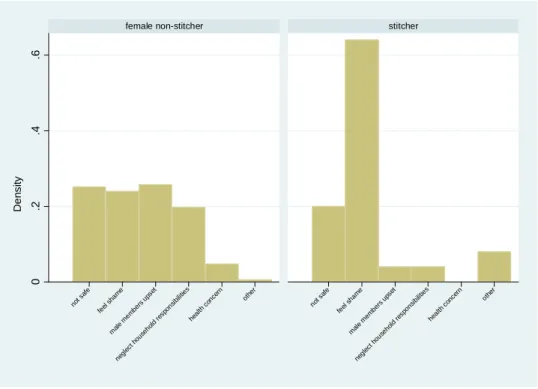
The questionnaire also asked all the women who responded ”not willing to work outside if they have a choice” why they have that attitude. Figure 7 depicts the reasons expressed by women who would not like to work outside for pay if they have a choice. The figure compares the answers between sewing operators and others. For non-sewing operators, the answers are divided almost evenly among ”not safe,” ”feel shame,” ”male members upset,” and ”neglect household responsibilities.” For sewing operators, the answers are predominantly ”feel shame,” which implies that these women do not respect their own job. The survey team encountered one household that first refused to accept interviews because the household head felt shame about letting his daughter work in a garment factory (though finally he accepted the survey team). Some unmarried female sewing operators told the author that nobody will marry a woman working in a factory. Surprisingly, female income earning ability as a sewing operator affects women negatively in the marriage
market.34
Nevertheless, female sewing operators contribute substantially to their households’ finances. As Table 6 reports, the household income is higher in households with female sewing operators by 8.1%, and earnings by male members of such households are lower by as much as 48.7%. Thus, female sewing operators are actually the primary breadwinners in most (69.2%) of such households. Furthermore, the average annual income of these sewing operators (Rs. 78,290) is not significantly lower than the average annual income of men (Rs. 83,241) at the 5% significance level. The results suggest that female sewing operators’ substantial contribution to the welfare of poor households merits recognition.
6
Concluding Remarks
Pakistan’s garment industry is unique in that primarily male sewing operators have tra-ditionally been hired at piece rates, whereas in other garment exporting countries such as China and Bangladesh, primarily female operators are hired on a salaried basis. This study explores why Pakistan exhibits this tradition and how it relates to the performance of its garment (especially knitwear) exports in the post-MFA period.
Although Pakistan’s woven wear exports have grown rapidly, its knitwear exports have suffered and many factories have closed since the quota phase-out. The interviews with managers in the garment sector revealed that the surviving knitwear factories have increased and are planning to further increase the percentage of salaried female sewing operators. To pursue this strategy, the factories must make efforts to improve their management skills related to human resources and the supply chain and to provide special facilities (training, transportation, etc.). We might reasonably attribute the relatively good performance of Pakistan’s knitwear exports since 2010 to these factories’ recently adopted tactical employment strategy.
The household survey conducted by the author reveals that as long as factories have reasonable management skills in human resource and supply chain, it is primarily household-side factors, rather than factory-household-side factors, that prevent women from working in Pak-istan’s garment sector. Financial needs are the main reason for women working outside their homes, especially in the garment sector. Although Pakistani society scorns the idea of working as a female sewing operator in a factory, these women contribute substantially to their households’ welfare. The measures that lower the women’s reservation wage by taking into account the social norm may help women overcome obstacles preventing their labor participation. For example, providing a segregated working area for women or fe-34Although this paper is about neither what determines the value of women in the marriage market nor whether such value affects the amount of dowries as expected in the price model suggested by Becker (1991), these are interesting research questions.
male supervisors may convince the male household members that it is acceptable for their female members to work at a factory. Enhancing women’s education level seems to mo-tivate women to work outside, though highly educated women in more affluent families actually do not work outside. The basic level of education, literacy, seems to encourage women to work in a garment factory despite the job’s low prestige and the women’s own disrespect for their job. Given Pakistan’s overall low female literacy rate (46% nationally), it seems important to provide girls the basic level of education. Such policy measures will improve the welfare of Pakistan’s poor households by increasing the number of females in the paid workforce. Increasing the number of female workers willing to work in garment factories will in turn benefit Pakistan’s garment exports.
References
[1] Abras, Ana Luisa Gouvea. 2011. ”Success and Upgrading after the End of the MFA” In Sewing Success? Employment and Wage Effects of the End of the Multi-fibre
Arrangement, edited by Gladys Lopez Acevedo and Raymond Robertson, 58-96.
Washington, D.C.: World Bank.
[2] Ahmad, Eatzaz, and Amtul Hafeez. 2007. ”Labour Supply and Earning Functions of Educated Married Women: A Case Study of Northern Punjab.” Pakistan
Develop-ment Review 46 (1) (Spring): 45-62.
[3] Amjad, Rashid. 2005. ”Skills and Competitiveness: Can Pakistan Break out of the Low-level Skills Trap?” Pakistan Development Review, 44 (4) Part I (Winter): 387-409.
[4] Angrist, Joshua D. and William N. Evans. 1998. ”Children and Their Parents’ Labor Supply: Evidence from Exogenous Variation in Family Size” American Economic
Review, 88(3): 450-477.
[5] Baland, Jean-Marie, Jean Dr`eze, and Luc Leruth. 1999. ”Daily Wages and Piece Rates in Agrarian Economies.” Journal of Development Economics 59 (2) (August): 445-461.
[6] Becker, Gary S., 1991. A Treatise on the Family, Enl. Edition. Cambridge: Harvard University Press.
[7] Bolton, Patrick, and Mathias Dewatripont. 2005. Contract Theory. Cambridge: The MIT Press.
[8] C¸ aˇgatay, Nil¨ufer. 2001. Trade, Gender and Poverty. New York, NY, UNDP. (http://www.beta.undp.org/content/dam/aplaws/publication/en/
publications/poverty-reduction/poverty-website/trade-gender-and-poverty/TradeGenderandPoverty.pdf, downloaded January 2012)
[9] Freeman, Richard B., and Morris M. Kleiner. 1998. ”The Last American Shoe Man-ufacturers: Changing the Method of Pay to Survive Foreign Competition.” NBER
Working Paper Series. No.6750.
[10] Government of Pakistan, 2011. Labour Force Survey 2010-2011.
[11] Hallak, Juan Carlos and Peter K. Schott. 2011. ”Estimating Cross-Country Differ-ences in Product Quality.” Quarterly Journal of Economics 126: 417-474.
[12] Haque, Ehsan-ul. 2009. Current Status and Prospects of Female Employment in the
Apparel Industry in Pakistan. UNDP-Pakistan.
(http://www.genprom.org.pk/pdf/21172.pdf, downloaded December 2011)
[13] Hirashima, Shigemochi. 1977. ”Economic Analysis of non-Farmer Households in Pak-istan Punjabi Villages.” Asian Economies 18 (6&7): 135-154 (in Japanese).
[14] Itoh, Hideshi. 1991. ”Incentives to Help in Multi-Agent Situations.” Econometrica 59 (3) (May): 611-636.
[15] Khan, Rana Ejaz Ali, and Tasnim Khan. 2009. ”Labor Force Participation of Married Women in Punjab (Pakistan).” Journal of Economic and Social Research 11 (2): 77-106.
[16] Khan, Shahzad Farid, Saira Akhtar, Amna Afzaal and Anila Kausar. 2005. ”A So-ciological Study of Working Women in Informal Sector of Readymade Garments Industry in Faisalabad (Pakistan).” Journal of Agricultural and Social Sciences 1 (1): 60-61.
[17] Lazear, Edward P. 1986. ”Salaries and Piece Rates.” Journal of Business 59 (3) (July): 405-431.
[18] Makino, Momoe. 2008. ”Competitiveness of the Garment Industry in Pakistan with Particular Focus on Piece Rate Workers.” In Globalization Employment and Mobility:
The South Asian Experience, edited by Hiroshi Sato and Mayumi Murayama, 94-123.
Palgrave Macmillan IDE-JETRO Series.
[19] Mirza, Jasmin. 2002. Between Chaddor and the Market-Female Office Workers in
[20] Sawada, Yasuyuki, Kensuke Kubo, Nobuhiko Fuwa, Seiro Ito, and Takashi Kurosaki. 2006. ”On the Mother and Child Labor Nexus under Credit Constrains: Findings from Rural India.” Developing Economies 44(4): 465-499.
[21] Siegmann, Karin Astrid. 2005. ”The Agreement on Textiles and Clothing: Potential Effects on Gendered Employment in Pakistan.” International Labour Review 144 (4): 401-421.
[22] ———-. 2009. The Trade and Gender Interface: A Perspective from Pakistan. Sus-tainable Development Policy Institute.
(http://repub.eur.nl/res/pub/17857/Siegmann2009.pdf, downloaded February 2012) [23] Sultana, Nargis, Hina Nazli and Sohail J. Malik. 1994. ”Determinants of Female Time Allocation in Selected Districts of Rural Pakistan.” Pakistan Economic Review 33 (4) Part II (Winter): 1141-1153.
[24] Wood, Adrian. 1991. ”North-South Trade and Female Labour in Manufacturing: An Asymmetry.” Journal of Development Studies 27 (2): 168-189.
China, 102076 Pakistan, 3615 Sri Lanka, 3382 Thailand, 2661 Others, 53397 China, 102076 Bangladesh, 16335 Vietnam, 11247 India, 10550 Indonesia, 7595 Cambodia, 4553 Pakistan, 3615 Sri Lanka, 3382 Thailand, 2661 Others, 53397
Figure 1: Exports of Garments (HS code 61 and 62) to USA, EU, Canada and Japan in 2011 (USD
million)
0.1 0.2 0.3 0.4 0.5 Pakistan Bangladesh India China Vietnam -0.2 -0.1 0 0.1 0.2 0.3 0.4 0.5 2004 2005 2006 2007 2008 2009 2010 2011 Pakistan Bangladesh India China Vietnam
(a) Knitwear(HS code 61)
0.1 0.15 0.2 0.25 0.3 0.35 0.4 Pakistan Bangladesh India China Vietnam -0.1 -0.05 0 0.05 0.1 0.15 0.2 0.25 0.3 0.35 0.4 2004 2005 2006 2007 2008 2009 2010 2011 Pakistan Bangladesh India China Vietnam
(b) Woven Wear(HS code 62)
Figure 2: Year to Year Growth of Exports of Knitwear/Woven Wear Products to USA, EU, Canada,
Japan Before and After the MFA Phase-Out
5 10 15 20 25 30 EU 2004 EU 2011 0 5 10 15 20 25 30 EU 2004 EU 2011
(a) Knitwear(HS code 61)
5 10 15 20 25 30 35 40 EU 2004 EU 2011 0 5 10 15 20 25 30 35 40 EU 2004 EU 2011
(b) Woven Wear(HS code 62)
Figure 3: Unit Price (USD/Kg) of Knitwear/Woven Wear imported to the EU in 2004 and in 2011