Cluster
Algebra
and
Complex
Volume
Kazuhiro HIKAMI
#,
Rei INOUE
# Faculty
of
Mathematics,
Kyushu
University,
Fukuoka
819-0395
Department
of
Mathematics
and
Informatics,
Faculty of Science,
Chiba
University,
Chiba
263-8522
1
Introduction
The volume conjecture [13, 15] indicates anintimate relationshipbetween quantum
in-variants of knots andcomplex volume of knotcomplements. Generallyquantum
invari-ants of knots
are
constructed combinatoricallybasedon$R$-matrix, andit is expected thatcomplex volume
can
be formulated based on knot diagram. Indeed in [24, 3, 2, 1]con-structedwasthe Neumann-Zagierpotentialfunction [20]basedonthe$R$-matrices of the
Kashaevinvariant and thecolored Jones polynomialatroot ofunity.
Our purpose in this article is to study complex volume of knot complements from
viewpoint of clusteralgebra. Seeourworks [9, 10]for detail.
2 Cluster
Algebra
and
3-Dimensional
Hyperbolic
Geometry
2.1 ClusterAlgebra
Wefollow adefinition of cluster algebras in [6, 7]. Let$(\mathbb{P}, \oplus, \cdot)$beasemifield endowed an
auxiliaryaddition $\oplus$, which iscommutative, associative, and distributive with respectto
the group multiplication. in$\mathbb{P}$
.
Let$\mathbb{Q}\mathbb{P}$ denote the quotient field of the group ring$\mathbb{Z}\mathbb{P}$of $\mathbb{P}$
.
Fix$N\in \mathbb{Z}_{>0}.$Definition2.1. $A$seedis atriple$(x,\epsilon,B)$,where
.
acluster$x=(x_{1,\ldots,N}x)$isan$N$-tupleof$N$algebraically independentvariables withcoefficients in$\mathbb{Q}\mathbb{P},$
acoefficient tuple $\epsilon=(\epsilon_{1}, \ldots,\epsilon_{N})$is an$N$-tuple of elements in$\mathbb{P},$
.
an
exchange matrix$B=(b_{ij})$isan
$NxN$ skew symmetric integer matrix.Definition 2.2. Let $(x,\epsilon,B)$ be
a
seed. For each $k=1,$$\ldots,N$, we define the mutation of$(x,\epsilon,B)$ by$\mu_{k}$ as
$\mu_{k}(x,\epsilon,B)=(\tilde{x},\tilde{\epsilon},\tilde{B})$,
where
the cluster$\tilde{x}=(\tilde{x}_{1}, \ldots,x_{N})$is
$\tilde{x}_{i}=1^{x_{i}}\frac{\epsilon_{k}}{1\oplus\epsilon_{k}}\cdot\frac{1}{x_{k}}\prod_{j:b_{jk}>0}x_{j}^{b_{jk}}+\frac{1}{1\oplus\epsilon_{k}}\cdot\frac{1}{xh}\prod_{j:b_{jk}<0}x;^{b_{jk}}, forifori=h\neq h,$
’
(1)
the coefficienttuple$\tilde{\epsilon}=(\tilde{\epsilon}_{1}, \ldots,\tilde{\epsilon}_{N})$is
$\tilde{\epsilon}_{i}=1_{\epsilon_{i}(}^{\epsilon_{h}^{-1}}\epsilon_{i}(\frac{\epsilon_{k}}{1\oplus\epsilon_{k})1\oplus\epsilon_{k}})^{b_{ki}}-b_{ki}, fori\neq h,b_{ki}\leq 0fori\neq k,b_{hi}\geq 0fori=h,$
,
(2)
the exchange matrix $\tilde{B}=(\tilde{b}_{ij})$is
$\tilde{b}_{ij}=\{\begin{array}{ll}-b_{ij}, for i=k or j=k,b_{ij}+\frac{1}{2}(|b_{ik}|b_{kj}+b_{ik}|b_{kj}|) , otherwise.\end{array}$ (3)
Note that the resultedtriplet$(\tilde{x},\tilde{\epsilon},\tilde{B})$ is againaseed.
Bystartingfroman initial seed$(x,\epsilon,B)$,
we
iterate mutations and collect all obtainedseeds. The cluster algebra $\mathscr{A}(x,\epsilon,B)$ is the $\mathbb{Z}\mathbb{P}$-subalgebra oftherational function field
$\mathbb{Q}\mathbb{P}(x)$ generated by all thecluster variables. Weusethefollowing.
Proposition2.3([7]). Let$y$bean$N$-tuple $y=(y_{1}, \ldots,y_{N})$,
defined
by useof
cluster$x$andcoefficient
$\epsilon$as$y_{j}= \epsilon_{j}\prod_{k}x_{k}^{b_{kj}}$
.
(4)Thenwehavea mutation,
$\mu_{k}ty,B)=(\tilde{y},\tilde{B})$, (5)
where
$\tilde{y}=(\tilde{y}_{1}, \ldots,\tilde{y}_{N})$isanalogous to(2),
$.\tilde{B}=(\tilde{b}_{ij})$is (3).
For the later use,
we
introducethepermutation actingon
seeds.Definition 2.4. For $i,j\in\{1, \ldots,N\}$and $i\neq j$, let$s_{i,j}$be
a
permutation of subscripts$i$ and$j$inseeds. For example permutated cluster $s_{i,j}(x)$is definedby
$s_{i,j}(\cdots,x_{i},\cdots,x_{j},\cdots)=(\cdots,x_{j},\cdots,x_{i},\cdots)$
.
Actions
on
$\epsilon$ and $B$are
defined in thesame
manner.
They inducean
action on$y$, and
$s_{i,j}(y)$has
a
same
form.2.2 Hyperbolic Geometry
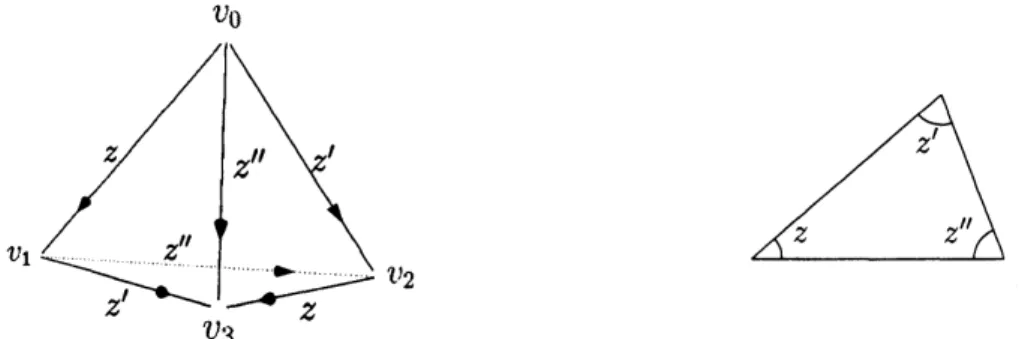
A fundamental object in three-dimensional hyperbolic geometry is
an
ideal hyperbolictetrahedron $\triangle$ in Fig. 1 [23]. The tetrahedron is parameterized byamodulus$z\in \mathbb{C}$, and
eachdihedralangle isgiven
as
inthe figure. Wemean
$z’$and$z”$for given modulus $z$ by$z’=1- \frac{1}{z}, z"=\frac{1}{1-z}$
.
(7)The
cross
section by the horosphere at each vertex is similar to the triangle in $\mathbb{C}$ withvertices $0,1$, and$z$. We have assigned avertex ordering following [27], which is crucial
incomputingthe complexvolume oftetrahedra modulo$\pi^{2}$
.
SeeFig. 1.
Figure 1: An ideal hyperbolic tetrahedron$\triangle$withmodulus$z$
.
Dihedralanglesaregivenby$z,$$z’=1$-llz,and$z”=1/(1-z)$.Each$v_{a}$denotesavertexordering. Wegiveanorientation toanedgefrom$v_{a}$to$v_{b}(a<b)$.
The hyperbolic volume of
an
ideal tetrahedron$\triangle$withmodulus$z$isgiven by the Bloch–Wigner function
$D(z)=\Im Li_{2}(z)+\arg(1-z)\log|z|$, (8)
where$Li_{2}(z)$is the dilogarithm function,
$Li_{2}(z)=-\int_{0}^{z}\log(1-s)\frac{ds}{s}.$
See,e.g., [26].
Aset of ideal tetrahedra$t\triangle_{v}$} is glued togethertoconstruct acusped hyperbolic
man-ifold$M.$ $A$modulus$z_{v}$ of eachideal tetrahedron$\triangle_{v}$is determined from bothgluing
volume of$M$is givenby
$Vol(M)=\sum_{v}D(z_{v})$. (9)
The complex volume,$Vol(M)+iCS(M)$, is given interms ofanextended Rogers
dilog-arithm function
$L([z;p,q])=Li_{2}(z)+\frac{1}{2}\log z\log(1-z)+\frac{\pi i}{2}(q\log z+p\log(1-z))-\frac{\pi^{2}}{6}$, (10)
where$p,q\in \mathbb{Z}$
.
To compute the complex volume, we need an additional structure to themoduliofideal tetrahedra:
Definition2.5 ([19]). $A$flattening ofanideal tetrahedron $\triangle$is
$(w0,w_{1},w_{2})=(\log z+p\pi i,-\log(1-z)+q\pi i,\log(1-z)-\log z-(p+q)\pi i)$, (11)
where $z$ isthe modulus of$\triangle$ and$p,q\in \mathbb{Z}$
.
Weuse $[z;p,q]$to denote theflatteningof$\triangle.$
In [19], the extendedpre-Blochgroup is defined as the free abelian group
on
flatten-ings subject to
a
five-term relation, and shown is that the flattening gives the complexvolume.
Proposition2.6([19]). The complex volume$ofM$is
$i(Vol(M)+iCS(M))=\sum_{v}$sign(v)$L([z_{v};p_{v},q_{v}])$, (12)
where $[z_{v};p_{v},q_{v}]$ and $sign(v)=\pm 1$ respectively denote aflattening and a vertex ordering
of
a tetrahedron $\triangle_{v}.$Fora tetrahedron $\triangle$ in Fig. 1, let
$c_{ab}$ be a complexnumber assigned to an edge
con-necting vertices $v_{a}$ and $vb$
.
Zickert clarified that the flattening$(z;p,q)$ of$\triangle$ is given by$c_{ab}$ asfollows.
Proposition2.7([27]). Whenwehave
$\frac{c_{03}c_{12}}{c_{02}c_{13}}=\pm z, \frac{c01^{\mathcal{C}}23}{c_{03}c_{12}}=\pm(1-\frac{1}{z}) , \frac{c_{02}c_{13}}{c_{01}c_{23}}o=\pm\frac{1}{1-z}$, (13)
the flattening$(z;p,q)$isgiven by
$lz+\pi i=lc_{03+lc_{12}-l-\log_{C}13},$
(14)
$-\log(1-z)+q\pi i=\log c_{02}+\log c_{13}-\log c_{01}-\log_{\mathcal{C}}23.$
Remark 2.8. Ingluingtetrahedra toconstruct$M$, identical edgeshavethesamecomplex
numbers.
2.3 Interrelationship
Correspondence between the cluster algebra and the hyperbolic geometry
can
beseen
inFig. 2. Triangulation is related
to
quiver where thenumber
of edges ina
triangulationis the same
as
the fixed number $N$ in the cluster algebra, and flipcan
be regarded asmutation,as depictedin thefigure. Note that the exchangematrix$B=(b_{ij})$ofquiveris
$b_{ij}=\#\{$
arrows
from$i$ to$j\}-\#\{$arrows
from$j$to $i\}.$Bydefinition(4), themutation$\mu_{3}(y,B)=(\tilde{y},\tilde{B})$, isexplicitlywritten
as
$\tilde{y}_{1}=y_{1}(1+y_{3})$, $\tilde{y}_{2}=y_{2}(1+y_{3^{-1}})^{-1},$ $\tilde{y}_{3}=y_{3^{-1}}$, (15) $\tilde{y}_{4}=y_{4}(1+y_{3^{-1}})^{-1},$ $\tilde{y}_{5}=y_{5}(1+y_{3})$
.
$arrow$Figure2: [Left]Triangulation ofa puncturedsurface.Associated quiver is depicted in red.[Right]Flipand attachment ofpleatedtetrahedron.
On the otherhand,wemayregardaflipinFig.2as anattachment ofideal tetrahedron
$\triangle$ with modulus
$z$ whose faces are pleated. When
we
denote $zk$as a
dihedral angleon
edge $k$,dihedral angle$\tilde{z}k$ afterattaching$\triangle$is given by
$\tilde{z}_{1}=z_{1}z’,$
$\tilde{z}=z,$
$\tilde{z}3=z$, (16)
$\tilde{z}_{4}=z_{4^{Z"}},$
$\tilde{z}_{5}=z_{5^{Z’}},$
with
a
hyperbolic gluing conditionComparing(15)with(16),
we
observethat the cluster$y$-variable is relatedto dihedralangle by
$y=-z,$
andespecially amodulus ofideal tetrahedron$\triangle$ isgiven by
$z=-\underline{1}$
, (17)
$\mathcal{Y}3$
where asubscript“3”is adirection ofmutation.
3
Braid Relation
3.1 $R\cdot operator$
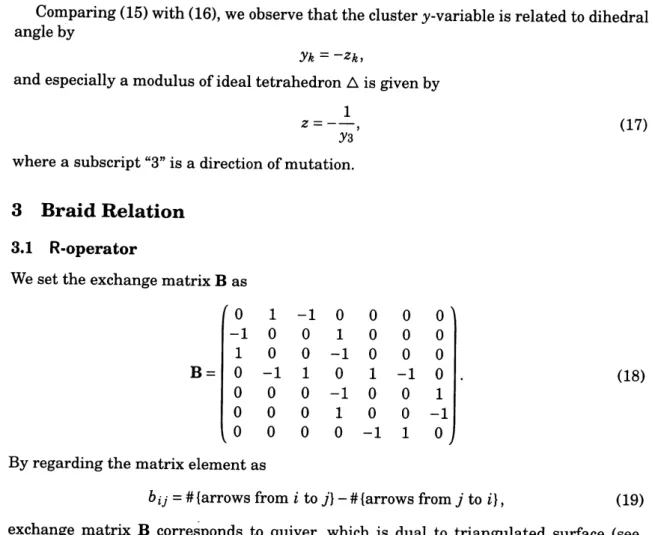
We set the exchange matrix$B$ as
$B=\ovalbox{\tt\small REJECT} 001000 -1000001 -1000001 -1-100101 -1000001 -1001000 -1001000]$
.
(18)By regarding thematrix elementas
$b_{ij}=\#t$
arrows
from $i$ to$jI-\#${arrows from$j$to $i$}, (19)
exchange matrix $B$ corresponds to quiver, which is dual to triangulated
surface (see,
e.g., [5]$)$
.
In our case (18), we have thequiver and the triangulated surface depicted
in Fig. 3.
7
Figure3: Quiver and triangulated surface
Definition3.1 ([10]). We define the $R$-operatorby
Note that the inverse of the $R$-operator is givenby
$R^{-1}=s_{3,6}s_{2,5}s_{3,5}\mu_{4}\mu_{5}\mu_{3}\mu_{4}$
.
(21)The permutations are included in the $R$-operator so that the exchange matrix$B(18)$
is invariant under R. We
use
atrivial semi-field [7], andwe set all cluster coefficients tobe 1. Exphcitly
we
have$R^{\pm 1}(x,B)=(R^{\pm 1}(x),B)$, (22)
where
$R(x)=[\frac{X_{1^{X_{3}x_{4}x_{5}+x_{3^{X}5^{X}7+x_{1}x_{2}x_{6}x_{7}}}}\frac{xxx+xxx+xxxx_{5}x_{1}}{4^{2_{x_{5}+x_{1}x_{3}x_{6}x_{7}+x_{3}x_{4}x}}x_{2}x_{4}}}{\frac{xxx_{\’{o}}+x_{3}xx_{7}+xxxxx_{5}x_{6}}{x_{4}x_{6}},xx_{7}^{3}}1^{T}$
$R^{-1}(x)=[x_{7}\frac{x_{1}x_{2}x_{4}x_{6+x_{2x_{4}^{2}x_{6}+x_{1}x_{3}x_{5}x_{7}+x_{1}x_{2}xx_{7}+xx_{4}x67}^{\frac{x_{135126246}xx+xxx+xxxx_{1}}{x_{3}x_{4}}}}x_{6}62x}{}\frac{xxx_{6}+x3x_{5}x7+x2xxx_{3}x_{4}x_{5}x_{2}}{x4x_{5}}]^{T}$ (23)
Correspondingly,actions ofthe$R$-operator, (20)and(21),onthe$y$-variable are
respec-tively givenasfollows:
$R(y)=[\frac{\frac{}{}\frac{y1(1_{\mathcal{Y}2y_{4\mathcal{Y}5\mathcal{Y}6}}+\mathcal{Y}2+\mathcal{Y}2\mathcal{Y}4)}{1^{+y_{2}+\mathcal{Y}6+y_{2}y_{6}+y_{2}y_{4\mathcal{Y}6}}1_{+2++y_{6}+y^{2}y_{4\mathcal{Y}6}}y_{y_{4}}2\mathcal{Y}4}}{t_{\frac{}{}}),\frac{1+y2+y_{2}y_{4})(1+\mathcal{Y}6+y_{4\mathcal{Y}6}1+y_{2}+y_{6}+y_{2}y6+y_{2\mathcal{Y}4\mathcal{Y}6}y2\mathcal{Y}3\mathcal{Y}4y_{6}y_{4\mathcal{Y}6}}{1+y2+y6+y_{2}y6+\mathcal{Y}2\mathcal{Y}4y_{6}(1+y_{6}+y_{4}y_{6})y_{7}}}T$ $R^{-1}(y)=y(2(1+3\mathcal{Y}4\mathcal{Y}5)]^{T}$ (24)
Duringtheworkshop, R. Kashaev kindlyinformedusthat anessentially sameaction
It should be noted that the$R$-operator(20)canbe writtenas
$R=s_{2,5}s_{3,6}\mu_{2}\mu_{6}\mu_{4}\mu_{2}\mu_{6}$
.
(25)3.2 Braid Relation
WegeneralizethequiverinFig. 3 to that inFig.4. Therein alsogivenis the triangulated
surface, and
an
exchangematrix$B$is given bythe rule(19)as
ageneralizationof(18).$2 5 3i-1 3n-1$
Figure 4:Quiverand triangulated surface.
Definition 3.2. By use of(20), we define the $R$-operator $Ri$ for $i=1,$$\ldots,n-1$ associated
with thequiverinFig. 4by
$R\mu_{3i+1}\mu_{3i-1}\mu_{3i+3}\mu_{3i+1}i_{=s_{3i,3i+2^{S}3i-1,3i+2^{S}3i,3i+3}}$
.
(26)Note that
$R^{-1}=s_{3i,3i+3}s_{3i-1,3i+2}s_{3i,3i+2}\mu_{3i+1}\mu_{3i+2}\mu_{3i}\mu_{3i+1}i$
.
(27)Theexchangematrix associatedtoFig.4 is invariant under the action ofthe $R$-operators
$R^{i_{\pm 1}}.$
The explicit forms ofthe actions onthe clustervariable $x=(x_{1},x_{2,\ldots,3n+1}x)$ and the
y-variable$y=(y_{1},y_{2}, \ldots,y_{3n+1})$ are as follows.
$R^{\pm 1}(x)=(x_{1},\ldots,x_{3i-3}, R^{\pm 1}(x_{3i-2},\ldots,x_{3i+4}),x_{3i+5},\ldots,x_{3n+1})i$, (28)
$R^{\pm 1}(y)=(y_{1}, \ldots,y_{3i-3}, R^{\pm 1}(y_{3i-2}, \ldots,y_{3i+4}),y_{3i+5,\ldots,\mathcal{Y}3n+1)}i$, (29)
Theorem3.3([10]). The $R$-operator
satisfies
thebraid relation, namelywe
have$RRRii+1i=RRRi+1ii+1$,
for
$i=1,2,$$\ldots,n-2_{J}$ (30)$RRi=RRji$
,
for
$|i-j|>1$.
(31)3.3 Octahedron
Based
on
3-dimensional interpretation of the cluster mutation given inSection
2.3,we
can
see
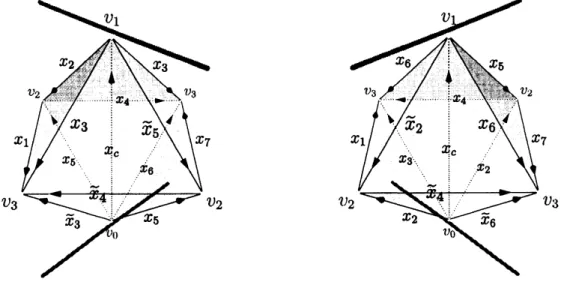
thatthe $R$-operator(20)isrealizedas
an
octahedron in Fig. 5,which is composedof four tetrahedra $t\triangle_{N},\triangle s,\triangle_{W},\triangle_{E}$}. The four tetrahedra originate from fourmutations
in the $R$-operator, (20)and(21). In octahedra,the cluster variables$Xk$ and$\tilde{x}k$ definedby
$\tilde{x}=R^{\pm 1}(x)$,
areassignedto edges,andwe have used
$x_{c}= \frac{x_{2}x_{6}+x_{3}x_{5}}{x_{4}}$
.
(32)Note thatwehave fixedvertexorderingforourconvention, and thatedgeswith the
same
complexparameters$(e.g., two$pairs$of$edges $v_{0}-v_{2}, v_{1}-v_{3})$
are
identical.Figure5:Octahedron for$R$(left)and$R^{-1}$(right)
As the $R$-operator satisfies the braid relation (Theorem 3.3), we can interpret that
each octahedron is assigned to every crossing of knot diagram
as
in Fig. 6. Thisre-minds a fact [22] that octahedron was assigned to the Kashaev $R$-matrix [12] (see also,
[8, 1, 3, 24]$)$
.
Note thatanother expression(25)ofthesame
$R$-operator corresponds to adecomposition ofoctahedron intofive tetrahedra,whichwasusedinstudies of the colored
$\triangle_{N}$ $\triangle_{N}$
$\triangle s \triangle s$
Figure6: Dihedral angleatcrossings, $R$(left)and$R^{-1}$(right).
Taking into account ofthe vertex ordering oftetrahedra, we can determine moduli
ofeach tetrahedron from (13) as in Table 1. From these results, we define dilogarithm
functions foreverycrossing by
$L([R^{\pm 1}])=\sum_{t\in\{N,S,W,E\}}sign(\triangle_{t})L([z_{\triangle_{t}};p\triangle_{t},q_{\triangle_{t}}])$
.
(33)Here integers$p\triangle_{t}$ and $q\triangle_{t}$
are
given from (14)by useof Table 1. Forinstance, $p\triangle_{E}$ and $q\triangle_{E}$ intheoperator$R$aregiven as
$p_{\triangle_{E}} \pi i=-\log(\frac{\tilde{x}_{5}x_{6}}{x_{3}x_{5}})+\log(\tilde{x}_{5})+l(X6)(X3,$
$q_{\triangle_{E}} \pi i=-\log(-\frac{xx}{x_{c}x_{7}})+\log(x3)+\log(x_{5})-\log(x_{c})-\log(x_{7})$
.
$R R^{-1}$
$\triangle$ Volume sign(A)
$z_{\triangle}$ $\frac{1}{1-z_{\triangle}}$ sign(A) $z_{\triangle}$ $\frac{1}{1-z_{\triangle}}$
$\Delta_{N} D(-\frac{1}{y_{4}}) - -\frac{x_{2}x_{6}}{x_{3^{X}6}} \frac{x_{3^{X}6}}{X4^{\chi_{C}}} + -\frac{x_{3}x_{5}}{x_{2}x_{6}} \frac{x_{2}x_{6}}{x4^{X}c}$
$\triangle s D(-\tilde{y}_{4}) - -\frac{\tilde{x}\tilde{x}}{x3^{X}5} \frac{xx}{\tilde{x}_{4}x_{c}} + -\frac{\tilde{x}_{2}\tilde{x}_{6}}{x_{2}x_{6}} \frac{xx}{x_{c}\tilde{x}_{4}}$ $\triangle w D(\frac{\tilde{y}_{1}}{y_{1}}) + \frac{x_{2^{\tilde{\chi}}3}}{xsx_{5}} -\frac{x_{3^{X}5}}{x_{1}x_{c}}=_{--} -- \frac{\tilde{x}_{2}\alpha_{3}}{x_{2}x_{6}} -\frac{X2^{X}6}{x_{1}x_{c}}$ $\triangle_{E} D(\frac{\tilde{y}_{7}}{y_{7}}1 + \frac{\tilde{x}_{5}x_{6}}{xx} -\frac{x_{3}x_{5}}{x_{c}x_{7}} - \frac{x_{5}\tilde{x}_{6}}{x_{2}x_{6}} -\frac{xx}{x_{c}x_{7}}$
Table1: Moduli of four tetrahedra assigned to operators$R$and$R^{-1}.$ $Sgn+$”(resp. “-,,)meansthat vertex
orderingoftetrahedron issame(resp. inverse)withFig. 1.
It should be remarkedthat,toidentify the$R$-operator with
a
hyperbolicoctahedron,we
needaconsistencycondition aroundacentraledgelabeledby$x_{c}$ inFig. 5. This condition
isautomaticallysatisfiedby
where$\tilde{y}=R^{\pm 1}(y)(24)$
.
In Fig. 6denotedare
dihedral angles around centralaxisassignedto eachcrossing.
3.4 GluingOctahedra
Theorem3.4. Let knot$K$have abraidgrouppresentation$\sigma_{k_{1}}^{\epsilon_{1}}\sigma_{k_{2}}^{\epsilon_{2}}\cdots\sigma_{k_{m}}^{\epsilon_{m}}$, where$\epsilon_{j}=\pm 1$
and
$\mathscr{R}_{n}=\langle\sigma_{1},\sigma_{2},\ldots,\sigma_{n-1}|\sigma_{i}\sigma_{i+1}\sigma_{i^{\sigma_{i}\sigma_{j}=\sigma_{j}\sigma_{i}fo}}=\sigma_{i+1}\sigma_{i}\sigma_{i+1}7_{ori=1,2,\ldots,n-2}^{|i-j|>1}\rangle.$
We
define
a clusterpatternfor
$x[.i]=(x[i]_{1}, \ldots,x[j]_{3n+1})$by$x[1]arrow x[2]R^{\epsilon_{1}}k_{1}arrow\cdots x[m+1]R^{E}2\underline{R^{\epsilon_{m}}}k_{2k_{m}}$
, (34)
with the exchange matrix associated to Fig. 4. Weassume thatthe initial cluster variable
$x[1]$
satisfies
$x[1]=x[m+1]$
.
(35)Then there exist
an
algebraic solution of(35)such that the complex volume $ofK$isgiven$by$
$i(Vol(S^{3}\backslash K)+iCS(S^{3}\backslash K))=\sum_{j=1}^{m}L([R^{\epsilon_{j}}])k_{j}$
.
(36)We study a
case
of trefoil $3_{1}$.
The braid group presentation is $\sigma_{1}^{3}$, and its clusterpattern is
$x[1]arrow R1x[2]arrow R1x[3]arrow R1x[4].$
We solve$x[1]=x[4]$by choosinganinitial cluster variableas
$x[1]=(1,x, -x, 1, -x^{2},1,1)$,
and get $x= \frac{1\pm i\sqrt{15}}{4}$
.
We check numerically that (36)gives -$8.22467 \cdots\simeq-\frac{5}{6}\pi^{2}$.
Itagrees
with the Chern-Simons invariant of$3_{1}$, which is also given from asymptotic limit of the
Kashaev invariant [14,25, 11].
4
2-Bridge
Knots
Computation from the cluster pattem basedonthe$R$-operator(20)is muchinvolved, and
itcanbe much simplifiedwhenweknow asimple triangulation ofhyperbolic manifolds,
suchas once-puncturedtorus bundle and 2-bridgeknotcomplements. In thissection,we
employacanonical triangulationof2-bridgeknot complementsstudied in[21].
Let$K_{q/p}$ be a hyperbolic 2-bridgeknot or link (see e.g. [16]). Herewe assume that$p$
continuedfractionexpressionof$q/p,$
$q/p= \frac{1}{\alpha 1+\frac{1}{a2+\frac{1}{1}}}$
, (37)
$+-a_{n}$
where$n\geq 1,$ $aJ\in \mathbb{Z}_{>0}$, and $a_{n}\geq 2$
.
We set$c= \sum_{i=1}^{n}a_{i}$
.
(38)We then setasequence ofsymbols to denoteflipsas
$F_{1}F_{2}\cdots F_{c-3}=\{\begin{array}{l}R^{a_{1}-1}L^{a}R^{a}\cdots R^{a_{n-1}}L^{a_{n}-2}, when n is even,R^{a_{1}-1}L^{a_{2}}R^{a_{3}}\cdots L^{a_{n-1}}R^{a_{n}-2}, when n is odd.\end{array}$ (39)
where$F_{k}$ denotesasymbol,$F_{h}=R$ or$L.$
Figure7:$A$quiverassociated to triangulation of four-puncturedsphere$\Sigma_{0,4}.$
A setup forclusteralgebrais asfollows. Weuseanexchange matrix
$B= (_{-}010_{1}1 -1-10011 -1-10011 -1-10011 -1-10011 -1-00111)$ , (40)
whose quiver is in Fig. 7. We introduce the flips$R$ and$L$ in (39) as cluster mutations
definedby
Permutations $St,j$
are
usedso
that the exchange matrix$B(40)$ is invariant under theseflips. The actionson$y$-variablesareexplicitlygivenby
$R(y)=[1^{-1}2^{-1}y_{2}^{-1}T$ $L(y)=(^{y_{1}(1+y)^{-1}(1+y)^{-1}}\mathcal{Y}2(1yy_{5}+6((y_{3^{-1}}11+y_{3})(1+y_{4}^{4})$
Theorem4.1 ([9]). We set$y[k]$recursively by
$y[k]arrow y[h+1]F_{k}$ (43)
where$F_{k}$ is$R$or$L$ in(39), andan initial$y$-variable is given by
$y[1]=(y,y,- \frac{1}{y},-\frac{1}{y},-1,-1)$
.
(44)Here$y$ isageometric solution
of
$\{\begin{array}{l}y[c-2]_{3}=y[c-2]_{4}=-1, ifn is even,y[c-2]_{1}=y[c-2]_{2}=-1, ifn is odd,\end{array}$ (45)
such that each modulus$z\iota[h]$
for
$i=1,2$and$k=1,2,\ldots,c-3$defined
by$z_{i}[k]=\{$ $-\perp$ $ifF_{k}=R,$ $y[k]_{j}$’ $- \frac{1}{y[h]_{2+i}},$ $ifF_{h}=L,$ (46)
is in the upper halfplane $\mathbb{H}.$
Then $z_{i}[k]$denotesa modulus
of
tetrahedron $\triangle_{i}(F_{k})_{J}$and the hyperbolic volumeof
the knotcomplement$S^{3}\backslash K_{q/p}$ is given by$v_{o1(S^{3}\backslash K_{q/p})=\sum_{k=1}^{c-3}\sum_{i=1,2}D(z\iota[h])}$
.
(47)We
can
compute thecomplexvolumeof 2-bridgeknotcomplement byuse
oftheclustervariables. In this case, we need aspecific semi-field to fulfill a“folding condition” at the
end, and it is tediousto fixan orientationof tetrahedra. See [9].
Acknowledgments
References
[1] J. Cho, H. Kim, and S. Kim, optimistic limits
of
Kashaev invariants and complexvolumes
of
hyperbolic links, preprint(2013), arXiv:1301.6219 [math. GT].[2] J. Cho and J. Murakami, The complex volumes
of
twistknots via colored Jonespoly-nomials, J. Knot Theory Ramifications 19, 1401-1421 (2010).
[3] J. Cho,J. Murakami, and Y.Yokota, Thecomplexvolumes
of
twistknots,Proc. Amer.Math. Soc. 137, 3533-3541 (2009).
[4] I. A. Dynnikov, On a Yang-Baxter map and the Dehornoy ordering, Russ. Math.
Surveys 57, 592-594 (2002).
[5] S. Fomin, M. Shapiro, and D. Thurston, Clusteralgebras and triangulated
surfaces
I. clustercomplexes,Acta Math. 201, 83-146(2008), arXiv:$math/0608367.$
[6] S. Fomin andA. Zelevinsky, ClusteralgebrasI. foundations,J. Amer. Math. Soc. 15,
497-529(2002), arXiv:$math/0104151.$
[7] –, Cluster algebras
rv:
coefficients, Composito Math. 143, 112-164 (2007),arXiv:$math/0602259.$
[8] K. Hikami, Hyperbolic structure arising
from
aknot invariant, Int. J. Mod. Phys.$A$16, 3309-3333 (2001).
[9] K. Hikami and R.Inoue,Clusteralgebraandcomplexvolumeofonce-punctured torus
bundlesand two-bridge knots, preprint(2012), arXiv:i212.6042 [math. GT].
[10] –, Braids, complex volume, and cluster algebra, preprint (2013),
arXiv:1304.4776 [math. GT].
[11] K. Hikami and A. N. Kirillov, Torus knot and minimal model, Phys. Lett. B575,
343-348(2003), arXiv: $hep-th/0308152.$
[12] R. M. Kashaev,A linh invariant
from
quantum dilogarithm, Mod. Phys. Lett. A10,1409-1418 (1995).
[13] –,Thehyperbolicvolume
ofknots
from
quantum dilogarithm,Lett. Math. Phys.39, 269-275(1997).
[14] R. M. Kashaev and O. Tirkkonen,
Proof of
the volume conjecturefor
torus knots, J.Math.Sci. 115, 2033-2036(2003).
[15] H. Murakami and J. Murakami, The coloredJonespolynomials and the simplicial
volume
ofa
knot,Acta Math. 186, 85-104(2001).[16] K. Murasugi, Knot Theory and ItsApplications, Birkh\"auser, 1996.
[17] K. Nagao,Y.Terashima,and M.Yamazaki,Hyperbolicgeometryand cluster algebra,
[18] W. D. Neumann, Combinatorics
of
triangulations and the Chern Simonsinvari-ant
for
hyperbolic 3-manifolds, in B. Apanasov, W. D. Neumann, A. W Reid, andL. Siebenmann, eds., Topology’90, OhioState Uniu. Math. Res. Inst. Publ. vol. 1, pp.
243-271,de Gruyter,Berlin, 1992.
[19] –,Extended Blochgroupand the$Cheeger-Chern$-Simonsclass, Geom.Topol. 8,
413-474(2004).
[20] W. D. Neumann and D. Zagier, Volumes
of
hyperbolicthree.manifolds, Topology 24,307-332(1985).
[21] M. Sakuma and J. Weeks, Examples
of
canonical decompositionsof
hyperbolic linkcomplements, JapanJ. Math. 21, 393-439(1995).
[22] D. Thurston, Hyperbolic volume and the Jonespolynomial, Lecture notes of
\’Ecole
d’\’et\’edeMath\’ematiques‘Invariants de noeudset devari\’et\’esdedimension3‘,Institut
Fourier(1999).
[23] W. P. Thurston, The geometry and topology
of
three-manifolds, Lecture Notes inPrinceton University, Princeton (1980).
[24] Y. Yokota, On the complex volume ofhyperbolicknots, J. Knot Theory Ramifications
20,955-976 (2011).
[25] D. Zagier, Vassiliev invariants anda strange identity related to the Dedekind
eta-function, Topology 40,945-960 (2001).
[26] –, The dilagarithm function, inP. Cartier, B.Julia,P. Moussa, and P.Vanhove,
eds., Frontiers in Number Theory, Physics, and Geometry $\Pi$
.
OnConformal
FieldTheories, Discrete GroupsandRenormalization,pp. 3-65,Springer, Berlin, 2007.
[27] C. K. Zickert, The volume and Chern-Simons invariant
of
a representation, DukeMath. J. 150, 489-532(2009), arXiv:0710.2049 [math. GT].
FacultyofMathematics
KyushuUniversity
Fukuoka606-8502
JAPAN
$E$-mail address: [email protected]
$7\iota^{J})\backslash b|\star\not\cong\cdot\ovalbox{\tt\small REJECT}^{\backslash }\downarrow$
fflffi
Departmentof Mathematics andInformatics, FacultyofScience,
Chiba University
Chiba263-8522
JAPAN
$E$-mailaddress: reiiy@math.$s$.chiba-u.ac.jp