Freeware,
Shareware,
and
Open-Source
Mathematical Software
Tools:
a
Feasible
Alternative
to Commercial
Symbolic
Packages
for
Mathematics
Education
Andr\’es
Iglesias1’2
lDepartment
of
Applied Mathematics and
Comp.
Sciences
University
of
Cantabria,
Avda.
de los
Castros
s/n,
E-39005, Santander,
Spain
2Department
of Information
Science
Faculty
of
Sciences,
Toho University
2-2-1
Miyama,
274-8510,
Funabashi,
Japan
E-mail:
[email protected]
Web
site:
http:
//personales.unican. es/iglesias
(Thispaper is specially devoted to my longtime dear
fnend Professor
Setsuo Takato, who is now writingbeautiful
lines in a new chapterof
his bookof life.
Best wishesfor
thisnew stage
of
hrslife
to be also bnzlliant, exciting andsuccessful.
Thanksfor
allowing meto become part
of
yourlife.
Doomo $arigatoo!//$)Abstract
Thispaper corresponds to the printed form of an invited talk the author deliv-ered inaRIMSworkshop held atKyoto University inAugust 2012. The main core of the presentationwas about the new challenges we face as educators of Mathe-matics subjects at University level and how to solve them. To this aim, the talk proposed an int\‘ensive use of freeware (mostly symbolic) computational tools, as a way to overcomeboth instructionaland economical issues. During the talk, itwas
emphasized that current freeware symbolic tools arepowerful enoughto represent a feasible, reliable altemative to costly commercial symbolic packages. The talk als$0$ explores thereasons behind the blossoming of this new freeware solutions for mathematical computation.
1
Introduction
On August $22nd$. 2012, the author was kindly invited to deliver a talk at the “RIMS
Workshop on Mathematical
Soflware
and Education: Study onEffective
Useof
Mathe-matical Software”, held at the Research Institute for Mathematical Sciences (RIMS) ofKyotoUniversity, Kyoto,Japan (http:$//www$.kurims. kyot$0-u$
.
ac.jp/en/index.html).The primary goal of this workshop was to analyze the interplay between mathematical software (mostlyCAS, computer algebra systems) and education regarding the effective use ofmathematical software in orderto improve the educational level and bring out the best of the students at all educational steps.
We areindeed facing a new era in which our students have to meet thenewchallenges ofan increasingly technological world. In this regard, it is clear that old approaches to education are no longer applicable and hence, new educational paradigms must be envi-sioned and implemented. This challenge is specially important in very difficult subjects such as Mathematics and otherscientific disciplines, which typically suffer from high
fail-ure rates. Several academic reports have pointed out the difficulties our students face when studying (and suffering) mathematical subjects. Students and professors at univer-sityoften cite lack ofpreparation from highschool, poor study habits and the rapid pace of the course as reasons for such low scores, but it is clear that there are many reasons
to explain why this problem arises recurrently everywhere.
Another issue is to recognize the profile of our current students, as they are quite different to those of previous decades. In general, they are less skilled than their
coun-terparts in the last decades in deduction, mathematicalintuition and scientific reasoning and encounter more problems in solving questions with scientific content. Their back-ground is also less solid in both science and arts. Furthermore, they also have less oral and written communication skills, with a much limited vocabulary and hence find some
troubles for a full comprehension of concepts and ideas. Very often, they lack discipline and exhibit poor study habits such as poor note-taking skills, poor time management, last minutework, procrastination, over-relianceon classmates and$/or$ Internet andso on.
On the positive side, most current students come to college and university with greater computer proficiency and technology skills than their predecessors. Technology is nat-ural to them as they got accustomed to use it from their childhood. Today’s students’ equipment is by far the most complete and varied we have ever seen: modern connectiv-ity devices such as last generation smartphones, powerful laptops, USB memory cards, webcam, $MP$3 player, memory sticks, digital camera and smart cards. Very often also
Internet connection at home, adesktop computer, videogameconsoles, wideflat screens, videotape players and recorders, cable $and/or$ satellite $TV$, and videocamera. Some
stu-dents alsohave GPS, beam proyector, Blue-ray player/recorder, car navigator and other sophisticated electronic devices. They are familiar with terms such as pixel, texturing,
RGB color palette, and technologies such as remote control, Internet surfing, DVI and HDMI connectors and many more. Muchbetter, theyare not only accustomed to technol-ogy but also they know how to use it efficiently. Therefore, proper use of computer tools andother technology turns outtobemore than appropriate to promotetheir background to an upper level [2, 3].
1.1
The role of
educational
materials
In our opinion, part of the solution must come from a good collection of supporting materials, of which computer software is undoubtely a primary
resource.
Mathematicsis very much practice-based. Students may grasp a concept in the classroom, but they will certainly lose it if not reinforced by homework. For doing so, students need to be
providedwith good supporting materials
so
that theycan
effectively learnbythemselves.High-quality, helpful educational materials all$ow$underachieving students catching up on
belated assignments and get extra time for successful backtracking. It is at this point
where
Computer
Algebra Systems (CAS onwards) can really pave the way, making themost with less. In author’s opinion, CAS arevery powerfultools (arguably thebestones) to facethe challenges of this new approach to Higher Education.
Fortunately, there is a wealth ofcomputational software coming in our help. Among them,thesymboliccomputationalprograms havealready proved to bevery effectivetools in order to improve the general performance ofour students both at the classroom and for homework. There is a limiting factor, however, in this educational approach. The most popular symbolic tools so far are commercial software and, in general, tend to be costly for standard students. In fact, we have witnessed a big rise in the cost of this symbolic software. Even although the companies developing this kind of software have tried to create special client license programs in order to increase their customer base and allow more people to access their programs, it is clear that economical issues have become increasingly important.
Asaconsequence, both individual
users
andacademic institutionsare
nowadaysstrug-gling to satisfy the increasing rates of prices for commercial mathematical software. In addition, the companies have generally fail to involve
users
in the process of updating their products. It is a typical complaint from many users that the new versions of very popular commercial programs aresometimes quite different than previous versions, very often involving substantial changes in the syntax and structures of the programminglan-guage, core of commands, graphical capabilities, and the like. This clearly affects users’ performance by increasing the time to get familiar with the new version and, therefore, lowering their learning curve. While it is clear that the primary goal is to improve the product and provide
users
with a better “user expenence”, itoftell
happens thateco-nomical motivations are also part of the equation. In a contradictory movement, some
companies have established the tradition to launch versions of their software according to
aprescribed schedule,even iftheyhave little (or nothing) of interestto offer at that time. Both undesirable situations may coexist in such a way that
some
versionsare
completely irrelevant while others are too different. $A$ classical example of the former is given bythe Premium licenses that usually provide access to the newupdates ofthe product for either a limited number of versions or a limited time. The disappointment comes when you discover that the new version provided by the Premium service license is basically the same you bought at the time of applying for that service, with no relevant features at all. By Murphy’s law, you have probably to wait until the new version (not covered by the Premium service) to really find amajor update of the program.
As asummary, usersof commercial mathematical software arefacing great challenges in both computational and economical terms. The former is hard (ifnot impossible) to be solved, since it relies completely on the software developers side. Typically, software companies are reluctant to give up part of theirbusinessto theircustomers and prefer to have full control of their products. While many softwaredevelopers hear their customers and try to incorporate their suggestions into thenewversions of their products,usersplay a very limited role (if any) into the strategic decisions of the company. The economical issue has also been a very limiting factor for years. Mathematical software can be very expensive. One can argue that these systems are usually very powerful, easy to use,
are equipped with a nice graphical user interface and good graphical capabilities, are
very flexible and come with a nice documentation and support. But still, they are very expensive, that’s the bottom line.
Anew actor in this scenario is theappearance andgrowthof anewgeneration of
pow-erfulfreewaremathematicalprogramsableto competeon anequal basiswith commercial solutions. The fact that they are provided for free does not meanthey are less powerful
than their commercial counterparts. Besides, they are not subjected to the typical
con-straints that proprietary systems have; dependingon the kind of license they have,these
programs can usually be freely downloaded, installed, modified and$/or$distributed.
Fur-thermore, most oftheseprograms
are
created bycommunities ofusers, thusallowing endusersto participate actively in thenewversions of such programs. Thisopen architecture has manyobvious advantages for usersfar beyond the economical considerations. In most cases, the source code can be freely accessed and modified, so that users can effectively adapt the software to their particular needs. In other cases, a powerful programming language is provided, so thatindividual userscan create their own functions and libraries in a transparent way. This
means
that these new functions and libraries are treated by the system as native libraries, and then, they can be invoked basically at will provided that they respect the programming guidelines and syntaxofthe underlying programming language.In this paper we explore some aspects of this on-going process currently happening within the mathematical communityas a results of thisshift from commercial to freeware mathematical software. In particular, next section discusses some issues related to this
new
approach, suchas
the kind of licenses available and their implications for further use. We also provide pointers to some open-source and freeware tools and middleware available to handle avarietyof tasks regarding mathematical education.2
$Eree/$Share
$/Open$
-Source
Software
2.1
Clarifying
the
terms
A very important issue is to distinguish clearly among what is freeware, free software, open-source software and shareware. Although there is a common misconception
por-trayed in many web sites and media about these terms being synonymous, they actu-ally refer to qualitatively different legal scenarios. The importance of this question for end-users and companies becomes clear as soon as you want to distribute your digital creations: being unaware about which kind of legal situation the software you use is might potentially leadto legal liability for using such software without the required per-missions (licenses). To make things tougher, there is not an unanimous opinion about the right meaning of those terms and their legal implications, so users should always read the corresponding license agreements as they are the only reliable source when it
comes to legal rights and obligations. As such, the description of terms below is mostly based on commonly accepted practices within relevant software communities rather than well-established “official” definitions themselves.
By
freeware
wereferto computersoftwareavailableforuseat nocostorforanoptional fee. Typically, freeware is fully functional and offered for an unlimited time, although some restrictions might apply. Of course, this concept can also include proprietarysoft-ware
provided
thatit is offered
for free. In this sense, freeware is used to refer tosoftware
whichis simply free-of-charge, withnoother implications behind. Therefore, it must not be confused withfree
software, the later meaning that it canbe used, studied, and modi-fied without restriction. Although proprietary softwarecompanies typicallyuse
the term(free software” to refer to price, freesoftware is actually a matter of freed$om$, not price.
In words of Richard Stallman in the famous “The Free Software Definition” document
[8] released bythe Free Software Foundation (FSF), an organization that advocates for free software [7], to understand the concept, one should “think
of free
as infree
speech, not as infree
beer”.By open-source
software
we mean
computer software that is available in source codeform. Usually, such
source
code and certain other rights normally reserved for copyright holders are provided under a software license that allowsusers
to study, change, andimprove the software. According to this concept, freeware may or
may
not be open-source, depending on whether or not thesource
code is also provided. Similarly, free software may ormay
not be open-source software, dependingon
the rights provided regarding the re-use of such software and subsequent distributions. This is, however, a matter of discussion. For the Free Software Foundation, free software is computersoftware liberally licensed to grant the right of
users
to use, study, change, and improve its design through the availability ofits source code. From this standpoint, all licenses qualifiedasfree softwareare also considered open-sourcelicenses,but this criterion is not unanimously acknowledged.Open-source licenses often meet (but not necessarily) the requirements of the Open
Source Definition [10], used bythe OpenSourceInitiative (OSI) [9] to determine whether
a
softwarelicense can be considered open-source. Such definition doesnotmatch exactly thatof free software issued bytheFSF. However, differences between bothtermsare verysmall, so in practice they basically refer to the
same
software licenses, with a few minor exceptions. According to FSF [6]: “However, thedifferences
in extensionof
the categoryare small: nearly all
free software
is open source, and nearly all open sourcesoftware
isfree.
”Another related term is shareware. By it we refer to proprietary software that is provided to
users
for freeon
a trial basis only. Usually, shareware is freely provided for a limited period oftime in order to offer potential customers the opportunity touse
the program thus determining its usefulness and potential advantages over competitors before taking a decision about buying a license. Often shareware is also labeled as “free
trial” or “trial version” to stress that meaning. In other cases, the software is offered with some limitations on functionality, such
as
import/export orsave
options and the like. Such missing functionalities can be fully activated after purchasing a license. Forinstance, in videogames, shareware has been traditionally used as a
mean
to distributegames developed by small-sized companies that do not have accessto major distribution channels for their products. In general, shareware games are different than game demos in the sense that the former are much less limited in terms ofplaytime and number of levels. It is not
uncommon
that shareware gamesinclude the fullgame, while additional content, assets, extras and other functionalities are only provided with the commercial license.2.2
Software
licenses
As pointed out in previous section, software can be classified according to the rights granted to end-users: availability of software at no cost, access to the source code, possi-bility of modifying it and
distributing
it and so on. All those rights are specified in thecorresponding software licenses, which can be categorized in a nutshell
as
proprietary li-censesand non-proprietarylicenses. In proprietary licenses, the softwarepublisher grantsalicense touse one or several copies of the software but maintains the ownership of such
softwareso as all rights are retained by the software publisher unless otherwise specified.
As a consequence, theuser must necessarilyaccept all terms of the license in order to use the software. Typically, those terms include an extensive list of activities that users are
not allowed to perform with the software, such as reverse engineering, any modification
of the software, its distributionto third parties and many others.
Onthe contrary, in non-proprietary licenses the ownership of the copy of the software
does not longer remain withthe software publisher, but the end-user (different than the ownership ofthecopyright, that stillbelongsto thesoftwarepublisher). Asaconsequence,
end-user can actually use the software without accepting the license. Such acceptance is optional but it is required if end-user also wants to access to other rights such as the
modification or distributionrights. At its turn, non-proprietarylicenses
can
beessentially of two different types: copylefted or permissive. The main difference between them is that copyleftedlicensesstate that when modified versions of suchsoftwarearedistributed, they must be distributed under the same terms as the original software. In particular, all improvements or modifications to copylefted software must also be distributed as free software. In other words, modified versions of software with copyleft come also with copyleft. This is sometimes referred to as “share and share alike” or “quidproquo” The ultimate goal of copyleft is to preserve thefreedom and openness of thesoftware itself. $A$typical exampleof copyleft is theGNUGeneral Public License [11] (GPL onwards). Under it, end-users
can
redistribute, reverse engineer, or otherwise modify the software, but all any modifications made and redistributed must include the source code, and the end-user is not allowed to modify the copylefted license for such new software. Additionally,ifGPLcode is used but not shared orsold, the code is not required to be made available
and any changes may remain private. This permits developers and organizations to use
and modify GPL codefor private purposes without being required to make their changes available to the public.
In opposition, permissive licenses aim to give users total freedom on that software, so users can do basically anything they want with the source code, including the right to use it as a part of software released under a proprietary license. For instance, GPL requires any derivative work that is distributed to be released according to the GPL while permissivelicenses, such as BerkeleySoftware Distribution (BSD), MITLicense or Universityof Illinois/NCSA OpenSource Licensedo not; they only require toacknowledge
theoriginal authors. As such, permissive licenses are more free than the copylefted ones.
In fact, code licensed under apermissive free software license (BSD for instance) can be incorporated intocopylefted projects (for example, GPL). Thenew code emanating from this process becomes GPL compatible. However, the opposite is not true: GPL licensed code cannot be distributed under the BSD license without the previous consent from
copyright holders. To summarize, copyleft and permissive licenses are compatible, but
permissive license.
Ahalfway between copyleft and permissive licenses is given by theGNU Lesser
Gen-eral Public license (LGPL) [12]. Under LGPL, copyleft restrictions apply totheprogram
itself but they do not to other software that merely links with the program. This license is mostly used for software libraries, since LGPL libraries can be used by a non-LGPL licensed program (in fact,
even
by a non-GPL licensed program). $A$ famous example ofLPGL application is OpenOffice.
A very interesting situation is that of multiple licenses, where software is distributed
under two or
more
different sets of terms and conditions so that end-users can choosewhich terms they want to use in order to further distribute the software. $A$ typical
example aresome
Mozilla
products (such asFirefox
web browser and Thunderbird$e$-mail client), which are actually tri-licensed, since in addition to the LGPL license, they arealso GPL and MPL licensed. That MPL (Mozilla Public License) is a weak copyleft version (source code copied
or
changed under the MPL must stay under the MPL, butcode under the MPL may be combined with proprietary files in one program) approved
as a open-source license and afree software license by OSI and FSF respectively.
3
Some
Freeware Mathematical Tools
This section providesacomprehensive (although not exhaustive) collectionofopen-source
and freeware mathematical tools and middleware available to handle different tasks
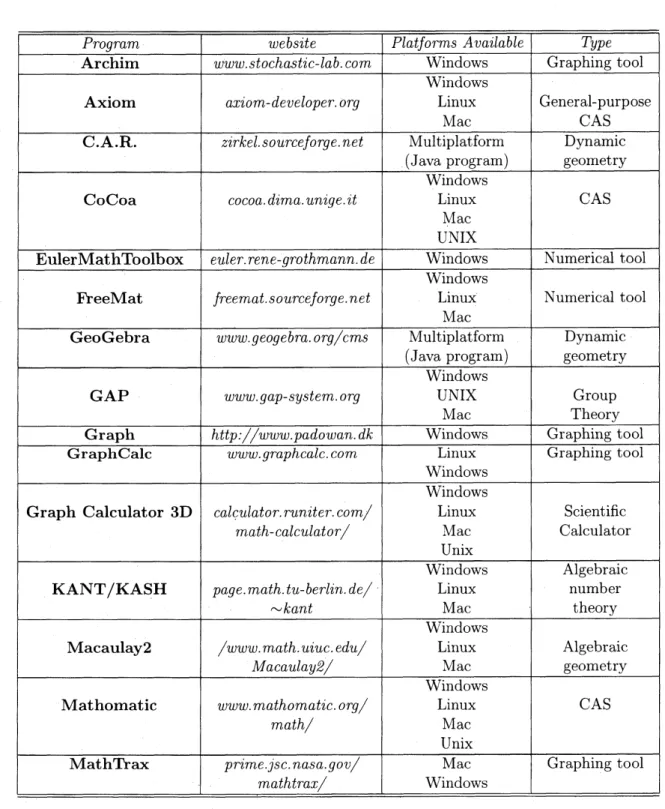
re-garding the interplay between mathematics and education. Table 1 summarizes all this information. The table is exclusively devoted to non-proprietary software; therefore, the readers will notice that commercial CAS are not reportedhere. The table lists, in rows, the different computer programsalong with the corresponding website, the platforms on
which the program is available and, finally, the typeof tasks theprogram is intended for.
All these items arereported in columns for each individual program.
It was the intenti\’on of the author to report the license information of the different
computer packages includedinthissection. However, thisplancollided with the difficulty ofthetask. Most programlicenseshavevaried greatlyoverthetime, making themdifficult to track. Other programshave multiple licenses, dependingon
several
factors,suchastheowners, platforms, developer teams and
so on.
Ata
certain point, it became clear thatprovidingthis informationmight be useless, since it could potentially becomeobsolete at the time of reading. So, instead, the reader is kindly advised to check the corresponding website for an up-to-date information regarding the legal issues of the program license and the different options
available.
4
Conclusions
and
Further Remarks
The main conclusion wecan derive from the phenomenon of freeware mathematical
soft-ware is the wide availability of powerful tools to accomplish $virtually\cdot any$task in away
that compares well with commercial software in almost every respect. But, as impor-tant as this aspect is, there is also another consideration that deserves full attention. Through the evolution of mathematical software, a repetitive topic has been the con-frontation between (apparently) opposite ends. This problem has appeared recurrently
Table 1 (cont’d)
in computer science (just think about the illustrative examples of Microsoft’s Windows vs. Apple’s Mac $OSX$, purists vs. free-spirit coders, or proprietary vs. open source
programs) and the mathematical software is certainly not an exception. Remarkable, well-documented examples are the typical “scientific fights” between Mathematica and Maple followers, between
users
of numerical and symbolic tools, orbetween freewareandcommercialsoftware.
In opinion of the author this way of thinking (the requirement to choose just one
among amyriadof alternativeoptions, muchlikein a “withme oragainst me” approach) reflects our natural tendency as human beings to grouping, but it is not very intelligent after all. All previous experience shows us that the best and most effective approach to an efficient
use
of mathematical software in education is to load all this stuff in ourbackpack andmove on. Whynot opening our minds and take the best out
of
allscientific
progmms in a coopemtive and complementary way?Acknowledgements
This paper is the printed version of an invited talk delivered by the author at RIMS
(Research Institute for Mathematical Sciences) workshop during the RIMS Workshop on
Mathematical
Software
andEducation: Study onEffective
Useof
Mathematical Software, Kyoto University (Japan), on August $22nd$. 2012. The author would like to thank the organizers of this exciting RIMS workshop for their diligent work and kind invitation. Special thanks are owed to Prof. Nakamura (Nagoya University) for his patience and support regarding the writing of this paper.This research has been kindlysupported by the Computer Science National Program of the Spanish Ministry of Economy and Competitiveness, Project Ref.
#TIN2012-30768,
References
[1] Iglesias, A., G\’alvez, A.: Effective $BD$-binding edutainment approach for powering
students’ engagement at University through videogames and VR technology. In:
In-ternational Conference on Convergence Information Technology-ICCIT’2008-Busan
(Korea). IEEE Computer Society Press, (2008) 307-314.
[2] Iglesias, A., Ipanaqu\’e, R.: Using computer algebra systems to achieve Bologna’s Declaration educational goals. A case study: symbolic proof of limits of functions.
Intemational Joumal
of
Computer Science andSoftware
Technology, 2(1) (2009)35-42.
[3] Iglesias, A.: Facing the challenges of the new European Space of Higher Educa-tion through effective use of computer algebra systems as an educational tool. RIMS
Kokyuroku Journal Series, 1624 (2009) 114-128.
[4] Iglesias, A.: Computer Technologies for XXI Century Education: A New Way to
Communicate and Learn.at the University of Cantabria. RIMS Kokyuroku Journal
Senes,
1674
(2010)53-67.
[5] Iglesias, A.: Combining Functional Equations and Computer Algebra Systems with Regard to XXI Century Mathematics Education. RIMS Kokyuroku Joumal Senes,
1735 (2011)
213-223.
[6] The Free Software Foundation: $http.\cdot//www$.gnu.org/philosophy/categories.html
[7] The Free Software Foundation Web site: $http://www.fsf.org/$
[8] The Free Software Definition: $http.\cdot//www$.gnu.org/philosophy/free-sw.html
[9] The Open Source Initiative Web site: http://opensource.$org/$
[10] The Open Source Definition: $http.\cdot//$opensource.org/docs/osd
[11] The GNU General Public License v3.0: $http://www$.gnu. org/licenses/gpl-3.0. txt [12] The GNU Lesser General Public License: $http://www$.gnu. org/copylefl/lesser. html