Quantum
groups,
quiver
varieties,
and
Lusztig’s
symmetries
Fan
QIN
AbstractIn this talk, I will give a geometric construction ofthe quantized
enveloping algebras of type ADE and their bases via cyclic quiver
varieties. The construction respects BGP reflections, which turns out
to be Lusztigs symmetries acting on these algebras.
1
Introduction
1.1
Quantum
group
$U_{t}(g)$We take the following notations:
$\bullet$ I is the set of vertices $\{$1, 2,
$\cdots$ ,$n\}.$
$\bullet$ $C=(C_{ij})_{i,j\in I}$ is a symmetric generalized Cartan matrix. $\bullet$
$g$ is complex Kac-Moody Lie algebra associated with $C.$
$\bullet$ $t$ is
an
indeterminate.The quantum group $U_{t}(g)$ is the $\mathbb{Q}(t)$-algebra generated by the Chevalley
generators $E_{i},$$K_{i}^{\pm},$$F_{i},$ $i\in I$, subject to the quantum Serre relations and
other relations $\sim$:
$U_{t}(g)=\langle E_{i}, K_{i}^{\pm}, F_{i}\rangle/\sim.$
It has the triangular decomposition into the sub-algebras $U_{t}(n^{+})=\langle E_{i}\rangle/\sim,$
$U_{t}(h)=\langle K_{i}^{\pm}\rangle/(K_{i}K_{i}^{-1}=1, K_{i}K_{j}=K_{j}K_{i})$, $U_{t}(n^{-})=\langle F_{i})/\sim.$
Now let us slightly enlarge the quantum group into $U_{t}(g)$, generated by
$E_{i},$$K_{i},$ $K_{i}’,$$F_{i}$, subject to similar relations. Then this algebra has the
tri-angular decomposition into the sub-algebras $U_{t}(n^{+})=\langle E_{i}\rangle/\sim,$ $\tilde{U}_{t}(h)=$
$\langle K_{i},$$K_{i}’\rangle/(K_{i}K_{j}’=K_{j}’K_{i})$, $U_{t}(n^{-})=\langle F_{i}\rangle/\sim.$
Taking the reduction of $\tilde{U}_{t}(g)$ by imposing the relation
$K_{i}K_{i}’=1$,
we
obtain the usual quantum group $U_{t}(g)$.
1.2
Categorification of
$U_{t}(n^{+})$We let $\Gamma$
denote the diagram of$C$, namely, it has the vertex set $I$, and $-C_{ij}$
edges between any two different vertices $i,j.$
By choosing
an
orientation $\Omega$on
the diagram $\Gamma$,we
obtain
an
orientedgraph (called quiver) $Q=(\Gamma, \Omega)$
.
We work
over
the base field $k=\mathbb{C}$.
Then we have the path algebra $\mathbb{C}Q,$whose category of left modules will be denoted by $\mathbb{C}Q-mod.$
Recall that, by naturally viewing $Q$
as
a category, its representationsare
the functors from the category $Q$ to the category of $\mathbb{C}$-vector spaces.
The category of the representations of $Q$, which
we
denote by Rep(Q), isequivalent to the module category $\mathbb{C}Q-mod$. For any $d=(d_{i})\in N^{I}$, let
Rep$(Q, d)$ denote the vector space of representations which sends $i$ to $\mathbb{C}^{d_{i}}.$
Theorem 1.1 (Ringel [Rin90], Green [Gre95]). Assume$Q$ is acyclic, $namely_{f}$
it has
no
oriented cycles. Let the basefield
$k$ bea
finite field
and take $t$ to be $\sqrt{|k|}$.
Let $H(Rep(Q))$ denote the Hall algebraof
the abelian categoryRep(Q)
.
Thenwe
havean
embeddingof
algebra$U_{t}(n^{+})c\prec H(Rep(Q))$
.
This embedding oe an isomorphism when $g$ is
of
type $ADE.$Here, the Hall algebra $H(Rep(Q\rangle)$ has the natural basis $\{[M]\}$, where
$|M]$ denote the isoclass of an object $M$ in Rep(Q)
.
Its multiplication isdetermined by counting the short exact sequences.
Theorem 1.2 (Lusztig $|Lus90]$ [Lus91]). Let the base
field
$k$ be $\mathbb{C}.$1. There is
an
embeddingfrom$U_{l}(n^{+})$ to the Grothendieck$r\acute{\iota}ng$ ofperversesheaves over the vector spaces Rep$(Q, d)$, $d\in N^{I}$
.
This embedding isan isomorphism
if
$g$ isof
type $ADE.$2. Via this embedding, we obtain the canonical basis
of
$U_{t}(n^{+})w\backslash hich$con-sists
of
perverse sheaves and whosestructure
constants are in $N[t^{\pm}].$Theorem 1.3 (Hernandez-Leclerc [HLII]). Let $g$ be
of
type $ADE$, Then$U_{t}(n^{+})$ is isomorphic to the dual
of
Grothendieck ringof
perverse sheavesover graded quiver varieties $\mathcal{M}(w^{d})_{f}$ where $w^{d}$ are
some
dimension vectorsassociated with $d\in N^{I}.$
Proof
Theyprove that the graded quivervarieties $\mathcal{M}(w^{d})$ areisomorphic to1.3
Categorification of
$U_{t}(g)$Let $\dot{U}_{t}(g)$ be the idempotended form of $U_{t}(g)$ introduced by Lusztig [Lus93].
Itcanbe categorified by using quiverHecke algebras (Khovanov-Lauda [KL09],
Rouquier [Rou08]).
Let $C_{2}(Rep(Q))$ denote the abelian category of 2-periodic complexes of
$Q$-representations $M^{\cdot}$ : $M^{0}rightarrow M^{1}.$ $Let\sim$ denote the quasi-isomorphisms.
Theorem 1.4 (Bridgeland[Bri13]). Let $k$ be a
finite field
and specialize $t$to $\sqrt{|k|}$
.
Assume $Q$ to be acyclic. Then there isan
algebra embeddingfrom
localized quantum algebra $\tilde{U}_{t}(g)[K_{i}^{-1}, K_{i}^{J-1}]$ to the localized Hall algebra$H(C_{2}(Rep(Q)))[[M^{\cdot}] : H\cdot(M^{\cdot})=0]/\sim$, such that $K_{i}$ and $K_{i}’$ correspond to
$[S_{i}arrow 1S_{i}]$ and $[S_{i}arrow 1S_{i}]$ respectively.
This embedding is an isomorphism
if
$g$ isof
type $ADE.$1.4
Main result
We take the base field $k=\mathbb{C}$
.
Let$?^{be}$oftype $ADE.$ $h$ the Coxeter number.
Take the complex number $q=e^{\frac{\pi}{2h}}$. Let $\mathcal{M}_{0}(w)$ denote the cyclic quiver
variety introduced by Nakajima, for any function $w$ from the cyclic group
$\langle q\rangle$ to N. This variety depends on the orientation of the associated quiver $Q,$
which we always take to be acyclic.
Theorem 1.5 (Main Theorem [Qin13]). (1)
After
thefield
extension to$\mathbb{Q}(\sqrt{t})_{f}$ we have the $isomo7phism$
of
algebras$R_{t}(Q)\otimes \mathbb{Q}(\sqrt{t})arrow^{Q}\kappa\tilde{U}_{i}(g)\otimes \mathbb{Q}(\sqrt{t})$
where
$R_{t}(Q)=\oplus_{specia1w}K_{0}^{*}(w)$,
$K_{0}(w)$ is the Grothendieck ring
of
some
perverse sheavesover
the cyclicquiver variety $\mathcal{M}_{0}(w)$ and $K_{0}^{*}(w)$ its dual.
As
a
consequence, the natural geometric basis $L(Q)$ in $R_{4}(Q)$ givesus
abasis $\kappa_{Q}(L(Q))$ in $R_{t}(Q)$
.
Moreover, it has the following property bycon-struction.
Theorem 1.6 ([HLII]). $L(Q)$ contains the dual canonical basis
of
$U_{t}(Q)$(dual to the canonical basis with respect to Lusztig’s bilinearform).
Corollary 1.7. Let $g(Q)$ be the reduction
of
$R_{t}(Q)$ by taking reduction$K_{i}K_{i}’=1$. Then we obtain corresponding claims
for
the quantum group $U_{t}(g)$ and the Grothendieck ring$g(Q)$.Remark 1.8. $\bullet$ Let$\Sigma$ denote the
shift
functor
on complexes. Then $\Sigma^{2}=$$1$ in $C_{2}(Rep(Q)\rangle$
.
Thisgives the indicationof
our choiceof
$q$ such that$q^{2h}=1.$
$\bullet$ Our choice
of
special$vJ$ is inspiredfrom
the choiceof
Hernandez Leclerc.We generalize their result
from
$U_{t}(n^{+})$ to $U_{t}(g)$.$0$ In $Bridgetand’s$ work, the Cartan part $U_{t}(h)$ is realized by contractible
complexes, which
are
redundantinfor
ation in the studyof
triangulatedcategories. In our approach, the Cartan part
are
associated withsome
strata
of
$\mathcal{M}_{0}(w)$.
Their counterpartsfor
generic $q\in \mathbb{C}^{*}$ choice areredundant information, by Nakajima, in the study
of
finite
dimensionalrepresentations
of
quantumaffine
algebras.2
Construction
2.1
Cyclic quiver
variety
$\mathcal{M}_{0}(w)$We
use
the language of Keller-Scherotzke [KS13] to define quiver varieties[NakOl].
Let $D^{b}(Q)$ denote the bounded derived category of Rep(Q), $\Sigma=[1]$ its
shift functor, $\tau$ the Auslander-Reiten translation.
We choose arepresentative for each isoclass of
an
indecomposable object.Let $IndD^{b}(Q)$ denote the corresponding full subcategory.
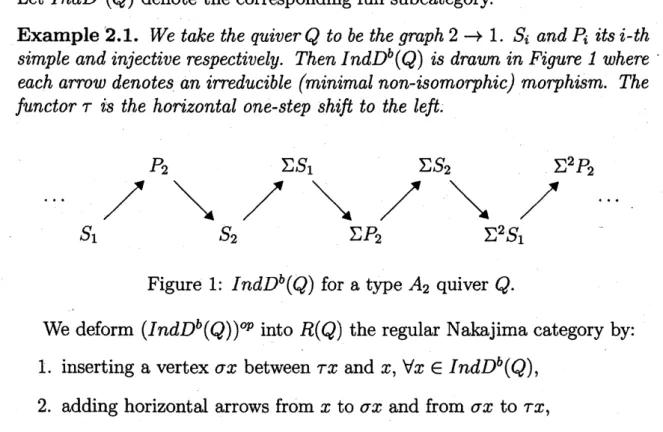
Example 2.1. We take the quiverQ to be thegraph $2arrow 1.$ $S_{i}$ and$P_{i}$ itsi-th
simple and injective respectively. Then$IndD^{b}(Q)$ is drawn in Figure 1 where
each
arrow
denotesan
irreducible (minimat non-isomorphic) morphism. Thefunctor
$\tau$ is the horizontal one-stepshift
to theleft.
$P_{2} \Sigma S_{1} \Sigma S_{2} \Sigma^{2}P_{2}$
$\cdots$ $\nearrow$ $\backslash _{x}$ $\nearrow$ $\backslash _{\searrow}$ $\nearrow$ $\backslash \backslash$ $\nearrow$ $\cdots$
$S_{1} S_{2} \Sigma P_{2} \Sigma^{2}S_{X}$
Figure 1: $IndD^{b}(Q)$ for a type $A_{2}$ quiver $Q.$
We deform $(IndD^{b}(Q))^{op}$ into $R(Q)$ the regular Nakajima category by: 1. inserting
a
vertex $\sigma x$ between $\tau x$ and $x,$ $\forall x\in IndD^{b}(Q)$,3. imposing the mesh relations
on
thiscategory (namely,sums
oftrianglesvanish).
see
Figure 2 for an example.$\sigma P_{2}arrow P_{2}arrow\sigma\Sigma S_{1}arrow\Sigma S_{1}\sim\sigma\SigmaS_{2}arrow\Sigma S_{2}+\sigma\Sigma^{2}P_{2}+\Sigma^{2}P_{2}$
$\cdots$
’
$\backslash$ $\nearrow$ $\backslash$ $\nearrow$ $\backslash$ $\swarrow^{/}$ $\cdots$$\sigma S_{1}arrow S_{1}arrow\sigma S_{2}arrow S_{2}arrow\sigma\Sigma P_{2}arrow\Sigma P_{2}+\sigma\Sigma^{2}S_{1}+\Sigma^{2}S_{1}$
Figure 2: $R(Q)$ for a type $A_{2}$ quiver $Q.$
Define the operator $\sigma$ such that $\sigma^{2}=\tau.$
Define the singular Nakajima category $S(Q)$ to be the full subcategoryof $R(Q)$ generated
on
$\sigma x,$ $x\in IndD^{b}(Q)$Fold thecategories$R(Q)$ and$S(Q)$ to $R(Q)/\Sigma^{2}$ and$S(Q)/\Sigma^{2}$ respectively.
We assign the
an
element in $\langle q\rangle$ (called the$q$-degree) to each object $u$ in
$R(Q)/\Sigma^{2}$ such that the
arrows
decrease the degrees by $q.$We take dimension vectors $v\in N^{IndD^{b}(Q)/\Sigma^{2}},$ $w\in N^{\sigma S\langle Q)/\Sigma^{2}}$
By standard
argument in Nakajima’s work,
we
obtain cyclic quiver varieties$\mathcal{M}(v, w)=Rep(R(Q)/\Sigma^{2}, v,w)//GL(v)$, (GITquotient)
and
$\mathcal{M}_{0}(w)=Rep(S(Q)/\Sigma^{2}, w)$.
Thereis
a
natural proper map $\pi$ from$\mathcal{M}(v, w)$ to $\mathcal{M}_{0}(w)$.
The derived pushforward $\pi_{1}$
on
the constant perverse sheaf givesus
the decomposition into perverse sheaves$\pi_{!}1_{\mathcal{M}(v,w)}=\oplus_{v’\leq v:(v’,w)l-do\min ant}IC(\mathcal{M}_{0}(v’, w$ (1)
where $l$-dominant is
some
combinatorial conditionon
the pair $(v, w)$,$\mathcal{M}_{0}(v’, w)$is a closed subvariety in $\mathcal{M}_{0}(w)$, $IC()$ denote the intersection cohomology
sheaf.
The ring $\mathbb{Z}[t^{\pm}]$ acts
on
the Grothendieck group of derived categories ofsheafs over $\mathcal{M}_{0}(w)$ such that $t$ acts
as
the shift functor. Let $K_{0}(w)$ denote2.2
Special
$w$We define $W^{S}=N^{\{\sigma \mathcal{S}_{i}\}},$ $W^{\Sigma S}=N^{\{\sigma\Sigma S_{i}\}}.$
Define $R_{4}(Q)$
as
$\oplus_{w\in W}s_{\oplus W}\Sigma sK_{0}^{*}(w)$.
Its multiplicationis definedgeomet-rically via restriction functors on quiver varieties.
Define
$R_{t}^{+}(Q)=\oplus_{w\in W}sK_{0}^{*}(w)$
$R_{\overline{t}}(Q)=\oplus_{w\epsilon W}\Sigma sK_{0}^{*}(w)$
$R_{t}^{0}(Q)=\langle K_{i}, K_{i}$
where $K_{i},$ $K_{i}’$
are
special central element in $R_{t}(Q)$.
Proof of
Theorem X.5. We show the triangulardecomposition$R_{\gamma}(Q)=Rf(Q)\otimes$$R_{t}^{0}(Q)\otimes R_{r}^{-}(Q)$. It is then easy to verify the quantum Serre relations which
implies $R_{t}^{+}(Q)\otimes \mathbb{Q}(\sqrt{t})$, $R_{t}^{0}(Q)\otimes \mathbb{Q}(\sqrt{t})$, $R_{y}^{-}(Q)\otimes \mathbb{Q}(\sqrt{t})$
are
isomorphic to$U_{t}(n^{+})\otimes \mathbb{Q}(\sqrt{t})$, $\tilde{U}_{t}(h)\otimes \mathbb{Q}(\sqrt{t})$, $U_{t}(n^{-})\otimes \mathbb{Q}(\sqrt{t})$ respectively.
Cl
3
Reflection
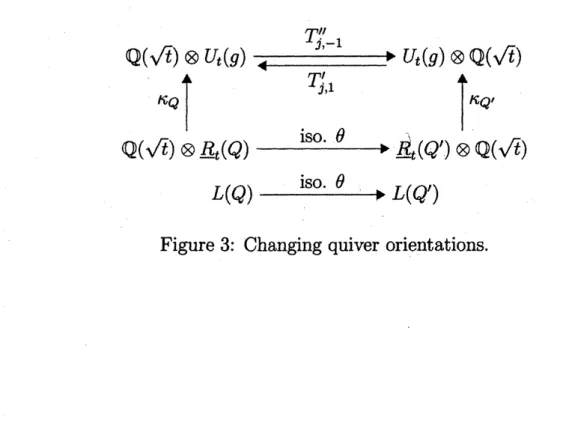
Theorem 3.1. Letj be asink point (no outgoing arrow) in Q. Let$Q’$ denote
the quiver obtained
from
$Q$ by areflection
at $j$ and $T_{j,-1}"$ and $T_{j,1}’$ Lusztig’ssymmetries. Then we
can
constructan
isomorphism$\theta$ such that the diagramin Figure 3 is commutative.
References
[Bri13] Tom Bridgeland. Quantum groups via hall algebras of complexes.
Annals
of
Mathematics, 177:739-759, 2013, 1111.0745vl.[Gre95] James A. Green. Hall algebras, hereditary algebras and quantum
groups. Invent. Math., $120(1):361-377$, 1995.
(HLII] David Hernandez and Bernard Leclerc. Quantum Grothendieck rings and derived Hall algebras. to appear in Journal f\"ur die reine
und angewandte Mathematik, 2011, 1109.0862vl.
[KL09] Mikhail Khovanov
and.Aaron
D. Lauda. A diagrammatic approachto categorification ofquantum groups I. Represent. Theory,
13:309-347, 2009, 0803.4121v2.
[KS13] Bernhard Keller and Sarah Scherotzke. Graded quiver varieties and
derived categories. to appear in Journal f\"ur die reine und ange-wandte Mathematik, 2013, 1303.2318.
[Lus90] G. Lusztig. Canonical bases arising from quantized enveloping
al-gebras. J. Amer. Math. Soc., $3(2):447-498$, 1990.
[Lus91] G. Lusztig. Quivers, perverse sheaves, and quantized enveloping
algebras. J. Amer. Math. Soc., $4(2):365-421$, 1991.
[Lus93] G. Lusztig. Introduction to quantum groups, volume 110 ofProgress
in Mathematics. Birkh\"auser Boston Inc., Boston, MA, 1993.
[NakOl] Hiraku Nakajima. Quiver $varieties\rangle and$
)
finite-dimensional
represen-tations ofquantum affine algebras. J. Amer. Math. Soc., $14(1):145-$
238
(electronic), 2001, $math/9912158.$[Qin13] Fan Qin. Quantum groups via cyclic quiver varieties I. 2013,
1312.1101.
[Rin90] Claus Michael Ringel. Hall algebras and quantum groups. invent.
Math., $101(1):583-591$, 1990.