On annulus twists
Tetsuya
Abe
Osaka
City
University
Advanced Mathematical
Institute
ABSTRACT. We survey someresults about annulus twists which are relatedto Dehn surgery on knots, knot concordance, and 4‐manifold theory.
1. INTRODUCTION
Lickorish
[15]
and Wallace[22]
proved
that every closed con‐nected orientable 3‐manifold can be obtained
by
Dehn surgery onsome link in
S^{3}
Inotherwords,
every closed connected orientable3‐manifold is described
by
a framed link inS^{3}
Our interest is inuniqueness
of framed linkdescriptions
of agiven
3‐manifold. \mathrm{A}natural
question
is thefollowing.
Question
1. If two framed links \mathcal{L} and \mathcal{L}'give
the same 3‐manifold,
then are \mathcal{L} and \mathcal{L}isotopic
as framed links?It is well‐known that the answer of
Question
1 is NO.Indeed,
for a
given
framed link \mathcal{L} and a1/n
‐framed unknot \mathcal{O}, two framedlinks \mathcal{L} and \mathcal{L}\sqcup \mathcal{O}
give
the same 3‐manifold. A modifiedquestion
is the
following.
Question
2. If two framed knots \mathcal{K} and \mathcal{K}give
the same 3‐manifold,
then are \mathcal{K} and \mathcal{K}isotopic
as framed knots?The answer of
Question
2 isagain
NO[16]
(see
also[8,
9,
17,
20 The
remaining questions
are thefollowing.
(1)
Under whatconditions,
are framed knotdescriptions
of a 3‐manifold
unique?
(2)
To whatextent,
are framed knotdescriptions
of a 3‐manifoldfar from
unique?
For the
question
(1),
forexample,
see[12,
13,
14,
18].
We con‐centrate on the
question
(2).
Moreprecisely,
we consider Clarksproblem
inKirby
problem
list[10]:
Problem
3.6(D).
Fix aninteger
n. Is there ahomology 3‐sphere
(or
any3‐manifold)
which can be obtainedby
n‐surgery on aninfinite number of distinct knots?
In
[19],
Osoinach solved Problem3.6(D)
for the case n=0by
constructing
knotsusing
the method oftwisting
along
an an‐nulus,
which we call an annulus twist. AfterTeragaitos
work[21] (see
also[7,
11Jong, Luecke, Osoinach,
and the author[3]
solved Problem3.6(D)
affirmatively,
wherethey
generalized
annulus twists.
In
[4],
a4‐dimensional extension of Problem3.6(D)
was pro‐posed
as follows:Problem 1. Let n be an
integer.
Findinfinitely
manymutually
distinct knots
K_{1}, K_{2},
\cdots such thatX_{K_{i}}(n)\approx X_{K_{j}}(n)
for eachi,
\dot{j}\in \mathbb{N}.
Here
X_{K}(n)
denotes the smooth 4‐manifold obtained from the4‐ball
B^{4}
by attaching
a 2‐handlealong
K withframing
n, andthe
symbol
\approx stands for adiffeomorphism.
Due to Akbulut[5,
6],
there exists apair
of distinct knotsK_{n}
andK_{n}'
such thatX_{K_{n}}(n)\approx
XKń(n)
for each n\in \mathbb{Z}, which is apartial
answer toProblem 1. In
[4],
Jong, Omae, Takeuch,
and the author solvedProblem 1 for the case
n=0,
\pm 4. In[3],
Jong,
Luecke,
Osoinach,
and the author also solved Problem 1
affirmatively.
2. OSOINACHS RESULT
In this
section,
we recall Osoinachs result in[19].
LetK_{n}
bethe knots in
Figure
1,
which isisotopic
to the knots in the page731 in
[19].
One of the main results in[19]
is thefollowing.
Theorem 2.1
(Osoinach [19]).
We have thefollowing.
(1)
The3‐manifold
obtainedby
0 ‐surgeryof
K_{0}
is toroidal.(2)
The sequence\{K_{n}\}
containsinfinitely
many distincthyper‐
bolic knots.(3)
S_{0}^{3}(K_{0})\approx S_{0}^{3}(K_{1})\approx S_{0}^{3}(K_{2})\approx S_{0}^{3}(K_{3})\approx\cdots
, whereS_{n}^{3}(K)
FIGURE 1. The definition ofthe knots K_{n}.
Note that we can check that
K_{n}
andK_{-n}
areisotopic,
andTakioka
proved
that the knotsK_{n}(n\geq 0)
aremutually
distinctby calculating
the Gammapolynomial
which is aspecialization
of the HOMFLYPT
polynomial.
Let V be the solid torus
standardly
embedded inS^{3}
and Vthe
3‐manifold as in
Figure
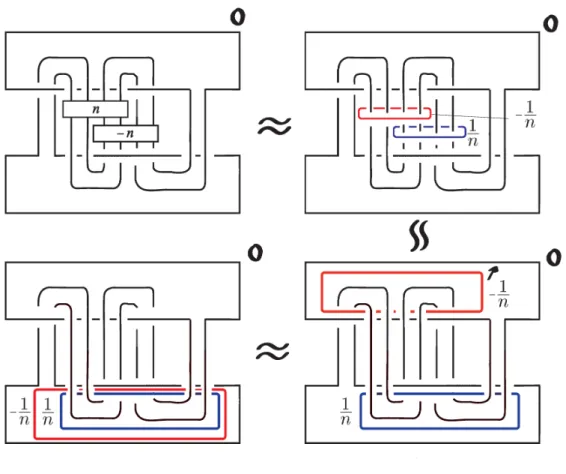
2. The main observation in[19]
is thefollowing.
FIGURE 2. The definitions ofV and V.
Lemma 2.2
(cf.
Theorem 2.1 in[19]).
There exists a(natural)
diffeomorphism
$\varphi$_{n}:V\rightarrow V
such that
$\varphi$_{n}|_{\partial V'}=id.
Figure
2explains
aproof
of(3)
in Theorem 2.1. Notethat,
by
Lemma2.2,
thepicture
on the bottom‐left isdiffeomorphic
toS_{0}^{3}
(K0).
FIGURE 3. Aproof of
(3)
in Theorem 2.1.3. DEHN SURGERY AND KNOT CONCORDANCE
We recall a
terminology
in knot concordance. Two knots K andK
are concordant if
they
cobound aproperly
embedded annulusin
S^{3}\mathrm{x}I
. In this paper, we do NOT consider orientations of agiven
knot.Dehn surgeryon knots and knot concordance are
closely
related.Question
3.1(A.Levine [24]).
If
K is concordant to K', thenfor
all n,
S_{n}^{3}(K)
ishomology
cobordant toS_{n}^{3}(K
Is the conversetrue9
The
following
conjecture
is due toAkbulut andKirby
(see
Prob‐lem 1.19 in the
Kirbys problem
list[10]).
Conjecture.
If 0‐framedsurgeries
on two knotsgive
the same3‐manifold,
then the knots are concordant.Tagami
and the author[2]
proved
thatAkbulut‐Kirbys
conjec‐
ture is false if the slice‐riuUon
conjecture
is true.Subsequently,
Yasui
[23]
proved
thatAkbulut‐Kirbys
conjecture
is falseby
con‐structing
knots K and K'satisfying
(1) X_{K}(0)
andX_{K'}(0)
are exotic(i.e.
homeomorphic
but non‐diffeomorphic).
(2)
K and K' are not concordant.Note that
X_{K}(0)
andX_{K'}(0)
are relatedby
a cork twist. Forthe
details,
see[23].
Theremaining conjecture
is thefollowing.
Conjecture.
Let K and Kbe knots. If
X_{K}(0)
andX_{K'}(0)
arediffeomorphic,
then K and K' are concordant.K_{\mathrm{O}} K_{1}
FIGURE 4. The definition of K_{0} and K_{1}.
Remark: Let
K_{0}
andK_{1}
be the knots inFigure
4.By
the re‐sult in
[4],
the 4‐manifoldsX_{K_{0}}(0)
andX_{K_{1}}(0)
arediffeomorphic.
Furthermore,
if the slice‐riuUonconjecture
istrue,
K_{0}
andK_{1}
areAcknowledgments.
The author wassupported by
JSPS KAK‐ENHI Grant Number 16\mathrm{K}17597.
REFERENCES
[1] T.Abe and M. Tange, A construction ofslice knots via annulus twists,
(2016), accepted by The MichiganMathematical Journal.
[2] T. Abe and K. Tagami, Fibered knots with the same 0‐surgery and the slice‐ribbon conjecture, (2016), to appear inMath. Research Letters.
[3] T. Abe, I. Jong, J. Luecke and J. Osoinach, infinitely many knots admitting the same integersurgeryand a4‐dimensional extension,Int. Math. Res. Not. IMRN.(2015),doi:
10.1093/\mathrm{i}\mathrm{m}\mathrm{r}\mathrm{n}/\mathrm{r}\mathrm{n}\mathrm{v}008.
[4] T. Abe, I. Jong, Y. Omae and M. Takeuchi, Annulus twist and diffeomorphic 4‐
manifolds, Math. Proc. Cambridge Philos. Soc. 155 (2013), 219‐235.
[5] S. Akbulut, Knots and exotic smoothstructureson4‐manifolds, J. KnotTheory Ram‐
ifications 2 (1993), no. 1, 1‐10.
[6] S. Akbulut, On 2‐dimensional homology classes of 4‐manifolds. Math. Proc. Camb.
Phil. Soc. 82 (1977), no. 1, 99‐106.
[7] K. L.Baker, C.McA.Gordon, and J.Luecke, Bridgenumber andintegralDehnsurgery,
Algebraic& Geometric Topology 16 (2016) 1−40.
[8] R. Brakes, Manifolds with multiple knot‐surgery descriptions, Math. Proc. Camb. Phil. Soc. 87 (1980), no. 3, 443‐448.
[9] A. Kawauchi, Mutative hyperbolic homology 3‐spheres with the same Floer homology,
Geom.Dedicata 61 (1996),no. 2, 205‐217.
[10] R. Kirby,Problemsinlow‐dimensionaltopology. AMS/IPStud.Adv. Math. 2(2), Geo‐
metrictopology (Athens, GA, 1993), (Amer. Math. Soc. 1997).
[11] R. Kouno, 3‐manifolds with infinitely many knot surgery descriptions (in Japanese), Mastersthesis, NihonUniversity (2002).
[12] D. Gabai, Foliations and the topology of 3‐manifolds. III,J. Differential Geom. 26, No.
3 (1987), 479‐536.
[13] P. Ghiggini Knot FloerHomologyDetects Genus‐One FibredKnots,American Journal of Mathematics 130,No. 5 (2008), 1151−1169
[14] M. Lackenby, DehnSurgery on Knots in3‐Manifolds, Journal of the American Math‐ ematicalSociety, No. 4 (1997), 835‐864.
[15] W. B. R. Lickorish, A representation oforientable combinatorial3‐manifolds, Ann. of Math 76 (1962), 531‐538.
[16] W. B. R.Lickorish, Surgery on knots, Proc. Amer. Math. Soc. 60 (1976), 296‐298.
[17] C.Livingston, More3‐manifoldswithmultipleknot‐surgeryand branched‐coverdescrip‐
tions, Math. Proc. Camb. Phil. Soc. 91 (1982), no. 3, 473‐475.
[1S] Yi Ni and Zhongtao Wu, Cosmetic surgeries on knots in S^{3}, J. Reine Angew. Math.,
706, (2015), 1‐17.
[19] J. Osoinach, Manifoldsobtainedbysurgeryon aninfinitenumberofknotsinS^{3},Topol‐
ogy 45 (2006), 725‐733.
[20] M. Teragaito, Toroidal Dehnsurgeryonhyperbolic knots andhitting number, Topology
Appl. 157 (2010),no. 1, 269‐273.
[21] M. Teragaito, A Seifert fibered manifoldwithinfinitelymanyknot‐surgery descriptions,
Int. Math. Res. Not. 2007, no. 9, Art. IDrnm028, 16 pp.
[22] A.Wallace, Modificationsandcobounding manifolds, Can.J.Math. 12 (1960),503‐528.
[23] K. Yasui Corks, exotic 4‐manifolds and knot concordance, arXiv:1505.02551v3 [math. GT].
[24] Problem list Banff2016, ` .
Synchronisation of smooth and topological 4‐manifolds ,
Banff International ResearchStation, February2016.
Osaka
City University
Advanced Mathematical Institute3‐3‐138
Sugimoto, Sumiyoshi‐ku
Osaka 558‐8585 JAPAN\mathrm{E}‐mail address: