Orthogonal Drawings
for
Plane
Graphs
with Specified Face Areas
Akifumi Kawaguchi and Hiroshi Nagamochi
Department of Applied Mathematics and Physics,
Graduate School ofInformatics, Kyoto University, Japan
Abstract. Weconsiderorthogonal drawingsof aplanegraph$G$with
spec-ified faceareas. For anatural number $k$, ak-gonal drawing of$G$ isan
or-thogonaldrawing suchthatthe outer cycle i.sdrawnas arectangleandeach
innerface isdrawnas apolygonwith atmost$k$cornerswhoseareaisequal
to the$\epsilon peciEed_{Va}1ue$
.
We showthat several classes of plane graphs haveak-gonal drawing with bounded$k$;Aslicinggraph hasa10-gonal drawing,a
rectangulargraphhasan l&gonaldrawingand a$3<onn\propto td$planegraph
whose maximumdegreeis3hasa34-gonal drawing.Inthispaper, weshow
$10-gonA$drawingsofslicinggraphs and the outlineofalgorithm tofindthe
drawing.
1
Introduction
Graph drawinghasimportant applicationsin many
areas
incomputersciencesuchas
VLSIdesign, information$v\dot{x}suffi^{r}z$ationandsoon.
Various graphic standardsare
$\iota xsd$ and studied fordrawing graphs [3].
Orthogonal drawings, in which every edge is drawn
as
asequence of alternate verticaland horizontal segments,haveapplicationsincircuit design,$g\infty metry$andconstruction. Manyaspects have been studied
on
orthogonal drawings. Studies ofan
orthogonal drawing with specified faceareas
have$beg\backslash m$recently. Fora
naturalnumber $k$, a k-gonal drawingof a graph is an orthogonal drawing such that the
outer cycle of the graph is drawnas arectangle and that each inner face is drawn
as a
polygon with$k$ corners. Rahman, Miura and Nishizeki[4] proposedan
8-gonaldrawing for a special class ofplane graphs called
a
good slicing graph. Recently, de Berg, Mumfordand Speckmann [1] proved that a general slicing graph admitsa
12-gonaldrawing. They also showed thata
rectangulargraph admitsa
20-gonaldrawing and a -connected plane graph whose maximum degree is
3
admitsa
60-gonaldrawing.
We show that
a
general slicing graph hasa
1&gonal drawing,a
rectangular graph hasan
l&gonal drawing md a 3-connected plane graph whose maXimum degree is 3 has a 34-gonal drawing. Our approach fora
general slicing graph isdifferent from that by de Berg et al. [1]. We $aLso$ show that every 3-connected
plane graph $G$ whose maximumdegree is 4 has
an
orthogonal drawing such thateach inner facial cycle $c$ is drawn as a polygon with at most $10p_{c}$. $+34$
corners
ifno
vertex whose degree is 4 ison
the outer cycle of$G$, where$p_{c}$ is the number ofverticesof degree
4
in the cycle $c$.
2
Preliminary
A plane graph is denoted by $G=(V,E,F,\backslash \prec\})$, where $V,E,F$ and $c_{S1}$ denote
a
set$n=|V|,m=|E|$ and $f=|F|$
.
Since
$G$ is aplte graph, $m=O(n)$ and $f=O(n)$hold. Avertex of deyee $ki_{L}s$ call\’e a $k$-degree vertex. We denote the maximlm
degee of agraph $G$ by $\Delta(G)$
.
An orthogonal $dmu$)$ing$ of aplane $\Psi^{aph}G$ is adrawing sllch that each edge $e\in E\dot{\iota}s$ drawn&s
an
altemate $seq_{11}ence$ of vertictand $hori_{4}^{r}$ontal line segments, and any two $edge_{\llcorner}s$ do not inteILSect exoept at their
comnon
end. It $\dot{x}s$ known [2] that aplanegraph $Gadmit_{\iota}s$an
orthogonal drawingif and only if$\Delta(G)\leq 4$
.
For anatural nllmber $k$,an
orthogonal drawing is calleda
$k$-gonal dmuring if the $0\backslash \iota ter$cycle of $G$is drawn $a_{*}s$ arectangle, and each inner$fac\ddagger al$ cycle $C_{i}\dot{L}S$ drawn $a_{\sim}s$apolygon with at moet $k\infty \bm{m}ers$
.
We $\infty n\epsilon ider$ aplane $\Psi^{a}PhG$ sllch that the
aoea
of each inner face $c_{i}\in F$ is$sp\infty ifid$ by areal$a_{i}>0$
.
$kt$ $A$ be asetofaIe&s$a_{i}$, and
we
denote aplane gaph with the sprifid faoe are&s by $(G,A)$.
For aphne graph $(G,A)$,
we
consideran
orthogonal drawing stlch that the aoea of each $fwec_{j}i\llcorner seq_{11}d$ to $a_{i}$.
$Fig_{t1}re1$$ilh_{1}strat\infty$
an
exunpleofaplane graph with $sp\propto ifld$ face areas, and its 10-gonaldrawing. 4 7 12 2 4 6 3 3 4 1 5 la) (b)
Fig. 1. (a) Anexampleofaplane graph $(G, A)$ withspecified areas, where the number
ineach facerepresentsthe axeaspecified forthe face; (b) A 10-gonaldrawing of$(G, A)$
Let $G$ be aplane graph that has exactly four 2-degrae verticae $a,$$b,c$, and $d$ in
it\S ollter cycle. We
can
thaee $f_{ot1}r$ vertices $a,b,c$ and $d$comer
$veni\alpha_{\wedge}9$.
The $fo\iota lr$comers
$ab,c’$.and$dd\ddagger vide$theotltercycleof$G\bm{i}to$four$patl\iota s$ sharingend$verti\varpi$;the top path, the bttompath the
lefl
path and the rightpath. Wecall$e\epsilon ch$ of$th\infty e$four $path_{\iota}s$
an
unit path. Apath $\pi$ in $G$ which do\’e not $pRsthro\backslash lgh$any
other ollter vertex is calleda
$verti\alpha l$ (horizontal) path of $G$ ifone
end of $\pi$ ison
the top $(1eR)$ path and theother ison
the bottom (right) path. Snchapath $\pi dIv\ddagger dae$the interiorof$G$intotwoare&s, each of whii is encloaed by acycle and $indu\varpi$
a
subyaph of$G$ (the sllbgraph$cons\dot{\iota}sting$ of$edg\infty$ and $vertic$}$ae$ inthe
area
and thecyde). We saythat $\pi sli\alpha_{\wedge}G$into $th\approx$ two$s\backslash lbgraphs$ of$G$
.
A
$sli\dot{\alpha}ng$ gmph $G$isaplnnegraph that isdefined
recursively $a*s$foUows; acycle$G$ of length 4with aningle inner face is aslicing graph, and $G$ has averticd
or
$hori^{r}z$ontal path $\pi$ stl&that each of the two $snbyaph_{-q}$ generated $homG$ byslicing $G$ with $\pi$ is aslicing yaph. Note that $\Delta(G)\leq 4$ for every slicing yaph
G. Avertical
or
$hori^{r}4$ontal path in slicing graph $Gi\llcorner s$ cdld aslicing path if twosllbyaphsgeneratd by slicing $G$with $\pi$
are
slicing $graph_{\sim}s$.
Asliring trrt, $Ti_{\iota}s$
a
$bin\theta xy$ toee which $repr\infty ents$a
$rectlr_{\iota}sive$ definition ofa
slicing graph G. We call
anon-leaf
nodeof$T$an
inkmd $nda$ Eachnode $u$ in $T$corr\infty pon&to asllbgraph $G_{u}$ of
G.
$ktu$bean
internd node $\ddagger nT,$ $\bm{t}dv$ and $w$bethe$1eR$ andrightcild of$u,$ $raepe\alpha ively$
.
Thenwe
denote by $\pi_{u}$thedicingpath(left) subgraph of $G_{u}$, and
G.
is the lower (right) subgraph of$G_{u}$.
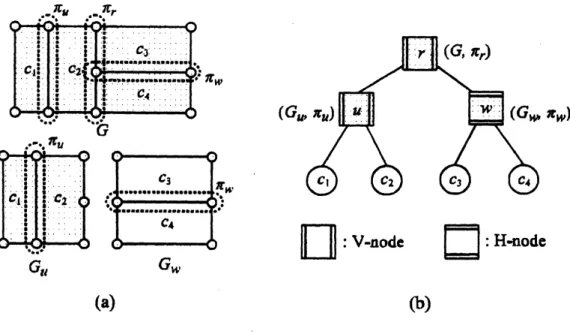
The node 21is called a V-node if $\pi_{u}$ is vertical, and $u$ is called
an
H-node if$\pi_{u}$ is horizontal. For a leaf$u’$ of$T$, the corresponded subgraph $G_{u’}$ hais one innerface $c_{\dot{B}}$.
Figure 2 illustratesan
example of a slicing tree and a slicing graph corresponded to each node of$T$.
$\ovalbox{\tt\small REJECT}$
:
V-node $\ovalbox{\tt\small REJECT}$ :H-node(a) (b)
Fig.2. (a) A slicin$g$ graph $G$ and $subgrap1_{L}sG_{u}$ and $G_{w}$ of $G;(b)$ A slicing tree with
nodes $r,u$and$w$
A rrrtangular graph is aplane graph whose outer$fa\iota e$and each innerface
can
be drawn
as
arectangle. Notethat $\Delta(G)\leq 4$ forevery rectangular graph $G$.
AS-connectedplane graphis aplanegraph that remainsconnected
even
atter
removalofany two vertices together with edges incident to them.
In this paper, we show the following result, where a “combined decagon” is
defined in the next section.
$Th\infty\iota em1$
.
$Eve\eta$ slicing gvaph with $\Psi^{r,ifie\Delta}$face
afta9 has $a$ 10-gonal dmuring$su\lambda$ that each inner
face
$\dot{t}$ dmumas
a combined demagon. Sucha
draunngcan
befound
in$O(n)$ timeif
its slicing tree andfour
comer
vertictson
the outer rectangleare
$\dot{\wp}ven$.
$O$For arectangular graph anda$\#\infty nne\alpha ed$planegraph,weobtained the
follow-ing results by $\infty nverting$ those graphs into slicing $yapl\iota s$ and applying $Th\infty rem$ $1$ ($pr\infty h_{\iota}$
are
omitted due tospace limitation).$Th\infty\iota em2$
.
Every rrxtangular graph $v\dot{n}\theta\iota 9p$nifi
$\Lambda$face
areas
hasan
18-gonaldrawing.
Such
a
draeuingcan
befound
in$O$($n$log$n$) timeif
its outer\dagger ectangle andits
four
corner
verticesare
given. $O$$\bm{h}h\infty oem3$
.
Every 3-eonnexted planegraph $(G,A)$ Utth$\Delta(G)=3$ has a34-gonaldmuring. Such a drautng
can
befound
in $O$($n$log$n$) time. $O$Corollary 1. For everyy 3-connextd plane graph $(G,A)$ uriffl $\Delta(G)=4such$ that
draunng such that (i) each
face
has at most $10p_{c}+34$ comers, where $p_{c}$ is thenumber
of
4-degrex vertices in itsfacial
cycleof
$c\in F$, and (ii) the numberof
straight-lines in the entire drawing is at most $28n$. $O$3
Drawings of Slicing
Graphs
Bydefinition, everyinner
face
ofa
slicing graphcan
be drawnas a
rectangleifwe
ignorethe
area
$\infty nstraint$.
Toequalizethearea
of innerfacetothe specified value,weneed todraw
some
edges withsequences ofseveral straight-line segments.We define
a
step-lineas an
alternate sequence of three vertical and horizontalstraight-line aegments.
A
step-line has two comers, whichwe
call $be_{d}nl_{9}$.
A
verti-cal stepline (VSL) is
a
sequence of vertical, horizontal and vertical straight-line segments. A horizontal step-line (HSL) isa
sequence ofhorizontal, vertical andhorizontal straight-line segments.
Based
on
step-lines, we introduce a polygon calleda
“combined decagon,” which plays a key role to finda
10-gonal drawing of aslicing graph.3.1 Combined Decagon
We $introd_{11}oe$ how to draw acycle with fotlr
corner
verticae&sa
$k$-gon
with $4\leq$ $k\leq 10$.
We$\infty nsider$aplanegraph $G$of cycle$G=(\{a,b,c,d\},$ $\{(a, b),$ $(b, c),$ $(c,d)$,$(d,a)\})$
.
Note that path $ab$ is the top path, $dc\dot{\iota}s$ the bottom path, $ad$ is the leftpath and $bc,$ isthe right path of G. Wecdl path $dab$the top-lefl path of$G$
.
We consider a $k$-gon $(4 \leq k\leq 10)$ in whi&eat path is drawn $a_{\wedge}s$ aline
$\S e_{i^{nent}}$, aVSL,
an
HSLor
apair of thaee. Wellse several typae of combinationsof $lin\infty$ for each of the $to\triangleright leR$ path, the right path and the bottom path; Five
$typ\infty$ for the $to_{I}\succ 1eftpa$th (Fig. 3), thoee $typ\alpha$ for the right path $(F\ddagger g. 4)$, and
thoee$typ\infty$ for the bottom path (Fig. 5).
Wedrawcycle $(a, b,c,d)$ by&oooeingadrawing pattern $A_{:}(i=1,2,3,4,5)$for
the $to\gamma leR$ path, $B_{j}(j=1,2,3)$ for the right path and $C_{k}(k=1,2,3)$ for the
bottom path. Notethat the raeultIng polygon h&satmost
10
$co\bm{m}er_{t}s$.
A
$combine\Lambda$decngon $P\dot{L}S$ defined $\kappa s$ apolygon $s\iota$)$\ thatea\iota h$ tlnit path of $P_{\dot{L}}s$ drawn
as
a
strnight-line
or a
$ste\triangleright line$ and at le&stone
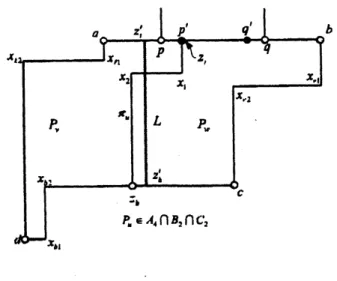
of its top and lefb paths is drawn&sastraighkline. $Fig_{t1}re6iu_{1}\iota stratae$ examplae ofacombind $d\propto agon$
.
We may let$A_{:}$ denote theset of combineddecagons sllch that the $to\iota\succ leR$path is drawn
as a
pattem in$A_{:}$
.
Similarly for $B_{j}$ and $C_{k}$.
Let $P$ be acombid decagon. Aline $\S e_{i^{nent}}$ in the top-leR path is call\’e
$\omega nnextabl_{k}$ ifit is incident to
corner
$b$or $d$.
Similarly aline segnent in the right(bottom) pathiscffied $\omega nnextable$if it isincident to
corner
$c$.
Otherline aegmentsare
called $urwonnec,table$.
In Figs. 3, 4 and 5, connectable $se_{i^{nent_{I}}}$ flre depictedby thicklinae.
We denote the $\infty nnectable$ segment in the top path, the left path, the right
path and the bottom path of$P$ by $\alpha_{t}(P),$ $\alpha_{\ell}(P),$ $\alpha,.(P)$ and $\alpha_{b}(P),$ $resp\propto tively$
.
An $\backslash$)$n\infty nnectable$ line seynent$\bm{i}$ the$to\iota\succ left$ path is caJld
a
$\omega ntmls\eta ment$ ifit is incident to $\omega mera$
.
$Simil\kappa ly$an
$\tau mconn\propto table$ line segment in the right(bottom) path is called
a
$\omega ntmls$’if itis$in\dot{\alpha}dent$ to $\infty merb(d)$.
$\bm{t}$Figs.3, 4and 5, control $aegment\llcorner s\epsilon redepict\alpha 1$by d&shed linae. We denote the control
sewent
in the top path, the left path, the right path and the bottom path of$P$by$\beta_{t}(P),$$\beta_{\ell}(P),$ $\beta,.(P)$ and$\beta_{b}(P),$ $r\infty pectively$
.
Let $\beta_{\max}(P)$ bea
$\infty ntrolsae\iota nent$$who_{\iota}se$ lengh is maximtlm In P. A $\infty ntrol$ segment $e$ is cffid $conve,x$ if both of
$a_{d}I^{X_{t2}}x_{\iota 1}L_{b}$
type$A_{3}$
$da\zeta^{X_{t1}}X_{l}r^{b}$
$qpeA_{5}$
Fig. 3. Five types of drawing patteaforthe top-left pathdab
I
脚$eB_{\downarrow}c$ $c_{\Psi^{peB_{2}}}$ $eype^{C}B_{3}$
Fig.4. Three types of drawingpattern for the right path$bc$
$drightarrow c$
cype
$C_{I}$Fig.5. Three types of drawing pattern for path&
$P_{t}\epsilon 4\cap B_{-}\cap C_{2}$ $P_{t}\epsilon A_{2}\cap B_{I}\cap C_{1}$
(a) (b)
Fig.6. Illustrationof combined decagons$P_{1}$ andlb
The $u\dot{n}d\theta_{b}w(P)$ of$P$is the distance from the leftmost vertical$Se_{i^{nent}}$ tothe
rightmost one, and the height $h(P)$ of $P$ is the distance from the top horizontal $\S e_{\Psi^{1ent}}$ to the bottom
one.
We denote by $xy$ the line $s\epsilon pment$with end points $x$and $y$
.
We denote the length ofsegment $xy$ by $|xy|$, thearea
ofa
polygon $P$ by$A(P)$, and the
sum
of theareas
specified for all inner faces ofa
plane graph $G$by $A(G)$
.
Fora
node $u$of aslicingtree $T$, we call the following condition the sizecondition ofcombined decagon $P_{u};A(P_{u})=A(G_{u})$
.
3.2 Outline of Algorithm
Thissubsection outlines
our
algorithmfor slicing$graph_{\iota}s$with specifiedareas.
Thealgorithm is
a
divideand-conquer basedon
slicing trees. Weare
givena
slicing graph $G$ with specifled areas, its slicing tree $T$, and rectangle $P$,
with $\infty rner$vertices for theouter cycleof$G$
.
Atthis point, theposition. of all verticeshave notbeen determined yet.
A
vertex whose position is detemined during the algorithmis cdled
fixeA
We first draw the outer cycle of $G$ ais the specified rectangle $P_{r}$,fixing the
comer
vertices. We then visit all internal nodes in $T$ in preorder andslice $P,$
.
recursively toobtainan
entire drawing of $G$.
Fora
node$u$ of$T$, supposethat theoutercycleof$G_{u}$ isto be drawn
as
a combineddecagon$P_{u}$ which satisfiesthesize condition.
Let $u$ be
a
V-node. Then $G_{u}$ has the vertical slicing path $\pi_{u}$, and let $z_{t}$ and$z_{b}$ be end vertices of $\pi_{u}$
on
the top and bottom path of $G_{u},$ $r\infty pectively$.
First,wetry to slice $P_{u}$ into two combineddecagons which satisfy the size condition by
choosing
a
(unique) vertical straight-line segmentL&s its slicing path $\pi_{u}$ (seeFig. 7). If$L$ can be drawn $\infty rr\infty tly$, i.e., the end points $z_{t}$ and $z_{b}$ of $L$are
on
$\alpha_{t}(P_{u})$ and $\alpha_{b}(P_{u})$,respectively, thenwe
slice $P_{u}$ by $L$to obtain twocombined decagons.Otherwise,
we
split $P_{u}$ by $choo_{\iota}s$inga
step-lineas
its slicing path $\pi_{u}$ (see Fig. 7).We
can
show that the existence of sucha
suitable step-line $\pi_{u}$ is ensured if $P_{u}$satisfiesthesize$\infty nd\ddagger tion$ and “boundarycondition,” which$wiU$bedescribedlater
(the detatl ofthe proofis omitted due tospace limitation).
The slicing procedure for H-nodes $u$ is analogous with that for V-nodes. An
entire drawing of the given slicing graph $G$ will be constnicted by applying the
above proc\’eure recursively. We call the algorithm described above Algorithm Denagonal-Draw.
To
ensur
$e$that acombin\’edecagoncan
be chosenas
thepolygon for the outerfacial cycle of each subgraph$G_{u}$, thepositionsofendvertices$z_{t}$and $z_{b}$of$\pi_{u}$ will be decided
so
that certain conditionsare
satisfied. Wenow
describe these conditions. For each node $?l$ of $T$, let $f_{u}^{t}$ be the number of inner faces of $G_{u}$ thatare
adjacent to the top path of $G_{u}$, and $f_{u}^{f}$ be the number of inner faces of$G_{u}$ that are adjacentto the left path of$G_{u}$
.
Let $a_{miu}$ be the minimum
area
of allareas
for inner $fa\varpi$ of$G$.
Let $W$ and $H$be the width and height of the rectangle specified for the outer facial cycle of a
given slicing graph $G$
.
We define$\lambda=\frac{a_{n1i)\iota}}{3f\cdot\max(W,H)}$
.
(1)Wedefine
some
$\infty nditions$on
combined decagon $P_{u}$.
A $\infty nt\mathfrak{w}1$ segment $e$ of $P_{u}$ is called $(\lambda, f)$-admissible if
one
of the followingsholds:
$e$ is a
convex
and vertical segment, and $f_{u}^{t}\lambda\leq|e|<f\lambda$,$e$ is a
convex
and horizontal segment, and $f_{u}^{\ell}\lambda\leq|e|<f\lambda$,$e\dot{x}s$ a
non-convex
and vertical segment, and $|e|<(f-f_{u}^{t})\lambda$, $e$ is anon-convex
and horizontalsegment, and $|e|<(f-f_{u}^{\ell})\lambda$.
Acombined decagon $P_{u}$ iscalled $(\lambda, f)$-admissible ifit satisfies the$f_{0}u_{oW}ing\S$
.
(a1) $|\alpha_{t}(P_{u})|\geq f_{u}^{t}\lambda$,
$(a2)|\alpha_{\ell}(P_{u})|\geq f_{u}^{\ell}\lambda$,
(a3) Every control segment of$P_{u}$ is $(\lambda, f)$-admissible,
(a4) If$P_{u}\in A_{1}$, then $|\alpha_{t}(P_{u})|\geq(f+f_{u}^{t})\lambda$or $|\alpha_{\ell}(P_{u})|\geq(f+f_{u}^{\ell})\lambda$, (a5) If$P_{u}\in A_{2}\cup A_{4}$, then $|\alpha_{\ell}(P_{u})|+|\beta_{\ell}(P_{u})|\geq(f+f_{u}^{\ell})\lambda$,
(a6) If$P_{u}\in A_{3}\cup A_{6}$, then $|\alpha_{t}(P_{u})|+|\beta_{t}(P_{u})|\geq(f+f_{u}^{t})\lambda$,
(a7) If$P_{u}\in A_{2}\cap B_{3}$, then $|\beta_{\ell}(P_{u})|-|\beta,.(P_{u})|\geq f_{u}^{t}\lambda$,
$(aS)$ If$P_{u}\in A_{3}\cap C_{3}$, then $|\beta_{t}(P_{u})|-|\beta_{b}(P_{u})|\geq f_{u}^{\ell}\lambda$, $(\theta)$ If$P_{u}\in A_{4}\cap B_{2}$, then $|\beta_{f}.(P_{u})|-|\beta_{\ell}(P_{u})|\geq fl_{u}\lambda$,
(a10) If $P_{u}\in A_{b}\cap C_{2}$, then $|\beta_{b}(P_{u})|-|\beta_{t}(P_{u})|\geq f_{u}^{\ell}\lambda$
.
By $(\lambda, f)$-admisSibilityof$P_{u},$ $P_{u}$ is
a
simple polygon, and the$d\dot{x}stance$ofany pair ofvertical line segments or any pairof horizontal line aegmentsof$P_{u}$ is atleast $\lambda$.
For
a
combined decagon $P_{u}$, let $a$ be the top-left corner vertexof$P_{u},$ $b’$ bea
fixedvertexwhich is the nearest to$a$
on
thetop pathof$P_{u}$, and$d’$bea
fixed
vertexwhich is the nearest to $a$
on
the left path of$P_{u}$.
We call the following conditionsthe boundary condition of$P_{u}$
.
(b1) If there$e\dot{r}\llcorner sts$fixed vertices
on
the top pathof$P_{u}$, then these verticesare
on
$\alpha_{\ell}(P_{u})$.
The distanceof any pair of fixed verticaeon
$\alpha_{t}(P_{u})$ isat least $f_{u}^{t}\lambda$,
andthe distancefrom both ends of$\alpha_{t}(P_{u})$ toany fixedvertexis atle&st$f_{u}^{t}\lambda$
.
(b2) If there exists fixed vertices
on
theleft pathof$P_{u}$, then these verticesare on
$\alpha_{\ell}(P_{u})$.
The distance ofany
pair offix\’e $verti\varpi$ on $\alpha_{\ell}(P_{u})$ is at least $f_{u}^{\ell}\lambda$,
and the distanoefromboth ends of$\alpha_{\ell}(P_{u})$ toanyflxed vertex isatleast$f_{u}^{\ell}\lambda$
.
(b3) If$P_{u}\in A_{1}$
,
then the distance from $b’$ to the left path of$P_{\tau\iota}$ is greater than$(f+f_{u})\lambda$
or
the distance from $d’$ to the top path of $P_{u}$ is greater than$(f+f_{u}^{\ell})\lambda$
.
(b4) If$P_{u}\in A_{2}\cup A_{4}$
,
then the distance from $d’$ tothe top path of $P_{u}$ is greaterthan $(f+f_{u}^{\ell})\lambda$
.
(b5) If $P_{u}\in A_{\theta}\cup A_{6}$, then the distancefrom $b’$ to the left path of $P_{u}$ is greater
Let $\mathcal{D}$ be the set of all $(\lambda, f)$-admissible $decagon_{\iota}s$ that satisfy the boundary
and size conditions.
The following lemma guarantees the correctness of the algorithm, whose proof
can be foimd in the full vervion of the paper.
Lemma 1. For
a
dexagon $P_{u}\in \mathcal{D}$, let$P_{v}$ and$P_{w}$ be combined demagons generatedby slicing $P_{u}$ in Decagonal-Drav 入 Then $P_{v}$ and $P_{w}$ belong to $\mathcal{D}$
.
ロ
By thislemma,we
can
prove the existence of 10-gonal drawings inTheorem 1.Lemma 2. Algorithm$Det_{d}agonal$-Draw
finds
$a$10-gonaldmutngof
a$sli\dot{\alpha}ng$gmph$G$ utth $\psi_{d}cifi\ell,d$
faoe
$ar\forall asco7vvr,tIy$.
Pro
of.
Let$P_{r}$ be a rectanglegivenas
theboundaryof$G$.
Clearly$P_{r}$ hasno
$\infty ntrol$segments and satisfies the size $\infty ndition$
.
Hence, $P,$. satisfies $(\lambda, f)$-admissibility.Since P. satisfies the boumdary condition, we have $P_{r}\in \mathcal{D}$
.
By Lemma 1, everyfaceof$G$isdrawn
as
a
decagonin$\mathcal{D}$recursively. Hence,algorithm Decagonal-Drawfinds
a
10-gonal drawing ofaslicing graph $G$with specified faoeareas.
$\square$It is not difficult toobserve the time complexityof the algorithm.
Lemma 3. Algorithm $D_{PJ}n$gonal-Draw
can
be implemented to $rnn$ in $O(n)$ timeand space. $O$
Lemmas
2
and 3 prove $Th\infty rem1$.
4
Conclusion
In this paper, we showed that every slicing graph has a 10-gonal drawing, and
we
also gavea
linear time algorithm to find sucha
drawing. $F\iota lrthermo\infty$,we
obtained the results that every $r\propto tang\iota 1lar$ graph has
an
18-gonal drawing, andevery 3-connected plane graph whose maximum degree is three has a 34-gonal
drawing by $\infty nverting$ thosegraphs into slicing graphs.
It is left as a future work to derive lower bounds
on
the number $k$ such thateveryslicing graph admits a k-gonal drawing.
References
1. M. deBerg,E.Mumford and B.Speckmann: Onrectilinear duals for vertex-weighted
plane graphs. In Proc lSth Intemational Spmposium on GraphDrautng, pp. 61-72,
2005.
2. G. DiBattista, P. Eades, R. Tamassia andI. G. Ibllis: Graph drawing: Algorithms for the visualization ofgraphs, Prentice $han$, 1999.
3. T. $Nish\dot{z}$eh, K. Muraand Md. S. Rahman: Algorithms for drawingplane graphs,
IBICB $I$}$uns$
.
Electron., Vol.E87-D, No.2, pp.281-289, 2004.4. M. S. Rahman, K. Miura and T. Nishizeki: Octagonal drawings of plane graphs
with prescribed face areas, In Graph Theoreti$c$ Concepts in ComputerScience: SOth
Intemational Workshop, Vol. 3353 of Lecture Notes in Computer Science, pp. 320