On
Relative Difference
Sets
In Non-Abelian
Groups of
Order
$p^{4}$Dominic
T.
Elvira
*1
Introduction
A $k$-element subset $R$ of agroup $G$ of order $mu$ is called an $(m, u, k, \lambda)$
relative
difference
set (RDS) relative to anormal subgroup $U$ of order $u$ ifthe number of ordered pairs $(r_{1}, r_{2})\in R\cross R$with rirjl $=g$ for every$g\in G$,
$g\neq 1$ is Aif $g\in G-U$ and 0if$g\in U$
.
The subgroup $U$ is often calledthe
forbidden
subgroup as its non-identity elements cannot be written in theabove form. If $G$ is cyclic, abelian, and so on, its respective property is
attached to the RDS $R$ in $G$
.
In the study of RDS’s, asubset $X$ ofagroup $G$ is often identified with
the group ring element $X= \sum_{x\in X}x\in \mathbb{Z}[G]$ and we write $X^{(t)}= \sum_{x\in X}x^{t}$.
With this notation, $R$ is an $(m, u, k, \lambda)$ RDS if and only if
$RR^{(-1)}=k+\lambda(G-U)$
.
(1.1)If $k=u\lambda$, $R$ is called semi-regular and by (1.1), its parameters are
$(u\lambda, u, u\lambda, \lambda)$
.
Also, in this case, $R$ is acomplete set of cosetrepresenta-tives of $G/U$
.
If$u=1$, $R$ is called atrivial semi-regular RDS. Any group $G$is itself atrivial semi-regular RDS.
Many extensive studies have been done on relativedifference sets,
partic-ularly the semi-regular case, in both abelian and non-abelian groups because
of their close connection to other areas of combinatorics (see [1], [3], [4],
[7], [12]$)$
.
Readers may refer to Pott’s book [10] or his survey [11] for morebackground information on RDS’s.
Let $R_{1}$ and $R_{2}$ be RDS’s in agroup $G$ relative to normal subgroups $U_{1}$
and $U_{2}$, respectively. If there exists $\mathit{4}\mathit{1}\in Aut(G)$, the full automorphism
group of $G$ such that $\theta(R_{1})=R_{2}$ and $\theta(U_{1})=U_{2}$, then $R_{1}$ and $R_{2}$ are
’The author is afaculty member of Philippine Normal University (PNU), Manila on
study leave at KumamotoUniversity under aMonbusho grant 数理解析研究所講究録 1299 巻 2003 年 96-102
said to be equivalent. In our study, we only consider non-trivial and
non-equivalent semi-regular $RDS$’s. We also denote aprime number by $p$ and
$I_{p}=\{0,1, \ldots, p-1\}$.
In this paper, we review the results on semi-regular RDS’s in non-abelian
groups of order $p^{4}$ with $p\geq 3$ and continue our study in [2].
2Results on
RDS’s
in
p-Groups of Order
$\underline{<}p^{4}$A group $G$ of order $p$ can contain only atrivial RDS. If $G$ is of order
$p^{2}$
then we have the following result contained in [6].
Result 2.1 Let G be a group
of
order$p^{2}$ containing a(p,p,p, 1)RDS. Then(i) $G\simeq \mathbb{Z}\mathrm{p}2$
if
and onlyif
$p=2$, and(ii) $G\simeq \mathbb{Z}_{p}\cross \mathbb{Z}_{p}$
if
and onlyif
$p\geq 3$.In (i) above, $R=\{1, x\}$ is a(2,2, 2,1) RDS in $\mathbb{Z}_{4}=\langle x\rangle$ relative to $U=\langle x^{2}\rangle$.
In (ii) with $G=\langle a, b\rangle$, the set $R=\{a^{i^{2}}b^{i}|i\in I_{p}\}$ is an RDS relative to
$U=\langle a\rangle$. We note that there is only one equivalence class ofRDS’s in (ii) and
all can be transformed into $R$ by an appropriate translate or automorphism
(see [6]). In fact, there exists a $(p^{n},p^{n},p^{n}, 1)$ RDS for every$p\geq 2$, $n\geq 1$ (see
[10], pp. 46-47).
Anon-trivial RDS in agroup $G$ of order $p^{3}$ has parameters $(p^{2},p, p^{2},p)$
.
If $G$ is abelian then $G=\mathbb{Z}_{p^{2}}\cross \mathbb{Z}_{p}$ or $\mathbb{Z}_{p}\cross \mathbb{Z}_{p}\cross \mathbb{Z}_{p}$ by Result 1.2 in [2].
The group ZP2 $\cross \mathbb{Z}_{p}$ contains non-trivial RDS’s and these are
characterized
as follows:
Result 2.2 (Ma-Pott, [6]) Let $R$ be $a(p^{2},p,p^{2},p)RDS$ in $G=\mathbb{Z}_{p^{2}}\cross \mathbb{Z}_{p}$
relative to $U$ with $p\geq 3$. Let $H_{1}$,
$\ldots$,$H_{p-1}$ denote $p-1$ subgroups
of
$G$ with
$|H_{i}|=p_{f}H_{i}\neq U_{f}$ and $G/H_{i}\simeq \mathbb{Z}_{p^{2}}$. Let $N$ be the subgroup
of
$G$ with$N\simeq \mathbb{Z}_{p}\cross \mathbb{Z}\mathrm{p}$. Then there is a subgroup $H0\neq H_{i}$
for
$i\neq 0$of
$N,$ $H_{0}\neq U$,and $p-1$ group elements $h_{i}$ with $\{1, h_{1}, \ldots, h_{p-1}\}_{f}$ a complete set
of
cosetrepresentatives
of
$N$ such that $R’=H_{0} \cup\bigcup_{i=1}^{p-1}h_{i}H_{i}$for
some translate $R’$of
R. Conversely, any subset similar to $R’$ is $a(p^{2},p,p^{2},p)RDS$ in $G$.The group $G=\mathbb{Z}_{p}\cross \mathbb{Z}_{p}\cross \mathbb{Z}_{p}=\langle x, y, z\rangle$ contains non-trivial RDS’$\mathrm{s}$
.
Thesets $R_{1}=\{x^{i}y^{j}z^{ij}|i,j \in I_{p}\}$ and $R_{2}=\{x^{i}y^{j}z^{i^{2}+j^{2}}|i,j \in I_{p}\}$ are RDS’s in $G$
relative to $U=\langle z\rangle$
.
More generalconstructions
on RDS’s in rgroups wereobtained by Davis [1] and Pott [9].
When $G$ is anon-abelian group of order $p^{3}$, we have
Result 2.3 (Elvira-Hiramine, [3] and [4]) A non-abelian group G
of
or-der $p^{3}$ contains a $(p^{2}, p,p^{2},p)RDS$ relative to a normal subgroup U unlessG $=D_{8}$, the dihedral group
of
order 8.As aconsequence ofResults 2.2, 2.3 and the contructions of$\mathrm{R}\mathrm{D}\mathrm{S}$’s in the
elementary abelian group, we have:
Remark 2.4 Every non-cyclic group G
of
order$p^{3}$ with p $\geq 3$ contains$a$
$(p^{2},p, p^{2},$p)RDS.
Problem: Classify the non-abelian $(p^{2},p,p^{2},p)RDS$’s and those in the
ele-mentary abelian group.
The parameters of anon-trivial semi-regular RDS in agroup $G$ of order
$p^{4}$ is either $(p^{2},p^{2},p^{2},1)$ or $(p^{3},p,p^{3},p^{2})$
.
Case: Abelian $(p^{2},p^{2},p^{2},1)RDS$’sResult 2.5 (Ma-Pott, [6])
If
an abelian group G contains a $(p^{2},p^{2},p^{2},1)$RDS with p $\geq 3$ then G is elementary abelian.
A(4,4, 4,1) RDS in an abelian group of order 16 exists only when $G\simeq$
$\mathbb{Z}_{4}\cross \mathbb{Z}_{4}$, $U\simeq \mathbb{Z}_{2}$ $\cross \mathbb{Z}_{2}$ (see [10]) and so abelian groups of order$p^{4}$ containing
a $(p^{2},p^{2},p^{2},1)$ RDS are determined.
Case: Abelian $(p^{3},p, p^{3},p^{2})RDS$’s
By Result 1.2 in [2], the only abelian groups of order$p^{4}$ that
can
possiblycontain a $(p^{3},p,p^{3},p^{2})$ RDS are $\mathbb{Z}_{p^{2}}\cross \mathrm{Z}\mathrm{p}2$, $\mathbb{Z}_{p^{2}}\cross \mathbb{Z}_{p}\cross \mathbb{Z}_{p}$, and $(\mathbb{Z}_{p})^{4}$
.
If$p\geq 3$ itwas shown by Ma and Schmidt [7] that each ofthese abelian groups contains
a $(p^{3},p,p^{3},p^{2})$ RDS relative to any subgroup $U$ except possibly in Zp2 $\cross \mathbb{Z}_{p^{2}}$
[8].
Question: Does Zp2 $\cross \mathbb{Z}_{p^{2}}$ contain a $(p^{3},p,p^{3},p^{2})RDS$, p $\geq 5$?
If $G\simeq \mathbb{Z}_{9}\cross \mathbb{Z}_{9}$, there exists no (27,3, 27,3) RDS in $G$ as mentioned in
[8]. When $p=2$, an abelian group $G$ contains an (8,2, 8,4) RDS relative
to $U$ if and only ifits exponent $exp(G)\leq 8$ and $U$ is contained in acyclic
subgroup of $G$ of order 4(see [7]). We extend these results by considering
semi-regular RDS’s in non-abelian groups of order $p^{4}$
.
Case: $G$ is non-abelian
of
order$p^{4}$Aclassification ofgroups of order $p^{4}$, $p\geq 3$ can be found in Huppert’s
book (see [5], pp. 346-347) or in Suzuki’s book (see [13], pp. 85-100). As
listed in [2], we denote by $C_{\tau_{(i,p)}}$, $1\leq i\leq 15$ the non-isomorphic groups of
order $p^{4}$. The first five are the abelian groups while the remaining denote
the non-abelian groups. We note that the number ofisomorphism classes of
non-abelian groups of order $p^{4}$ with $p\geq 5$ is 10 only while that of order 81
is 11 with $G_{(16,3)}$ as an additional group. Refer to [2] for the definitions and
properties of these groups.
Let $H_{1}$ and $H_{2}$ be subsets of agroup $G$. If there exists $\mathrm{O}\in Aut(G)$ such
that $\theta(H_{1})=H_{2}$ then $H_{1}$ and $H_{2}$ are called equivalent. In [2] and [4], we
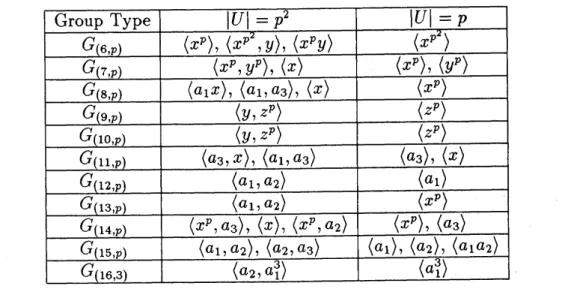
have determined all possible normal subgroups $U$ of order $p$ and $p^{2}$ in $G_{(i,p)}$,
$i=6$, $\ldots$, 15, $p\geq 3$ and $G_{(16,3)}$ up to equivalence for the forbidden subgroups
and these computations are summarized in Table 1.
Table 1: The non-equivalent normal subgroups $U$
of
order$p$ and $p^{2}$ in $C\tau(i,p)$,$6\leq i\leq 15$, $p\geq 3$ and $G_{(16,3)}$.
3Results
on Non-Abelian
$(p^{2},p^{2},p^{\underline{9}},$1)
RDS’s
When $p=2$, by simple computations and computer search we have the
following:
Theorem 3.1 There exists no (4,4,4, 1) RDS in a non-abelian group
of
or-der 16 relative to a normal subgroup U except in the following:
(i) $G=M_{4}(2)=\langle x, y|x^{8}=y^{2}=1, y^{-1}xy=x^{5}\rangle$, $U=\langle x^{4}, y\rangle=Z(G)$,
(ii) G $=Q_{8}\cross \mathbb{Z}_{2}$ where $Q_{8}=\langle x, y|x^{2}=y^{2}=m, m^{2}=1, y^{-1}xy=x^{-1}\rangle$
and$\mathbb{Z}_{2}=\langle z\rangle$, U $=\langle x^{2}, z\rangle=Z(G)$.
In (i), the set $R=\{1, x^{2}y, x^{3}y, x^{5}y\}$ is an RDS (K. Akiyama) and in (ii), the
set $R=\{1, x^{3}z, y, xy\}$ is an RDS.
For $p\geq 3$, we now enumerate all our results.
Result 3.2 (Elvira-Hiramine, [4]) There exists no $(p^{2},p^{2},p^{2},1)RDS$ in
the group $G_{(6,p)}$ relative to any normal subgroup
of
order$p^{2}$.
Result 3.3 ([2]) There exists no $(p^{2},p^{2},p^{2},1)RDS$ in $\mathrm{G}(\mathrm{e},\mathrm{P})$ relative to any
normal subgroup.
Result 3.4 ([2]) There exists a $(p^{2},p^{2},p^{2},1)RDS$ in $G_{(11,p)_{l}}$ p $\geq 3$ relative
to $\langle a_{3},$x\rangle.
An example of an RDS in Result 3.4 is the set
$R=\{a_{1}^{i}a_{2}^{j}a_{3^{\overline{2}}}^{-\mathit{1}}.x^{\frac{-i(i-1)}{2}+_{2}^{\Delta\llcorner}}-\lrcorner 1S|i, j\in I_{p}\}$
where $s=\alpha^{2}\in GF(p)$, $\alpha\in GF(p^{2})$
.
We ask the following:Question: Do $(p^{2},p^{2},p^{2},1)RDS$’s exist in $G(i,p))8\leq i\leq 15$ with p $\geq 3$
aside
from
the RDS’s in Result 3.4?4Results
on Non-Abelian
$(p^{3},p,p^{3},p^{2})$RDS’s
When $p=2$, we have the following:
Result 4.1 (Elvira-Hiramine, [4]) A non-abelian group
of
order 16con-taining a maximal cyclic subgroup
of
order 8does not contain an (8,2, 8,4)$RDS$ except $Q_{16}$.
An example in Qi6 $=\langle x, y|x^{4}=y^{2}=m, m^{2}=1, y^{-1}xy=x^{-1}\rangle$ relative
to $\langle x^{4}\rangle=\mathrm{Z}(\mathrm{Q}\mathrm{i}\mathrm{e})$ is $R=(1+x^{2})(1+\mathrm{y})(1+xy)$.
We now consider $(p^{3},p,p^{3},p^{2})$ RDS’s in non-abelian groups when $p\geq 3$
.
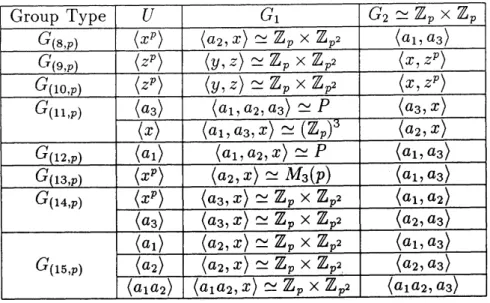
Result 4.2 ([2]) Let $G$ be a group
of
order $p^{4},$ $p\geq 3$.
If
$G$ containsnon-cylic subgroups $G_{1}$ and $G_{2}$
of
order$p^{3}$ and $p^{2}$, respectively, satisfying $G=$$G_{1}G_{2}$ and $G_{1}\cap G_{2}=U\simeq \mathbb{Z}_{p}\triangleleft G_{1}$ then $G$ contains $a(p^{3},p,p^{3},p^{2})RDS$
relative to $U$
.
Group Type $U$ $G_{1}$ $G_{2}\simeq \mathbb{Z}_{p}\cross \mathbb{Z}_{p}$
$G_{(8,p)}$ $\langle x^{p}\rangle$ $\langle a_{2}, x\rangle\simeq \mathbb{Z}_{p}\cross \mathbb{Z}_{p^{2}}$ $\langle a_{1}, a_{3}\rangle$
$\langle z^{p}\rangle$ $\langle y, z\rangle\simeq \mathbb{Z}_{p}\cross \mathbb{Z}_{p^{2}}$ $\langle x, z^{p}\rangle$
.
$\langle z^{p}\rangle$ $\langle y, z\rangle\simeq \mathbb{Z}_{p}\cross \mathbb{Z}_{p^{2}}$ $\langle x, z^{p}\rangle$
.
$\langle a_{3}\rangle$ $\langle a_{1}, a_{2}, a_{3}\rangle\simeq P$ $\langle a_{3}, x\rangle$
$\langle x\rangle$ $\langle$
$a_{1}$,a3,$x\rangle$ $\simeq(\mathbb{Z}_{p})$ $\langle a_{2}, x\rangle$
$G_{(12,p)}$ $\langle a_{1}\rangle$ $\langle a_{1}, a_{2}, x\rangle\simeq P$ $\langle a_{1}, a_{3}\rangle$
. .
$\langle x^{p}\rangle$ $\langle a_{2}, x\rangle\simeq M_{3}(p)$ $\langle a_{1}, a_{3}\rangle$
. .
$\langle x^{p}\rangle$ $\langle a_{3}, x\rangle\simeq \mathbb{Z}_{p}\cross \mathbb{Z}_{p^{2}}$ $\langle a_{1}, a_{2}\rangle$
$\langle a_{3}\rangle$ $\langle a_{3}, x\rangle\simeq \mathbb{Z}_{\mathrm{p}}\cross \mathbb{Z}_{p^{2}}$ $\langle a_{2}, a_{3}\rangle$
$G_{(15,p)}$
$\langle a_{1}\rangle$ $\langle a_{2}, x\rangle\simeq \mathbb{Z}_{p}\cross \mathbb{Z}_{p^{2}}$ $\langle a_{1}, a_{3}\rangle$
$\langle a_{2}\rangle$ $\langle a_{2}, x\rangle\simeq \mathbb{Z}_{p}\cross \mathbb{Z}_{p^{2}}$ $\langle a_{2}, a_{3}\rangle$
. .
$\langle a_{1}a_{2}\rangle$ $\langle a_{1}a_{2}, x\rangle\simeq \mathbb{Z}_{p}\cross \mathbb{Z}_{p^{2}}$ $\langle a_{1}a_{2}, a_{3}\rangle$
Table 2: Existence
of
$a(p^{3},p,p^{3},p^{2})RDS$ in $G_{(i,p)}$, $8\leq i\leq 15$, $p\geq 3$ relativeto a normal subgroup $U$.
In the groups $\mathrm{G}(\mathrm{z},\mathrm{p})$, $8\leq i\leq 15$, $p\geq 3$, we can find examples of
sub-groups $G_{1}$ and $G_{2}$ satisfying the conditions of Result 4.2. Thus there exist
$(p^{3},p,p^{3},p^{2})$ RDS’s in these groups relative to the forbidden subgroups $U$
given in Table 1. We summarize these results in Table 2.
Remark 4.3 By usingTable 2, we conclude that there exists a $(p^{3},p,p^{3},p^{2})$
RDS in non-abelian groups
of
order$p^{4}$, p $\geq 3$ except possibly in the following:(i) $\mathrm{G}(6,\mathrm{p})$ with $U=\langle x^{p}\rangle$, $p\geq 5$,
(i) $G(7,p)$ with $U=(\mathrm{x})$ or $\langle y^{p}\rangle fp\geq 3$ and
(i) $G_{(16,3)}$ with $U=\langle a_{1}^{3}\rangle$
.
We note that each group $G$ not covered by Remark 4.3 has $\Omega_{1}(G)=\{g\in$
$G|g^{p}=1\}\simeq \mathbb{Z}_{p}\cross \mathbb{Z}\mathrm{p}$
.
Also, a(27,3, 27,9) RDS does not exist in $G_{(6,3)}$ byacomputer search done in [4]. We ask the following:
Question: Do $(p^{3},p,p^{3},p^{2})RDS$’s exist in the groups given in Remark
4.32
If we consider groups $G$ containing anormal subgroup $N\subset U$ such that
$G/N\simeq \mathbb{Z}_{p^{2}}\cross \mathbb{Z}_{p}$
.
Then by Result 2.2 in [2], we can obtain asimpler formfor an RDS $R$ in $G$. The groups satisfying this condition are:
(1) $G_{(6,p)}$, $U=\langle x^{p^{2}}, y\rangle$,$\langle x^{p}y\rangle$, $N=\langle x^{p^{2}}\rangle$
(2) $G_{(7,p)}$, $U=\langle x^{p}, y^{p}\rangle$, $\langle x\rangle$, $N=\langle x^{p}\rangle$, and
(3) $G_{(15,p)}$, $U=\langle a_{1}, a_{2}\rangle$,$\langle$
a2:$a_{3}\rangle$, $N=(2)$.
At present, only case (3) remains open.
References
[1] J.A. Davis. Constructions of Relative Difference Sets in $p$-Groups. Discrete Math.
103 (1992), 7-15.
[2] D.T. Elvira. On Semi-Regular RDS’s in Non-Abelian Groups ofOrder$p^{4}$. To appear
in Kyushu Journal of Math.
[3] D.T. Elvira and Y.Hiramine.OnNon-AbelianSemi-Regular RelativeDifferenceSets. Finite Fields and Applications: Proceedings of the Fifth International Conference
$F_{q}(5)$, University of Augsburg, Germany, August 2-6, 1999, eds. D. Jungnickel and
H. Niederreiter, Springer (2001), 122-127.
[4] D.T. Elvira and Y. Hiramine. On Semi-Regular Relative Difference Sets in Non-Abelian pgroups. To appear.
[5] B. Huppert. Endliche Gruppen I. Springer, New York (1967).
[6] S.L. Ma and A. Pott. Relative Difference Sets, Planar Functions, and Generalized Hadamard Matrices. Journal of Algebra 175 (1995), 505-525.
[7] S.L. MaandB. Schmidt. On $(p^{a},$p,$p^{a},p^{a-1})$ Relative Difference Sets. Designs, Codes
and Cryptography 6(1995), 75-71.
[8] S.L. Ma and B. Schmidt. Relative $(p^{a},p^{b}, p^{a}, p^{a-b})$-Difference Sets: AUnified
ExpO-nent Bound and aLocal Ring Construction. Finite Fields and Applications 6(2000) no.1, 1-22.
[9] A. Pott. On the Structure of Abelian Groups Admitting Divisible Difference Sets. Journal ofCombinatorial Theory Ser A65 (1994), 202-213.
[10] A. Pott. Finite Geometry andCharacterTheory. Lecture Note 1601 Springer-Verlag, Berlin (1995).
[11] A. Pott. ASurvey ofRelative Difference Sets. Groups, Difference Sets and the Mon-ster. Eds. Arasu K.T., et. al. De Gruyter Verlag,Berlin-New York (1996), 195-233.
[12] B. Schmidt. On $(p^{a},p^{b},p^{a}, p^{a-b})$ Relative Difference Sets. J. Algebraic Combin. 6
(1997), 279-297.
[13] M. Suzuki. Group Theory II. Springer-Verlag, New York (1986).
Department
of
MathematicsGraduate School
of
Science and TechnologyKumamoto University
Kurokami, $Ii’umamoto_{f}$ Japan
$E$-mail:[email protected]