Strategies for Rewrite Systems:
Normalization
and
Optimality
Aart
Middeldorp
Institute
of
Information
Sciences
and Electronics
University of
Tsukuba,
Tsukuba 305-8573,
Japan
[email protected]
http:
$//\mathrm{w}\mathrm{w}\mathrm{w}$.
score.
is.
tsukuba.$\mathrm{a}\mathrm{c}.\mathrm{j}\mathrm{p}/\sim \mathrm{a}\mathrm{m}\mathrm{i}$
Abstract
In this paperwepresent agentle introduction to the important topic of rewrite
strate-gies for term rewrite systems. Wesurveynormalization results and introduce the recent
ffamework of Durand andMiddeldorp for the study ofoptimalrewrite strategies.
1
Introduction
Term rewriting is a general model of computation. One of the fundamental issues in term rewriting is the ability to compute normal forms. Given a rewrite system and
a
term, arewrite strategy specifies which part(s) of the term to evaluate. The desirable property of
$\mathrm{r}.\mathrm{e}$write strategies is normalization: repeatedevaluation $0.\mathrm{f}$the part$(\mathrm{s},)$ selected by the rewrite
strategy leads to a normal form, if the termunder consideration has a normal form.
Consider the term rewrite system (TRS for short) $\mathcal{R}_{1}$ consisting ofthe following rewrite
rules, specifying addition and multiplication on natural numbers:
$0+y$ $arrow$ $y$ $0\cross y$ $arrow$ $0$
$\mathrm{s}(x)+y$ $arrow$ $\mathrm{s}(x+y)$ $\mathrm{s}(x)\cross y$ $arrow x\cross y+y$
Suppose we want to compute the term $(0+0\cross \mathrm{s}(0))+0\cross 0$
.
This term contains threeinstances ofleft-hand sides of rewrite rules (so-called redexes):
Redexes (1) and (3) are not contained in larger redexes. We call them outermost. Re-dexes (2) and (3) are innermost; they do not contain smaller redexes. If
we
select theleftmost-outermost
redex (1),we
obtain the term $\mathrm{O}\cross \mathrm{s}(\mathrm{O})+\mathrm{O}\cross \mathrm{O}$ which contains twore-dexes. Selecting again the leftmost-outermost redex, we obtain the term $0+0\cross 0$
.
Aftertwo further contractions of the leftmost-outermost redex
we
arrive at the normal form $0$.
Instead ofselecting a single redex in each step, we
can
also contract redexes in parallel. Forinstance, redexes (1) and (3) do not interfere, i.e., aftercontraction of redex (1), redex (3) is
not affected, and vice-versa. If we contract all outermost redexes in parallel we also obtain the normal form $0:(0+0\mathrm{x}\mathrm{s}(0))+0\cross 0arrow^{*}0\cross \mathrm{s}(\mathrm{O})+\mathrm{O}arrow \mathrm{O}+\mathrm{O}arrow \mathrm{O}$
Does itmatterwhich redexes we select for contraction? For theaboveexamplethe
answer
is no since $\mathcal{R}_{1}$ does not admit infinite rewrite sequences. Hence, no matter which redexes
we
select for contraction, we
are
guaranteed to find a normal form. In general, however, termsmay have a normalform but also admit infinite rewrite sequences. Consider for example the
TRS $\mathcal{R}_{2}$ consisting ofthe following rewrite rules:
$0+y$ $arrow$ $y$ head$(x:y)$ $arrow x$
$\mathrm{s}(x)+y$ $arrow$ $\mathrm{s}(x+y)$ $\mathrm{t}\mathrm{a}\mathrm{i}\mathrm{I}(x:y)$ $arrow$ $y$
fib $arrow$ $\mathrm{f}(\mathrm{s}(\mathrm{O}), \mathrm{s}(\mathrm{O}))$ $\mathrm{f}(x, y)$ $arrow$ $x:\mathrm{f}(y, x+y)$
This TRS computes the infinite list of Fibonacci numbers. The term head$(\mathrm{t}\mathrm{a}\mathrm{i}\mathrm{l}(\mathrm{t}\mathrm{a}|\mathrm{I}(\mathrm{f}\mathrm{i}\mathrm{b})))$ can be reduced to its normal form $\mathrm{s}(\mathrm{s}(\mathrm{O}))$, the third number in the list of Fibonacci numbers,
e.g. by means of the rewrite strategy that always selects the leftmost-outermost redex, but repeatedly contracting an innermost redex will produce an infinite rewrite sequence.
Ifaterm$t$has anormal formwe canalways computeanormal formof$t$by computingthe
reducts of$t$in
a
breadth-first manner until weencounter anormal form. However, in generalthis is a highly inefficient way to compute normal forms. In this paper
we
present more effi-cient ways to compute normal forms. The basic idea is to compute a single rewrite sequence rather than explore all rewrite sequences starting from a given term. The computation of this rewrite sequence is guided by a strategy.Definition 1.1 A rewrite strategy for a TRS is a mapping $S$ that assigns to every term $t$
not in normal form a non-empty set of finite non-empty rewrite sequences starting from $t$.
We write $t\prec^{S}t’$ if$tarrow^{+}t’\in S(t)$. A rewrite strategy is called deterministic if$S(t)$ contains
a
single rewrite sequence for every non-normal form $t$.
A strategy$S$is uselessifforaterm $t$that has
a
normal formarewritesequence computedby $S$ misses the normal form.
Definition 1.2 Astrategy$S$ normalizes aterm$t$ifthere
are
no infinite$S$-rewrite sequencesstarting from $t$
.
We call $S$ normalizing if it normalizes every term that has a normal form.In the next section we present several rewrite strategies and summarize their
2
Normalizing Reduction Strategies
In the following we are mostly dealing with the class of left-linear TRSs without critical pairs, the so-called orthogonal TRSs. Orthogonality is
a
syntactic condition thatensures
that redexes cannot eliminate each other in a harmful way. Orthogonal TRSs have the nice
property that every term has at most one normal form. More information on orthogonal
TRSs and term rewriting in general can be found in $[1, 10]$.
Most rewrite strategies
are
defined by selecting the redexes which are to becont.racted
in each step. Below four such strategies are defined.Definition 2.1 The
leflmost-outermost
rewrite strategy $S_{10}$ always selects the leftmost ofthe outermost redexes, i.e., $s\prec^{s_{\iota\circ}}t$ if $t$ is obtained from $s$ by contracting its
leftmost-outermostredex. The parallel-outermost rewrite strategy$S_{\mathrm{p}\mathrm{o}}$ contractsalloutermost redexes
in parallel. Likewise, the
leflmost-innermost
rewrite strategy $S_{1\mathrm{i}}$ contracts the leftmost ofthe innermost redexes and the parallel-innermostrewrite strategy $S_{\mathrm{p}\mathrm{i}}$ contractsallinnermost
red.exes
in parallel.The above strategies are defined for arbitrary TRSs, but for non-orthogonal TRSs they need not be deterministic. The following strategy is only defined for orthogonal TRSs. Its well-definedness is a consequence of the complete developments theorem. A complete
development ofa set of redexes in a term $t$ is a rewrite sequence starting from $t$ in which all
these redexes are contracted.
Definition 2.2 The
full
substitution rewrite strategy $S_{\mathrm{f}\mathrm{s}}$ assigns to every term $t$ not innormal form a complete development of the set of all redexes in $t$
.
Let us illustrate the different strategies on
a
small example. Consider the TRS $\mathcal{R}_{1}$ ofSection 1 and the term $t=\mathrm{s}(0+0)\cross(0+\mathrm{s}(0))$
.
We have$tarrow^{S_{1\mathrm{i}}}\mathrm{s}(0)\cross(0+\mathrm{s}(0))arrow^{S_{1\mathrm{i}}}\mathrm{s}(0)\mathrm{x}\mathrm{s}(0)arrow^{S_{1\mathrm{i}}}0\cross \mathrm{s}(0)+\mathrm{s}(0)arrow^{S_{1\mathrm{i}}}0+\mathrm{s}(0)$
$arrow^{S_{1\mathrm{i}}}\mathrm{s}(0)$
$tarrow^{S_{\mathrm{p}\mathrm{i}}}\mathrm{s}(0)\cross \mathrm{s}(0)arrow^{S_{\mathrm{p}\mathrm{i}}}0\cross \mathrm{s}(0)+\mathrm{s}(0)arrow^{S_{\mathrm{p}\mathrm{i}}}0+\mathrm{s}(0)arrow^{S_{\mathrm{p}\mathrm{i}}}\mathrm{s}(0)$
$tarrow^{S_{10}}(0+0)\cross(0+\mathrm{s}(0))+(0+\mathrm{s}(0))arrow^{S_{10}}0\cross(0+\mathrm{s}(0))+(0+\mathrm{s}(0))$
$arrow^{S_{10}}0+(0+\mathrm{s}(0))arrow^{S_{10}}0+\mathrm{s}(0)arrow^{S_{10}}\mathrm{s}(0)$
$tarrow^{S_{\mathrm{p}\mathrm{o}}}(0+0)\mathrm{x}(0+\mathrm{s}(0))+(0+\mathrm{s}(0))arrow^{S_{\mathrm{p}\mathrm{o}}}0\cross \mathrm{s}(0)+\mathrm{s}(0)arrow^{S_{\mathrm{p}\mathrm{o}}}0+\mathrm{s}(0)$
$arrow^{S_{\mathrm{p}\mathrm{o}}}\mathrm{s}(0)$
$tarrow^{S_{\mathrm{f}\mathrm{s}}}0\mathrm{x}\mathrm{s}(0)+\mathrm{s}(0)arrow^{S_{\mathrm{f}\mathrm{s}}}0+\mathrm{s}(0)arrow^{S_{\mathrm{f}\mathrm{s}}}\mathrm{s}(0)$
All five strategies succeed in computing the normal form$\mathrm{s}(\mathrm{O})$, which is not surprising as $R_{1}$
is terminating. In the presence of infinite rewrite sequences, however, innermost strategies
Theorem 2.3 A term$t$ in
an
orthogonal $TRS$ admits a rewrite sequence to normalform
inwhich only innermost redexes are contracted
if
and onlyif
$t$ does not admitinfinite
rewrite$\square$
sequences.
Corollary 2.4 An innermost strategy $S$ is normalizing
for
an orthogonal $TRS\mathcal{R}$if
andonly
if
$\mathcal{R}$ is terminating.$\square$
Gramlich [6] showed that these results remain true for the largerclass oflocallyconfluent
overlay systems.
The following theorem is intuitively clear: by repeatedly contracting all redexes it is
impossible to miss the normalform.
Theorem 2.5 The
full
substitution strategy is normalizingfor
orthogonal TRSs.O’Donnell [14] also showed that parallel-outermost is a normalizing strategyfor
orthogo-nal TRSs. As a matter offact, he showed a stronger result: if a term in anorthogonal TRS has a normal form then it does not admit outermost-fair rewrite sequences.
Definition 2.6 An infinite rewrite sequence $t_{1}arrow t_{2}arrow t_{3}arrow\cdots$ is called
outermost-fair
if there do not exist a position$p$ and anindex $n\geq 1$ such that for all$i\geq n,$ $t_{i|p}$ is anoutermostredex in $t_{i}$ which is not contracted in the step from $t_{i}$ to $t_{i+1}$
.
Let us illustrate the concept of $01\iota \mathrm{t}\mathrm{e}\mathrm{r}\mathrm{m}\mathrm{o}\mathrm{s}\mathrm{t}$-fairness by means of two examples. The infinite rewrite sequence $\mathrm{A}:\mathrm{f}(\mathrm{a})arrow \mathrm{g}(\mathrm{f}(\mathrm{a}))arrow \mathrm{g}(\mathrm{g}(\mathrm{f}(\mathrm{a})))arrow\cdots$ with respect to the TRS
$\{\mathrm{a}arrow \mathrm{b}, \mathrm{f}(x)arrow \mathrm{g}(\mathrm{f}(x))\}$ is outermost-fair since every term in $A$ contains
a
single outermostredex which is immediately contracted. The infinite rewrite
sequence
$B:\mathrm{f}(\mathrm{a}, \mathrm{c})arrow \mathrm{f}(\mathrm{a}, \mathrm{d})$$arrow \mathrm{f}(\mathrm{a}, \mathrm{c})arrow \mathrm{f}(\mathrm{a}, \mathrm{d})arrow\cdots$with respect to the TRS $\{\mathrm{a}arrow \mathrm{b}, \mathrm{c}arrow \mathrm{d}, \mathrm{f}(x, \mathrm{d})arrow \mathrm{f}(x, \mathrm{c})\}$ is also
outermost-fair. Observe that redex a in $B$ is only half of the time an outermost redex, even
though it is never contracted.
Theorem 2.7
If
a term in an orthogonal $TRS$ admits anoutermost-fair
rewrite sequencethen it does not have a normal
form.
$\square$Since infinite rewrite sequences produced by the parallel-outermost strategy are trivially
outermost-fair,
we
obtain the following result.Corollary 2.8 The parallel-outermost strategy is normalizing
for
orthogonal TRSs. $\square$Very recently van Oostrom [15] extended Theorem 2.7 to the class ofweakly orthogonal
higher-order rewrite systems.
Theleftmost-outermost strategy is not normalizing for orthogonalTRSs. A simple
The leftmost-outermost strategy selects redex $\mathrm{c}$ and hence will produce the infinite rewrite sequence $\mathrm{f}(\mathrm{c}, \mathrm{a})\prec^{S_{1\circ}}\mathrm{f}(\mathrm{c}, \mathrm{a})\prec^{S_{1\circ}}\cdots$ whereas the parallel-outermost strategy normalizes
$\mathrm{f}(\mathrm{c}, \mathrm{a})$ in two steps: $\mathrm{f}(\mathrm{c}, \mathrm{a})arrow^{S_{\mathrm{p}\circ}}\mathrm{f}(\mathrm{c}, \mathrm{b})\prec^{S_{\mathrm{p}\circ}}\mathrm{b}$
.
Nevertheless, there is an important subclassof the orthogonal TRSs for which $S_{10}$ is normalizing.
Definition 2.9 ATRS is called
lefl-normal
if variables do not precede function symbols in the left-hand sides ofthe rewrite rules.Note that the above $\mathcal{R}$ is not left-normal as
the variable $x$ in the left-hand side $\mathrm{f}(x, \mathrm{b})$ of
the third rewrite rule precedes theconstant $\mathrm{b}$. The prime example of
a
left-normalorthogonal
TRS is combinatory logic.
Theorem 2.10 (O’Donnell [14]) The
leftmost-outermost
rewrite strategy is normalizingfor
lefl-normal
orthogonal TRSs. $\square$3
Optimal
Rewrite
Strategies
In the previous section we have seenthat the parallel-outermost rewritestrategyis normaliz-ing for orthogonal TRSs. However, it is not optimal. Consider the TRS $\mathcal{R}_{1}$ ofSection 1 and
the term $(\mathrm{O}\cross \mathrm{s}(\mathrm{O}))\cross(0+\mathrm{s}(0))$. In the sequence
$(0\mathrm{x}\mathrm{s}(0))\cross(0+\mathrm{s}(0))arrow^{S_{\mathrm{p}\circ}}\underline{0\cross \mathrm{s}(0)}\prec^{S_{\mathrm{p}\circ}}0$
the three underlined redexes are contracted. Without contracting the redex $0+\mathrm{s}(0)$ the
normal form $0$ can still be reached:
$(0\cross \mathrm{s}(0))\vee\cross(0+\mathrm{s}(0))arrow\underline{0\cross(0+\mathrm{s}(0))}arrow 0$. So redex
O+s(O) is not needed to reach the normal form. An optimal rewrite strategy selects only
needed redexes. The formal definition of neededness is given below. Definition 3.1 A redex $\triangle$in aterm
$t$is needed ifinevery rewrite sequence from$t$to normal
form a descendant of $\triangle$ is
contracted.
Let $\mathcal{R}$ be a TRS over a signature $\mathcal{F}$
.
Weassume
the existence ofa
constant $\bullet$ notappearing in $\mathcal{F}$ and
we
view $\mathcal{R}$as
a TRSover
the extended signature $F$
.
$=\mathcal{F}\cup\{\bullet\}$. So$\mathrm{N}\mathrm{F}_{\mathcal{R}}$, the set ofground normalforms of$\mathcal{R}$, consists of all terms in
$\mathcal{T}(\mathcal{F}.)$ that
are
in normalform. Let $\mathcal{R}$
.
be the TRS$\mathcal{R}\cup\{\bulletarrow\bullet\}$
.
Note that $\mathrm{N}\mathrm{F}_{\mathcal{R}}$.
coincides with $\mathrm{N}\mathrm{F}_{\mathcal{R}}\cap \mathcal{T}(F)$, the setof ground normal forms that do not contain the symbol $\bullet$
.
The following easy lemma givesan alternative definition of neededness, not depending on the notion of descendant. Lemma 3.2 Let $\prime \mathcal{R}$ be an orthogonal $TRS$ over a signature
$\mathcal{F}$. Redex $\triangle$ in term
$C[\triangle]\in$
$\mathcal{T}(\mathcal{F})$ is needed
if
and onlyif
there is no term $t\in \mathrm{N}\mathrm{F}_{\mathcal{R}}$.
such ihat $C[\bullet]arrow_{\mathcal{R}}^{*}t$.
$\square$Note that the above lemma implies that needed redexes are uniform, which
means
thatonly the position ofa redex in
a
term is important for determining neededness. So if redex$\triangle$ in term
$C[\triangle]$ is needed then so is redex $\triangle’$ in
The following theorem of Huet and L\’evy [7] forms the basis of all results
on
optimalnormalizing rewrite strategies for orthogonal TRSs. Theorem 3.3 Let $\mathcal{R}$ be
an
orthogonal $TRS$.
1. Every reducible ierm contains a needed redex.
2. Repeated contraction
of
needed redexes results in a normal form, whenever the term under consideration has a normalform.
$\square$
Unfortunately, needed redexes are not computable in general. Hence, in order to obtain
a
computable optimal rewrite strategy,we are
left to find (1) decidable approximations of neededness and (2) decidable properties of TRSs whichensure
that every reducible term has a needed redex identified by (1). Starting with the seminal work of Huet and L\’evy [7]on strong sequentiality, these issues have been extensively investigated in the literature [2, 8, 9, 11, 12, 16, 18]. In all these works Huet and L\’evy’s notions of index, $\omega$-reduction,
and sequentiality figure prominently. Recently, Durand and Middeldorp [5] presented an
approach to decidable call by need computations to normal form in which issues (1) and
(2) above are addressed directly. Besides facilitating understanding, much larger classes of
TRSs are shown to admit a computable optimal normalizing strategy. In the remainder of
this paper we recall the framework of [5]. Due to lack of space, we omit most proofs.
4
Approximations
In the remaining part of the paper we are dealing with finite TRSs only. Moreover,
we
consider rewriting on ground terms only. So we assume that the set of ground terms is non-empty. This requirement entails no loss of generality. It is undecidable whether a redex
in a term is needed with respect to a given (orthogonal) TRS. In this section we present
decidable sufficient conditions for a redex to be needed.
Because the $\mathrm{r}\mathrm{e}\mathrm{l}\mathrm{a}\mathrm{t}\mathrm{i}\mathrm{o}\mathrm{n}arrow^{*}\mathcal{R}$ is in general not computable, neededness is undecidable. In order to obtain decidable sufficient conditions, the idea is now to $\mathrm{a}\mathrm{p}\mathrm{p}\mathrm{r}\mathrm{o}\mathrm{x}\mathrm{i}\mathrm{m}\mathrm{a}\mathrm{t}\mathrm{e}arrow^{*}\mathcal{R}\mathrm{b}\mathrm{y}\prec_{S}^{*}$
for some suitable TRS $S$ such that it is decidable whether a term admits
an
S-rewrite sequence to a term in $\mathrm{N}\mathrm{F}_{\mathcal{R}}.$.
Definition 4.1 Let $\mathcal{R}$ and$S$be TRSs over the
same
signature. We say that$S$ approximates $\mathcal{R}\mathrm{i}\mathrm{f}arrow^{*}\mathcal{R}\subseteqarrow_{S}^{*}$ and $\mathrm{N}\mathrm{F}_{\mathcal{R}}=\mathrm{N}\mathrm{F}_{S}$. We say that redex $\triangle$ in $C[\triangle]\in \mathcal{T}(F)$ is $\mathcal{R}$-needed ifthereis no term $t\in \mathrm{N}\mathrm{F}_{\mathcal{R}}$
.
such that $C[\bullet]\prec_{\mathcal{R}}^{*}t$. The set of allsuch $C$[$\bullet$] is denotedby$\mathcal{R}$-NEEDED.So redex $\Delta$ in $C[\triangle]\in \mathcal{T}(F)$ is$\mathcal{R}$-needed if and only if$C[\bullet]\in \mathcal{R}$-NEEDED. The following
Lemma 4.2 Let$\mathcal{R}$ be a $TRS$ and let
$S$ be an approximation
of
$\mathcal{R}$.
Every$S$-needed redexis
$\mathcal{R}$-needed.
$\square$
Definition 4.3 An approximation map is a map $\alpha$ from TRSs to TRSs with the property
that $\alpha(\mathcal{R})$ approximates$\prime \mathcal{R}$, for every TRS $\prime \mathcal{R}$. In the followingwe write
$\mathcal{R}_{\alpha}$ instead of$\alpha(\mathcal{R})$
.
We define a partial order $\leq$ on approximation maps as follows: $\alpha\leq\beta$ if and only if
$\mathcal{R}_{\beta}$
approximates $R_{\alpha}$, for every TRS $\mathcal{R}$
.
In the literature several approximations have been studied. These approximations$\cdot$ have
the
same
left-hand sidesasthe originalTRS$\mathcal{R}$, hence thesecond requirement inthedefinition
of approximation is trivially satisfied, but differ in the way they treat the right-hand sides ofthe rewrite rules of$\mathcal{R}$
.
Definition 4.4 Let $\mathcal{R}$ be a TRS. The TRS
$\mathcal{R}_{\mathrm{s}}$ is obtained from $\mathcal{R}$ by replacing
the right-hand side of every rewrite rule by a variable that does not occur in the corresponding
left-hand side.
The idea of approximating a TRS by ignoring the right-hand sides ofits rewrite rules is due to Huet and L\’evy [7]. Our $\mathcal{R}_{\mathrm{s}}$-needed redexes coincide with their strongly
needed redexes. A better approximation is obtained by preserving the
non-v
ariable parts of theright-hand sides of the rewrite rules.
Definition 4.5 Let $\mathcal{R}$be a TRS. The TRS
$\mathcal{R}_{\mathrm{n}\mathrm{v}}$ isobtainedfrom$R$by replacing the variables
in the right-hand sides of the rewrite rules by pairwise distinct variables that do not
occur
in the corresponding left-hand sides.The idea of approximating a TRS by ignoring the variables in the right-hand sides of
the rewrite rules is due to Oyamaguchi [16]. Note that $\mathcal{R}_{\mathrm{n}\mathrm{v}}=\mathcal{R}$ whenever $\mathcal{R}$ is
right-ground. Hence for every orthogonal right-groundTRS $\mathcal{R}$, a redex
is needed if and only if it is $\mathcal{R}_{\mathrm{n}\mathrm{v}}$-needed.
Definition 4.6 A TRS $\mathcal{R}$is called growing if
for every rewriterule $larrow r\in \mathcal{R}$ the
common
variables in $l$ and$r$ occur at depth 1 in $l$. (The depth ofa
subterm
occurrence
is the numberof function symbols along the path to the root of the term.) We define $R_{\mathrm{g}}$ as the growing
TRS that is obtained from $\mathcal{R}$ by
renaming those variables in the right-hand sides of the rewrite rules that violate the restrictions imposed on growing TRSs.
GrowingTRSs, introducedby Jacquemard [8], are aproper extension of the shallow TRSs considered by Comon [2]. The growing approximation defined above stems from Nagaya
and Toyama [13]. It extends the growing approximation in [8] in that the right-linearity
Let us illustrate the difference between the three approximations on
a
small example.Consider the TRS $\mathcal{R}$ consisting ofthe two rules $\mathrm{f}(\mathrm{a}, \mathrm{b}, x)$ $arrow$
a
$\mathrm{f}(\mathrm{b}, x, \mathrm{a})$ $arrow x$
and the term $t=\mathrm{f}(\triangle_{1}, \triangle_{2}, \triangle_{3})$ with redexes $\triangle_{1}=\mathrm{f}(\mathrm{a}, \mathrm{b}, \mathrm{a})$ and $\triangle_{2}=\Delta_{3}=\mathrm{f}(\mathrm{b}, \mathrm{a}, \mathrm{a})$. One
easily verifies that all redexes are needed. In particular,
as
$\triangle_{1}$ and $\triangle_{2}$ rewrite only to a, $\triangle_{3}$ cannot be erased by the first rule. Since $\prime \mathcal{R}$ is orthogonal and$\mathcal{R}_{\mathrm{g}}=\mathcal{R}$, all redexes are
$\mathcal{R}_{\mathrm{g}}$-needed. So using the growing approximation we are able to identify all needed redexes in $t$. The TRS $\mathcal{R}_{\mathrm{n}\mathrm{v}}$ consists of the rules
$\mathrm{f}(\mathrm{a}, \mathrm{b}, x)$ $arrow$
a
$\mathrm{f}(\mathrm{b}, x, \mathrm{a})$ $arrow$ $y$
We have $\triangle_{2}arrow \mathcal{R}_{\mathrm{n}\mathrm{v}}\mathrm{b}$ and thus $\mathrm{f}(\Delta_{1}, \triangle_{2}, \bullet)\prec_{\mathcal{R}_{\mathrm{n}\mathrm{v}}}^{+}\mathrm{f}(\mathrm{a}, \mathrm{b}, \bullet)arrow \mathcal{R}_{\mathrm{n}\mathrm{v}}$ a, showing that $\triangle s$ is not
$\mathcal{R}_{\mathrm{n}\mathrm{v}}$-needed. Redexes $\triangle_{1}$ and $\triangle_{2}$ are $\mathcal{R}_{\mathrm{n}\mathrm{v}}$-needed. Finally, consider the TRS $\mathcal{R}_{\mathrm{s}}$ which
consists ofthe rules
$\mathrm{f}(\mathrm{a}, \mathrm{b}, x)$ $arrow$ $y$
$\mathrm{f}(\mathrm{b}, x, \mathrm{a})$
-a
$y$In $\mathcal{R}_{\mathrm{s}}$ a redex rewrites to every term. Hence $\mathrm{f}(\triangle_{1}, \bullet, \triangle_{3})\prec_{\mathcal{R}_{8}}^{+}\mathrm{f}(\mathrm{b}, \bullet, \mathrm{a})\prec_{\mathcal{R}_{\mathrm{S}}}$ a, showing that $\triangle_{2}$ is not $\mathcal{R}_{\mathrm{s}}$-needed. Redex $\triangle_{3}$ is also not $\mathcal{R}_{8}$-needed (since it is not $\mathcal{R}_{\mathrm{n}\mathrm{v}}$-needed), but $\triangle_{1}$
is $\mathcal{R}_{\mathrm{s}}$-needed.
The above example confirms the intuition that with a better approximation, i.e., an approximation which is closer to the original rewrite system, more needed redexes can be identified.
A set of terms is regular ifit is accepted by a finite tree automaton. We refer the reader to [3] for a comprehensive survey oftree automata techniques.
Theorem 4.7 The set $\mathcal{R}_{\alpha}$-NEEDED is a regular tree language
for
lefl-linear
$\mathcal{R}$ and $\alpha\in$$\{\mathrm{s}, \mathrm{n}\mathrm{v}, \mathrm{g}\}$. $\square$
For $\alpha\in\{\mathrm{s}, \mathrm{n}\mathrm{v}\}$ an easy proofusing ground tree transducers is given in [5]. Nagaya and
Toyama [13] obtained the regularity of$\mathcal{R}_{\mathrm{g}}$-NEEDED bymodifying the construction given in
Jacquemard [8] for right-linear $\mathcal{R}_{\mathrm{g}}$
.
Since membership is decidable for regular tree languages, we obtain the following result.
Corollary 4.8 Let$\mathcal{R}$ be a
lefl-linear
$TRS$ and$\alpha\in\{\mathrm{s}, \mathrm{n}\mathrm{v}, \mathrm{g}\}$.
Itis decidable whethera redex5Decidable Call
by Need Computations
A TRS $\mathcal{R}$ admits a
computable call by need strategy if it has
an
approximation $S$such that(1) S-needed redexes arecomputable and (2) everyterm not in normal form has an S-needed
redex. In the previous section we addressed the first issue. In this section
we
deal with the second issue.Definition 5.1 Let $\alpha$ be an approximation map. The class of TRSs
$\mathcal{R}$ such that every
reducible ground term has an $\mathcal{R}_{\alpha}$-needed redex is denoted
by $\mathrm{C}\mathrm{B}\mathrm{N}_{\alpha}$.
The next lemma is an easy consequence of Lemma 4.2. Lemma 5.2 Let $\alpha$ and$\beta$ be approximation maps.
If
$\alpha\leq\beta$ then $\mathrm{C}\mathrm{B}\mathrm{N}_{\beta}\subseteq \mathrm{C}\mathrm{B}\mathrm{N}_{\alpha}$. $\square$Lemma 5.3 Let $\mathcal{R}$ be an
orihogonal $TRS$.
If
$\mathcal{R}$ is right-ground then$\mathcal{R}\in \mathrm{C}\mathrm{B}\mathrm{N}_{\mathrm{n}\mathrm{v}}$
.
If
$\mathcal{R}$ isgrowing then $\mathcal{R}\in \mathrm{C}\mathrm{B}\mathrm{N}_{\mathrm{g}}$.
$\square$
The proofofthe following theorem relieson standardproperties ofregulartree languages
and ground tree transducers.
Theorem 5.4 (Durand and Middeldorp [5]) Let $\mathcal{R}$ be a
lefl-linear
$TRS$ and $\alpha$ anapproxi-maiion map such that $\mathcal{R}_{\alpha}$-NEEDED is regular. It
is decidable whether $\mathcal{R}\in \mathrm{C}\mathrm{B}\mathrm{N}_{\alpha}$
.
$\square$Corollary 5.5 Let $\prime \mathcal{R}$ be a
lefl-linear
$TRS$ and $\alpha\in\{\mathrm{s}, \mathrm{n}\mathrm{v}, \mathrm{s}\mathrm{h}, \mathrm{g}\}$. It is decidable whether$\prime \mathcal{R}\in \mathrm{C}\mathrm{B}\mathrm{N}_{\alpha}$.
$\square$
It should not
come
as a surprise thata
better approximationcovers
a larger class ofTRSs. This is expressed formally in the next lemma.
Lemma 5.6 We have $\mathrm{C}\mathrm{B}\mathrm{N}_{\mathrm{s}}\subset \mathrm{C}\mathrm{B}\mathrm{N}_{\mathrm{n}\mathrm{v}}\subset \mathrm{C}\mathrm{B}\mathrm{N}_{\mathrm{g}}$ , even when these classes
are restricted to orthogonal TRSs.
Proof.
Accordingto Lemma 5.2 $\mathrm{C}\mathrm{B}\mathrm{N}_{\mathrm{s}}\subseteq \mathrm{C}\mathrm{B}\mathrm{N}_{\mathrm{n}\mathrm{v}}\subseteq \mathrm{C}\mathrm{B}\mathrm{N}_{\mathrm{g}}$ . Consider the orthogonalTRSs
$\mathcal{R}_{1}$
$R_{2}$
$\mathrm{f}(\mathrm{a}, \mathrm{b}, x)$ $arrow$
a
$\mathrm{f}(\mathrm{a}, \mathrm{b}, x)$ $arrow$ a$\mathrm{f}(\mathrm{b}, x, \mathrm{a})$ $arrow$ $\mathrm{b}$
$\mathrm{f}(\mathrm{b}, x, \mathrm{a})$ $arrow$ $\mathrm{b}$
$\mathrm{f}(x, \mathrm{a}, \mathrm{b})$ $arrow$ $\mathrm{c}$ $\mathrm{f}(x, \mathrm{a}, \mathrm{b})$ $arrow$ $x$
We have $\mathcal{R}_{1}\in \mathrm{C}\mathrm{B}\mathrm{N}_{\mathrm{n}\mathrm{v}}$ and
$\mathcal{R}_{2}\in \mathrm{C}\mathrm{B}\mathrm{N}_{\mathrm{g}}$ byLemma 5.3. So it remains to show that
$\mathcal{R}_{1}\not\in \mathrm{C}\mathrm{B}\mathrm{N}_{\mathrm{s}}$
and $\mathcal{R}_{2}\not\in \mathrm{C}\mathrm{B}\mathrm{N}_{\mathrm{n}\mathrm{v}}$
.
We have$(R_{1})_{\mathrm{s}}$ $(\mathcal{R}_{2})_{\mathrm{n}\mathrm{v}}$ $\mathrm{f}(\mathrm{a}, \mathrm{b}, x)$ $arrow$ $y$ $\mathrm{f}(\mathrm{a}, \mathrm{b}, x)$ $arrow$
a
$\mathrm{f}(\mathrm{b}, x, \mathrm{a})$ $arrow$ $y$ $\mathrm{f}(\mathrm{b}, x, \mathrm{a})$ $arrow$ $\mathrm{b}$
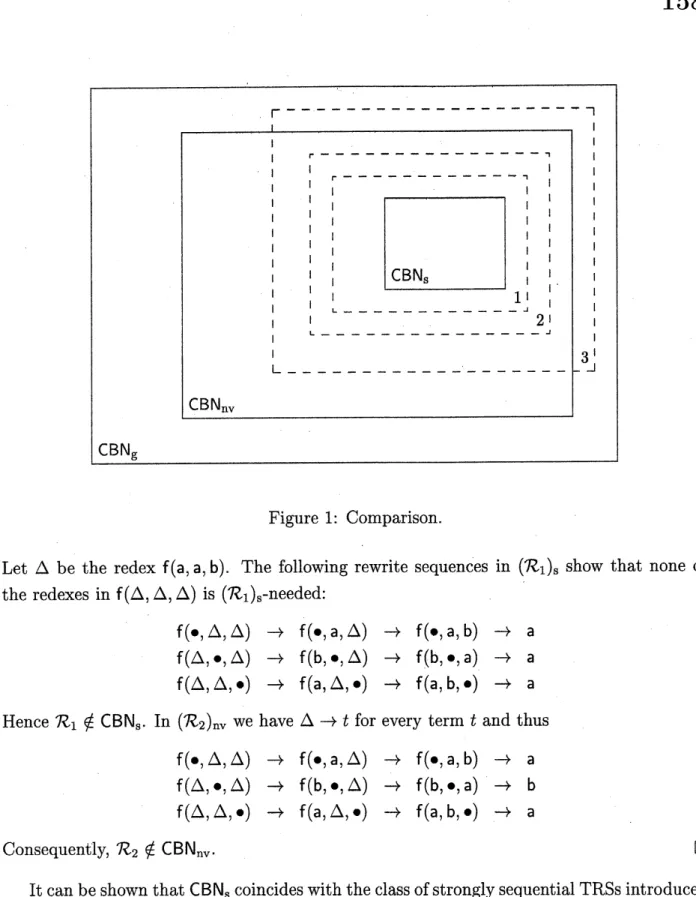
Figure 1: Comparison.
Let $\triangle$ be the redex $\mathrm{f}(\mathrm{a}, \mathrm{a}, \mathrm{b})$. The following rewrite sequences in $(\mathcal{R}_{1})_{\mathrm{s}}$ show that none of
the redexes in $\mathrm{f}(\triangle, \triangle, \triangle)$ is $(\mathcal{R}_{1})_{\mathrm{s}}$-needed:
$\mathrm{f}(\bullet, \triangle, \triangle)$ $arrow$ $\mathrm{f}(\bullet, \mathrm{a}, \Delta)$ $arrow$ $\mathrm{f}(\bullet, \mathrm{a}, \mathrm{b})$ $arrow$ a
$\mathrm{f}(\triangle, \bullet, \triangle)$ $arrow$ $\mathrm{f}(\mathrm{b}, \bullet, \triangle)$ $arrow$ $\mathrm{f}$($\mathrm{b}$,
$\bullet$, a) $arrow$ a
$\mathrm{f}(\triangle, \triangle, \bullet)$ $arrow$ $\mathrm{f}(\mathrm{a}, \triangle, \bullet)$ $arrow \mathrm{f}(\mathrm{a}, \mathrm{b}, \bullet)$ $arrow$ a
Hence $R_{1}\not\in \mathrm{C}\mathrm{B}\mathrm{N}_{\mathrm{s}}$. In $(\mathcal{R}_{2})_{\mathrm{n}\mathrm{v}}$ we have $\Deltaarrow t$ for every term $t$ and thus
$\mathrm{f}(\bullet, \triangle, \triangle)$ $arrow$ $\mathrm{f}(\bullet, \mathrm{a}, \triangle)$ $arrow \mathrm{f}(\bullet, \mathrm{a}, \mathrm{b})$ $arrow$
a
$\mathrm{f}(\triangle, \bullet, \triangle)$ $arrow$ $\mathrm{f}(\mathrm{b}, \bullet, \triangle)$ $arrow$ $\mathrm{f}$($\mathrm{b}$,
$\bullet$, a) $arrow$ $\mathrm{b}$
$\mathrm{f}(\Delta, \triangle, \bullet)$ $arrow$ $\mathrm{f}(\mathrm{a}, \triangle, \bullet)$ $arrow \mathrm{f}(\mathrm{a}, \mathrm{b}, \bullet)$ $arrow$ a
Consequently, $R_{2}\not\in \mathrm{C}\mathrm{B}\mathrm{N}_{\mathrm{n}\mathrm{v}}$.
It canbeshownthat $\mathrm{C}\mathrm{B}\mathrm{N}_{\mathrm{s}}$ coincideswith the classofstrongly sequentialTRSs introduced
by Huet and L\’evy [7]. However, $\mathrm{C}\mathrm{B}\mathrm{N}_{\mathrm{n}\mathrm{v}}$ properly includes the class of $\mathrm{N}\mathrm{V}$-sequential TRSs
introducedby Oyamaguchi [16] aswell
as
theextensionto NVNF-sequentialTRSs consideredby Nagaya et al. [12]. For instance, the TRS $\mathcal{R}_{1}$ defined in the above proofis neither
NV-sequential nor NVNF-sequential (because the term $\mathrm{f}(\Omega,$$\Omega,$ $\Omega)$ does not have
an
index).Figure 1 shows therelationship between several classes ofTRSs that admit decidable call
by need computations to normalform. Areas (1), (2), and (3) consist of all $\mathrm{N}\mathrm{V}$, NVNF, and
It is not difficult to show that the leftmost-outermost redex is always $\mathcal{R}_{\mathrm{s}}$-needed for left-normal TRSs $\mathcal{R}$
.
Hence$\mathrm{C}\mathrm{B}\mathrm{N}_{\mathrm{s}}$ includes the class of left-normal orthogonal TRSs
and
Theorem 2.10 is a special case of Theorem 3.3.
6
Conclusion
In this paper we addressed normalization and optimality results for rewrite strategies. We presented the framework of Durand and Middeldorp forthe study ofoptimal rewrite
strate-gies. Let us conclude with
some
remarks about complexity. Not much is known about thecomplexity of the problem of deciding membership in
one
of the classes that guarantees acomputable optimal strategy. Comon [2] showed that strong sequentiality (i.e., membership
in $\mathrm{C}\mathrm{B}\mathrm{N}_{\mathrm{s}}$) of a left-linear TRS can be decided in exponential time. Moreover, for
left-linear TRS satisfying the additional syntactic condition that whenever two proper subterms of
left-hand sides are unifiable one of them matches the other, strong sequentiality can be
de-cided in polynomial time. The class of forward-branching systems (Strandh [17]),
a
proper subclass of the class of orthogonal strongly sequential systems, coincides with the class of transitive systems (Toyama et al. [19]) and can be decided in quadratic time (Durand [4]).References
[1] F. Baader and T. Nipkow. Term Rewriting and All That. Cambridge University Press, 1998.
[2] H. Comon. Sequentiality, second-order monadic logic and tree automata. In Proc. 10th LICS, pages 508-517, 1995.
[3] H. Comon, M. Dauchet, R. Gilleron, D. Lugiez, S. Tison, and M. Tommasi. Tree automata techniques and applications, 1998. Draft, available from http:$//\mathrm{w}\mathrm{w}\mathrm{w}$
.
grappa.univ-lille3.$\mathrm{f}\mathrm{r}/\mathrm{t}\mathrm{a}\mathrm{t}\mathrm{a}/$.
[4] I. Durand. Bounded, strongly sequentialand forward-branchingterm rewritingsystems.
Journal
of
Symbolic Computation, 18:319-352, 1994.[5] I. Durand and A. Middeldorp. Decidable decidable call by need computations in term
rewriting (extended abstract). In Proc.
14ih
CADE, volume 1249 ofLNAI, pages 4-18,1997.
[6] B. Gramlich. Abstract relations between restricted termination and confluence
[7] G. Huet and J.-J. L\’evy. Computations in orthogonal rewriting systems, I and II. In
Computational $Logic_{f}$ Essays in Honor
of
Alan Robinson, pages396-443.
The MITPress, 1991. Original version: Report 359, Inria, 1979.
[8] F. Jacquemard. Decidable approximations ofterm rewriting systems. In Proc. 7th RTA, volume 1103 of LNCS, pages 362-376, 1996.
[9] J.-P. Jouannaud and W. Sadfi. Strong sequentiality of left-linear overlapping rewrite
systems. In Proc.
4th
CTRS, volume 968 of LNCS, pages 235-246, 1995.[10] J.W. Klop. Term rewriting systems. In Handbook
of
Logic in Computer Science, Vol.2, pages 1-116. Oxford University Press, 1992.
[11] J.W. Klop and A. Middeldorp. Sequentiality in orthogonal term rewriting systems. Journal
of
Symbolic Computation, 12:161-195, 1991.[12] T. Nagaya, M. Sakai, andY. Toyama. NVNF-sequentiality of left-linearterm rewriting systems. In Proc. RIMS Workshop on Theory and Applications
of
Rewriting Systems,pages 109-117, 1995.
[13] T. Nagaya and Y. Toyama. Decidabilityfor left-linear growing term rewriting systems.
In Proc. 10th RTA, LNCS, 1999. To appear.
[14] M.J. O’Donnell. Computing in Systems Described by Equations, volume 58 of LNCS.
1977.
[15] V. van Oostrom. Normalisation in weakly orthogonal rewriting. In Proc. 10th RTA, LNCS, 1999. To appear.
[16] M. Oyamaguchi. $\mathrm{N}\mathrm{V}$-sequentiality: A decidable condition forcall-by-need computations
in term rewriting systems. SIAM Journal on Computation, 22:114-135, 1993.
[17] R. Strandh. Classes of equational programs that compile into efficient machine code. In Proc. 3rd RTA, volume 355 of LNCS, pages 449-461, 1989.
[18] Y. Toyama. Strong sequentiality of left-linear overlapping term rewriting systems. In Proc. 7th LICS, pages 274-284, 1992.
[19] Y. Toyama, S. Smetsers, M. van Eekelen, and R. Plasmeijer. The functional strategy
and transitive term rewriting systems. In Term Graph Rewriting: Theory and Practice,