Japan Advanced Institute of Science and Technology
JAIST Repository
https://dspace.jaist.ac.jp/Title Graph Isomorphism Completeness for Chordal Bipartite Graphs and Strongly Chordal Graphs Author(s) Uehara, Ryuhei; Toda, Seinosuke; Nagoya, Takayuki Citation Discrete Applied Mathematics, 145(3): 479-482 Issue Date 2005-01-30
Type Journal Article
Text version author
URL http://hdl.handle.net/10119/4896
Rights
NOTICE: This is the author’s version of a work accepted for publication by Elsevier.
Changes resulting from the publishing process, including peer review, editing, corrections, structural formatting and other quality control mechanisms, may not be reflected in this
document. Changes may have been made to this work since it was submitted for publication.
A definitive version was subsequently published in Ryuhei Uehara, Seinosuke Toda and Takayuki Nagoya, Discrete Applied Mathematics, 145(3), 2005, 479-482,
http://dx.doi.org/10.1016/j.dam.2004.06.008 Description
Graph Isomorphism Completeness for
Chordal bipartite graphs and Strongly
Chordal Graphs
Ryuhei Uehara
aSeinosuke Toda
bTakayuki Nagoya
caNatural Science Faculty, Komazawa University. This work was done while the
author was visiting University of Waterloo.
bDepartment of Computer Science and System Analysis, College of Humanities
and Sciences, Nihon University.
cDepartment of Mathematical Sciences, Tokyo Denki University.
Abstract
This paper deal with the graph isomorphism (GI) problem for two graph classes: chordal bipartite graphs and strongly chrdal graphs. It is known that GI prob-lem is GI complete for some special graph classes including regular graphs, bi-partite graphs, chordal graphs, comparability graphs, split graphs, and k-trees for unbounded k. On the other side, the relative complexity of the GI problem for the above classes was unknown. We prove that deciding isomorphism of the classes are GI complete.
Key words: Graph isomorphism problem, Graph isomorphism complete, Strongly
chordal graphs, Chordal bipertite graphs
1 Introduction
The graph isomorphism (GI) problem is a well-known open problem and was listed as an important open problem in Karp (Kar72) three decades ago. Al-though the problem is trivially in NP, the problem is not known to be in P and not known to be NP-complete either (see (RC77; KST93)). In par-ticular, Mathon (Mat79) showed that the counting version of GI problem is
Email addresses: [email protected] (Ryuhei Uehara),
[email protected] (Seinosuke Toda), [email protected] (Takayuki Nagoya).
GI-complete. Thus, it is very unlikery that the GI problem is NP-complete as well as the unlikelihood that the problem is in P given the recent results coming from cryptography.
The GI problem is called GI complete for a graph class if the GI problem for the graph class is polynomial time equivalent to the problem for general graphs. The GI problem is GI complete for several graph classes including reg-ular graphs, bipartite graphs, chordal graphs, comparability graphs, and split graphs, and k-trees for unbounded k (see (BC79) for a review). On the other hand, the GI problem is solvable in polynomial time when it is restricted to special graph classes, e.g., graphs of bounded degrees, planar graphs, interval graphs, permutation graphs, k-trees for fixed k (see (BPT96) for reference), and convex graphs (Che99).
Recently, many graph classes have been proposed and widely investigated (see (BLS99) for a comprehensive survey). However, relative complexity of the GI problem is not known for some graph classes. Among them, the graph classes of strongly chordal graphs and chordal bipartite graphs are on the border. We show that the GI problem for the graph classes is GI complete. This results solve the open problems listed by J.P. Spinrad (Spi95; BPT96).
2 Preliminaries
For given graph G = (V, E), G[U ] denotes the subgraph of G induced by U ⊆ V . Two graphs G = (V, E) and G0 = (V0, E0) are isomorphic if and only if there is a one-to-one mapping φ : V → V0 such that {u, v} ∈ E if and only if {φ(u), φ(v)} ∈ E0 for every pair of vertices u, v ∈ V . We denote by G ∼ G0 if G and G0 are isomorphic. The graph isomorphism (GI) problem is to determine if G ∼ G0 for given graphs G and G0. An edge which joins two vertices of a cycle but is not itself an edge of the cycle is a chord of that cycle. A graph is chordal if every cycle of length at least 4 has a chord. A graph is chordal bipartite if the graph is bipartite and every cycle of length at least 6 has a chord. A chord {xi, xj} in a cycle (x1, x2,· · · , x2k, x1) of even length
2k is an odd chord if |j − i| ≡ 1 (mod 2). A graph is strongly chordal if G is chordal and each cycle in G of even length at least 6 has an odd chord. Inand Kn denote an independent set and a clique of size n, respectively. A graph G = (V, E) is a split graph if V can be partitioned into two subsets X and Y such that G[X] is K|X| and G[Y ] is I|Y |.
v1 v2 v3
v4 v5 v6
v1 v2 v3 v4 v5 v6
G Gˆ
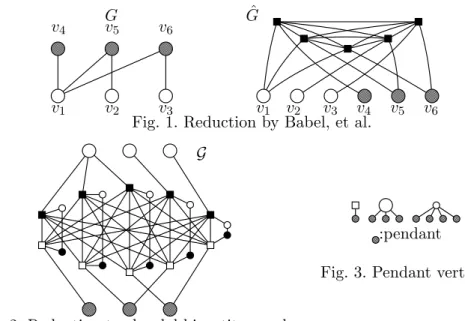
Fig. 1. Reduction by Babel, et al.
G
Fig. 2. Reduction to chordal bipartite graph
:pendant Fig. 3. Pendant vertices
3 Main Results
In (BPT96), Babel, et al. give the following reduction from a bipartite graph to a directed path (DP) graph such that two given bipartite graphs are iso-morphic if and only if the reduced DP graphs are isoiso-morphic: given bipartite graph G = (X, Y, E) with |X ∪ Y | = n and |E| = m, the edge set ˆE of the reduced graph ˆG = (X∪ Y ∪ E, ˆE) contains {e, e0} for all e, e0 ∈ E, and {x, e} and {y, e} for each e = {x, y} ∈ E (Figure 1). Our starting point is the DP graph ˆG that is a split graph having the following properties: (a) ˆG[E]∼ Km, (b) ˆG[X∪Y ] ∼ In, and (c) each e ∈ E has exactly one neighbor in X, and an-other one in Y (thus d(e) = m + 1). Without loss of generality, we also assume that (d) m > 1 and (e) |X| > |Y | > 1 (if |X| = |Y | , construct new graph (X1∪ Y2∪ {v}, X2∪ Y1, E0) from (X, Y, E) as follows: for each e ={x, y} ∈ E,
xi ∈ Xi, yi ∈ Yi, and {xi, yi} ∈ E0 for i = 1, 2, and for every u ∈ X2 ∪ Y1,
{v, u} ∈ E0).
We reduce the split graph ˆG = (X ∪ Y ∪ E, ˆE) to a graph G = (V, E). We set V = X ∪ Y ∪ E ∪ E0 ∪ B ∪ W such that each vertex e ∈ E corresponds to three vertices e0 ∈ E0, eb ∈ B, and ew ∈ W , respectively (hence |E| = |E0| = |B| = |W | = m). Vertices are connected as follows: (1) for each e ∈ E, {e, e0}, {e0, eb}, {eb, ew}, {e, ew} ∈ E, (2) for each e1, e2 ∈ E, {e1, e02},
{e0
1, e2} ∈ E (thus G[E∪E0]∼ Km,m), and (3) for each vertex x∈ X, {x, e} ∈ E if{x, e} ∈ ˆE, and for each vertex y ∈ Y , {y, e0} ∈ E if {y, e} ∈ ˆE. The reduced graphG for ˆG in Figure 1 is shown in Figure 2. The reduction can be done in polynomial time.
Lemma 1 G is chordal bipartite.
show every cycle of length at least 6 has a chord. To derive a contradiction, we assume that we have a chordless cycle C of length at least 6. Then we show that any four consecutive vertices on C has a chord.
If C contains at least one vertex in B ∪ W , that induces C4. Thus C only
contains vertices in X∪ Y ∪ E ∪ E0. Let v0, v1, v2, v3 be consecutive vertices on
C. If they are all in E∪E0, sinceG[E ∪E0] is Km,m,{v0, v3} ∈ E. Thus at least
one vertex is in X ∪ Y . Without loss of generality, assume that v1 ∈ X, and
hence v0, v2 ∈ E. Then, by (c), no other vertex in X is incident to v0 and v2.
Since no vertices in Y are incident to E, v3 ∈ E0. Hence{v0, v3} ∈ E, which is
a contradiction. Thus G is chordal bipartite. 2
Lemma 2 Given bipartite graphs G1 and G2, G1 ∼ G2 if and only ifG1 ∼ G2.
Proof. It is sufficient to show that ˆG1 ∼ ˆG2 if G1 ∼ G2. Given ˆG1, we assume
thatG1 ∼ G2 for some ˆG2. We show that we can reconstruct ˆG2 isomorphic to
ˆ
G1 fromG2 uniquely.
Let e ={u, v} be any edge with d(u) = d(v) = 2, and u0 and v0be the (unique) vertices with u0 ∈ N(u) − {v} and v0 ∈ N(v) − {u}. Then, by (c) and (d) and the reduction, u, v ∈ B ∪ W and u0v0 ∈ E ∪ E0. Therefore, finding all four-tuples using the handles e, and contracting each four-tuple into a vertex, we can reconstruct the graph ˆG2 ∼ ˆG1. 2
Theorem 3 The GI problem is GI complete for chordal bipartite graphs and
strongly chordal graphs.
Proof. Lemmas 1 and 2 imply the claim for chordal bipartite graphs. We next reduce the chordal bipartite graph G = (V1,V2,E) constructed above to a
graph G0 as follows: first add edges to change the independent set V1 into a
clique. More precisely, we add e = {u, v} for each u, v ∈ V1. We note that
we can uniquely determine the set V1 since |V1| > |V2| by (e). We then add
pendant vertices to each vertex in V1 as follows (see Figure 3): (1) for each
vertex e0 ∈ E0, we add vertex e00 into V and an edge {e0, e00} into E, (2) for each vertex x in X, we add vertices xi with 1≤ i ≤ 3 into V and edges {x, xi} with 1≤ i ≤ 3 into E, and (3) for each vertex w in W , we add vertices wi with 1≤ i ≤ 4 into V and edges {w, wi} with 1 ≤ i ≤ 4 into E. Then G0 is strongly chordal ifG is chordal bipartite (BLS99, Theorem 3.4.3). On G0, the following claims are easy to see: each vertex having four neighbors of degree 1 is in W , each vertex having three neighbors of degree 1 is in X, and each vertex having one or two neighbors of degree 1 is in E0. Moreover, for each vertex having two neighbors of degree 1, one of two neighbors is in Y . Thus, deleting the pendant vertices and the additional edges to make the clique G[V1], we can
reconstruct G from G0. Thus G1 ∼ G2 iff G10 ∼ G20, which completes the proof.
2
4 Concluding Remarks
The class of strongly chordal graphs is between chordal graphs and interval graphs. Babel, et al. show that the GI problem for directed path (DP) graphs is GI complete, while the GI problem for rooted directed path (RDP) graphs is polynomial time solvable in (BPT96). The class of the RDP graphs is between the strongly chordal graphs and interval graphs, although the class of the DP graphs is incomparable to strongly chordal graphs. In the paper, we draw a line between the RDP graphs and strongly chordal graphs for GI completeness, which answers the open problem stated in (BPT96).
The class of chordal bipartite graphs is between bipartite graphs and interval bigraphs. Recently, Hell and Huang show that any interval bigraph is the complement of a circular arc graph (HH03). Thus, combining the result by Hsu (Hsu95), we can see that the GI problem for interval bigraphs can be solved in polynomial time. Therefore we draw a line between the interval bigraphs and chordal bipartite graphs for GI completeness, which improves the GI completeness results.
As mentioned in Introduction, we have many graph classes, which are pro-posed recently, and we do not know whether the GI problem is GI complete or polynomial time solvable on some classes. In order to clarify the complex-ity of the GI problem, considering the GI problem on such graph classes is future work. For example, trapezoid graphs are the natural and classic graph class such that the complexity of the GI problems is still unknown, which is mentioned by Spinrad (Spi03).
Acknowledgements
The authors are grateful to Jeremy Spinrad, who informed us that the relative complexity of the GI problem on strongly chordal graphs was still open.
References
[BC79] K.S. Booth and C.J. Colbourn, Problems Polynomially Equivalent to Graph Isomorphism, Technical Report CS-77-04, Computer Sci-ence Department, University of Waterloo, 1979.
[BLS99] A. Brandst¨adt, V.B. Le, and J.P. Spinrad, Graph Classes: A Survey (SIAM, 1999).
Problem For Directed Path Graphs and For Rooted Directed Path Graphs, J. Algorithms 21 (1996) 542–564.
[Che99] L. Chen, Graph Isomorphism and Identification Matrices: Sequen-tial Algorithms, J. of Comput. System Sci. 59 (1999) 450–475. [HH03] P. Hell and J. Huang, Interval Bigraphs and Circular Arc Graphs,
J. Graph Theory, to appear.
[HKM82] F. Harary, J.A. Kabell, and F.R. McMorris, Bipartite intersection graphs, Comment. Math. Univ. Carolin. 23 (1982) 739–745.
[Hsu95] W.L. Hsu, O(M·N) Algorithms for the Recognition and Isomor-phism Problem on Circular-Arc Graphs, SIAM J. Comput. 24(1995) 411–439.
[Kar72] R.M. Karp, Complexity of Computer Computations, chapter Re-ducibility among Combinatorial Problems (Plenum, 1972).
[KST93] J. K¨obler, U. Sch¨oning, and J. Tor´an, The Graph Isomorphism Problem: Its Structural Complexity (Birkh¨auser, 1993).
[Mat79] R. Mathon, A Note on The Graph Isomorphism Counting Problem, Information Processing Letter 8 (1979) 131–132.
[Mul97] H. M¨uller, Recognizing Interval Digraphs and Interval Bigraphs in Polynomial Time, Disc. Appl. Math. 78 (1997) 189–205.
[RC77] R.C. Read and D.G. Corneil, The Graph Isomorphism Disease, J. Graph Theory 1 (1977) 339–363.
[Spi95] J.P. Spinrad, Open Problem List.
http://www.vuse.vanderbilt.edu/~spin/open.html, 1995. [Spi03] J.P. Spinrad, Efficient Graph Representations (American
Mathe-matical Society, 2003).