西 南 交 通 大 学 学 报
第 54 卷 第 6 期
2019 年 12 月
JOURNAL OF SOUTHWEST JIAOTONG UNIVERSITY
Vol. 54 No. 6
Dec. 2019
ISSN: 0258-2724 DOI:10.35741/issn.0258-2724.54.6.18
Research article
Computer and Information Science
N
EW
A
UTHENTICATION
M
ODEL FOR
M
ULTIMODAL
B
IOMETRICS
B
ASED ON
S
HAPE
F
EATURES
V
ECTORS
基于形状特征向量的多模态生物验证新模型
Sundos Abdulameer Alazawi, Huda Abdulaaliabdulbaqi, Yasmin Makki Mohialden
Computer Sciences, Mustansiriyah University, Baghdad, Iraq, [email protected]
Abstract
Biometrics is the science and technology dealing with the measurement and analysis of the biological features of the human body. The analysis is based on comparing the value of certain measured features with the form features in the database. Unimodal Biometric Systems have many limitations regarding precision in the identification/authentication of personal data. To accurately identify a person, a multimodal biometrics system such as combining face and fingerprint characteristic is used. Many such multi-biometrics fusion possibilities exist that can be utilized as an authentication system. In this paper, we present a new authentication system of the multimodal biometrics method for both face and fingerprint characteristics based on general shape feature fusion vectors. There are two main phases in our method: first, the fused shape features for both face and fingerprint images are extracted in accordance with central moments, and second, these features were recognized for retrieval of an authorized person using direct Euclidian distance. Experimentally, we tested about 100 shape features vectors, and observed that our method allows to improve the multimodal biometrics model when we are using the same features for two biometric images. A new method has a high-performance precision when invariant moments are used to extract shape features vectors and when similarity measurements computed based on direct Euclidean distance in the experiments are performed. We recorded False Acceptance Rate, False Rejection Rate, and Accuracy, FAR and FRR where the accuracy of the model is 91 %.
Keywords: Biometric, Image Retrieval, Central Moments, Shape Features Fusion, Fingerprint, Face, Authentication, Pattern Recognition.
摘要 生物识别技术是处理和分析人体生物学特征的科学技术。该分析基于将某些测量特征的值与数据库中 的表单特征进行比较。单峰生物识别系统在识别/验证个人数据的准确性方面有很多限制。为了准确地识别 人,使用了多模式生物识别系统,例如结合了面部和指纹特征。存在许多可以用作认证系统的多种生物计 量学融合的可能性。在本文中,我们提出了一种基于通用形状特征融合向量的针对面部和指纹特征的多峰 生物特征识别方法的新认证系统。我们的方法有两个主要阶段:首先,根据中心矩提取人脸和指纹图像的 融合形状特征,其次,识别这些特征以使用直接欧几里得距离检索授权人。通过实验,我们测试了约 100 个形状特征向量,并观察到当我们对两个生物特征图像使用相同特征时,我们的方法可以改进多峰生物特 征模型。当使用不变矩提取形状特征向量时以及在实验中执行基于直接欧几里德距离计算的相似性测量时 ,该新方法具有高性能的精度。我们记录了错误接受率,错误拒绝率以及准确性,远 和财务报告率,其中
模型的准确性为 91 %。
关键词: 生物特征识别,图像检索,关键时刻,形状特征融合,指纹,面部,身份验证,模式识别。
I.
I
NTRODUCTIONBiometrics systems offer a solution for verification and identification of individual identity.
Authentication of a person or an individual is an important requirement in numerous governmental and civilian applications where errors in recognizing a person can be costly [1].
Biometrics is the skill of establishing or determining an identity based on the physiological or behavioral attributes of an individual. The biometric characteristics are both physical and biological; thus, the characteristics include fingerprints, face recognition, iris recognition, signature, hand geometry, voice recognition, which are all physical characteristics, while gait, keystroke, etc. are biological characteristics [2], [3], [4]. In combination with the traditional authentication process, biometrics provide a strong tool for identifying a person’s identity.
Biometrics systems’ applications are classified into two different types: a unimodal biometrics system using only one biometric, and a multimodal biometrics system that may use two or more of biometrics, such as the face, iris, and ear features. The requirements for biometrics systems have increased because it is an essential part of many security applications [4].
Akin to other biometrics solutions, facial recognition techniques are employed for measuring and matching unique features required by the identification or authentication system [5]. Face recognition, when integrated with another biometric method such as fingerprint authentication, can yield better results than traditional recognition and identification systems based on only one feature [6]. Each person is believed to have a unique fingerprint pattern, and it is estimated that there is 1 in 64,000,000,000 probability of two persons having the same fingerprints [7].
Features that can yield a rich set of biometric data are ideal for matching and identity determination, and should be combined with other congruent features for greater accuracy [8].
Thus, a fusion of features (e.g. face, iris, hand, fingerprint, and ear) is increasingly being used for this purpose.
In 2005, Ross and Govindarajan [9] proposed a biometrics method for fusing information obtained from an individual’s hand and face. The decision score was obtained as a sum of all feature values calculated by applying
the method to 50 individuals. The authors reported a Genuine Acceptance Rate of nearly 90%. The main drawback of this method is failure to account for noise and its effects on performance.
In 2007, Rattani et al. [8] utilized fingerprint images to obtain raw data via a suitable feature extraction method which were subsequently fused. When Rattani and colleagues applied this method to 100 cases, they achieved accuracy close to 98%. However, the researchers did not take into account the shape or texture features.
In a later study, Long et al. [10] extracted face and fingerprint domain features based on Zernike Moments, obtaining accuracy rate close to 97 %, while their experimental results yielded FAR and FRR close to 5 % and 1 %, respectively.
In 2014, Hassan et al. [11] developed a recognition system based on the fusion of face and fingerprint features. Recognition tasks for each pattern were implemented via support vector mechanics, such as a classifier. When the recognition systems based on facial and fingerprint features were rated, the Equal Error Rate (EER) ratio of 2.50 % and 5.56 % was obtained, respectively, while the EER ratio for the system based on fusion was 0.833 %.
In the same year, Telgad et al. [12] reported on their work as a part of which they normalized match scores and sum score level fusion. In the proposed system, fingerprint recognition was achieved with the help of minutiae matching and Gabor filter, while relevant facial features were extracted based on Principal Component Analysis, and match scores were used at fusion level to improve the outcome.
Ho et al. [13] proposed a recognition method based on a complete match effect fusion of fingerprint and face biometrics. Using the Biometric Scores Set Release and Simple Sum and Product Rule fusion of match effect, these authors relied on a feature vector based on biometric scores for combining facial and fingerprint features. The obtained results show that the use of match effects by fusion method can yield accurate output. Moreover, when the proposed method was combined with Bayes Network, K-Nearest, and SVM approaches, the authors found that SVM yielded superior results.
Somashekhar and Nijagunarya [14] present an approach for an authentication system, where each face and fingerprint image is processed using SIFT and Gabor features by three feature-extraction methods to gain similar features from
3
the data. In terms of the accuracy system, the maximum score is close to 96% for Gabor features. In observation of the performance, it is not as good as correlated features (independent or uncorrelated sources).
Thivakaran et al. [15] fused features by concatenating the fingerprint and ear features and used the registration and similarity score for matching. The method achieved 95.96 % accuracy with low error rates of 0.11 % FAR and 0.19 % FRR, while the existing method saw a score of 0.17 % FAR and 0.37 % FRR.
Regardless of the richness of work on multimodal biometrics research, feature-level fusion has not been studied enough. Feature-level fusion is comparatively more complex to attain because multimodal features may result in discordant sets, and the correspondence of diverse features such as texture, color, or shape may be not compatible.
Thus, in this context, we suggested working on the same type of features (face and fingerprint) for multimodal images to avoid the expected difficulties of using different features for each image. The proposed method made use of fused shape features for both face and fingerprint images that are extracted according to the central moments for a multimodal authentication model, which is the best fusion of moment feature reduction, and matching design has been tested on the real multimodal database gained. Our method was based on central and invariant moments to extract shape feature vectors and the Direct Euclidean distance for similarity measurement for authentication level.
II.
F
EATUREE
XTRACTIONFeatures are basically categorized as general and domain specific. General features are independent, e.g., shape, color, and texture. Domain-specific features belong to specific biometric category such as the face, fingerprint, and eyes [16]. Feature extraction is essentially separating the visible information from the image and storing them in the feature vectors format in a database. In the domain of pattern recognition, features can be defined as a path to distinguish one class of object from another [15]. Many obtainable features are used in image classification and retrieval/recognition; the grade of similarity between request/query images and images in databases can be obtained by color division measurement, texture allocation, and shape similarity [16], [17].
A. Shape Features
In 1962, Hu [17] proposed seven moment invariants of a connected region that never changes because of rotation, scaling, and translation. Moment invariants that are calculated from each of the values are used in a feature vector form. They simply mark the computed set features of the region that can be used to classify and identify the region’s shape [18], [19].
A set of seven invariant moments (IM) is given by Hu [17] and is defined in more ways than one for binary connected components. This can be achieved simply by using the central moments:
∂1 = η20 + η02 (1) ∂2 = (η20 + η02)2 + 4 η 2 11 (2) ∂3 = (η30 + 3η12)2 + (3η21 + η03)2 (3) ∂4 = (η30 + η12 )2 + (η12 + η03)2 (4) ∂5 = (η30 + 3η12)(η30 + η12) [(η30 + η12)2 – 3(η21 + η03)2] + (3η21 – η03)(η21+ η03) (5) ∂6 = (η20 + η02) [(η30 + η12)2 – 3(η21 + η03)2 ] + 4 η11 (η30 + η12) (η21 + η03) (6) ∂7 = (3η21 – 3η03) (η30 + η12) [(η30 + η12)2 – 3(η21 + η03)2] + (3η12 – η03) (η21 (7)
III. P
ROPOSEDM
ODELM
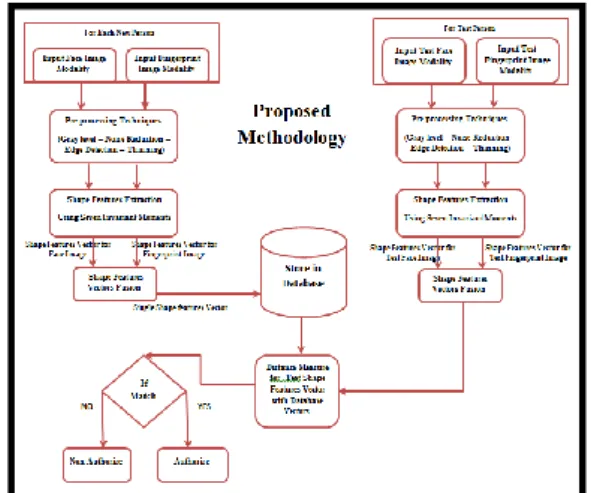
ETHODOLOGYBefore images are processed based on their feature extraction from the databases of images, preprocessing techniques in digital images are executed in all types of images. The preprocessing steps include different traditional image processing methods, which are applied to each other to obtain better input data from the face and fingerprint authentication system [20], [21], [23]. Traditional methods, such as the edge detection method, threshold, and enhancement techniques, are used on binary data to determine shape features; and object limitation is desired for this model to cancel noise effectively and simplify an image processing operation. The most remarkable shape features are based on human conception; thus, it is very important to discover an efficient method to compute the shape pattern of an image. Therefore, we use the shape moment specified by Hu [17], which is an invariant. We extract the shape features for the face and right thumb fingerprint for the same person and fuse these feature vectors for better result during the retrieval and authentication stages of this model. Fig. 1
show a proposed algorithm of the proposed methodology for our suggested model.
Figure 1. Proposed methodology.
A. Proposed Algorithm Begin: For each new person
Step 1: Capture color image of face and right
thumb fingerprint.
Step 2: Perform the image preprocessing
techniques for each input image:
1. Convert the two images from RGB to grayscale.
2. Perform edge detection with the threshold gray images.
3. Boundary thinning.
Step 3: Extract the shape features of the face
and fingerprint form the feature vector with equations 1 to 7.
Face feature vector = [∂1F, ∂2F, ∂3F, ∂4F, ∂5F, ∂6F, ∂7F]
Fingerprint feature vector = [∂1P, ∂2P, ∂3P, ∂4P, ∂5P, ∂6P, ∂7P]
where ∂1F is the first feature for the face, ∂1P is the first feature for the fingerprint, and so on.
Step 4: Fuse the combination of face shape
feature vectors and fingerprint feature vectors into a single shape feature vector:
Shape feature vector = [F1, F2, F3, F4, F5, F6, F7]
where: F1 = (∂1F + ∂1P), F2 = (∂2F + ∂2P), and so on.
Step 5: Apply the similarity measurement
algorithm. The direct Euclidian distance between the image stored in the database for image P and query image Q can be given as equation 8 [22]:
𝐷𝐸𝐷 = ∑ ( 𝑉𝑝𝑖− 𝑉𝑞𝑖)2 7
𝑖=1 (8)
where Vpi and Vqi are the shape feature vectors of image P from the database, and Query image Q.
Step 6: Retrieve the relevant images for the
authentication task based on measuring the similarity from images stored in the database, by comparing the test image with different images
from the image database ranging from P1 to PN, where the range of the images is from 1 to N.
Step 7: Authentication. From Step 4 and Step
5, the new person’s login is accepted or rejected.
End
IV.
E
XPERIMENTALR
ESULTSThe results of image segmentation and some preprocessing method such as enhancement and thinning are the first steps in this work and features to any image in the database. This process constitutes the recognition phase and will be applied to the face and fingerprint images to find out image features that were already stored – the task of identifying and recognizing images that were entered and stored in the database. Thereafter, we compared them to find out anything new in the database. Our image database initially contained 50 face images and 50 right thumb fingerprint images, one for each person with shape vector features for each person stored in the database model, and 50 person images for the recognition and retrieval stage. The experiment is calculated under the following conditions:
1. Only the frontal view of the face image is analyzed throughout this model.
2. Just the latent fingerprint for the right thumb is used in this model.
3. All face images are the same size.
The image features for our model are dependent on invariant moments to extract shape features from the face and fingerprint images. For each person, the face and fingerprint images will be processed in our algorithm from Step 1 to Step 5 to obtain the shape feature vector that will be stored in the vector features database and it usable in the retrieval stage for the user authentication model.
Fig. 2 and 3 show an example of shape feature vector extraction using our algorithm for Person_001 and Person_067, respectively. Each figure shows the results of the preprocessing methods for the face and fingerprint for Person_001 including grayscale face and fingerprint images, enhancement result, edge detection result, and thinning image.
5
Figure 2. Person_001a-F: Original face image, b-F: Gray scale image enhance, c-F: Edge detection, d-F: Thinning image, a-P: Original fingerprint image, b-P: Fingerprint image enhance, c-P: Fingerprint edge detection, d-P: Fingerprint thinning image.
Figure 3. Person_067 a-F: Original face image, b-F: Edge detection, c-F: Thinning image, a-P: Original fingerprint image, b-P: Fingerprint edge detection, c-P: Fingerprint thinning image.
Tables 1 and 2 include all the data of shape vector features for our examples of Person_001 and Person_067, respectively. Note that each face and fingerprint has seven shape features in column 1 and column 2.
Table 1.
Shape features vectors for Person _001
Face_001 FingerPrint_001
Shape feature vector for face
Shape feature vector for fingerprint ∂1F 1.960143 ∂1P 0.249309 ∂2F 3.935806 ∂2P 0.842552 ∂3F 6.505910 ∂3P 1.862065 ∂4F 6.490458 ∂4P 1.532608 ∂5F 12.98862 ∂5P 3.229617 ∂6F 8.458362 ∂6P 1.953711 ∂7F 9.399991 ∂7P 1.818869 Table 2.
Shape features vectors for Person _067
Face_067 FingerPrint_067
Shape features vector Shape feature vector for
fingerprint ∂1F 2.182441 ∂1P 0.903765 ∂2F 4.369264 ∂2P 2.040328 ∂3F 7.155975 ∂3P 3.658069 ∂4F 7.151555 ∂4P 3.433712 ∂5F 14.30531 ∂5P 6.979463 ∂6F 9.336186 ∂6P 4.453785 ∂7F 9.596365 ∂7P 5.383977
The final shape vector features for Person_001 and Person_067 follows based on summation of two vectors (shape feature vector for face and shape feature vector for fingerprint). All shape vector features for each person in this model will be saved in the database model for the retrieval stage.
Shape features vector for Person_001: 2.209452, 4.778358, 8.367975, 8.023066, 16.21824, 10.41207, and 11.21886.
Shape features vector for Person_067: 3.086206, 6.409592, 10.81404, 10.58527, 21.28478, 13.78997, and 14.98034.
Vector features are used in Steps 6 and 7 in our algorithm. Whenever a user tries to log in, the user needs to provide two images, one of the front of their face and another of their right thumb fingerprint. A new user/new person trying to log in will be named Person_Test the first time, then all steps of our algorithm are applied to check and authorize that user. Table 3 includes all the data of shape vector features for Person_Test that will be compared with all shape vector features data stored in the database model.
Table 3.
Shape features vectors for Person _Test
Face_Test FingerPrint_Test
Shape feature vector for face
Shape feature vector for fingerprint ∂1F 2.414036 ∂1P 0.903765 ∂2F 4.829691 ∂2P 2.040328 ∂3F 7.846593 ∂3P 3.658069 ∂4F 7.844974 ∂4P 3.433712 ∂5F 15.690757 ∂5P 6.979463 ∂6F 10.259819 ∂6P 4.453785 ∂7F 10.342132 ∂7P 5.383977
The final shape vector features for Person_Test follow based on summation of two vectors.
Shape features vector for Person_Test: 3.317801, 6.870019, 11.50466, 11.27869, 22.67022, 14.7136, and 15.72611.
Figure 4. Compare result of seven shape features for Person_Test with database image.
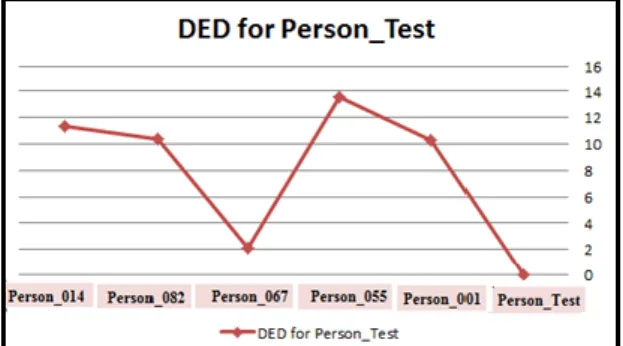
Figure 5. Compare result of DED measurement for Person_Test with database image.
By comparing the test image with different images from the image database ranging from P1
to PN, the data of shape features vector for each of
the top five values from the direct Euclidian distance were used to compare the image to be retrieved with the images stored in the database. The five images with the closest values of shape features vector of Person Test are as follows:
Person_001, Person_014, Person_055, Person_067, and Person_082
Person_Test with Person_Test = 0 Person_Test with. Person_001 = 10.3193 Person_Test with. Person_055 = 13.53014 Person_Test with. Person_067 = 2.133572 Person_Test with. Person_082 = 10.35896 Person_Test with. Person_014 = 11.30048. From the results of the direct Euclidian distance measurement shown in Table Z, we find that the image for Person_067 with the DED = 2.133572 is closest to the image for Person_Test. Fig. 4 shows that the convergence in the seven shape features is very clear between the input image for retrieval (Person_Test) and the image for Person_067, while Fig. 5 show that image for Person_067 is closest to the image for Person_Test by comparing the DED measurements.
Evaluation: Our image database initially contained 100 face images and 100 right thumb fingerprint images, one for each person with shape vector features for each person stored in the database model, which means the database for shape features vector contained 100 vectors. The accuracy of a biometric modality model is the standard to evaluate that model; it is commonly computed by matching errors with false acceptance rate (FAR) and false rejection rate (FRR). When we applied 100 face test images plus their 100 fingerprint images through all the steps of our retrieval algorithm we obtained about 100 shape features vectors; more than 93 of these vector images were retrieved in the model database. The best fusion of moment features has been tested on the real multimodal database; the method has a high-performance precision when invariant moments are used to extract shape features vectors and when similarity measurement computed based on direct euclidean distance in the experiments are performed. We recorded False Acceptance Rate, False Rejection Rate, and Accuracy, FAR = and FRR where the accuracy of the model is close to 0.912, where FRR= 0.092 and FAR = 0.084.
V.
C
ONCLUSIONIn our proposed method, preprocessing methods are important in this work. We start with
a grayscale conversion for images if the image input is colored in order to reduce the computational cost. This grayscale image is processed by a medium filter to reduce the noise, and then a Sobel filter with thresholding for the image is used to detect image edges. In our proposed method, two images per person are used, one of their face and another of their thumb fingerprint. For the multimodal authentication model, each unknown person is tested against the first face and fingerprint image. The best fusion of moments feature reduction and matching design has been tested on the real multimodal database gained. The new method has good performance in terms of precision using invariant moments to extract shape features vectors and the direct Euclidean distance for similarity measurement when the experiments are performed. We recorded False Acceptance Rate, False Rejection Rate, and Accuracy, FAR and FRR where the performance of the model is 86%. Note that we are using the same algorithm for each of the face and fingerprints. In future work we suggest using different approaches for each face and fingerprint.
A
CKNOWLEDGMENTThe author's thankful Department of Computer Science, Collage of Science, Mustansiriyah University for supporting this work.
R
EFERENCES[1] PUJA,
K.G.,
PRASAD,
S.,
and
ARVIND, S. (2018) Vulnerabilities of
Biometric Authentication Systems: A
Survey. Helix, 8(5), pp. 4100-4103.
[2] HEBLE, R.N.D. (2017) A Review on Iris
and Fingerprint Fusion Authentication
Systems.
International
Journal
of
Advanced Research in Computer and
Communication Engineering, 6(1), pp.
194-197.
[3] AKHTAR, Z., DASGUPTA, D., and
BANERJEE,
B.
(2019)
Face
Authenticity: An Overview of Face
Manipulation Generation, Detection and
Recognition.
Proceedings
of
the
International
Conference
on
Communication
and
Information
Processing.
[4] GHAYOUMI, M. (2015) A review of
multimodal biometric systems: Fusion
methods
and
their
applications.
7
International Conference on Computer
and Information Science, pp. 131-136.
[5] SCHROEDER, C.C. (1998) Biometric
security
process
for
authenticating
identity and credit cards, visas, passports
and facial recognition. [Online] Google
Patents.
Available
from:
https://patents.google.com/patent/US5787
186A/en [Accessed 10/08/19].
[6] BHATIA, R. (2013) Biometrics and face
recognition
techniques.
International
Journal of Advanced Research in
Computer
Science
and
Software
Engineering, 3(5), pp. 93–99.
[7] NARAYANA,
B.L.,
RANGAIAH,
Y.K.C., and KHALID, M.A. (2016)
Study of fingerprint patterns in relation to
gender and blood group. Journal of
Evolution
of
Medical
and
Dental
Sciences, 5(14), pp. 630-633.
[8] RATTANI, D., KISKU, R., BICEGO, M.,
and TISTARELLI, M. (2007) Feature
level fusion of face and fingerprint
biometrics. Proceedings of the 1st IEEE
International Conference on Biometrics,
Theory, Applications and Systems, pp.
1-6.
[9] ROSS, A.A. and GOVINDARAJAN, R.
(2005) Feature level fusion of hand and
face biometrics. Proceedings of the SPIE
Conference on Biometric Technology for
Human Identification II, pp. 196-204.
[10] LONG, T.B. THAI, L.H., and HANH, T.
(2012) Multimodal biometric person
authentication using fingerprint, face
features. Proceedings of the Pacific Rim
International Conference on Artificial
Intelligence:
Trends
in
Artificial
Intelligence, pp. 613-624.
[11] HASSAN, N., RAMLI, D.A., and
SUANDI, S.A. (2014) Fusion of face and
fingerprint
for
robust
personal
verification system. International Journal
of Machine Learning and Computing,
4(4), pp. 371- 375.
[12] TELGAD, R.L., DESHMUKH, P., and
SIDDIQUI, A.M. (2014) Combination
approach to score level fusion for
multimodal biometric system by using
face and fingerprint. Proceedings of the
International Conference on Recent
Advances and Innovations in Engineering,
pp. 892-899.
[13] HO, C.C., HUSSIN, M.A., and NG, H.
(2015) Match score fusion of fingerprint
and face biometrics for verification.
Jurnal Teknologi, 77(18), pp. 93-102.
[14] SOMASHEKHAR,
B.M.
and
NIJAGUNARYA, Y.S. (2018) Face and
fingerprint fusion system for identity
authentication using fusion classifiers.
International
Journal
of
Computer
Science & Engineering Survey, 9(1/2/3).
[15] THIVAKARAN,
T.K.,
PADIRA,
S.V.V.N.C., KUMAR, A.S., and REDDY,
S.S. (2019) Fusion Based Multimodel
Biometric Authentication System using
Ear
and
Fingerprint.
International
Journal of Intelligent Engineering and
Systems, 12(1), pp. 62-73.
[16] KUMAR, V., SENDHILKUMAR, S.,
and
MAHALAKSHMI,
G.
(2019)
Improving
accuracy
of
short
text
categorization
using
contextual
information. In PATI, B., PANIGRAHI,
C., MISRA, S., PUJARI, A., and
BAKSHI, S. (Eds.) Progress in Advanced
Computing and Intelligent Engineering.
Springer, pp. 281-292.
[17] HU,
M.-K.
(1962)
Visual
pattern
recognition by moment invariants. IRE
Transactions on Information Theory, 8(2),
pp. 179-187.
[18] BAGRI, N. and JOHARI, P.K. (2015) A
comparative study on feature extraction
using texture and shape for content based
image retrieval. International Journal of
Advanced Science and Technology, 80(4),
pp. 41-52.
[19] YANG, M., KPALMA, K., and RONSIN,
J. (2008) A survey of shape feature
extraction techniques. In PENG-YENG,
Y. (Ed.) Pattern Recognition. In-Tech, pp.
43-90.
[20] ABDULLAH,
N.A.,
SAIDI,
M.J.,
RAHMAN, N.H.A., WEN, C.C., and
HAMID, I.R.A. (2017) Face recognition
for
criminal
identification:
An
implementation of principal component
analysis for face recognition. AIP
Conference Proceedings, 1891, 020002.
[21] BURGER, W. and BURGE, M.J. (2016)
Algorithmic Introduction Using Java.
Springer, New York.
[22] ADITI, M. and SHAH, P. (2013) Review
and comparison of various feature
extraction
techniques
in
CBIR.
International
Journal
of
Computer
Applications, 71(23), pp. 38-43.
[23] MAHMOOD, M., AL-KUBAISY, W.J.,
and AL-KHATEEB, B. (2019) Using
Artificial Neural Network for Multimedia
Information
Retrieval.
Journal
of
Southwest Jiaotong University, 54(3).
参考文
[1] PUJA , K.G. , S 。 PRASAD 和 S.
ARVIND( 2018 )生物特征认证系 统
漏洞:一项调查。螺旋,8(5),第
4100-4103 页。
[2] HEBLE,R.N.D。 (2017)虹膜和指纹
融合身份验证系统的评论。国际计算
机和通信工程高级研究杂志,6(1),
第 194-197 页。
[3] AKHTAR , Z. , DASGUPTA , D. 和
BANERJEE , B. ( 2019 ) 人 脸 真 实
性:人脸操纵生成,检测和识别概述。
国际通信和信息处理会议论文集。
[4] GHAYOUMI,M.(2015)多模式生物
特征识别系统综述:融合方法及其应
用。 2015 电气工程师学会/ 阿西斯第
14 届计算机和信息科学国际会议论文
集,第 131-136 页。
[5] SCHROEDER,抄送(1998)用于身份
验证和信用卡,签证,护照和面部识
别的生物识别安全过程。 [在线] 谷歌
专 利 。 可 从 以 下 网 址 获 得 :
https://patents.google.com/patent/US5787
186A/en [19/10/08 访问]。
[6] BHATIA,R.(2013)生物识别和面部
识别技术。国际计算机科学与软件工
程高级研究杂志,3(5),第 93–99
页。
[7]
B.L.
NARAYANA
, Y.K.C 。
RANGAIAH 和 M.A. KHALID(2016)
与性别和血型相关的指纹模式研究。
《 医 学 与 牙 科 科 学 发 展 杂 志 》 , 5
(14),第 630-633 页。
[8] RATTANI,D.,KISKU,R.,BICEGO,
M. 和 TISTARELLI,M.(2007)人脸
和指纹生物特征的特征级融合。第一
届电气工程师学会国际生物识别,理
论,应用和系统会议论文集,第 1-6 页。
[9] ROSS,A.A。和 GOVINDARAJAN,R.
(2005)手和脸生物特征的特征级融
合。斯皮关于人类识别的生物识别技
术会议 II 的会议记录,第 196-204 页。
[10] LONG,T.B. THAI,L.H. 和 HANH,
T.(2012)使用指纹,面部特征的多
式联运生物特征身份验证。 《环太平
洋人工智能国际会议论文集:人工智
能趋势》,第 613-624 页。
[11] N. HASSAN,D.A。的 RAMLI 和 S.A.
的 SUANDI(2014)融合面部和指纹,
以构建强大的个人验证系统。国际机
器学习与计算杂志,4(4),第
371-375 页。
[12] TELGAD,R.L.,DESHMUKH,P. 和
SIDDIQUI,A.M. (2014)组合方法,
通过使用面部和指纹为多模式生物识
别系统评分水平融合。工程学最新进
展和创新国际会议论文集,第 892-899
页。
[13] HO,C.C.,HUSSIN,M.A. 和 NG,H.
(2015)指纹和面部生物特征的匹配
分数融合以进行验证。法律杂志,77
(18),第 93-102 页。
[14]
SOMASHEKHAR
,
B.M.
和
NIJAGUNARYA , Y.S 。 (2018 )使
用融合分类器进行身份认证的人脸和
指纹融合系统。国际计算机科学与工
程杂志,9(1/2/3)。
[15] THIVAKARAN , T.K. , PADIRA ,
S.V.V.N.C. , KUMAR , A.S. 和
REDDY,S.S.(2019)基于融合的使
用耳朵和指纹的多模型生物特征认证
系统。国际智能工程与系统杂志,12
(1),第 62-73 页。
[16] KUMAR,V.,SENDHILKUMAR,S.
和 MAHALAKSHMI , G. ( 2019 ) 使
用上下文信息提高短文本分类的准确
性 。 在 BATI , B.PANIGGRAHI ,
C.MISRA , S. , PUJARI , A 。 和
9