Author(s)
YOSHIKAWA, Hiroya
Citation
沖縄大学法経学部紀要 = Okinawa University JOURNAL
OF LAW & ECONOMICS(6): 1-15
Issue Date
2006-03-31
URL
http://hdl.handle.net/20.500.12001/6021
Regional (Developing) Promotion Theory and Practice (I)
Taking Experience of Regional Promotion in Okinawa to Southeast Asia
-Hiroya YOSHIKAWA < Contents >
Foreword : Why are Regional Developing Promotion the Current Themes? Chapter I : Drawing on Japanese and my Experience of Regional Promotion
1. Using Japanese Experience
2. Drawing on my Experience of Regional Promotion 3. The Subject of the Regional Promotions
< What is a Desirable Region, and What is Development? > < Evaluation of Development >
Chapter n : Regional Activity and International Cooperation in Japan 1. Decentralization moves in Asian Countries 2. Main Types of Regional Promotion
3. Community Development is Human Development — < To be continued >—
Chapter III : Ways and Means for Developing Regional Activities into International Cooperation Chapter IV : Conditions for Continuation of Regional Activities as International Cooperation Proposal ' Regional Promoter Upbringing, Educational Program -using the JICA-Net
Development, Implementation and a Evaluation
-Foreword : Why are Regional Developing (the following abbreviation)
Promotion the Current Themes?
Why the regional revitalization including the promotion of regional industry and enterprises is the current topic?
Now, the theme for this paper was selected with the aim of applying this experience for regional development and promotion in Southeast Asia. Repeated experience shows that the social phenomena and problems that have happened in Japan recur in Southeast Asian countries a number of years later. So as globalization advances, these problems are probably already in effect.
There has been a boom in regional development and promotion in Japan since around ten years ago, and a considerable body of theory and knowledge has been built up through trial and error.
Now regional promotions are so popular in all over Japan. Regional promotions are carried out not only in small villages in mountain area, but also large firm villages in plains, big cities, small towns, fishing villages in costal area, and islands. You see many regional projects in all over Japan. Mass media also report these projects frequently. Now regional
projects are in full bloom. Why regional promotions are so popular?
< Beginning of regional promotion boom >
In the first place, Takeshita cabinet's policy named "Regional Creation Program One
Hundred Million Yen" played important role in 1988 and in 1989. The policy was said
"Subsidiary for self participation of people in the region". This policy was extraordinary.
The subsidiary gave people opportunity to think and act for their own region. 100,000,000 yen was not big money for major cities but it was big amount of money for small villages. Whatever the subsidiary is big amount or small amount, it stimulated people to discuss regional promotion and future vision of their place.
Of course, many cities and towns had carried regional project out before the policy launched but the policy should be highly valued for the reason that it expand regional promotion activities to places in all over Japan. The policy, "Regional Creation Program One Hundred Million Yen", made the boom of regional promotion.
< Background of regional promotion >
I would like to explain the background and potentials of regional promotion because they are common with ones in Southeast Asian countries.
Through the process of postwar rehabilitation in Japan, many people left rural areas and concentrated in cities. In the result, original and regional characteristics of nature, history culture, and environment were lost. People adopted national standard. In the process of internationalization, regional culture and originality were collapsed. Many people thought that we needed to stop the breakdown or decline of regional culture. This is why the policy was suggested
So the activities of regional promotion are not temporary and not a coincidence. The activities are in the dynamism of society.
< Philosophy of regional promotion "Regionalism" >
Activities of regional promotion are supported by the idea of "Regionalism". The idea
also is explained with the term "Times of Region". We can see practices of the idea in many
regional projects.
Some governor and mayor suggested "Regionalism" in 1970s and in 1980s. For example, governor of Oita prefecture and Kazushi Nagasu, governor of Kanagawa prefecture introduced the idea. The four followings are main points of "Regionalism".
• Local government and people in the region should have autonomy on politics, economy,
society, and culture in the region. Local people should quite just to follow the central governance. So far central government set standard but now local people should decide
-by themselves.
• Diversity of nature, ecosystem, history, and culture in each region are important. The diversity should be maintained. It is important to stop nationwide standardization. • Values in society are now changing from richness of material to richness of mind Now
regional promotion should emphasis not firstly on economy but on life and culture. • To establish autonomy, people in community should have democracy. The democracy
should be totally different from the traditional passe order.
This concept of regionalism is so popular in many developed countries and I am sure that it will be popular in Southeast Asian countries soon or later. Regions in Southeast Asian countries still have original culture and diversity. So the result of regional promotion will be much more abundant than ones in developed countries where once nationwide standardization was carried out. I consider these regions in Southeast Asia "top runner with a delay of a circuit".
The idea of regionalism continues to effect actives of regional promotion strongly. It will never be weak. Promotion will be supported with the idea of regionalism.
Chapter I : Drawing on Japanese and my Experience of Regional promotion 1. Using Japanese Experience
The current boom in regional development and promotion in Japan is, in a sense, a natural result of Japan's post-war economic recovery. Japan's prioritization of the economy and devotion to efficiency, which it pursued after the end of World War II with the aim of becoming an economic superpower, brought a high level of economic growth, as shown in Figure 1-(1). The development methods used in that effort were heavy chemical industrialization, the center development method (large-scale development), and Archipelago Remodeling Theory.
This ongoing development process made Japan a world-leading nation, producing 16% of the world's GNP.The process also resulted in major problems and challenges, including destruction of the natural environment, urban pollution and overcrowding, regional (rural) depopulation and impoverishment, and the collapse of communities. It has become clear in recent years that the path of prioritizing the economy has led to a dead end In the process, Japan's underlying socio-economic trends have reached a great turning point, one which obliges it to turn aside from the economic route and find another way forward
New demands, such as those described below, are being made of the new era, and those demands must be met in Figure l-(2). The following is an extract from a government
report, which gives an objective view of those demands. From "The Beginning of a New Era",
A General Review of the Fourth Comprehensive National Development Plan.We must now reflect on the life of mass consumption and mass waste we have lived until now, and come to a renewed recognition of nature. At the same time, we must
reconsider our prioritization of the economy as we search for the principles of welfare and environmental conservation, which underlie an era of regional devolution and advanced welfare. There are also emerging market needs, brought by an age of globalization and the maturation of markets. The advance of IT is creating unprecedented types of business (such as venture businesses), in an age that demands even more severe adherence to market principles.
Is there any kind of forum where these demands and conflicting principles of new times can be brought together and reconciled?
Raymond Vernon said "Nation states are too small to deal with global-scale issues, such
as the environment, and they are too big to deal with issues close to individuals, like public welfare" (*1}
Kenichi Ohmae, a Japanese international consultant, says the same. "From the perspective of both producers and consumers, the economy doesn't start to work at the national level, but at the regional level, where there is a clear common benefit. ••• (abbreviate) •••In this global, borderless era, the region as a unit has come to the fore".
He also states that "Consumers may be oriented towards brands (companies), but it is
very rare for them to be oriented to nationality". (*2)Thus, there are great expectations for regional regeneration. Now, in an era that increasingly demands adherence to market principles, there are differences between countries in the speed with which their social structures adapt to market economics and globalization, and the limits to that adaptation. The IMF (The International Monetary Fund) has demanded uniform compliance, and its approach failed in the 1997 Asian Currency Crisis. Asian countries bore the brunt of that failure. It is not states but communities that are best able to control and resist uniform and hasty demands for market transition. Regions and communities must have independence and internal creativity if they are to escape from external dependency.
Autonomous regional communities must be created if their future and their management is not to be surrendered to central forces and market forces that far surpass local strengths. What is needed is the development of regional promotion built on autonomy, which is supported in turn by local initiative. Regional promotion in the past has tended to focus on attracting companies to the area, or has relied totally on projects subsidized by central government agencies. Instead, communities should bring together their own internal strengths, so that they can build autonomous regions. That is internal creativity.
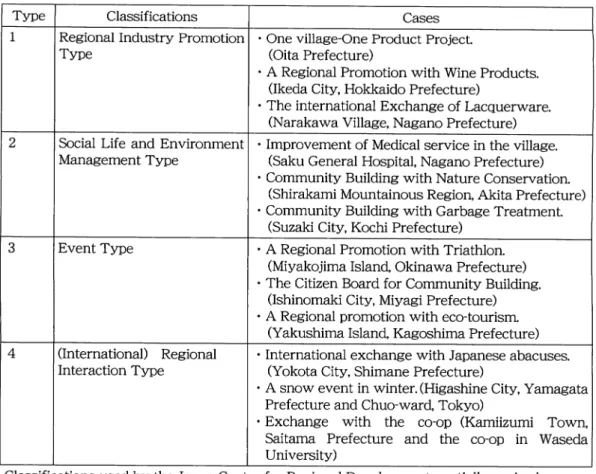
The specific content of regional development and promotion can be classified, as shown in Figure l-(3), into promotion of regional industry, promotion of improvement of social and environment, and international and inter-regional exchange, but these
classifications are inter-related. Of the above classifications, this course will address
promotion of local industries and companies, with reference to venture businesses, which are attracting global attention.-4-Figure 1: Japan's post-war economic recovery and era Path of Japan's post-war reconstruction
Economic
superpower
High economic growth Direction of
development Heavy chemical industry
Center development(large-scale development theory)
I
I
I "The Remodeling Japanese islands" proposed by the Tanaka administration
I
Challenges and problems raised
Environmental destruction
Urban over-population and pollution Rural depopulation and impoverishment
Demands of a new era
Era of re-recognition of nature (reflection on mass v consumption and mass waste) Era of regional devolution I j>
Era of advanced welfare
Principles of welfare and
environmental conservation
Conflict
\j——I Era of globalization
\ 1 Era of advanced IT \ 1 Era of market maturity
(Service economy, niche markets)
Market principles
1
Coexistence (key words: autonomy, Spontaneous motivation*-—* external dependency)
Regional promotion I
Main types of Regional Promotion
"Regional Industry Promotion" type "Improvement of Social Life and
I
Environment" type1-(3) I
"International and inter-regional exchange" type
L .
,
.
,
_■
2. Drawing on my Experience of Regional Promotion
In this paper I will present real, successful examples of regional promotion projects. The themes and content of these regional promotion projects vary according to the social needs of the region concerned. Similarly, the regional promotion projects I have worked on have changed from those springing from internal origins to the more recent regional venture businesses.
The following examples are drawn from my experience, and can be applied selectively to suit the needs of southeast Asia
1) Okinawa Island Development Study Group (1978 - 1988)
It was led by Mr. Tadao Kiyonari, currently chancellor of Hosei University (chairman of the Study Group), and I took part in it. At that time, Okinawa had just reverted to Japan (from US occupation), and there was not much interchange with the mainland.
People from around the Japanese mainland, who were involved in unique regional activities and crafts, were invited to the islands of Okinawa for seminars and exchanges. This program resulted in Okinawa generating its own local industries and businesses in fields such as carpentry, silk cultivation and weaving, and eco-tourism, using local resources. Those industries are still developing today.
2) Yonaguni Island Port Development Promotion (1987-1990) (*3)
Yonaguni Island is only 100km from Hualien in Taiwan, but because it had no open port (a port usable for international trade), those traveling to Taiwan had to go via Naha, the capital of Okinawa, increasing the distance tenfold to 1,000km. The same was true for distribution of goods. Therefore I worked with a newspaper company in Okinawa (Okinawa Times) to hold a symposium and publish special news features that publicized the benefits of a port to the islanders of Yonaguni (who only numbered l,500peoples). This publicity campaign was successful, and the port development project was formally adopted as a "Regional Creation Program One Hundred Million Yen" Project". I then worked with the island as an advisor. The completion of the port opened direct trade with Taiwan and China, enabling a 30% reduction in prices of daily goods and construction materials. The island is also working on other projects, such as intermediary trade and tourism.
3) Ibaraki (prefecture) Hometown Academy (1991 ~ 1995)
I am now working at Okinawa University (Okinawa prefecture), but before that I was teaching at University of Tsukuba in Ibaraki prefecture. Tsukuba, near Tokyo, is famous as
"Tsukuba Academic City".
When the above-mentioned "Regional Creation Program One Hundred Million Yen"
was attempted in Ibaraki in 1988 and '89, there was clearly a shortage of suitable personnel-6-in all the municipalities -6-involved This shortage prompted the beg-6-inn-6-ing of "Ibaraki
Hometown Academy", a program carried out in collaboration with municipalities in the
prefecture to educate personnel and build community leaders. I participated in the planning of the project and worked as a full-time instructor for the academy.The governor of the prefectural office became the headmaster of the academy, which
worked towards "independent, voluntary and pro-active efforts to build communities in ways
that reflect the character of their local history, culture and industries", by educating personnel and leaders able to realize that goal. The program targeted municipal staff and the employees of major companies in the prefecture.Participants in this Hometown Academy study the planning theories and methods for regional development, as well as attending several residential training sessions (monthly). After their training is complete, another important aim is for the trainees to enjoy discussions and informal communication over drinks in the evenings. That is a way to smooth communication between the staff of municipalities and companies of the prefecture, building friendly relationships. In future, municipalities, other local authorities (public) and companies
(private) will have to be able take care of business for the sake of wide-area or collaborative
projects with a single call (or e-mail, more recently), without having to reintroduce themselves. 4) Campaign to establish air and sea routes between Okinawa (Naha) and China (Xiamen)-Radio programs as a tool for regional promotion - (1993 - 1995) (*4)
At the time (1994 and before), Okinawa was situated on the border with Japan, but there were no sea or air routes to other countries, so it could not make the most of its advantages.
For example, if there was a direct freight route between Okinawa and China, it
would have been Japan's closest point to China, but instead, freight had to go via the ports of
Kobe and Kita-Kyushu. For Okinawa to exploit its border position in an age of globalization, it needs to open routes for container vessels between Okinawa and China (overseas destinations), establish an organization (cooperation) to encourage trade between the two countries, and set up a liaison office in China for companies in Okinawa doing business with China
To achieve these things, people concerned in Okinawa prefecture must be convinced of the advantages, and those who wish to participate in the projects must be invited to do so, reaching a wide range of people. Radio programs were planned for regular broadcast ("Great Trade Renaissance, every Sunday, 5~6pm) as a tool and a forum for business coordinators, calling for participation in projects. As a result, a regular container vessel link between Okinawa (Naha) and China (Xiamen) was achieved, and it still runs three times a month. Charter cargo flights flew between Okinawa and China four times, leading to a regular link which now runs to Shanghai (daily).
My role was as an advisor to the Okinawa China Economic Exchange Council, in which I carried out theoretical research, made policy proposals and conducted negotiations with the Chinese side.
5) Proposal, promotion and practical activities of Okinawa-style venture businesses (1995-present)(*5)
The unemployment rate in Okinawa is double that of the Japanese mainland, and income is only 72% of the mainland level. On the other hand, Okinawa now has a business chance that only comes once a century. One of the most modern ways of exploiting business chances is to set up a venture business.
When I moved to Okinawa University in 1995,1 was presenting theories, classifications and policies for venture businesses to use this business chance, as well as promoting such businesses and putting them into practice. First I ran night classes called "Open Venture
Seminar", which was open to the general public. There were an average of 50-60 participants
per year. I planned, prepared and broadcast a series of 13 half-hour programs on "New Industrial Theory in Okinawa", as a TV course for the Okinawa-region Broadcasting University. I also worked for three years planning and preparing "Professor Yoshikawa's Easy Economics" (monthly, ten minutes), a program for NHK Okinawa The program showcased venture businesses in Okinawa Graduates of the course started a number of venture businesses with my help, and I am still helping and taking part in their efforts. What Okinawa needs the most now are the actual role models and success stories.3. The subject of the Regional promotions
I have described the five main regional promotions that I have been involved in, but their content has been changing over the years to follow the changes in regional needs. In future, local society will globalize and IT will progress, but whatever path these changes take, both the country and the region will have to pursue regional promotion from a perspective of independence and internal generation.
So how should we look at the regional development that is the aim of regional promotion, and how should we consider the regions that are the target of that promotion? We intend to make that clear.
<What is a desirable region, and what is development?)
A desirable region depends on the level of abilities commanded by the individual occupants of the region and whether it is easy for them to use their abilities in the region concerned
Thus it is a society which imposes few obstacles and barriers when the potentiality of
a region's people emerges.
For example, when individuals want to put their abilities to use, they must not be
blocked by personal discrimination based on their gender, family status or other birth
attributes. Thus, they must have access to opportunities which enable them to exercise their
full potential.
Development is the positive, active pursuit of that situation. Therefore, for example, attracting industry to a region that has only agriculture, or proceeding with the industrialization of that region, will certainly increase incomes, but that is not the ultimate
goal. The people living in that region have many different abilities. Previously, only people
well suited to farming (such as people who are physically strong or can do the same job for
long periods) had opportunities to exploit their abilities.Attracting factories to that region increases opportunities for other people with abilities
valuable in factory work (such as skills for intricate, detailed work, and creativity) to use their
abilities, and makes those opportunities more clearly visible.<EvaJuation of development)
Next, I would like to describe how development and industrialization should be evaluated, in terms of level, scope and dimensions.
Evaluation should not be at the national level, or the industrial level. I believe the only dimension for evaluation of development is the microcosm of a few kilometers centered on
the regular marketplace (called "Machiyagwa" in Okinawa, "Pasar" in Indonesia and "Tarai" in
Thailand), which forms a complete, self-sufficient microcosm for the daily lives of farmers and citizens.Development and industrialization are what they are, so there is no question of
whether or not they are correct or desirable. They must be evaluated according to whether
they have improved the every-day wellbeing of the lives of farmers and citizens, the individual members of society.Chapter II : Regional Activity and International cooperation in Japan 1. Decentralization Moves in Asian Countries
Developing countries have been moving towards decentralization, leading to a rapid increase in requests for Japanese assistance to development and regional activities centered on local authorities and residents. The background to this situation will be presented here.
Several Asian countries are making rapid moves towards decentralization, but I would like to look briefly at the three following countries. My aim is to examine the background needs for those three countries, and clarify (with Proposal a chapterV). Japaness gaverment (actually JICA, Japan International Cooperation Agency) recent (1999-2001) stance on local governments and collaborative projects.
The Philippines (*6>
In 1991, the Aquino administration passed the Decentralization Act making it a relatively early starter towards decentralization in Asia In spring 1999, OECF (now JBIC) began preparations for the formation of the {North Samar General Agriculture Development Project?}, but by that time, authority over nearly all such projects had already been transferred to the regions, and the provincial governments lead negotiations over the project. The agricultural extension workers who played an important role in the project were national civil servants until 1991, but by that time they had become regional civil servants. It was a transition period, and budget shortages caused many problems. There was strong interest in the Japanese extension system, but projects for improving living standards were carried out by JICA.
Thailand <*7>
Article 78 of the constitution, from 1997, stipulates that "Decentralization must be
pursued as a basic government policy" and Article 284 says "Plans and procedures for
decentralization of local governments must be set by separate legislation". The law specifying
the decentralization plan and procedure was passed in November 1999, clearly stating that at least 20% of the 2001 budget and at least 35% of the 2006 budget should be spent by local governments. The transfer of duties, civil servants and budgets is proceeding. Training by JICA for "sustainable agricultural and rural development through capacity building in the regions" was carried out at Tsukuba International Center in November 2002, and it was targeted on one country, so that while students learned a great deal in Japan, it was clear which points could be applied to Thailand
Indonesia^
Decentralization is proceeding under the Megawati administration, with related laws coming into effect in 2001. Central government jurisdiction is limited to five fields, including diplomacy, defense and civil order, with other matters transferred to the jurisdiction of 348 counties and cities nationwide. Regional governments are now able to draw up budgets, carry out development plans and set their own taxes and surcharges. However, human resource development is of paramount importance, and JICA is implementing a "Capacity Building Program for Regional Administration".
2. Main types of regional promotion
Various types of regional promotion are developing strongly in Japan, based on the initiatives of local governments and residents. These unique activities have made a great contribution to regional and village development and in some cases, the experience gained has been applied to cooperation with developing countries.
The reason we have singled out Okinawa as a special case is "Utilizing characters common through-out neighboring countries in Asia", but I will explain the details later.
-I have been involved in, and studied, many regional promotion projects throughout
Japan, not just in Okinawa, and they can be classified as shown in Figure 2. The
classifications are explained below.Figure 2 The Classification of Regional Development
Type 1 2 3 4 Classifications Regional Industry Promotion Type
Social Life and Environment Management Type
Event Type
(International) Regional Interaction Type
Cases • One village-One Product Project.
(Oita Prefecture)
• A Regional Promotion with Wine Products. (Ikeda City, Hokkaido Prefecture)
• The international Exchange of Lacquerware. (Narakawa Village, Nagano Prefecture) • Improvement of Medical service in the village.
(Saku General Hospital, Nagano Prefecture) • Community Building with Nature Conservation.
(Shirakami Mountainous Region, Akita Prefecture) • Community Building with Garbage Treatment.
(Suzaki City, Kochi Prefecture) • A Regional Promotion with Triathlon.
(Miyakojima Island, Okinawa Prefecture)
• The Citizen Board for Community Building.(Ishinomaki City, Miyagi Prefecture) • A Regional promotion with eco-tourism.
(Yakushima Island, Kagoshima Prefecture) • International exchange with Japanese abacuses.
(Yokota City, Shimane Prefecture)
• A snow event in winter. (Higashine City, Yamagata Prefecture and Chuo-ward, Tokyo)
• Exchange with the co-op (Kamiizumi Town, Saitama Prefecture and the co-op in Waseda University)
Classifications used by the Japan Center for Regional Development, partially revised * These four types are classified by the Japan Center for Regional Development
** Refer to the Japan Center for Regional Development [2001] "Trends of regional policies" Regional development should be a comprehensive concept, incorporating a broad range of fields. Projects can be classified, according to content, into four types, as shown in Figure 2, Type 1. It shows specific cases in Okinawa which have developed into cooperative projects with JICA.
<Regional Industry Promotion Type)
This type promotes regional industries in order to increase local job opportunities and raise living standards. Thus, this type mainly pursues economic prosperity. It is a challenge that can arise at any time or place. Now that regional economic disparities between cities and
rural areas are becoming increasingly stark, the importance of this type of project is growing Industrial promotion policies vary with local circumstances, thus they should not be discussed in generalizations. Policies for attracting companies, which were expected to yield great benefits for under-developed areas, have lost their appeal and potential amid changes in
the economic environment, such as the recent shift of production facilities from Japan to
other countries. There is now a notable shift in emphasis towards industrial promotion based on local resources. It is also important to tackle entrepreneurial activity to enable the promotion of regional industries (called income-generation activities).
<Social Life and Environment Development Type)
Development of roads, communications, education, medical treatment and other factors in residents' live build regions that are good to live in. It is another universal challenge, but the aspects emphasized differ between urban and rural areas. In the cities, environmental problems such as overcrowding and pollution are addressed, while the low level of development is cause for concern in rural areas. Nevertheless, seen from the outside, even rural areas have changed almost beyond recognition from the previous state. In Japan the luxuriously high standard of some public facilities can cause amazement and disgust.
What is needed now, more than the development of large-scale social capital, is the building of facilities that are directly and intimately connected to people's everyday lives, such as sewerage, together with a shift of emphasis from hardware to services.
For a community to be good to live in, the most important thing is that its residents be on good terms with each other. In recent years there has been a notable move towards measures to improve community comfort and amenity, such as flower-planting campaigns along roads and around houses, river cleaning, anti-littering regulations, systems to encourage preservation of the built environment, and scenic preservation bylaws. Lifelong education, cultural activities and residents' environmental conservation campaigns must be built up to create communities that are good to live in. Women and the elderly are expected to take the lead in this kind of regional development. Volunteer work helps to support pleasant communities.
(Event type)
Various events are held to publicize a region externally and increase its name recognition, while instilling pride in the community and making it more lively and interesting to live in. This type of project has become very common in recent years, with countless examples. Some take the view that these events are symbolic of regional development today.
However, events are inherently transient, taking place and then ending, thus they do not really merit the name of regional development. The term "Regional development" first becomes applicable with sustained and goal-oriented efforts.
(Regional Interaction Type)
Interaction gives the people involved new momentum for progress. Throughout
-human history, societies, economies and cultures have developed through interaction.
Regional interaction is also becoming the mainstream in development today. Specifically,
there are international exchanges, exchanges between urban and rural areas, between
twinned cities, between upstream and downstream areas of river systems and many otherforms where some common ground can be found. The content of exchanges are also diverse,
including trade in produce, owner methods, profit-sharing contracts, special residence
systems, cross-cultural experiences and fund-raising. Regional development based around interaction is certain to become increasingly active in future.The Yonaguni Port Development Project in Okinawa, and the opening of the container
ship route between Naha in Okinawa and Xiamen in China, which described in Chapter I ,
are typical examples of regional interaction projects. What that means is that as regions see
their self sufficiency crumbling rapidly, they are expected to enjoy growing benefits from
openness and interaction with other regions. The following example illustrates the relationship between cities and villages.Cities contain enormous accumulations of wealth. At the same time, the urban
problems of overcrowding, pollution and psychological demoralization are emerging and
deepening. On the other hand, rural areas are relatively abundant storehouses of nature, but
they are underpopulated, economically weak and suffer land degradation, problems which
are forcing them into decline. It is not easy for either side to generate its own solutions
internally, but complementary links between the two, so that cities can be saved by rural elements and the countryside can draw on the economic strength of the cities. That is how regional interaction is established The same holds true if cities are replaced with developing countries and the rural areas with developed countries in the above discussion.3. Community development Is human development
Regional development as it is now developing is classified into four types, as above. Clearly, the four types are deeply interlinked, and in practice they are not carried out in isolation. One recent characteristic is that they are being combined in various ways for different types of activity.
For example, regional industrial promotion and regional interaction can be advanced in parallel, and such moves can be linked to events, and improvements of the social and living infrastructure can encourage events and interaction. There are many other possible combinations. That is now a social current that helps to form modern regional development It is truly a comprehensive campaign.
What that means is that regional development can begin from any of the types. Local conditions determine which field should be the starting point. To put it another way, regional development does not consist of quantitative processes and arrangements. It can gather momentum from any source, and proceed by many and various methods. It is undesirable to
try and fit all such development to a single pattern.
The important thing is simply to get started Regional development is the same, as there must be one single starting point, appropriate to local conditions. After that, there must be sustained expansion and broadening of scope, so that the effort does not end as a transient or isolated attempt. In that way, regional development gradually builds its vitality.
The basic strategy for regional development can, therefore, be summarized as "find an
opening, then spread to all aspects". But who is in charge of managing and propelling thisbasic strategy? Without that person, there is no progress in regional development. If "find an
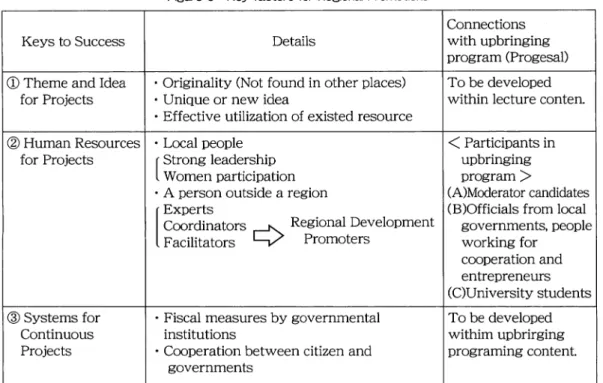
opening, then spread to all aspects" is not to end as a mere theme, there must be human development, concentrating on the people who will do the work of regional developmentFigure 3 shows "Keys for success in regional projects", and one of those three is Figure
3 ©, human resources for projects.
As is often said, "regional development is human development". It could also be said
that "regional development begins and ends with human development". In that sense,
educating people who can take the initiative and develop it is a central plank in the basic strategy for regional development
Figure 3 Key factors for Regional Promotions
Keys to Success ® Theme and Idea
for Projects © Human Resources for Projects (3) Systems for Continuous Projects Details
• Originality (Not found in other places) • Unique or new idea
• Effective utilization of existed resource Local people
Strong leadership
. Women participation
A person outside a region
Experts
Coordinators
iv Regional Development
Facilitators ^ Promoters
• Fiscal measures by governmental institutions
• Cooperation between citizen and
governments
Connections with upbringing program (Progesal) To be developed within lecture conten. < Participants in
upbringing program >
(A)Moderator candidates (B)Officials from local
governments, people working for cooperation and entrepreneurs (C)University students To be developed withim upbrirging programing content
To Readers, comment on this paper and send me it by e-mail([email protected]) please.
-<References>
(*1) Vernon R., Beyond Globalism : Remaking American Foreign Economic Policy, Simon
& Schuster Adult Publishing Group, 1988.(*2) Ohmae K., The Borderless World: Power and Strategy in the Interlinked Economy,
London Collins, 1990.
(*3) See in detail, Yoshikawa R, "An Open Port for Yonaguni: Japan's southern most outpost
seeks to make of locational advantages", By The Way, vol.5, No.2(March, 1999), pp.42-49.(*4) See in detail, Yoshikawa H., "EnRoute to a Trade RenaissancerOkinawa sets its sights on
prosperity as a community without borders", By The Way, vol.5, No.4(May, 1999), pp.38-47.
(*5) See in detail, Yoshikawa H., "Theory of Regional Venture Business(l)(2)", the Study
Bulletin of Department of Law and Economics, Okinawa University, No.4 (March, 2004), pp.1-19, No.5 (March, 2005), pp.1-16.(*6,7,8) Extracted from "Taking Experience of Regional Promotion to the World", edited by the
Japan International Cooperation Agency, and the Institute for InternationalCooperation, 2003, pp.10-11.
Home Page (http://www.h-yosikawa.com)