C12
Numerical Simulation of Long-term Bed Deformation of Braided River
Considering Sediment Sorting
〇Shampa, Yuji HASEGAWA, Hajime NAKAGAWA, Hiroshi TAKEBAYASHI, Kenji KAWAIKE
Introduction
Braided rivers are characterized by numerous channels and bedforms (ripples, dunes, small to large scale bars). During the high stage, due to the complex geometry of the braided bed, channels and bedforms experience variable flow depth and sediment concentration. During this process, non-uniform sedimentation becomes prominent if the river bed is characterized by a variable sediment size. The alluvial braided rivers transporting non-cohesive sediments (fine grains) are more subjective to such type of sediment sorting as pick-up and transportation of fine grains requires less energy. In the highly dynamic river, this sorting process may influence the small-scale morphology (e.g., dune proportions, bed composition, and bed roughness) as well as size-selective sediment transport resulting mean bed and flow depth alteration. Therefore this process affects the long-term channel avulsion or short-term channel shifting and bar sedimentation process. Hence, the main objective of this research is to calculate the long term bed evolution of braided river due to extreme flood considering the sediment sorting. As the study area, 225 km reach of Brahmaputra- Jamuna River at Bangladesh was selected.
Methodology
The hydrodynamics are modeled by applying Navier Stokes equations in two-dimension for incompressible flow as described in Shampa et al (2017). For non-cohesive sediment transport prediction, the equations of Van Rijn (1993) was used. The model was calibrated and verified using the hydrodynamic data condition of
the year 2011 and 2012.
Previous researches of bed sorting may be categorized into three kinds-mixed layers based approach, multi-layer approach and sorting evolution approach. Here, a modified multi-layer approach had been used (Ribberink 1987). The natural river bed is discretized vertically into a series of layers including active, transition, under and the base layer above a datum level, 𝜂 as shown in Fig. 1. Only the sediment contained in the active layer is available for erosion or deposition during a calculation time step. A transition layer is situated below the active layer, can exchange particles to the active layers. According to Figure 1 the bed level, 𝜂 can be expressed as
𝜂 = 𝜂 + 𝑡ℎ + 𝑡ℎ + ∑ 𝑡ℎ
Where, 𝑡ℎ , 𝑡ℎ and 𝑡ℎ represents the thickness of active, transition and under layers. The summation of the bed changes, δ𝜂 due to all the size fractions, k is the resulted the tot inal bed variation in one time step as follows
δ𝜂 = ∑ δ𝜂
Here, M is the total size fractions. The repeated flood hydrograph Brahmaputra-Jamuna for 100, 50, 20, and 2.33 year return period with 25-year duration were used as a boundary condition (Fig. 2).
As the bed composition, initially, five layers of sediments were set which were the combination of sediment with d50 ranging from 100 µm to 277 µm
including a uniform base of 277 µm sediment. The active layer was proportional to the water depth and the thickness of each transport layer was assumed to be 1m with the 30 maximum under layers.
Results
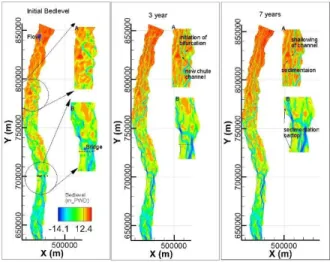
Results are basically divided into two parts. At first, the sediment sorting morphology model was compared to yearly bed change for the flooding period 2011 with the uniform bed composition at different measured cross-sections. The comparison result at Mathura is shown in Fig. 3. This figure showed a more reasonable prediction of river bed with bed sorting compared to uniform bed sorting. After that, the model was used to calculate the long-term sediment transport and bed evolution. Fig. 4 shows the result of bed evolution 7-year change due to 100-7-year flood. The results indicate that due to high amplitude flood the braiding intensity will increase in the upstream part of the river reach (Y= 750,000 m to 850,000 m). Channel shifting and new bifurcation were also observed which seemed to be prominent with time. The sediment fraction of the top
layer became coarser with time. Conclusions
In this study, the long term bed evolution of braided river has been assessed due to extreme flooding with the consideration of non-uniform sedimentation. The inclusion of bed-sorting in the morphology model enhances its prediction capacity compared to the uniform bed. Due to extreme flooding, the braiding intensity in the upstream reaches where the slope is relatively higher tends to increase. At the same time, high magnitude flood also results in the coarser river bed in the long run.
Acknowledgments
The authors acknowledge JST-JICA funded SATREPS project “Research on Disaster Prevention/Mitigation Measures against Floods and Storm Surges in Bangladesh” for funding this research.
Reference
Ribberink, J. S. (1987): Mathematical modelling of one-dimensional morphological changes in rivers with non-uniform sediment, Faculty of Civil Engineering, Docteral Thesis.
Shampa, Hasegawa, Y., Nakagawa, H., Takebayashi, H., and Kawaike, K. (2017): Dynamics of sand bars in braided river : a case study of Brahmaputra-Jamuna river, Journal of Japan Society of Natural Disaster Science,Vol. 36 (Special issue), pp.121–135.
-5 5 15 25 0 50000 100000 0 60 120 180 240 300 360 W at er L ev el (m _P W D) D isc hr ge (m 3/s ) Time (days) Discharge Water level
Fig. 2 Boundary condition of the model due to 100year return period flood
Fig. 3 Comparison between initial and final bed level at Mathura due to mixed and uniform bed
Fig. 4 Bed changes of Brahmaputra-Jamuna due to 100 year return period flood