著者
キャラ・ フィリップス
著者別名
Cara PHILLIPS
journal or
publication title
Journal of business administration
volume
92
page range
127-138
year
2018-11
URL
http://id.nii.ac.jp/1060/00010238/
Creative Commons : 表示 - 非営利 - 改変禁止 http://creativecommons.org/licenses/by-nc-nd/3.0/deed.jaTechnology-Assisted English Self-Study
Cara PhillipsAbstract
Given the limited instruction time in English that most undergraduate non-English majors receive at many Japanese universities, looking to self-study possibilities is often more practical than focusing solely on in-class activities. This study looks specifically at self-study options utilizing the ubiquitous Smartphone. A survey was administered to gauge which English learning apps and mobile-friendly websites were used by first-year business administration majors at a Japanese university. Several teacher-recommended apps/websites were also given to the students after the administration of the survey. Survey responses were examined according to the most frequently used apps/websites and the rate of English-learning technology use in general (including CD-ROMs, online dictionaries, etc.) with regard to the students’ English levels and other explanations written on the surveys by the respondents themselves. These results could lead university EFL/ESL instructors to make more informed recommendations to students about their self-study options.
1. Introduction
1.1 English Self-Study through Technology
The ubiquity of mobile technology is a gateway to the possibilities for autonomous language learning. Mobile Assisted Language Learning – or “MALL” – is a rapidly emerging area of language education because mobile technology is now widely used by people all over the world, not just in developed countries. Thus, it has the potential to aid in language learning on a global level (Motteram, 2013a).
MALL can help supplement or extend language learning beyond the classroom when class time is limited. Similar to the non-major English learners at Japanese universities, the adult distance learners, who were the subjects of a study by Demouy et al. (2016), did not have enough time in class or with their instructors. As a result, the subjects chose to supplement their English language study with mobile devices because they needed “to find ways of compensating for the lack of frequent regular classroom contact with teachers and peers” (Demouy et al., 2016).
Technology further allows for direct communication with native speakers and other learners all over the world, such as video conferencing (Motteram,
2013b). While generally this kind of activity is not completely autonomous, and often needs to be organized by a teacher, “talking to real people is the best way to practice English”. When real conversations in English are not possible, apps and websites can provide worthwhile alternatives for speaking and listening practice (Beck, 2014).
1.2 Apps and Websites for English Self-Study
There is a wide range of technology available to language learners today. Mobile or tablet apps, websites, online dictionaries, podcasts, video chat programs are multitudinous and available for language learning (Zazulak, 2015). There is a whole world of podcasts, Youtube channels, WebQuests, online games, blogs, and audiobooks to explore (Fudin, 2012).
Many types of technology give English learners “the ability to listen anytime, anywhere” to improve one’s listening skills (Zazulak, 2015), which, without technology, would be hard to develop in environments where English is not widely spoken. Practicing speaking is even more difficult than practicing listening in these environments, but mobile apps like CoffeeStrap, HelloTalk, and Skype now provide opportunities to practice speaking in English with other learners or native speakers (Zazulak, 2015; Fudin, 2012).
Some other popular English learning apps recommended by educators and researchers are as follows, in alphabetical order:
Babbel: babbel.com – new vocabulary and grammar through interactive quizzes, listening and speaking, reading and writing, or pronunciation, both app and website, Japanese interface option, not free (Beck, 2014; Educational App, 2016)
BBC: bbc.co.uk/learningenglish – video and radio broadcast lessons from intermediate to advanced learners, website but no app, no Japanese interface option, free (Beck, 2014)
British Council: learnenglish.britishcouncil.org – interactive lessons, videos, games, podcasts, and exercises, categorized by age group, both app and website, no Japanese interface option, free (Beck, 2014; EducationalApp, 2016)
Busuu: busuu.com – vocabulary and interactive tests about many topics, some parts are free, Japanese interface option (Pesce, 2012; EducationalApp, 2016)
Duolingo: duolingo.com – new vocabulary and grammar through interactive games and quizzes, lessons separated by categories, both app and website, Japanese interface option, free (Beck, 2014; EducationalApp, 2016)
English Central: ja.englishcentral.com – video-based learning, pronunciation and speaking practice, blog, membership allows progress tracking, Japanese
interface option, some parts free (Beck, 2014; Zakhareuski, 2013)
iKnow!: iknow.jp – various skills and vocabulary learning, dictations, games, quizzes, etc. Learners can even create activities/study content to share with other users, both app and website, Japanese interface option, some parts free (Toto, 2008)
Memrise: memrise.com – innovative and creative methods of vocabulary expansion and grammar learning, Japanese interface option, free (Educational App, 2016)
Speaking Pal: speakingpal.com – 5-minute lessons through a simulated video call, some parts are free, Japanese translation option, but interface is only in English (Pesce, 2012)
Quizlet: quizlet.com – vocabulary learning with flashcards, games, tests, both app and website, Japanese interface option, free (Taylor & Birchley, 2008) 2. Procedure
2.1 The Survey Given to Participants
A survey was administered to gauge which English learning apps and mobile-friendly websites were used by the participants. The survey (appendix) deals with research questions #1-3 below and was conducted at the beginning of the term.
Research Questions:
1. What are the students’ experiences to date using technology for English study?
2. How frequently are the students already using apps and websites for English study?
3. For those that are using them, specifically which apps and websites have they used?
Several of the teacher-recommended apps/websites mentioned in part 1.2 of this study were also explained and recommended to the students after the administration of the survey: Quizlet, Speaking Pal, iKnow!, English Central, and Busuu. The researcher had experience using these apps/websites and felt them useful, so they were included in the recommendations to the participants of this study.
2.2 The Participants
The 146 survey respondents were all students in four of the researcher’s 2017 spring semester first-year Business English courses. The English levels – and resulting course placement – of these respondents are based on their TOEIC Bridge scores from April of the same year. Given that Classes 7 and 8 have very similar average scores, they fall under the category of mid-level (A1/A2) “basic
users”. Given that Classes 16 and 18 have very similar average scores, they fall under the category of high level (A2) “basic users” of English, respectively, following the Common European Framework of Reference for Languages (CEFR) (ETS, 2015). To note, there are 21 classes total, 1 being the lowest level and 21 the highest.
The following are the average TOEIC Bridge scores per class: Class 7- Total 130, Listening 64 (lowest A2), Reading 66 (high A1) Class 8- Total 133, Listening 64 (lowest A2), Reading 69 (highest A1) Class 16- Total 150, Listening 71 (middle A2), Reading 79 (middle A2) Class 18- Total 154, Listening 74 (middle A2), Reading 80 (middle A2) According to the CEFR, there are six levels for non-native users of English: A1– A2 (Basic User), B1– B2 (Independent User), C1– C2 (Proficient User). The following chart shows how these CEFR levels correspond to TOEIC Bridge scores (ETS, 2015):
Test/Test Section Total Score Scale Range Minimum Score A1 A2 B1 B2 C1
TOEIC BridgeTM Listening 10–90 46 64 84
TOEIC BridgeTM Reading 10–90 46 70 86 3. Survey Results
Figure I.a.“Yes” answers to technology use for English self-study by level Type of English learning
technology: English Level A1/A2 A2 Class 7 (n=37) Class 8 (n=36) Com-bined (n= 73) Class 16 (n= 35) Class 18 (n= 38) Com- bined (n= 73) app on smart phone
or tablet 16 (43%) 24 (67%) 40 (55%) 25 (71%) 28 (74%) 53 (73%) computer program or CD-ROM 2 (5%) 6 (17%) 8 (11%) 5 (14%) 10 (26%) 15 (21%) websites, social media, etc. 8
(22%) 8 (22%) 16 (22%) 10 (29%) 12 (32%) 22 (30%) online/app dictionaries 20 (54%) 23 (64%) 43 (59%) 22 (63%) 24 (63%) 46 (63%)
The first set of results of Survey 1 show that more than half of all students reported having experience with two types of technology for English language learning: apps and online dictionaries. 55% of the A1/A2 level and 73% of the A2 level reported having used English learning apps, which shows a somewhat large difference of 18% between the two levels. As for their experience using dictionary apps or online dictionaries, 59% of the A1/A2 level and 63% of the
A2 level reported having used them. On the other hand, only 11% of the A1/A2 level and 21% of the A2 level reported having used computer programs/CD-ROMs for English learning. This is not surprising, since computer programs/CD-ROMs do not usually utilize the internet and are not accessible from mobile devices. In addition, they are rather old forms of technology - popular before these students were even school-aged. However, the more generation-appropriate websites and social media are underutilized for English learning by these students and cannot be explained by the same rationale: 22% of the A1/A2 level and 30% of the A2 level.
Figure I.b. Most frequently used apps, programs/CD-ROMs, websites/social
media, and dictionaries
Type of technology: Class 7 A1/A2 (n=37) Class 8 A1/A2 (n=36) Class 16 A2 (n=35) Class 18 A2 (n=38) app on smart phone
or tablet ターゲット Mikan 英単語学習 Mikan ターゲット キクタン 東進 TOEIC Mikan ターゲット ラジオ英会話 Mikan ターゲット スタディ サプリ computer program or CD-ROM Break Through Speed learning ビーゴ チャーピー センター試験 リスニング TOEIC の ネット授業 リスニングCD (テキストに付随) 東進予備校 スタディ サプリ Everyday English DMM 英会話 アルク All in one キクタン websites, social media, etc. Youtube TED CBS News Facebook HelloTalk
Youtube Youtube Twitter Youtube online or app dictionaries Weblio Google Weblio Google Weblio Google ジーニアス Weblio LINE Google ウィズダム
The students also wrote the names of apps, websites, programs, dictionaries, etc. that they have used for English learning. The learning apps that were reported the most often were Target and Mikan, used by students in all classes. Weblio and Google Online dictionaries were also used across the board. Youtube was the most popular website used by students in all classes. There were no
common computer programs/CD-ROMs used by the participants.
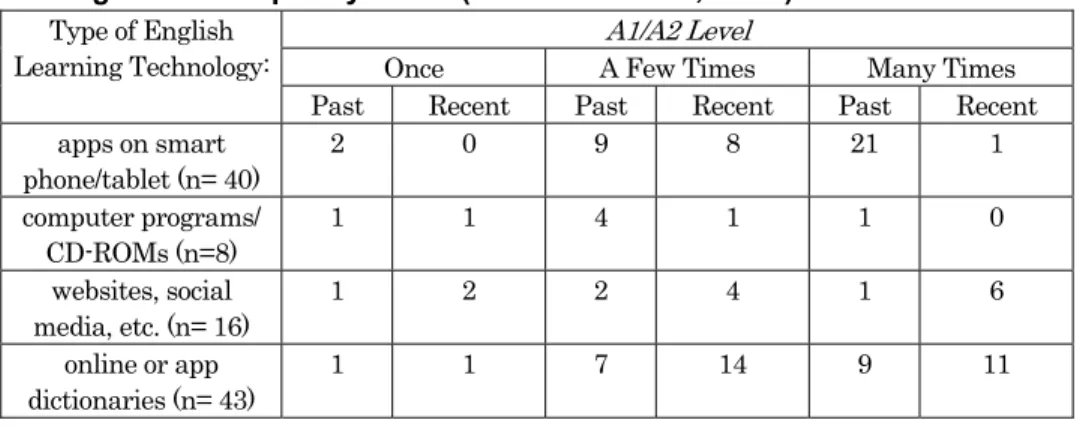
Figure II.a. Frequency of use (for YES answers, n= 73) for A1/A2 level: Type of English
Learning Technology:
A1/A2 Level
Once A Few Times Many Times Past Recent Past Recent Past Recent apps on smart phone/tablet (n= 40) 2 0 9 8 21 1 computer programs/ CD-ROMs (n=8) 1 1 4 1 1 0 websites, social media, etc. (n= 16) 1 2 2 4 1 6 online or app dictionaries (n= 43) 1 1 7 14 9 11
For A1/A2 level participants, while as many as 30 (41% of all participants at this level) have used apps for language learning a few or many times in the past, only 9 (12% of all participants at this level) have used them a few or many times recently. Recent online dictionary/dictionary app use of a few or many times is higher than other English study app use for the A1/A2 level participants, at 25 (34% of all participants at this level). Recent A1/A2 English computer program/CD-ROM use was low at only 1 participant, and recent English websites/social media use was at 10 (14% of all participants at this level).
Figure II.b. Frequency of use (for YES answers, n= 73) for A2 level: Type of English
Learning Technology:
A2 Level
Once A Few Times Many Times Past Recent Past Recent Past Recent apps on smart phone/tablet (n= 53) 3 0 15 13 22 7 computer programs/ CD-ROMs (n=15) 1 0 8 2 6 0 websites, social media, etc. (n= 22) 2 2 5 4 4 7 online or app dictionaries (n= 46) 1 2 7 14 5 20
The results for the A2 level participants followed a similar pattern. While as many as 37 (51% of all participants at this level) have used apps for language learning a few or many times in the past, only 20 (27% of all participants at this level) have used them a few or many times recently. Recent online dictionary/dictionary app use of a few or many times is a little higher than other
English study app use for the A2 level participants, at 34 (47% of all participants at this level). Recent A2 English computer program/CD-ROM use was low at only 2 participants, and recent English websites/social media use was at 11 (15% of all participants at this level).
4. Analysis of Results
The research questions revisited:
1. What are the students’ experiences to date using technology for English study?
2. How frequently are the students already using apps and websites for English study?
3. For those that are using them, specifically which apps and websites have they used?
Concerning research questions #1 and #2, even though the majority of the participants have experience using the internet/technology to look up words and apps to study English (Figure I.a.), their “frequency of use” results (Figure II.b.) show that these are not frequently practiced English learning activities among many first-year Japanese university students. In addition, compared to app and dictionary use, website and social media access for the purpose of language learning is even more uncommon among these participants. Demouy et al. (2016) found similar results, that apps were more popular than social media among learners, supporting the hypothesis “that the mobile language learners prefer to use their devices for independent study”. While there is not a great difference between the two levels, there is an almost consistently – albeit slightly – higher average use of technology for English study among the A2 level participants compared with that of the A1/A2 level. According to these results, a slight increase in app use appears to be associated with a slight increase in L2 learning success.
With regard to research question #3, Mikan and Target were the most used apps, as reported by the respondents, and are Japanese-language medium sites that have flashcard style learning activities. This could be demonstrating the participants’ preference for a first-language interface and vocabulary learning app. Youtube was the most popular website used by students in all classes, which demonstrates participants’ preference for audio-video style learning. Similarly, participants in the Demouy et al. (2016) study reported that listening “is the activity they engage in the most on their mobile device. Accessing authentic resources is also a popular choice. ‘I use YouTube to listen to French’”, reported one participant.
5. Discussion
While the popularity of the Mikan and Target apps and Youtube website/app was clear, the reasons why the participants chose these sites were not explicitly given in their responses. Future studies could further explore university students’ app/site preferences and specific reasons for those preferences. In addition, there could be a separate follow-up to see if students would use and find beneficial the apps/websites on the list of educator-recommend apps presented in the literature review. Finally, a further study on motivation and how it relates to self-study, specifically independent mobile-assisted language learning, would also enhance one’s understanding about students’ tendencies and preferences presented in this paper.
6. Conclusion
Japanese university students literally have a means to learn English at their fingertips: their mobile phones. The majority of Japanese university students today constantly have smart phones in their possession, providing them with quick and easy access to a wide world of English language learning opportunities - if they choose to utilize them. The results of this study show that using mobile and computer technology to study English is not foreign to Japanese university non-major students, and that use may be slightly higher with increased L2 proficiency, but students on average are spending little time engaged in English self-study using this technology. Given the limited time non-major students generally spend in their English classes and/or with their English instructors each week, self-study options should be recommended to students. Since Smartphone technology is readily available to most, if not all, of said students, self-study utilizing this technology would be a logical – and likely enjoyable – option for them.
Unfortunately, the teacher/class time required for training students to use the various English self-study technology is generally limited for non-English majors, and there is often little wiggle-room around the tight syllabus. Therefore, for self-study that has potential to further English language learning beyond the very limited class time, the apps/websites that instructors recommend to students should have user-friendly and L1-language-option interfaces enabling students to navigate them easily on their own with limited instruction.
References
Beck, J. (2014) The 8 best interactive websites for adults to learn English. FluentU English Educator Blog. Retrieved November 12, 2017, from https://www.fluentu.com/blog/ english/best-websites-to-learn-english.
Demouy, V., Jones, A., Kan, Q., Kukulska-Hulme, A., & Eardley, A. (2016). Why and how do distance learners use mobile devices for language learning? The EuroCALL Review, 24 (1). Retrieved December 15, 2017, from https://polipapers.upv.es/index.php/eurocall/ article/view/5663/5659
Educational Testing Service (ETS). (2015). Mapping the TOEIC® tests on the CEFR.
Retrieved May 9, 2017, from https://www.ets.org/s/toeic/pdf/toeic_cef_mapping_flyer.pdf EducationalAppStore.com. (2016). 5 best apps for English language learners. Retrieved
November 12, 2017, from https://www.educationalappstore.com/best-apps/5-best-apps-for-english-language-learners
Fudin, S. (2012, November 21). 10 modern ways to use technology in ESL instruction. Busy Teacher. Retrieved November 12, 2017, from http://busyteacher.org/13732- using-technology-esl-instruction-10-modern-ways.html
Motteram, G. (2013a). Innovations in learning technologies for English language teaching.
London: British Council. Retrieved December 22, 2017, from https://www.teaching english.org.uk/sites/teacheng/files/C607%20Information%20and%20Communication_ WEB%20ONLY_FINAL.pdf
Motteram, G. (2013b, September 18) The benefits of new technology in language learning.
Voices Magazine, British Council. Retrieved November 9, 2017, from https://www. britishcouncil.org/voices-magazine/the-benefits-new-technology-language-learning Pesce, C. (2012, August 29). The 9 best mobile apps for your ESL students. Busy Teacher. Retrieved
April 20, 2017, from http://busyteacher.org/12155-9-best-mobile-apps-for-esl-students.html. Taylor, C., & Birchley, S.L. (2008). Virtual cards: An action research project exploring how far
online flashcards can invigorate vocabulary learning. Bulletin of Toyo Gakuen University, 16, 47–55.
Toto, S. (2008, October 15). iKnow is a social learning platform that can really make you smarter. Opens API. TechCrunch. Retrieved December 21, 2017, from
https://techcrunch.com.2008/10/15/iknow-is-a-social-learning-platform-that-can-really-make-you-smarter-opens-api,
Zakhareuski, A. (2013, June 20). Englishcentral.com: BusyTeacher’s detailed review. Busy Teacher. Retrieved November 29, 2017, from http://busyteacher.org/15742-english-central-busy-teacher-detailed-review.html
Zazulak, S. (2015, November 19). How students can use technology to improve their English.
Pearson English. Retrieved November 30, 2017, from https://www.english.com.blog/ students-can-use-technology-improve-english
Appendix
Technology and English Learning Survey
テクノロジーと英語の学習に関するアンケート
This questionnaire is not related to your grade on the test or in this class, so please answer honestly.このアンケートは試験や授業の採点と関係ありませんの で、正直にお答えください。
Please check the following you have used to learn English. (English learning games using the following technology also apply.) Also, please check when, and how often.
使った事がある英語を学ぶためのテクノロジーを下記の項目からチェックしてく
ださい。(英語学習のテクノロジーにゲームにも含みますので、英語のゲームでも
チェックしてください。)そして、いつ使ったか、また頻度もチェックしてくださ
い。
1. English learning app on smart phone or tablet (except dictionaries):
スマートフォンまたはタブレットの英語学習のアプリ(辞書以外):
IF YES, please check one or more boxes below:
使った事ある場合、下の項目をチェックしてください。 (複数回答可)
IF YES, please give the name of the app(s) that you used: 使った事ある場合、アプリの名前(複数回答可) を書いてください。
2. English learning program on computer or CD-ROM (except dictionaries):
パソコンまたはCD-ROM の英語学習のプログラム(辞書以外):
IF YES, please check one or more boxes below:
YES/使った事がある NEVER
/使った事がない
Once, recently 一回、最近
A few times, recently 数回、最近
Many times, recently よく、最近
Once, a long time ago 一回、昔
A few times, a long time ago 数回、昔
Many times, a long time ago よく、昔
YES/使った事がある NEVER
/使った事がない
使った事ある場合、下の項目をチェックしてください。(複数回答可)
IF YES, please give the name of the programs(s) that you used:
使った事ある場合、プログラムの名前(複数回答可) を書いてください。
3. English learning website, including using Youtube, social media, etc. in English (except dictionaries)
英語学習のホームページ、英語を使う Youtube, ソーシャルメディア(SMS)
等を含みます。(辞書以外):
IF YES, please check one or more boxes below:
使った事ある場合、下の項目をチェックしてください。 (複数回答可)
IF YES, please give the name of the website(s) or SMS that you used:
使った事ある場合、ホームページまたはSMS の名前(複数回答可)を書いて
ください。
4. English online dictionaries/ dictionary app:
アプリ、パソコンプログラム、オンラインの辞書(和英、英和、英英)
IF YES, please check one or more boxes below:
Once, recently 一回、最近
A few times, recently 数回、最近
Many times, recently よく、最近
Once, a long time ago 一回、昔
A few times, a long time ago 数回、昔
Many times, a long time ago よく、昔
YES/使った事がある NEVER
/使った事がない
Once, recently 一回、最近
A few times, recently 数回、最近
Many times, recently よく、最近
Once, a long time ago 一回、昔
A few times, a long time ago 数回、昔
Many times, a long time ago よく、昔
YES/使った事がある NEVER
/使った事がない
使った事ある場合、下の項目をチェックしてください。(複数回答可)
IF YES, please give the name of the dictionary that you used: 使った事ある場合、辞書の名前(複数回答可)を書いてください。