On the spread of ‘-wise’ viewpoint adverbs
to L2 varieties of English
著者
MORROW Phillip R.
journal or
publication title
THE NAGOYA GAKUIN DAIGAKU RONSHU; Journal of
Nagoya Gakuin University; LANGUAGE and CULTURE
volume
30
number
2
page range
11-18
year
2019-03-31
発行日 2019 年 3 月 31 日
On the spread of ‘-wise’ viewpoint adverbs to
L2 varieties of English
Phillip R. MORROW
Faculty of Foreign Studies Nagoya Gakuin University 〔Article〕観点を表す副詞
-wise における英語の L2 varieties への
浸透について
P. R. モロウ
名古屋学院大学外国語学部 AbstractThe case of –wise viewpoint adverbs provides an intriguing instance of a new form that has entered English relatively recently and has spread across dialects and genres. Previous research has documented the development and spread of this form in L1 varieties of English; the present study extends this research by investigating its spread and use in L2 varieties, drawing on data from the GloWbE Corpus. –Wise viewpoint adverbs are shown to have spread to L2 varieties. In these varieties they are also productive: forms occur in them which did not occur in the L1 varieties. Also, there are instances of –wise being affixed to an adjective rather than noun base, and occasionally to a non-English base.
名古屋学院大学論集
Introduction
There is general agreement that viewpoint adverbs formed with the suffix –wise came into use in American English in the 1940s and that their use has become more widespread since then. Although the formation of viewpoint adverbs with –wise is a relatively recent phenomenon, there are many common manner adverbs from an earlier period that contain –wise, for example, otherwise, lengthwise and clockwise. The suffix –wise comes from a noun in Old English that meant ‘manner’ or ‘fashion’. This noun is no longer used as an independent noun in current English, though its meaning survives in words with the suffix –wise, and in phrases such as, in no wise or in any wise. While such phrases are relatively infrequent, there are numerous and frequently-used adverbs formed with –wise (e.g., endwise, sidewise, widthwise). These are termed manner adverbs since they indicate the direction or dimension of an action, or more generally how an action is performed. They are distinct from viewpoint adverbs, which are the subject of the present study. Typical viewpoint adverbs include expressions like careerwise or moneywise. They can be usually paraphrased using prepositional phrases such as, ‘from a ___ point of view’ or ‘in terms of _____’.
Viewpoint adverbs with –wise have attracted the interest of linguists partly because of their productivity. Quirk et.al. (1985: 1557) notes that they are quite “freely productive” (especially in American English) in the sense that speakers can create new words by adding –wise to noun base forms. However, style manuals tend to frown upon the use of such forms. For example, the online Oxford dictionary provides the following information regarding the use of the –wise suffix: “In modern English the suffix –wise is attached to nouns to form a sentence adverb meaning ‘concerning or with respect to’, as in confidence-wise, tax-wise, price-wise, time-wise, news-wise, and culture-wise. The suffix is very productive and widely used in modern English but most of the words so formed are considered inelegant or not good English style.” (en.oxforddictionaries.com) Likewise, the English Plus website cautions writers that, “Coining new words with the suffix –wise may be clever, but it is nonstandard,” and advises using, “He did well in sales this quarter,” rather than, “He did well this quarter saleswise” (englishplus.com).
Nevertheless, viewpoint adverbs with –wise have continued to be used, and indeed have become more frequent as corpus-based studies have shown (Cowie 2006, Lindquist 2007). This is true not only in American English where the form orginated, but also in British English to which it has spread. There have been several in-depth studies of –wise viewpoint adverbs. Lenker’s (2002) study is primarily concerned with their history and development. She suggested that the –wise viewpoint adverbs arose in response to a functional need in scientific discourse to specify the domain of utterances. Lenker concluded that the form developed through pattern transfer from likewise and otherwise, which had already been lexicalized.
–ful and –type as productive formatives in English. Using data from the British National Corpus they examined the grammatical status of these elements, in particular whether their use should be considered suffixation or compounding. They concluded that word forms with –wise and –ful, should be considered suffixations, but noted that forms with –wise were less frequent than those with –ful. Regarding its role in word formation, Lenker (2002) observes that viewpoint adverbs with –wise are similar to those formed with –(ic)ally, but the latter are normally used only with nouns of Romance origin, while –wise is not restricted in the type of noun it can be attached to.
The most thorough study of –wise viewpoint adverbs is that of Lindquist (2007). Using several corpora, Lindquist made a detailed study of the frequency, morphological constraints and usage of these adverbs in different registers and dialects of English. Several significant findings came out of his study. First, he found that although –wise viewpoint adverbs originated in American English and have been considered a feature of American English (Quirk et al. 1985: 568), they are, in fact, widely used in British English. Comparisons of their use in the American New York Times and the British Independent “indicate clearly that the frequency of viewpoint adverbs in –wise has increased throughout the period [1990-2000], that the increase is quicker in British English so that that variety now has taken the lead in the use of viewpoint adverbs in –wise, and that the rise in frequency is due to a very high productivity of the suffix” (Lindquist 2007: 141). Further analysis of the newspaper corpora showed a tendency for –wise viewpoint adverbs to be used in particular domains of reporting, especially in sports, art and entertainment and living. Lindquist attributes the usage in these domains to –wise viewpoint adverbs having “a strong element of informality” (2007: 147) making them suitable for these “less-serious” domains.
Lindquist also presented some interesting findings regarding the types of base words to which the –wise suffix is affixed. In the newspaper corpora, –wise viewpoint adverbs were more frequently used with abstract than with concrete base nouns (2007: 150). He also cited instances in which –wise was affixed to adjectives (e.g., academic-wise, cerebral-wise), when one would have expected the –(al)ly form to have been used instead. There were not many such cases so they could be considered performance errors or cases in which there was ellipsis of a noun modified by the adjective, however Lindquist believes that these examples “can be seen as signs that –wise is becoming more prone to affix generalization” (2007: 151).
Regarding the use of –wise viewpoint adverbs in spoken and written English, Lindquist found that they were more frequent in spoken English, occurring more than twice as frequently in conversation than in newspaper texts. In addition to the productivity of –wise, he suggested that there were various factors that accounted for the spread of these forms. In the spoken language the –wise viewpoint adverbs are useful to speakers such as officials and coaches who wish to sound authoritative. In writing, the –wise viewpoint adverb can be used as a text-organizer, and for younger people it can function as a “youthful style marker” in writing on the Internet (Lindquist 2007: 153).
名古屋学院大学論集
The studies cited here have shown that –wise is a productive suffix for the formation of viewpoint adverbs, and that these have become increasingly frequent in various registers of spoken and written English. However, these studies dealt with only American and British English. The general aim of this study is to extend this research to L2 varieties of English (i.e. varieties of English as a Second Language) and to examine the extent to which the –wise viewpoint adverbs are used in them. To this end, the study will attempt to answer the following two research questions: (1) How does the frequency of use of –wise viewpoint adverbs in L2 varieties of English compare with that of American English and British English? (2) Is the –wise suffix productive in L2 varieties of English?
Data and method
To investigate the frequency and usage of a linguistic construction across varieties requires a very large corpus. Fortunately, such a corpus exists and is freely available. The corpus of Global Web-based English (GloWbE) is comprised of 1.9 billion words from 1.8 million webpages on 340,000 websites from 20 different countries. It was compiled in 2012 and can be considered to represent current usage. For this study, nine sub-corpora from GloWbE were selected: two of L1 English varieties (American English and British English), and seven of L2 English varieties (Indian English, Singapore English, Philippine English, Hong Kong English, South African English, Nigerian English and Kenyan English). The American English and British English sub-corpora each contained around 387 million words, the Indian English one about 96 million words, and the others, around 40 to 45 million words each.
As a first step, I conducted a search of the entire GloWbE corpus for all items ending in wise. In order to limit the scope of the study to more frequent items, I decided to use only the –wise viewpoint adverbs that occurred in the first 100 hits. However, among the first 100, there were many items that were not viewpoint adverbs and these were checked and eliminated manually. Otherwise and likewise were the items that occurred most frequently, but there were also many occurrences of manner adverbs such as clockwise and lengthwise. In addition, forms such as wise, unwise, pennywise and streetwise were common. The search also returned items such as voipwise, thinawise and hexawise, which could be identified as names by checking their occurrence in concordance lines. From the 100 hits, 54 items were identified as –wise viewpoint adverbs. They are shown in Table 1 in order of frequency with the number of tokens in parentheses. Note that some forms have alternate spellings: they are spelled with a hyphen in some cases, and without in others (e.g., career-wise, careerwise). Since they are treated as separate items in the corpus, they are listed separately in Table 1.
After identifying the –wise viewpoint adverbs, I checked their frequencies in the subcategories of the corpora. The results are reported and discussed in the following section.
the L2 varieties of English. In order to do this I searched the GloWbE Corpus again for all forms ending in wise. This time I checked not just the first 100 hits, but looked at the first 1,000 to count and identify how many items occurred in one of the selected L2 varieties, but not in American or British English.
Results and Discussion
Since the sub-corpora were of unequal size, I compared the frequency of the –wise adverbs in terms of token frequency per million words rather than comparing the raw frequencies of tokens. Even in a very large corpus, the number of –wise viewpoint adverbs is relatively small. Among the 54 –wise adverbs that I identified, none had a frequency of even one per million words in any of the sub-corpora. In fact, for the 54 items in the nine sub-corpora, there were only 40 cases in which an item had a
Table 1 Frequent –wise Viewpoint Adverbs in the Corpus of Global Web-based English
1. career-wise (251) 2. time-wise (147) 28. policy-wise ( 57) 29. production-wise ( 57) 3. weather-wise (129) 4. health-wise (122) 5. performance-wise (121) 6. money-wise (118) 7. price-wise (107) 8. percentage-wise (106) 9. healthwise (103) 10. business-wise (101) 11. design-wise ( 99) 12. work-wise ( 90) 13. fictionwise ( 88) 14. entertainmentwise ( 83) 15. plot-wise ( 79) 16. story-wise ( 79) 17. food-wise ( 71) 18. moneywise ( 70) 19. personality-wise ( 70) 20. size-wise ( 67) 21. timewise ( 63) 22. age-wise ( 62) 23. state-wise ( 62) 24. workwise ( 62) 25. quality-wise ( 61) 26. style-wise ( 60) 27. music-wise ( 57) 30. talent-wise ( 57) 31. content-wise ( 54) 32. cost-wise ( 52) 33. storywise ( 51) 34. foodwise ( 48) 35. population-wise ( 48) 36. careerwise ( 46) 37. waterwise ( 46) 38. energy-wise ( 45) 39. plotwise ( 45) 40. pricewise ( 45) 41. taste-wise ( 44) 42. fashion-wise ( 42) 43. fitness-wise ( 41) 44. sound-wise ( 41) 45. energywise ( 39) 46. gameplay-wise ( 39) 47. looks-wise ( 39) 48. sales-wise ( 39) 49. weatherwise ( 39) 50. character-wise ( 38) 51. security-wise ( 38) 52. football-wise ( 37) 53. hardware-wise ( 36) 54. technology-wise ( 35)
名古屋学院大学論集
frequency of 0.1 per million words. For example, for career-wise, the –wise adverb with the highest overall frequency in the GloWbE Corpus, there were 55 tokens in the American English sub-corpus, which contained 386,809,355 words. Thus, it had a frequency of 0.14 tokens per million words in that sub-corpus.
Due to the low frequencies, it was not possible to compare the frequencies of –wise adverbs in the English L1 and L2 sub-corpora statistically. However, some observations can be made based on the frequency of tokens in the corpora. The American English and British English sub-corpora contained more tokens of –wise adverbs than any of the other sub-corpora, and this could be expected since they were about eight to nine times larger than any of the L2 sub-corpora. Of the 40 cases in which a –wise adverb had a frequency greater than 0.1 per million words, 33 cases were in the L2 sub-corpora. This can be related to the fact that the L2 sub-corpora were smaller and thus, even a small number of tokens could raise the average frequency considerably. As for the variety of –wise adverbs in the sub-corpora, of the 54 –wise adverbs, the American sub-corpus contained one or more tokens of 50 of them, while the British sub-corpus contained tokens of 52. Many of the 54 –wise adverbs did not occur in all of the selected L2 sub-corpora: Each of the L2 sub-corpora contained between 21 and 39 tokens of the 54 –wise viewpoint adverbs.
The results suggest that the frequency of occurrence of the –wise adverbs is somewhat similar between the L1 and L2 corpora, but this finding remains to be corroborated by further analysis with larger corpora. The frequency figures obtained from the occurrence of –wise viewpoint adverbs in the present study are a bit lower than those obtained by Lindquist for American and British newspaper genres. Again, it is difficult to draw definite conclusions when the frequencies are low, but it could suggest that genre is an important factor, and perhaps further differences could be observed in a more fine-grained study of L1 and L2 varieties that took genre into account.
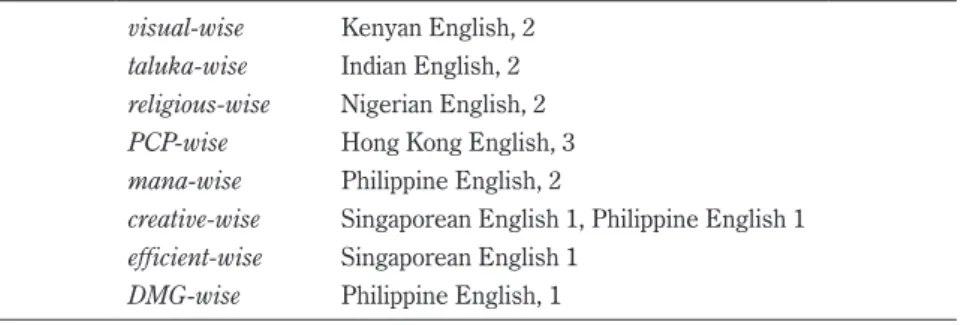
One aim of this study was to examine the productivity of –wise adverbs in L2 varieties of English. To investigate this, I checked to see which –wise viewpoint adverbs occurred in the L2 varieties, but not in the American English or British English varieties. From an examination of the first 1,000 items ending with –wise in the GloWbE Corpus, 66 items were identified as –wise viewpoint adverbs that did not occur in the American or British sub-corpora. For the most part, these 66 items were very much like the others in that they were formed by the addition of –wise to a common noun base as in, for example, areawise, city-wise, futurewise. However, among the 66 items there were several that were unusual in that they were formed not with a common noun, but with an adjective, or an acronym. These are listed in Table 2, along with the sub-corpus in which they occurred, and number of tokens. One of these forms, taluka-wise is particularly interesting because it is formed with a non-English noun. Taluka refers to an administrative district in India. Mana-wise is also interesting. Although it is listed as in the Collins online English dictionary, it is a Polynesian or Melanasian concept. Collins online dictionary defines it as “(in Polynesia, Melanesia, etc.) a concept of a life force, believed to be
seated in the head, and associated with high social status and ritual power” (www.collinsdictionary. com/dictionary/english/mana). The fact that –wise is combined with non-English nouns and with terms for foreign concepts testifies to its productivity in the L2 varieties in which these forms occur. Another noteworthy point is the occurrence of –wise adverbs formed with adjectives (visual-wise, religious-wise, creative-wise and efficient-wise) in various L2 varieties of English. Lindquist argued that “the –wise suffix is showing signs of generalization to new types of bases” (Lindquist 2007: 134). He cited the occurrence of forms such as strategic-wise, competetivewise, academic-wise, cerebral-wise and social-wise as evidence of the trend toward greater generalization. The appearance of adjective base forms in L2 varieties of English could be adduced as further evidence of this trend.
Concluding remarks
The case of –wise viewpoint adverbs provides an intriguing instance of a new form entering English at a fairly recent time and spreading rapidly across dialects and genres. The spread and use of the new –wise adverb has been amply documented in the studies of Lenker (2002), Cowie (2006) and, especially, Lindquist (2007). The present study has attempted to extend this strand of research by investigating the spread and use of –wise adverbs in L2 varieties of English. The development of the GloWbE Corpus with its sub-corpora of English L2 varieties makes such research possible. However, despite the very large size of the GloWbE Corpus, there remains a difficulty in investigating relatively infrequent forms such as this one. From this study it is clear that the –wise viewpoint adverb occurs in L2 varieties, though perhaps at a lower frequency than in American or British English. Furthermore, the results show that the –wise suffix is also productive in the L2 varieties. There are forms which do not show up in the American and British English varieties, and these include some blended forms that are made with a non-English noun base. Of course, the fact that some forms did not appear in the American and British English corpora may be attributable to the size of the sub-corpora: perhaps in a larger corpus they would occur. Another notable finding from the L2 sub-corpora was the occurrence of some –wise adverbs formed with adjectives, rather than noun bases. This
visual-wise Kenyan English, 2
taluka-wise Indian English, 2
religious-wise Nigerian English, 2
PCP-wise Hong Kong English, 3
mana-wise Philippine English, 2
creative-wise Singaporean English 1, Philippine English 1
efficient-wise Singaporean English 1
DMG-wise Philippine English, 1
名古屋学院大学論集
would seem to lend further support to Lindquist’s contention that the range of bases for the –wise suffix is broadening.
This study is limited by the size of the sub-corpora from which the data are drawn. It is further limited by the choice of the L1 and L2 varieties which were included in the study. The study did not include, for example, Australian English or New Zealand English, nor many of the more numerous varieties of L2 English. Because the number of –wise adverb tokens is relatively low, conclusions about frequency have to be considered provisional, and in need of corroboration by further research with yet-to-be-developed larger corpora of L2 varieties of English. Yet, the findings so far are intriguing and it will be interesting to see if the spread of –wise viewpoint adverbs continues on the same trajectory as it continues to spread through L1 and L2 varieties of English.
References
Cowie, C. (2006) Economical with the truth: Register categories and the function of –wise viewpoint adverbs in the British National Corpus. ICAME Journal 30:5―36.
Dalton-Puffer, C. & I. Plag (2000) Categorywise, some compound-type morphemes seem to be rather suffix-like: On the status of –ful, –type, and –wise in present day English. Folia Linguistica 34.3―4: 225―245.
Lenker, U. (2002) Is it, stylewise or otherwise, wise to use –wise? Domain adverbials and the history of English –wise. In T. Fanego, M. J. Lopez-Couso & J. Perez-Guerra (Eds.) English historical syntax and morphology: Selected papers from 11 ICEHL, Santiago de Compostela, 7―11 September 2000. (157―180). Amsterdam: John Benjamins.
Lindquist, H. (2007) Viewpoint-wise: The spread and development of a new type of adverb in American and British English. Journal of English linguistics 35.2: 132―156.
Quirk, R., S. Greenbaum, G. Leech & J. Svartvik. (1985) A comprehensive grammar of the English language. London: Longmans.
Sicherl, E. (2009) The English suffix –wise and its productivity from the non-native speaker perspective. Slovene linguistic studies 7: 169―187. Websites http://www.englishplus.com/grammar/00000272.htm https://corpus.byu.ed/glowbe https://en.oxforddictionaries.com https://www.collinsdictionary.com