Title
Polyoxyethylene as the Stationary Phase in Ion Chromatography(
本文(Fulltext) )
Author(s)
LIM, Lee Wah; RONG, Li; TAKEUCHI, Toyohide
Citation
[Analytical sciences : the international journal of the Japan
Society for Analytical Chemistry] vol.[28] no.[3] p.[205]-[213]
Issue Date
2012-03-10
Rights
The Japan Society for Analytical Chemistry (公益社団法人日本
分析化学会)
Version
出版社版 (publisher version) postprint
URL
http://hdl.handle.net/20.500.12099/46167
2012 © The Japan Society for Analytical Chemistry
† To whom correspondence should be addressed. E-mail: [email protected]
Polyoxyethylene as the Stationary Phase in Ion Chromatography
Lee Wah L
IM,* Li R
ONG,*
,** and Toyohide T
AKEUCHI*
†* Department of Chemistry, Faculty of Engineering, Gifu University, 1-1 Yanagido, Gifu 501–1193, Japan
** Department of Chemistry, School of Physics and Chemistry, Xihua University, 999 Jinzhou-Road,
Chengdu 610039, China
The present article reviews the use of polyethylene glycol (PEG) or polyoxyethylene (POE) as the stationary phase for the separation of inorganic anions in ion chromatography and discusses about the retention mechanisms involved in the separation of anions on the novel stationary phases. PEG permanently coated on a hydrophobic stationary phase retained anions in the partition mode and allowed us to use high-concentration eluents because the retention of anions increased with increasing eluent concentration for most of the eluents. This situation was convenient to determine trace anions contained in seawater samples without any disturbance due to matrices. Chemically bonded POE stationary phases retained not only anions but also cations. Anions were retained in the ion-exchange mode, although POE chains possess no ion exchange sites. The retention behavior suggested that eluent cations could be trapped among multiple POE chains
via ion-dipole interaction, and that the trapped cations worked as the anion-exchange sites. Anions could be separated using crown ether, i.e., cyclic POE, as the eluent additive with a hydrophobic stationary phase, where analyte anions were retained via electrostatic interaction with the eluent cation trapped on the crown ether.
(Received November 25, 2011; Accepted December 26, 2011; Published March 10, 2012)
1 Introduction 206
2 Permanently-coated PEG as Stationary Phases 206 2·1 Phase separation of aqueous PEG solutions 2·2 Retention behavior of inorganic anions on
permanently-coated PEG phase 2·3 Separation of inorganic anions on
permanently-coated PEG phase
2·4 Determination of iodide and thiocyanate in seawater samples
2·5 Separation of inorganic anions on unmodified C30 column
3 Chemically-bonded Polyoxyethylene as
Stationary Phases 209
3·1 Preparation of chemically bonded PEG stationary phases
3·2 Preparation of POE-bonded stationary phase 3·3 Retention of anions on POE-bonded phase 3·4 Separation of anions on POE-bonded phase 3·5 Retention mechanism
4 Dynamically-coated Crown Ether as
Stationary Phases 211
4·1 Equilibria in the column
4·2 Separation of anions on a dynamically coated 18C6
4·3 Effect of other eluent conditions on retention of anions
5 Conclusions 213
6 References 213
Lee Wah LIM received her
BS (Hons) degree from the National University of Malaysia (1999) and an ME degree from Gifu University (2002) before she was appointed as Research Associate in 2004 at the same university. In 2007, she obtained a PhD degree from Nagoya University, and was promoted to Assistant Professor at Gifu University in the same year. Her current research interests are focused on the development of novel stationary phases, novel detection and separation systems for capillary LC.
Li RONG received a BS
degree (2000) from Sichuan University, and a ME degree (2004) and PhD degree (2007) from Gifu University. After working as a lecturer in Xihua University (Chengdu, Sichuan of China) in 2008 – 2009, she has been serving as an Associate Professor in the School of Physics and Chemistry of Xihua University. From 2011, she worked with Professor Takeuchi as a researcher at Gifu University. Her current research interest is focused on the development of stationary phases in chromatography.
Toyohide TAKEUCHI received
a Bachelor degree of Engineering (1977), a Master degree of Engineering (1979) and a Doctor degree of Engineering (1985) from Nagoya University. He was appointed as Research Associate (1980) and Associate Professor (1989) at Nagoya University, and joined Gifu University as Associate Professor in 1992, where he was promoted to Professor of Chemistry in 2001. His research interests include the development of capillary columns, novel detection and separation systems for capillary LC.
1 Introduction
Various types of stationary phases and separation modes have been being developed in ion chromatography since it was initiated by Small et al.1 Ion exchange, ion exclusion, ion pair,
partitioning, adsorption or zwitterionic interaction is selected as the separation mode considering the properties of samples. Most stationary phases employed in ion chromatography have functional groups with charged or chargeable moieties.
Polyethylene glycol (PEG) stationary phases have been widely used as the stationary phase in capillary gas chromatography, liquid chromatography (LC), countercurrent chromatography (CCC) and ion chromatography. Besides hydrophobic interaction, PEG moieties can provide some other interactions, such as hydrogen bonding and dipole-dipole interaction.
Guo et al.2 introduced a PEG stationary phase for
reversed-phase LC and separated phenyl compounds and traditional Chinese medicines. PEG-bonded silica-based columns, e.g., Discovery HS PEG column (Supelco; Bellefonte, PA), are now commercially available, and they have been applied to the analysis of natural products.3,4 Polymer-based
PEG monolithic capillary columns were also prepared and applied to hydrophobic interaction chromatography of proteins5
as well as to reversed-phase chromatography of aromatic carboxylic acids and phenols.6 In addition, the PEG moiety
could form a helix-like conformation in the organic-aqueous media, leading to generation of different selectivity compared with common C18 stationary phases.
CCC with aqueous biphasic systems such as PEG-potassium phosphate buffer or PEG-dextran has been used for the purification of proteins.7–10 CCC with aqueous biphasic systems
consisting of PEG and sodium sulfate was also studied using some inorganic anions as model compounds,11 where the
PEG-rich upper phase was used as the stationary phase and the salt-rich lower phase was used as the mobile phase, and ions are separated on the PEG stationary phase in the partitioning mode.
We have examined PEG or polyoxyethylene (POE) as the stationary phase for the separation of ions. This review will focus on the separation of inorganic anions using permanently/ dynamically coated PEG/POE and chemically-bonded POE as the stationary phase in ion chromatography.
2 Permanently-coated PEG as Stationary Phases
2·1 Phase separation of aqueous PEG solutions
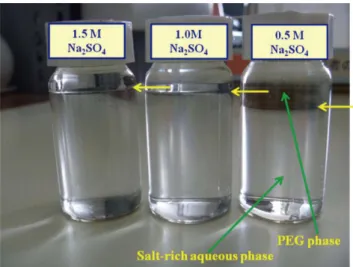
PEG is soluble in water. For example, 1 g of PEG with nominal average molecular weight of 20000 (PEG-20000) is soluble in 19 ml of water. However, when 1 g of PEG-20000 is added into 19 ml of 1 M sodium sulfate, magnesium sulfate or ammonium sulfate aqueous solution, the solutions become inhomogeneous and finally separate into two phases, as shown in Fig. 1. The upper phases are PEG phases, while the lower phases are salt-rich aqueous phases. It can be seen that the volume of the PEG phase decreases in the order of ammonium sulfate, magnesium sulfate and sodium sulfate. The volume of the PEG phase also depends on the concentration of the salt added in the solution. Figure 2 shows that the volume of the PEG phase decreases with increasing sodium sulfate concentration. In addition, both phases became clearer many days after the preparation, but the boundary of the two phases was not distinct for the 0.5 M sodium sulfate. Contrarily, when 1 g of PEG-20000 was added into 19 ml of 1 M sodium chloride, 0.5 M magnesium chloride, 1 M ammonium chloride
or 1 M sodium perchlorate aqueous solution, the solutions were homogeneous. It is found that the phase separation is related to both cation and anion of the salt as well as to the salt concentration, and that strongly-hydrating ions (kosmotropic ions) tend to separate the PEG phase from the salt-rich aqueous phase, compared to less-hydrating ions (chaotropic ions). For example, sulfate and magnesium ions are kosmotropic ions, while ammonium and perchlorate are chaotropic ions.
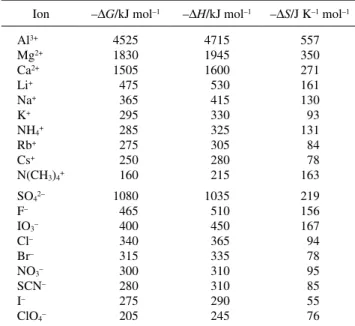
Table 1 shows changes in the molar Gibbs free energy, enthalpy and entropy of hydration for representative cations and anions.12 It is seen that the above kosmotropic ions have larger
negative Gibbs free energies of hydration (–ΔG) than the chaotropic ions. It can be expected that the larger the –ΔG is, the larger is the strength of hydration.
It is expected that these two separated phases can be applied for partition chromatographic separation. Actually, such a PEG phase can be utilized as one phase in CCC.11 When PEG can be
fixed on an appropriate support, the PEG phase can also be used as a stationary phase in LC. Hydrophobic adsorbents such as
Fig. 1 Phase separation for PEG and aqueous sulfate solution. PEG-20000 (1 g) dissolved in 19-ml volume of 1 M each sulfate solution.
Fig. 2 Effect of sodium sulfate solution on the PEG-phase volume. PEG-20000 (1 g) dissolved in 19-ml volume of different concentrations of sodium sulfate solution.
octadecyl-functionalized silica (C18) and triacontyl-functionalized silica (C30) are candidates of the support.
2·2 Retention behavior of inorganic anions on permanently-coated PEG phase
Since C30 is more hydrophobic than C18, it is expected that PEG adsorbed on the C30 stationary phase will be more stable than that on the C18 stationary phase. C30 stationary phases possess another advantage over C18 stationary phases in that the retention time of analytes is stable even when an aqueous solution or pure water is used as the eluent. This is because little aqueous eluent is excluded from the mesopores of C30 packing materials during the operation.13
A fused-silica capillary was packed with 5-μm Develosil C30-UG-5 (Nomura Chemical, Seto, Japan) by using a slurry packing method, and then was conditioned with purified water. An aqueous solution containing PEG was then passed into the fused-silica capillary at a flow-rate of 2.1 μl/min for ca. 3 h, followed by washing with purified water for ca. 20 min until the baseline was stabilized.
Figure 3 shows the retention behavior of iodide on the C30 column permanently coated with 5% PEG-20000 using different eluents.14 It can be seen that both cation and anion of the eluent
affect the retention of iodide. The retention time of iodide increased with increasing eluent concentration except for ammonium sulfate. Contrarily, when ammonium sulfate was used as the eluent, the retention time of iodide decreased with increasing eluent concentration. Since the present stationary phase possesses no ion-exchange sites, the retention of analyte anions may not be caused by electrostatic interaction with the stationary phase, but by partition into the PEG phase. It is presumed that the retention of an analyte anion on the PEG stationary phase increases as its hydrophobic property increases. Considering the phase separation observed in the PEG/water/sodium sulfate system, authors have suggested that water is transferred from the PEG phase to the bulk phase as the eluent salt concentration increases, as demonstrated in Fig. 2. This in turn means that the PEG stationary phase becomes less polar with increasing eluent salt concentration.
Figure 3 also shows that the retention time of iodide also
depended on the combination of the eluent anion and the eluent cation. For example, when the eluent concentration was 100 – 200 mM, ammonium sulfate, sodium sulfate and magnesium sulfate achieved longer retention time for iodide in this order. On the other hand, when chloride was chosen as the eluent anion, a slightly longer retention time of iodide was observed for lithium chloride than for sodium chloride and potassium chloride.
Although the reason for the abnormal retention behavior for ammonium sulfate is not yet elucidated, the following contributions are conceivable in the retention of iodide. As the eluent concentration increases, the eluent salt concentration in the PEG phase also increases, which in turn leads to the increase in the polarity of the PEG phase. Contrarily, the water concentration in the PEG phase decreases with increasing eluent concentration, leading to the decrease in the polarity of the PEG phase. These two contributions are competing. Since ammonium ion is chaotropic, the first contribution for ammonium sulfate is expected to be larger than those of other sulfates, whereas the second contribution for ammonium sulfate is smaller than those of other sulfates. The more polar the PEG phase is, the smaller the retention of iodide that is expected. It is presumed that the first contribution is preferential for ammonium sulfate, whereas the second contribution is preferential for other salts examined in Fig. 3. Furthermore, since ammonium ion is chaotropic, the retention of ammonium iodide is expected to be larger than those of other iodides, e.g., sodium iodide or magnesium iodide.
Figure 4 illustrates an imaginary description of the PEG stationary phase. Kosmotropic eluent anions and cations withdraw water molecules from the PEG phase into the bulk solution, which would decrease the polarity of the stationary phase. On the other hand, the eluent cation could also affect the retention of analyte ions in a different manner, because the eluent cations are the counter ions of the analyte anions. Less-hydrating cations would have a chance to increase the retention of analyte anions as the counter ions, leading to the observation of complex retention behaviors, as observed in Fig. 3. 100 200 300 4 5 6 [Eluent] / mM R et en tio n tim e / m in 1 2 34 5 6
Fig. 3 Retention time of iodide as a function of the eluent concentration. Column, Develosil C30-UG-5 (100 × 0.32 mm i.d.) modified with 5% PEG-20000; eluent, magnesium sulfate (1), potassium chloride (2), sodium chloride (3), lithium chloride (4), sodium sulfate (5), ammonium sulfate (6); flow-rate, 2.1 μl/min; injection volume, 0.2 μl; analyte, 1 mM iodide; wavelength of UV detection, 220 nm. Reproduced from Ref. 14 with permission. Table 1 Molar Gibbs free energy, enthalpy and entropy of
hydration for representative cations and anions12
Ion –ΔG/kJ mol–1 –ΔH/kJ mol–1 –ΔS/J K–1 mol–1
Al3+ Mg2+ Ca2+ Li+ Na+ K+ NH4+ Rb+ Cs+ N(CH3)4+ SO42– F– IO3– Cl– Br– NO3– SCN– I– ClO4– 4525 1830 1505 475 365 295 285 275 250 160 1080 465 400 340 315 300 280 275 205 4715 1945 1600 530 415 330 325 305 280 215 1035 510 450 365 335 310 310 290 245 557 350 271 161 130 93 131 84 78 163 219 156 167 94 78 95 85 55 76
2·3 Separation of inorganic anions on permanently-coated PEG phase
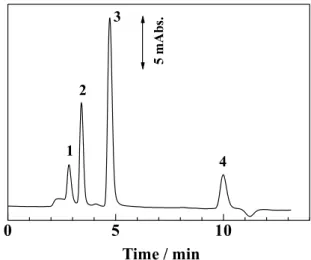
Figure 5 demonstrates the separation of iodate, nitrate, iodide and thiocyanate on the C30 stationary phase modified with PEG-20000.14 Nitrate, iodide and thiocyanate are hydrophobic
anions and are retained on the PEG-modified C30 stationary phase. The present stationary phase allows us to employ higher-concentration eluents, which is convenient for applying the present system to the determination of trace ions in seawater samples.
2·4 Determination of iodide and thiocyanate in seawater samples
A conventional-size C30 column with a dimension of 150 × 4.6 mm i.d. was used in order to improve the concentration sensitivity. As shown in Fig. 6, UV-absorbing anions such as iodate, nitrate, iodide and thiocyanate could be separated within 6 min on the C30 column permanently coated with PEG-20000 at a flow-rate of 1.0 ml/min using an aqueous solution containing 300 mM sodium sulfate and 50 mM sodium chloride as the eluent.15 The composition of the eluent was determined by
considering the retention of analyte anions and the composition of seawater. Under the operating conditions in Fig. 6, the limit of detection of iodide was 0.5 ng/ml at the signal-to-noise ratio (S/N) of 3, and the limit of quantitation was 2.0 ng/ml (S/N = 10), whereas the limit of detection of thiocyanate was 2.0 ng/ml (S/N = 3), and the limit of quantitation was 6.0 ng/ml (S/N = 10). The linear range of quantification of iodide and thiocyanate was 2.0 ng/ml to 5.1 μg/ml and 6.0 ng/ml to 2.3 μg/ml, respectively.
Figure 7 demonstrates chromatograms for a seawater sample, where a 20-μl seawater sample is injected in the lower trace, while the spiked seawater sample is injected in the upper trace. It can be seen in Fig. 7 that iodide and thiocyanate are actually observed for the seawater samples. Iodide and thiocyanate
C30
PEG
H2O
→ becoming less polar
Na+ SO 4 2-H2O H2O H2O H2O Analyte Eluent H2O I -I -Na+
Fig. 4 Description of PEG stationary phase and interaction between analytes and PEG phase.
0
5
10
5 m A bs .1
2
3
4
Time / min
Fig. 5 Separation of UV-absorbing anions on a C30 column permanently coated with PEG-20000. Eluent, 300 mM sodium sulfate; analytes, iodate (1), nitrate (2), iodide (3), thiocyanate (4); analyte concentration, 0.2 mM each; other operating conditions as in Fig. 3. Reproduced from Ref. 14 with permission.
0
2
4
6
8
1
2
3
4
Time / min
0. 1 A bs .Fig. 6 Separation of UV-absorbing anions on a conventional-size C30 column permanently coated with PEG. Column, Develosil C30-UG-5 column (150 × 4.6 mm i.d.) permanently coated with 5% PEG-20000; eluent, 300 mM sodium sulfate and 50 mM sodium chloride; flow-rate, 1.0 ml/min; injection volume, 20 μl; analytes, iodate (1), nitrate (2), iodide (3), thiocyanate (4); analyte concentration, 0.2 mM each; wavelength of UV detection, 220 nm. Reproduced from Ref. 15 with permission.
0
2
4
6
8
Time / min
1 m A bs.I
-SCN
-A
B
Fig. 7 Separation of iodide and thiocyanate in seawater sample. Samples: lower trace (A), 20 μl seawater; upper trace (B), seawater spiked with 254 ng/ml iodide and 58 ng/ml thiocyanate. Other operating conditions as in Fig. 6. Reproduced from Ref. 15 with permission.
contained in the seawater samples were then determined to be 83 and 15 ng/ml, respectively, by using a standard addition method. In addition, although nitrite, bromide and nitrate are contained in seawater samples, these anions could not be determined by the proposed PEG-coated stationary phase because of its poor selectivity to these anions.
2·5 Separation of inorganic anions on unmodified C30 column
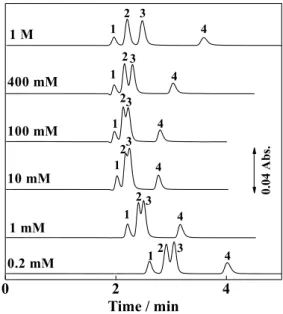
Since the above results show that hydrophobic stationary phases are capable of retaining hydrophobic anions, the separation of iodate, nitrate, iodide and thiocyanate was carried out on an unmodified C30 stationary phase by using various concentrations of sodium sulfate from 0.2 mM to 1 M, as demonstrated in Fig. 8.12 It is found that, although the best
resolution of iodate, nitrate, iodide and thiocyanate is achieved for 1 M sodium sulfate, the retention values of the analyte anions are smaller than that obtained by the C30 permanently coated with PEG-20000. This means that the PEG coated on the C30 stationary phase enhances the retention of hydrophobic anions in addition to the underlying C30 phase.
The retention factor (k) of the analyte anions is plotted as a function of the sodium sulfate concentration in Fig. 9, where water dip peak is adopted as the non-retained signal. The elution time for the water dip was 1.93 to 1.94 min, and the values were nearly the same for all of the sodium sulfate concentrations examined. It can be seen from Figs. 8 and 9 that the retention factor decreases with increasing sodium sulfate concentration for iodate, whereas the retention factor of nitrate, iodide and thiocyanate also decreases with increasing sodium sulfate concentration in the lower concentration region, but it increases in the higher concentration region. The reasons for the above retention behaviors have not been elucidated.12
3 Chemically-bonded Polyoxyethylene as Stationary
Phases
3·1 Preparation of chemically bonded PEG stationary phases
Since permanently coated PEG stationary phases lack long-term stability, the PEG chains should be chemically bonded onto supports to overcome the drawback. Various reagents for PEGylation have been used to provide a spacer into proteins in order to increase their stability and to reduce their tendency toward aggregation and immunogenicity. Commercially available PEGylation reagents are single compounds of defined molecular weight with discrete POE chain lengths or they possess low-dispersion POE chains. It should be noted that these reagents are therefore very expensive. However, capillary LC has an advantage in such a case because it requires a very small quantity of the stationary phase for a single column. The present section examines a new PEGylation reagent for the preparation of a POE-bonded stationary phase for capillary ion chromatography.16,17
3·2 Preparation of POE-bonded stationary phase
POE-bonded stationary phases were prepared as previously reported.16,17 A 0.2-g amount of TSKgel NH2-60 (TOSOH,
Tokyo, Japan) was placed in a 20-ml vial. A 0.1-g amount of one N-hydroxysuccinimide ester reagent of POE was dissolved in 2 – 3 ml volume of 0.1 M phosphate buffer (pH 6.7 – 7.0), and the solution was then poured into the vial. The reaction was carried out at room temperature (20 – 26°C) for 30 min, followed by washing with deionized water and methanol. Separation columns were prepared from a fused silica capillary tube (0.53 mm i.d.) using a slurry packing method.
Structures of the POE reagents employed as well as the expected reaction scheme are shown in Fig. 10.17 The numbers
of the oxyethylene unit for Methyl-POE-2000-NHS ester and Methyl-POE-5000-NHS ester are calculated from the average molecular weights provided by the manufacturer.
3·3 Retention of anions on POE-bonded phase
Inorganic anions were also retained on prepared POE-bonded stationary phases. However, the retention of analyte anions decreased with increasing eluent concentration. This observed retention behavior is quite different from that observed for the
0
2
4
400 mM 100 mM 10 mM 1 mM 0.2 mMTime / min
1 M 1 2 3 4 1 1 1 1 1 2 2 2 2 2 3 3 3 3 3 4 4 4 4 4 0. 04 A bs .Fig. 8 Separation of anions on an unmodified C30 column using different concentrations of sodium sulfate as the eluent. Column, Develosil C30-UG-5 (C30), 100 × 0.53 mm i.d.; eluent, sodium sulfate, the concentrations as indicated; flow-rate, 8.0 μl/min; analytes, iodate (1), nitrate (2), iodide (3), thiocyanate (4); concentration of analytes, 0.1 mM each; injection volume, 0.15 μl; wavelength of UV detection, 210 nm. 0.1 1 10 100 1000 0 0.5 1 1.5 [Na2SO4] / mM
k
2 1 3 4Fig. 9 Retention factor of analytes as a function of sodium sulfate concentration. Operating conditions as in Fig. 8. Reproduced from Ref. 12 with permission.
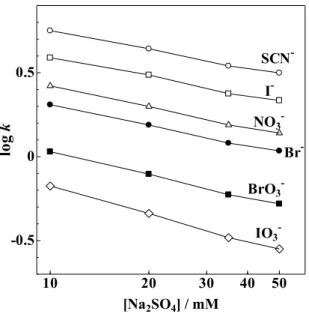
permanently coated PEG phase, as shown in Fig. 3. Figure 11 shows some effects of the eluent concentration on the retention of anions, as examined by using sodium sulfate as the eluent.16
It can be seen from Fig. 11 that the relationships between the logarithm of the retention factor of analytes (log k) and the logarithm of the concentration of sodium sulfate are almost linear. The slopes of the linear curves were –0.545, –0.453, –0.401, –0.41, –0.375, and –0.368 for iodate, bromate, bromide, nitrate, iodide, and thiocyanate, respectively. It is found that the slope of the curves decreases with increasing retention factor. The slope should be theoretically –0.5, provided that the retention is based on ion exchange and the selectivity coefficient is constant. Although the POE-bonded phases possess no ion exchange sites, anions are supposed to be retained in the ion-exchange mode.
Nearly linear relationships between log k and the logarithm of the eluent concentration were also observed when ammonium sulfate or magnesium sulfate was used as the eluent.16 The
slopes for iodide were –0.434 and –0.383 for ammonium sulfate and magnesium sulfate, respectively. Magnesium sulfate
achieved larger retention factor values for examined anions than ammonium sulfate. It was apparent that the eluent cation also could affect the retention of analyte anions.
3·4 Separation of anions on POE-bonded phase
Figure 12 demonstrates the separation of UV-absorbing anions on a Methyl-12OE-bonded aminopropylsilica column using 50 mM sodium sulfate as the eluent.17 It can be seen from the
figure that the selectivity of the analyte anions is satisfactory except for nitrite and bromide and that the separation is achieved within a reasonable time. It should be noted that the elution order of these anions was the same as that observed for common anion exchangers employed in ion chromatography. On the other hand, the selectivity for the above anions under neutral eluent conditions was poor on the unmodified stationary phase,
i.e., TSKgel NH2-60, and its retention of anions was much
weaker than the modified stationary phase under the conditions as in Fig. 12. These results indicate that the retention of anions is caused by the chemically-bonded POE phase.
Figure 12 also demonstrates the separation of inorganic UV-absorbing anions contained in a saliva sample using the 10-cm Methyl-12OE-bonded column, where nitrate, iodide and thiocyanate could be separated; the concentrations of the anions in the saliva were determined to be 47, 2.4 and 20 μg/g for nitrate, iodide and thiocyanate, respectively.
It was possible to demonstrate indirect photometric detection of anions using sodium iodide as the eluent and the Methyl-12OE column as the stationary phase.16 This means that the analyte
anions replace the eluent anions. Although the present stationary phase does not possess any ion-exchange sites, it is expected that one-to-one replacement between the analyte anions and iodide may take place in the column when traveling through the column. Considering these results, one can be expected that ion exchange is involved in the retention of analyte anions for the POE-bonded stationary phases.
SiO-(CH2)3-NH2
+
NH2-60 POE-NHS ester+
N O O O C O ( CH2CH2O)nCH3 ( CH2O)m N O O OH Methyl-2OE-NHS ester: m = 0, n = 2 Methyl-4OE-NHS ester: m = 0, n = 4 Methyl-12OE-NHS ester: m = 0, n = 12 Methyl-POE-2000-NHS ester: m = 1, n ≈ 45 Methyl-POE-5000-NHS ester: m = 1, n ≈ 114 C O ( CH2CH2O)nCH3 ( CH2O)m SiO-(CH2)3-NH SiO-(CH2)3-NHFig. 10 The structures of the POE reagents employed as well as the expected reaction scheme. Reproduced from Ref. 17 with permission.
0
5
10
B
A
Time / min
SCN -I -NO3 -NO2-+Br -IO3 -B rO3 -SCN -I -NO3 -0. 01 A bs .Fig. 12 Separation of inorganic anions in saliva on a Methyl-12OE-bonded stationary phase. Column, Methyl-12OE (100 × 0.53 mm i.d.); mobile phase, 50 mM sodium sulfate; flow rate, 8.0 μl/min; wavelength of UV detection, 210 nm; samples, 0.2 mM each of iodate, bromate, nitrite, bromide, nitrate, iodide and thiocyanate (A), saliva sample (B); injection volume, 0.15 μl. Reproduced from Ref. 17 with permission.
10 20 30 40 50 -0.5 0 0.5
lo
g
k
[Na2SO4] / mM IO3 -BrO3 -Br -NO3 -I -SCN-Fig. 11 Effect of sodium sulfate concentration on the retention of analyte anions. Column, Methyl-12OE, 100 × 0.53 mm i.d.; eluent, sodium sulfate; flow rate, 8.0 μl/min; analyte concentration, 0.2 mM each; injection volume, 0.15 μl; wavelength of UV detection, 210 nm. Reproduced from Ref. 16 with permission.
3·5 Retention mechanism
After the Methyl-12OE column was equilibrated with 100 mM sodium sulfate aqueous solution, copper(II) sulfate aqueous solution was passed into the column. It was observed that copper(II) ion was adsorbed on the stationary phase. This means that the Methyl-12OE column retains both anions and cations.
It is well-known that crown ethers have a unique ability to selectively complex with alkali and alkaline earth metal ions as well as with various cations, and they have been used to improve the resolution of cations in ion chromatography. Crown ethers are cyclic POE, and it is therefore expected that the eluent cations could also be fixed on the oxygen atoms of the POE chains by ion-dipole interactions to work as the anion-exchange sites.
It is also known that the POE moiety could form a coil- or helix-like conformation in the organic-aqueous media, leading to generation of different selectivity values compared with common C18 stationary phases.18 Trapping of eluent cations on
the Methyl-12OE-bonded stationary phase is similar to trapping of cation into crown ethers, but the former is more flexible, and the size of the cation may not be very significant.
The effect of the POE chain length on the retention of anions was examined for the oxyethylene unit numbers of 2 – 114. It was observed that anions were retained on all of the stationary phases examined, although the retention times were different.17
In Fig. 13, the retention factor of the anions is plotted as a function of the number of the oxyethylene unit. It is found that the maximum retention is observed for the oxyethylene unit number of around 12. It can be expected that more eluent cations could be trapped among the POE chains with increasing chain length, leading to an increase in the retention of anions for the oxyethylene unit number of 2 – 12. However, it would be more difficult to adjust the location of the POE chain for much larger oxyethylene unit numbers, leading to a decrease in the amount of trapped eluent cations.
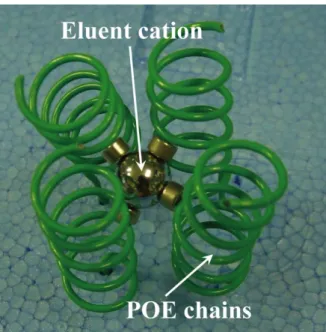
It is expected that the coil or helical POE chain could trap the eluent cation in a single chain. However, considering that the Methyl-2OE stationary phase could also trap the eluent cation, where anion-exchange could still take place, one finds that the eluent cation is trapped among multiple POE chains. The proposed cation-trapping structure is shown in Fig. 14.17 It is
indicated that the eluent cation is trapped by ion-dipole interaction with the oxygen atoms of multiple POE chains, and the eluent and analyte anions can compete for the trapped cation. Inorganic anions can therefore be separated on the POE-bonded phases in the ion-exchange mode.
4 Dynamically-coated Crown Ether as Stationary
Phases
4·1 Equilibria in the column
18-Crown-6 ether (18C6) is often used as the eluent additive in ion chromatography in order to improve the resolution of the cations, where the retention of potassium ion is especially enhanced by the addition of 18C6. This is because 18C6 is adsorbed on the stationary phase and potassium ions are favorably retained on the adsorbed 18C6, leading to an increase in the retention. It is expected that 18C6 will be adsorbed on a hydrophobic stationary phase such as C30 when the eluent contains 18C6 and potassium ions. Free 18C6 and K+-incorporated 18C6 are present in the eluent, and both species
could be adsorbed on the hydrophobic stationary phase. Potassium ions trapped on 18C6 then attract anions by electrostatic interaction, and analyte anions compete for the trapped potassium ions with the eluent anions, viz., an ion-exchange mechanism is involved in the retention of anions.
There are two different routes for 18C6 to adsorb on the C30 stationary phase: adsorption of free 18C6 followed by trapping of potassium ion or adsorption of K+-incorporated 18C6, as
illustrated in Fig. 15. The retention of anions in the present system should be influenced by the concentrations of an organic modifier, 18C6 and eluent salt as well as by the crown ether size, and these parameters were examined.19
Based on the above idea, the unique ability of macrocyclic ligands, such as crown ethers and cryptands, to selectively complex alkali metal cations could be used as the basis for chromatographic separations of anions.20 It was reported that
alkylated macrocycles such as n-tetradecyl-18C6 or
n-decylcryptands permanently coated onto a reversed-phase
0 20 40 60 80 100 120 0 1 2 3 4 5 IO3 -NO3 -I -SCN
-k
Number of oxyethylene units
Fig. 13 The retention factor as a function of oxyethylene unit number. Columns, 100 × 0.53 mm i.d.; mobile phase, 50 mM sodium sulfate; flow rate, 8.0 μl/min; wavelength of UV detection, 210 nm; analytes, 0.1 mM each; injection volume, 0.15 μl. Reproduced from Ref. 17 with permission.
Fig. 14 Proposed cation-trapping structure. Reproduced from Ref. 17 with permission.
column formed positively charged anion-exchange sites when they combined with eluent cations and that anion retention increased with increasing eluent strength and organic modifier content using 18C6 as the eluent additive.20
Lamb et al. also reported effective perchlorate determinations using standard conductimetric detection by combining an 18C6-based mobile phase and a reversed-phase stationary phase, where the eluent contained 18C6 and potassium hydroxide KOH, facilitating the suppressed conductimetric detection of the target analyte anions.21 They used 18C6 dynamically coated on
the reversed-phase stationary phase for recognizing anions.
4·2 Separation of anions on a dynamically coated 18C6
The association constant for complexation between 18C6 and the metal cation is different for different cations, as shown in Table 2.22–24 Therefore, the eluent cation could affect the
retention of anions in the present separation system. Figure 16 demonstrates the separation of anions on a C30 column using 10 mM chloride of various salts containing 3% acetonitrile and 0.1% 18C6 as the eluent. It is seen that potassium chloride gives the largest retention, followed by rubidium chloride, ammonium chloride, cesium chloride, and sodium chloride. Lithium chloride, magnesium chloride and calcium chloride gave nearly the same smaller retention time. The elution order was the same for all of the eluents examined: iodate, nitrate, iodide and thiocyanate in this order. It should be noted that the larger the association constant between 18C6 and the metal cation is, the larger is the retention observed in Fig. 16, although the association constants are not given for lithium, magnesium and calcium ions. It can be concluded that the larger association constant leads to the larger amounts of the eluent cation trapped on the stationary phase via 18C6, leading to the increase in the cation-exchange site and the increase in the retention of analyte anions.
In addition, the eluent anion also affected the retention of analyte anions, because analyte anions were retained in the ion-exchange mode. It is reported that potassium dihydrogenphosphate gave the largest retention, followed by potassium chloride, potassium sulfate and potassium perchlorate.19
4·3 Effect of other eluent conditions on retention of anions
It is expected that the larger the amounts of 18C6 adsorbed on the stationary phase, the larger the retention of analyte anions will be. Since the organic modifier can control the amount of
Fig. 15 Retention mechanism of 18C6 and ions. Adapted from Ref. 19 with permission.
Table 2 Association constants for 1:1 complexation between crown ether and metal ion
Ligand Cation Log K Ref.
18C6 15C5 12C4 Li+ Na+ K+ Rb+ Cs+ NH4+ Mg2+ Ca2+ Li+ Na+ K+ Rb+ Cs+ NH4+ Mg2+ Ca2+ Li+ Na+ K+ ~0 0.80 ± 0.10 2.03 ± 0.10 1.56 ± 0.02 0.99 ± 0.07 1.23 ± 0.06 — < 0.5 ~0 0.70 ± 0.10 0.74 ± 0.08 0.62 ± 0.10 0.8 ± 0.2 1.71 ± 0.16 — — ~0 –0.16 –0.06 a b b b b b b a b b b b b a c c Reproduced from Ref. 19 with permission.
a. Ref. 20 (27 ± 1°C). b. Ref. 21 (25°C). c. Ref. 22 (25.0°C).
0
5
10
15
Time / min
1 2 3 4 LiCl NaCl KCl RbCl CsCl NH4Cl MgCl 2 CaCl 2 0. 05 A bs .Fig. 16 Separation of inorganic anions on a C30 column using eluents containing different cations. Column, Develosil C30-UG-5 (100 × 0.53 mm i.d.); eluents, 10 mM chloride containing 0.1% (w/v) 18C6 and 3% (v/v) acetonitrile; flow rate, 8.0 μl/min; wavelength of UV detection, 210 nm; analytes, 0.2 mM each of iodate (1), nitrate (2), iodide (3) and thiocyanate (4); injection volume, 0.15 μl. Reproduced from Ref. 19 with permission.
18C6 adsorbed on the stationary phase, it can then control the retention of analyte anions. The analyte retention increased with decreasing acetonitrile concentration in the eluent. When the eluent contained no acetonitrile, the retention of analyte anions was not stable and gradually decreased. This may be because the surface of the packing material is hydrophobic and the eluent was gradually excluded from the pores.14,25
The concentration of 18C6 in the eluent on the retention of analyte anions was examined up to 0.3% using 10 mM potassium chloride containing 3% acetonitrile as the eluent.19
The retention time of anions increased with increasing 18C6 concentration. The increase in the retention time is due to the increase in the amount of adsorbed 18C6 on the C30 stationary phase. The increase in the retention time of anions was not significant at the concentrations higher than 0.17% (w/v).
The effect of eluent concentration on the retention of anions on the C30 column was also examined using aqueous solutions of potassium chloride containing 0.1% (w/v) 18C6 and 3% (v/v) acetonitrile as the eluent.19 As the concentration of potassium
ion in the eluent increases, the amounts of trapped potassium ion on 18C6 increase, leading to an increase in the retention of analyte anions. Contrarily, as the concentration of chloride in the eluent increases, the elution strength increases, leading to a decrease in the retention of analyte anions. The two effects are competing, and the maximum retention times were observed at 10 – 20 mM, depending on the analyte.
The size of crown ether affected the retention of anions when crown ether is used as the eluent additive.19 The retention of the
anions is smaller for 15-crown-5 ether (15C5) and 12-crown-4 ether (12C4) because the association constants between cations and 15C5 (or 12C4) are smaller than those for 18C6 except for NH4+, as shown in Table 2. However, the retention of the
analyte anions is much smaller than expected from the association constants. It is supposed that the adsorption of both 15C5 and 12C4 on the C30 stationary phase is weaker than that of 18C6.
5 Conclusions
Ions are usually separated using stationary phases with charged or chargeable functional groups in LC. Contrarily, the present article showed the potential of PEG or POE groups as well as crown ethers to recognize ions in the different retention mechanisms. Permanently-coated PEG stationary phases retained hydrophobic anions in the partition mode, while chemically-bonded POE phases retained both anions and cations. Since chemically-bonded POE chains are more flexible in comparison with permanently coated PEGs, the former stationary phase could trap cations via ion-dipole interaction like crown ethers. We proposed an imaginary stationary phase model to show that multiple POE chains trap eluent cations via ion-dipole interaction, on which anions are retained by electrostatic interaction. This model was verified by using crown ethers as the eluent additive in the reversed-phase mode. Chemically-bonded crown ether stationary phases will provide a novel separation method for both anions and cations.
In order to accelerate the widespread use of the proposed methods, researchers should examine indirect photometric detection methods as well as conductivity detection systems in detail. Then, the determination of non-UV-absorbing analyte anions involving fluoride, chloride, sulfate and phosphate can also be targeted. The use of suppressor systems for the present separation systems would enhance the determination of their capabilities for ionic species.
6 References
1. H. Small, T. S. Stevens, and W. C. Bauman, Anal. Chem.,
1975, 47, 1801.
2. Z. Guo, Y. Liu, J. Xu, Q. Xu, X. Xue, F. Zhang, Y. Ke, X. Liang, and A. Lei, J. Chromatogr., A, 2008, 1191, 78. 3. F. Pellati, S. Benvenuti, and M. Melegari, J. Chromatogr.,
A, 2005, 1088, 205.
4. F. Cacciola, P. Jandera, Z. Hajdú, P. Cˇesla, and L. Mondello,
J. Chromatogr., A, 2007, 1149, 73.
5. Y. Li, H. D. Tolley, and M. L. Lee, J. Chromatogr., A, 2010,
1217, 4934.
6. T. Mori, T. Kubo, and K. Hosoya, Anal. Sci., 2010, 26, 311. 7. Y. Ito, J. Chromatogr., 1991, 538, 3.
8. Y. Shibusawa and Y. Ito, J. Chromatogr., 1991, 550, 695. 9. Y. Shibusawa, N. Misu, H. Shindo, and Y. Ito, J.
Chromatogr., B, 2002, 776, 183.
10. Y. Ito, T. Clary, J. Powell, M. Knight, and T. M. Finn, J.
Chromatogr., A, 2009, 1216, 4193.
11. K. Ishii, Y. Tanaka, K. Hata, M. Goto, K. Saitoh, H. Minamisawa, and M. Shibukawa, Bunseki Kagaku, 2004,
53, 911.
12. T. Takeuchi, B. Jiang, and L. W. Lim, Anal. Bioanal. Chem,
2012, 402, 551.
13. N. Nagae, T. Enami, and S. Doshi, LCGC, 2002, 20, 964. 14. L. Rong and T. Takeuchi, J. Chromatogr., A, 2004, 1042,
131.
15. L. Rong, L. W. Lim, and T. Takeuchi, Chromatographia,
2005, 61, 371.
16. T. Takeuchi, B. Oktavia, and L. W. Lim, Anal. Bioanal.
Chem., 2009, 393, 1267.
17. T. Takeuchi and L. W. Lim, Anal. Sci., 2010, 26, 937. 18. M. L. Alessi, A. I. Norman, S. E. Knowlton, D. L. Ho, and
S. C. Greer, Macromolecules, 2005, 38, 9333.
19. T. Takeuchi and L. W. Lim, Anal. Sci., 2011, 27, 1019. 20. J. D. Lamb, R. G. Smith, and J. Jagodzinski, J. Chromatogr.,
A, 1993, 640, 33.
21. J. D. Lamb, D. Simpson, B. D. Jensen, J. S. Gardner, and Q. P. Peterson, J. Chromatogr., A, 2006, 1118, 100. 22. A. J. Smetana and A. I. Popov, J. Solution Chem., 1980, 9,
183.
23. R. M. Izatt, R. E. Terry, B. L. Haymore, L. D. Hansen, N. K. Dalley, A. G. Avondet, and J. J. Christensen, J. Am.
Chem. Soc., 1976, 98, 7620.
24. L. C. Manege, T. Takayanagi, M. Oshima, and S. Motomizu,
Analyst, 2000, 125, 1928.