
Energy-Efficient Allocation of Periodic Real-Time Tasks for Heterogeneous System by Execution-Variance
4
0
0
全文
(2) ESS2017 2017/8/25. 組込みシステムシンポジウム2017 Embedded Systems Symposium 2017. cluster composed with little cores and big cores, respectively. The two types of cores differ by their power and performance characteristics but share the same ISA. Based on the single-cluster design supported by next generation DynamIQ big.Little technology [4], we assume each core is DVFS-capable. The power consumption at frequency f is presented as following formulation [5]: (1) P( f ) = kf α + β Where the first term is the frequency-dependent power consumption and the second term is the frequencyindependent power consumption. 2.2. Task Model We model a real-time application by considering a task set Γ consists of n independent periodic real-time tasks {τ 1,τ 2,...,τn} . Task τi ∈ Γ is characterized by {WCETL,i, WCETB,i, Ti, Di}, where Ti is period time, which is assumed to be equal to its relative deadline Di, i.e. Ti = Di . The utilization of task τi allocated to core j is uj , i =. WCETj , i , and the sum utilization of a task set is Ti. Uj = ∑ uj , i . As we consider two types of cores only in this τi∈Γj. paper, core j is either big core or little core. 2.3. Task Model Considering different tasks may have different periods, the energy consumption of system can be calculated within the minimum repeating interval, hyperperiod time L, where L = LCM ({Ti : τi ∈ Γ}) . With the assumption of system and task model above, the energy consumption of a core over the interval L is the sum energy in active mode and idle mode, which can be calculated as follows: Ujfj , MAX Ujfj , MAX E ( fj,Uj ) = L[ Pj ( fj ) + (1 − ) Pidlej ] (2) fj fj Where, fj,MAX is the maximum frequency, Uj is the computational of Γ, Pidlej is the idle power.. 3. TASK ALLOCATION 3.1 Desired Utilization Division For a given task set, the task allocation for the big.Little platform can be concluded as dividing the total utilization U into two parts U1 and U2, where U1 denotes the utilization capacity of tasks that allocated to the little cluster U 1 = ∑ uL , i , and U denotes the utilization τi∈ΓL. 2. allocated to the big cluster U 2 =. ∑u τ. ⓒ 2017 Information Processing Society of Japan. B, i. i∈ΓB. . According to. previous method DL-CAP [6], the optimal distribution is formulated as a convex optimization problem by dividing the load into as many fragments as cores and splitting each fragment into as many sub-fragments as tasks. As their solution has to be solved by specified toolbox, the tasks are generated in the condition that the optimal division is known in advance, which makes their method not general. We propose a simplified solution for the convex optimization problem by using executionvariance rdif. Theorem 1 If a platform consists of two different cores, assigning tasks with large rdif to big core and tasks with small rdif to little core guarantees the minimum system utilization. Proof. Suppose that, U1 and U2 are optimal utilization distribution for a given task set. If part of the utilization Uy from big core is picked out to switch to little core, where for Uy the corresponding execution-variation is ry; In this case, we choose to switch Ux from little core to big core, where Ux=Uyry, to guarantee the utilization of little core equals U1. Considering Ux is selected from little core, we can get the execution-variance rx meeting: rx ≤ ry . The variation of system utilization after switching can Uyry ) − (Uy + Ux) , where the be presented as: U ' = (Uyry + rx Uyry ) is the additional utilization, the rx second term (Uy + Ux) is the removed utilization. As. first term (Uyry +. Ux = Uyry , by replacing Ux with Uyry, U’ can be simplified as: U ' =. Uyry − Uy . As rx ≤ ry , we can get U’≥0, which rx. means, switching tasks that violate the ordering rule of rdif must increase the total system utilization.■ According to previous work, load-balance has been proven to be most energy efficient for homogeneous system, combined with the above theorem, the desired utilization distribution of a task set ranked in increasing order of rdif can be calculated as follows: Minimize E = N [ E (U 1, f 1) + E (U 2, f 2)] (3) s.t.. U1 +U 2 =. U N. m. U 1 = ∑ uL , i + xuL , m + 1. U2 =. i =0 n. ∑u. L, i. + (1 − x)uB , m + 1. i =m+ 2. 0 ≤ m ≤ n , m is integer 0 ≤ x ≤1. 44.
(3) ESS2017 2017/8/25. 組込みシステムシンポジウム2017 Embedded Systems Symposium 2017. Where n is the number of tasks, m is the first m tasks selected to allocate to little cluster, x is the partition of the first m+1 task divided to little cluster. All possible m and x, with minimum step of 0.01, are tested to find the most energy-efficient division of utilization. Consider that, after the utilization is divided into two parts, each cluster is executed at a single voltage/frequency, specifically, the Single Frequency Approximation (SFA) scheme [7] which aims at finding the minimum frequency can be used for calculating the operating frequencies f1 and f2 for little and big clusters, respectively. 3.2. Proposed Task Allocation Algorithm As part 3.1 has introduced the calculation method of desired utilization distribution, in this section, we describe how the tasks are allocated to heterogeneous systems by DL-EVBA (Desired-Load ExecutionVariance- Based Algorithm). Algorithm 1: DL-EVBA. 3: (U1,U2,f1,f2)<--Utilization-Division-Calculation (П, Γ). proposed method compared to two state-of-the-art related approaches: Lower-power First which aims at allocating more tasks to energy-efficient cores by Largest-TaskFirst (LTF) strategy [2,3], and DL-CAP which uses a heuristic to approximate the load distribution [6]. In the experiment, the power parameters are obtained from [6], where they tested the experiments based on real platform ODROID XU-3, and the energy consumption is measured as a function of two task set factors: the execution-variance rdif and the total utilization U on little core. rdif is the reflection of the difference between two types of cores and U is a measurement of the workload. The task generation procedure is summarized as follows: l rdif is selected from a uniform random distribution in the range of [2.8, 4.2], which is calculated from the performance variance between Cortex-A7 and Cortex-A15 [1]. l When the total utilization U is fixed, the utilization of each task on little core uL,i is generated in the range of [0.01, MTU] one by one, where MTU is the maximum utilization of each task. Then the utilization of the same task on big core can be uL , i computed as: uB , i = . rdif , i. 4: (Θ and Q)<--m-pwr(Γ, f1,f2). l. Input: task set Γ, platform П; Output: task allocation queue Θ and frequency settings of each core Q; 1: Function DL-EVBA (П,Γ) 2: order tasks in order of increasing rdif. 5: 6: 7:. if Θ!= ∅ (Θ and Q)<--m-pwr(Γ, fL,MAX, fB,MAX) end if. 8: return Θ and Q 9: end Function. Algorithm 1 gives a general description of our heuristic method, denoted by DL-EVBA. Tasks are first ordered by their execution-variance in line 2, then desired utilization division and minimum operating frequencies in line 3 are calculated as part 3.1. Available capacities of each cluster are first set as f1 and f2 as line 4, but if tasks cannot be finished allocating, the capacities are restored to the maximal frequencies fL,MAX and fB,MAX as line 6. In this paper, to make fair comparison to DL-CAP, algorithm m-pwr is chosen to allocate tasks between the same cores in line 4 and 6, for which the minimum power consumption core is always selected for each task [6].. 4. EXPERIMENTAL EVALUATION In this section, we present the evaluation results of. ⓒ 2017 Information Processing Society of Japan. For each task, period Ti is randomly generated using a uniform distribution in the interval [1, 1000] [8], then the WCET is computed as: WCETL,i=TiuL,i, WCETB,i=TiuB,i. All the experimental results are plotted as Figure 1 and 2. We generate 100 task sets and calculate the average normalized energy consumption for each experiment. 1) Impact of Execution-Variance: In the first experiment, as Fig.1, we fix the total utilization U as 10, MTU as 0.3 and vary the upper bound of rdif interval. Here U=10 is randomly selected, as the same results can be obtained when U is different. As we can see, compared to Lower-power First, both the normalized energy of DLCAP and DL-EVBA are decreased because of larger rdif. Actually, When rdif is from [2.8, 3.5], the average saved energy is 14.6%, while when rdif is from [3.5, 4.2], the average saved energy is up to 23.1%. The reason of more saved energy is that larger rdif contributes to better performance of big core. Briefly, when rdif is increased, the execution time for the same task operated on big core is shortened, in that case, Lower-power First becomes. 45.
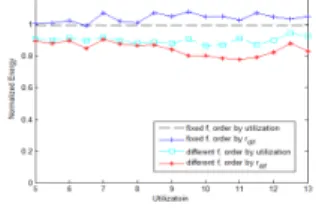
(4) ESS2017 2017/8/25. 組込みシステムシンポジウム2017 Embedded Systems Symposium 2017. energy wasting. Besides, DL-EVBA algorithm separates tasks into two sections in the first phase which effectively utilizes the priorities of rdif and reduce the system utilization, as a result, when the value of rdif increases, DL-EVBA saves more energy. 2 ) Impact of Per-Core-DVFS Assumption: In this experiment, we compare our method DL-EVBA to well performed DL-CAP. We fix the range of rdif as [2.8,4.2], MTU as 0.3 and vary the total utilization U. Fig.2 shows that regardless of the workload, Per-Core-DVFS assumption (“different f”) is always more energyefficient than Per-Cluster-DVFA assumption (“fixed f”). Besides, rdif-based ordering does not save energy for the case of “fixed f”, but saves energy for “different f”. The reason is that utilization-based allocation makes workload more balanced, while rdif-based allocation guarantees less system utilization. When the frequency of the cluster is fixed, frequency is determined by the maximum utilization, as a result, balanced-workload is more energy-efficient. But when we assume frequency is different, frequency of each core is determined by their own utilization, in this case, less utilization makes less energy.. based on the assumption that frequencies of the cores from one cluster could be different. The experimental results show the efficiency of our proposed method. For the future work, an alternative approach AMBFF [9] will be used for further comparison and task migration will be considered to make improvements.. REFERENCES [1] [2]. [3]. [4] [5]. [6]. Figure 1. Normalized energy with respect to Lower-power First. [7]. Figure 2. Normalized energy with respect to DL-CAP. [8]. 5.CONCLUSION The Desired-Load Distribution method [6] is studied in this work to efficiently schedule real-times tasks in heterogeneous system. We simplify the calculation method by using execution-variance and propose the DLEVBA algorithm to allocate tasks. In contrast to existing allocation approaches, we propose to order tasks by rdif. ⓒ 2017 Information Processing Society of Japan. [9]. P. Greenhalgh, Big. little processing with arm cortex-a15 and cortex-a7. White Paper, 2011. D. Liu et al, Energy-efficient scheduling of realtime tasks on heterogeneous multicores using task splitting. IEEE International Conference on Embedded and Real-Time Computing Systems and Applications (RTCSA), 2016. S. Pagani, A. Pathania et al, Energy efficiency for clustered heterogeneous multicores. IEEE Transactions on Parallel and Distributed Systems, 2017. ARMDeveloper, “http://developer.arm/technologies/dynamiq.” J.-J. Chen and C.-F. Kuo, Energy-efficient scheduling for real-time systems on dynamic voltage scaling (DVS) platforms. IEEE International Conference on Embedded and RealTime Computing Systems and Applications, 2007. A. Colin, A, A. Kandhalu, R. R. Rajkimar, Energy-efficient allocation of real-time applications onto single-ISA heterogeneous multicore processors. Journal of Signal Processing Systems, 2015. V. Devadas, H. Aydin. Coordinated power management of periodic real-time tasks on chip multiprocessors. In Proceedings of International Conference on Green Computing (GREENCOMP’ 10). R. Davis and A. Burns. Improved priority assignment for global fixed priority pre-emptive scheduling in multiprocessor real-time systems. Real-Time Systems, 2011. G. Zeng, T. Yokoyama and H. Takada, Practical energy-aware scheduling for real-time multiprocessor systems. IEEE International Conference on Embedded and Real-Time Computing Systems and Applications, 2009.. 46.
(5)
図
関連したドキュメント
The main purpose of this paper is to extend the characterizations of the second eigenvalue to the case treated in [29] by an abstract approach, based on techniques of metric
T. In this paper we consider one-dimensional two-phase Stefan problems for a class of parabolic equations with nonlinear heat source terms and with nonlinear flux conditions on the
It is suggested by our method that most of the quadratic algebras for all St¨ ackel equivalence classes of 3D second order quantum superintegrable systems on conformally flat
Recently, Velin [44, 45], employing the fibering method, proved the existence of multiple positive solutions for a class of (p, q)-gradient elliptic systems including systems
By applying the Schauder fixed point theorem, we show existence of the solutions to the suitable approximate problem and then obtain the solutions of the considered periodic
Keywords: continuous time random walk, Brownian motion, collision time, skew Young tableaux, tandem queue.. AMS 2000 Subject Classification: Primary:
A monotone iteration scheme for traveling waves based on ordered upper and lower solutions is derived for a class of nonlocal dispersal system with delay.. Such system can be used
The construction of homogeneous statistical solutions in [VF1], [VF2] is based on Galerkin approximations of measures that are supported by divergence free periodic vector fields
