T itle
D evelopment of a visible nanothermometer with a highly
emissive 2′
-O-methylated guanosine analogue
A uthor(s )
Y amamoto, S eigi; Park, S oyoung; S ugiyama, Hiroshi
C itation
R S C A dvances (2015), 5(126): 104601-104605
Is s ue D ate
2015
UR L
http://hdl.handle.net/2433/207678
R ig ht
T his article is licensed under a C reative C ommons A ttribution
3.0 Unported L icence.
T ype
J ournal A rticle
Development of a visible nanothermometer with
a highly emissive 2
0
-O-methylated guanosine
analogue
†
Seigi Yamamoto,aSoyoung Park*aand Hiroshi Sugiyama*ab
We have synthesized afluorescent base analogue, 2-aminothieno[3,4-d]pyrimidine based G-mimic deoxyribonucleoside, 20-OMe-thG, and
investigated its photophysical properties and DNA incorporation. The 20methoxy group of 20-OMe-thGeffectively induces the Z-form DNA.
Finally we have constructed a visible nanothermometer based on the B–Z transition of DNA using 20
-OMe-th
G.
The development of nanodevices and molecular machines such as nanorobots and molecular switches has been a very active research area in the eld of nanotechnology. A variety of nanomaterials such as gold nanoparticles, graphene oxide, and mesoporous silica have been investigated, and are now widely utilized to develop nanodevices. DNA is an outstanding natural building block with which to construct two- and three-dimensional nanostructures because of its unique comple-mentarity, chemical stability, and dynamic conformational changes by external stimuli.1–5Besides natural nucleobases (A, T, C, G), with the rapid advancements in chemical biology, multifarious functionalized nucleobase analogues have been developed, and these articial genetic alphabet characters widen the sphere of DNA technology applications.6–10 Previ-ously, Tor and coworkers have developed isomorphic uores-cent RNA nucleosides derived from thieno[3,4-d]-pyrimidine and demonstrated their attractive photophysical properties including visible light emission and a high quantum yield.11
Recently, we have synthesized a highly emissive deoxy-guanosine analogue,thdG, as a
uorescent probe and found that thdG
uorescence could be applied to visualize B to Z transitions of DNA based on different p-stacking of B- and Z-DNA (Fig. 1).12In this context, we have focused the nucleotide
modications to enhance the utility of thdG and synthesized a highly emissive 20-O-methylated guanosine analogue, 20-OMe-thG, and investigated its photophysical properties as auorescent base analogue.
20-O-Methyl-modication of oligonucleotides is a well-known strategy used to increase the binding affinity of oligonucleotides for their target and to enhance the thermal stability of the resulting duplex structure. This methylation also has the advantage that the 20-O-methyl substituent inhibits the hydro-lysis of oligonucleotides in vivo.13–18 Herein, we report the development of a visible nanothermometer by a combination of highly emissive 20-O-methylated guanosine analogue, 20-OMe-thG, and distinctive B
–Z transition of DNA.
The synthesis of 20-OMe-thG (3) was achieved based on
re-ported procedures for thdG nucleosides and 20 -O-methyl-modied oligonucleotides (Scheme 1).11a,12a,19 The protected
20-O-methylated ribonucleoside (2) was obtained through Frie-del–Cras C-glycosylation between thienoguanine (1) and an
acylated sugar derivative. This coupling mainly afforded ab-anomer in 83% yield. The benzoyl-protecting groups were removed in a methanolic base and theN,N -dimethylformami-dine group was introduced for protection of the purine amino group (4). Subsequently, the 50-hydroxyl group was protected
Fig. 1 Different stacking conformation in B-form DNA and Z-form DNA.
aDepartment of Chemistry, Graduate School of Science, Kyoto University,
Kitashirakawa-oiwakecho, Sakyo-ku, Kyoto 606-8502, Japan. E-mail: oleesy@ kuchem.kyoto-u.ac.jp; [email protected]
bInstitute for Integrated Cell-Material Sciences (iCeMS), Kyoto University,
Yoshida-ushinomiyacho, Sakyo-ku, Kyoto 606-8501, Japan
†Electronic supplementary information (ESI) available. See DOI: 10.1039/c5ra24756j
Cite this:RSC Adv., 2015,5, 104601
Received 7th October 2015 Accepted 26th November 2015
DOI: 10.1039/c5ra24756j
www.rsc.org/advances
COMMUNICATION
Open Access Article. Published on 27 November 2015. Downloaded on 04/03/2016 01:06:14.
This article is licensed under a
Creative Commons Attribution 3.0 Unported Licence.
View Article Online
with the dimethoxytrityl ether (DMTr) and the desiredb-anomer (5) could be isolated in 75% yield. The conguration at the C-1 carbons of theb-anomer was conrmed by 1D and 2D (NOESY) 1H NMR experiments (see ESI†).
To evaluate oligonucleotides containing the 20-O-methylated guanosine analogue, the phosphoramidite 20-OMe-thG(6) was synthesized and incorporated into the center of 18-mer DNA oligonucleotides of 50-d(CGTCCGTCXTACGCACGC)-30, whereX ¼ 20-OMe-thG, by automated solid-phase synthesis. The complementary strands of ODN1 containing matched or mis-matched bases and the corresponding native DNA duplexes with G were also prepared. The 20-OMe-th
G–C base pair showed
almost identical thermal stability (Tm¼72.1C) compared with native duplex DNA with a G–C base pair (Tm ¼ 72.1 C), as shown in Fig. 2. The complementary strands containing mis-matched bases (ODN4–7) decreased the melting temperature
compared with one obtained using the complementary stands containing dG. The thermodynamic stability and base pairing selectivity indicate that 20-OMe-thGcould replace a G base in the
strand without structural disruption. The photophysical prop-erties of 20-OMe-thGmonomer were also investigated (see ESI†). The uorescence of 20-OMe-th
G ribonucleoside (1) shows absorption at 320 nm and visible emission at 457 nm with a high quantum yield of 0.652 under neutral conditions in water.
We prepared a self-complementary decamer 50
-d(CGCXCGCGCG)-30 (ODN8), where X ¼ 20-OMe-th
G, and examined its conformation using circular dichroism (CD) spectra. Fig. 3a shows the CD spectra of ODN8 in various concentrations of NaClO4at 5C. At 1–3 M NaClO4, a negative Cotton effect at around 250 nm and a positive Cotton effect at around 285 nm were observed; ODN8 maintained the B-form. When we increased the NaClO4concentrations from 5 to 9 M, we observed a positive Cotton effect at around 260 nm and
a negative Cotton effect at around 290 nm; 20-OMe-th
G -con-taining decamer duplex converted to Z conformation. In a recent study, we demonstrated that the B–Z transition could
be visualized by theuorescence intensity ofthdG.12Although
thdGindicated the comparable resemblance to the native dG
nucleosides regarding thermodynamic stability and base pair-ing selectivity, the B–Z transition became more difficult when
th
dGwas incorporated as a replacement for a dG nucleotide. BecausethdGfavors the anti-conformation to stabilize B-form DNA, 8-methylguanine (m8G) was additionally introduced into DNA sequences as a Z-stabilizing unit.20 Fortunately, the
ob-tained results indicate that the oligonucleotide possessing 20-OMe-th
G could convert Z conformation without the aid of a Z-DNA inducer. Subsequently, we observed the change in uorescent intensity by B–Z transition of ODN8. As shown in
Fig. 3b, theuorescence of ODN8 increased signicantly with increasing NaClO4 concentration. This result indicated that strong uorescence enhancement was observed in Z-DNA compared with B-DNA.
Previously, we have found that B–Z transition can be
controlled by temperature and high salt conditions, and demonstrated a DNA-based switching device that responds to Scheme 1 Synthesis of 20-OMe-thG. Reagents and conditions: (a)b
-D -deoxyribofuranose 1-acetate 4,5-dibenzoate, SnCl4, MeNO2, 0C to
RT, 83%; (b) NH3/MeOH, 65C, 51%; (c) dimethylformamide dimethyl
acetal, DMF/MeOH; (d) DMTrCl, Py, 75%; (e) 2-cyanoethylN,N -diiso-propylchlorophosphoramidite, iPr2NEt, DCM/MeCN, 0C to RT.
Fig. 2 Fidelity 20-OMe-thG of against canonical bases. (a) Thermal melts of 20-OMe-thG containing DNA paired with ODN3
–7: 50 -GCGTGCGTAYGACGGACG-30Y¼C, T, A, G, or dSpacer. ODN1: 50 -CGTCCGTCXTACGCACGC-30X¼20-OMe-thG. (b) Comparison ofT
m
values. ODN1,2: 50-CGTCCGTCXTACGCACGC-30X¼20-OMe-thGor Gpaired with ODN3–7. All samples contained 5mM of each oligo-nucleotide strand, 20 mM Na cacodylate (pH 7.0), and 100 mM NaCl.
RSC Advances Communication
Open Access Article. Published on 27 November 2015. Downloaded on 04/03/2016 01:06:14.
This article is licensed under a
Creative Commons Attribution 3.0 Unported Licence.
thermal stimuli.21 Based on previous studies and the
photo-physical properties of 20-OMe-thG, we devised a visible
nano-thermometer. To test this concept, the 20-OMe-thG-containing
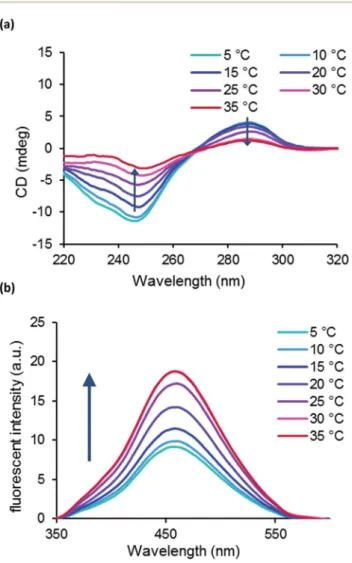
oligonucleotide 50-d(CGCGCXCGCGCGCG)-30(ODN9), where X ¼ 20-OMe-thG, was prepared and conformational changes by temperature were investigated in 3.5 M NaClO4. At 5C, ODN9 predominantly converted to Z-DNA because of its lower entropy. As the temperature increased from 5C to 40C, the proportion of B-DNA gradually increased (Fig. 4a and c). We ascertained that the equilibrium between B-DNA and Z-DNA of ODN9 could be controlled by temperature. Therefore, the uorescence of ODN9 was observed at different temperatures in 3.5 M NaClO4. To our delight, the uorescence intensity of ODN9 changed depending on the temperature in conjunction with its B–Z
transition. As shown in Fig. 3b, very strong uorescence enhancement was observed at 5C, whereas theuorescence intensity of ODN9 decreased signicantly at 40 C. The proportions of Z-DNA, B-DNA, and single-strand DNA are shown in the ESI (Fig. S6†). To examine the utility of 20-OMe-thG -con-taining oligonucleotide as a nanothermometer, we monitored theuorescence of ODN9 under a repetitive temperature cycle between low temperature (5C) and high temperature (40C).
Consequently, a reproducible uorescence of ODN9 was observed according to the change in the proportion of Z- and B-DNA (Fig. 4c). As shown in Fig. 4d, the distinguishable blue Fig. 3 Conformational changes from B-DNA to Z-DNA andfl
uores-cence intensity of ODN8 at various NaClO4 concentrations. (a)
Observation of the B–Z transition by CD spectroscopy. (b) Change in
fluorescence intensity. All samples contained 5mM of ODN8 in 20 mM sodium cacodylate buffer (pH 7.0) at 5C.
Fig. 4 Conformational changes from B-DNA to Z-DNA andfl uores-cence intensity at various temperatures. (a) Observation of the B–Z transition by CD spectroscopy. (b) Change influorescence intensity. (c) Repeated experiments showingfluorescence emission of ODN9 at 5C and 40C. (d) Photo of visible nanothermometer. Samples con-tained 5mM of ODN9 in 20 mM sodium cacodylate buffered (pH 7.0) 3.5 M NaClO4. The photo was taken under UV (365 nm) irradiation.
Open Access Article. Published on 27 November 2015. Downloaded on 04/03/2016 01:06:14.
This article is licensed under a
emission of the nanothermometer at 5 C was visible to the naked eye.
For further investigation of the devised nano-thermometer we prepared two 20-OMe-th
G-containing oligonucleotide 50-d(CGCXCXCGCG)-30 (ODN10), where X ¼ 20-OMe-thG, and
evaluated it by CD spectra and uorescent spectra measure-ments. Although ODN10 did not indicate dramatic B–Z
transi-tion in the range of 0 M to 5 M NaClO4,uorescent intensity strongly increased with increasing NaClO4concentration from 7 M to 9 M (Fig. S7†). Therefore, CD and emission spectra of ODN10 were measured in 7 M NaClO4at various temperatures. Interestingly, ODN10 indicated that the population of Z-form increased by increasing temperature from 5C to 35C and the emission increased in line with the proportion of Z conformation (Fig. 5); the thermal response of ODN10 was in inverse to that of ODN9. It is known that Z-RNA is the more stable at higher temperature.21b,22This result suggests that four
20-OMe group in duplex ODN10 may induce RNA-like thermal conformational change and we can reverse the response to the same stimuli by control the incorporation of 20-OMe-thG.
In conclusion, we synthesized a usefuluorescent guanine analogue, 20-OMe-th
G, and developed a visible nano-thermometer using a combination of distinctive B–Z transition
of DNA and robust brightness of 20-OMe-th
G in the visible region. Temperature is a critical factor inuencing various biochemical transformations in living systems.23 A visible
nanothermometer based on a nucleic acid may be a useful tool for the development of biocompatible nanodevices to monitor the temperature in an intracellular environment.24–29Further investigations into the application of 20-OMe-th
Gare ongoing in our laboratory.
Acknowledgements
We express sincere thanks for a Grant-in-Aid Priority Research from Japan Society for the Promotion of Science (JSPS) and the grant from the WPI program (iCeMS, Kyoto University).
Notes and references
1 F. C. Simmel and W. U. Dittmer,Small, 2005,1, 284. 2 A. Condon,Nat. Rev. Genet., 2006,7, 565.
3 A. V. Pinheiro, D. Han, W. M. Shih and H. Yan, Nat. Nanotechnol., 2011,6, 763.
4 L. A. Yatsunyk, O. Mendoza and J.-L. Mergny,Acc. Chem. Res., 2014,47, 1836.
5 Y. Krishnan and F. C. Simmel,Angew. Chem., Int. Ed., 2011,
50, 3124–3156.
6 R. W. Sinkeldam, N. J. Greco and Y. Tor,Chem. Rev., 2010,
110, 2579.
7 A. T. Krueger and E. T. Kool,Curr. Opin. Chem. Biol., 2007,11, 588.
8 (a) A. A. Henry and F. E. Romesberg,Curr. Opin. Chem. Biol., 2003,7, 727; (b) A. M. Leconte and F. E. Romesberg,Nature, 2006,444, 553; (c) A. M. Leconte and F. E. Romesberg,Nat. Methods, 2006,3, 667.
9 S. A. Benner,Acc. Chem. Res., 2004,37, 784.
10 (a) I. Hirao, Biotechniques, 2006, 40, 711; (b) I. Hirao and M. Kimoto, Proc. Jpn. Acad., Ser. B, 2012, 88, 345; (c) I. Hirao, M. Kimoto and R. Yamashige, Acc. Chem. Res., 2012,45, 2055.
11 (a) D. Shin, R. W. Sinkeldam and Y. Tor,J. Am. Chem. Soc., 2011, 133, 14912; (b) R. W. Sinkeldam, L. S. McCoy, D. Shin and Y. Tor,Angew. Chem., Int. Ed., 2013,52, 14026;
(c) M. Sholokh, R. Sharma, D. Shin, R. Das,
O. A. Zaporozhets, Y. Tor and Y. M´ely, J. Am. Chem. Soc., 2015,137, 3185.
12 (a) S. Park, H. Otomo, L. Zheng and H. Sugiyama, Chem. Commun., 2014, 50, 1573; (b) H. Otomo, S. Park, S. Yamamoto and H. Sugiyama,RSC Adv., 2014,4, 31341. 13 P. Lubini, W. Z¨urcher and M. Egli,Chem. Biol., 1994,1, 39. 14 L. L. Cummins, S. R. Owens, L. M. Risen, E. A. Lesnik,
S. M. Freier, D. McGee, C. J. Guinosso and P. D. Cook, Nucleic Acids Res., 1995,23, 2019.
15 J. Kurreck,Eur. J. Biochem., 2003,270, 1628. Fig. 5 Conformational changes of ODN10 at various temperatures. (a)
Observation of the B–Z transition by CD spectroscopy. (b) Change in
fluorescence intensity. Samples contained 5mM of ODN10 in 20 mM sodium cacodylate buffer (pH 7.0) 7.0 M NaClO4.
RSC Advances Communication
Open Access Article. Published on 27 November 2015. Downloaded on 04/03/2016 01:06:14.
This article is licensed under a
Creative Commons Attribution 3.0 Unported Licence.
16 A. Grunweller, E. Wuszko, B. Bieber, R. Jahnel, V. A. Erdmann and J. Kurreck,Nucleic Acids Res., 2003,31, 3185.
17 T. P. Prakash, C. R. Allerson, P. Dande, T. A. Vickers, N. Siou, R. Jarres, B. F. Baker, E. E. Swayze, R. H. Griffey and B. Bhat,J. Med. Chem., 2005,48, 4247.
18 H. Doessing and B. Vester,Molecules, 2011,16, 4511. 19 (a) A. H. Haines,Tetrahedron, 1973, 29, 2807; (b) C. G´
enu-Dellac, G. Gosselin and J.-L. Imbach, Tetrahedron, 1991,
216, 249; (c) B. S. Ross, R. H. Springer, G. Vasquez, R. S. Andrews, P. D. Cook and O. L. Acevedo,J. Heterocycl. Chem., 1994, 31, 765; (d) G. Parmentier, G. Schmitt, F. Dolle and B. Luu,Tetrahedron, 1994,50, 5361.
20 (a) H. Sugiyama, K. Kawai, A. Matsunaga, K. Fujimoto, I. Saito, H. Robinson and A. H.-J. Wang,Nucleic Acids Res., 1996,24, 1272; (b) Y. Xu, R. Ikeda and H. Sugiyama,J. Am. Chem. Soc., 2003, 125, 13519; (c) F. Y.-H. Chen, S. Park, H. Otomo, S. Sakashita and H. Sugiyama, Articial DNA: PNA & XNA, 2014,5, e28226.
21 (a) R. Tashiro and H. Sugiyama,Angew. Chem., Int. Ed., 2003,
42, 6018; (b) R. Tashiro and H. Sugiyama,J. Am. Chem. Soc., 2005,127, 2094.
22 (a) K. Hall, P. Cruz, I. Tinoco Jr, T. M. Jovin and J. H. van de Sande,Nature, 1984,311, 584; (b) M. K. Teng, Y. C. Liaw, G. A. van der Marel, J. H. van Boom and A. H.-J. Wang, Biochemistry, 1989, 28, 4923; (c) P. W. Davis, R. W. Adamiak and I. Tinoco Jr,Biopolymers, 1990,29, 109; (d) B. A. Brown II, K. Lowenhaupt, C. M. Wilbert, E. B. Hanlon and A. Rich, Proc. Natl. Acad. Sci. U. S. A., 2000,97, 13532.
23 B. B. Lowell and B. M. Spiegelman,Nature, 2000,404, 652. 24 S. Lal, S. E. Clare and N. J. Halas,Acc. Chem. Res., 2008,41,
1842.
25 K. M. McCabe and M. Hernandez, Pediatr. Res., 2010,67, 469.
26 J. Lee and N. A. Kotov,Nano Today, 2007,2, 48.
27 J. S. Donner, S. A. Thompson, M. P. Kreuzer, G. Baffou and R. Quidant,Nano Lett., 2012,12, 2107.
28 F. H. Wang, D. S. Banks, A. Abu-Arish and C. Fradin,J. Am. Chem. Soc., 2007,129, 10302.
29 P. Leiderman, D. Huppert and N. Agmon,Biophys. J., 2006,
90, 1009.
Open Access Article. Published on 27 November 2015. Downloaded on 04/03/2016 01:06:14.
This article is licensed under a