Doctoral Thesis
Study on Material Texture Control of Composite Materials by Self-assembly Process -Applications to Piezoelectric Biosensor and High Thermal Conductive Materials- 自己組織化プロセスを用いたコンポジット材料の材料組織制御に関する研究
-圧電体バイオセンサ及び高熱伝導材料への適用-
Mariko Takeda 武田 真理子
Electrical Engineering and Chemistry
Graduate School of Integrative Science and Engineering Tokyo City University
March 2021
I ABSTRACT
The targets applications of the ceramics / polymer and ceramics / stainless steel composite materials were the piezoelectric biosensor and the high thermal conductivity components in this study. Tuberculosis (TB) has become prevalent mainly in developing countries. In this study, the TB diagnostic method that combines the LAMP (Loop-mediated Isothermal Amplification) method and polymer piezoelectric material was proposed to solve the safety and cost problems. In order to achieve the final goal of TB diagnosis by combining the LAMP method and the polymer piezoelectric biosensor, it is necessary to improve the sensitivity and responsivity of the biosensor. Therefore, in this study, the ceramics / polymer composite materials were applied to biosensors to improve the dielectric properties related to the sensitivity and responsivity.
In high thermal conductivity components, the friction and abrasions of the engine generated cause energetic and material losses and decrease the efficiency of mechanical systems. The materials with high thermal conductivity are required. However, the thermal conductivity of general iron alloys is low. Therefore, in order to improve the thermal conductivity, ceramics / stainless steel composites were applied as high thermal conductivity components in this study.
Generally, the dielectric constant of a polymer is low. The thermal conductivity of stainless steel is low. In the general studies of composite materials, ceramic fillers are dispersed. However, the volume fraction of the filler is 50 vol.%, and it is not suitable for the applications. Therefore, the purpose of this study was to design composite materials in order to improve dielectric properties and thermal conductivity with a small amount of ceramic filler addition (0-20 vol.%). The dielectric properties and the thermal conductivity are affected by the material texture. In the material design approach of this
II
study, it was proposed that the dielectric properties were able to improve by forming self-assembled ceramic aggregates having a ceramics / polymer / ceramics heterointerface. In the thermal conductivity, it was proposed that the thermal conductivity would be improved by forming ceramic particle groups for the thermal conductivity networks. Therefore, in this study, the material texture of the composite was controlled by the self-assembly process involving solids in order to improve the dielectric properties and thermal conductivity. There are few studies on material texture controlled with self-assembly processes involving the solid. In addition, the relationship between the self-assembled material texture and the dielectric properties and the thermal conductivity has not been clarified. Therefore, in this thesis, the relationship between the dispersion states of self-assembled ceramics secondary particle groups under the different manufacturing processes and the dielectric properties and the thermal conductivity of the ceramics / polymer and ceramics / stainless steel composites were investigated. And then, the relationship between the self-assembled material texture and the dielectric constant and the thermal conductivity was discussed, and the material design was proposed. In particular, the multifractal analysis was performed to quantify the morphology, entropy of the configuration, dispersibility of the self-assembled ceramic secondary particle groups and the interface state in the ceramic secondary particle groups.
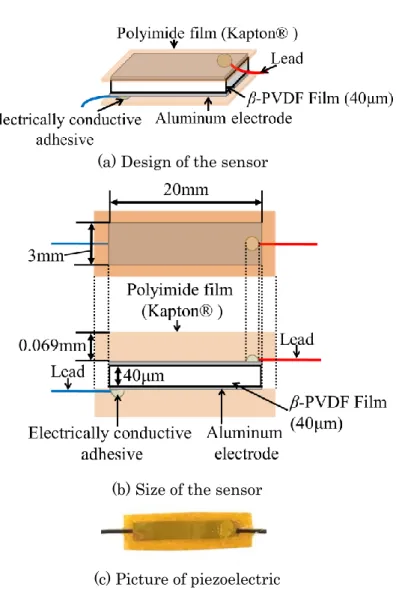
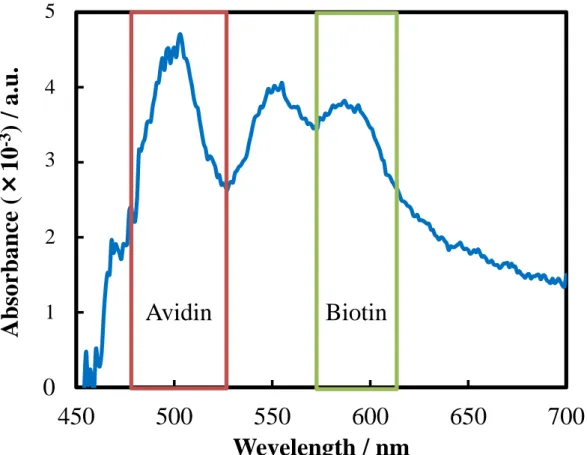
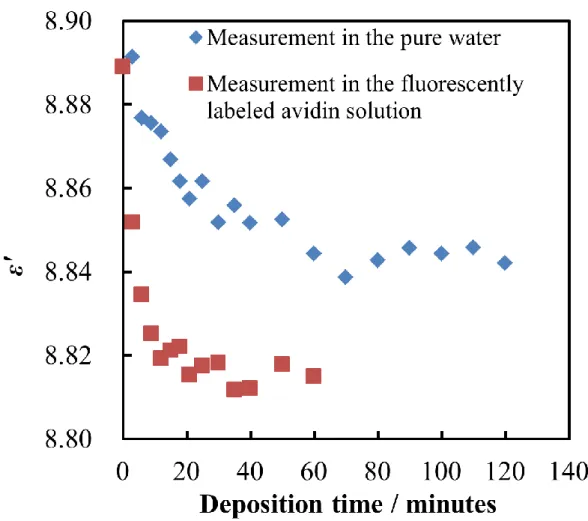
In this thesis, a polymer piezoelectric biosensor was prepared with polyvinylidene fluoride (β-PVDF) to present the problems of the piezoelectric biosensor. (1) The weight sensing property by loading polymer films and (2) the sensor sensing properties by adsorption of fluorescently labeled avidin and biotin were investigated. It was possible to detect biopolymers using the immobilization characteristics associated with
III
the host-guest reaction at 100 kHz to 6 MHz by using the relaxation process of the complex permittivity. According to the results of the investigation of the sensor detection characteristics, it was found that (1) the shear vibration of β-PVDF is affected by the viscosity of the solution due to the low elastic modulus of β-PVDF, and (2) the sensitivity of the sensor is 5 μg/ml and the response time is 60 minutes, so the improvement of the sensitivity and response time is necessary for practical use. To solve these problems, ceramics/polymer composites were applied to piezoelectric biosensors.
Barium titanate (BT) was used as a ceramic filler, and polylactic acid (PLLA) and PVDF were used as polymer matrices. In order to control the material texture, BT/polymer composites were fabricated by changing (1) the kneading conditions and (2) the viscosity of the dispersant. According to the investigation of the material texture control by the self-assembly process, BT agglomerate with the BT / BT interface was formed under high-speed kneading conditions (30 rpm) and high viscosity of PEG. On the other hand, the BT aggregates with the BT / polymer / BT heterointerface were formed under the low kneading conditions (10 rpm) and low viscosity of PEG. From the results of the material texture and the dielectric properties of the BT / PLLA composites, the dielectric constant of the self-assembled BT aggregates with the BT/ PLLA / BT heterointerface depending on the secondary particle group improved by 24.5 times compared to the BT / PLLA composite with BT / BT interface. This is that the electric dipole of a BT / polymer / BT heterointerface induced to improve the dielectric constant.
Similarly, the dielectric constant of the self-assembled BT aggregates depending on the secondary particle group improved by 1.16 times compared to the BT / PVDF composite with BT agglomerates. The fractal analysis was used for the evaluation of the material texture with SEM images. It was suggested that it is possible that multifractal
IV
analyses were applied to evaluate the morphology, configuration entropy, and dispersibility of the self-assembled BT secondary particle groups and the formation of the BT / polymer / BT heterointerfaces in self-assembled BT aggregates. It was expected to improve the sensitivity by 2.1 times and responsivity by 7 times compared to the conventional PVDF by using the BT / PVDF composites.
The material was designed to improve the thermal conductivity (λe) of silicon nitride (SN)/stainless steel (SUS316L) composites. To discuss the relationship of the self-assembled material texture and thermal conductivity, SUS316L powders with an average particle size of 3 μm and 8 μm were used. According to the results of the secondary particle area of SN filler and λe, it was clarified that the λe was efficiently improved by increasing the SN/SN interface and the formation of thermal conductive network with the formation of SN particle groups. The thermal conductivity was improved by 1.22 times at 10 vol.% compared to the volume fraction of 0 vol.% for SN.
Based on the results of the multifractal analysis, the morphology, configuration entropy, and dispersibility of the self-assembled SN particle groups due to the difference in packing with the self-assembly process were analyzed to determine the characteristics of the thermal conductive network.
Hence, it was clarified that the fabrication conditions affected the self-assembly process of the reaction-diffusion system and were able to control the morphology, configuration entropy, and dispersibility of the BT and SN particle groups and the interface state in the BT and SN particle groups. From the results of the material texture control, the material designs that solve the problems of conventional PVDF or stainless steel were proposed. The actual application to biosensors is expected to enable more sensitive and rapid TB diagnosis. In the future, it is also expected to contribute to the
V
electronic substrate materials that are required low loss and high thermal conductivity by combining the material design of the dielectric properties and thermal conductivity of the composite materials of this study. The material design in this study can be applied to electrical, thermal conductivity, strength, optical, and sonic materials and the results of this study can contribute to the development of new materials.
1
Contents
ABSTRACT Ⅰ
Chapter 1 Introduction 3
1.1 Composite material and applications 3
1.2 Self-assembly process 17
1.3 Aggregates and agglomerates 19
1.4 Fractal analysis 21
1.5 Problems and concepts for applications and material design of composites 24
1.6 Purpose of this study 35
1.7 Thesis organization 37
References 38
Chapter 2 Self-assembled barium titanate (BT) / polymer composite material texture and dielectric properties -application to a piezoelectric biosensor-
47
2.1 Properties of biopolymers detection with piezoelectric polymer biosensor in relaxation behavior process
48
2.1.1 Introduction 48
2.1.2 Experimental procedures 49
2.1.3 Results and discussion 56
2.1.4 Conclusions 67
2.1.5 Setting of problems for the polymer piezoelectric biosensor 67 2.2 Fractal characters and dielectric constant of material texture of
self-assembled BaTiO3/Poly-L-Lactic-Acid composites
69
2.2.1 Introduction 69
2.2.2 Experimental procedures 72
2.2.3 Results 75
2.2.4 Discussion 82
2.2.5 Conclusions 86
2.3 Effect of ceramics / polymer heterointerface on dielectric property of self-assembled BT / PLLA acid composite materials
88
2.3.1 Introduction 88
2.3.2 Experimental procedures 90
2.3.3 Results 92
2.3.4 Discussion 102
2.2.5 Conclusions 106
2.4 Material texture of self-assembled BT / polyvinylidene fluoride composites 108
2 and dielectric properties
2.4.1 Introduction 108
2.4.2 Experimental procedures 110
2.4.3 Results 114
2.4.4 Discussion 122
2.4.5 Conclusions 130
2.5 Conclusions of chapter 2 131
References 136
Chapter 3 Self-assembled silicon nitride / stainless steel (SUS316L) composites material texture and thermal conductivity
144
3.1 Fractal characters and thermal conductive properties of self-assembled material texture of silicon nitride / stainless steel (SUS316L) composites
144
3.1.1 Introduction 144
3.1.2 Experimental procedures 146
3.1.3 Results and discussion 149
3.1.4 Conclusions 159
3.2 Grain size effect of material matrix SUS316L in SN / SUS316L composites on self-assembled texture and thermal conductivity
160
3.2.1 Introduction 160
3. 2.2 Experimental procedures 162
3.2.3 Results 165
3.2.4 Discussion 170
3.2.5 Conclusions 175
3.3 Conclusions of chapter 3 176
References 177
Chapter 4 Conclusions of this thesis and future works 181
4.1 Conclusions of this thesis 181
4.2 Future works 191
Appendix 195
Acknowledgments 201
3
Chapter 1 Introduction
1.1 Composite material and applications 1.1.1 Composite material
Composite materials are mixed with a matrix material and a filler material. The composite materials have properties that do not appear as a single material by controlling the structure and the interface between materials. This is, two inherently different materials that when combined together produce a material with properties that exceed the constituent materials [1]. Therefore, the composite materials can be designed to have excellent structure, mechanical properties, and chemical conditions depending on the purpose. The composite materials have inorganic / inorganic, inorganic / organic, and organic / organic combinations. Applications of these composite materials have the construction of buildings and bridges, automobile bodies, automobile industry, and biomedical fields [2]. The following factors affect the performance of composite materials.
(1) Properties of matrix and filler
(2) Volume fraction of filler in the composite material (3) Shape and size of the filler
(4) Distribution of temperature, the electric field between fillers (5) Dispersion state of fillers
(6) Interface state between matrix and filler (7) Orientation of fillers
(8) Interface state between fillers
4
1.1.2 Physical properties and model equations of composite materials
The coefficients which reflect the potential gradient and the flow velocity relate to dielectric constant, magnetic susceptibility, electrical conductivity, and thermal conductivity. These properties are used with the same composite rule. In this study, dielectric composites and thermally conductive composites were focused on.
Many models of conductivity, dielectric constant, magnetic susceptibility, and thermal conductivity have been reported. The volume-fraction average is a simple (but inaccurate) method to estimate the effective dielectric constant of a polymer composite material [3]:
𝜆𝑒 = 𝑣𝑐𝜆𝑐 + 𝑣𝑑𝜆𝑑 (1-1)
λe is the dielectric constant and thermal conductivity of the composites. λc is the dielectric constant and thermal conductivity of the matrix material. λd is the dielectric constant and thermal conductivity of the filler. vc and vd is the volume fraction of matrix and filler, respectively.
Clausius and Mossotti derived independently a mean-field theory for a disordered system of polarizable spheres [4]. The effective medium theory has been proposed since their work. The theory is shown as [5]:
𝜆𝑒 = 𝜆𝑐+ 𝑣𝑑⁄[1 (𝜆⁄ 𝑑− 𝜆𝑐) + (1 − 𝑣𝑑) 3𝜆⁄ 𝑐] (1-2)
Maxwell proposed a model in which a single sphere presents in a sufficiently large solid when the distance of spheres is large [6]. The model is considered the temperature
5
distribution and around the sphere, the following equation is shown [6]:
𝜆𝑒
𝜆𝑐 =2𝜆𝑐+𝜆𝑑−2(𝜆𝑐−𝜆𝑑)𝑣
2𝜆𝑐+𝜆𝑑+(𝜆𝑐−𝜆𝑑)𝑣 (1-3)
where vd is the volume fraction of particles. In this Maxwell model, it is assumed that the matrix and filler material is isotropy and homogeneous. The shape of the filler affects the physical properties of the composite material. Therefore, a model was proposed that considers the interaction in that the distribution of the shape and the temperature around one particle is disturbed by other particles focusing on one particle.
Fricke proposed an equation for the elliptical model which the theory of the shape effect of the dispersed particle in a two-phase mixture [7], [8]. Hamilton et al. [9]
proposed an equation for irregularly shaped fillers dispersed without orientation.
𝜆𝑒
𝜆𝑐= x𝜆𝑐+𝜆𝑑−𝑥(𝜆𝑐−𝜆𝑑)𝑣
𝑥𝜆𝑐+𝜆𝑑+(𝜆𝑐−𝜆𝑑)𝑣 (1-4)
where x is a parameter related to the shape of the filler, thermal conductivity, dielectric constant.
Bruggeman proposed an equation that can be applied to high volume fractions [10].
In this equation, the non-uniform phase around the sphere is regarded as a uniform phase with average thermal conductivity and dielectric constant and the average thermal conductivity and dielectric constant are obtained [10].
1 − 𝑣 = 𝜆𝑒−𝜆𝑑
𝜆𝑐−𝜆𝑑(𝜆𝑐
𝜆𝑒)1/3 (1-5)
6
Various studies have indicated that the effective dielectric constant predicted by the Bruggeman model increases sharply for filler volume fractions above 20% and can be very high for ceramic particle loadings higher than 50% by volume [11]. Fig. 1-1 shows the dielectric constant predicted by models of Volume fraction average, Bruggeman spheres, and Maxwell for a blend of inorganic spheres (λd = εfiller = 1,000) dispersed in a polymer matrix (λe = εmatrix = 2.3).
Meridith expanded Fricke's equation for the case which the ellipsoids are dispersed without orientation [8].
Fig.1-1 The dielectric constant predicted by various models for a blend of inorganic spheres (λd = εfiller = 1,000) dispersed in a polymer matrix (λe = εmatrix = 2.3) [12].
7
1 − 𝑣 = 𝜆𝑒−𝜆𝑑
𝜆𝑐−𝜆𝑑(𝜆𝑒+𝛼𝜆𝑑
𝜆𝑐+𝛼𝜆𝑑)𝛾・ (𝜆𝑐
𝜆𝑒)𝛽 (1-6)
where α, β, and γ are parameters determined only by the shape of the ellipsoid. Kanari's equation was proposed by solving it assuming that x does not depend on the thermal conductivity of the composite [13], [14].
1 − 𝑣 = 𝜆𝑒−𝜆𝑑
𝜆𝑐−𝜆𝑑(𝜆𝑐
𝜆𝑒)1/(𝑥+1) (1-7)
In the behavior of conductivity, Percolation theory describes the connectivity of objects within a network structure and the effects of this connectivity on the macroscale properties of the system (see Fig.1-2) [15]. The theory is shown as [16]:
𝜆𝑒 = 𝜆𝑐(𝑣𝑑 − 𝑣𝑝)𝑡, 𝑓𝑜𝑟 𝑣𝑑 > 𝑣𝑐 (1-8)
where vp is the percolation threshold and t is the critical exponent based on theoretical prediction.
Fig.1-2 Schematic view of Percolation.
8
1.1.3 Dielectric and Piezoelectric Materials
Dielectrics and piezoelectric materials are used in capacitors, sensors, and energy storage [11]. Table 1-1 and Table 1-2 show the general dielectrics and piezoelectric ceramic and polymer [11]. A part of the ceramic filler and polymer matrix is described below.
1.1.3.1 Barium Titanate (BaTiO3) [11]
Barium titanate (BT) has a crystal with a perovskite structure and is ferroelectric ceramics.BT exists in the paraelectric cubic phase above its Curie point of about 130 °C, while in the temperature range of 0 °C to 130 °C, the ferroelectric tetragonal phase is stable. BT’s dielectric properties arise from a structural change where the center Ba2+
and Ti4+ cations are displaced relative to the O2- ions, leading to the formation of electric dipoles. This spontaneous polarization is the net dipole moment produced per unit volume for the dipoles pointing in a given direction.
1.1.3.2 Pb(Zr・Ti)O3 (PZT) [17]
PLZ is used for a wide range of piezoelectric applications. However, PZT is rigidity, brittleness, toxicity, high density, lower voltage coefficient, and lack of design flexibility limit their energy‐related application to some extent.
9
Table 1-1 Dielectric permittivity values of commonly used ceramics for capacitors [11] .
Table 1-2 List of dielectric permittivities of commonly used polymers in capacitors [11]
10
1.1.3.3 Polyvinylidene fluoride (PVDF)
The dielectric properties of PVDF based polymers originate from the presence of the highly electronegative fluorine on the polymer chains and from the spontaneous alignment of the C-F dipoles in the crystalline phases [18]. PVDF has four different crystalline phases, including α, β, γ, and δ phases (see Fig.1-3). The α phase is nonpolar, and the β, γ, and δ phases are ferroelectric. The β phase has the largest spontaneous polarization due to its large dipole moment. The β phase is formed by poling the α phase sample under an electric field of 100-200 MV/m. The dielectric constants of the α, β, and γ phases depending on the frequency are different (see Fig.1-4) [19].
Fig.1-3 The crystalline phases (α, β, and γ) of PVDF.
11
Fig.1-4 Dielectric constant and loss of PVDF with α, β, and γ phase. [19]
1.1.3.4 Poly Lactic Acid (PLA) [20]
PLA is biocompatible and is developed natural piezoelectricity after mechanical stretching. The stretching creates a non-chiral film poly-L-lactic acid (PLLA).
Piezoelectric materials are used in energy harvesting [21], [22], sensors [23]–[25] and actuators. In this study, BT is used for filler, and PVDF and PLLA are used for matrix materials.
1.1.4 Biosensor – Application of ceramics / polymer composites -
Biosensors are used in the food industry, fermentation industry, and medicine including detection of pathogens, where quality and safety are required [26].
12
Biosensors consist of a biocatalyst that can detect a biological element and a transducer that can convert the combination event of the biocatalyst and the biological element into a detectable parameter [26], [27]. The biocatalyst can be biomolecules such as enzymes, DNA, RNA, metabolites, cells, and oligonucleotides, and the transducers can be electrochemical, optical, piezoelectric, acoustics, calorimetric [26], [27]. The types of biosensors are shown in Fig.1-5 [28].
Fig.1-5 Examples of biosensors unit [28].
Examples of biosensors are shown below [26].
Enzyme-based sensors
Immobilization methods of the sensor are adsorption of enzymes by van der Waals forces, ionic bonding, or covalent bonding.
Microbe-based or cell-based sensors
The tissues for tissue-based sensors are used with plant and animal sources. The
13
analyte of interest is an inhibitor or a substrate of these processes.
Immunosensors
The sensors have anti-bodies that have a high affinity towards their respective antigens.
DNA biosensors
The sensors detect a single-strand nucleic acid molecule with a property that can recognize and bind to its complementary strand.
Magnetic biosensors
The sensors detect magnetic micro- and nanoparticles in microfluidic channels using the magnetoresistance effect.
Thermal biosensors or calorimetric biosensors
The sensors are developed by assimilating biosensor materials into a physical transducer.
Piezoelectric biosensors
The sensors detect the changes in the resonance frequency of a piezoelectric crystal due to mass changes.
Optical biosensors
The sensors have a light source and optical components which generate a light beam with specific characteristics and beeline.
In this study, the ceramics / polymer composite materials are applied to piezoelectric biosensors.
In general, a quartz oscillator is used as a piezoelectric biosensor for weight detection.
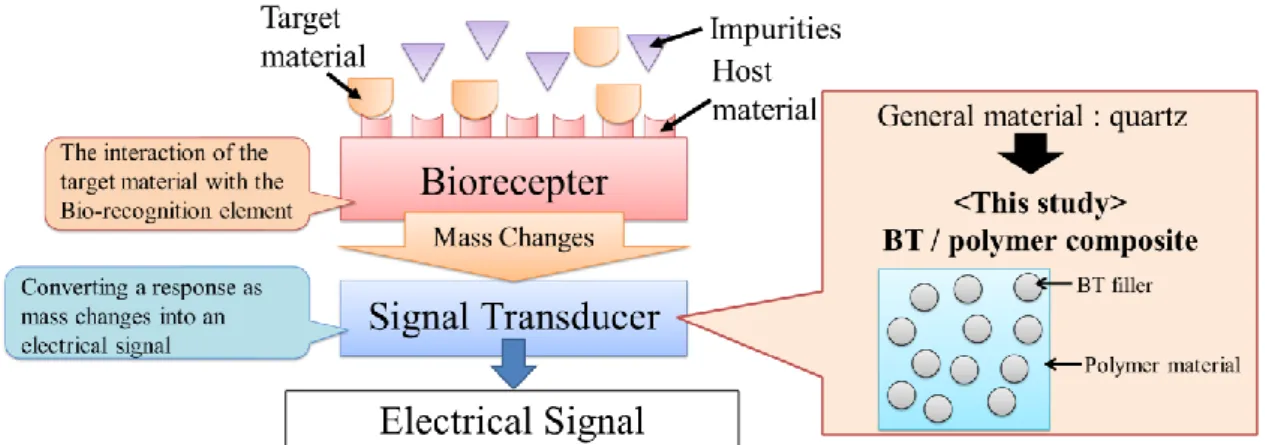
This piezoelectric biosensor is composed of a bioreceptor which is able to absorb
14
selectively an object to be detected, and a piezoelectric signal transducer sensor which is able to convert a weight change due to adsorption into an electric signal. The components of this biosensor are shown in Fig.1-6. The detection method is that applies an electric field to the quartz oscillator and the shear vibration is driven [23]. The change in weight of the target substance adsorbed on the quartz is detected as a frequency change with the shear vibration (see Fig.1-7) [23].
Fig.1-6 The components of the poezoelectric biosensor.
Fig.1-7 Illustration of the detectaion with the shear vibration.
15
Previously, Sauerbrey [29] has proposed Sauerbrey's equation for the relationship between weight change and frequency change, and it is possible to quantitatively measure weight change. The general mass sensor using quartz are explained with Sauerbrey's equations as shown below [29]:
𝛥𝐹 = − 2𝐹02
√𝜇𝑞𝜌𝑞 𝛥𝑚
𝐴 (1-9)
where F0 is the fundamental frequency of the sensor, A is the electrode area, μq is the elastic constant of the piezoelectric sensor, ρq is the density of the piezoelectric sensor, Δm is the weight change, and ΔF is the measured frequency change.
1.1.5 Highly thermally conductive components
–Application of thermal conductive materials-
Thermal conductivity is an important role in a physical property because it determines the reliability and performance of industrial components in many industrial applications.In particular, the development of high thermal conductivity solid materials and the improvement of thermal conductivity are important for manufacturing high-performance and highly reliable insulations. In the case of automotive engines, low thermal conductivity is required for heat insulation components to reduce fuel consumption. Therefore, ceramics / stainless steel composites have been studied. A part of the ceramic filler is described below.
1.1.5.1 Aluminum nitride
Aluminum nitride (AlN) has high thermal conductivity, low thermal expansion
16
coefficient, and high electrical resistivity [26] .
1.1.5.2 Boron nitride [30]
Boron nitride (BN) has high thermal conductivity and electrical resistance, and has excellent heat resistance and low density. BN has amorphous (a-BN) and crystalline (hexagonal and cubic) structures. Hexagonal crystals (h-BN) have a layered structure similar to graphite.
1.1.5.3 Silicon nitride
Silicon nitride (Si3N4) has a highly thermally conductive compound with excellent mechanical strength, fracture toughness, wear resistance, corrosion resistance, fire resistance, and lightweight. The silicon nitride has two crystal structures, α- and β-. In particular, it was reported that the thermal conductivity of β-Si3N4 material with the ceramic crystal nuclei was about 100 Wm-1K-1 [33].The β-Si3N4 ceramics is applied as a high-strength material to gas turbine engines and bearings of the components for the aircraft and automobile engines[34].
In general, high thermal conductivity can be achieved by forming thermally conductive pathways (a network of the conductive particles in the matrix material [35]
and a percolating network [36]).To form the network and the percolating networks, the fillers are adding with a high volume fraction, which could deteriorate the mechanical and other properties of the composites. Therefore, it is necessary to develop composites with low particle loading. The thermal conductivity is affected by interfacial thermal resistance [37] , filler size [38], filler distribution.
17
1.2 Self-assembly process
The process of structure and order formation includes self-assembly and self-organization, which involve pattern formation. The self-organization is the pattern-forming system that is driven by an input of energy [39]. The self-assembly is a part of self-organization, and it is the system for equilibrium situations that assemble components to create a new level of the organization without external input [39], [40].
On the other hand, there have been reports of both occurring at the same time (see Fig.1-8).
Fig.1-8 The distinction between self-assembly and self-organization [41].
18
Belousov - Zhabotinsky (BZ) reaction is known as the self-organization processes in a non-equilibrium chemical system in a solution system [43] and the patterns are formed by the BZ reaction. Fig.1-9 shows one example of BZ reaction. The self-organization process is seen in the reaction-diffusion system, which is assumed to occur due to a competitive reaction between an inhibitor and a promoter within a diffusion process.
The reaction is shown in the following equation (1-10),
𝜕𝑣 𝜕𝑡⁄ = 𝑢 − 𝑣 + 𝐷𝑣∇2𝑣 (1-10)
Where u is the active term; v is the inhibitive term; Dv is the diffusion coefficient. In this study, the composites were prepared with the self-assembly process involving a solid. In general, self-assembly is the spontaneous organization of materials through noncovalent interactions (hydrogen bonding, Van der Waals forces, electrostatic forces, π-π interactions) with no external intervention [44]. In this study, the self-assembly
Fig.1-9 One example of BZ reaction [42].
19
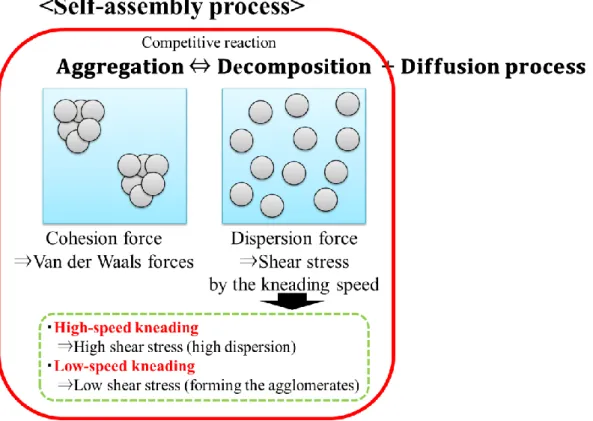
process involving solid particles is assumed to be driven by both condensing and dispersing forces. Fig.1-10 shows the self-assembly process of a solid based on equation (1-10).
Fig.1-10 Schematic diagram showing the self-assembly process in this study.
In this study, this reaction corresponds to a process of aggregation and decomposition.
Van der Waals force acts as a cohesion force. The shear stress by the kneading speed acts for decomposition. The kneading process can indicate the diffusion process in the reaction-diffusion system.
1.3 Aggregates and agglomerates
As shown in Fig.1-11, secondary particle groups are formed by the binding of ceramic fillers. There are two types of secondary particle groups (aggregates and agglomerates), and their definitions are shown in Table 1-3.
20
Fig.1-11 Schematic diagram of the ceramic secondary particle groups
Table 1-3 The definitions of aggregates and agglomerates [40], [45], [46].
Based on Table 1-3, Fig.1-12 shows a schematic diagram of aggregates and agglomerates in this study. Aggregates are assumed that matrix materials, such as polymer, are included in the ceramic secondary particle group. On the other hand, agglomerates are assumed that the ceramic fillers are bonded in the ceramic secondary
Term Definitions
Aggregates
・ A heterogeneous particle in which the various components are held together by relatively strong forces, and thus not easily broken apart
・ A particle comprising strongly bonded or fused particles where the resulting external surface area may be significantly smaller than the sum of calculated surface areas of the individual components
・ The forces holding an aggregate together: strong forces (for example covalent bonds) or those resulting from sintering or complex
physical entanglement
Agglomerates
・A group of nanoparticles held together by relatively weak forces, including van der Waals forces, electrostatic forces, and surface tension, that may be broken apart into smaller particles upon processing
・A collection of loosely bound particles or aggregates or mixtures of the two where the resulting external surface area is similar to the sum of the surface areas of the individual components
・Simple physical entanglement
21
particle group.
Fig.1-12 The aggregates and agglomerates assumed in this study.
1.4 Fractal analysis
The characteristics of materials such as the physical properties, strength, and toughness are determined by the material texture which is decided by the manufacturing process. It is essential to connect processes, structures, and characteristics to understand their interrelationships [47]. In this study, the structure of the composite material formed by the self-assembly process was quantified by the fractal and multifractal analysis that were able to analyze the pattern, and the relationship between the dielectric properties and thermal conductivity and the material texture was investigated.
1.4.1 Box-counting method
Fractal analysis is used to analyze spatially complex patterns using images [48]. In fact, the feature definition of structural analysis in pattern recognition has been studied [49]–[51]. Generally, the box counting method is used to derive the fractal dimension.
The box-counting method was defined by Russel et al.[52]. By covering a binary
22
signal with boxes of scale r, the fractal dimension is estimated as [48] (see Fig.1-13 [53]):
𝐷 = − lim𝑟 → 0log(𝑁(𝑟))
log(𝑟) (1-11)
where N(r) is the number of boxes needed to completely cover the signal.
1.4.2 Multifractal analysis
The multifractal analysis which is seen as an extension of fractals has been used in medical technology [48]. The generalized dimension, Dq was described by the multifractal analysis. The generalized dimensions Dq is computed as a function of the order of the probability moment q. This is, the multifractal dimension can be characterized on the basis of the generalized dimensions of the qth order moment of a distribution, Dq [54]:
Fig.1-13 Schematic diagram showing the fractal analysis of the crack [53].
23
𝐷𝑞 = lim𝑟→0( 1
𝑞−1
log 𝜇(𝑞,𝑟)
log(𝑟) ) (1-12)
where μ(q, r) is the partition fraction :
𝜇(𝑞, 𝑟) = ∑𝑁(𝑟)𝑖=1 𝑃𝑖𝑞(𝑟) (1-13)
where the probability (P) is a measured quantity varies with scale r (see Fig.1-14).
When q takes the values of q=0, 1 or 2, (Eq. 1-10) is reduced to [54]:
𝐷0 = − lim𝑟→0log𝑁(𝑟)
log𝑟 (1-13) 𝐷1 = lim𝑟→0∑ 𝜇𝑖(𝑟)𝑙𝑜𝑔(𝜇𝑖(𝑟))
𝑁(𝑟) 𝑖=1
𝑙𝑜𝑔(𝑟) (1-14) 𝐷2 = lim𝑟→0𝑙𝑜𝑔(𝐶(𝑟))
𝑙𝑜𝑔(𝑟) (1-15)
where D0 is the capacity dimension. C(r) is the correlation function. D1 and D2 are the entropy dimension and the correlation dimension, respectively. The relationship between D0, D1, and D2 is,
𝐷2 ≤ 𝐷1 ≤ 𝐷0 (1-16)
The equality D0=D1=D2 occurs only if the fractal is statistically or exactly self-similar and homogeneous[54].
24
Fig.1-14 Schematic diagram showing the multifractal analysis of the crack [53].
1.5 Problems and concepts for applications and material design of composites In this study, dielectric composites and thermal conductive composites were focused on because the dielectric constant and thermal conductivity were reflected the potential gradient and the flow velocity and these properties are used with the same composite rule.
1.5.1 Problems and concepts for applications of composites
1.5.1.1 Application of ceramics / polymer composites:piezoelectric biosensor
Tuberculosis (TB) has become prevalent mainly in developing countries. According to the report of World Health Organization (WHO), TB caused an estimated approximately 10 million new cases and 1.6 million deaths per year worldwide [55].
Therefore, it is necessary to detect patients with TB in developing countries. In the diagnostic environment in developing countries, it is essential for a diagnostic method that is portable, can be diagnosed quickly, and can be incinerated after diagnosis. Table
25
1-4 shows the characteristics of the conventional technology and the concepts of this study for tuberculosis diagnosis.
Table 1-4 Comparison of technologies for TB detection
<This study>
Combination of Loop-mediated Isothermal amplification (LAMP) and piezoelectric
biosensors (Polymer)
Combination of LAMP and a piezoelectric biosensor
(Quartz)
Polymerase chain reaction (PCR)
PVDF [56] Ceramics / polymer composites
Sensitivity 5 μg/ml
<Final goal for the application>
Less than 1 μg/ml 0.01 μm/ml [57] 1 μg/ml [58]
Response
speed 60 minutes 5 minutes 30 minutes [57] About 200 minutes
Safety
High
(Sensors are able to be incinerated after a diagnosis.)
Low (Sensors are
reused.)
Medium (Reaction tubes are
disposable.)
Total Cost Low High High
Polymerase chain reaction (PCR) is required thermocyclers or equipment for result analysis and experienced staffs, and its applicability is limited in laboratory settings use [59]. In addition, the reaction time is long, and the total cost of the detection is expensive due to the use of the turbidity and fluorescence measuring device. Conversely, the loop-mediated isothermal amplification (LAMP) LAMP amplifies DNA with high efficiency under isothermal conditions with high specificity and sensitivity and detected by visual inspection [59]. Moreover, the results of LAMP are able to be provided faster than those of PCR [60]. As another TB detection method, a method of a combination of a piezoelectric biosensor using quartz which detects the mass change and the LAMP method has been proposed [57].This method can diagnose TB more quickly. However,
26
the quartz must be reused after TB diagnosis since it is expensive, and then there is a risk of secondary infection. Therefore, in this study, the diagnostic method of the combination of the piezoelectric polymer biosensor which is disposable and not expensive and the LAMP method was proposed. In the case of a piezoelectric biosensor using PVDF, it is necessary to increase the sensitivity and responsivity in order to achieve the final goal for TB detection (Chapter 2). Thus, this study applied composite materials to the piezoelectric biosensor in order to improve the sensitivity and responsivity of the biosensors.
In the detection of the piezoelectric biosensor, the target materials can be detected by following the vibration of PVDF. A high elastic constant of the transducer of the biosensor is required since the vibration is affected by the viscosity of the liquid.
Therefore, the ceramic fillers are added to the polymer matrix to improve the elastic constant. The sensitivity of the biosensor is related to the amount of change in the dielectric constant of the piezoelectric material, and the high dielectric constant is required. In this study, the dielectric constant was improved by controlling the material texture of the ceramics / polymer composite material.
1.5.1.2 Application of ceramics / stainless steel composites:high thermal conductive components
The components of engines are exposed to high loads, high temperatures and move at high speeds [61]. The contact friction of the engine occurs at the places where the engine slips over each other. The friction increases with increasing temperature and load so that the components cause abrasion [61]. The elevated friction and abrasions generated cause essential energetic and material losses and decrease the efficiency of
27
mechanical systems [62]. However, the thermal conductivity of general iron alloys is low. In order to improve the thermal conductivity, it is necessary to form a thermal conductive network and control the heat as shown in Fig.1-15. Thus, this study applied composite materials to the thermal conductive components to improve thermal conductivity.
Fig.1-15 Schematic diagram showing the thermal conductive network and heat-control.
1.5.2 Problems and concepts for material design of composites
Dielectric and piezoelectric polymer materials are widely used because they are easily processed into large area films [11].
Thermal conductivity materials are used for industries such as manufacturing and production, chemical plant, building materials, and automobile component including engines.
However, the dielectric and piezoelectric polymer materials and the high thermal conductive components have the following problems.
28
1.5.2.1 General problems
<Dielectric and piezoelectric material>
Generally, the dielectric constants (ε') of piezoelectric polymers are relatively low at less than 10 [11].
<High thermal conductive components >
1. The thermal conductivity of the iron alloys is relatively low around room temperature.
2. The thermal conductivity of one of the austenitic stainless steel alloys, SUS316L stainless steel, is about 15 W m-1K-1, which is lower than carbon steel. Therefore, the sliding component of the engine that operates at high load pressure is limited for the application.
1.5.2.2 Target of material development
1. To increase the ε' for the polymers, ceramic powder fillers with a high ε' are added to the polymer matrix [11]. (Ceramics / polymer composites)
2. It is considered to combine SUS316L stainless steel and excellent ceramics to increase the thermal conductivity of SUS316L stainless steel with maintaining excellent characteristics. (Ceramics / SUS316L stainless steel composite)
1.5.2.3 Material development problems
A 50 vol.% or more of ceramics with a high dielectric constant and thermal conductivity are applied to the polymer or stainless steel matrix to achieve a high dielectric constant or thermal conductivity. Thus, the mechanical properties of these
29
composites are extremely poor and are not suitable for use in dielectric and piezoelectric materials and thermal conductivity materials, such as capacitors, piezoelectric materials, or automotive engines.
1.5.3 Previous reports and problems for the researches of the composites
In ceramics / polymer composites, it was proposed that the size, shape, and aggregation of BaTiO3 (BT) particles influence the effective bulk ε' of BT fillers or polymer composites with a high ε' [63]. Meanwhile, it was reported that the particle shape and size of the granules in the related ceramics play an important role in the network formation [64].It was shown that the average secondary particle area of BT filler aggregates of BT filler/poly-L-lactic acid (PLLA) composites is related to the dielectric constant [65]. Hence, it was suggested that the formation of ceramic secondary particle groups improves function. In addition, the electrical properties are controlled by a microstructure with grain boundaries such as ceramics / intergranular material. Therefore, it is important to control the microstructure to increase the dielectric properties.
In order to improve the automobile engine components, it is important to form a thermal conductivity network using ceramic fillers. In addition, it is important to reduce the effect of thermal resistance at the interface between filler and matrix material to improve the thermal conductivity of the composites [37].Therefore, it is necessary to control the microstructure of the thermally conductive composite material.
Thus, in this thesis, the purpose was to improve the dielectric properties and the thermal conductivity with a small amount of filler (0 vol.% -20 vol.%) for the application, the piezoelectric biosensor and high thermal conductivity component. In
30
conventional composite research, fillers are dispersed in a matrix material.On the other hand, in this thesis, the ceramics aggregate and the thermal conductivity network using ceramic secondary particle groups were formed by the self-assembly process to improve the dielectric properties and the thermal conductivity. The ceramics / polymer composite relates to the self-assembly process of solids in a liquid. The ceramics / SUS316L stainless steel composite relates to the self-assembly process of solids in solid. The problems of the research are as follows:
(1) The self-assembly process of solids in liquid and solids in solids have not clarified.
(2) There are few research examples of quantitative evaluation of self-assembled material texture.
(3) There are few studies on the ceramics / polymer heterointerface in the ceramics aggregate in the ceramics / polymer composite material and dielectric properties.
(4) There are few studies on the ceramics / stainless steel interface and thermal conductivity with forming the self-assembled ceramic secondary particle group.
1.5.4 Concepts and approach of material design in this study
In this study, the material is designed to improve the dielectric properties and thermal conductivity by adding a small amount of filler (0 to 20 vol.%).In particular, targets of the design materials are piezoelectric biosensor and high thermal conductive components. The material design concepts of this thesis are shown in Fig.1-16.In the material design approach of this study, it was proposed that the dielectric properties would improve by forming self-assembled ceramic aggregates having a ceramics / polymer / ceramics heterointerface. In the thermal conductivity, it was proposed that the
31
Fig.1-16 Concepts of the composites material design to improve the dielectric properties and thermal conductivity.
32
thermal conductivity was possible to be improved by forming ceramic particle groups for the thermal conductivity networks. In this study, the formation of ceramic secondary particle groups was controlled by the self-assembly process as shown in Fig.1-10. The self-assembly processes in this thesis are as follows:
<Ceramics / polymer composite (solids in liquid)>
The self-assembly process of the ceramics / polymer composites was assumed as shown in Fig.1-17.
Fig.1-17 Self-assembly process of solids in liquid in this study.
Van der Waals force acts as a cohesion force.
The shear stress by the kneading speed acts for decomposition.
33
The kneading process can indicate the diffusion process in the reaction-diffusion system, and the temperature, kneading time, and viscosity relate to the diffusion process.
Therefore, (1) the kneading speed and (2) viscosity of the dispersant were controlled to prepare the ceramics / polymer composite materials in this study.
<Ceramics / SUS316L stainless steel composite (solids in solid)>
Fig.1-18 shows the self-assembly process of ceramics / SUS316L stainless steel composites. In the case of ceramics / SUS316L stainless steel composites, it is considered that the diffusion dissipation process and sintering process relate to the diffusion process. In this study, spark plasma sintering (SPS) can exclude the diffusion process due to grain growth.
Fig.1-18 Self-assembly process of solids in solid in this study.
34
The pattern is formed within the self-assembly process. In this study, the fractal analysis (the box-counting and multifractal analysis) which evaluates quantitatively the pattern was applied to characterize (1) the morphology of the self-assembled ceramic secondary particle group and (2) the distributed state of ceramic fillers (see Fig.1-19)
Fig.1-19 Characters of the self-assembled material texture by the fractal analysis.
35
The material design approaches of this thesis are as follows (see Fig.1-20):
(1) The morphology of the ceramic secondary particle group, dispersion state (the entropy of configuration and dispersibility of the ceramic secondary particle groups), and formation of the interface of ceramic secondary particle groups by the self-assembly process of solids in solids and solids in liquid were investigated.
(2) The relationship between the self-assembled material texture prepared under the different manufacturing processes and the dielectric properties and thermal conductivity was discussed.
(3)Quantitative evaluation of this self-assembled material texture was performed using the multifractal analysis that analyzes patterns.
1.6 Purpose of this study
In this study, the material is designed to improve the dielectric properties and thermal conductivity by adding a small amount of filler (0 to 20 vol.%). In particular, the targets of the design materials were piezoelectric biosensors and high thermal conductive components. The material texture was controlled by the self-assembly process involving the solid to improve dielectric properties and thermal conductivity. In this study, the morphology, dispersion state, and the formation of the filler / matrix interface formation of fractal ceramic secondary particle groups prepared under the different manufacturing processes were discussed. The morphology, the entropy of configuration and dispersibility of the self-assembled ceramic secondary particle groups were performed by the multifractal analysis. Hence, self-assembled secondary particle groups were formed, and the relationship between the morphology, the dispersion state, and the interface state of the self-assembled ceramic secondary particle groups and the dielectric
36
Fig.1-20 The approach of material design in this study.
37
properties and thermal conductivity was investigated toward the application.
1.7 Thesis organization
The thesis consists of the following 4 Chapters.
Chapter 1 shows the research background, problems, concepts and approach, and purpose.
In Chapter 2, ceramics / polymer composite materials were produced for the application, a piezoelectric biosensor. First, a biosensor with a piezoelectric polymer was prepared and the problems of the polymer piezoelectric biosensor were set. Next, in order to improve the dielectric properties by adding a small amount of filler, the self-assembled ceramics / polymer composites were manufacturing under the different processes, and the multifractal analysis was performed as a quantitative evaluation of the self-assembled material texture. In addition, the dispersion state under different production conditions was investigated. In particular, the ceramics / polymer / ceramics heterointerface in the ceramic particle group and dielectric properties of the ceramics / polymer composites with the manufacturing process were discussed. Finally, the material texture of the self-assembled ceramics / polymer composites and dielectric properties by changing the viscosity of the dispersant were investigated. Furthermore, the morphology, the entropy of configuration, and dispersibility of the ceramic secondary particle groups were characterized by the multifractal. In this study, the piezoelectric materials PLLA and PVDF were used as a matrix, and BT was used as ceramic filler.
In Chapter 3, a silicon nitride (SN) / stainless steel (SUS316L) composite material was prepared. And then, the relationship between the self-assembled material texture
38
and the thermal conductivity was investigated. In particular, fractal analysis and multifractal analysis were attempted to quantitatively evaluate the thermal conductivity network using the self-assembled SN secondary particle groups.
Chapter 4 shows the conclusions of this thesis and future works.
References
[1] M. K. S. Sai, “Review of Composite Materials and Applications,” vol. 7.
[2] M. K. Egbo, “A fundamental review on composite materials and some of their applications in biomedical engineering,” Journal of King Saud University - Engineering Sciences, 2020, doi: 10.1016/j.jksues.2020.07.007.
[3] D. H. Yoon, J. Zhang, and B. I. Lee, “Dielectric constant and mixing model of BaTiO3 composite thick films,” Materials Research Bulletin, vol. 38, no. 5, pp.
765–772, 2003, doi: 10.1016/S0025-5408(03)00075-8.
[4] B. Sareni, L. Krähenbühl, A. Beroual, and C. Brosseau, “Effective dielectric constant of periodic composite materials,” Journal of Applied Physics, vol. 80, no.
3, pp. 1688–1696, 1996, doi: 10.1063/1.362969.
[5] K. Monden, Y. Okajima, and K. Yashima, “Application of percolation theory and development of high conducting material in a compound thermal component,”
Journal of Japan Institute of Electronics Packaging, vol. 14, no. 6, pp. 485–491, 2011, doi: 10.5104/jiep.14.485.
[6] C. J. Maxwell, A Treatise on Electricity and Magnetism, vol. 1. 1904.
[7] H. Fricke, “A Mathematical Treatment of the Electrical conductivity and
Capacity of Disperse Systems,” Physics Review, vol. 24, pp. 575–587, 1924, doi:
10.1103/PhysRev.24.575.
39
[8] E. R. Meredith, STUDIES ON THE CONDUCTIVITIES OF DISPERSIONS.
Lawrence Berkeley National Laboratory, 1959.
[9] R. L. Hamilton and O. K. Crosser, “Thermal conductivity of heterogeneous two-component systems,” Industrial and Engineering Chemistry Fundamentals, vol. 1, no. 3, pp. 187–191, 1962, doi: 10.1021/i160003a005.
[10] V. D. A. G. Bruggeman, “Berechnung verschiedener physikalischer Konstanten von heterogenen Substanzen,” vol. 24, pp. 665–676, 1935.
[11] P. Barber et al., “Polymer composite and nanocomposite dielectric materials for pulse power energy storage,” Materials, vol. 2, no. 4, pp. 1697–1733, 2009, doi:
10.3390/ma2041697.
[12] P. Barber et al., Polymer composite and nanocomposite dielectric materials for pulse power energy storage, vol. 2, no. 4. 2009.
[13] K.Kanari and T.Ozawa, “充てん材配合エポキシ樹脂の熱伝導率,” 熱物性, vol. 3, no. 2, pp. 106–111, 1989.
[14] K.Kanari, “Thermal Cnnrluctivitv of Composite Matprials,” Kobunshi, vol. 26, no. 8, pp. 557–561, 1977.
[15] R. M. Mutiso and K. I. Winey, Reference Module in Materials Sicence and Materials Englineering -Polymer Science: A Comprehensive Reference-, vol. 7.
Elsevier B.V., 2012.
[16] M. R. Mansor, S. H. S. M. Fadzullah, N. A. B. Masripan, G. Omar, and M. Z.
Akop, Functionalized Graphene Nanocomposites and their Derivatives. Elsevier Inc., 2018.
[17] S. Mishra, L. Unnikrishnan, S. K. Nayak, and S. Mohanty, “Advances in Piezoelectric Polymer Composites for Energy Harvesting Applications: A
40
Systematic Review,” Macromolecular Materials and Engineering, vol. 304, no. 1, pp. 1–25, 2019, doi: 10.1002/mame.201800463.
[18] A. J. Lovinger, “Ferroelectric Polymers,” SCIENCE, vol. 220, no. 4602, pp.
1115–1121, 1983, [Online]. Available:
http://www.sciencemag.org/content/220/4602/1115.short.
[19] W. Xia and Z. Zhang, “PVDF-based dielectric polymers and their applications in electronic materials,” IET Nanodielectrics, vol. 1, no. 1, pp. 17–31, 2018, doi:
10.1049/iet-nde.2018.0001.
[20] F. Bernard, L. Gimeno, B. Viala, B. Gusarov, and O. Cugat, “Direct Piezoelectric Coefficient Measurements of PVDF and PLLA under Controlled Strain and Stress,” Proceedings, vol. 1, no. 10, p. 335, 2017, doi:
10.3390/proceedings1040335.
[21] R. Mishra, S. Jain, and C. D. Prasad, “A review on piezoelectric material as a source of generating electricity and its possibility to fabricate devices for daily uses of army personnel,” International Journal of Systems, Control and Communications, vol. 6, no. 3, pp. 212–221, 2015, doi:
10.1504/IJSCC.2015.068908.
[22] C. Covaci and A. Gontean, “Piezoelectric energy harvesting solutions: A review,”
Sensors (Switzerland), vol. 20, no. 12, pp. 1–37, 2020, doi: 10.3390/s20123512.
[23] V. M. Mecea, “Is quartz crystal microbalance really a mass sensor?,” Sensors and Actuators, A: Physical, vol. 128, no. 2, pp. 270–277, 2006, doi:
10.1016/j.sna.2006.01.023.
[24] Y. Okahata and H. Furusawa, “Biosensor Using a Quartz-crystal Microbalance,”
IEEJ Transactions on Sensors and Micromachines, vol. 123, no. 11, pp. 459–464,
41
2003, doi: 10.1541/ieejsmas.123.459.
[25] J. F. Tressler, S. Alkoy, and R. E. Newnham, “Piezoelectric sensors and sensor materials,” Journal of Electroceramics, vol. 2, no. 4, pp. 257–272, 1998, doi:
10.1023/A:1009926623551.
[26] P. Mehrotra, “Biosensors and their applications - A review,” Journal of Oral Biology and Craniofacial Research, vol. 6, no. 2, pp. 153–159, 2016, doi:
10.1016/j.jobcr.2015.12.002.
[27] S. K. Metkar and K. Girigoswami, “Diagnostic biosensors in medicine – A review,” Biocatalysis and Agricultural Biotechnology, vol. 17, no. October 2018, pp. 271–283, 2019, doi: 10.1016/j.bcab.2018.11.029.
[28] T. Bhardwaj, “A Review on Immobilization Techniques of Biosensors,”
International Journal of Engineering Research & Technology (IJERT), vol. 3, no.
5, pp. 294–298, 2014, [Online]. Available: www.ijert.org.
[29] G. Sauerbrey, “Verwendung von Schwingquarzen zur Wägung dünner Schichten und zur Mikrowägung,” Zeitschrift für Physik, vol. 155, no. 2, pp. 206–222, 1959, doi: 10.1007/BF01337937.
[30] X. Huang, P. Jiang, and T. Tanaka, “A review of dielectric polymer composites with high thermal conductivity,” IEEE Electrical Insulation Magazine, vol. 27, no. 4, pp. 8–16, 2011, doi: 10.1109/MEI.2011.5954064.
[31] G. Long and L. M. Foster, “Aluminum Nitride, a Refractory for Alumium to 2000℃,” vol. 42, no. 2, pp. 53–59, 1959.
[32] G. A. Slack, “Nonmetallic crystals with high thermal conductivity,” vol. 34, pp.
321–335, 1973.
[33] K. Furuya, F. Munakata, K. Matsuo, Y. Akimune, J. Ye, and A. Okada,
42
“Microstructural control of β-silicon nitride ceramics to improve thermal conductivity,” Journal of Thermal Analysis and Calorimetry, vol. 69, no. 3, pp.
873–879, 2002, doi: 10.1023/A:1020660006988.
[34] K. Komeya and F. Noda, “Aluminum nitride and silicon nitride for high
temperature gas turbine engines,” SAE Paper, no. 40237, pp. 1030–1035, 1974.
[35] X. Cui, P. Ding, N. Zhuang, L. Shi, N. Song, and S. Tang, “Thermal conductive and mechanical properties of polymeric composites based on solution-exfoliated boron nitride and graphene nanosheets: A Morphology-Promoted Synergistic Effect,” ACS Applied Materials and Interfaces, vol. 7, no. 34, pp. 19068–19075, 2015, doi: 10.1021/acsami.5b04444.
[36] A. Shimamura, Y. Hotta, H. Hyuga, N. Kondo, and K. Hirao, “Effect of amounts and types of silicon nitride on thermal conductivity of Si3N4/epoxy resin
composite,” Journal of the Ceramic Society of Japan, vol. 123, no. 1441, pp.
908–912, 2015, doi: 10.2109/jcersj2.123.908.
[37] H. He, R. Fu, Y. Shen, Y. Han, and X. Song, “Preparation and properties of Si3N4/PS composites used for electronic packaging,” Composites Science and Technology, vol. 67, no. 11–12, pp. 2493–2499, 2007, doi:
10.1016/j.compscitech.2006.12.014.
[38] F. Wang, L. T. Drzal, Y. Qin, and Z. Huang, “Mechanical properties and thermal conductivity of graphene nanoplatelet/epoxy composites,” Journal of Materials Science, vol. 50, no. 3, pp. 1082–1093, 2015, doi: 10.1007/s10853-014-8665-6.
[39] B. Bensaude-Vincent, “Self-Assembly, self-organization: Nanotechnology and vitalism,” NanoEthics, vol. 3, no. 1, pp. 31–42, 2009, doi:
10.1007/s11569-009-0056-0.
43
[40] British Standards Institution, Terminology for nanomaterials. PAS 136:2007, vol.
PAS 136:20. 2007.
[41] A. B. Sendova-franks and N. R. Franks, “Self-assembly, self-organization and division of labour,” vol. 354, no. 1388, pp. 1395–1405, 1999.
[42] Stefan C. Müller, T. Plesser, and Benno Hess, “Two-dimensional
sperctraphotometory and pseudo-color representation of chemical reaction patterns,” vol. 73, pp. 165–179, 1986.
[43] I. R. Epstein, J. A. Pojman, and O. Steinbock, “Introduction:self-organization in nonequilibrium chemical systems,” Chaos, vol. 16, no. 3, 2006, doi:
10.1063/1.2354477.
[44] C. J. Brinker, “Evaporation-induced self-assembly: functional nanostructures made easy,” MRS Bulletin, vol. 29, no. 9, pp. 631–640, 2004, doi:
10.1557/mrs2004.183.
[45] National Institute for Occupational Safety and Health, Approaches and safe nanotechnology -Managing the health and safety concerns associated with engineered nanomaterials-, vol. 2009–125. 2009.
[46] ASTM International, Standard terminology relating to textiles, vol. 06, no.
ASTM E2456. 2012.
[47] N. Sato, S. Sadamatsu, and Y. Adachi, “A change and prospect of quantitative evaluation of microstructure morphology,” Tetsu-Hagane, vol. 100, no. 10, pp.
1182–1190, 2014.
[48] R. Lopes and N. Betrouni, “Fractal and multifractal analysis: A review,” Medical Image Analysis, vol. 13, no. 4, pp. 634–649, 2009, doi:
10.1016/j.media.2009.05.003.
![Table 1-1 Dielectric permittivity values of commonly used ceramics for capacitors [11]](https://thumb-ap.123doks.com/thumbv2/123deta/5804480.2045269/15.892.302.593.237.628/table-dielectric-permittivity-values-commonly-used-ceramics-capacitors.webp)