IMPACT OF POSITIVE LYMPHOCYTE CROSS-MATCH TEST ON LIVING- DONOR LIVER TRANSPLANT
Shunji Narumi1,3),Minoru Umehara2),Yoshikazu Toyoki3),Keinosuke Ishido3), Daisuke Kudo3),Norihisa Kimura3),Kazuyuki Mori4),Chikara Ohyama1,4),
and Kenichi Hakamada3)
Abstract
[Introduction]
In liver transplant, antibody mediated rejection is believed to occur less frequently and to lead less graft losses than in kidney transplant. So, liver transplant has been performed irrespective of positive lymphocyte cross- match test. Nowadays, even in kidney transplant, both ABO incompatibility and cross-match positivity are being overcome with plasmapheresis, intravenous immunoglobulin, and improvement of immunosuppressive agents such as rituximab and IL-2 receptor antagonists. Retrospective analysis on living donor liver transplant recipient was performed focusing on cross-match positivity and posttransplant complications.
[Patients and methods]
Since 1994, 41 living-donor liver transplants were performed. Retrospective analysis was done in 33 patients, who were done pretransplant cross-match test. Immunosuppression was basically initiated with steroid and tacrolimus.
[Results]
Twelve patients (36.3%) were positive for lymphocyte cross-match. Acute rejection occurred in 13 cases(33.3%)
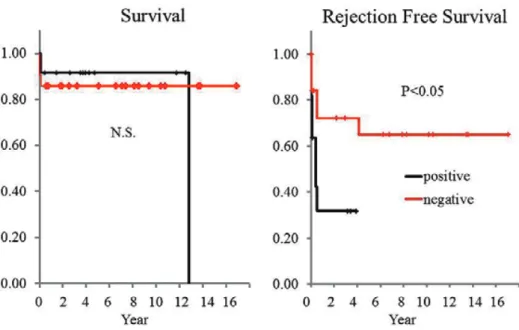
within 180 post transplant days. One-year rejection-free survival were 42.3% in positive cases and 72.2% in negative cases (p<0.05), but there was no significance in patient survival. Posttransplant complications including biliary stenosis, hepatic vein stenosis, and portal vein stenosis occurred more frequently in positive lymphocyte cross- match transplant patietns(p<0.05).
[Conclusion]
With improvement of immunosuppressive agents, liver transplant can be successfully performed with more favorable survival even in cross-match positive pair. Complications, however, happen more frequently in those recipients compared to cross-match negative ones. Posttransplant course should be carefully followed focusing on biliary and vascular complications. Screening of donor specific antigen by FACS cross-match test and LABScreen®
would give us new information and strategy.
Hirosaki Med.J. 64, Supplement:S107―S112,2013 Key words: cross-match test; liver transplantation; antibody mediated rejection
1)Department of Advanced Transplant and Regenerative Medicine, Hirosaki University Graduate School of Medicine
2)Department of Pediatric Surgery, Hirosaki University Graduate School of Medicine
3)Department of Gastrointestinal Surgery, Hirosaki University Graduate School of Medicine
4)Department of Urology, Hirosaki University Graduate School of Medicine
Address Corresponding to; Shunji Narumi, M.D., Ph.D.
Associate Professor
Department of Advanced Transplant and Regenerative Medicine, Hirosaki University Graduate School of Medicine, 5 Zaifu-cho, Hirosaki City, Aomori Prefecture, 036-8562 JAPAN
Tel: +81-172-39-5091, Fax: +81-172-39-5092 E-mail: [email protected]
[Introduction]
In liver transplant, antibody mediated rejection is believed to occur less frequently and to lead less graft losses than in kidney transplant1-3). So, liver transplant has been
performed irrespective of positive lymphocyte cross-match test. Nowadays, even in kidney transplant, both ABO incompatibility and cross- match positivity are being overcome with plasmapheresis, intravenous immunoglobulin, and improvement of immunosuppressive agents
S 108 S. Narumi, et al.
such as rituximab and IL-2 receptor antagonists
4-7). Retrospective analysis on living- donor liver transplant recipient was performed focusing on cross-match positivity and posttransplant complications.
[Patients and methods]
Since 1994, 41 living-donor liver transplants were performed in department of Gastrointestinal Surgery, Hirosaki University Graduate School of Medicine. Retrospective analysis was done in 33 patients, who were performed pretransplant cross-match test. Immunosuppression was basically initiated with steroid and tacrolimus.
Acute rejection was diagnosed mostly based on biopsy, but treatment was sometimes initiated only by liver function tests. For patients with steroid-resistant rejection, mycophenolate mofetil was used. Nobody lost their graft due to acute cellular rejection or antibody-mediated rejection. Direct lymphocyte cross-match was preoperatively ordered for SRL laboratory, Japan. However, some emergent cases were not able to be performed pretransplant cross-match test. Recipient sera 0.5ml and 10 ml whole blood of donor were used cytotoxicity test. Cross- match by FACS (FCXM) was also performed with procedures reported in elsewhere. Both FACScanTM and FACSCantoTMII by Becton, Dickinson and Company were used for FCXM.
Mean fluorescence intensity > 2.0 of negative control was considered positive. For analysis on this paper, only direct cross-match positive was considered as positive cross-match patient irrespective of FAXM result. Complications severer than Clavien’s grade II8, 9) were picked up. Kai-square test was used to determine univariate analysis. Kaplan-Meyer analysis was used for survival and log-rank test was used to determine statistical difference. SPSS was used for statistical analysis and p value <0.05 was considered as significant.
[Results]
Patients included 17 males and 16 females.
Average age was 26.5 years. There were 16 patients whose age was <18 y and 17 patients were ≥ 18years. Etiologies were biliary atresia 10, fulminant hepatitis 4, primary biliary cirrhosis 3, primary sclerosing cholangitis
(PSC) 2, viral cirrhosis 2, Wilson’s disease 4, hepatocellular carcinoma (HCC) 4, and other metabolic diseases 4. Donor relation to recipients were mother in 14, father in 6, sibling in 5, offspring in 4, and spouse in 4. Twelve patients
(36.3%) were positive for lymphocyte cross- match (TW 4, BW 11). Acute rejection occurred in 13 cases (33.3%)within 180 post transplant days. One-year rejection-free survival were 42.3% in positive cases and 72.2% in negative cases (p<0.05), but there was no significance in patient survival (Fig.1). Univariate analysis between positive cross-match and clinical factors
(age, sex, acute rejection, biliary complication, portal vein stenosis, and hepatic vein stenosis)
failed to reveal significant risk factors; there were 7 male patients (58.3%) and 6 patients
(50.0%) were >18-year in cross-match positive recipients. Acute cellular rejection happened 7 (58.3%) of cross-match positive patients but 6 (28.5%) patients in cross-match negative patients. In positive cross-match positive recipients, biliary stenosis occurred in 6 (50.0%)
, portal vein stenosis in 3 (23.0%), and hepatic vein stenosis in 2 (16.7%)(n.s). However, when biliary stenosis, portal vein stenosis and hepatic vein stenosis were combined into one group as complications, it significantly occurred in positive lymphocyte cross-match transplant (p=0.04), especially in B-cell positive recipients (p=0.011).
Strong T-cell cross-match positivity was detected in a pair of a wife-recipient and a husband-donor.
This recipient was initiated mycophenolate mofetil soon after transplant but complicated with biliary stricture. Her FCXM showed B-cell
positivity even 5 years after transplantation.
[Case presentation]
Herein we introduce an interesting case whose posttransplant course was suggestive as antibody-mediated rejection (AMR). Patient is a 61-year-old man with HCV and HCC. His pretransplant cross-match was positive in T-cell but FCXM was negative. He underwent living-donor liver transplantation with a right lobe graft from his son. Immunosuppression was initiated with tacrolimus and steroid. His posttransplant liver function tests started to rise POD4 especially in ALT without increase of bilirubin. Since ALT reached to 800 IU/l, percutaneous liver biopsy was taken and revealed little inflammation around Glisson’s sheath, but spotty hepatocyte necrosis without C4d deposition. He was administered pulse steroid and mycophenolate mofetil then his liver function test recovered promptly (Fig.2).
[Discussion]
With improvement of immunosuppressive agents, liver transplant can be successfully performed with more favorable survival even in cross-match positive pairs. There have been many reports about impacts of cross- match test on liver transplantation. Successful liver transplantation from cross-match positive donor was first described by Iwatsuki, et al. 10). The liver seems to remove or neutralize circulating anti-donor antibody because of successful combined liver-kidney transplantation from cross-match positive donor1). Since then, impact of cross-match positivity has been a controversial. Decrease in survival11-13) were of great concern. However, with improvement of immunosuppression, reports with negative impact on survival increased3, 14). More recently, importance of cross-match test prior to liver transplantation for donor selection has been emphasized15-17). In our small series, survival was not significantly affected by positive cross-
Fig. 1 Patient and rejection-free survival
There was no significant difference in patient survival between cross-match negative and positive recipients by log-rank test. Rejection-free survival was significantly shorter in cross-match positive recipients.
S 110 S. Narumi, et al.
match test. Acute rejection is universally reported frequent but treatable3). Rejection- free survival was significantly shorter in cross- match positive recipients also in our series. So frequent monitoring of acute rejection is essential and administration of mycophenolate mofetil or induction therapy would be effective as seen in our case presented.
Complications have not been focused among this condition in literatures. Vanishing bile duct syndrome after cross-match positive liver transplantation was reported in 198818). So far we have experienced recurrent primary sclerosing cholangitis (PSC) in 1 cross-match positive recipient. Her pathology was somewhat atypical for PSC with vanishing bile duct. C4d was not positively stained in her specimen. She died 167 months after the transplant. Since vanishing bile duct was seen in her native liver prior to transplant, we diagnosed as recurrent disease. We are not sure whether positive cross-
match affected to her multiple biliary strictures.
Positive cross-match was not reported as an independent risk factor for biliary complication19)
as seen in our recipients. However, when we included life-threatening complications such as portal vein stenosis and hepatic vein stricture into complication categories, those happened more frequently in cross-match positive recipients. Two patients developed hepatic vein stenosis which were treated with balloon dilation and/or expandable metallic stent20). Portal vein thrombosis was happened in one case who was rescued reoperations twice. Three cases developed portal vein stricture. In 2 cases, percutaneous transhepatic portal vein dilation was attempted with failure. Portsystemic shunt or REX shunt would be next modalities21). Posttransplant course should be carefully followed focusing on biliary and vascular complications especially in cross-match positive cases.
Fig. 2 Suggestive antibody mediated rejection in a case with positive cross-match
Posttransplant course was remarkable with early elevation of ALT (left). Needle biopsy on POD 8 revealed spotty hepatocyte necrosis without inflammatory cells in Glisson’s sheath. C4d staining was negative (right).
AMR in ABO-compatible liver transplantation have been increasingly reported17, 22). FCXM, LABScreen test, and detection of donor-specific antibody have been used in the field of kidney transplantation for selecting both recipients and donors. These proved to be a better prognostic indicator of rejection than the conventional cytotoxic cross-match23). In ABO-incompatible kidney transplant, pretransplant anti-sensitization therapy has been established, which included administration of mycophenolate mofetil and rituximab, plasmapheresis, and IVIG4, 5, 24). In our presented case whose pretransplant cross-match was strongly positive demonstrated FCXM positivity even 5 years after the transplantation.
This patient underwent splenectomy at the time of transplant and had a massive intraoperative bleeding. She also bled a large quantity due to surgical complication and was transfused multiple units. There remain possible hypothesis that splenectomy functioned as desensitization and massive bleeding substituted for plasmapheresis.
She was also given IVIG 5g/day for 7 days after the transplant.
Advanced immunological strategies might be necessary for cross-match positive liver transplant as well as for ABO-incompatible transplantation. Pretransplant screening of donor specific antigen by FACS and LABScreen should be performed and we should establish new immunological strategy for patients with positive cross-match test.
[Conclusion]
With improvement of immunosuppressive agents, liver transplant can be successfully performed with more favorable survival even in cross-match positive pairs. Complications, however, happen more frequently in those recipients compared to cross-match negative ones. Posttransplant course should be carefully followed focusing on biliary and vascular complications. Screening of donor specific antigen
by FACS cross-match test and LABScreen would give us new information and strategy.
[References]
1)Gordon RD, Fung JJ, Markus B, et al. The antibody crossmatch in liver transplantation. Surgery 1986;100:705-15.
2)Moore SB, Wiesner RH, Perkins JD, Nagorney DM, Sterioff S, Krom RA. A positive lymphocyte cross-match and major histocompatibility complex mismatching do not predict early rejection of liver transplants in patients treated with cyclosporine.
Transplantat Proceedings 1987;19:2390-1.
3)Sugawara Y, Tamura S, Kaneko J, Togashi J, Makuuchi M, Kokudo N. Positive lymphocytotoxic crossmatch does not adversely affect survival in living donor liver transplantation. Dig Surg 2009;26:482-6.
4)Takahashi K, Saito K, Takahara S, et al. Excellent long-term outcome of ABO-incompatible living donor kidney transplantation in Japan. Am J Transplant 2004;4:1089-96.
5)Warren DS, Zachary AA, Sonnenday CJ, et al. Successful renal transplantation across simultaneous ABO incompatible and positive crossmatch barriers. Am J Transplant 2004;4:561-8.
6)Thielke JJ, West-Thielke PM, Herren HL, et al.
Living donor kidney transplantation across positive crossmatch: the University of Illinois at Chicago experience. Transplantation 2009;87:268-73.
7)Stegall MD. Clinical management of renal trans- plant patients with donor-specific alloantibody:
the state of the art. Clin Transpl 2010:307-15.
8)Clavien PA, Camargo CA, Jr., Croxford R, Langer B, Levy GA, Greig PD. Definition and classification of negative outcomes in solid organ transplantation.
Application in liver transplantation. Ann Surg 1994;220:109-20.
9)Dindo D, Demartines N, Clavien PA. Classification of surgical complications: a new proposal with evaluation in a cohort of 6336 patients and results of a survey. Ann Surg 2004;240:205-13.
10)Iwatsuki S, Iwaki Y, Kano T, Klintmalm G,
S 112 S. Narumi, et al.
Koep LJ, Weil R, Starzl TE. Successful liver transplantation from crossmatch-positive donors.
Transplant Proc 1981;13:286-8.
11)Karuppan S, Ericzon BG, Moller E. Relevance of a positive crossmatch in liver transplantation.
Transpl Int 1991;4:18-25.
12)Takaya S, Bronsther O, Iwaki Y, et al. The adverse impact on liver transplantation of using positive cytotoxic crossmatch donors. Transplantation 1992;53:400-6.
13)Charco R, Balsells J, Murio E, Lazaro JL, Margarit C, Martorell J. Adverse impact of high panel- reactive antibody (PRA) and positive cytotoxic crossmatch in liver transplantation. Transpl Int 1994;7 Suppl 1:S94-6.
14)Kasahara M, Kiuchi T, Takakura K, et al.
Postoperative flow cytometry crossmatch in living donor liver transplantation: clinical significance of humoral immunity in acute rejection.
Transplantation 1999;67:568-75.
15)Goh A, Scalamogna M, De Feo T, Poli F, Terasaki PI. Human leukocyte antigen crossmatch testing is important for liver retransplantation. Liver transplant 2010;16:308-13.
16)Hori T, Uemoto S, Takada Y, et al. Does a positive lymphocyte cross-match contraindicate living- donor liver transplantation? Surgery 2010;147:840- 4.
17)Kozlowski T, Rubinas T, Nickeleit V, et al.
Liver allograft antibody-mediated rejection with demonstration of sinusoidal C4d staining and circulating donor-specific antibodies. Liver
transplant 2011;17:357-68.
18)Batts KP, Moore SB, Perkins JD, Wiesner RH, Grambsch PM, Krom RA. Influence of positive lymphocyte crossmatch and HLA mismatching on vanishing bile duct syndrome in human liver allografts. Transplantation 1988;45:376-9.
19)Pirenne J, Monbaliu D, Aerts R, et al. Biliary strictures after liver transplantation: risk factors and prevention by donor treatment with epoprostenol. Transplantat Proc 2009;41:3399-402.
20)Narumi S, Hakamada K, Totsuka E, et al. Efficacy of cutting balloon for anastomotic stricture of the hepatic vein. Transplant Proc 2004;36:3093-5.
21)Krebs-Schmitt D, Briem-Richter A, Grabhorn E, et al. Effectiveness of Rex shunt in children with portal hypertension following liver transplantation or with primary portal hypertension. Pediatr Transplant 2009;13:540-4.
22)Barth RN, Campos L, Kukuruga DL, Drachenberg C, Philosophe B. Antibody-mediated rejection of renal allograft in combined liver-kidney transplant. Clin Transplant 2010;24:685-90.
23)Talbot D, Bell A, Shenton BK, et al. The flow cytometric crossmatch in liver transplantation.
Transplantation 1995;59:737-40.
24)Tanabe K, Tokumoto T, Ishida H, et al. Excellent outcome of ABO-incompatible living kidney transplantation under pretransplantation immu- nosuppression with tacrolimus, mycophenolate mofetil, and steroid. Transplantat Proc 2004;36:
2175-7.