Guanshen Fang
*1Massoud Amini
*2Hao Chen
*3 福田信幸*4 細矢治夫*5 河合雅弘*6Joseph E. LeBlanc
*7Paul G. Mezey
*8 成木勇夫*9 岡田 正*10Eric Rambo
*11Mark Spivakovsky
*12 竹内 茂*13Keith F. Taylor
*14Hongyi Wong
*15山中 聡*16 横谷正明*17
Peter Zizler
*18 有本 茂*19Mathematics and chemistry
interdisciplinary joint research and the Fukui Project XXVI
Guanshen FANG, Massoud AMINI, Hao CHEN, Nobuyuki FUKUDA, Haruo HOSOYA Masahiro KAWAI, Joseph E. LEBLANC, Paul G. MEZEY, Isao NARUKI, Tadashi OKADA Eric RAMBO, Mark SPIVAKOVSKY, Shigeru TAKEUCHI, Keith F. TAYLOR, Hongyi WONG
Satoshi YAMANAKA, Masaaki YOKOTANI, Peter ZIZLER and Shigeru ARIMOTO
†This is the 26th part of the series of articles that records and further develops essentials of the Mathematics and Chemistry Interdisciplinary Symposium 2013 Tsuyama, whose main themes were symmetry, periodicity, and repetition. The symposium was held on April 5th and 6th in Tsuyama city, Okayama, Japan, in conjunction with the Fukui Project and was devoted to the memory of the late Professor Kenichi Fukui (1981 Nobel Prize) who initiated the project. The present series also provides challenging cross-disciplinary problems which are directly related to the Fukui conjecture, the Global Pattern Identification (GPI) in the Repeat Space Theory (RST), and Artificial Intelligence (AI). Some of these problems are formulated using mathematical language not well known among chemists despite the importance of these notions in elucidating additivity and high-speed asymptotic phenomena in molecules having many repeating identical moieties. The cross-disciplinary interaction between the Repeat Space Theory and the Spatial Anthropology has been discussed in connection with the Science-Art Multi- angle Network (SAM Network) Project, which seeks to bridge Science and Art (visual, audial, and conceptual) for a creative collaboration, and is an important part of the Fukui Project.
Key Words
:
the Fukui conjecture, Memoir of Prof. K. Fukui, Unique factorization domain (UFD), Global Pattern Identification in the Repeat Space Theory (RST), Spatial Anthropology, Artificial Intelligence (AI)I Introduction
Okayama prefecture, Japan. The main themes of the
原稿受付 平成30年9月20日*1, *6, *10 *11, *16 *17総合理工学科
*4 総合理工学科非常勤講師
*2 Dept. of Math.Tarbiat Modares University, Iran
*3 Dept. of Fund.Ed., Dalian Neusoft University of Information, China
*5 お茶の水女子大学 理学部・元教授
*7 School of Sciences, Humanities, and Visual Communications, Pennsylvania College of Technology, USA
*8 Institute of Chemistry, Eotvos University of Budapest, Hungary
*9 立命館大学 理工学部・数学物理学系・数理科学科・元教授
*12 CNRS and Institute de Mathématiques de Toulouse, France
*13 岐阜大学 教育学部・数学科・元教授
*14 Dept. of Math. and Stat., Dalhousie University, Canada
*15 School of Communication, Arts and Social Sciences, Singapore Polytechnic, Singapore
*18 Dept. of Math., Phys., and Eng., Mount Royal University, Canada
*19 Former Professor of NIT, Tsuyama College, Japan †Director of the Fukui Project (New Frontier Project) For correspondence, visit:
https://www.researchgate.net/profile/Shigeru_Arimoto (Links to other co-authors also available at the above website.)
5. Global Pattern Identification (GPI) in the Repeat Space Theory (RST) and its Interaction with Spatial Anthropology
Shigeru Arimoto
In connection with the Fukui Conjecture that involves the notion of the original repeat space
Xr(q) [cf. the Appendix of Section X and Ref. [1] and references therein], a reader of this series of articles asked the author of this section (S.A.) about the definition of the original repeat space X
r(q) and asked if it is still central in the Repeat Space Theory (RST). Later, some of the new members of the Fukui Project (New Frontier Project) Group asked similar questions. And they showed an interest in the research mode and methodology called the Global Pattern Identification in the Repeat Space Theory and in the late Professor Haruo Shingu’s (Universalization) Program.
Posing the following questions, the present author would like to briefly answer them in this section:
Question 1. Is the original repeat space Xr
(q) still central in the Global Pattern Identification (GPI) in the Repeat Space Theory?
Question 2. What is the late Professor Haruo Shingu’s
(Universalization) Program?
Question 3. What is the relation between Shingu’s
(Universalization) Program and the Global Pattern Identification?
The answer to Question 1 is yes and no. The early versions of the Asymptotic Linearity Theorems (ALTs) that involve the original repeat space
Xr(q) prove the Fukui Conjecture in a broader context. And they also solve a variety of physico-chemical network and related problems in a unifying manner (cf. [1] and references therein).
Moreover, with the help of Logical Interface Language (LIL), which exploits basic general topology, one can solve the above-mentioned pyisico-chemical problems with a single unifying perspective with the minimum knowledge of preliminaries. In this sense, the notion of the original repeat space retains its centrality especially in applying the repeat space theory to physico-chemical problems. The original philosophy of the repeat space was expressed in earlier publications of the theory as the ‘Aspect of Form’.
Later, recalling and respecting the notion of ‘Aspect of Form’
and its underlying philosophy, we also began to use the terms ‘Global Pattern Recognition’ or ‘Global Pattern Identification’ to clarify the mode of global recognition for
more global pattern identifications beyond physico- chemical problems to math and computer-science-oriented problems, the original repeat space
Xr(q) has become less dominant ever since it was embedded into more powerful and universal (general) notions such as general repeat spaces and normed repeat spaces.
In fact, the notion of the original repeat space X
r(q) has been evolving with the guideline of dynamic structural evolution, whose idea was motivated by Shingu’s (Universalization) Program, expounded in what follows, and by the publications of a Swiss spatial anthropologist and architect Gaudenz Domenig (Cf. [2,3] and references therein).
In the late 1970s, the author of this section came to know Swiss and Japanese spatial (cultural) anthropologists and architects then doing anthropological and ethnographic field research in Japan, some of which was supported by the then Ministry of Education of Japan, some by the Swiss National Science Foundation. It was around that time that I came to know the above-mentioned Domenig’s seminal work and related works.
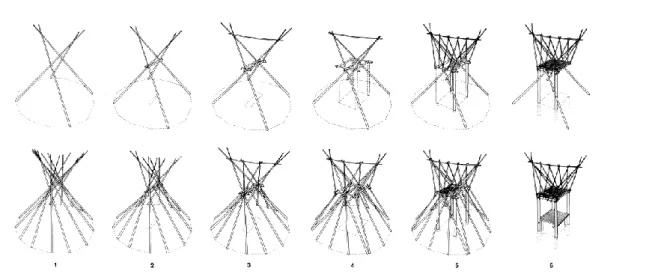
The author of the present section was especially struck by Domenig’s house forms structurally evolving gradually from an architectonic prototypal form step by step like in the following sequential manner (for details cf. Fig 1 on the next page, courtesy of G. Domenig):
Original Prototypal Form 0 => Evolved Form 1 => Evolved Form 2 => … => Evolved Form n
With gradual modifications and alternations of building blocks, the original prototypal structure evolves step by step acquiring new functionalities. Later, the above type of schematic representation given in Domenig’s ‘Kouzou Hattatsu Ron’ (Structural Developmental Theory) in his spatial anthropology became a hint to the mathematical structural evolution in the repeat space theory.
At the same time, I came to be fascinated by the fundamental spatial anthropological works of G. Domenig and his associate M. Domenig that provide new visions and insights to the spatial cultural anthropological development of architectonic objects and of human behaviour in building and handling them in an interactive manner.
The author of the present section recently talked about
this cross-disciplinary interaction with our new Singaporean
colleague of the Fukui Project, Hongyi Wong, in Okayama,
while he was visiting Japan. When he talked about early structuralism in the 1970s, I recalled Prof. Kenichi Fukui’s early suggestion, ‘Natural scientists should interact with social and humanity scientists more. The distance of the interaction could be long; the longer the better because the interaction could bring forth newer unexpected effects and profits to both sides.’ I also recalled the fascinating lecture entitled ‘One Culture’ [4] by Professor Roald Hoffmann (Nobel Prize 1981 co-recipient with Prof. Fukui) in the inauguration symposium at the then new Institute for Fundamental Chemistry (IFC) Kyoto, headed by Professor Kenichi Fukui as Director. Professor Hoffmann then also talked about the importance of cross-disciplinary interactions between natural science, social science, and art.
Concerning Question 2, Prof. Shingu, who had been Prof.
Fukui’s teacher, was a collaborator in the initial development of Fukui’s Frontier Electron Theory. It is also well-known that Prof. Shingu was a name-giver of the
‘Frontier Electron Theory’ to Fukui’s pioneering theory.
Around the time when the notion of the original repeat space was formed, Prof. Haruo Shingu asked me about the possibility of universalizing the theory of the repeat space so that it gains more power and wider range of applications.
Later, in the Fukui Project, I recalled and took Prof.
Shingu’s words to heart, and in order to realize his vision, started a research program, called Shingu’s (Universalization) Program.
Concerning Question 3, the author of the present section would like to recall and refer to the atmosphere of the 1970s when the ideas and practices of structuralism and post- structuralism were prevalently argued all over the world.
Shortcomings of static structuralism lacking in dynamic development or evolution were criticized, e.g., by Akira Asada in the 1970s and early 1980s in Japan. Theories of
‘chaos’ and ‘fractal’ were on the lips of many people those days and Professor Heisuke Hironaka (Fields Medal 1970) picked up the current topics of chaos and fractal in his fascinating lecture [5] entitled ‘Mathematics and Sciences’
given just after Professor Hoffmann in the IFC Kyoto.
Professor Hironaka’s talk [5] later became one of the important triggers of starting Science-Art Multi-angle Network Project (SAM-Net Project), cf. [6] and references given in the cloud website.
In the 1970s, in Kyoto which has been noted for its openness to free minds, active inter-disciplinary researches were flourishing both in natural and social sciences.
To concisely answer Question 3, Shingu’s Universalization Program was born in such an open and free atmosphere of Kyoto in the 1970s and it has become a great enhancer of the Global Pattern Identification in the repeat space theory. And the latter also gave impact to the former as a result of cyclic feedback.
Fig. 1. Hypothetical transformation of a truss with projecting gables, involving diachronic change by ‘mediated replacement’.The supporting truss of stages 1 to 5 is assisted by vertical posts in 4 and 5 (in 4 only temporarily, in 5 and 6 permanently). When the posts are firmly fixed in the ground (stage 6) they can replace the original truss, which becomes redundant and is removed (6 below). Functionally,the decorative top part of stage 1 becomes a useful attic in 5 and 6.(Courtesy of G. Domenic, from Ref. [3].)
References
[1] S. Arimoto, New proof of the Fukui conjecture by the Functional Asymptotic Linearity Theorem, J. Math. Chem. 34 (2003) 259-285.
[2] Gaudenz Domenig, Religion and Architecture in Premodern Indonesia:
Studies in Spatial Anthropology. Leiden/Boston: Brill, 2014.
[3] Gaudenz Domenig, Tektonik im primitiven Dachbau, Zürich: ETHZ/gta Institut, 1980, p.105.
[4] Roald Hoffmann, ‘One Culture’, Proceeding of the 4th IFC Symposium, IFC Kyoto (1988).
[5] Heisuke Hironaka, ‘Mathematics and Sciences’, Proceeding of the 4th IFC Symposium, IFC Kyoto (1988).
[6] Science-Art Multi-angle Network Project (SAM-Net Project) Visit:
http://bit.ly/1Mrbd2R
6. Challenging Problems B1 and B2 related to Creativity
and to Artificial Intelligence (AI)
Shigeru Arimoto, Massoud Amini, Hao Chen Guanshen Fang, Nobuyuki Fukuda, Masahiro Kawai
Joseph E. LeBlanc, Isao Naruki, Tadashi Okada Eric Rambo, Mark Spivakovsky, Keith F. Taylor Hong Yi Wong, Satoshi Yamanaka, Masaaki Yokotani
and Peter Zizler
A project called Mindful Frontier International Project (MFI Project) started within the framework of the New Frontier Project (Cf. [1-5] and references therein), along with the Science-Art Multi-angle Network (SAM Network).
This MFI project originates from earlier teachings of Prof.
Kenichi Fukui, his teacher Prof. Haruo Shingu, and Prof.
Fukui’s English acquaintance, Prof. G.G. Hall (Applied Mathematics). See Figs. 1-3 on the next page for their pictures. [Remarks. Prof. G.G. Hall (1925-2018) is a pioneer in Quantum Chemistry, noted for his discovery of the Roothaan-Hall equation. Prof. G.G. Hall, Nottingham University, England, was invited to Kyoto University in 1983 as the first full-time non-Japanese professor of national university in post-war Japan, through the efforts of Prof.
Fukui and his Japanese colleagues.]
The MFI Project originally aimed at enhancing the lively and creative activities of students and researchers using the assets of teaching mainly from the above-mentioned three pioneers in science. The first author of this section (S.A.) who was a student of all the three professors in Kyoto University, recalled their lectures, seminars, publications, and personal conversations which were especially related to
innovative thinking and global cross-disciplinary education.
The first author began to store and share the assets from these teachers with the members of the New Frontier Project and with people outside the circle of this project.
In this section, we pose the following Challenging Problems B1 and B2. Problem B1 is for general researchers and educators who are interested in innovative research and education in general. Problem B2 is for specific researchers and educators who are especially interested in innovative research and education in connection with Artificial Intelligence (AI).
The reader of this series of articles is invited to pose the same problems and related similar questions, e.g., given below for your own colleagues, students, and acquaintances.
Challenging Problem B1: How can we raise globally
capable and creative talents in the field of science, technology, engineering, and mathematics?
Challenging Problem B2: How can we raise globally
capable talents in the field of science, technology, engineering, and mathematics who cannot be easily replaced by AI?
In 2030, it is said that more than 2 million people will have their jobs taken away by AI in Japan. The situation will be similar all over the world. We are thus considering the possibility of utilizing and sharing the wisdom of the above-mentioned pioneers of science to contribute to the public good in coping with the foreseeable peril in the 2030s and following years.
After introducing the classical movie ‘2001: Space Odyssey’, in which computer Hal 9000 begins to rebel against humans in the space shuttle, the first author (S.A.) posed the following questions in his seminar in 2007:
Q1: What kind of jobs will be easily replaced by AI in the future?
Q2: What kind of jobs will be hardly replaced by AI in the
future?
Fig. 1. Prof. Kenichi Fukui and the first author of this section (Shigeru Arimoto) in front of the Institute for Fundamental Chemistry, Kyoto, 1990.
Fig. 2. Prof. Haruo Shingu, courtesy of Mrs. Emiko Shingu.
Fig. 3. Prof. Kenichi Fukui, Mrs. Tomoe Fukui, Prof. George G. Hall, and Mrs. Doreen Hall.
References
[1] S. Arimoto, M. Amini, H. Chen, N. Fukuda, J.E. LeBlanc, T. Murakami, I.
Naruki, M. Spivakovsky, S. Takeuchi, K.F. Taylor, H.Y. Wong, S. Yamanaka, M.
Yokotani, and P. Zizler, "Mathematics and Chemistry Interdisciplinary Joint Research and the Fukui Project XIX", Bulletin of National Institute of Technology, Tsuyama College 59 (2017) 1-7.
[2] S. Arimoto, M. Amini, H. Chen, N. Fukuda, J.E. LeBlanc, T. Murakami, I.
Naruki, M. Spivakovsky, S. Takeuchi, K.F. Taylor, H.Y. Wong, S. Yamanaka, M.
Yokotani, and P. Zizler, "Mathematics and Chemistry Interdisciplinary Joint Research and the Fukui Project XX", Bulletin of National Institute of Technology, Tsuyama College 59 (2017) 9-16.
[3] S. Arimoto, M. Amini, H. Chen, N. Fukuda, J.E. LeBlanc, T. Murakami, I.
Naruki, M. Spivakovsky, S. Takeuchi, K.F. Taylor, H.Y. Wong, S. Yamanaka, M.
Yokotani, and P. Zizler, "Mathematics and Chemistry Interdisciplinary Joint Research and the Fukui Project XXI", Bulletin of National Institute of Technology, Tsuyama College 59 (2017) 17-24.
[4] S. Arimoto, M. Amini, H. Chen, N. Fukuda, J.E. LeBlanc, T. Murakami, I.
Naruki, M. Spivakovsky, S. Takeuchi, K.F. Taylor, H.Y. Wong, S. Yamanaka, M.
Yokotani, and P. Zizler, "Mathematics and Chemistry Interdisciplinary Joint Research and the Fukui Project XXII", Bulletin of National Institute of Technology, Tsuyama College 59 (2017) 25-31.
[5] S. Arimoto, M. Amini, H. Chen, N. Fukuda, J.E. LeBlanc, T. Murakami, I.
Naruki, M. Spivakovsky, S. Takeuchi, K.F. Taylor, H.Y. Wong, S. Yamanaka, M.
Yokotani, and P. Zizler, "Mathematics and Chemistry Interdisciplinary Joint Research and the Fukui Project XXIII", Bulletin of National Institute of Technology, Tsuyama College 59 (2017) 33-37.