27
"PlantofForgetfulness"Onomastics
MichaelCarr EastAsianlanguageshave"plant/herbofforgetfulness"namesfor daylilies,forinstance,ChinesewaLngyo‑ucaYo
忘憂草
"forgetsorrow plant"andJapanesewasure‑gus
a 忘れ草
"forgetplant."Thepresentarticle investigatesdevelopmentsof"forgetfulplants"andstudieshow plant namesevolve.I ThefirstsectionintroducesHemerocallisdayliliesand theirnamesinsomeWesternlanguages. Thesecondandthirdlinguis‑ ticallyanalyzedozensofChineseandJapanesèdaylily'appellationsand outlinetheirtextualhistory. Theconclusion discussesinterrelations betweenpharmacologyandfloralmetaphor,andspeculatesastowhy Chineseherbalmedicine"disremembered"the"plantofforgetfulness"tradition.
HEMEROCALLIS
Hemerocallis,ordaylily,isagenus(familyLiliaceae,orderLiliales) OfflowersnativetoAsiaandEurope. Theyhavefibrousroots,basal
1.ThanksgotoJim Brennan,PaulBue
l
l,Sam °han,Tim Fehr,Matthew Hanley,KaminishiToshio,PeiZheng,Shimomuralsao,andGrahamTown‑sendforcontributingtoearlierversionsofthispape
r
.Theauthor'sinterest in"plantsofforgetfulness"grewfromastudy(Carr1993)oftheChinesetiaJo鱗
̀aminnow,
2bccopla妙 u
s'thatwheneaten,likethedaylil
y,issupposedto makeyouforgetsorrow.linearleaves,capsulatefruits,andsmallclustersoffunnel‑Shapedflowers thatarecontinuallyproducedduringspringandsummer. Thecolorful blossomsareyellow,orange,orredinwildvarieties;andpink,mahogany, orpurpleincommercialhybrids.
TheHemerocallisgenusincludesmorethanthirtyspeciesworld‑
wide.InEastAsia,themostcommonare.・tawnyorangeH.fuluaL.(orH.
distichaDoun.),smaller‑blossomedH.minorMill. (H.gramineaAndr.) andH.dumortieriiMor.,brightyellow H.jlauaL"reddishyellow H.
longitubaMiq.,lightorangeH.middendoml‑iTrautv.etMey.,seashore‑ growingH.littweaMa
k
.,night‑bloomingH̲thunbeygiiBak.andlemon yellow H.CitrinaBar.,ManchurianH.auylantiacaBak.,andautumn‑bloomingH.semperviylenSAra.
A daylilyblossom lastsaboutoneday(ornightforC31/JllH.
thunbeygiiandJ19H.j7ava∀ar.yezoensis),andthisliliaceousephemer‑ alityaffected̀daylily'namesinmanyWesternlanguages.Thebotanical Hemey10Callisdesignationcomesfrom Greek WePOXα九
九L E <
qJLePὰday'十 xαu o
E
̀beauty,'whichwastheetymologicalsourceforthese Romancelanguagenames:Latinhemerocalles,Italianemerocallide,Fren‑chhe'me'rocal
l
e,Portuguesehemerocallia,andSpanishhemerocala.Other languagesnamedHemerocalliswithnativèlily'and̀day'terms(e.g., GermanTaglilie,Dutchdaglelie,andEnglishdaylily2),orcoinagessuchas Russian lileynikJIHJtefiHl1f (
"littlelily,"Mongolian ik shar tsetseg"big2.Daylilylooselyreferstoplantain liliesoftheHosta〜 Funkiagenus,and dayj70uJernamesseveralshort‑lived plantsincluding ̀rockrose,Cistus lada
m
ferus'and 'spiderworts,Commelinaspp.'Compare two Oriental Hdayflower(ing)"plantnames:Chinesen)' t日及
"day'sreach"̀roseofsharon,
Hibiscussyriacus
'andJapanese nichi‑nichika日日花
"day day flower"'Madagascarperiwinkle,Vincarosea.'
"PlantofForgetfulness"Onomastics 29 yellow flower,"orKazakhsharana(<?"yellow")andaltangul"golden flower."
TheOriental"plantofforgetfulness"hasanOccidentalparallelin theforget‑me‑not(<OldFrenchnem'Oubliezmye)nameforMyosotis
,
especiallyM.i)alustrisandM.sco7Piodes,flowerswithasupposedvirtue thatthosewhowearthem willneverbeforgottenbytheirlovers. This poeticsymbolofconstancyoriginatedwith15thcenturyGermanwriters whocalled ̀germanderspeedwel l
,Veronica chamaedYyS'the "Veygisz mein nicht,"allegedlythelastwordsofaknightwhodrownedafter fallingfrom ariverbankwhiletryingtopicksomeforhislady, The ChinesewuLuJaLngcaYo勿忘草
andJapanesewasuylena‑guSa勿忘草
namesare"don'tforgetplant"CalquesmodeleduponEnglishforget‑me‑not.3
Recentcross‑linguistic studiesofuniversalsin folk biological classifications(e.g.,Berlin,Breedlove,andRaven1973;Brown1977;Hunn 1982;Atran1990)provideatheoreticalframeworkfor=plantofforgetful‑ ness"names. Folktaxonomiesconsistentlyhavefivehierarchicallevels called ̀̀unique beginner,life form,gener
i c
,specific,and varietal . "
Japaneseexamplesofthesefiveare:Shokubutsu
*%
'plant,'kii〜 1g̀tree,'sakura
桜
̀Japanesecherry(tree),PninuSSpp.,'mine‑zakura峰桜
"peakcherry"̀Prunusnil)ponica,'andchishima‑zakuy
l
a千島桜
"Thousand Island[theKuriles]Cherrytree"̀P.mi)Ponicavar.kurilensis.'Lexemes3.Baseduponthis
勿忘草
transcriptionwiththeclassicalChineseu)uL>Japanesemochi
勿
̀no,not'(e.g.,mochiron勿論
"nodiscussion"̀ofcourse,
naturally')insteadofusualJapanese‑nanegative(e.g.,wasurena忘れな
̀not forget ' ) ,勿忘草
wouldseem tohavebeencoinedinChina;buttheearliest recordedusage(Kytitoku1966:1)istheJapanese1898Wasuylena‑guSaわ すれな ぐさ
Foyge:t‑Me‑NotpoetrycollectionofShimadaAiko島 田愛子.
Like wuLwatngcaY
òforget一me‑not,'manyChineseborrowingsofEnglishscientific terminologycamethroughJapanese(seeMair1992).canbedifferentiatedbetween"primary/secondary"or"monomial/com‑
plex"(e.g.,ivyandpoison
i v y) .
WhileHemey10Callisconstitutesabotanical genus,theEnglishdaylily〜 day‑lilynamesoundslikeasecondaryspecific oflily( c
f.
tl'gerlily,Easterlily),andexemplifieswhatBrown(1987)calls a"folksubgenus."Languagestypicallydistinguishmembersof"specific"andHvarietali'taxaonbasesofcolor,size,taste,habitat,season,etc.4
TakethesecommonEnglish'daylily'namesasanillustration:tau)ny oymlge(Orfuluous)daylilyforH.fulva,lemondaylilyforH.jlava,yellou) daylilyforH.citrina,nanlOuJdwa7fdaylilyforH.dumortierii,andgolden summerdaylilyforH.au71antiaca.Havingintroducedtheseonomastic preliminaries,Orientalnamesfordayliliescanbeanalyzed.
CHINESENAMES
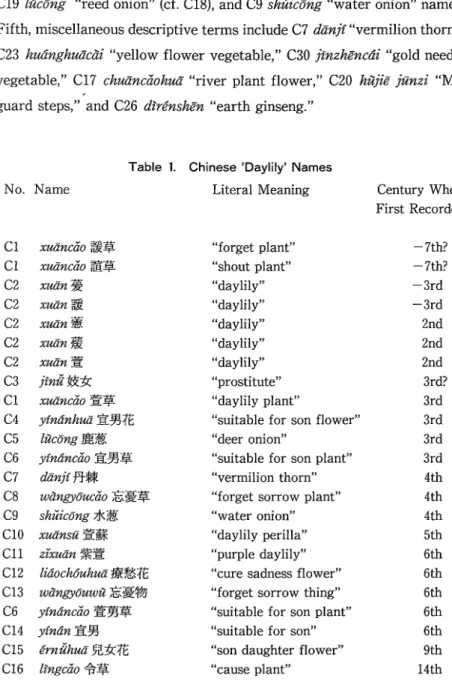
Beforediscussing Oriental̀daylily'names,afew transcription conventionsandlinguistictermsneedtobepresented. ThePinyinsys‑ tem isusedtoromanizeModernStandardChineseandtheHepburnfor Modern Japanese. Forthe sake ofbrevity,Chinese and Japanese
̀daylily'namesareabbreviatedwith"C"and
"
∫"prefixesandnumbered from C1‑C39and J1‑
J22in approximatechronologicaldevelopment."Names"aretakentomeanspoken,ratherthanwritten,designations; compare
J
Iwasure‑gusatranscriptionsof萱草,忘 れ ぐさ,忘草,忘 れ草
,and4.FormostChineseplantnames,Chao(1953:382)explains
,
"Colorwords, tastewords,etc.,whichareoftensaidtobèprefixed'toplantwords,are reallythefirstmembersofcompoundsandnottrueprefixes."5.SincethepresentarticlefocusesuponhistoricaldevelopmentsofHemerocal‑ lisvocabulary,notallChineseorJapanesenamesareincluded.Twosetsof excluded̀daylily'termsare:namesforspeciesnotnativetoChinaorJapan (e.g.,Japanesecholsen‑kisuge
朝鮮黄菅
"Koreanyellowsedge"H.minor∀
ar .
"PlantofForgetfulness"Onomastics 31
わすれ草
intable2.5Sometechnicalterminologywillbenecessarytodescribehow logographicwritingaffectedOriental̀daylily'names. Totakeanillus‑ trationfrom Japanese
,萱
(properlykeǹdaylily')iscommonlywrittenfor kaya〜 suge菅
̀sedge'and菅 for̀daylily.' Theterm logog71aPhisused insteadoftheinexact"Chi
nesecharacter,"whileyladicalsandphonetics refertotherecurring logographiccomponentsthatroughly indicate meaningandpronunciation. MostChinesebotanicalnamesarewritten witheitherthe=plantradical"廿 (contracted
< 州
picturingsprouting shoots)orthe"treeradical"木
(depictingatrunkandroots). Namely, theChinese萱
logographforxua‑
ǹdaylily'combinesthe"plantradical"overthexuaJn
宣
̀announce,proclaim;declare;spread;all‑embracing' phonetic. Commonplacelogographswiththisxua‑nphonetic(intur
n,the"roofradical"JJIoverthexua‑n
亘
̀revolve;goaround'phonetic)include xua‑n喧̀sunlight;dryinthesun'(withtheロ
"sunradical")andxua‑n置
〜 喧 ̀shout,yell;clamor,hubbub'(with
言
"speech"〜 口
"mouthradi‑ cals").I nJ
apanese,kanj i
#S "Chinesel
ogographs
"generallyhavetwo (ormore)readings:nativepronunciationsandSiniticborrowings. This萱
logographreadseitherasvernacularkaya〜 sugèreed'orasSinoI Japaneseban〜 keǹdaylily.'Jiay]lie'傾借
"phoneticloans"‑ logographs usedtowritewordswithsimilarpronunciations‑ furthercomplicated thelinguistichistoryofChinesèdaylily'names,asexemplifiedbytwo earlyredactionsoftheShijing(seep.40)writingCIx
ua‑ncdo萱草
as譲
cweana,MatsuokaandHotta1966:40),andunattestednames(e.i"Chinese e'j'iayohu