Harumi Nishida
1. Introduction
要 旨
英語教育がコミュニケーション力育成重視に移行して以来,学生の リーディング力に低下が見られるようになったと指摘されている。原 因としては,初級学習者はボトムアップ処理ができていないことが考 えられる。リーディング研究では,優れた読み手は語彙認識処理の自 動化(LaBerge and Smuels, 1974; 赤松, 2000)が行われており,ボ トムアップ処理が自動化しているのでトップダウン処理ができる(ネ オボトムアップ理論,門田,2002)という指摘があり,リーディング 力育成にはボトムアップ処理の自動化が不可欠である。しかし日本の EFL環境では英語がインプットされる機会は少ない。そこで,語彙力と 文法力を身につけてリスニング力を育成するために授業に音読指導を 取り入れた。リスニングの処理過程はリーディングの処理過程と高次 レベルにおいて同じであることから,リスニング力はリーディング力 に転移すると考えられる。結果はリスニング力・リーディング力共に 有意な差が見られた。
キーワード: 音読,音読利用指導,リハーサル効果,チャンク理解,リスニング力から リーディング力への転移
It has long been the target of English education at Japan’s junior high schools, high schools and universities to “develop practical communication skills”. In 2002, the Ministry of Education, Culture, Sports, Science and Technology hammered out a
“Strategic Vision for Developing ‘Japanese Who Can Use English’”, which set English education in Japan on a direct course for developing practical communication skills.
However, if we look at the actual situation, it remains difficult to say, since there is no data to prove as much, that students are acquiring better practical communication skills today than before. English communication skills today are either at the same level as before or possibly at a lower level. This comes despite the emphasis on communication that has become the trend of English education. Worse yet, it is quite thinkable that reading comprehension and knowledge of grammar, which have been neglected in the shift of emphasis to communication skills, could have declined.
Current TOEFL scores for reading comprehension have fallen. However, it is a fact that there are some students with a high level of English proficiency and many of the schools that produce these advanced level students have an English program that emphasizes communication skills development. Also, some of the universities have made the acquisition of communication skills a curriculum target and are using various teaching methods to achieve that. It would not be an overstatement today to claim that teaching methods depend on the number of teachers; there is no single sure-fire approach. That is to say, there is no single standard teaching method at present.
Regarding reading comprehension, because of the practical necessity, there are many universities with programs that develop skimming skills that help readers understand information in English by quick reading as used in taking the TOEFL or reading a newspaper, as well as scanning skills that enable readers to search for information as used on some reading comprehension questions of TOEIC. These skills are extremely important for living in the information age of today, but the ability to accurately understand a text as well as skimming and scanning skills is needed. Many students can understand comparatively simple English texts but cannot comprehend or go any farther than guessing at the rough meaning of difficult texts. A high level of English reading comprehension might be obtained in other ways.
2. Problems Students Have in Reading
The following four problems can be raised as possible problems that students have in reading:
1) The students cannot comprehend the text because they do not know the vocabulary.
2) Though the students know the vocabulary, they get the wrong meaning of a text because they do not understand the sentence structure.
3) Though the students know the vocabulary and understand the sentence structure, because the content is complicated, they translate it word-for-word into Japanese and, resultantly, they cannot make heads or tails out of the Japanese.
4) The student can understand the content, but it requires time.
What should be targeted with reading comprehension is the ability to read English in the given word order and quickly gain an accurate—not rough—
understanding of the text. For this reason, this study provided training that included reading aloud.
3. Previous Studies
Why is it that reading aloud improves reading skills? This study focuses on the following three effects that reading aloud has on improving reading skills.
1) By reading aloud, the students can identify meaning units (chunks) and smoothly and accurately read English in the given word order and understand the text.
When having students read aloud, it was astonishing how few of them could read correctly. Naturally, it is not expected that they read on the level of a native speaker.
However, when checking to see that they pause in the correct location while reading, often they stop where they should not or do not pause. This inconsistent pausing shows that they do not understand the meaning as they read the text. If they correctly understood the content as they read it, they would pause in the proper location. It is surmised that they are simply following the letters.
Placing pauses in the proper location and understanding the content as the learner reads are prerequisites to reading quickly and accurately. Correctly pausing is an indication that the learner has understood that chunk. A correct understanding of chunks leads to a correct understanding of structure and is absolutely essential towards correctly interpreting the text. Chunks play an important role in the mechanism for understanding sentences.
Many previous studies into the information processing units of reading comprehension have been based on syntax information such as phrase structure, and have suggested that most understanding is done in units of phrases or more than phrases.
Nonetheless, the processing unit of reading comprehension is not restricted to a single constant syntax unit such as a phrase, but actually changes according to factors such as the comprehension skill of the reader, the degree of difficulty of the text, reading speed and the degree to which background information such as schema is used, for example.
The information‐processing unit used in comprehension is thus flexible. Rather than divide the processing unit based on syntax information such as phrase structure, focusing on the meaning information of the text, the reader processes a text in units of the meaning and concepts-that is units of chunks.
According to Blachowicz (1977), and Franks and Bransford (1976), the reader immediately forgets what format and grammatical structure (e.g., whether the passive voice or the active voice was used) the text had once having comprehended, but the meaning remains. Furthermore, Kadota (1982) visually presented English text of, first, five syllables and gradually increased thereafter two syllables at a time to Japanese college students who were studying English as a foreign language. Kadota required them to write down the English text and meaning each time, and measured their memory span. It was learned that meaning information was accurately reproduced more than the format of the text, indicating a long memory span. These studies support the position that Bransford and Franks (1973) take with regard to the foundations of meaning information, which is that, in order to understand and memorize a language, people integrate each fragment of meaning information into a more abstract idea.
Moreover, a role of reading aloud for reading comprehension is to acquire prosody (rhythm, intonation, etc.). If learner can read meaning chunks aloud with the correct
rhythm and intonation, even new words and text that cannot be understood in one reading can be deciphered by reading aloud. Ono, Midorikawa & Robson (1999) studied “how university students get through difficulties in the reading process”. As a result, they reported that students actually use reading aloud and Japanese translation as their main strategy and that students with particularly high comprehensive English skills go back over the preceding or other earlier paragraphs and read aloud each meaning chunk.
Because meaning processing like this is done in units of chunks, it is a major pretext to understanding English that learners understand chunks. In having students read aloud, they can quickly and accurately read English by having them listen to model reading so as to confirm where to pause, and then having them read aloud with pauses placed after each chunk so as to understand each chunk in the given word order.
2) By reading aloud the students can learn vocabulary, composition and grammar.
In the reading comprehension process, learners search for necessary information in their database kept in long-term memory and analyze the input information; but if this analysis cannot be done, we may think that the required information is not in the database. Accordingly, it is urgent for the learners to input the correct vocabulary, composition and grammar into the database, for which reading aloud is effective.
Sound and text are simultaneously provided and sent to the working memory by paying attention to both. Then, the information above, that is the information on how to read the text with its meaning can be sent to the long-term memory by reading aloud, which functions as a rehearsal. Once entered in the long-term memory, information can be referenced as needed, so the next time the same vocabulary is encountered, the meaning can be known.
This kind of information retention must be accompanied by vocalization. Kadota (1984) confirmed that, when the long-term memory is referenced, subvocalization occurs even in silent reading. He went on to point out that decoding is extremely important from the perspective of vocabulary access to mental lexicons (“dual route model”, Kadota 1998, etc.).
By learning sound changes via reading aloud, text and sound can be matched and retained along with the meaning in the long-term memory, which leads to the
formation of mental lexicons.
3) Listening ability that has been improved by reading aloud transfers into reading ability.
Listening and reading processes overlap, therefore listening ability is believed to transfer into reading ability.
It can be easily understood that listening and reading on a low level such as individual phoneme, character or word perception are somewhat different processes because of the differences in input mode: one being audio, the other visual. However, on the higher level of understanding texts and conversations, the two skills seem to follow almost the same process. In other words, it is supposed that, though some difference exists in how information is stored in phonological loops, a rather similar mechanism is conceivably executed when the different input mode is processed into the working memory and information is processed. For example, the top-down prediction-testing mechanism in the schema theory functions with both spoken language and written language.
Another opinion that explains the transfer of listening to reading is that, in principle, the latter includes the former. In other words, the content of the two skills is similar, so rather than view the two as separate processes, as the phonological coding, the retention and use of the that coded phonological information in the working memory is seen in reading, so a kind of spoken language processing mechanism is functioning in reading comprehension (Kadota, 1987, 1990, etc.; Baddeley, 1999). By repeatedly listening to model reading and reading aloud with the intent to imitate the model reader, the students can rather successfully catch the words and meanings and read aloud in a way very similar to the model reading. By carefully listening to model reading, the students improve their listening abilities and, as argued above, those transfer into reading abilities.
Research hypothesis
From the three aforementioned conceivable reasons why reading aloud improves learners’ reading abilities, it was hypothesized that reading ability could be improved by imparting training that included reading aloud.
4. Research Question
To reveal the difference in learners’ reading abilities, the following two research questions were put forward in the present study: 1) Will a teaching method utilizing reading aloud show a difference of reading ability between the experimental group and the control group? And 2) will a teaching method utilizing reading aloud show a difference of reading ability between the higher scoring group and the lower scoring group?
5. Subjects
Subjects in this study were 184 Japanese undergraduate students from two universities. They were divided into an experimental group and a control group. The experimental group numbered 97, while the control group numbered 87.
6. Procedure
The treatment was conducted from September 2005 through January 2006 (one semester) and consisted of ten weekly sessions. The texts used in this treatment were passages of about 150 words, and the speed at which the texts were read was between 100 and130 words per minute.
Subjects listened to the text and then answered about three multiple-choice questions without looking at the relevant unit of the textbook. By guiding the subjects to the correct answer, contents grasp exercises of the relevant unit was performed.
Then the scripts were handed out and read aloud. The subjects followed the script while listening to it, and checked how it was read. Next, they read aloud imitating a native speaker and learned pronunciation and sound changes.
Reading aloud was performed as follows:
1) Vocabulary check
The students reviewed the script and marked unknown words. (There was no need to remember words at this point. This step went no further than identifying words the students did not know.)
2) Reading aloud
The students read aloud the script without any concern about pronunciation.
3) Listening to model reading
The students confirmed unknown pronunciations.
4) Reading aloud
The students read aloud with the intention of reproducing the sounds confirmed in the model reading.
5) Listening to model reading
The students paid attention to sound changes..
6) Reading aloud
The students read aloud with the intention of reproducing sound changes confirmed in the model reading.
7) Listening to model reading
The students paid attention to speed and rhythm were confirmed.
8) Reading aloud
The students read aloud with the intention of reproducing the speed and rhythm confirmed in the model reading.
Once the subjects could read correctly, reading aloud was done at a slightly faster speed than natural reading. This was practice for the subjects to understand the meaning when listening to the sound at a natural speed of 150 words or more per minute. After repeated listening to the sound and reading aloud, recognition load decreased; and it became easier to process input information both in terms of syntax and meaning, using prosody such as rhythm, pause location, and intonation. Reading aloud quickly thinking the meaning of the text increases processing speed. Ultimately, the subjects understood the content by just listening to the sound without following the script. At this stage, the meaning was processed in the listening order without any loss of speed and their understanding of the content was almost perfect.
7. Pretest and Posttest
Two types of tests were used in this study for both the pretest and the posttest.
They were reading and listening tests. The reading test consisted of 4 passages from
TOEFL and STEP for a total of 24 questions. The subjects were given 25 minutes to read and then answer multiple choice questions designed to measure comprehension.
The passages from STEP used in this test were from level 2.
The listening test was the fill-in-the-blank test using VOA Special English. The fill-in-the-blank tests consisted of approximately 400 words with 50 blanks in every 7-word. The listening materials used in the test and the materials used in treatment were of the same level.
8. Results
Results from the reading comprehension test given to both the experimental group and the control group at the start of the treatment did not show a significant difference between groups when analyzed by t test.
One-way ANOVA repeated measure was performed to analyze the following two differences:
1) the difference between the mean score of the pretest and that of the posttest, and 2) the difference between the mean score of the experimental group and that of the
control group in the pretest, and the difference between the groups in the posttest.
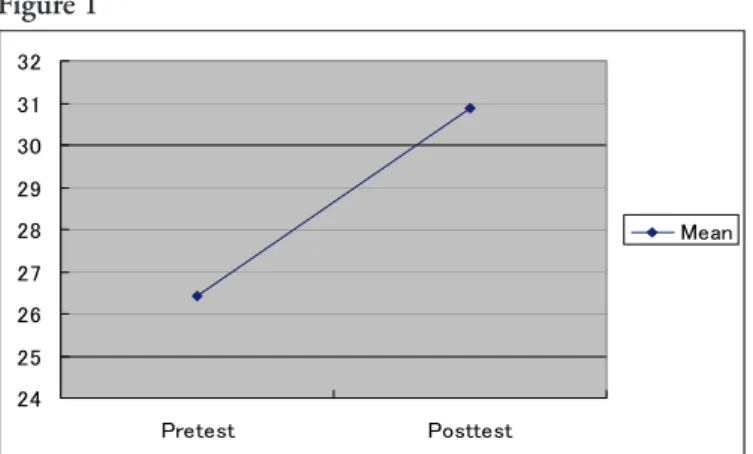
Table 1 and Figure 1 show improvement between the listening pretest and the posttest. ANOVA repeated measure detected a significant difference for the results of the listening tests (F (1,366) = 28.13, p < .01).
Table 1 Figure 1
Mean Pretest 26.43 Posttest 30.88
��
��
��
��
��
��
��
��
��
������� ��������
����
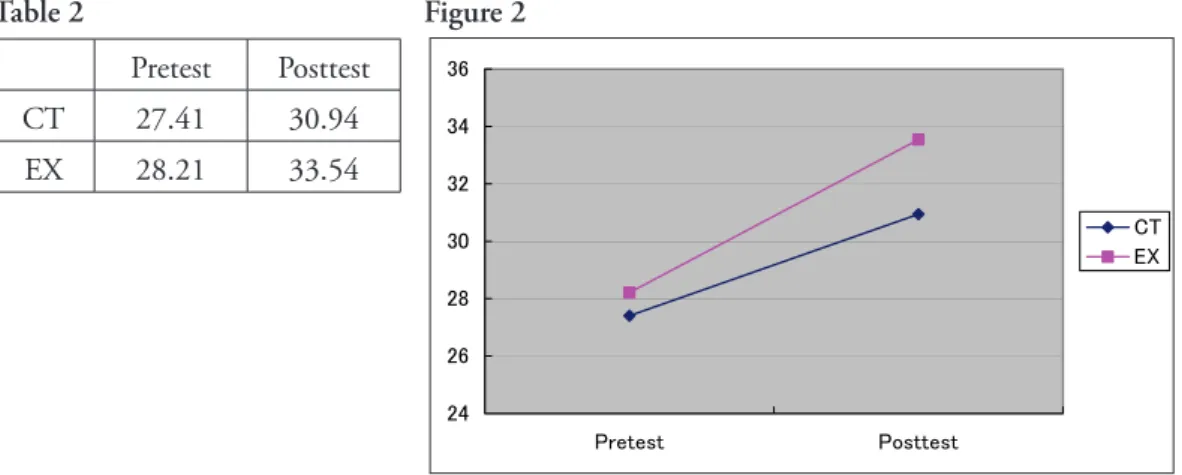
Table 2 and Figure 2 show improvement between the listening pretest and the posttest of both groups. ANOVA repeated measure detected a significant difference for the groups (F (1,182) = 14.81 p < .01).
Table 2 Figure 2
Pretest Posttest
CT 27.41 30.94
EX 28.21 33.54
Table 3 and Figure 3 show improvement between the reading pretest and the posttest. ANOVA repeated measure detected a significant difference for the results of the reading tests (F (1,366) = 54.32, p < .01).
Table 3 Figure 3
Mean Pretest 8.54 Posttest 11.27
Table 4 and Figure 4 show improvement between the reading pretest and the posttest of both groups. ANOVA repeated measure detected a significant difference for the groups (F (1,182) = 5.72, p < .01).
�
�
�
��
��
��
������� ��������
�
��
��
��
��
��
��
��
������� ��������
��
��
Table 4 Figure 4 Pretest Posttest
CT 9.03 11.20
EX 8.71 12.29
The improvement seen in the listening and reading tests of both the experimental and control groups can be attributed to studying, but the significant difference between the groups in the two tests can be attributed to reading aloud.
Accordingly, in response to research question 1) “will a teaching method utilizing reading aloud show a difference of reading ability between the experimental group and the control group?” the use of reading aloud can be considered effective because of the greater improvement seen in the experimental group than the control group.
After these findings, further analyses were performed to examine the different effect that reading aloud has on the students of different proficiency level. This time, the experimental group was divided into four groups based on the mean score of the listening pretest—high intermediate (HI), middle intermediate (MI), low intermediate (LI) and high beginner (HB) — and the improvement of each group on listening and reading tests was measured. Results showed a significant difference in the reading tests of the four experimental groups.
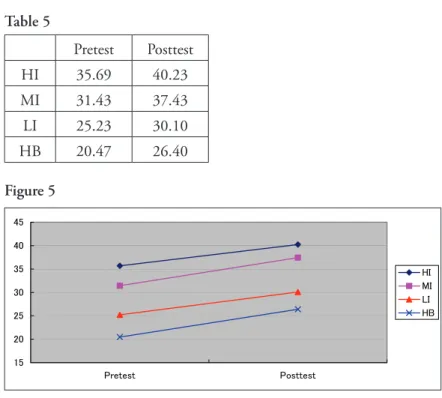
Table 5 and Figure 5 show the improvement between the listening pretest and the posttest scores of the four groups. A significant difference between test scores was seen among the three groups other than the HI group. Scores were 4.54 for the HI group, 6.00 for the MI group, 4.87 for the LI group and 5.93 for the HB group. There was not a significant difference by proficiency level.
�
�
�
��
��
��
��
������� ��������
��
��
Table 5
Pretest Posttest
HI 35.69 40.23
MI 31.43 37.43
LI 25.23 30.10
HB 20.47 26.40
Figure 5
��
��
��
��
��
��
��
������� ��������
��
��
��
��
Then, what effect did the reading tests have? Table 6 and Figure 6 show the improvement between the reading pretest and the posttest scores of the four groups.
Though a significant difference between test scores was seen among the four groups, the score improvement decreased alongside the proficiency level with the HI group scoring 5.23, the MI group scoring 4.44, the LI group scoring 2.87 and the HB group scoring 1.73.
Table 6
Pretest Posttest
HI 10.23 15.46
MI 10.30 14.74
LI 7.97 10.84
HB 6.37 8.10
Figure 6
�
�
�
�
��
��
��
��
��
��
��
������� ��������
��
��
��
��
To imitate the intonation, rhythm, pause location and so forth of model reading when reading aloud, attention must be carefully paid to the model reading, which readily improves listening ability. A possible reason why a significant difference was not seen in the listening test of the HI group is because the pretest score was a high 35.69, so conceivably a ceiling effect worked. In general, students of a high proficiency level will find it hard to improve.
On the other hand, the reason why the HI and MI groups’ improvement rate on the reading test was higher than other groups was likely that, by reading aloud, reading with accurately positioned pauses enabled them to identify meaning units (chunks) and thus read smoothly while understanding the content. The LI and HB groups still do not successfully transfer listening ability into reading ability. To begin with, if intonation, rhythm and pauses are not correct in the reading aloud stage, the content cannot be understood by chunks while reading. If the content cannot be understood while reading aloud, it is difficult to transfer listening ability into reading ability.
Though a correct interpretation can be made even at this level, it takes a very long time. Accordingly, the reason why the score improvement of the LI and HB groups is lower is conceivably because reading aloud has not yet a significant impact on reading ability at this level.
9. Conclusions
Instruction that uses reading aloud can improve the listening and reading abilities of the students. The listening improvement was roughly the same for all groups from HI to HB, but the reading improvement was markedly higher in the HI and MI
groups than in the LI and HB groups. It is believed that HI and MI students readily improve because they have fundamental listening and reading abilities. On the other hand, LI and HB students lack these fundamental abilities, therefore, even with reading aloud, they learn no more than intonation, rhythm and pause location. Their listening ability improved, but it did not transfer into reading ability.
A future topic of study will be to identify at what proficiency level do students benefit from instruction that utilizes reading aloud and how.
References
Baddeley, A. D. (1986). Working memory. Oxford University Press.
Baddeley, A. D. (1999). Essentials of human memory. Hove: psychology Press.
Blachowicz, C. L. Z. (1977). Semantic constructivity in children’s comprehension. Reading Research Quarterly 13: 188–199.
Bransford, J. D. & J. J. Franks. (1973). The abstraction of linguistic ideas: A review. Cognition 1:
211–249.
Coltheart, M., & Rastle, K. (1994). A left-to-right serial process in reading aloud. Journal of Experimental Psychology: Human Perception and Performance, 20, 1197–1211.
Ellis, R. (1997). SLA Research and Language Teaching. Oxford: Oxford University Press.
Franks, J. J. & Bransford. (1976). Memory for syntactic form as a function of semantic context. In H. Singer & R. B. Ruddell (eds.), Theoretical Models and Processes of Reading (2nd ed.), 103–107. New York: International Reading Association.
Garrod, S. & Pickering, M. (eds.). (1999). Language Processing. UK: Psychology Press.
Griffin, M. S. (1992). Reading aloud. TESOL Quarterly, 26, 784–787.
Kadota, S. (1982). Some psycholinguistic experiments on the process of reading comprehension.
Journal of Assumption Junior College 9: 49–70.
Kadota, S. (1984). Subvocalization and processing units in silent reading. Journal of Assumption Junior College 11: 29–58.
Kadota, S. (1987). The role of prosody in silent reading. Language Science 9: 185–206.
Kadota, S. (1990). The contribution of rhythm to reading Japanese. 16th LACUS (Linguistic Association of Canada and the United States) Forum, 332–339.
Kadota, S. & Noro, T. (eds.), (2001). Eigo Ridingu no Ninchi Mekanizum [How the mind works in EFL Reading]. Tokyo: Kuroshio Shuppan.
Kadota, S. (2002). Eigo no Kakikotoba to Hanashikotoba wa Ikani Kankei Shiteiruka [How Phonology Works in L2 Reading Comprehension]. Tokyo: Kuroshio Shuppan.
Kido, H. (1993). Reading Aloud no koka wo shidojikken niyotte kenshosuru [An experimental study on the effect of reading-aloud teaching]. Eigokyoiku Kenkyu [Studies on English Language Education], 16, 136–143.
Mineo, M. (1985). Yomukoto no gengo katsudo niokeru ondokuno yakuwari ni kansuru kosatsu [Roles of oral reading in reading]. Eigokyoiku Kenkyu [Studies on English Language Education], 28, 65–71.
Miyasako, N. (2002). Kokosei no ondoku to eigoryo wa kankei ga aruka [Does oral reading ability have a relationship with English language ability for senior high school students?]. STEP Bulletin, 14, 14–25.
Miyasako, N. (2003). What relationships does metacognition of oral reading have with oral reading ability and English ability for Japanese senior high school students? LET, 40, 121–140.
Miyasako, N. (2004). What relationships does working memory have with reading comprehension for Japanese senior high school students of English? LET, 41, 17–36.
Miyasako, N. (2005). The effects of oral reading practice on English language ability and metacognition of oral reading among Japanese senior high school students, JLTA Journal, 7, 92–109.
Miyasako, N. & Takatsuka, S. (2004). What realationships do the efficiencies of phonological coding and lexical access have with reading comprehension for Japanese learners of English?
ARELE, 15, 159–168.
Niizato, M. (1991). Ondoku no igi to shidoho [Why and how of oral reading]. In Sanseido (ed.), Eigo Kyoikugaku no Shiten [Perspectives on English Language Education], 130–141. Tokyo:
Sanseido.
Ono, N., Midorikawa, H. & Robson, G. (1999). “Exploring the Nature of Good and Poor L2 Reading Process,” Paper Presented at 12th World Congress of Applied Linguistics.
Sakuma, Y. (2000). Ondoku no Shido [Teaching oral reading]. Takanashi, Y., & Ushiro, Y. (eds.), Eigo Ridingu Jiten [Dictionary of English Reading], 136–146. Tokyo: Kenkyusha Shuppan.
Suzuki, J. (1998). Ondoku shido sai-hyoka: Ondoku shido no koka ni kansuru jissho kenkyu [Reevaluation of oral reading instruction: Empirical studies on the effectiveness of oral reading instruction]. Monograph Series 7: A Re-consideration of Foreign Language Teaching Methods.
Kansai Chapter, LLA.
Takanashi, Y. & Takahashi, M. (1984). Ridingu ni kansuru 12 no shitsumon (9) ondoku wa hitsuyo ka [12 questions on reading (9): Is oral reading necessary?]. The English Teachers’ Magazine, Sep., 1984, 32–34.
Tuchiya, S. (2004). EIgo Komyunikeshon no Kiso wo Tsukuru Ondoku Shido [Instruction of Oral Reading Aiming at Communication in English]. Tokyo: Kenkyusha Shuppan.
Watanabe, Y. (1990). Ondoku saiko: Mokudoku no sokudoku-ka wo unagasu ondoku sido no igi to arikata [Reconsideration of oral reading: why and how oral reading improves silent reading speed]. Leo, 19, 101–130.
Ziegler, J. C., Perry, C., & Coltheart, M. (2000). The DRC model of visual word recognition and reading aliud: An extension to German. European Journal of Cognitive Psychology, 12, 413–
430.